 Скачать презентацию Deconstructing Neuroscience graduate curricula Journal club does
b1b8eb559e55d2a8af4d789d6d2603c7.ppt
- Количество слайдов: 17



Deconstructing Neuroscience graduate curricula: Journal club – does format matter? David Morilak, Ph. D. Integrated Graduate Program in Neuroscience, University of Texas Health Science Center Graduate School of Biomedical Sciences, San Antonio, TX
Why do we have journal club? 1. Help our students learn to think, read (and write!) critically - how to evaluate literature - how to discern what to cite and why - how to separate self-sustaining dogma from accepted theory; how to deal with outliers - how to ”prioritize” literature, ie apply a hierarchical “vertical” structure to a “horizontal” universe of Pub. Med and one-click-away information! 2. Give our students (more) experience presenting - different purpose than a research talk - different organization - “Presenting” vs leading a discussion
Questions of format, structure & procedure How often to meet – weekly, biweekly, monthly? Broad subject matter or focused interest group? How many students and what level (early and/or advanced)? How much and what kind of faculty involvement What is the presentation format? Feedback and evaluation
Two models of “programmatic” journal clubs, in Pharmacology and Neuroscience In both: subject matter is broadly based and wide-ranging all students participate, beginning in 2 nd (PH) or 1 st year (NS) meet once monthly, 1 hr at lunch time (pizza provided) driven and organized by the respective program Other JC opportunities include research-specific interest groups (RIGs), many of which are translational in nature (both basic and clinical): Drug Addiction, PTSD/Stress, Mood Disorders, Aging & Neurodegeneration, Pain, Epilepsy & Ion Channelopathies, etc Focused, driven & organized by lab(s) and PIs, meet more frequently, involve data discussion as well as paper evaluation
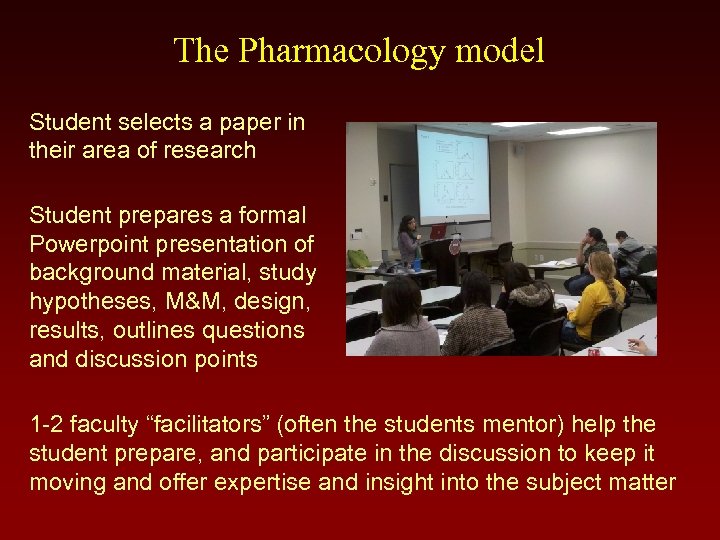
The Pharmacology model Student selects a paper in their area of research Student prepares a formal Powerpoint presentation of background material, study hypotheses, M&M, design, results, outlines questions and discussion points 1 -2 faculty “facilitators” (often the students mentor) help the student prepare, and participate in the discussion to keep it moving and offer expertise and insight into the subject matter
Advantages and positive feedback Thorough, informative and really well-prepared presentations The presenting student is working in their “comfort zone” Faculty provide useful guidance in the preparation, and by participating in the discussion, they can provide models for the kinds of questions to ask in evaluating a paper
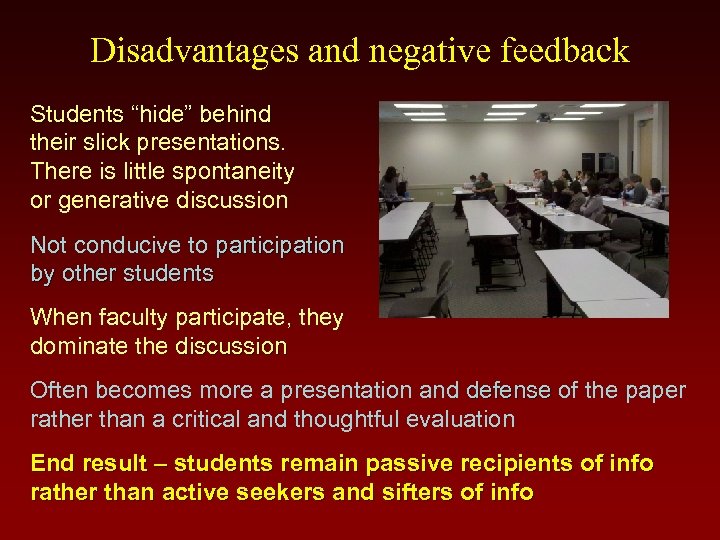
Disadvantages and negative feedback Students “hide” behind their slick presentations. There is little spontaneity or generative discussion Not conducive to participation by other students When faculty participate, they dominate the discussion Often becomes more a presentation and defense of the paper rather than a critical and thoughtful evaluation End result – students remain passive recipients of info rather than active seekers and sifters of info
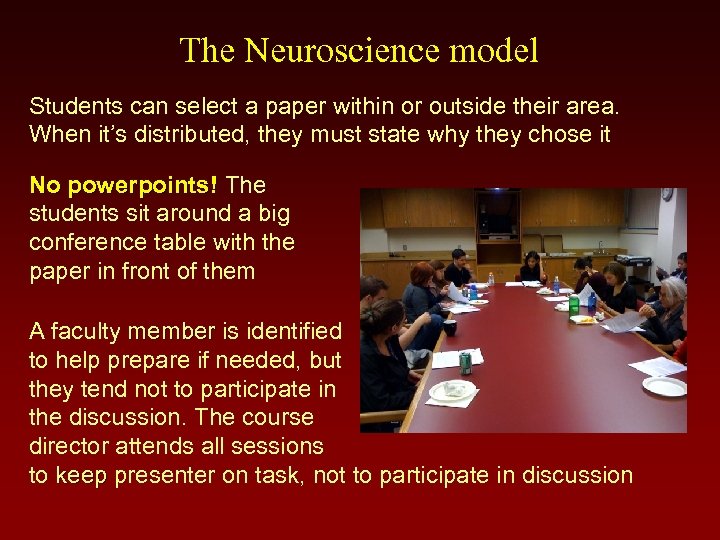
The Neuroscience model Students can select a paper within or outside their area. When it’s distributed, they must state why they chose it No powerpoints! The students sit around a big conference table with the paper in front of them A faculty member is identified i to help prepare if needed, but they tend not to participate in the discussion. The course director attends all sessions to keep presenter on task, not to participate in discussion
Advantages and positive feedback Very informal and conversational, stimulates lots of discussion Much more conducive to evaluation and discussion of the paper rather than simply a presentation and defense Faculty provide guidance, but do not dominate discussion. provid So students gain experience in a non-traditional presentation format, and a chance to truly participate in the discussion
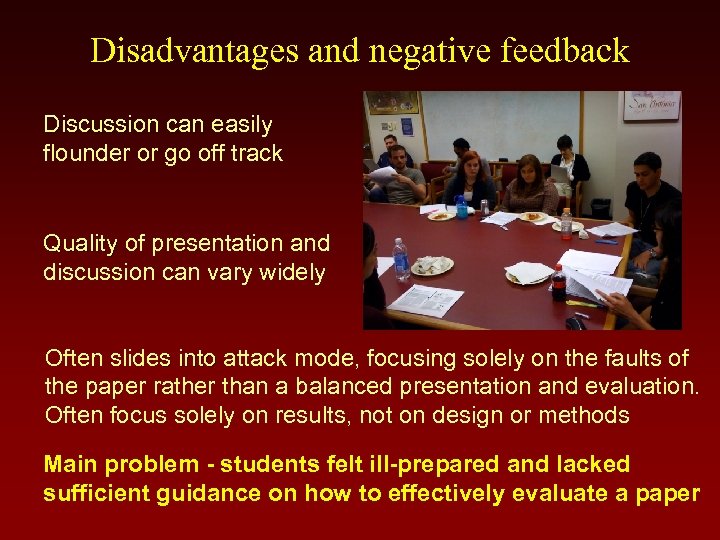
Disadvantages and negative feedback Discussion can easily flounder or go off track Quality of presentation and discussion can vary widely Often slides into attack mode, focusing solely on the faults of the paper rather than a balanced presentation and evaluation. Often focus solely on results, not on design or methods Main problem - students felt ill-prepared and lacked sufficient guidance on how to effectively evaluate a paper
So we distributed a “guide to evaluating a paper” Seems bloody obvious to us, but has proved useful to our students. Feedback has been positive – and it has improved the quality of discussion in JC without intrusion by faculty First “beta-tested” in the program directors lab, using a “raw” manuscript, followed by discussion of the actual review, then revision and refinement of the questions on the guide Outlines questions to keep in mind while reading a paper, specifically to focus on evaluation – the purpose is to move from being a passive recipient of info to an active sifter of info Feedback indicates our students are actually using it as they read and, as a bonus, as they write their own papers
So does format matter? Yes – to an extent…. If “technology” has contributed to difficulty prioritizing info, then forcing informal “raw” discussion can at least stimulate more active participation and a new set of presentation skills There is a critical balance between providing adequate faculty “guidance” and intrusive domination, to the point of encouraging the very passivity we are trying to exorcise… What seems obvious to us may not be to our students! Simply putting it to paper, spelling it out, then leaving them to use their new tools and exercise new skills can be beneficial
Creating opportunities for clinical and translational experience for students in a basic neuroscience graduate program The Clinical Practicum Elective Graduate Program in Neuroscience UTHSCSA
Clinical Practicum – UTHSCSA Elective course offered in 2 nd semester of 2 nd year – during preparation for the Qualifying Exam Possible because of extensive interaction and “buy-in” of Clinical Departments related to Neuroscience Psychiatry Neurology Neurosurgery Hand-on experience for our graduate students in a clinical setting of relevance and interest to them
Clinical Practicum, Program in Neuroscience, UTHSCSA 1 credit hr, students spend 2 -3 days in intensive contact, 12 times in the semester, total of ~16 -24 contact hrs No exams, no lectures, no notes, just participation Students keep a journal of all experience, meet with mentor and course director at the end to discuss
Clinical Practicum, Program in Neuroscience, UTHSCSA Psychiatry – spend the night with attending Psychiatrist on ER rounds w/ residents on in-patient Psych ward in both cases, follow-up and diagnostic interviews Neurology – AD/PD clinics (VA) – rounds, diagnostic testing Sleep Disorders, Stroke, Epilepsy clinics Endodontics (Dental School) – Pain clinic Neurosurgery – Fri - tactical team planning session Tues - into the OR (e. g. , frontal glioma, hpx, spina bifida) Thur-Mon - follow-up w/ residents in NS-ICU
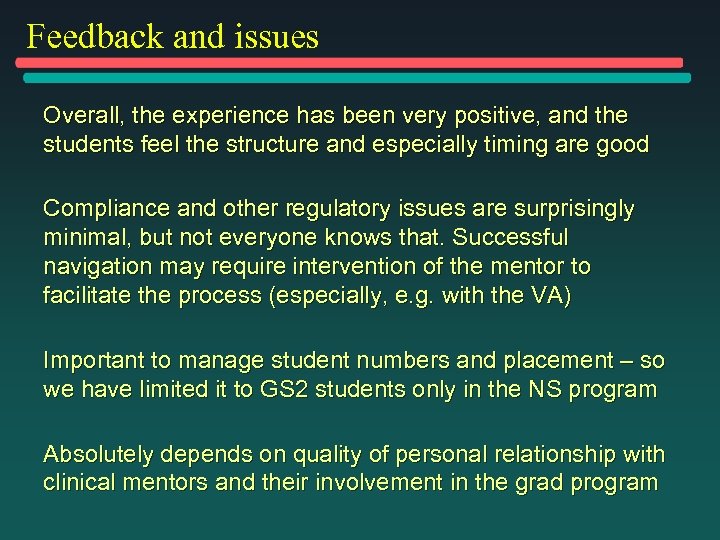
Feedback and issues Overall, the experience has been very positive, and the students feel the structure and especially timing are good Compliance and other regulatory issues are surprisingly minimal, but not everyone knows that. Successful navigation may require intervention of the mentor to facilitate the process (especially, e. g. with the VA) Important to manage student numbers and placement – so we have limited it to GS 2 students only in the NS program Absolutely depends on quality of personal relationship with clinical mentors and their involvement in the grad program
Скачать презентацию Deconstructing Neuroscience graduate curricula Journal club does
b1b8eb559e55d2a8af4d789d6d2603c7.ppt