


 Скачать презентацию Deconstructing attainment gaps How LSYPE can help explain
11b23155172f0dea04aa2021aeebe99d.ppt
- Количество слайдов: 39
 Deconstructing attainment gaps: How LSYPE can help explain gaps in pupil attainment Steve Gill, Schools Analysis and Research Division Zenta Henkhuzens, Disadvantage and Education Team Presentation at DCSF Conference: The Use of Evidence in Policy Development and Delivery, 9 February 2010
 Contents Narrowing the Gaps – The Current Picture Narrowing the Gaps – The DCSF Programme of Work Using LSYPE to Deconstruct Attainment Gaps Next Steps for Analysts and Policy
 Narrowing The Gaps The Current Picture
 Why is Government interested in Nt. G? • Emergent policy priority • Raising standards in education 1997 -present • Striving for equality – the needs of particular groups • Different perspectives: social, economic, health and educational • Introduction of the national pupil database 2002 significant • National results and international comparisons
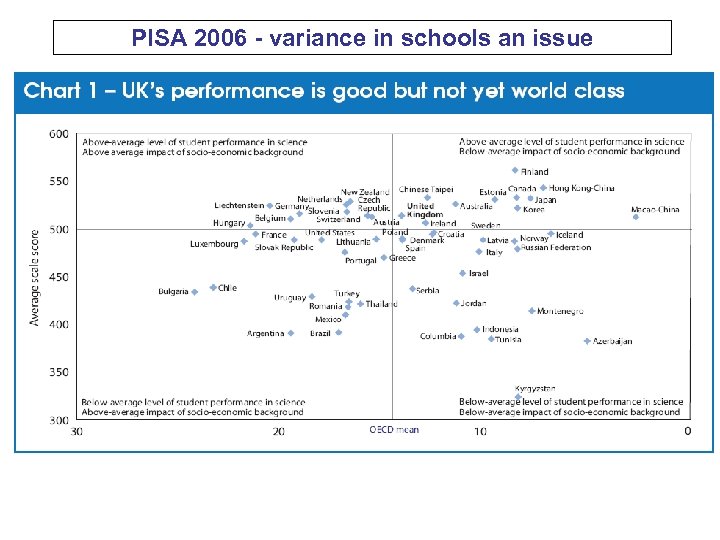 PISA 2006 - variance in schools an issue
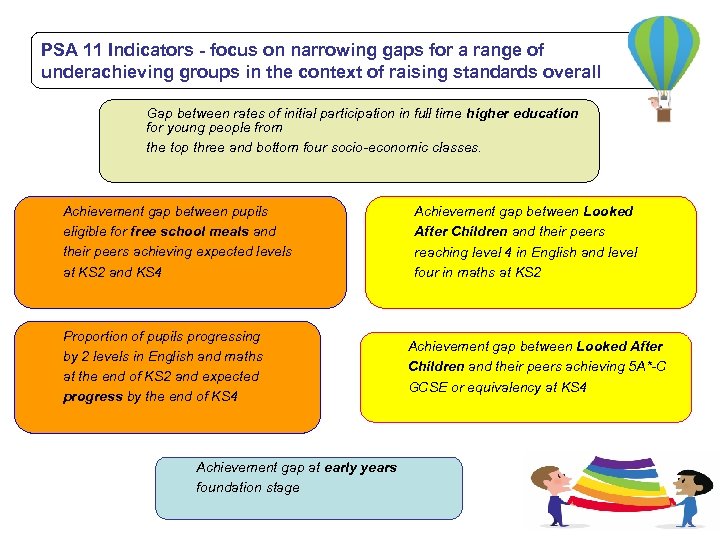 PSA 11 Indicators - focus on narrowing gaps for a range of underachieving groups in the context of raising standards overall Gap between rates of initial participation in full time higher education for young people from the top three and bottom four socio-economic classes. Achievement gap between pupils eligible for free school meals and their peers achieving expected levels at KS 2 and KS 4 Proportion of pupils progressing by 2 levels in English and maths at the end of KS 2 and expected progress by the end of KS 4 Achievement gap at early years foundation stage Achievement gap between Looked After Children and their peers reaching level 4 in English and level four in maths at KS 2 Achievement gap between Looked After Children and their peers achieving 5 A*-C GCSE or equivalency at KS 4
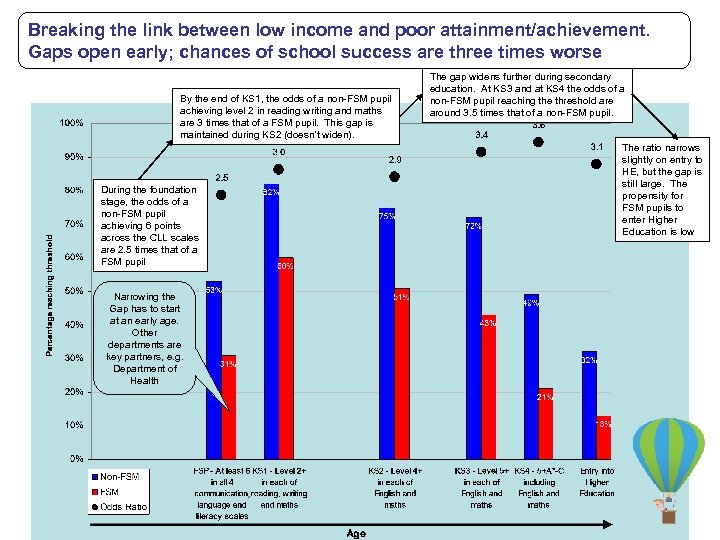 Breaking the link between low income and poor attainment/achievement. Gaps open early; chances of school success are three times worse By the end of KS 1, the odds of a non-FSM pupil achieving level 2 in reading writing and maths are 3 times that of a FSM pupil. This gap is maintained during KS 2 (doesn’t widen). During the foundation stage, the odds of a non-FSM pupil achieving 6 points across the CLL scales are 2. 5 times that of a FSM pupil Narrowing the Gap has to start at an early age. Other departments are key partners, e. g. Department of Health The gap widens further during secondary education. At KS 3 and at KS 4 the odds of a non-FSM pupil reaching the threshold are around 3. 5 times that of a non-FSM pupil. The ratio narrows slightly on entry to HE, but the gap is still large. The propensity for FSM pupils to enter Higher Education is low
 Narrowing The Gaps The DCSF Programme of Work
 Narrowing the Gap programme of activity In March 2009 we published Breaking the Link between disadvantage and low attainment: Everyone’s Business, which set out a clear strategy to address the FSM attainment gap, with intervention actions on 5 levels. The document included a range of data including: • The Trends in International Maths and Science Study (TIMSS) 2007 • The Programme for International Student Assessment (PISA) results 2007 • Ofsted Reports on outstanding schools And presented a range of data including Key Stage results comparing pupils in receipt of Free School Meals with those not in receipt of Free School Meals.
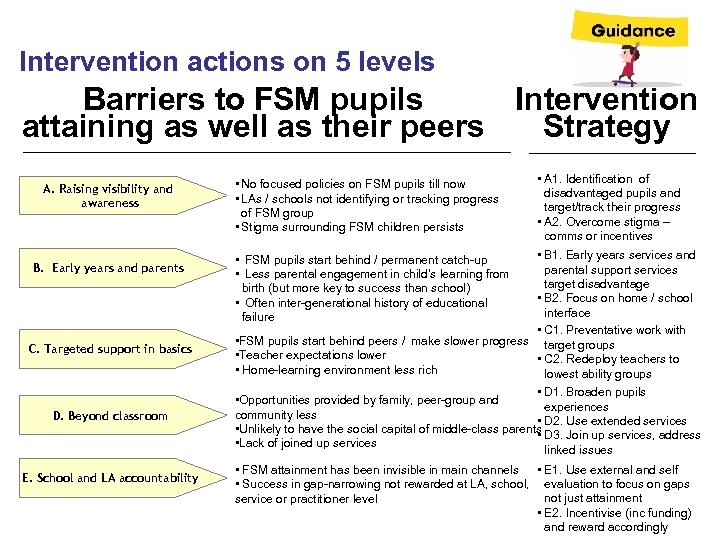 Intervention actions on 5 levels Barriers to FSM pupils Intervention attaining as well as their peers Strategy A. Raising visibility and awareness B. Early years and parents C. Targeted support in basics D. Beyond classroom E. School and LA accountability • No focused policies on FSM pupils till now • LAs / schools not identifying or tracking progress of FSM group • Stigma surrounding FSM children persists • A 1. Identification of disadvantaged pupils and target/track their progress • A 2. Overcome stigma – comms or incentives • B 1. Early years services and parental support services target disadvantage • B 2. Focus on home / school interface • C 1. Preventative work with • FSM pupils start behind peers / make slower progress target groups • Teacher expectations lower • C 2. Redeploy teachers to • Home-learning environment less rich lowest ability groups • D 1. Broaden pupils • Opportunities provided by family, peer-group and experiences community less • D 2. Use extended services • Unlikely to have the social capital of middle-class parents • D 3. Join up services, address • Lack of joined up services linked issues • FSM pupils start behind / permanent catch-up • Less parental engagement in child’s learning from birth (but more key to success than school) • Often inter-generational history of educational failure • FSM attainment has been invisible in main channels • E 1. Use external and self • Success in gap-narrowing not rewarded at LA, school, evaluation to focus on gaps not just attainment service or practitioner level • E 2. Incentivise (inc funding) and reward accordingly
 Overview of Nt. G programme of Activity • We identified a long list of existing policies that are already narrowing gaps or that could do so. • Based upon impact (extent, speed and ease of implementation), we identified 11 top existing programmes (since expanded to take on further programmes many mentioned in Schools White Paper). • From each programme we have or will agree work strands that focus on Nt. G and increase impact. • Each Nt. G work strand has specific actions built into delivery plans. • Modelled impact, where possible, for each policy area.
 DCSF Nt. G policies/programmes • National Challenge • City Challenge • Curriculum • Extended Schools • Academies • 121 Tuition • Parental Engagement • Every Child interventions • School report card • LA Target Setting • School Funding
 We also manage Extra Mile, a school-based action research project specifically aimed at raising achievement of disadvantaged pupils in over 100 schools Extra Mile – Aims • To narrow the gap in educational achievement between disadvantaged children and their more advantaged peers from EYFS to KS 4 • To raise the aspirations of disadvantaged children, and engage them in their education • To demonstrate that schools in deprived areas can make a difference to children’s achievement and aspiration through targeted activities and support • To transfer identified school improvement processes and key activities which have been particularly successful in raising aspirations and attainment across the school system
 DCSF’s making policy model 1. Establishing Rationale 2. Testing Options 3. Securing Delivery 4. Evaluating Impact
 Using LSYPE to Deconstruct Attainment Gaps
 What is the background to this work? § New team in Schools Analysis and Research Division § Part of remit to broaden understanding of factors related to pupil attainment and progression § Collecting together a range of sample datasets which, in some cases, can be matched to National Pupil Database § Allows models to be constructed which contain broader range of topics which can affect progress § This is a presentation of some of the methodology and emerging findings from this work
 Can we get the caveats out of the way early on please? § § These are emerging findings They are subject to revisions They are just a couple of sections of the current work The current work will hopefully only be the first part of a longer term scheme of work
 Why the Longitudinal Study of Young People in England? § LSYPE has lots of extra information about pupils’ home background e. g. parental employment status, income, education § LSYPE also collected information about aspirations, parental engagement, etc § LSYPE matched to NPD, and the cohort have GCSE results available (unlike EPPSE, ALSPAC) § https: //ilsype. gide. net/workspaces/public/wik i/Welcome
 Are there any issues with using LSYPE? § Only a sample of 15, 000 young people § Uses the 2006 GCSE cohort - things may have changed and some of the questions are slightly dated So why are you using it then? § Minority ethnic groups and schools with high FSM rates were oversampled, so have reasonable numbers for our areas of interest § Key results probably still hold, and we’re not aware of a more recent dataset that can be used to do the same
 What does this work do that makes it different? § Many reports have put different factors into models of progress to see relative importance of each § Here we take things one step further to look at specific groups of pupils and see what affects them § Gaps arise where one group is disproportionately affected by negative factors than another § LAs set targets for eight ‘under-performing groups’ § This work shows which factors ‘contribute’ most to their underperformance, and which ones are protective
 What is the starting point for your work? § Two regression models produced, each with outcome variable of capped GCSE points score § 1. Looks at KS 2 -4 progression so includes KS 2 attainment § 2. Looks at raw attainment so excludes KS 2 attainment § Contain all the variables from Contextual Value Added model as well as some of the interesting ones that come from LSYPE or Annual School Census § These give coefficients for how important each factor is for predicting KS 4 attainment or KS 2 -4 progress
 What happens to Free School Meal eligibility in this broader model? § Well known that there are wide FSM gaps in attainment and progress at national level (2006 CVA model = -25 points, LSYPE sample = -33 points) § On national datasets, FSM is the only indicator we have of a pupil’s home circumstances, but seems unlikely that FSM status itself is causing gaps § Using the extra LSYPE information we can understand which family/home characteristics are related to attainment and progress § We find that FSM status is now only of relatively minor importance (-7 points)
 So where does the FSM gap go then? § Coefficient reduced by three quarters, but FSM gap can’t vanish – must now be explained by other factors § Some of the new variables must be explaining what had previously shown up under FSM eligibility § These variables contribute most to FSM gap where the magnitude of the coefficient is large and the characteristic is considerably more prevalent among either FSM or non-FSM pupils § If a characteristic occurs fairly equally in all pupils or only has a small impact then it does not contribute as much to a gap
 Aren’t FSM gaps particularly large among White British pupils? § Yes - therefore, the following analysis relates specifically to White British FSM pupils and White British non-FSM pupils § Corresponding analysis has been carried out comparing FSM and non-FSM pupils from the underperforming ethnic minority groups § That work not presented here to avoid repetition, but worth noting that overall gap is a little smaller
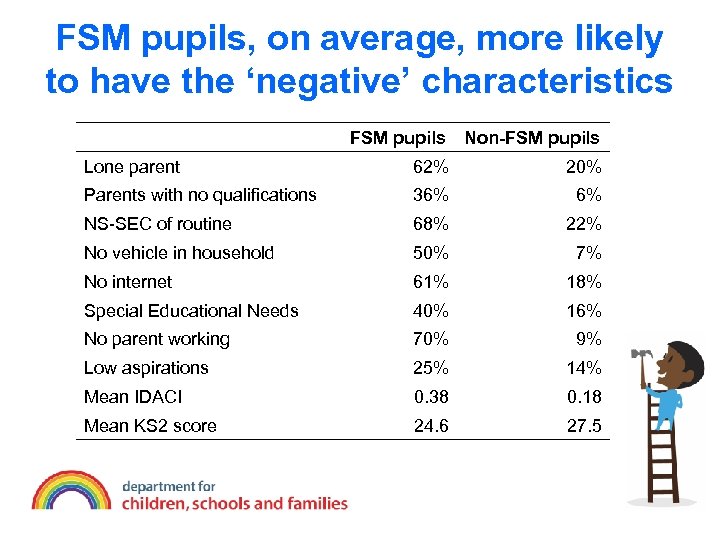 FSM pupils, on average, more likely to have the ‘negative’ characteristics FSM pupils Non-FSM pupils Lone parent 62% 20% Parents with no qualifications 36% 6% NS-SEC of routine 68% 22% No vehicle in household 50% 7% No internet 61% 18% Special Educational Needs 40% 16% No parent working 70% 9% Low aspirations 25% 14% Mean IDACI 0. 38 0. 18 Mean KS 2 score 24. 6 27. 5
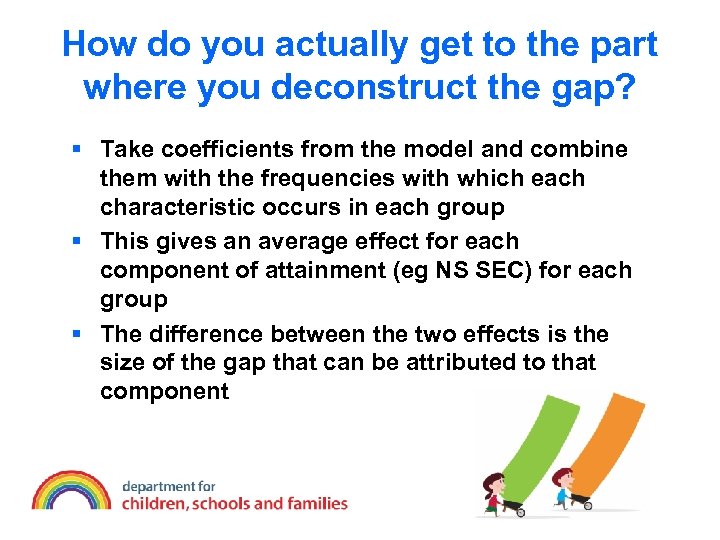 How do you actually get to the part where you deconstruct the gap? § Take coefficients from the model and combine them with the frequencies with which each characteristic occurs in each group § This gives an average effect for each component of attainment (eg NS SEC) for each group § The difference between the two effects is the size of the gap that can be attributed to that component
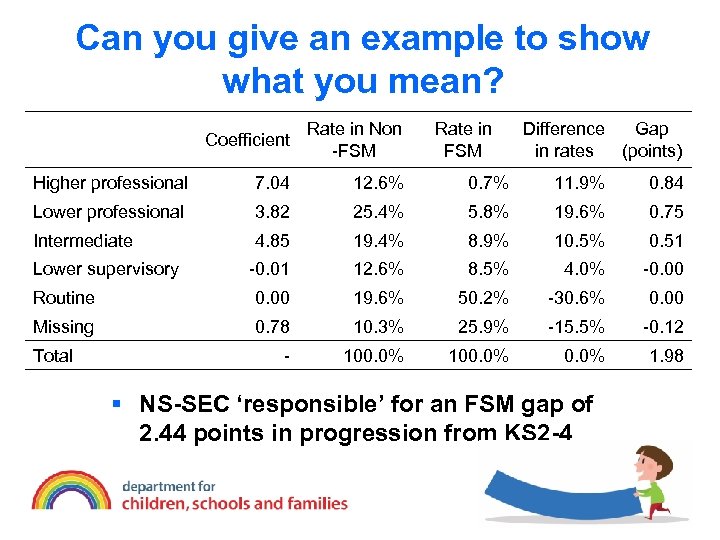 Can you give an example to show what you mean? Coefficient Rate in Non -FSM Higher professional 7. 04 12. 6% 0. 7% 11. 9% 0. 84 Lower professional 3. 82 25. 4% 5. 8% 19. 6% 0. 75 Intermediate 4. 85 19. 4% 8. 9% 10. 5% 0. 51 -0. 01 12. 6% 8. 5% 4. 0% -0. 00 Routine 0. 00 19. 6% 50. 2% -30. 6% 0. 00 Missing 0. 78 10. 3% 25. 9% -15. 5% -0. 12 - 100. 0% 1. 98 Lower supervisory Total Rate in FSM Difference Gap in rates (points) § NS-SEC ‘responsible’ for an FSM gap of 2. 44 points in progression from KS 2 -4
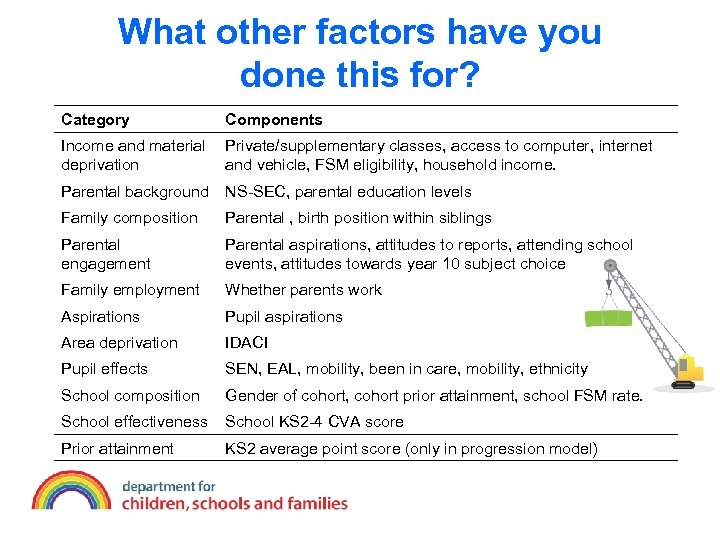 What other factors have you done this for? Category Components Income and material deprivation Private/supplementary classes, access to computer, internet and vehicle, FSM eligibility, household income. Parental background NS-SEC, parental education levels Family composition Parental , birth position within siblings Parental engagement Parental aspirations, attitudes to reports, attending school events, attitudes towards year 10 subject choice Family employment Whether parents work Aspirations Pupil aspirations Area deprivation IDACI Pupil effects SEN, EAL, mobility, been in care, mobility, ethnicity School composition Gender of cohort, cohort prior attainment, school FSM rate. School effectiveness School KS 2 -4 CVA score Prior attainment KS 2 average point score (only in progression model)
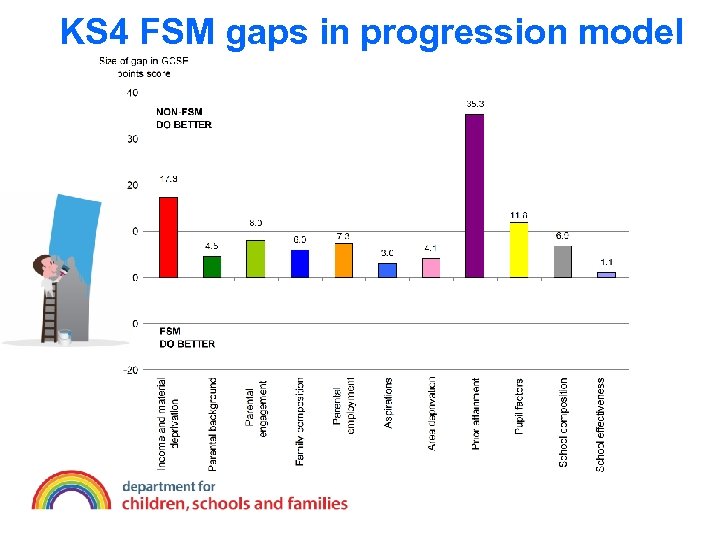 KS 4 FSM gaps in progression model
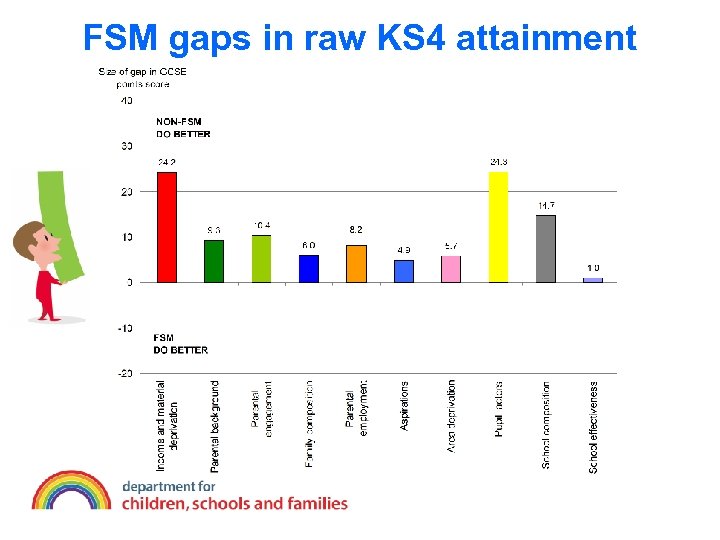 FSM gaps in raw KS 4 attainment
 The same process can be used to examine ethnicity gaps § Certain factors are more prevalent among underperforming ethnic minority groups – some are negative, while others protect against the gap § Using the importance of the facts (as seen earlier) and the rates with which the factors occur in underperforming ethnic minority groups, we can also deconstruct the (much smaller) ethnicity gaps § Protecting factors will go the opposite direction on the charts…
 KS 4 ethnicity gaps in progression model
 Ethnicity gaps in raw KS 4 attainment
 Key messages from research § Gaps are not down to just one problem § Need to address policies in the right areas and in a range of areas – just targeting schools won’t have huge impacts on gaps § Differences between problems linked with progress and problems linked with raw attainment § Targeting issues around deprivation will disproportionately affect those groups that underperform
 Next Steps For Analysts and Policy
 Next steps from analysis perspective § Nothing set firmly in stone § Changes in priorities could take the team in any number of directions § But…we would be interested in – replicating work using EPPSE for KS 1 -2 progress and KS 2 attainment – using ALSPAC to look at progress and attainment through whole of school life – looking at development of LSYPE 2 § Watch this space?
 Next Steps/Challenges § Carrying out impact analysis of each of the Nt. G policy areas – allow for time to ‘bed down’ § Identifying and spreading good practice amongst schools – how? § Developing a 0 -19 Narrowing the Gaps Strategy § Embedding Nt. G in strategic partners’ business plans
 Contact details § Steve Gill Schools Analysis and Research Division Tel: 0207 340 7782 Email: steve. gill@dcsf. gsi. gov. uk § Zenta Henkhuzens Team Leader, Disadvantage and Education Tel: 0207 783 8778 Email: zenta. henkhuzens@dcsf. gsi. gov. uk
 Deconstructing attainment gaps: How LSYPE can help explain gaps in pupil attainment Steve Gill, Schools Analysis and Research Division Zenta Henkhuzens, Disadvantage and Education Team Presentation at DCSF Conference: The Use of Evidence in Policy Development and Delivery, 9 February 2010