


 Скачать презентацию Declining Market Seller Pricing Strategies The Seller s Dilemma
f2ab7e20316783a4775114a8de56a74b.ppt
- Количество слайдов: 7
 Declining Market Seller Pricing Strategies “The Seller’s Dilemma!” Copyright © Mike Wardley, 2008
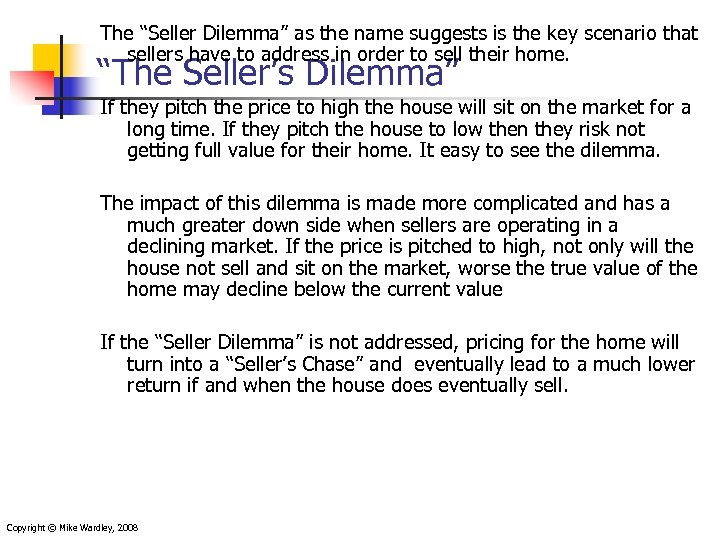 The “Seller Dilemma” as the name suggests is the key scenario that sellers have to address in order to sell their home. “The Seller’s Dilemma” If they pitch the price to high the house will sit on the market for a long time. If they pitch the house to low then they risk not getting full value for their home. It easy to see the dilemma. The impact of this dilemma is made more complicated and has a much greater down side when sellers are operating in a declining market. If the price is pitched to high, not only will the house not sell and sit on the market, worse the true value of the home may decline below the current value If the “Seller Dilemma” is not addressed, pricing for the home will turn into a “Seller’s Chase” and eventually lead to a much lower return if and when the house does eventually sell. Copyright © Mike Wardley, 2008
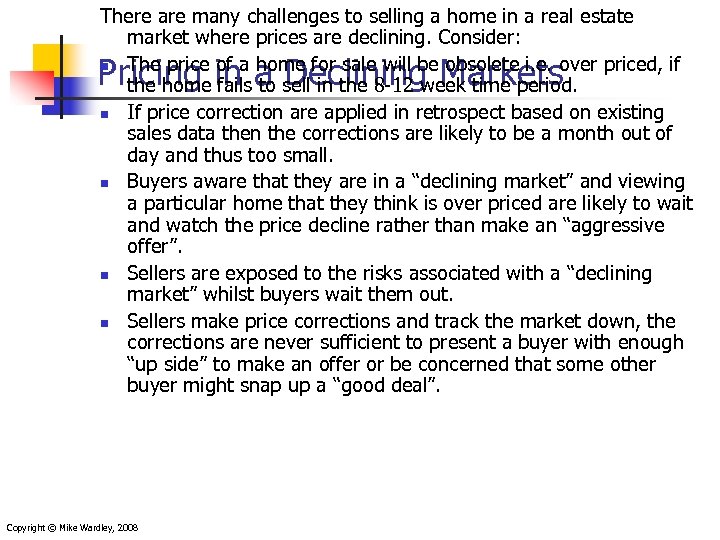 There are many challenges to selling a home in a real estate market where prices are declining. Consider: n The price of a home for sale will be obsolete i. e. over priced, if the home fails to sell in the 8 -12 week time period. n If price correction are applied in retrospect based on existing sales data then the corrections are likely to be a month out of day and thus too small. n Buyers aware that they are in a “declining market” and viewing a particular home that they think is over priced are likely to wait and watch the price decline rather than make an “aggressive offer”. n Sellers are exposed to the risks associated with a “declining market” whilst buyers wait them out. n Sellers make price corrections and track the market down, the corrections are never sufficient to present a buyer with enough “up side” to make an offer or be concerned that some other buyer might snap up a “good deal”. Pricing in a Declining Markets Copyright © Mike Wardley, 2008
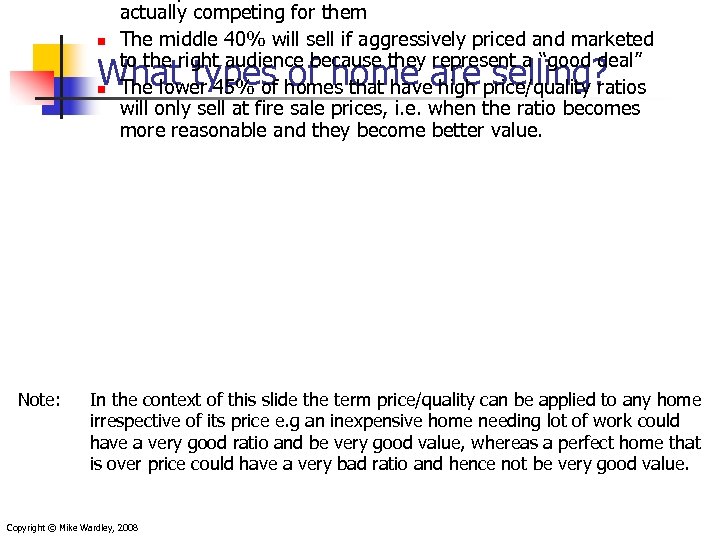 n actually competing for them The middle 40% will sell if aggressively priced and marketed to the right audience because they represent a “good deal” The lower 45% of homes that have high price/quality ratios will only sell at fire sale prices, i. e. when the ratio becomes more reasonable and they become better value. What types of home are selling? n Note: In the context of this slide the term price/quality can be applied to any home irrespective of its price e. g an inexpensive home needing lot of work could have a very good ratio and be very good value, whereas a perfect home that is over price could have a very bad ratio and hence not be very good value. Copyright © Mike Wardley, 2008
 How the price right is relativity easy, it becomes more difficult to Getting to get the price right? keep the price right, especially in a declining marketing. Consider: n n n Build a price based on current market conditions and not your needs or any type of “paid plus COS” model. Homes only sell for what they’re worth, not what you need. Use a complex CMA and repeat the analysis every 60 days to ensure price tracking. Use a valuation from the 3 rd party source i. e. a professional appraiser familiar with the area your home is in and the current market conditions, then repeat the analysis every 120 days to ensure price tracking. Build in price corrections as part of the pricing plan in case the house does not sell within the average days on market time-scale and include how far and how fast to apply price reductions. Document a net sellers sheet that reflects all of the price corrections. Copyright © Mike Wardley, 2008
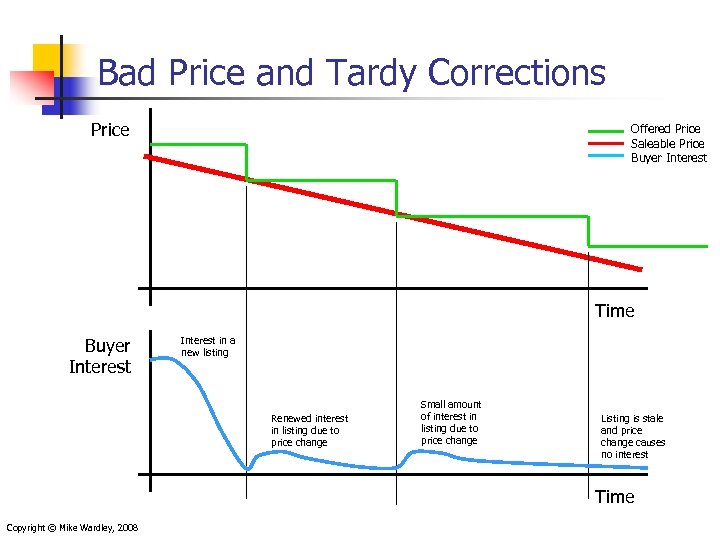 Bad Price and Tardy Corrections Price Offered Price Saleable Price Buyer Interest Time Buyer Interest in a new listing Renewed interest in listing due to price change Small amount of interest in listing due to price change Listing is stale and price change causes no interest Time Copyright © Mike Wardley, 2008
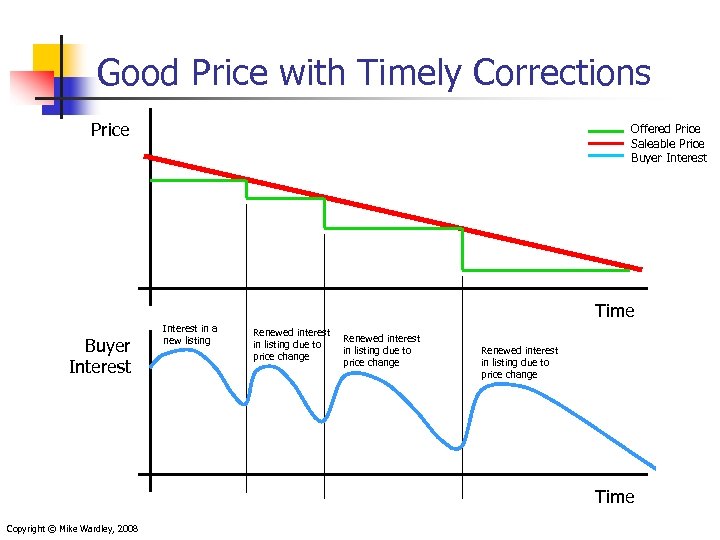 Good Price with Timely Corrections Price Offered Price Saleable Price Buyer Interest Time Buyer Interest in a new listing Renewed interest in listing due to price change Time Copyright © Mike Wardley, 2008