


 Скачать презентацию Decision Trees an introduction Entropy over the
97f0616c0479d5afa0dcc30afc1ccc4d.ppt
- Количество слайдов: 24
 Decision Trees an introduction
 Entropy over the class attribute g g g A class attribute contains uncertainty over the values g uncertainty captured by entropy H(p) of the target Increase certainty about the class by considering other attributes Conditioning (splitting) on an informative attribute produces splits with lower entropy g information gain: entropy before split compared to entropy after split
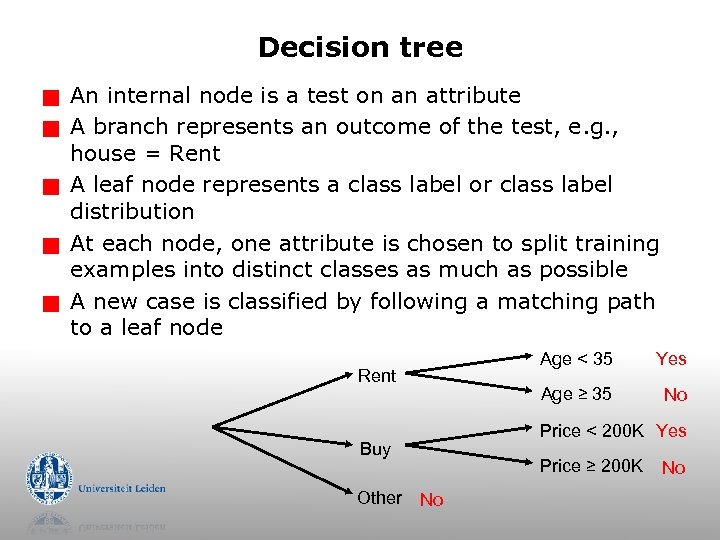 Decision tree g g g An internal node is a test on an attribute A branch represents an outcome of the test, e. g. , house = Rent A leaf node represents a class label or class label distribution At each node, one attribute is chosen to split training examples into distinct classes as much as possible A new case is classified by following a matching path to a leaf node Age < 35 Age ≥ 35 Rent No Price < 200 K Yes Buy Other Yes Price ≥ 200 K No No
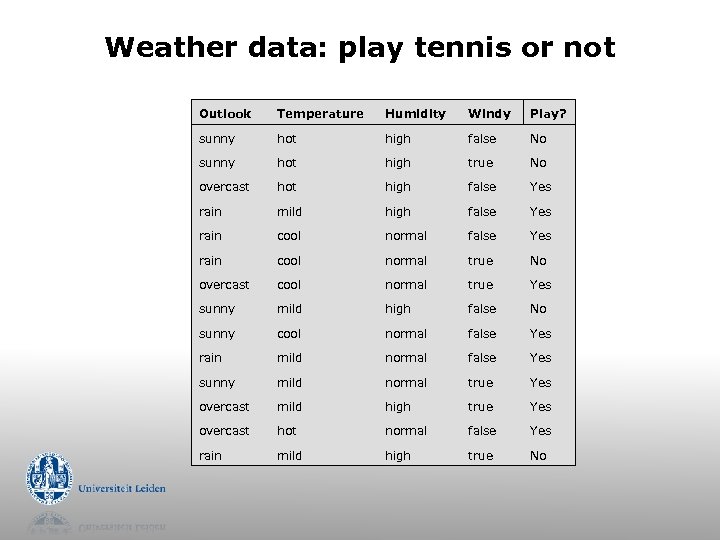 Weather data: play tennis or not Outlook Temperature Humidity Windy Play? sunny hot high false No sunny hot high true No overcast hot high false Yes rain mild high false Yes rain cool normal true No overcast cool normal true Yes sunny mild high false No sunny cool normal false Yes rain mild normal false Yes sunny mild normal true Yes overcast mild high true Yes overcast hot normal false Yes rain mild high true No
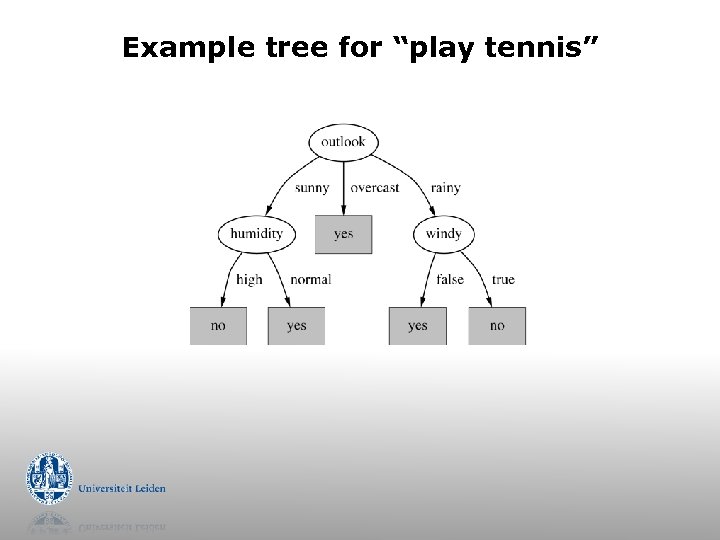 Example tree for “play tennis”
 Building decision tree, Quinlan 1993 g Top-down tree construction g g g At start, all training examples are at the root Partition the examples recursively by choosing one attribute each time. Bottom-up tree pruning g g Remove subtrees or branches, in a bottom-up manner, to improve the estimated accuracy on new cases Discussed next week
 Choosing the splitting attribute g g g At each node, available attributes are evaluated on the basis of separating the classes of the training examples A goodness function is used for this purpose Typical goodness functions: g g g information gain (ID 3/C 4. 5) information gain ratio gini index (not discussed)
 A criterion for attribute selection g Which is the best attribute? g g Popular impurity criterion: information gain g g g The one which will result in the smallest tree Heuristic: choose the attribute that produces the purest nodes Pure and high entropy are opposites Information gain uses entropy H(p) of the class attribute Information gain increases with the average purity of the subsets that an attribute produces Strategy: choose attribute that results in greatest information gain
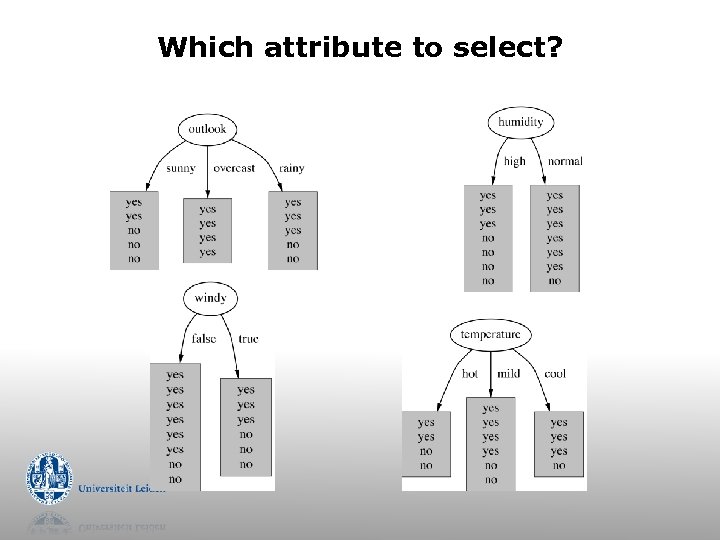 Which attribute to select?
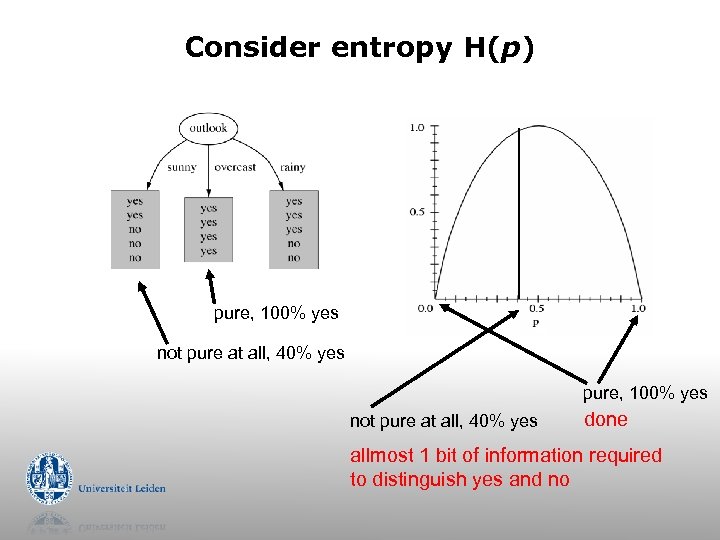 Consider entropy H(p) pure, 100% yes not pure at all, 40% yes done allmost 1 bit of information required to distinguish yes and no
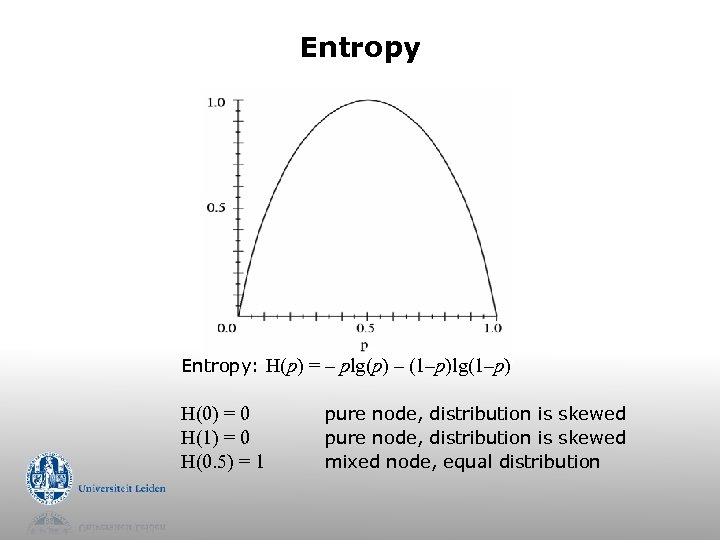 Entropy: H(p) = – plg(p) – (1–p)lg(1–p) H(0) = 0 H(1) = 0 H(0. 5) = 1 pure node, distribution is skewed mixed node, equal distribution
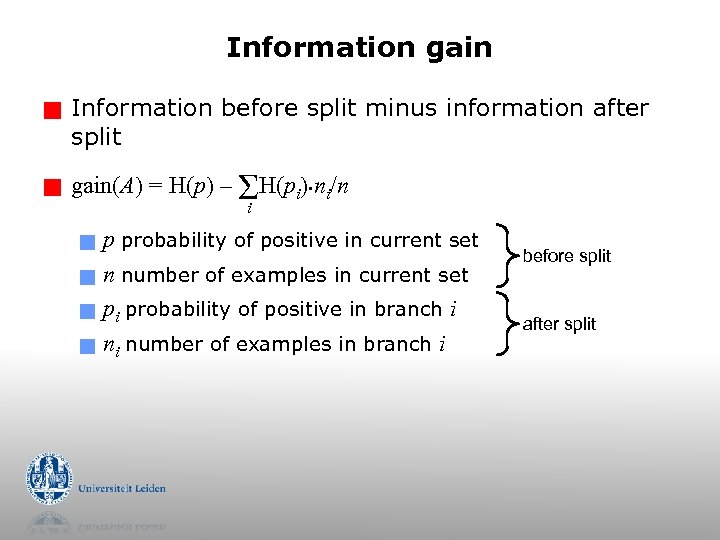 Information gain g g Information before split minus information after split gain(A) = H(p) – ΣH(pi) ni/n i g g p probability of positive in current set n number of examples in current set pi probability of positive in branch i ni number of examples in branch i before split after split
![Example: attribute “Outlook” g Outlook = “Sunny”: 0 lg(0) is not H([2, 3]) =](https://present5.com/presentation/97f0616c0479d5afa0dcc30afc1ccc4d/image-13.jpg "Example: attribute “Outlook” g Outlook = “Sunny”: 0 lg(0) is not H([2, 3]) =") Example: attribute “Outlook” g Outlook = “Sunny”: 0 lg(0) is not H([2, 3]) = H(0. 4) = − 0. 4 lg(0. 4)− 0. 6 lg(0. 6)defined, bit = 0. 971 but we evaluate 0 lg(0) as zero g g g Outlook = “Overcast”: H([4, 0]) = H(1) = − 1 lg(1)− 0 lg(0) = 0 bit Outlook = “Rainy”: H([3, 2]) = H(0. 6) = − 0. 6 lg(0. 6)− 0. 4 lg(0. 4)= 0. 971 bit Average entropy for Outlook: Weighted sum: (5/14) 0. 971 + (4/14) 0 + (5/14) 0. 971 = 0. 693
Example: attribute “Outlook” g Outlook = “Sunny”: 0 lg(0) is not H([2, 3]) = H(0. 4) = − 0. 4 lg(0. 4)− 0. 6 lg(0. 6)defined, bit = 0. 971 but we evaluate 0 lg(0) as zero g g g Outlook = “Overcast”: H([4, 0]) = H(1) = − 1 lg(1)− 0 lg(0) = 0 bit Outlook = “Rainy”: H([3, 2]) = H(0. 6) = − 0. 6 lg(0. 6)− 0. 4 lg(0. 4)= 0. 971 bit Average entropy for Outlook: Weighted sum: (5/14) 0. 971 + (4/14) 0 + (5/14) 0. 971 = 0. 693
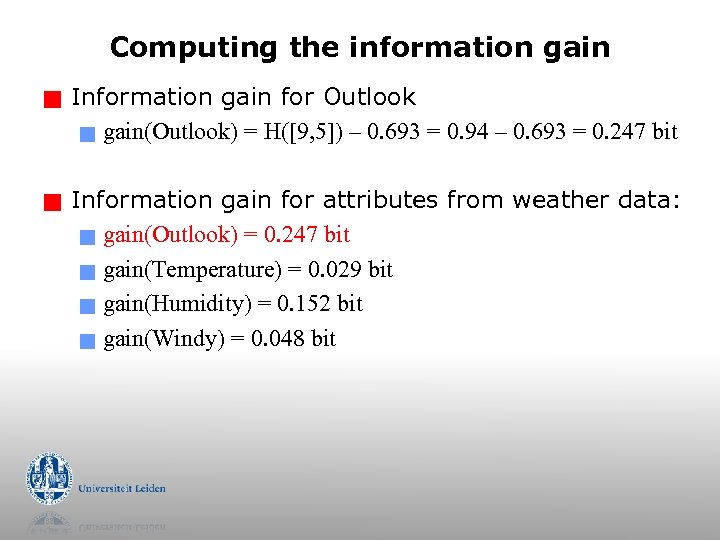 Computing the information gain g g Information gain for Outlook g gain(Outlook) = H([9, 5]) – 0. 693 = 0. 94 – 0. 693 = 0. 247 bit Information gain for attributes from weather data: g gain(Outlook) = 0. 247 bit g gain(Temperature) = 0. 029 bit g gain(Humidity) = 0. 152 bit g gain(Windy) = 0. 048 bit
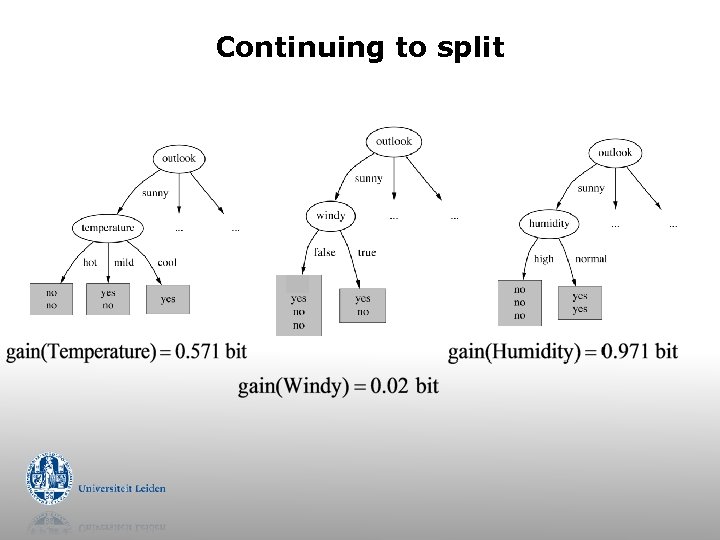 Continuing to split
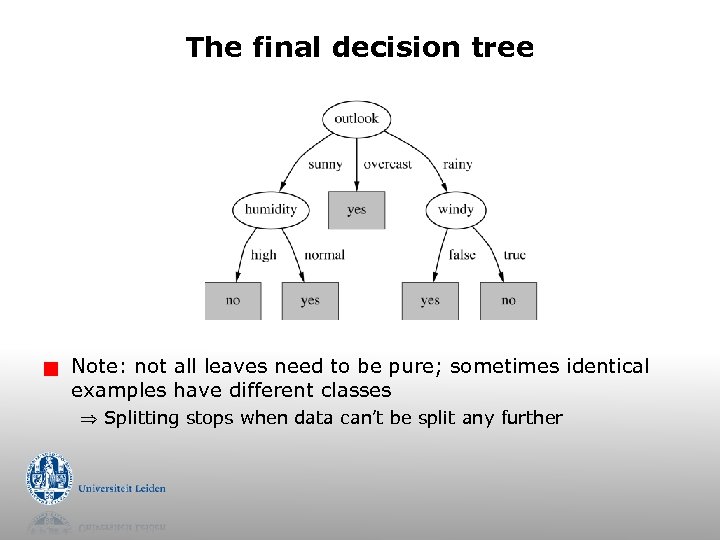 The final decision tree g Note: not all leaves need to be pure; sometimes identical examples have different classes Splitting stops when data can’t be split any further
 Highly-branching attributes g g Problematic: attributes with a large number of values (extreme case: customer ID) Subsets are more likely to be pure if there is a large number of values g g Information gain is biased towards choosing attributes with a large number of values This may result in overfitting (selection of an attribute that is non-optimal for prediction)
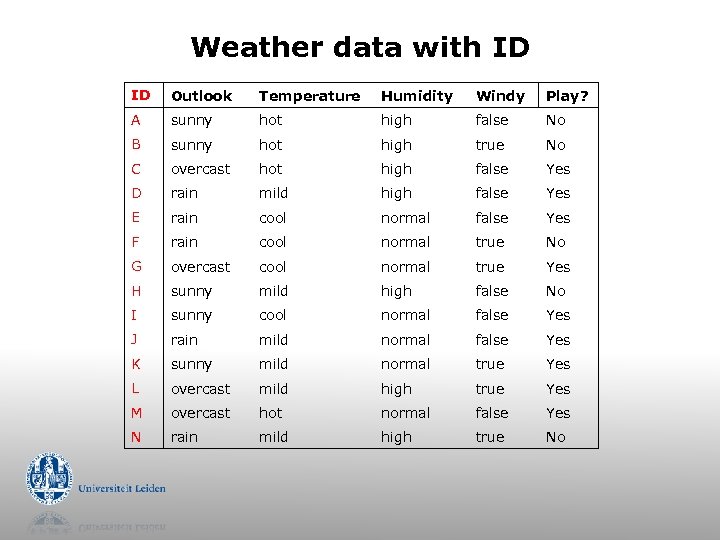 Weather data with ID ID Outlook Temperature Humidity Windy Play? A sunny hot high false No B sunny hot high true No C overcast hot high false Yes D rain mild high false Yes E rain cool normal false Yes F rain cool normal true No G overcast cool normal true Yes H sunny mild high false No I sunny cool normal false Yes J rain mild normal false Yes K sunny mild normal true Yes L overcast mild high true Yes M overcast hot normal false Yes N rain mild high true No
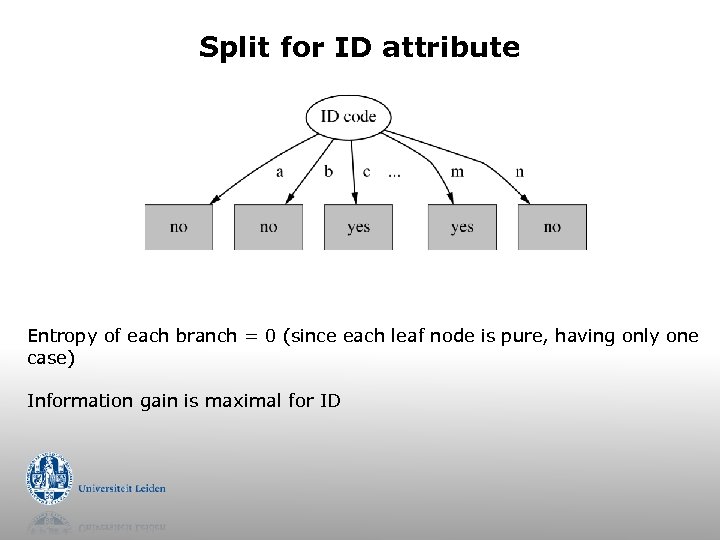 Split for ID attribute Entropy of each branch = 0 (since each leaf node is pure, having only one case) Information gain is maximal for ID
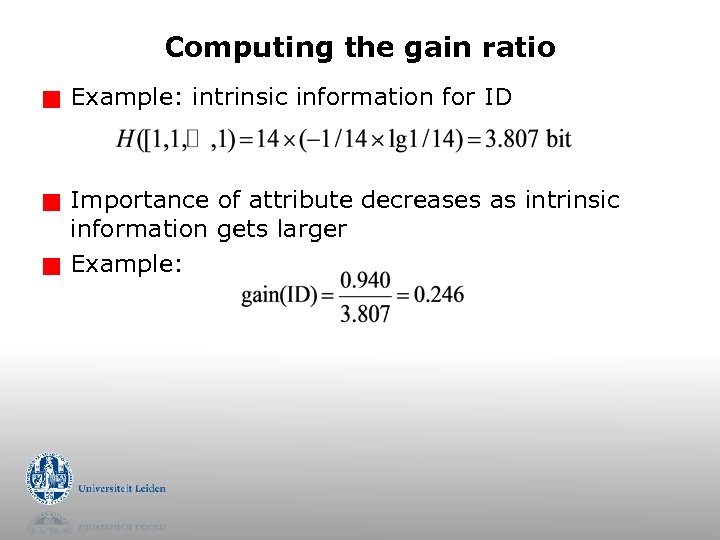
 Gain ratio g g Gain ratio: a modification of the information gain that reduces its bias on high-branch attributes Gain ratio should be g g g Large when data is divided in few, even groups Small when each example belongs to a separate branch Gain ratio takes number and size of branches into account when choosing an attribute g It corrects the information gain by taking the intrinsic information of a split into account (i. e. how much info do we need to tell which branch an instance belongs to)
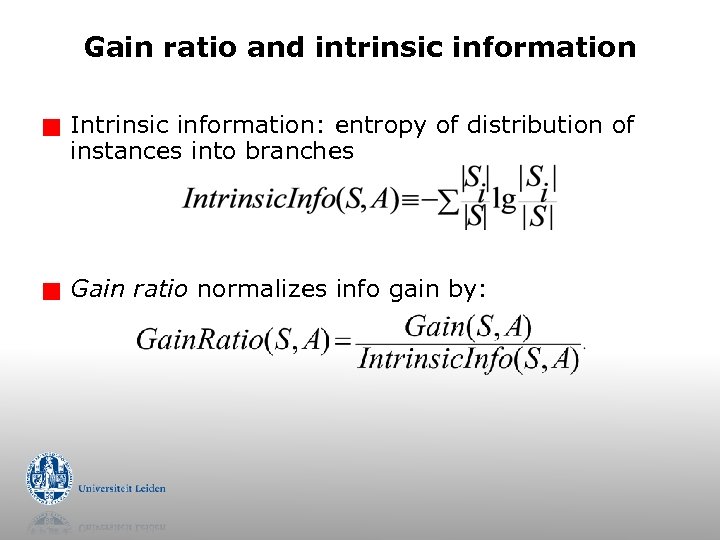 Gain ratio and intrinsic information g Intrinsic information: entropy of distribution of instances into branches g Gain ratio normalizes info gain by:
 Computing the gain ratio g g g Example: intrinsic information for ID Importance of attribute decreases as intrinsic information gets larger Example:
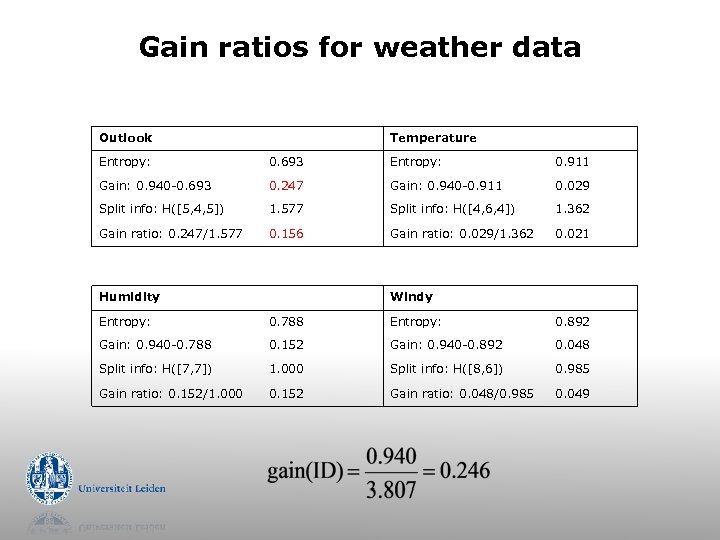 Gain ratios for weather data Outlook Temperature Entropy: 0. 693 Entropy: 0. 911 Gain: 0. 940 -0. 693 0. 247 Gain: 0. 940 -0. 911 0. 029 Split info: H([5, 4, 5]) 1. 577 Split info: H([4, 6, 4]) 1. 362 Gain ratio: 0. 247/1. 577 0. 156 Gain ratio: 0. 029/1. 362 0. 021 Humidity Windy Entropy: 0. 788 Entropy: 0. 892 Gain: 0. 940 -0. 788 0. 152 Gain: 0. 940 -0. 892 0. 048 Split info: H([7, 7]) 1. 000 Split info: H([8, 6]) 0. 985 Gain ratio: 0. 152/1. 000 0. 152 Gain ratio: 0. 048/0. 985 0. 049
 More on the gain ratio g g Outlook still comes out top However: ID has greater gain ratio g g Standard fix: ad hoc test to prevent splitting on that type of attribute Problem with gain ratio: it may overcompensate g g May choose an attribute just because its intrinsic information is very low Standard fix: • First, only consider attributes with greater than average information gain • Then, compare them on gain ratio