


 Скачать презентацию Decision Support Systems Chapter 6 Decision Support System
87b3baac53632799986bb2b8ee92a384.ppt
- Количество слайдов: 20
 Decision Support Systems Chapter 6 Decision Support System Development © 2005 Prentice Hall, Decision Support Systems and Intelligent Systems, 7 th Edition, Turban, Aronson, and Liang 1
 Outline • 1. The system development life cycle Tools • 2. Alternative development methodologies • 3. DSS development methodology • 4. DSS technology levels and tools • 5. DSS development tool selection • 6. Team developed DSS • 7. User developed DSS © 2005 Prentice Hall, Decision Support Systems and Intelligent Systems, 7 th Edition, Turban, Aronson, and Liang 2
 1. Systems Development Life Cycle • Four phases – – Planning Analysis Design Implementation • Cyclical • Can return to other phases • Waterfall model © 2005 Prentice Hall, Decision Support Systems and Intelligent Systems, 7 th Edition, Turban, Aronson, and Liang 3
 Tools • Computer-aided software engineering design tools – Upper CASE – • Creates systems diagrams – Lower CASE • Manages diagrams and code – Integrated CASE • Combination • RAD (rapid application development) design tools – Enterprise class repository and collaboration tools – UML modeling • Analysis and design software • Code debugging methods • Testing and quality assurance tools © 2005 Prentice Hall, Decision Support Systems and Intelligent Systems, 7 th Edition, Turban, Aronson, and Liang 4
 Successful Project Management • • • Establish a baseline Define scope of project Manage change and scope creep Get support from upper management Establish timelines, milestones, and budgets based on realistic goals • Involve users • Document everything © 2005 Prentice Hall, Decision Support Systems and Intelligent Systems, 7 th Edition, Turban, Aronson, and Liang 5
 Implementation Failures • • Lack of stakeholder involvement Incomplete requirements Unclear purpose Unrealistic expectations Project champion leaves Lack of skill or expertise Inadequate human resources New technologies © 2005 Prentice Hall, Decision Support Systems and Intelligent Systems, 7 th Edition, Turban, Aronson, and Liang 6
 Project Management Tools • Project management software can allow: – – Collaboration among disparate teams Resource and program management Portfolio management Web enabled (to allow collaborative teamwork online over time and distance) – Aggregates and analyses project data © 2005 Prentice Hall, Decision Support Systems and Intelligent Systems, 7 th Edition, Turban, Aronson, and Liang 7
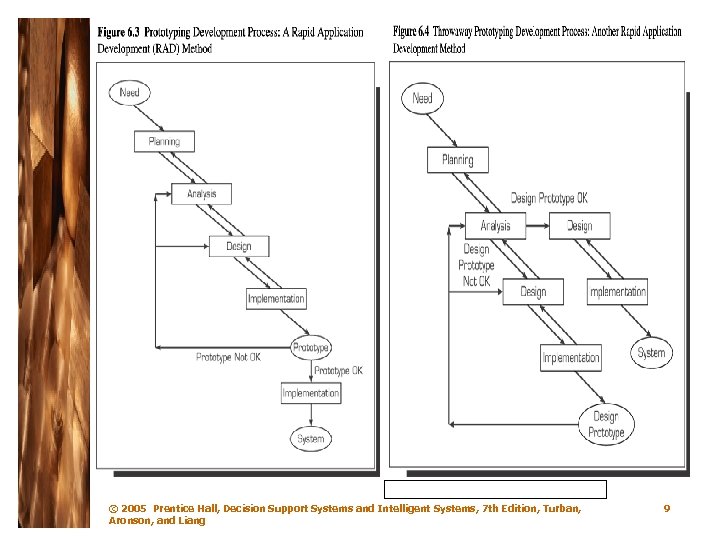
 2. Alternative Development Methodologies • Parallel development – Multiple development on separate systems • RAD – Quick development allowing fast, but limited functionality • Phased development – Sequential serial development (each version has more functionality than the previous one) • Prototyping – Rapid development of portions of projects for user input and modification – Small working model or may become functional part of final system • Throwaway prototyping – Pilot test on simple development platforms to learn about user requirements and the final system to be developed © 2005 Prentice Hall, Decision Support Systems and Intelligent Systems, 7 th Edition, Turban, Aronson, and Liang 8
 © 2005 Prentice Hall, Decision Support Systems and Intelligent Systems, 7 th Edition, Turban, Aronson, and Liang 9
 Agile Development • A new form of rapid prototyping • Extreme Programming (XP) is the most popular example of agile processes • Used for: – Unclear or rapidly changing requirements – Speedy development • Characteristics of the tools: – Heavy user input – Incremental delivery with short time frames – Tend to have integration problems © 2005 Prentice Hall, Decision Support Systems and Intelligent Systems, 7 th Edition, Turban, Aronson, and Liang 10
 DSS Development Methodology • Most DSS are developed through the prototyping process. • Iterative design • Evolutionary development • Middle-out process • Adaptive design • Incremental design © 2005 Prentice Hall, Decision Support Systems and Intelligent Systems, 7 th Edition, Turban, Aronson, and Liang 11
 DSS Prototyping • Short steps – – Planning Analysis Design Prototype • Immediate stakeholder feedback to ensure that the development is proceeding correctly • Iterative – In development of prototype – Within the system in general – Evaluation is integral part of the development process • Control mechanism © 2005 Prentice Hall, Decision Support Systems and Intelligent Systems, 7 th Edition, Turban, Aronson, and Liang 12
 3. DSS Prototyping • Advantages – User and management involvement – Learning explicitly integrated – Prototyping bypasses information requirement – Short intervals between iterations – Low cost – Improved user understanding of system • Disadvantages – Changing requirements – May not have thorough understanding of benefits and costs – Poorly tested – Dependencies, security, and safety may be ignored – High uncertainty – Problem may get lost – Reduction in quality – Higher costs due to multiple productions © 2005 Prentice Hall, Decision Support Systems and Intelligent Systems, 7 th Edition, Turban, Aronson, and Liang 13
 Change Management • • • Crucial to DSS People resistant to change Examine cause of change May require organizational culture shift Lewin-Schein change theory: three steps – Unfreeze • Create awareness of need for change • People support what they help create – Move • Develop new methods, attitutes and behaviors • Create and maintain momentum – Refreeze • Reinforce desired changes • Establish stable environment © 2005 Prentice Hall, Decision Support Systems and Intelligent Systems, 7 th Edition, Turban, Aronson, and Liang 14
 4. DSS Technology Levels • DSS primary tools – Fundamental elements • Programming languages, graphics, editors, query systems • DSS generator (engine) – Integrated software package for building specific DSS • Modeling, report generation, graphics, risk analysis – Examples: Excel, OLAP systems, Lingo. • Specific DSS – DSS application that accomplishes the work • DSS primary tools are used to construct integrated tools that are used to construct specific tools © 2005 Prentice Hall, Decision Support Systems and Intelligent Systems, 7 th Edition, Turban, Aronson, and Liang 15
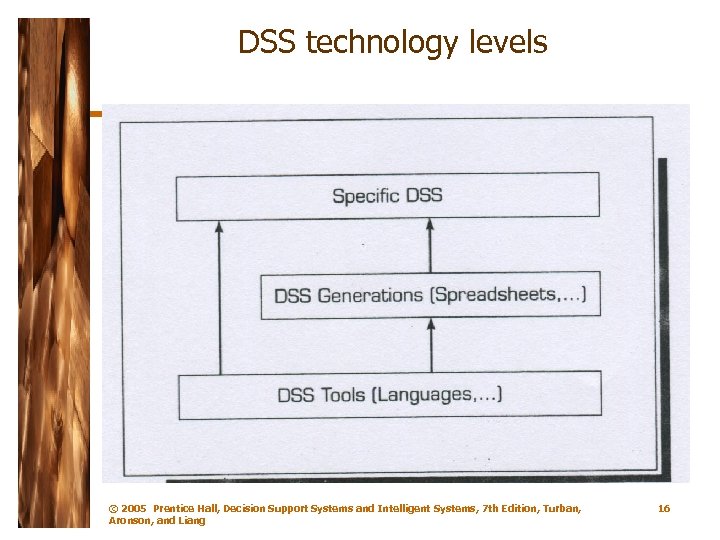 DSS technology levels © 2005 Prentice Hall, Decision Support Systems and Intelligent Systems, 7 th Edition, Turban, Aronson, and Liang 16
 5. DSS Development Tool Selection • Hardware – PCs to multiprocessor mainframes • Software – Involves multiple criteria (when selecting software) – Develop in house, outsource, or buy off the shelf – Off the shelf software rapidly updated; many on market – Prices fluctuate – Different tools available © 2005 Prentice Hall, Decision Support Systems and Intelligent Systems, 7 th Edition, Turban, Aronson, and Liang 17
 6. Team developed DSS • Team developed DSS requires substantial effort to build and manage. • The systems are constructed by a team composed of users, DSS developers, technical support experts, and IS personnel. • Developing a DSS with a team is a complex, lengthy, costly process. • Since early 2000 s, tools and generators have improved, smaller teams can handle complex DSS development. © 2005 Prentice Hall, Decision Support Systems and Intelligent Systems, 7 th Edition, Turban, Aronson, and Liang 18
 End user developed DSS • Decision-makers and knowledge workers develop to solve problems or enhance productivity – Advantages • • Short delivery time User requirements specifications are eliminated Reduced implementation problems Low costs – Risks • Quality may be low • May have lack of documentation • Security risks may increase © 2005 Prentice Hall, Decision Support Systems and Intelligent Systems, 7 th Edition, Turban, Aronson, and Liang 19
 7. Developing DSS: Putting the system together • Two important concepts: – The use of highly automated tools throughout the DSS development process – The reuse of prefabricated components. • DSS is much more than just a DBMS, MBMS, GUI, interface, and knowledge component. There are interfaces among the components and with outside systems. • The system core includes a development language or a DSS generator. © 2005 Prentice Hall, Decision Support Systems and Intelligent Systems, 7 th Edition, Turban, Aronson, and Liang 20