 Скачать презентацию Decision Support System DSS BRIEF TO XMSF Conference
14875403ca0c1a24cb707737451ef104.ppt
- Количество слайдов: 12



Decision Support System (DSS) BRIEF TO: XMSF Conference Naval Postgraduate School Monterey, CA Rebecca Morgan AIR 4. 0 X Program Manager (301) 342 -0108 August 3, 2003 Don Adams Illgen Simulation Technologies
Agenda • The Challenge • What’s Needed? • Approach • Decision Support System • Relation to XMSF 2
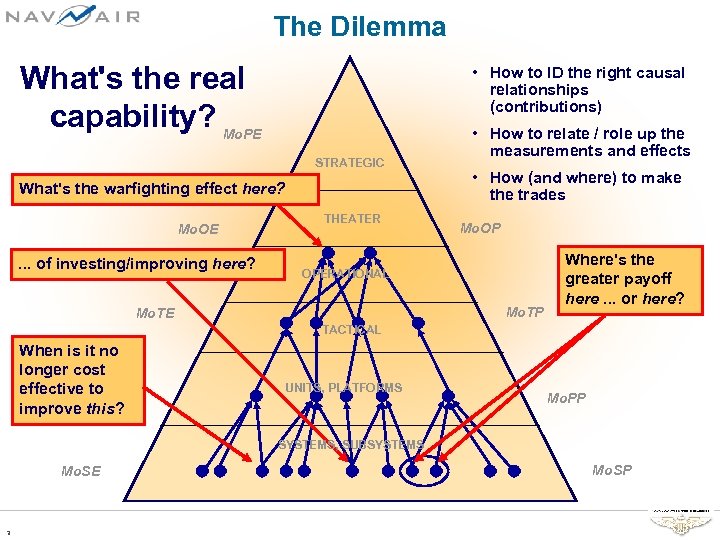
The Dilemma What's the real capability? Mo. PE • How to ID the right causal relationships (contributions) STRATEGIC What's the warfighting effect here? Mo. OE . . . of investing/improving here? THEATER • How to relate / role up the measurements and effects • How (and where) to make the trades Mo. OP OPERATIONAL Mo. TP Mo. TE Where's the greater payoff here. . . or here? TACTICAL When is it no longer cost effective to Mo. PE improve this? UNITS, PLATFORMS Mo. PP SYSTEMS, SUBSYSTEMS Mo. SE 3 Mo. SP
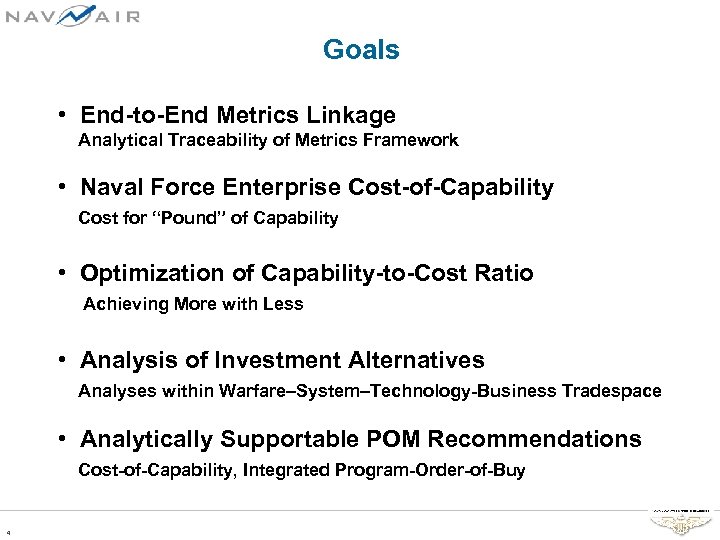
Goals • End-to-End Metrics Linkage Analytical Traceability of Metrics Framework • Naval Force Enterprise Cost-of-Capability Cost for “Pound” of Capability • Optimization of Capability-to-Cost Ratio Achieving More with Less • Analysis of Investment Alternatives Analyses within Warfare–System–Technology-Business Tradespace • Analytically Supportable POM Recommendations Cost-of-Capability, Integrated Program-Order-of-Buy 4
What’s Needed? • Analytically-based Decision Support Capability • Cost-of-Capability Assessment Process • Interoperable Collaborative Environment for Internal NAVAIR and External Stakeholders GUIDING RATIONALE: –Core capability based on Industry Best Practice, Proven DOD Programs –Ops/Warfare Analysis tools focused on NCW applications –Cost Analysis tools focused on business case development –T&E assets provide dynamic trade space for mix of conceptual and actual systems –Aligns current and planned activities for N 70, CHENG, JTF/ JFCOM –Leads integration of NAVAIR infrastructure for implementation –Provides integrated, cross-competency analytical service for NAVAIR programs –Ensures consistent implementation, essential to capability maturity and NCW product quality 5
Approach Blueprinting the Naval Force Capability through Model-Based, Architecture-Centered Method –Complementary suite of systems engineering, architecture and management tools provide authoritative information & analytical rigor –Presentation of engineering source information across the infrastructure, from warfare analysis to ACETEF –Multiple security level, assured collaborative environment serves as an extension of TEAM infrastructure for use by external organizations –Blue & Red (supporting context) cell capabilities modeled for requirements, performance, cost and risk –Development aligned towards Tradespace for “cost of capability” assessments 6
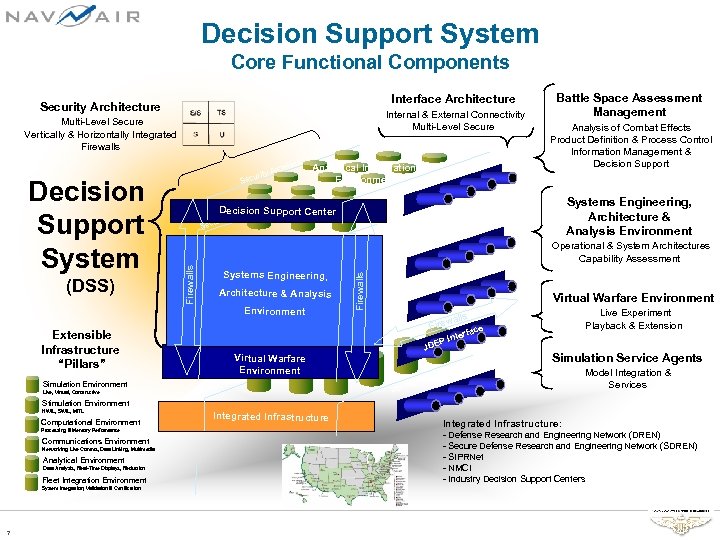
Decision Support System Core Functional Components Interface Architecture Security Architecture Multi-Level Secure Internal & External Connectivity Multi-Level Secure Vertically & Horizontally Integrated Firewalls hitec u Sec Systems Engineering, Architecture & Analysis Live, Virtual, Constructive ture hitec c e Ar rfac Inte ilit rab ope e nter ourc IR I s AVA ata Re N D rity A Environment Simulation Environment Inte r ect Decisiitonu. Support Center rch Extensible Infrastructure “Pillars” In alls w Fire JDE tur hitec c e Ar rfac Inte Capability Assessment Virtual Warfare Environment Live Experiment Playback & Extension e rfac e ite h Arc Operational & System Architectures l En igita D ated tegr Virtual Warfare Environment e ctur Systems Engineering, Architecture & Analysis Environment y nts nme viro te P In urity Sec Product Definition & Process Control Information Management & Decision Support e Analytical Information ctur chite Environment e Ar rfac Firewalls (DSS) ture e Firewalls Decision Support System Se c y Ar curit Battle Space Assessment Management Analysis of Combat Effects Simulation Service Agents Model Integration & Services Stimulation Environment HWIL, SWIL, MITL Computational Environment Processing & Memory Performance Communications Environment Networking, Live Comms, Data Linking, Multimedia Analytical Environment Data Analysis, Real-Time Displays, Reduction Fleet Integration Environment System Integration, Validation & Certification 7 Integrated Infrastructure: - Defense Research and Engineering Network (DREN) - Secure Defense Research and Engineering Network (SDREN) - SIPRNet - NMCI - Industry Decision Support Centers
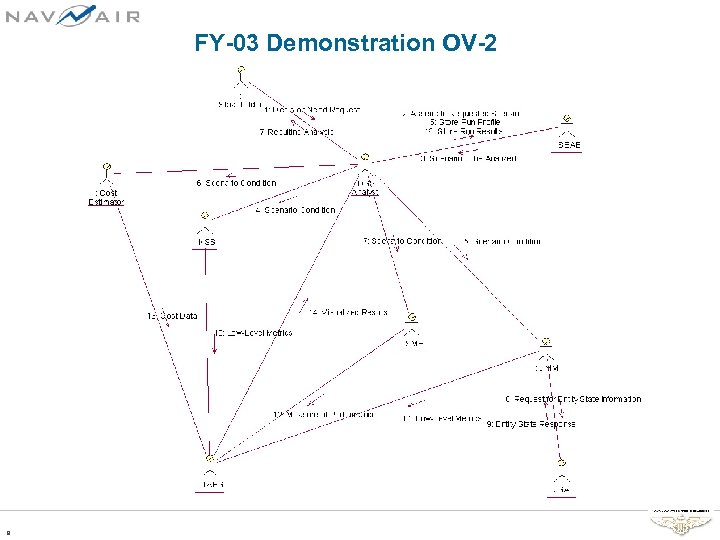
DSS in Relation to XMSF • UML – Operational Architecture: An overarching picture of mission functions and information exchanges required for the decision making process. – Visualization: Allows the decision maker to visualize how the organization operates and how required tasks are performed. Provides engineers with information to define system(s) to be developed without technical restrictions • XML, XML Schema and XSLT – M&S Messaging and Interfaces: All messaging between M&S is XML. Interfaces of M&S are described with XML Schema. Translations between M&S accomplished with XSLT • Web Technologies – Web Services paradigm: HTTP, RMI/IIOP, Client GUI downloaded from Browser as are other tools and Platform independent with distributed M&S. Makes wide use of Open source packages as well as standard network protocols. • Scalability – Peer to Peer: Employs a modified peer to peer paradigm (similar to Napster) • Discovery, Composition and Reuse – M&S Agents and Proxies: M&S agents/proxies are generically prepared to encourage reuse. Client GUI allows for M&S resource discovery and composition. 8
FY-03 Demonstration OV-2 9
Questions? 10
BACKUP MATERIAL 11
UML in the DSS • SI International – SI International is assisting NAVAIR 4. 0 X with the Decision Support System (DSS) Enterprise using object-oriented, Unified Modeling Language business modeling techniques compliant with Do. D Architecture Framework (Do. DAF) operational views. Referred as operational architecture (OA) by the Do. DAF, the OA facilitates the development of integrated capability. The OA is an overarching picture of the mission functions and the information exchanges required for mission accomplishment. The OA is meant to be a living concept, which allows for new missions, new functions, new technology and new alliances. It is conceived as a "plug-and-play" configuration where new mission functionalities are added to the existing system and seamlessly integrated into the operator's activities and tasks. – One of the primary features and benefits of this "plug-and-play" configuration design is its interface with the user. It allows the DSS decision-maker to visualize, in pictures and words, how the organization operates and how all the required tasks are performed. Another purpose of the OA is to provide the DSS systems engineer with the information needed to define the system(s) to be developed without placing any technological restrictions on the system's design. The OA standards outlined in the DSS Enterprise Model ensure the development of common communication, data standards, and algorithms throughout the DSS mission areas. – The OA provides different ways to examine the business of any organization. For example, they examine business processes for reengineering activities or for providing new technology and training. OAs reflect doctrinal and policy implications. They assist in the definition of the physical and system requirements that allow the operator to accomplish any mission in an effective and efficient manner. 12
Скачать презентацию Decision Support System DSS BRIEF TO XMSF Conference
14875403ca0c1a24cb707737451ef104.ppt