 Скачать презентацию Decision Support and Business Intelligence Systems 9 th
ddea412f427a5b44fa94b040551bbf6d.ppt
- Количество слайдов: 59



Decision Support and Business Intelligence Systems (9 th Ed. , Prentice Hall) Chapter 11: Knowledge Management
Learning Objectives n n n 11 -2 Define knowledge and describe the different types of knowledge Describe the characteristics of knowledge management Describe organizational learning and its relationship to knowledge management Describe the knowledge management cycle Describe the technologies that can be used in a knowledge management system Copyright © 2011 Pearson Education, Inc. Publishing as Prentice Hall
Learning Objectives n n n 11 -3 Describe different approaches to knowledge management Describe the chief knowledge officer and others involved in knowledge management Describe the role of knowledge management in organizational activities Describe the different ways of evaluating intellectual capital in an organization Describe how KMS are implemented Copyright © 2011 Pearson Education, Inc. Publishing as Prentice Hall
Learning Objectives n n 11 -4 Describe the roles of technology, people, and management in knowledge management Describe the benefits and drawbacks of knowledge management initiatives Describe how knowledge management can revolutionize the way an organization functions The future of KN: Web 2. 0 and beyond… Copyright © 2011 Pearson Education, Inc. Publishing as Prentice Hall
Opening Vignette: “MITRE Knows What It Knows Through Knowledge Management” n Company background n Problem description n Proposed solution n Results n Answer and discuss the case questions 11 -5 Copyright © 2011 Pearson Education, Inc. Publishing as Prentice Hall
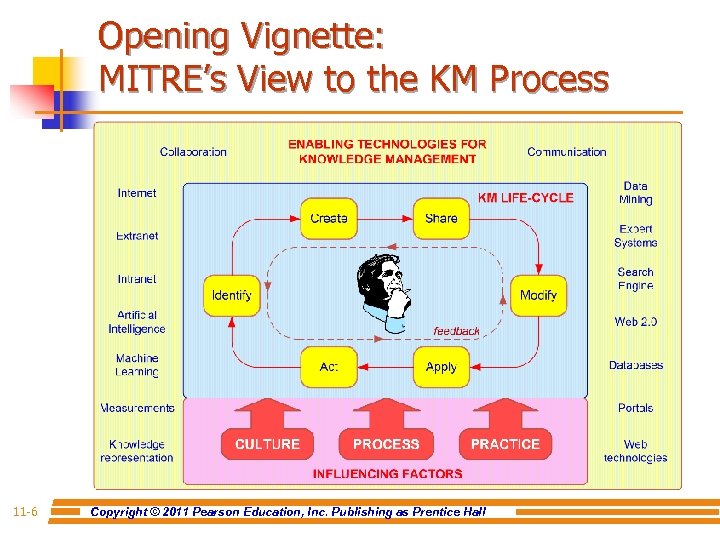
Opening Vignette: MITRE’s View to the KM Process 11 -6 Copyright © 2011 Pearson Education, Inc. Publishing as Prentice Hall
Introduction to Knowledge Management n Knowledge management concepts and definitions n Knowledge management The active management of the expertise in an organization. It involves collecting, categorizing, and disseminating knowledge n Intellectual capital The invaluable knowledge of an organization’s employees 11 -7 Copyright © 2011 Pearson Education, Inc. Publishing as Prentice Hall
Introduction to Knowledge Management n Knowledge is n n n information that is contextual, relevant, and actionable understanding, awareness, or familiarity acquired through education or experience anything that has been learned, perceived, discovered, inferred, or understood. In a knowledge management system, “knowledge is information in action” 11 -8 Copyright © 2011 Pearson Education, Inc. Publishing as Prentice Hall
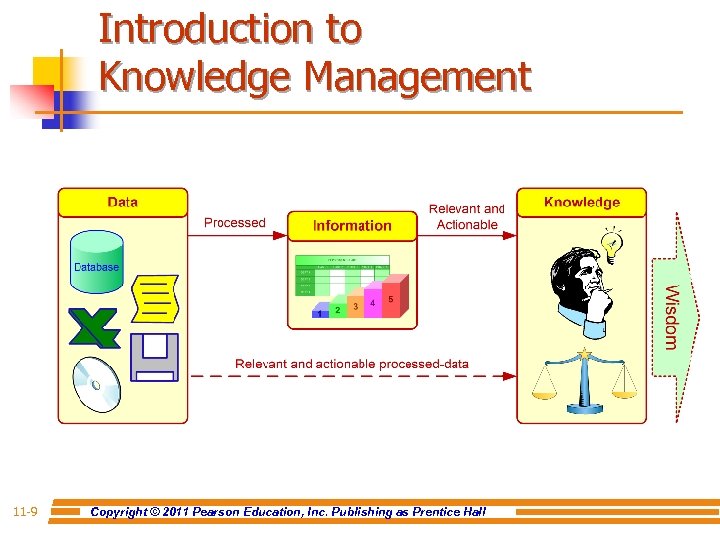
Introduction to Knowledge Management 11 -9 Copyright © 2011 Pearson Education, Inc. Publishing as Prentice Hall
Introduction to Knowledge Management n Characteristics of knowledge n n n 11 -10 Extraordinary leverage and increasing returns Fragmentation, leakage and the need to refresh Uncertain value of sharing Knowledge-based economy The economic shift from natural resources to intellectual assets Copyright © 2011 Pearson Education, Inc. Publishing as Prentice Hall
Introduction to Knowledge Management n Explicit and tacit knowledge n n n 11 -11 Explicit (leaky) knowledge Knowledge that deals with objective, rational, and technical material (data, policies, procedures, software, documents, etc. ) Easily documented, transferred, taught and learned Examples… Copyright © 2011 Pearson Education, Inc. Publishing as Prentice Hall
Introduction to Knowledge Management n Explicit and tacit knowledge n n n 11 -12 Tacit (embedded) knowledge Knowledge that is usually in the domain of subjective, cognitive, and experiential learning It is highly personal and hard to formalize Hard to document, transfer, teach and learn Involves a lot of human interpretation Examples… Copyright © 2011 Pearson Education, Inc. Publishing as Prentice Hall
Introduction to Knowledge Management n 11 -13 Knowledge management systems (KMS) A system that facilitates knowledge management by ensuring knowledge flow from the person(s) who know to the person(s) who need to know throughout the organization; knowledge evolves and grows during the process Copyright © 2011 Pearson Education, Inc. Publishing as Prentice Hall
Organizational Learning and Transformation n n 11 -14 Learning organization An organization capable of learning from its past experience, implying the existence of an organizational memory and a means to save, represent, and share it through its personnel Organizational memory Repository of what the organization “knows” Copyright © 2011 Pearson Education, Inc. Publishing as Prentice Hall
Organizational Learning and Transformation n Organizational learning n n n 11 -15 Development of new knowledge and insights that have the potential to influence organization’s behavior The process of capturing knowledge and making it available enterprise-wide Need to establish corporate memory Modern IT helps… People issues are the most important! Copyright © 2011 Pearson Education, Inc. Publishing as Prentice Hall
Organizational Learning and Transformation n Organizational culture The aggregate attitudes in an organization concerning a certain issue (e. g. , technology, computers, DSS) n n 11 -16 How do people learn the “culture”? Is it explicit or implicit? Can culture be changed? How? Give some examples of corporate culture: Microsoft, Google, Apple, HP, GM, … Copyright © 2011 Pearson Education, Inc. Publishing as Prentice Hall
Organizational Learning and Transformation n 11 -17 Why people don’t like to share knowledge: n Lack of time to share knowledge and time to identify colleagues in need of specific knowledge n Fear that sharing may jeopardize one’s job security n Low awareness and realization of the value and benefit of the knowledge others possess n Dominance in sharing explicit over tacit knowledge n Use of a strong hierarchy, position-based status, and formal power n Insufficient capture, evaluation, feedback, communication, and tolerance of past mistakes Copyright © 2011 Pearson Education, Inc. Publishing as Prentice Hall
Organizational Learning and Transformation n 11 -18 Why people don’t like to share knowledge: n Differences in experience and education levels n Lack of contact time and interaction between knowledge sources and recipients n Poor verbal/written communication and interpersonal skills n Age, gender, cultural and ethical defenses n Lack of a social network n Ownership of intellectual property n Lack of trust in people because they may misuse knowledge or take unjust credit for it n Perceived lack of accuracy/credibility of knowledge Copyright © 2011 Pearson Education, Inc. Publishing as Prentice Hall
Knowledge Management Activities n Knowledge management initiatives and activities n Most knowledge management initiatives have one of three aims: 1. 2. 3. 11 -19 To make knowledge visible To develop a knowledge-intensive culture To build a knowledge infrastructure Copyright © 2011 Pearson Education, Inc. Publishing as Prentice Hall
Knowledge Management Activities Knowledge creation is the generation of new insights, ideas, or routines Four modes of knowledge creation: n n n Socialization Externalization Internalization Combination n Analytics-based knowledge creation? n n n 11 -20 Copyright © 2011 Pearson Education, Inc. Publishing as Prentice Hall
Knowledge Management Activities Knowledge sharing n n n 11 -21 Knowledge sharing is the willful explication of one person’s ideas, insights, experiences to another individual either via an intermediary or directly In many organizations, information and knowledge are not considered organizational resources to be shared but individual competitive weapons to be kept private Copyright © 2011 Pearson Education, Inc. Publishing as Prentice Hall
Knowledge Management Activities Knowledge seeking n n n 11 -22 Knowledge seeking (knowledge sourcing) is the search for and use of internal organizational knowledge Lack of time or lack of reward may hinder the sharing of knowledge or knowledge seeking Copyright © 2011 Pearson Education, Inc. Publishing as Prentice Hall
Approaches to Knowledge Management n Process approach to knowledge management attempts to codify organizational knowledge through formalized controls, processes and technologies n n Practice approach focuses on building the social environments or communities of practice necessary to facilitate the sharing of tacit understanding n 11 -23 Focuses on explicit knowledge and IT Focuses on tacit knowledge and socialization Copyright © 2011 Pearson Education, Inc. Publishing as Prentice Hall
Approaches to Knowledge Management n Hybrid approaches to knowledge management n Hybrid at 80/20 to 50/50 n n 11 -24 The practice approach is used so that a repository stores only explicit knowledge that is relatively easy to document Tacit knowledge initially stored in the repository is contact information about experts and their areas of expertise Increasing the amount of tacit knowledge over time eventually leads to the attainment of a true process approach Copyright © 2011 Pearson Education, Inc. Publishing as Prentice Hall
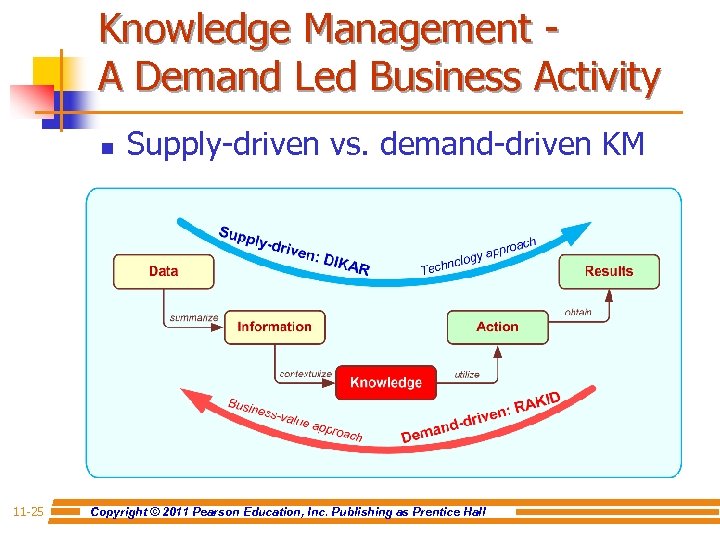
Knowledge Management - A Demand Led Business Activity n 11 -25 Supply-driven vs. demand-driven KM Copyright © 2011 Pearson Education, Inc. Publishing as Prentice Hall
Approaches to Knowledge Management n n 11 -26 Best practices In an organization, the best methods for solving problems. These are often stored in the knowledge repository of a knowledge management system Knowledge repository is the actual storage location of knowledge in a knowledge management system. Similar in nature to a database, but generally textoriented Copyright © 2011 Pearson Education, Inc. Publishing as Prentice Hall
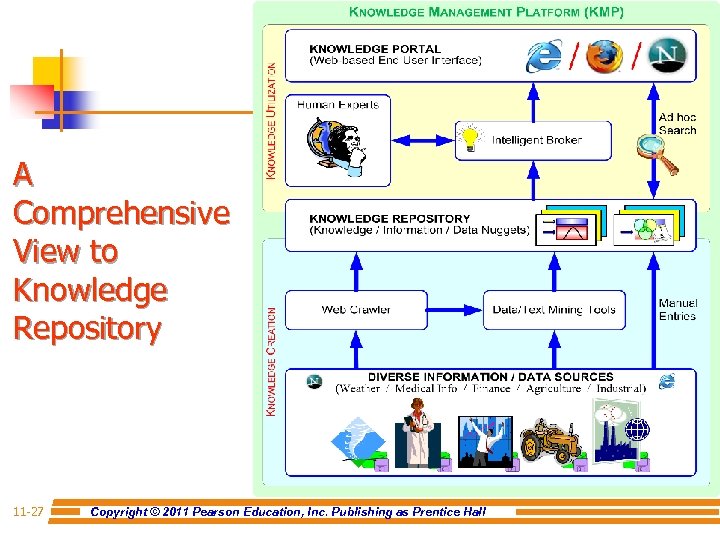
Approaches to Knowledge Management A Comprehensive View to Knowledge Repository 11 -27 Copyright © 2011 Pearson Education, Inc. Publishing as Prentice Hall
Approaches to Knowledge Management n Developing a knowledge repository n n 11 -28 Knowledge repositories are developed using several different storage mechanisms in combination The most important aspects and difficult issues are making the contribution of knowledge relatively easy for the contributor and determining a good method for cataloging the knowledge Copyright © 2011 Pearson Education, Inc. Publishing as Prentice Hall
Information Technology (IT) in Knowledge Management The KMS cycle n n 11 -29 KMS usually follow a six-step cycle: 1. Create knowledge 2. Capture knowledge 3. Refine knowledge 4. Store knowledge 5. Manage knowledge 6. Disseminate knowledge Copyright © 2011 Pearson Education, Inc. Publishing as Prentice Hall
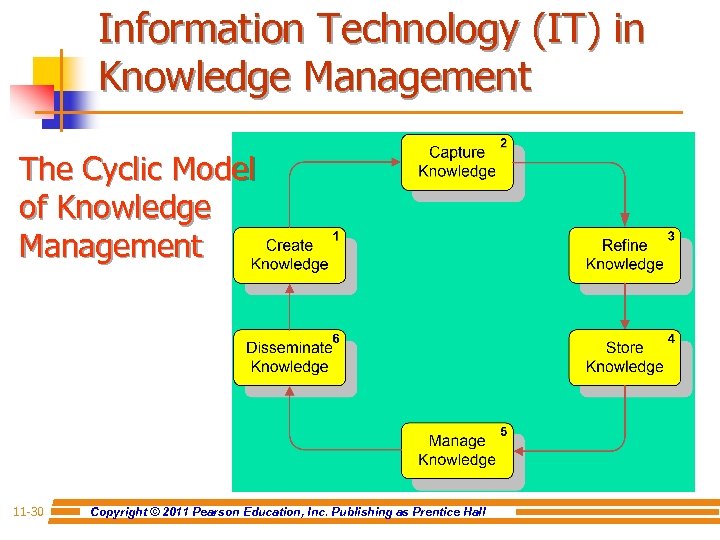
Information Technology (IT) in Knowledge Management The Cyclic Model of Knowledge Management 11 -30 Copyright © 2011 Pearson Education, Inc. Publishing as Prentice Hall
Information Technology (IT) in Knowledge Management Components of KMS n n n 11 -31 KMS are developed using three sets of core technologies: 1. Communication 2. Collaboration 3. Storage and retrieval Technologies that support KM n Artificial intelligence n Intelligent agents n Knowledge discovery in databases n Extensible Markup Language (XML) Copyright © 2011 Pearson Education, Inc. Publishing as Prentice Hall
Information Technology (IT) in Knowledge Management n Artificial intelligence n AI methods used in KMS: n n 11 -32 Assist in and enhance searching knowledge Help for knowledge representation (e. g. , ES) Help establish knowledge profiles of individuals and groups Help determine the relative importance of knowledge when it is contributed to and accessed from the knowledge repository Copyright © 2011 Pearson Education, Inc. Publishing as Prentice Hall
Information Technology (IT) in Knowledge Management n AI methods used in KMS: n n n 11 -33 Scan e-mail, documents, and databases to perform knowledge discovery, determine meaningful relationships and rules Identify patterns in data (usually through neural networks and other data mining techniques) Forecast future results by using data/knowledge Provide advice directly from knowledge by using neural networks or expert systems Provide a natural language or voice command– driven user interface for a KMS Copyright © 2011 Pearson Education, Inc. Publishing as Prentice Hall
Information Technology (IT) in Knowledge Management n Intelligent agents n n Intelligent agents are software systems that learn how users work and provide assistance in their daily tasks They are used to elicit and identify knowledge n n 11 -34 See ibm. com, gentia. com for examples Combined with enterprise knowledge portal to proactively disseminate knowledge Copyright © 2011 Pearson Education, Inc. Publishing as Prentice Hall
Information Technology (IT) in Knowledge Management n Knowledge discovery in databases (KDD) A machine learning process that performs rule induction, or a related procedure to establish (or create) knowledge from large databases n 11 -35 a. k. a. Data Mining (and/or Text Mining) Copyright © 2011 Pearson Education, Inc. Publishing as Prentice Hall
Information Technology (IT) in Knowledge Management Model marts Small, generally departmental repositories of knowledge created by employing knowledgediscovery techniques on past decision instances. Similar to data marts n Model warehouses Large, generally enterprise-wide repositories of knowledge created by employing knowledge-discovery techniques. Similar to data warehouses n 11 -36 Copyright © 2011 Pearson Education, Inc. Publishing as Prentice Hall
Information Technology (IT) in Knowledge Management n Extensible Markup Language (XML) n n Web 2. 0 n 11 -37 XML enables standardized representations of data structures so that data can be processed appropriately by heterogeneous information systems without case-by-case programming or human intervention The evolution of the Web from statically disseminating information to collaboratively creating and sharing information Copyright © 2011 Pearson Education, Inc. Publishing as Prentice Hall
KM System Implementation n Knowledge management products and vendors n n Knowware Technology tools (software/hardware products) that support knowledge management Software development companies / vendors n n n 11 -38 Collaborative computing tools Knowledge servers Enterprise knowledge portals (EKP) An electronic doorway into a knowledge management system… Copyright © 2011 Pearson Education, Inc. Publishing as Prentice Hall
KM System Implementation n Software development companies / vendors n n 11 -39 Electronic document management (EDM) A method for processing documents electronically, including capture, storage, retrieval, manipulation, and presentation Content management systems (CMS) An electronic document management system that produces dynamic versions of documents, and automatically maintains the current set for use at the enterprise level Copyright © 2011 Pearson Education, Inc. Publishing as Prentice Hall
KM System Implementation n Software development tools n n n 11 -40 Knowledge harvesting tools Search engines Knowledge management suites Knowledge management consulting firms Knowledge management ASPs Copyright © 2011 Pearson Education, Inc. Publishing as Prentice Hall
KMS Implementation n Integration of KMS with other business information systems n n n 11 -41 With DSS/BI Systems With AI With databases and information systems With CRM systems With SCM systems With corporate intranets and extranets Copyright © 2011 Pearson Education, Inc. Publishing as Prentice Hall
Roles of People in Knowledge Management n Chief knowledge officer (CKO) The person in charge of a knowledge management effort in an organization n n n 11 -42 Sets KM strategic priorities Establishes a repository of best practices Gains a commitment from senior executives Teaches information seekers how to better elicit it Creates a process for managing intellectual assets Obtain customer satisfaction information Globalizes knowledge management Copyright © 2011 Pearson Education, Inc. Publishing as Prentice Hall
Roles of People in Knowledge Management n Skills required of a CKO include: n n n n 11 -43 Interpersonal communication skills Leadership skills Business acumen Strategic thinking Collaboration skills The ability to institute effective educational programs An understanding of IT and its role in advancing knowledge management Copyright © 2011 Pearson Education, Inc. Publishing as Prentice Hall
Roles of People in Knowledge Management n The CEO, other chief officers, and managers n n The CEO is responsible for championing a knowledge management effort The officers make available the resources needed to get the job done n n 11 -44 CFO ensures that the financial resources are available COO ensures that people begin to embed knowledge management practices into their daily work processes CIO ensures IT resources are available Managers also support the KM efforts by providing access to sources of knowledge Copyright © 2011 Pearson Education, Inc. Publishing as Prentice Hall
Roles of People in Knowledge Management n Community of practice (Co. P) A group of people in an organization with a common professional interest, often self-organized for managing knowledge in a knowledge management system n 11 -45 See Application Case 11. 7 as an example of how Xerox successfully improved practices and cost savings through Co. P Copyright © 2011 Pearson Education, Inc. Publishing as Prentice Hall
Roles of People in Knowledge Management n KMS developers n n n KMS staff n 11 -46 The team members who actually develop the system Internal + External Enterprise-wide KMS require a full-time staff to catalog and manage the knowledge Copyright © 2011 Pearson Education, Inc. Publishing as Prentice Hall
Ensuring the Success of Knowledge Management Efforts n Success stories of knowledge management n 11 -47 Implementing a good KM strategy can: n Reduce… n loss of intellectual capital n costs by decreasing the number of times the company must repeatedly solve the same problem n redundancy of knowledge-based activities n Increase… n productivity n employee satisfaction Copyright © 2011 Pearson Education, Inc. Publishing as Prentice Hall
Ensuring the Success of Knowledge Management Efforts n MAKE: Most Admired Knowledge Enterprises “Annually identifying the best practitioners of KM” n Criteria (performance dimensions): 1. 2. 3. 4. 5. 6. 7. 8. 11 -48 Creating a knowledge-driven corporate culture Developing knowledge workers through leadership Fostering innovation Maximizing enterprise intellectual capital Creating an environment for collaborative knowledge sharing Facilitating organizational learning Delivering value based on stakeholder knowledge Transforming enterprise knowledge into stakeholders’ value Copyright © 2011 Pearson Education, Inc. Publishing as Prentice Hall
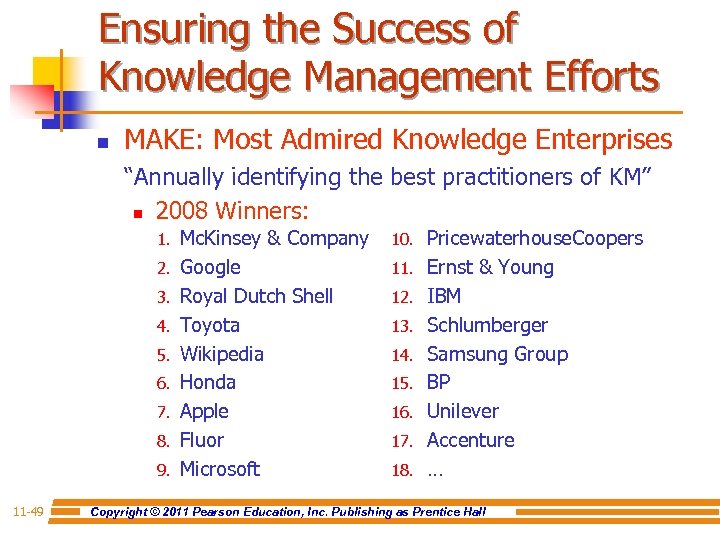
Ensuring the Success of Knowledge Management Efforts n MAKE: Most Admired Knowledge Enterprises “Annually identifying the best practitioners of KM” n 2008 Winners: 1. 2. 3. 4. 5. 6. 7. 8. 9. 11 -49 Mc. Kinsey & Company Google Royal Dutch Shell Toyota Wikipedia Honda Apple Fluor Microsoft 10. 11. 12. 13. 14. 15. 16. 17. 18. Pricewaterhouse. Coopers Ernst & Young IBM Schlumberger Samsung Group BP Unilever Accenture … Copyright © 2011 Pearson Education, Inc. Publishing as Prentice Hall
Ensuring the Success of Knowledge Management Efforts n Useful applications of KMS n Finding experts electronically and using expert location systems n 11 -50 Expert location systems (know-who) Interactive computerized systems that help employees find and connect with colleagues who have expertise required for specific problems—whether they are across the county or across the room—in order to solve specific, critical business problems in seconds Copyright © 2011 Pearson Education, Inc. Publishing as Prentice Hall
Ensuring the Success of Knowledge Management Efforts n Knowledge management valuation n Financial metrics for knowledge management valuation n n 11 -51 Focus knowledge management projects on specific business problems that can be easily quantified When the problems are solved, the value and benefits of the system become apparent Copyright © 2011 Pearson Education, Inc. Publishing as Prentice Hall
Ensuring the Success of Knowledge Management Efforts n Knowledge management valuation n Nonfinancial metrics for knowledge management valuation—new ways to view capital when evaluating intangibles: n n n 11 -52 Customer goodwill External relationship capital Structural capital Human capital Social capital Environmental capital Copyright © 2011 Pearson Education, Inc. Publishing as Prentice Hall
Ensuring the Success of Knowledge Management Efforts n Causes of knowledge management failure n n 11 -53 The effort mainly relies on technology and does not address whether the proposed system will meet the needs and objectives of the organization and its individuals Lack of emphasis on human aspects Lack of commitment Failure to provide reasonable incentive for people to use the system… Copyright © 2011 Pearson Education, Inc. Publishing as Prentice Hall
Ensuring the Success of Knowledge Management Efforts n Factors that lead to knowledge management success n n n 11 -54 A link to a firm’s economic value, to demonstrate financial viability and maintain executive sponsorship A technical and organizational infrastructure on which to build A standard, flexible knowledge structure to match the way the organization performs work and uses knowledge Copyright © 2011 Pearson Education, Inc. Publishing as Prentice Hall
Ensuring the Success of Knowledge Management Efforts n Factors that lead to knowledge management success n n 11 -55 A knowledge-friendly culture that leads directly to user support A clear purpose and language, to encourage users to buy into the system A change in motivational practices, to create a culture of sharing Multiple channels for knowledge transfer Copyright © 2011 Pearson Education, Inc. Publishing as Prentice Hall
Ensuring the Success of Knowledge Management Efforts n Factors that lead to knowledge management success n n n 11 -56 A significant process orientation and valuation to make a knowledge management effort worthwhile Nontrivial motivational methods to encourage users to contribute and use knowledge Senior management support Copyright © 2011 Pearson Education, Inc. Publishing as Prentice Hall
Last words on KM n n Knowledge is an intellectual asset IT is “just” an important enabler Proper management of knowledge is a necessary ingredient for success Key issues: n n n 11 -57 Organizational culture Executive sponsorship Measurement of success Copyright © 2011 Pearson Education, Inc. Publishing as Prentice Hall
End of the Chapter n 11 -58 Questions / comments… Copyright © 2011 Pearson Education, Inc. Publishing as Prentice Hall

All rights reserved. No part of this publication may be reproduced, stored in a retrieval system, or transmitted, in any form or by any means, electronic, mechanical, photocopying, recording, or otherwise, without the prior written permission of the publisher. Printed in the United States of America. Copyright © 2011 Pearson Education, Inc. Publishing as Prentice Hall 11 -59 Copyright © 2011 Pearson Education, Inc. Publishing as Prentice Hall
Скачать презентацию Decision Support and Business Intelligence Systems 9 th
ddea412f427a5b44fa94b040551bbf6d.ppt