 Скачать презентацию Decision Making with Fuzzy Logic Armin Shmilovici Ben-Gurion
2a99117775fea150903df88b30adab2f.ppt
- Количество слайдов: 69




Decision Making with Fuzzy Logic Armin Shmilovici Ben-Gurion University, Israel armin@bgu. ac. il

Credits for some slides S. Natarajan, Fuzzy Decision Making J. -S. R. Jang, Neuro-Fuzzy and Soft Computing M. Casey, Lectures on Artificial Intelligence – CS 364
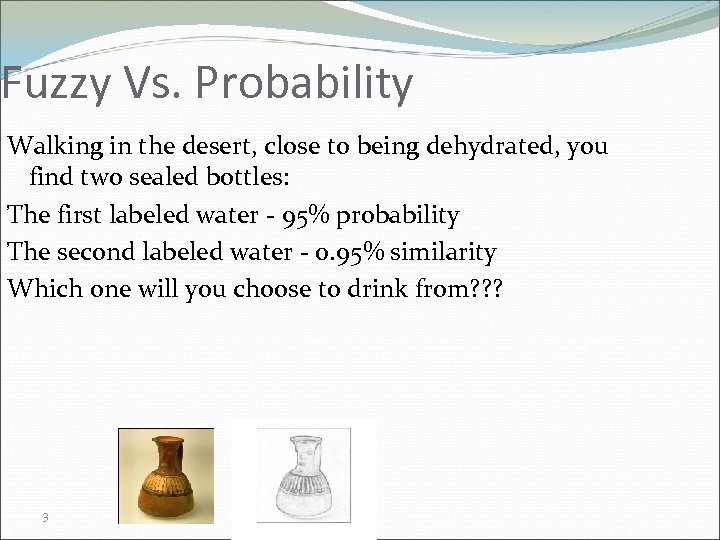
Fuzzy Vs. Probability Walking in the desert, close to being dehydrated, you find two sealed bottles: The first labeled water - 95% probability The second labeled water - 0. 95% similarity Which one will you choose to drink from? ? ? 3
Uncertainty Information can be incomplete inconsistent, uncertain, or all three. Uncertainty is defined as the lack of the exact knowledge that would enable us to reach a perfectly reliable conclusion. Some Sources of Uncertain Knowledge: Weak implications Imprecise language. Our natural language is ambiguous and imprecise. Unknown data. When the data is incomplete or missing views of different experts.
Definition Many decision-making and problem-solving tasks are too complex to be understood quantitatively, however, people succeed by using knowledge that is imprecise rather than precise. Fuzzy set theory resembles human reasoning in its use of approximate information and uncertainty to generate decisions. It was specifically designed to mathematically represent uncertainty and vagueness and provide formalized tools for dealing with the imprecision intrinsic to many problems.
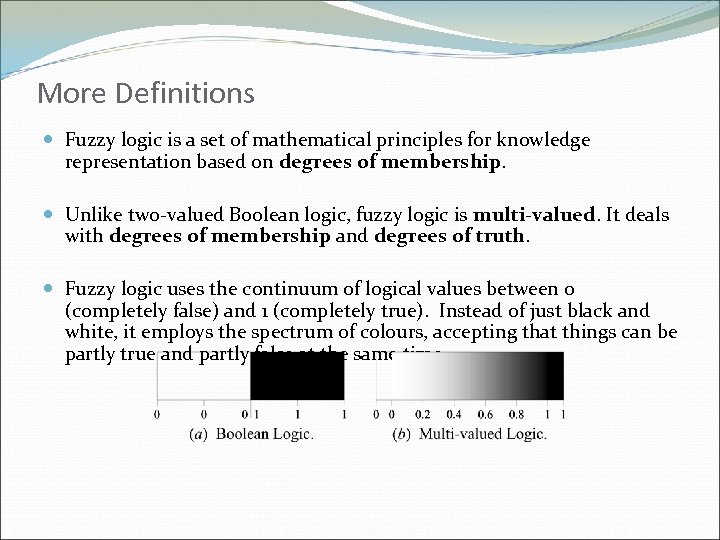
More Definitions Fuzzy logic is a set of mathematical principles for knowledge representation based on degrees of membership. Unlike two-valued Boolean logic, fuzzy logic is multi-valued. It deals with degrees of membership and degrees of truth. Fuzzy logic uses the continuum of logical values between 0 (completely false) and 1 (completely true). Instead of just black and white, it employs the spectrum of colours, accepting that things can be partly true and partly false at the same time.
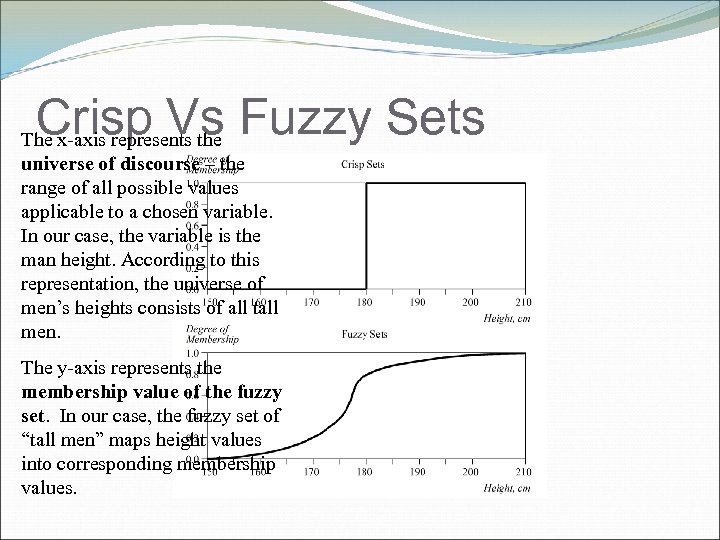
Crisp Vs Fuzzy Sets The x-axis represents the universe of discourse – the range of all possible values applicable to a chosen variable. In our case, the variable is the man height. According to this representation, the universe of men’s heights consists of all tall men. The y-axis represents the membership value of the fuzzy set. In our case, the fuzzy set of “tall men” maps height values into corresponding membership values.
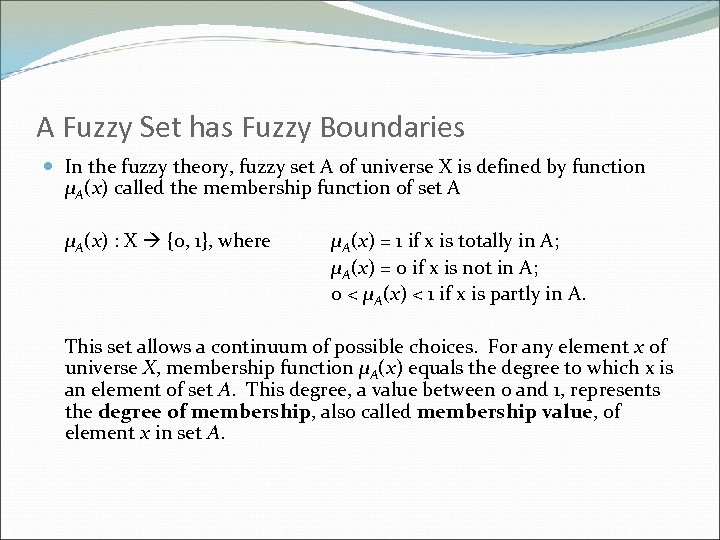
A Fuzzy Set has Fuzzy Boundaries In the fuzzy theory, fuzzy set A of universe X is defined by function µA(x) called the membership function of set A µA(x) : X {0, 1}, where µA(x) = 1 if x is totally in A; µA(x) = 0 if x is not in A; 0 < µA(x) < 1 if x is partly in A. This set allows a continuum of possible choices. For any element x of universe X, membership function µA(x) equals the degree to which x is an element of set A. This degree, a value between 0 and 1, represents the degree of membership, also called membership value, of element x in set A.
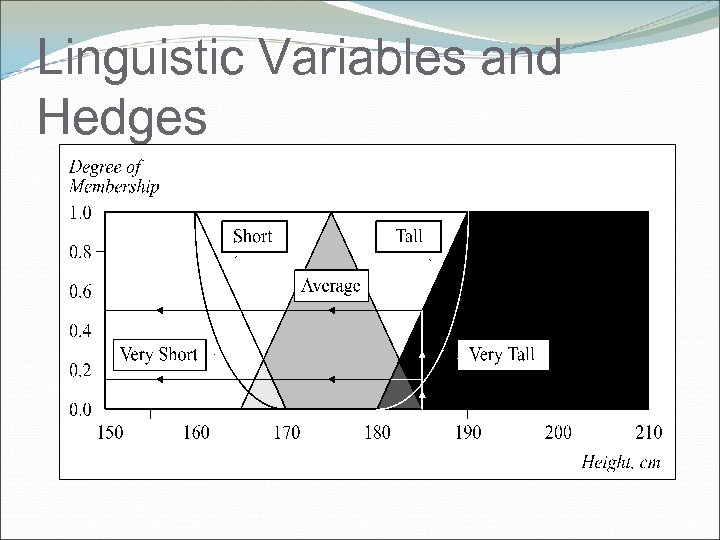
Fuzzy Set Representation First, we determine the membership functions. In our “tall men” example, we can obtain fuzzy sets of tall, short and average men. The universe of discourse – the men’s heights – consists of three sets: short, average and tall men. As you will see, a man who is 184 cm tall is a member of the average men set with a degree of membership of 0. 1, and at the same time, he is also a member of the tall men set with a degree of 0. 4. (see graph on next page)
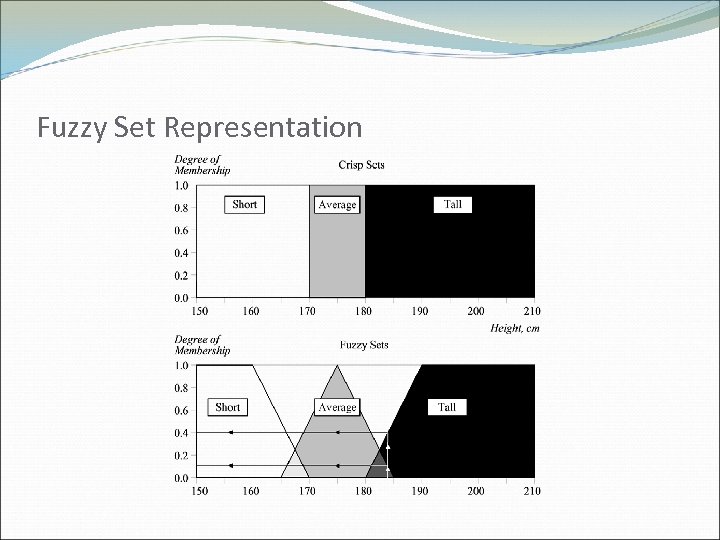
Fuzzy Set Representation
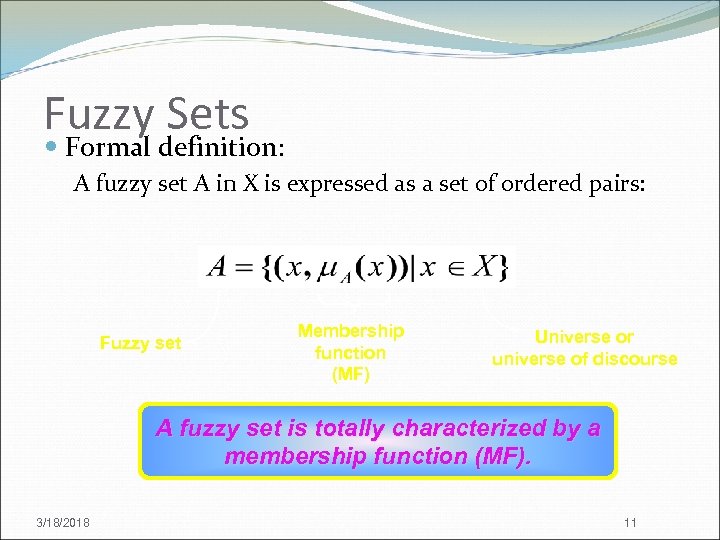
Fuzzy Sets Formal definition: A fuzzy set A in X is expressed as a set of ordered pairs: Fuzzy set Membership function (MF) Universe or universe of discourse A fuzzy set is totally characterized by a membership function (MF). 3/18/2018 11
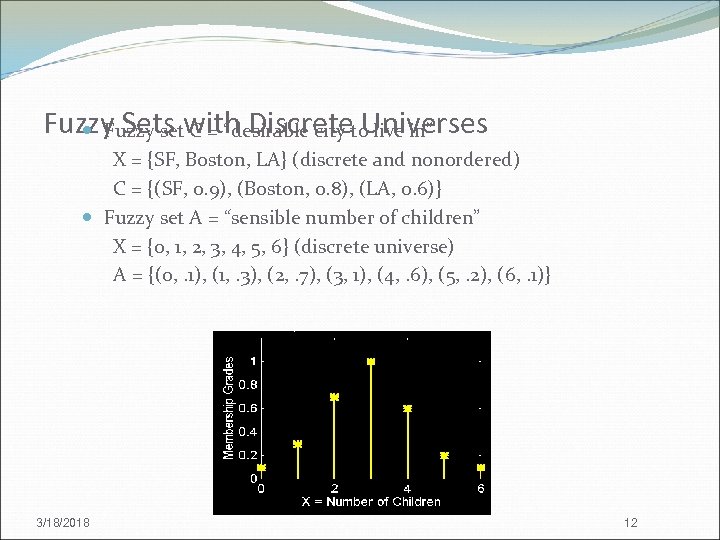
Fuzzy Sets with Discreteto live in” Fuzzy set C = “desirable city Universes X = {SF, Boston, LA} (discrete and nonordered) C = {(SF, 0. 9), (Boston, 0. 8), (LA, 0. 6)} Fuzzy set A = “sensible number of children” X = {0, 1, 2, 3, 4, 5, 6} (discrete universe) A = {(0, . 1), (1, . 3), (2, . 7), (3, 1), (4, . 6), (5, . 2), (6, . 1)} 3/18/2018 12
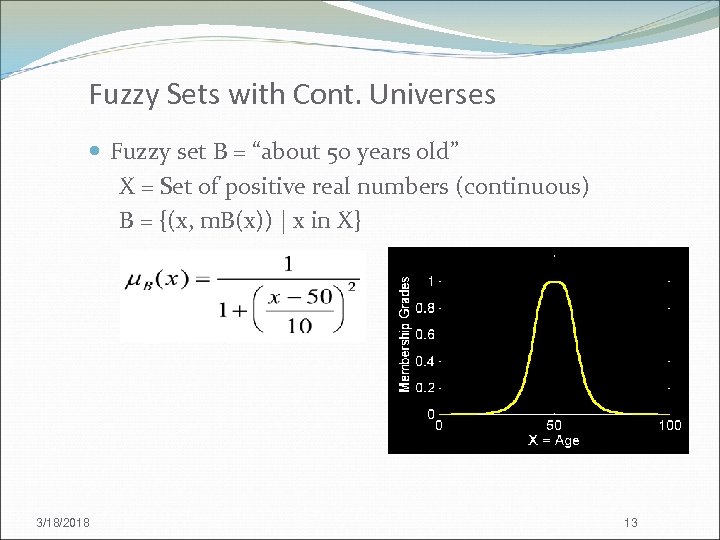
Fuzzy Sets with Cont. Universes Fuzzy set B = “about 50 years old” X = Set of positive real numbers (continuous) B = {(x, m. B(x)) | x in X} 3/18/2018 13
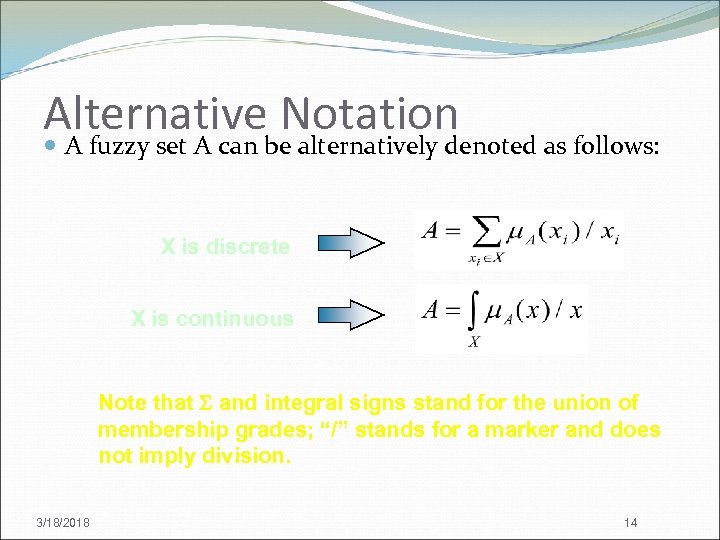
Alternative Notation A fuzzy set A can be alternatively denoted as follows: X is discrete X is continuous Note that S and integral signs stand for the union of membership grades; “/” stands for a marker and does not imply division. 3/18/2018 14
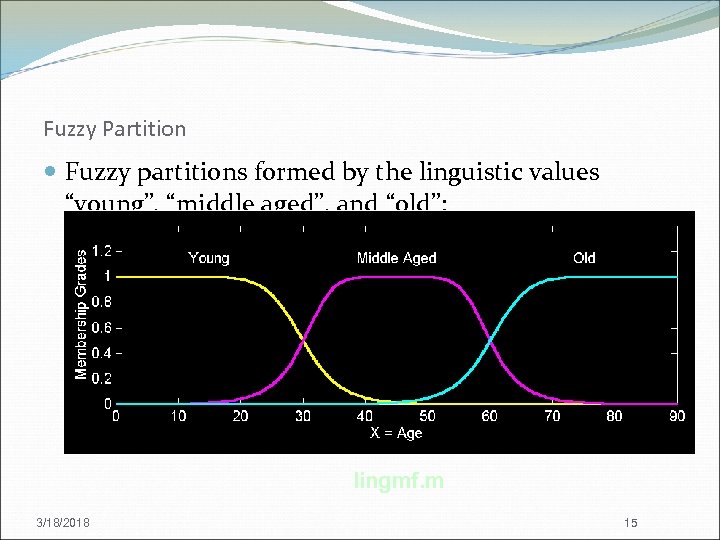
Fuzzy Partition Fuzzy partitions formed by the linguistic values “young”, “middle aged”, and “old”: lingmf. m 3/18/2018 15
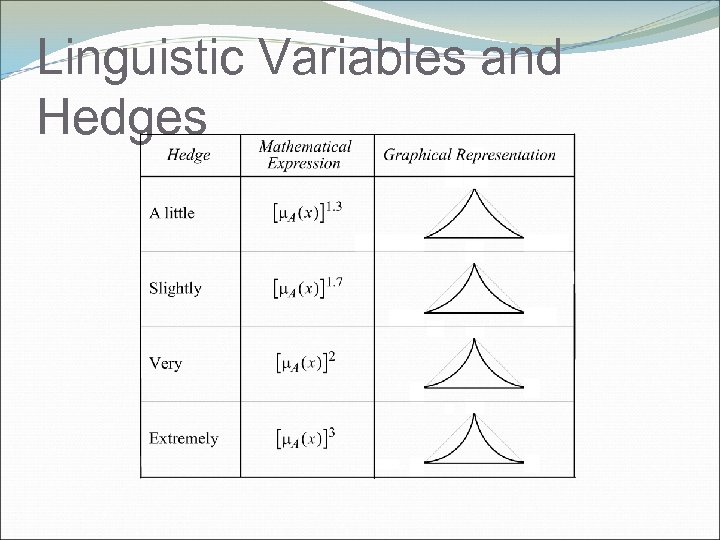
Linguistic Variables and Hedges The range of possible values of a linguistic variable represents the universe of discourse of that variable. For example, the universe of discourse of the linguistic variable speed might have the range between 0 and 220 km/h and may include such fuzzy subsets as very slow, medium, fast, and very fast. A linguistic variable carries with it the concept of fuzzy set qualifiers, called hedges. Hedges are terms that modify the shape of fuzzy sets. They include adverbs such as very, somewhat, quite, more or less and slightly.
Linguistic Variables and Hedges
Linguistic Variables and Hedges
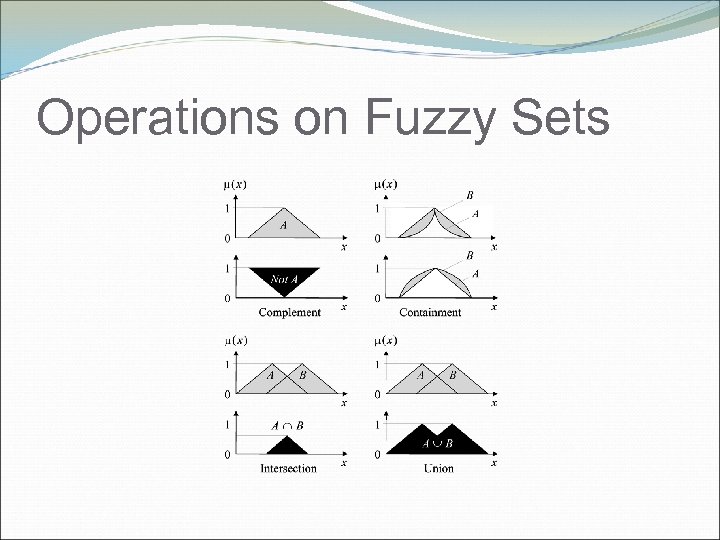
Operations on Fuzzy Sets
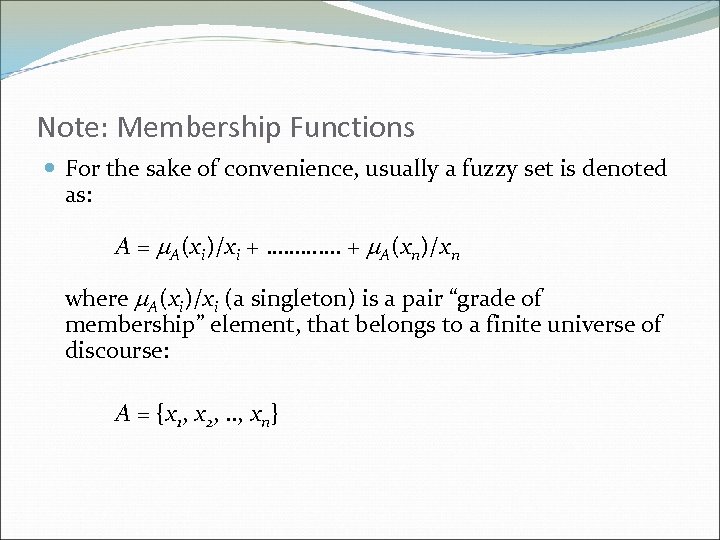
Note: Membership Functions For the sake of convenience, usually a fuzzy set is denoted as: A = A(xi)/xi + …………. + A(xn)/xn where A(xi)/xi (a singleton) is a pair “grade of membership” element, that belongs to a finite universe of discourse: A = {x 1, x 2, . . , xn}
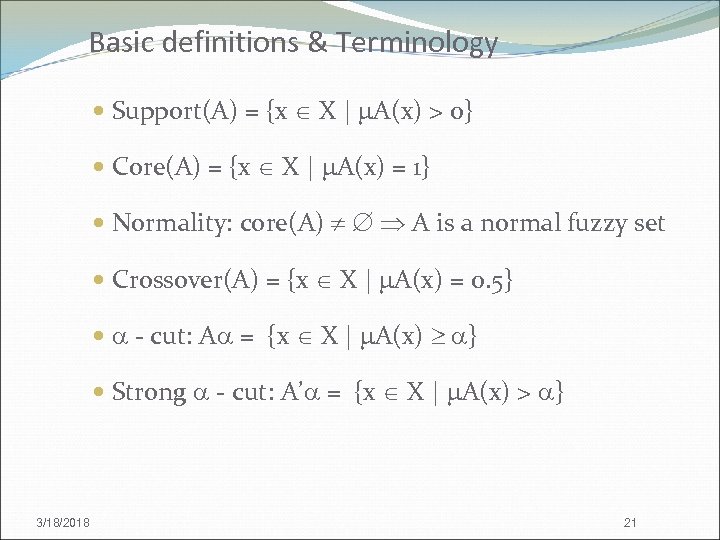
Basic definitions & Terminology Support(A) = {x X | A(x) > 0} Core(A) = {x X | A(x) = 1} Normality: core(A) A is a normal fuzzy set Crossover(A) = {x X | A(x) = 0. 5} - cut: A = {x X | A(x) } Strong - cut: A’ = {x X | A(x) > } 3/18/2018 21
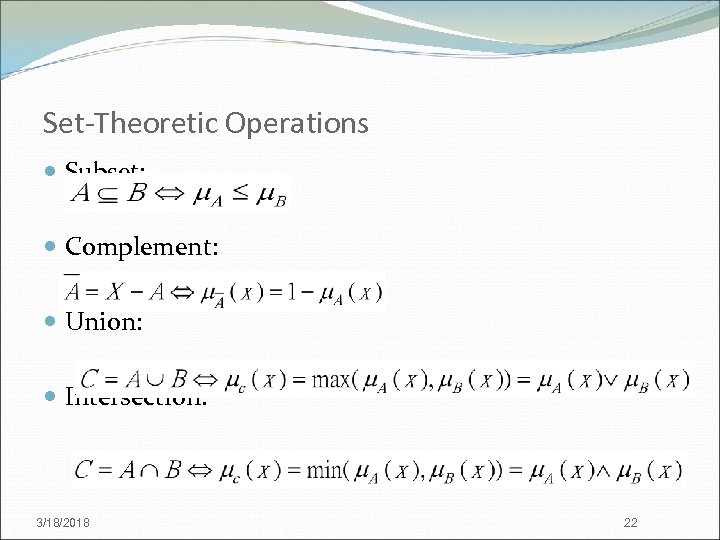
Set-Theoretic Operations Subset: Complement: Union: Intersection: 3/18/2018 22
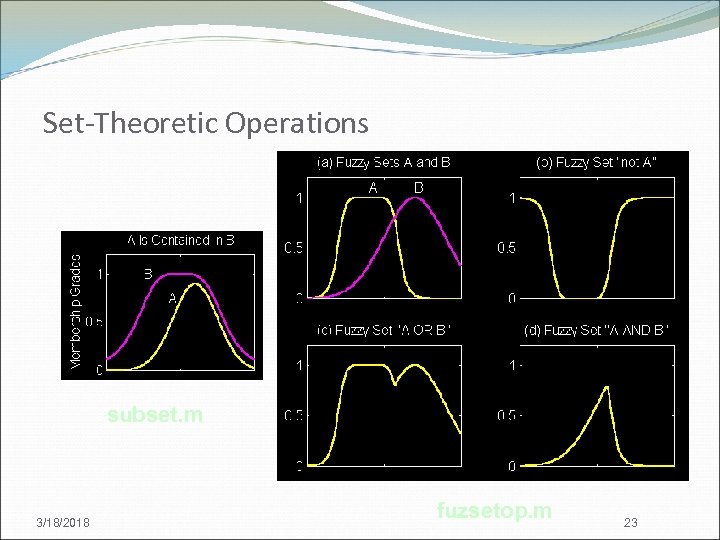
Set-Theoretic Operations subset. m 3/18/2018 fuzsetop. m 23
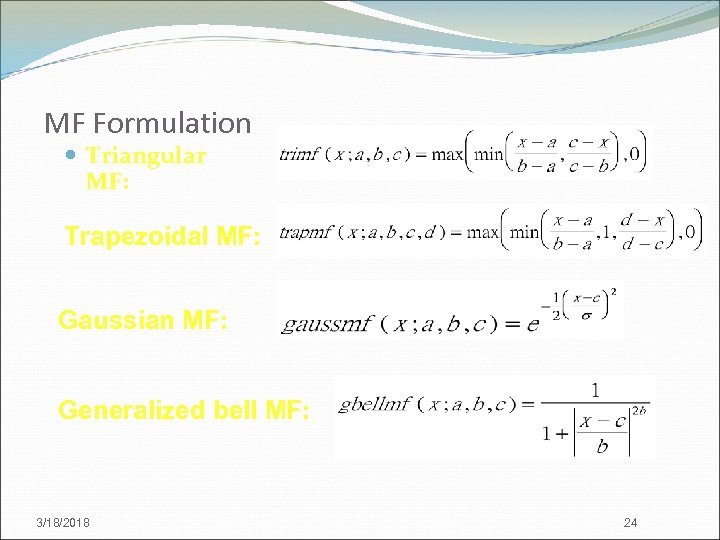
MF Formulation Triangular MF: Trapezoidal MF: Gaussian MF: Generalized bell MF: 3/18/2018 24
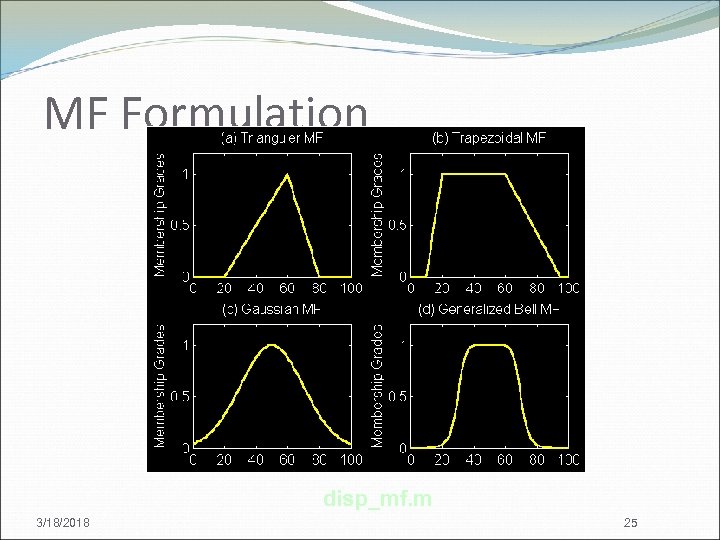
MF Formulation disp_mf. m 3/18/2018 25
Equality Fuzzy set A is considered equal to a fuzzy set B, IF AND ONLY IF (iff): A(x) = B(x), x X A = 0. 3/1 + 0. 5/2 + 1/3 B = 0. 3/1 + 0. 5/2 + 1/3 therefore A = B
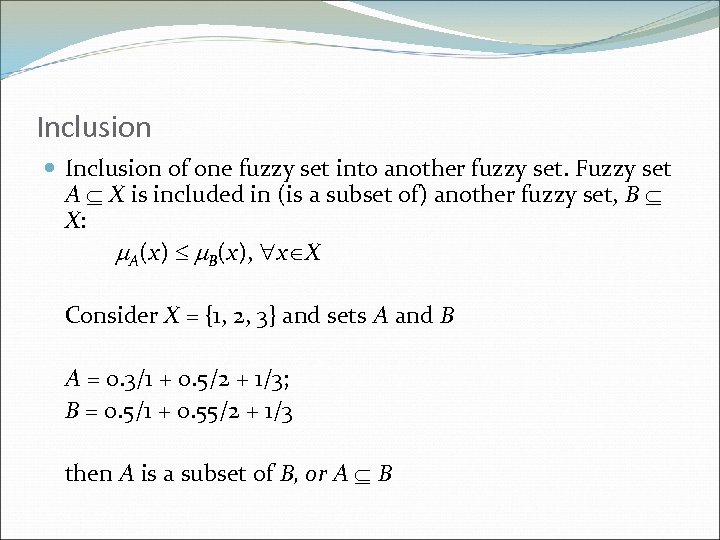
Inclusion of one fuzzy set into another fuzzy set. Fuzzy set A X is included in (is a subset of) another fuzzy set, B X: A(x) B(x), x X Consider X = {1, 2, 3} and sets A and B A = 0. 3/1 + 0. 5/2 + 1/3; B = 0. 5/1 + 0. 55/2 + 1/3 then A is a subset of B, or A B
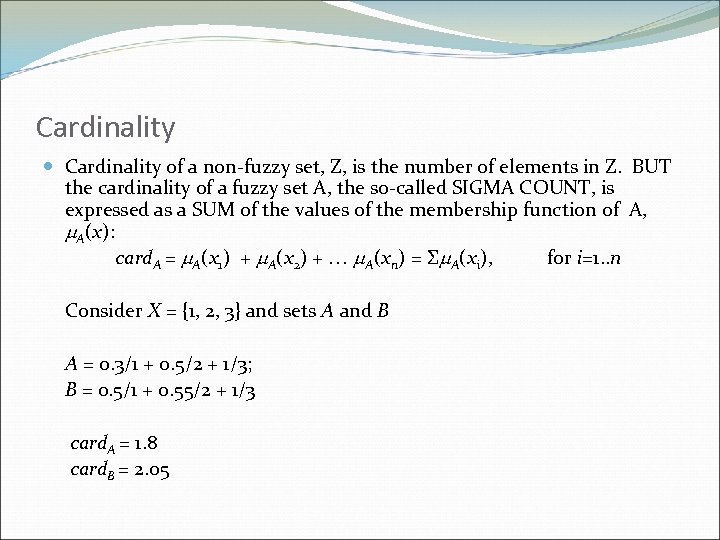
Cardinality of a non-fuzzy set, Z, is the number of elements in Z. BUT the cardinality of a fuzzy set A, the so-called SIGMA COUNT, is expressed as a SUM of the values of the membership function of A, A(x): card. A = A(x 1) + A(x 2) + … A(xn) = Σ A(xi), for i=1. . n Consider X = {1, 2, 3} and sets A and B A = 0. 3/1 + 0. 5/2 + 1/3; B = 0. 5/1 + 0. 55/2 + 1/3 card. A = 1. 8 card. B = 2. 05
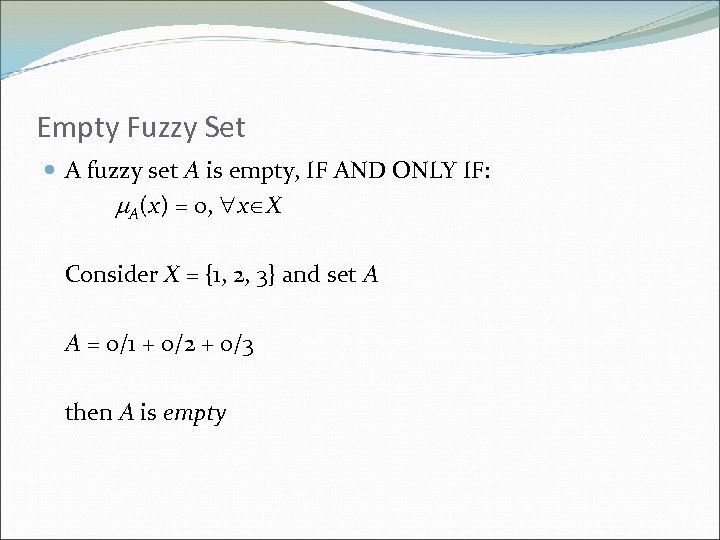
Empty Fuzzy Set A fuzzy set A is empty, IF AND ONLY IF: A(x) = 0, x X Consider X = {1, 2, 3} and set A A = 0/1 + 0/2 + 0/3 then A is empty
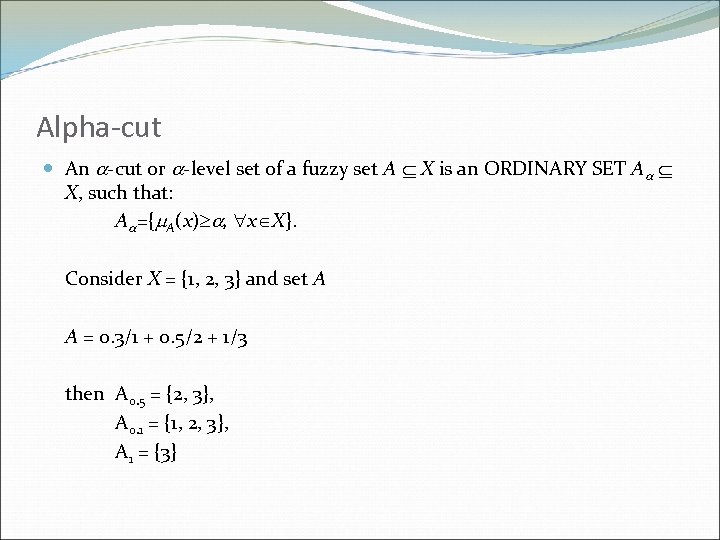
Alpha-cut An -cut or -level set of a fuzzy set A X is an ORDINARY SET A X, such that: A ={ A(x) , x X}. Consider X = {1, 2, 3} and set A A = 0. 3/1 + 0. 5/2 + 1/3 then A 0. 5 = {2, 3}, A 0. 1 = {1, 2, 3}, A 1 = {3}
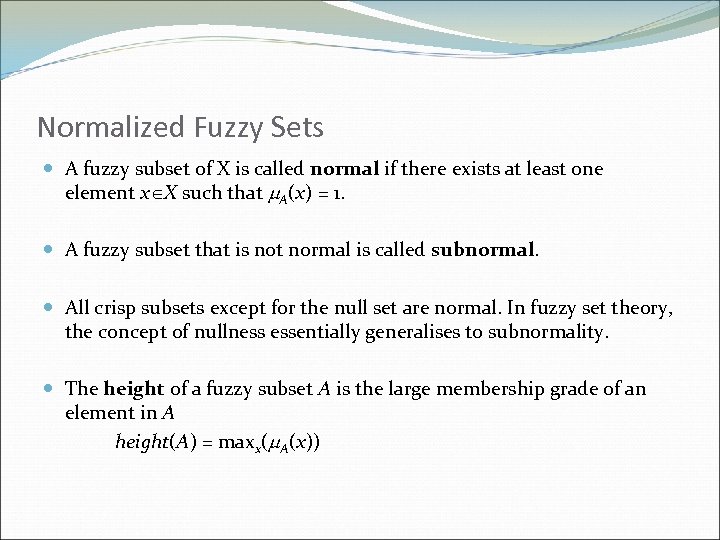
Normalized Fuzzy Sets A fuzzy subset of X is called normal if there exists at least one element x X such that A(x) = 1. A fuzzy subset that is not normal is called subnormal. All crisp subsets except for the null set are normal. In fuzzy set theory, the concept of nullness essentially generalises to subnormality. The height of a fuzzy subset A is the large membership grade of an element in A height(A) = maxx( A(x))
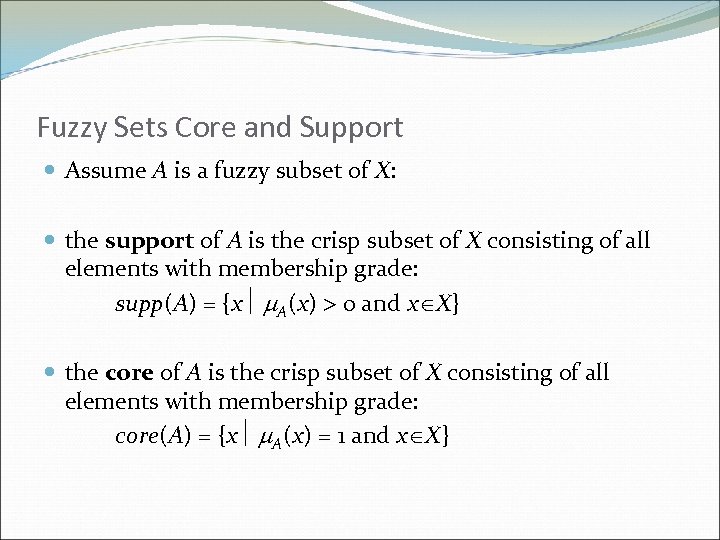
Fuzzy Sets Core and Support Assume A is a fuzzy subset of X: the support of A is the crisp subset of X consisting of all elements with membership grade: supp(A) = {x A(x) 0 and x X} the core of A is the crisp subset of X consisting of all elements with membership grade: core(A) = {x A(x) = 1 and x X}
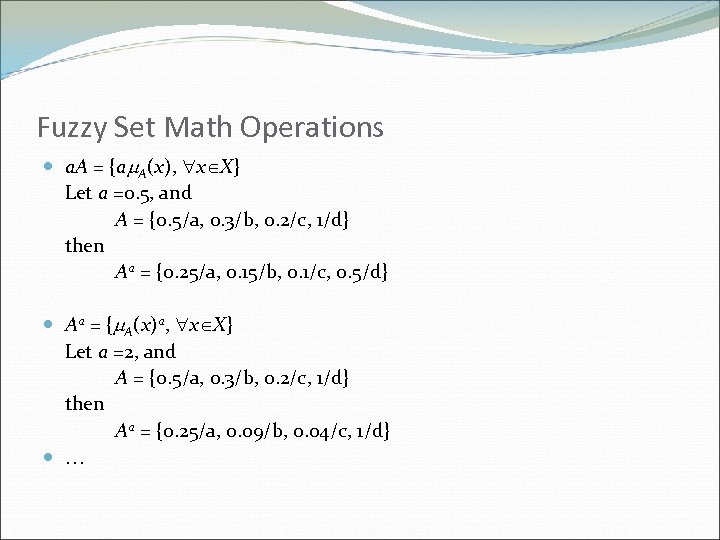
Fuzzy Set Math Operations a. A = {a A(x), x X} Let a =0. 5, and A = {0. 5/a, 0. 3/b, 0. 2/c, 1/d} then Aa = {0. 25/a, 0. 15/b, 0. 1/c, 0. 5/d} Aa = { A(x)a, x X} Let a =2, and A = {0. 5/a, 0. 3/b, 0. 2/c, 1/d} then Aa = {0. 25/a, 0. 09/b, 0. 04/c, 1/d} …
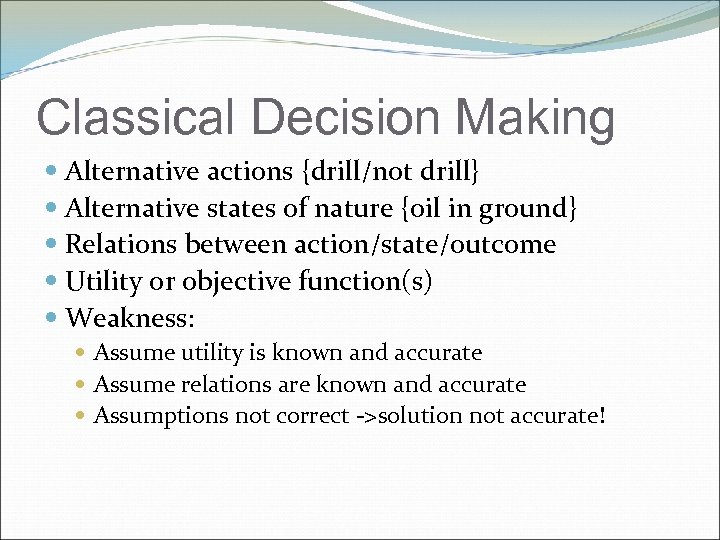
Classical Decision Making Alternative actions {drill/not drill} Alternative states of nature {oil in ground} Relations between action/state/outcome Utility or objective function(s) Weakness: Assume utility is known and accurate Assume relations are known and accurate Assumptions not correct ->solution not accurate!
Fuzzy Logic v. Simulating the process of human reasoning v framework to computing with words and perception, using linguistics variables. v Deals with uncertainties v Dreative decision-making process 35
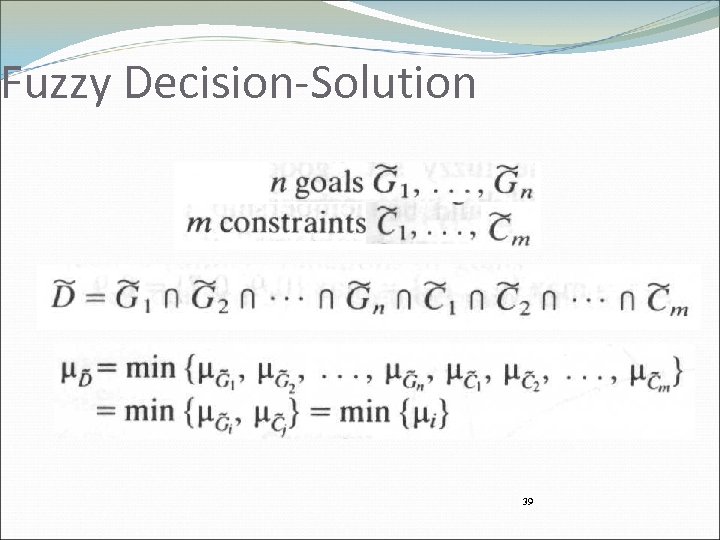
Fuzzy Decision Making A model for decision making in a fuzzy environment. Object function and constraints are characterized as their membership functions. The intersection of fuzzy constraints and fuzzy objection function. 36
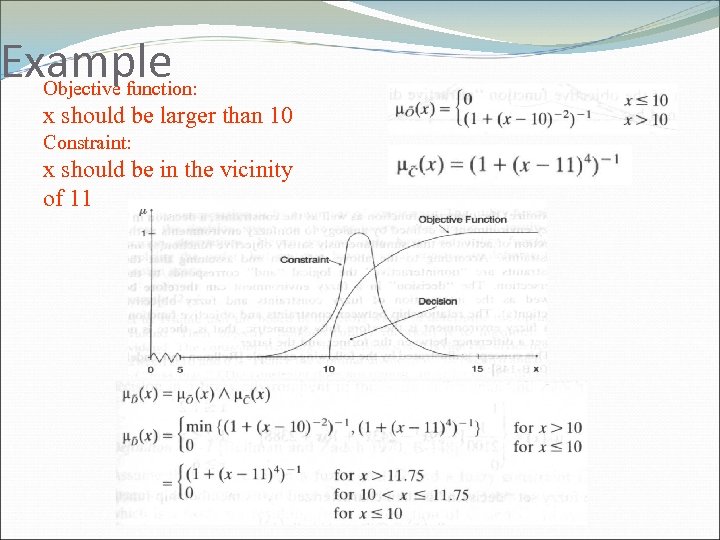
Example Objective function: x should be larger than 10 Constraint: x should be in the vicinity of 11 37
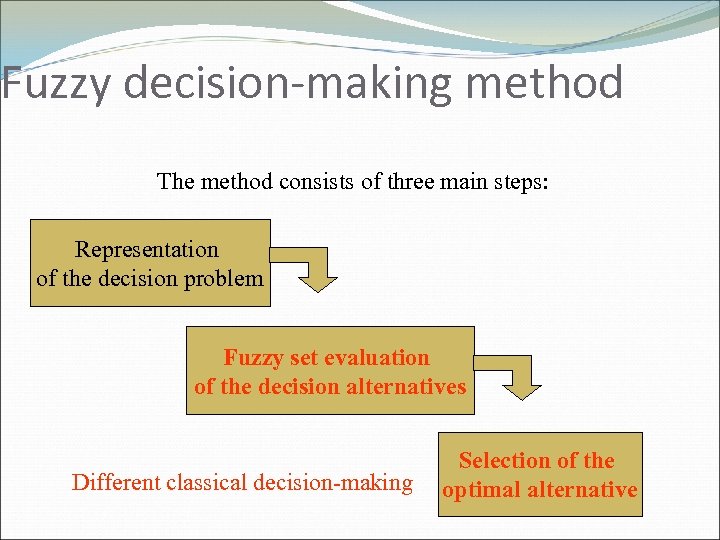
Fuzzy decision-making method The method consists of three main steps: Representation of the decision problem Fuzzy set evaluation of the decision alternatives Different classical decision-making Selection of the optimal 38 alternative
Fuzzy Decision-Solution 39

Example-Job Selection Choose one of four alternative job offers {a 1, a 2, a 3, a 4} Following criteria High Salary (G 1) Interesting Job (C 1/G 2) Close driving time (C 2) Salaries in Eu {40 k, 45 k, 50 k, 60 k} Time in minutes {42, 18, 4}
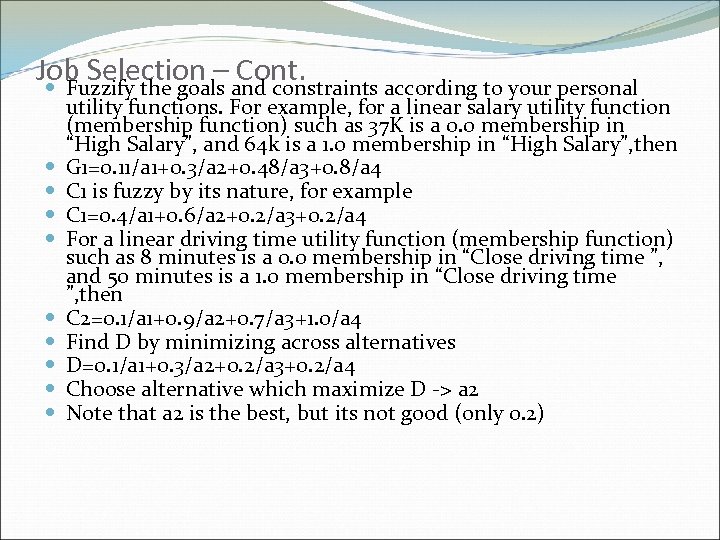
Job Selection – and constraints according to your personal Cont. Fuzzify the goals utility functions. For example, for a linear salary utility function (membership function) such as 37 K is a 0. 0 membership in “High Salary”, and 64 k is a 1. 0 membership in “High Salary”, then G 1=0. 11/a 1+0. 3/a 2+0. 48/a 3+0. 8/a 4 C 1 is fuzzy by its nature, for example C 1=0. 4/a 1+0. 6/a 2+0. 2/a 3+0. 2/a 4 For a linear driving time utility function (membership function) such as 8 minutes is a 0. 0 membership in “Close driving time ”, and 50 minutes is a 1. 0 membership in “Close driving time ”, then C 2=0. 1/a 1+0. 9/a 2+0. 7/a 3+1. 0/a 4 Find D by minimizing across alternatives D=0. 1/a 1+0. 3/a 2+0. 2/a 3+0. 2/a 4 Choose alternative which maximize D -> a 2 Note that a 2 is the best, but its not good (only 0. 2)
MULTIOBJECTIVE DECISION MAKING Most simple decision processes are based on a single objective, such as minimizing cost, maximizing profit, minimizing run time, and so forth. Often, however, decisions must be made in an environment where more than one objective function governs constraints on the problem, and the relative value of each of these objectives is different. For example, we are designing a new computer, and we want simultaneously to minimize the cost, maximize CPU, maximize Random Access Memory (RAM), and maximize reliability. 42
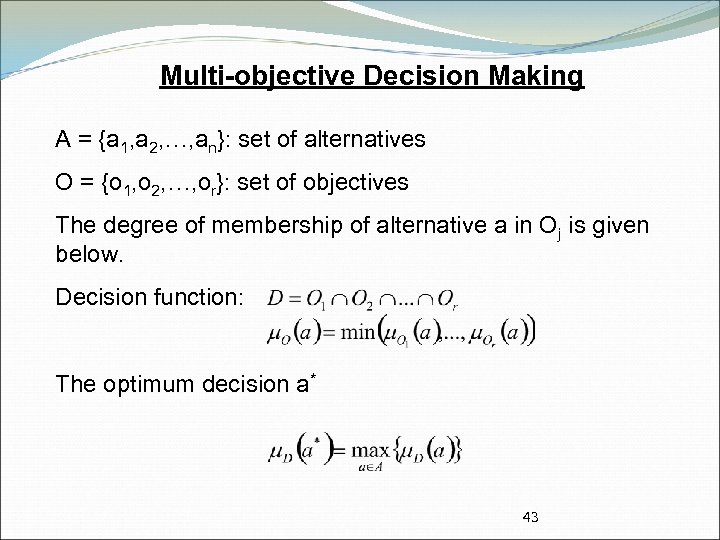
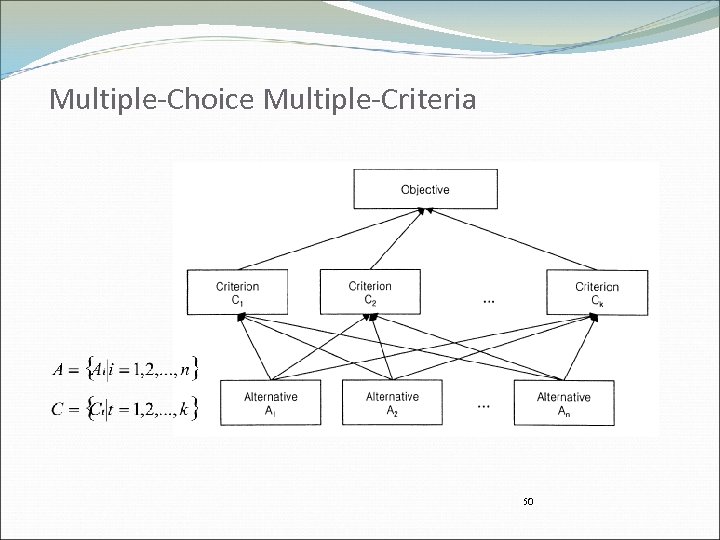
Multi-objective Decision Making A = {a 1, a 2, …, an}: set of alternatives O = {o 1, o 2, …, or}: set of objectives The degree of membership of alternative a in Oj is given below. Decision function: The optimum decision a* 43
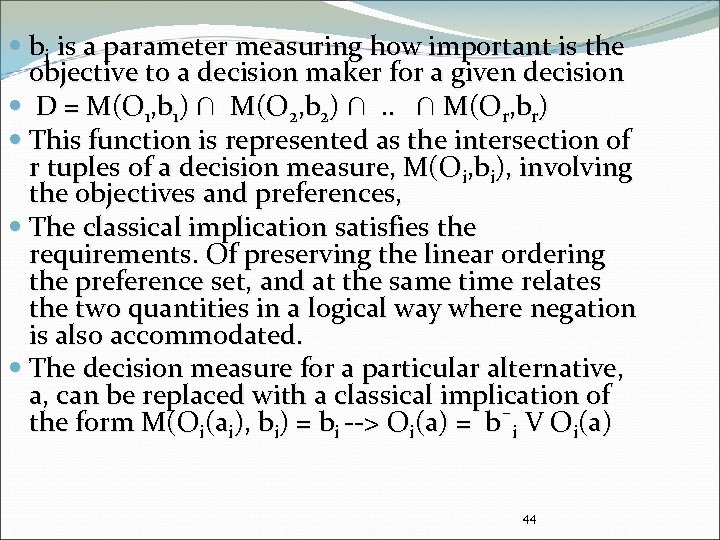
bi is a parameter measuring how important is the objective to a decision maker for a given decision D = M(O 1, b 1) ∩ M(O 2, b 2) ∩. . ∩ M(Or, br) This function is represented as the intersection of r tuples of a decision measure, M(Oi, bi), involving the objectives and preferences, The classical implication satisfies the requirements. Of preserving the linear ordering the preference set, and at the same time relates the two quantities in a logical way where negation is also accommodated. The decision measure for a particular alternative, a, can be replaced with a classical implication of the form M(Oi(ai), bi) = bi --> Oi(a) = b¯i V Oi(a) 44
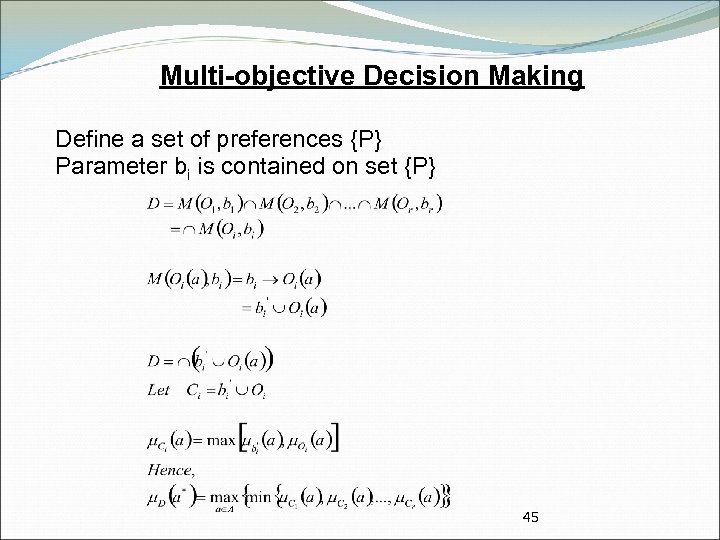
Multi-objective Decision Making Define a set of preferences {P} Parameter bi is contained on set {P} 45

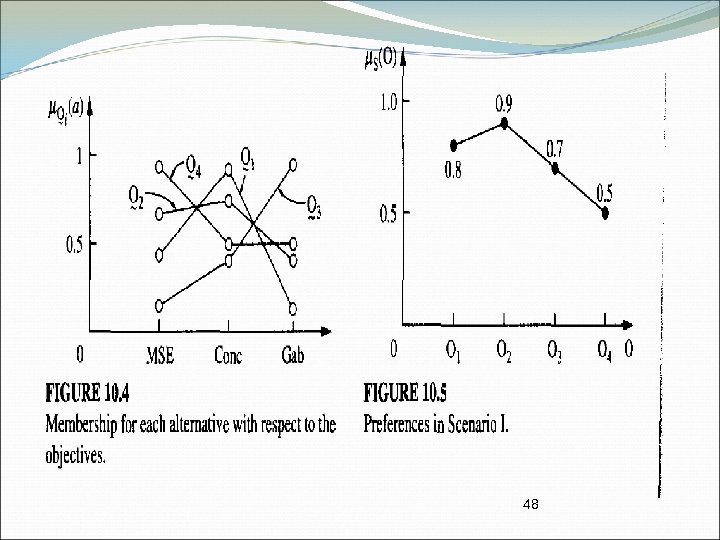
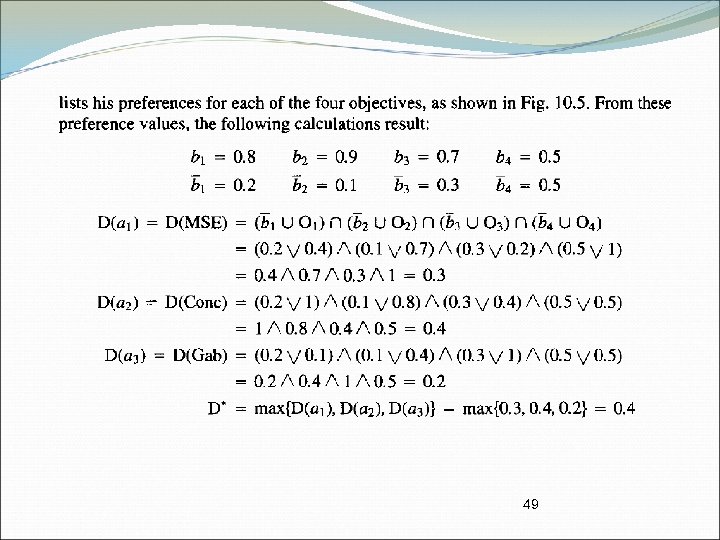
EXAMPLE – Multi-Objective Decision A construction engineer on a construction project must retain the mass of soil form sliding into a building site. Alternatives : MSE - mechanically stabilized embankment Conc - a mass concrete spread wall Gab -a gabion wall Four objectives that impact his decision: Cost C Maintainability M Standard S Environment E A = { MSE, Conc, Gab} = {a 1, a 2, a 3} O = {C, M, S, E} = {O 1, O 2, O 3, O 4} P = {b 1, b 2, b 3, b 4} [0, 1] 46
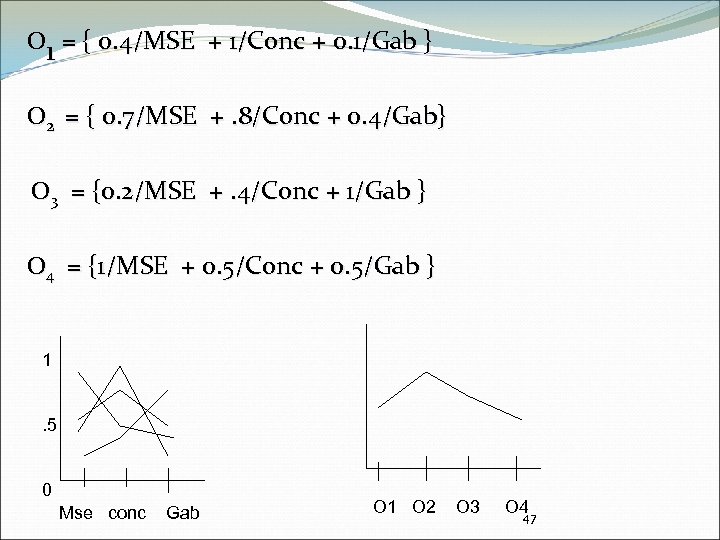
O 1 = { 0. 4/MSE + 1/Conc + 0. 1/Gab } O 2 = { 0. 7/MSE +. 8/Conc + 0. 4/Gab} O 3 = {0. 2/MSE +. 4/Conc + 1/Gab } O 4 = {1/MSE + 0. 5/Conc + 0. 5/Gab } 1. 5 0 Mse conc Gab O 1 O 2 O 3 O 4 47
48
49
Multiple-Choice Multiple-Criteria 50
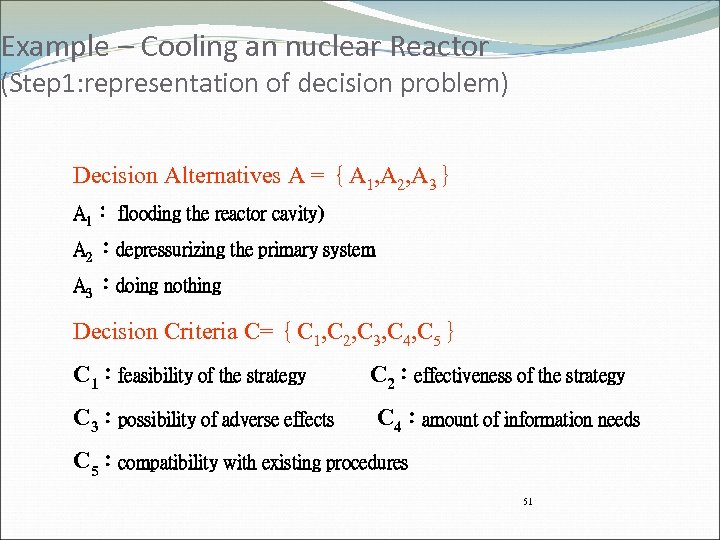
Example – Cooling an nuclear Reactor (Step 1: representation of decision problem) Decision Alternatives A ={A 1, A 2, A 3} A 1: flooding the reactor cavity) A 2 :depressurizing the primary system A 3 :doing nothing Decision Criteria C={C 1, C 2, C 3, C 4, C 5} C 1:feasibility of the strategy C 3:possibility of adverse effects C 2:effectiveness of the strategy C 4:amount of information needs C 5:compatibility with existing procedures 51
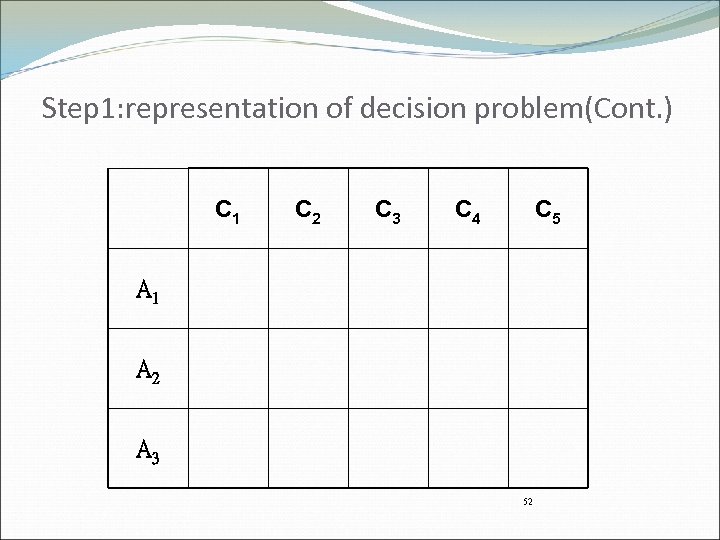
Step 1: representation of decision problem(Cont. ) C 1 C 2 C 3 C 4 C 5 A 1 A 2 A 3 52
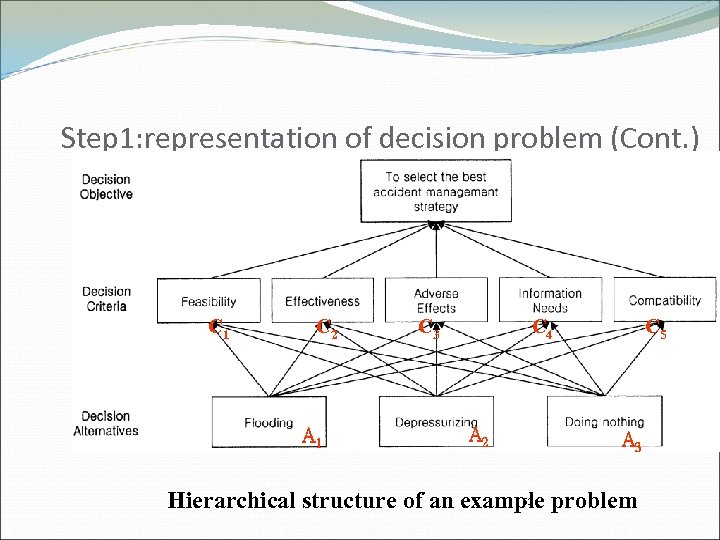
Step 1: representation of decision problem (Cont. ) C 1 C 2 A 1 C 3 C 4 A 2 C 5 A 3 53 Hierarchical structure of an example problem
Fuzzy set evaluation of decision alternatives The step consist of three activities (1) Choosing sets of the preference ratings for the importance weights of the decision Preference ratings include Linguistic variable and triangular fuzzy number Example:The preference ratings for the importance weights of the decision criteria can be defined as follows: T importance={very low, medium, high, very high} 54
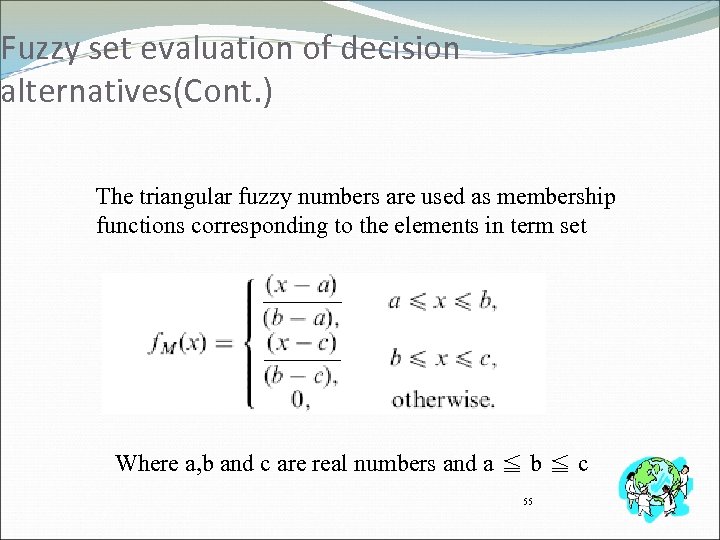
Fuzzy set evaluation of decision alternatives(Cont. ) The triangular fuzzy numbers are used as membership functions corresponding to the elements in term set Where a, b and c are real numbers and a ≦ b ≦ c 55
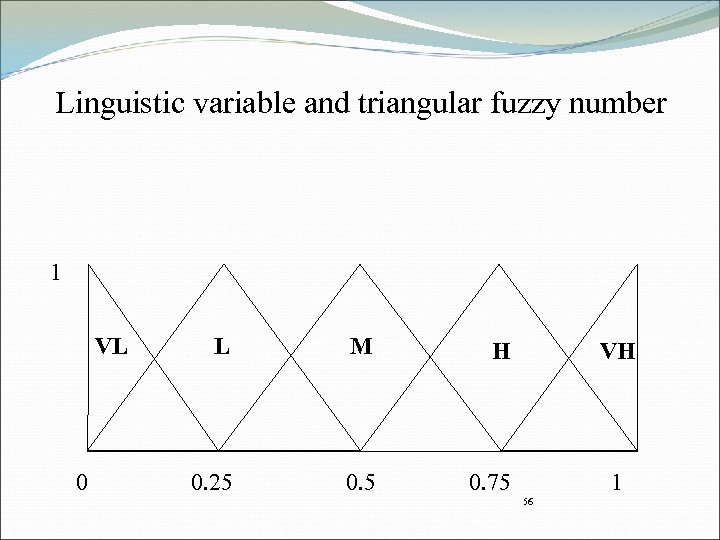
Linguistic variable and triangular fuzzy number 1 VL 0 L M H 0. 25 0. 75 VH 1 56
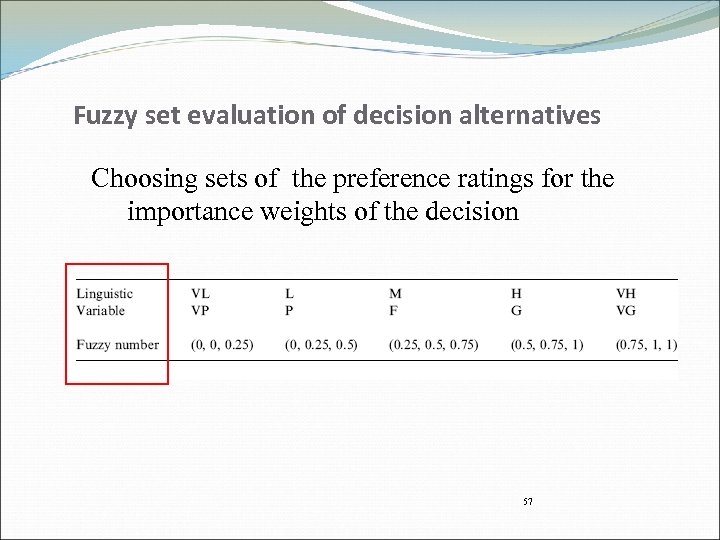
Fuzzy set evaluation of decision alternatives Choosing sets of the preference ratings for the importance weights of the decision 57
Fuzzy set evaluation of decision alternatives(Cont. ) (2) Evaluating the importance weights of the criteria and the degrees of appropriateness of the decision alternatives (3) Aggregating the weights of the decision criteria 58
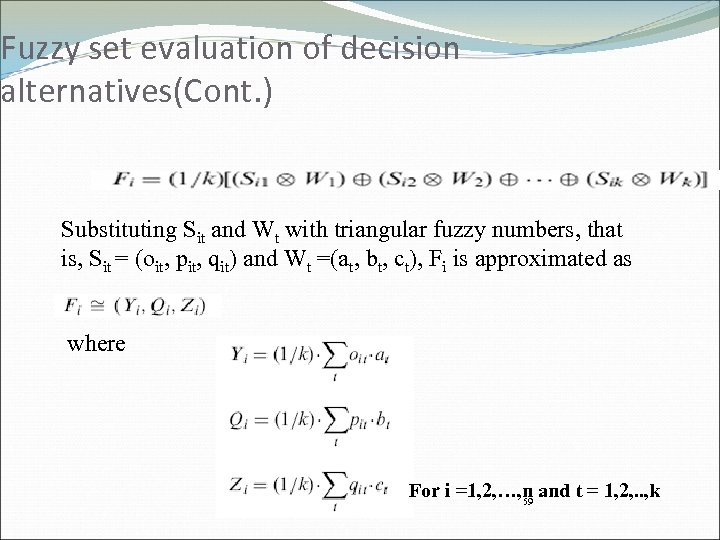
Fuzzy set evaluation of decision alternatives(Cont. ) Substituting Sit and Wt with triangular fuzzy numbers, that is, Sit = (oit, pit, qit) and Wt =(at, bt, ct), Fi is approximated as where For i =1, 2, …, n and t = 1, 2, . . , k 59
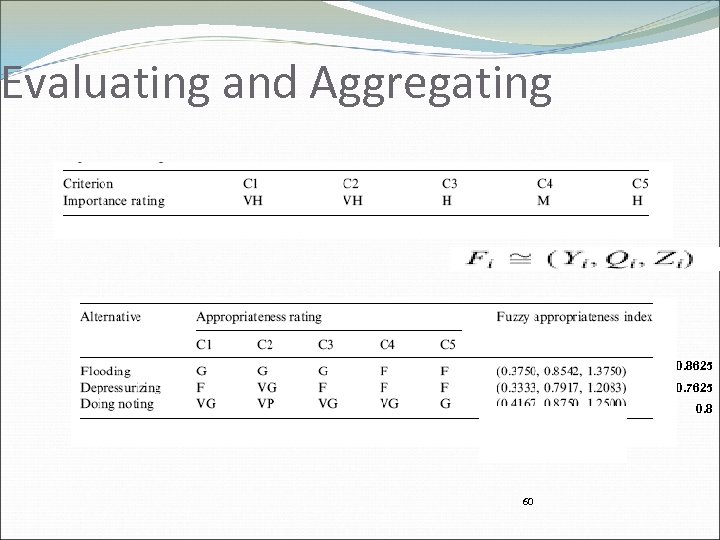
Evaluating and Aggregating 0. 2375 0. 8625 0. 2125 0. 7625 0. 275 60 0. 5375 0. 5625 0. 8
Selection of the optimal alternative This step includes two activities Prioritization of the decision alternatives using the aggregated assessments Choice of the decision alternative with highest priority as the optimal 61
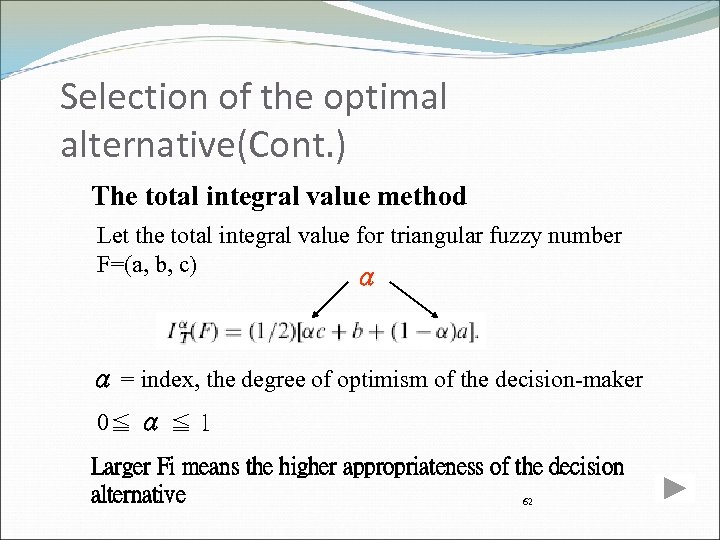
Selection of the optimal alternative(Cont. ) The total integral value method Let the total integral value for triangular fuzzy number F=(a, b, c) α α = index, the degree of optimism of the decision-maker 0≦ α ≦ 1 Larger Fi means the higher appropriateness of the decision alternative 62
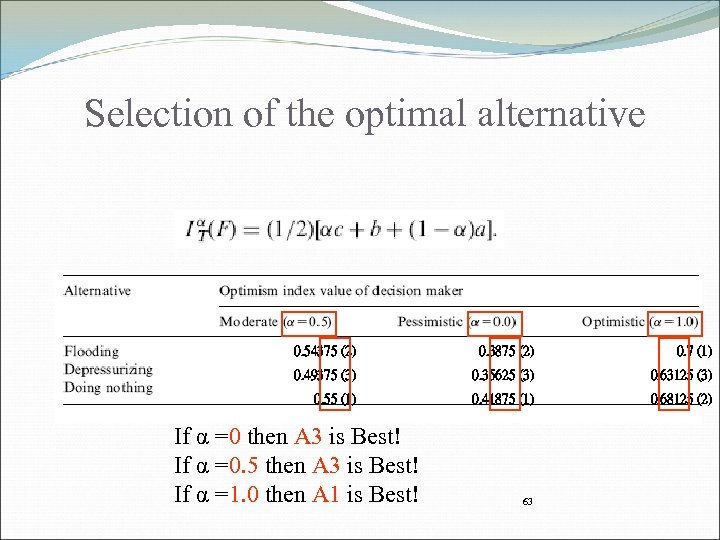
Selection of the optimal alternative 0. 54375 (2) 0. 3875 (2) 0. 7 (1) 0. 49375 (3) 0. 35625 (3) 0. 63125 (3) 0. 55 (1) 0. 41875 (1) 0. 68125 (2) If α =0 then A 3 is Best! If α =0. 5 then A 3 is Best! If α =1. 0 then A 1 is Best! 63
64
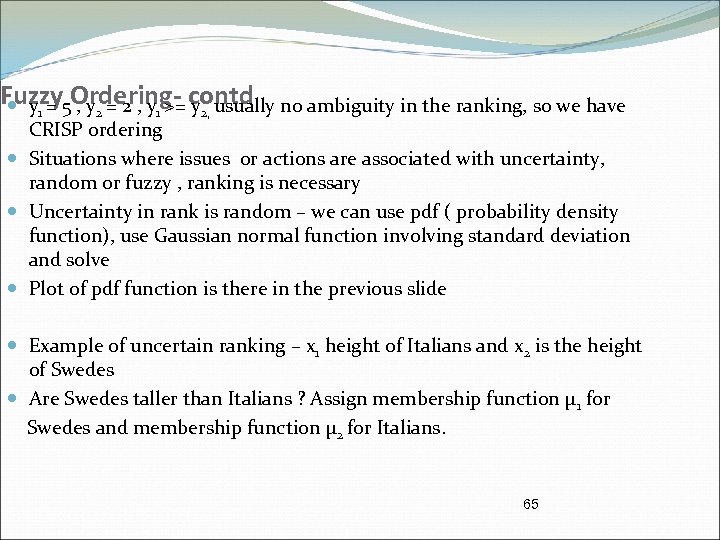
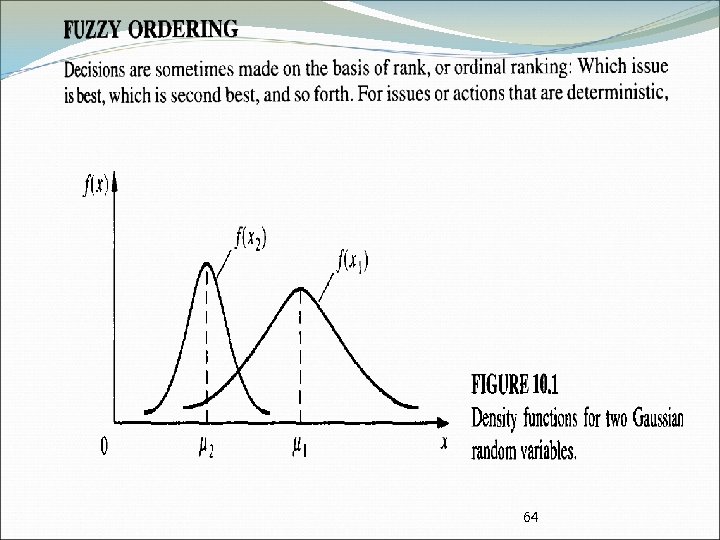
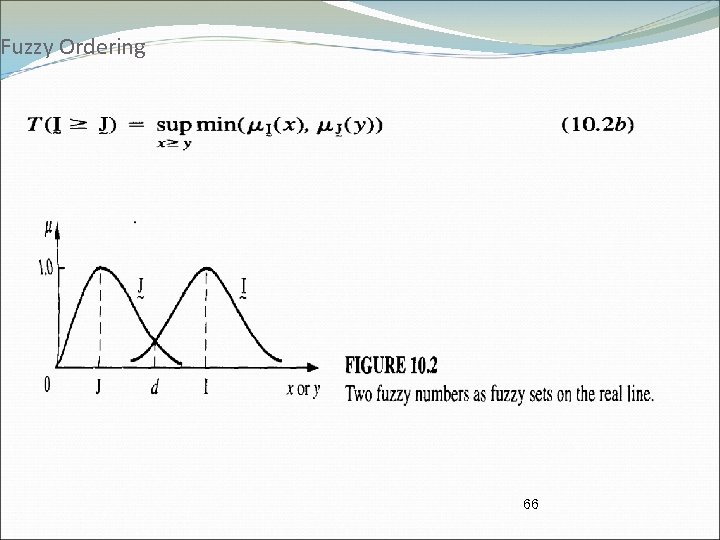
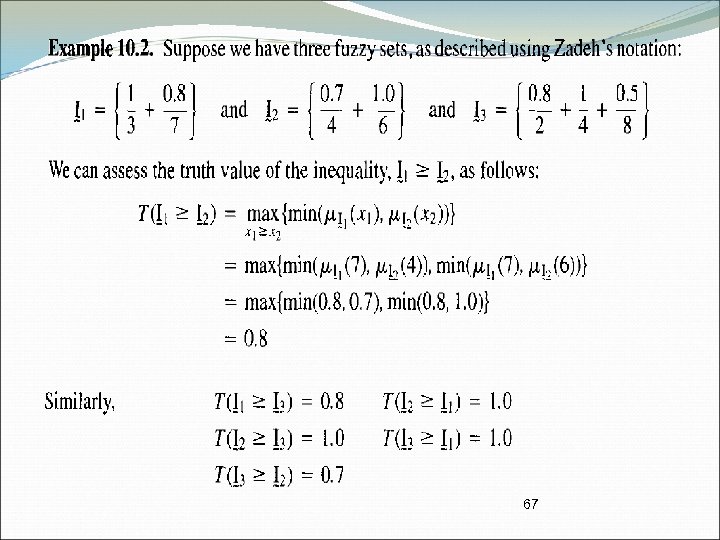
Fuzzy 5 Ordering- contd no ambiguity in the ranking, so we have y 1 = , y 2 = 2 , y 1 >= y 2, usually CRISP ordering Situations where issues or actions are associated with uncertainty, random or fuzzy , ranking is necessary Uncertainty in rank is random – we can use pdf ( probability density function), use Gaussian normal function involving standard deviation and solve Plot of pdf function is there in the previous slide Example of uncertain ranking – x 1 height of Italians and x 2 is the height of Swedes Are Swedes taller than Italians ? Assign membership function µ 1 for Swedes and membership function µ 2 for Italians. 65
Fuzzy Ordering 66
67
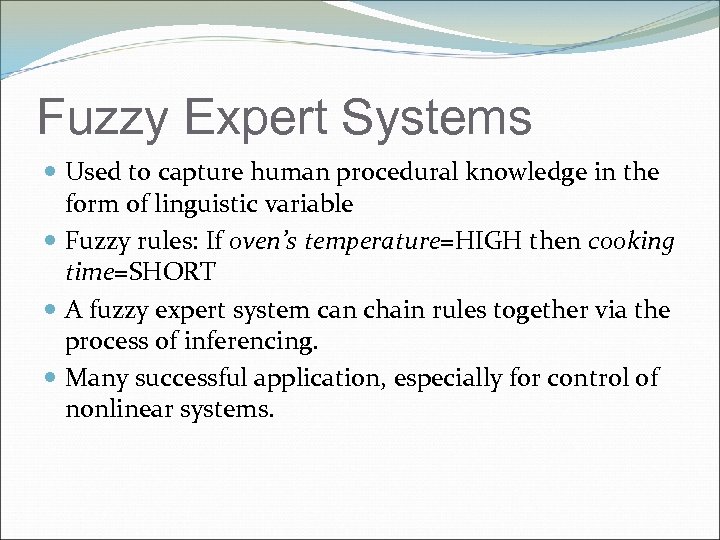
Fuzzy Expert Systems Used to capture human procedural knowledge in the form of linguistic variable Fuzzy rules: If oven’s temperature=HIGH then cooking time=SHORT A fuzzy expert system can chain rules together via the process of inferencing. Many successful application, especially for control of nonlinear systems.
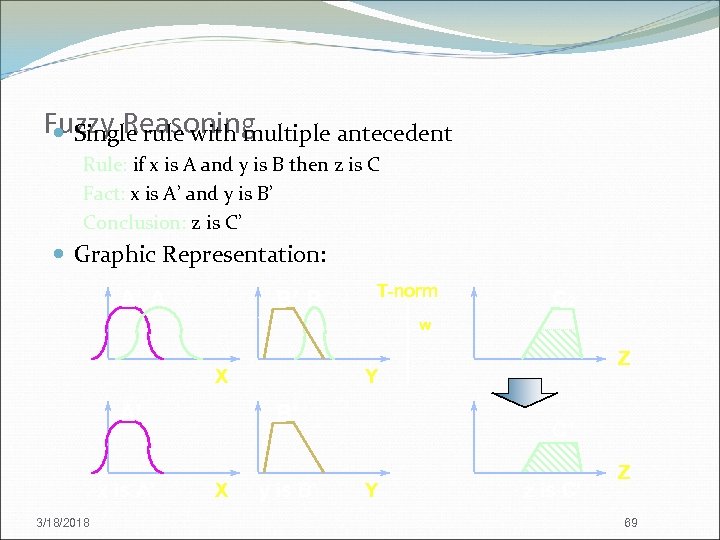
Fuzzy Reasoning Single rule with multiple antecedent Rule: if x is A and y is B then z is C Fact: x is A’ and y is B’ Conclusion: z is C’ Graphic Representation: A’ A B’ B T-norm C 2 w X A’ x is A’ 3/18/2018 Y B’ X Z y is B’ C’ Y z is C’ Z 69
Скачать презентацию Decision Making with Fuzzy Logic Armin Shmilovici Ben-Gurion
2a99117775fea150903df88b30adab2f.ppt