


 Скачать презентацию Decision-making process and the CAP in the EU
17407670381382a2cd54117d7a290c5e.ppt
- Количество слайдов: 30
 Decision-making process and the CAP in the EU - Experiences of Hungary Szent István University 22, June Dr. Laszlo Benedek Flamm Head of EU Coordination Unit Ministry of Rural Development, Hungary 1
 Decision-making process and the CAP in the EU - Experiences of Hungary n n n n Basic data on Hungarian agriculture Political framework of EU institutions and the CAP About the CAP Adopting the CAP in Hungary Main players, Decision-making process and the CAP Experiences, practises Conclusion/messages 2
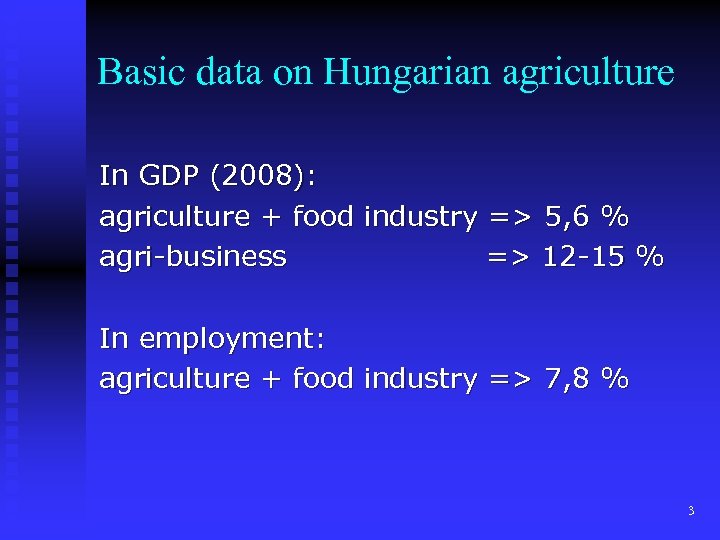 Basic data on Hungarian agriculture In GDP (2008): agriculture + food industry => 5, 6 % agri-business => 12 -15 % In employment: agriculture + food industry => 7, 8 % 3
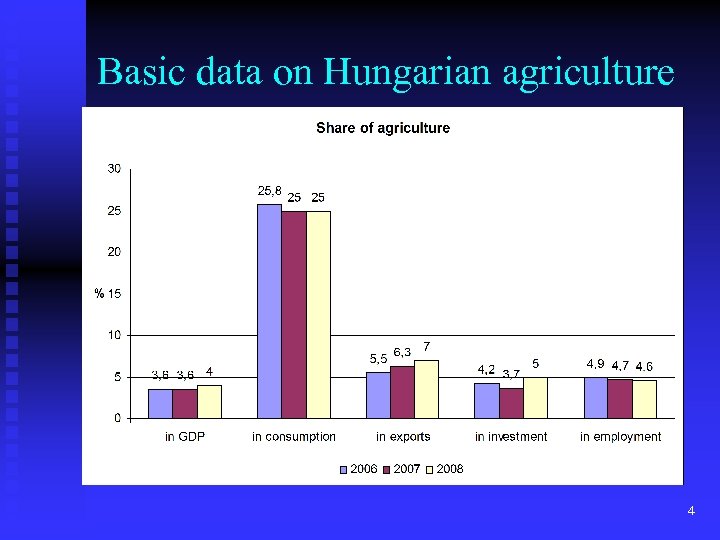 Basic data on Hungarian agriculture 4
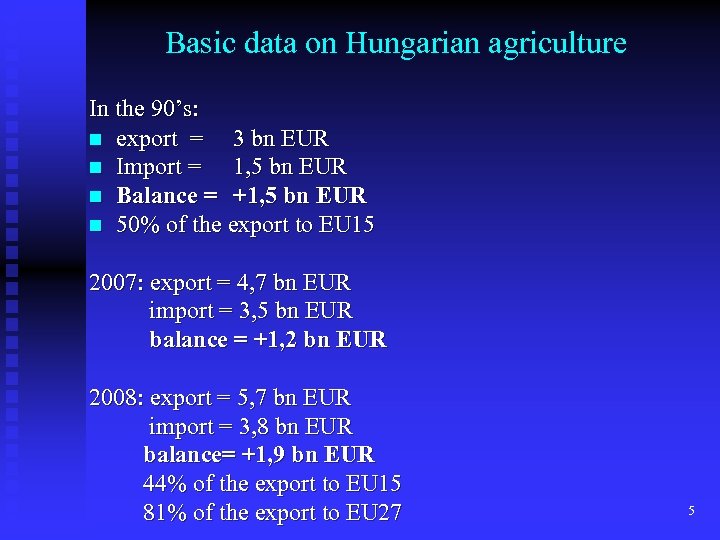 Basic data on Hungarian agriculture In the 90’s: n export = 3 bn EUR n Import = 1, 5 bn EUR n Balance = +1, 5 bn EUR n 50% of the export to EU 15 2007: export = 4, 7 bn EUR import = 3, 5 bn EUR balance = +1, 2 bn EUR 2008: export = 5, 7 bn EUR import = 3, 8 bn EUR balance= +1, 9 bn EUR 44% of the export to EU 15 81% of the export to EU 27 5
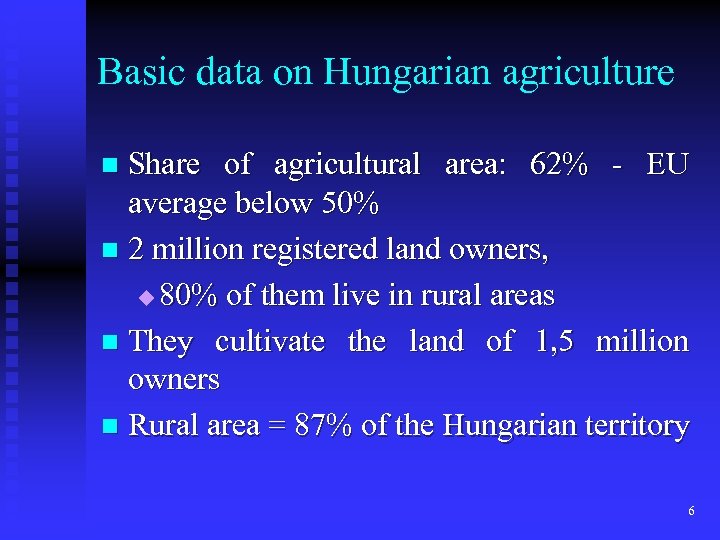 Basic data on Hungarian agriculture Share of agricultural area: 62% - EU average below 50% n 2 million registered land owners, u 80% of them live in rural areas n They cultivate the land of 1, 5 million owners n Rural area = 87% of the Hungarian territory n 6
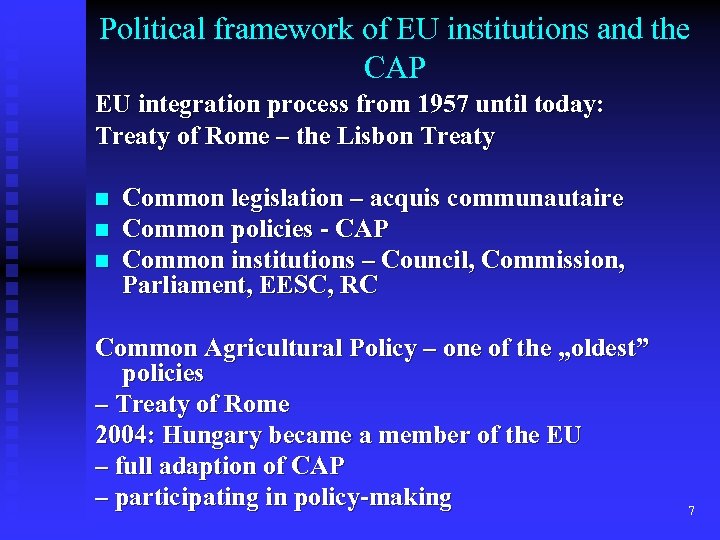 Political framework of EU institutions and the CAP EU integration process from 1957 until today: Treaty of Rome – the Lisbon Treaty n n n Common legislation – acquis communautaire Common policies - CAP Common institutions – Council, Commission, Parliament, EESC, RC Common Agricultural Policy – one of the „oldest” policies – Treaty of Rome 2004: Hungary became a member of the EU – full adaption of CAP – participating in policy-making 7
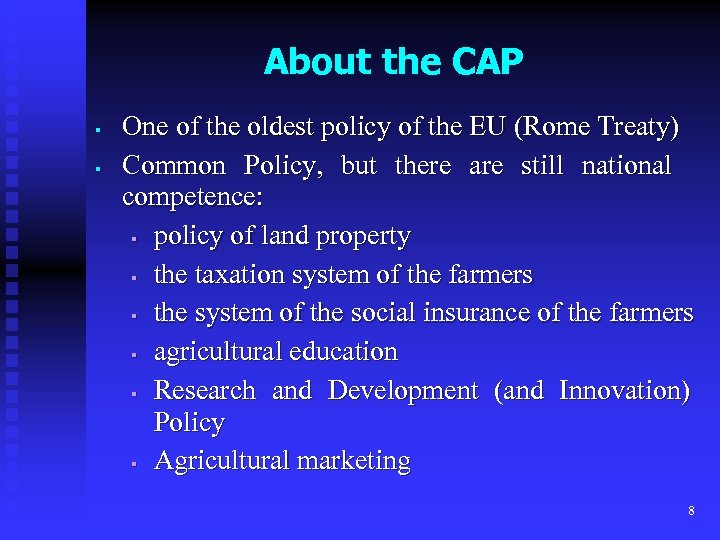 About the CAP § § One of the oldest policy of the EU (Rome Treaty) Common Policy, but there are still national competence: § policy of land property § the taxation system of the farmers § the system of the social insurance of the farmers § agricultural education § Research and Development (and Innovation) Policy § Agricultural marketing 8
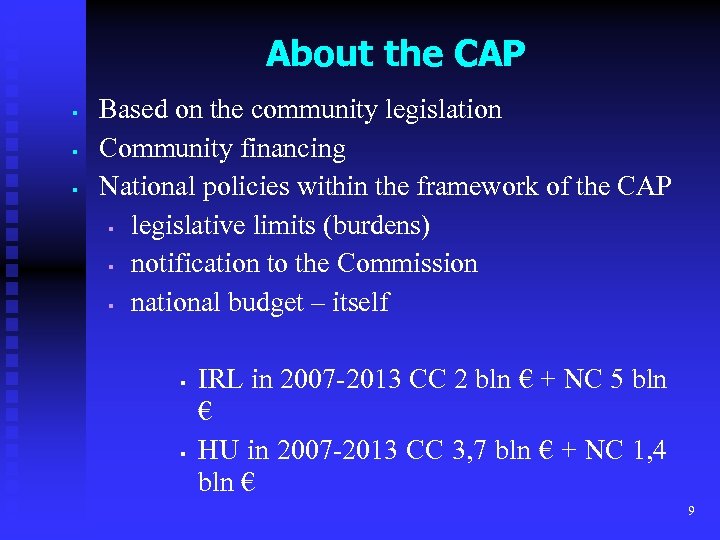 About the CAP § § § Based on the community legislation Community financing National policies within the framework of the CAP § legislative limits (burdens) § notification to the Commission § national budget – itself § § IRL in 2007 -2013 CC 2 bln € + NC 5 bln € HU in 2007 -2013 CC 3, 7 bln € + NC 1, 4 bln € 9
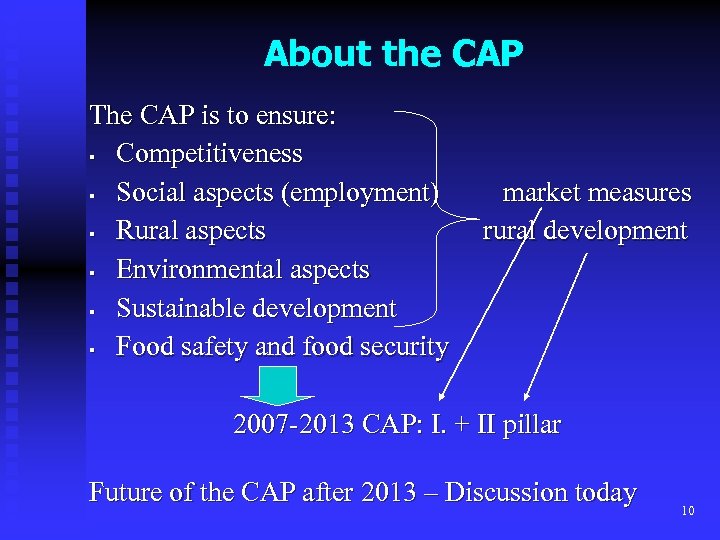 About the CAP The CAP is to ensure: § Competitiveness § Social aspects (employment) § Rural aspects § Environmental aspects § Sustainable development § Food safety and food security market measures rural development 2007 -2013 CAP: I. + II pillar Future of the CAP after 2013 – Discussion today 10
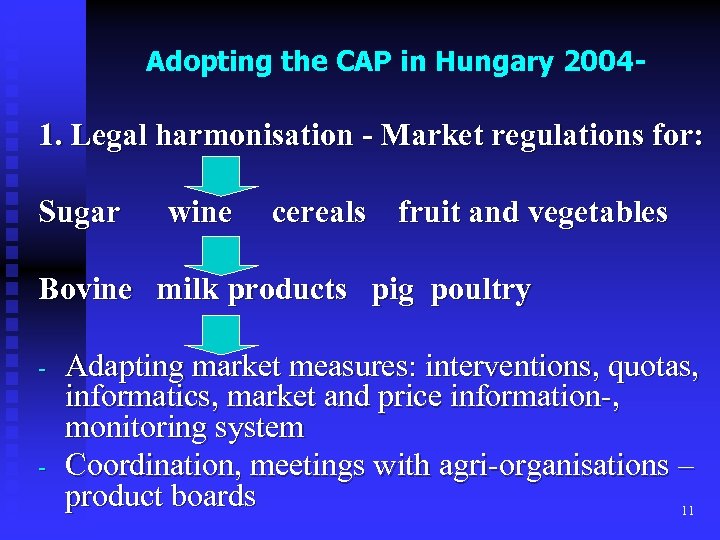 Adopting the CAP in Hungary 2004 - 1. Legal harmonisation - Market regulations for: Sugar wine cereals fruit and vegetables Bovine milk products pig poultry - - Adapting market measures: interventions, quotas, informatics, market and price information-, monitoring system Coordination, meetings with agri-organisations – product boards 11
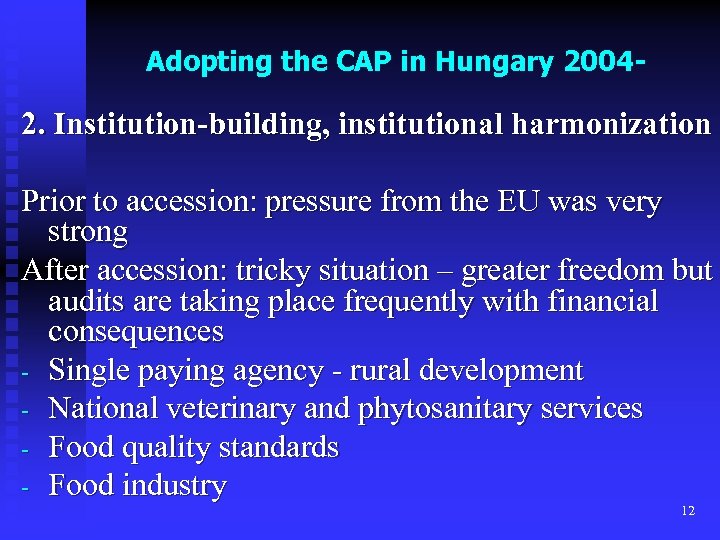 Adopting the CAP in Hungary 2004 - 2. Institution-building, institutional harmonization Prior to accession: pressure from the EU was very strong After accession: tricky situation – greater freedom but audits are taking place frequently with financial consequences - Single paying agency - rural development - National veterinary and phytosanitary services - Food quality standards - Food industry 12
 Adopting the CAP in Hungary 20042. Institution-building, institutional harmonization - Land administration and registry system – county, local-level land offices Extension service – farm advisory services Agri-environment Investments in infrastructure, informatics: establishing data-, statistics-, integrated information system, purchase of technical equipments, setting up laboratories 13
 Adopting the CAP in Hungary 2004 - 2. Institution-building n Single paying agency – a real challenge – spending EU money in the Member State ARDA: Agricultural and Rural Development Agency –from 1998 SAPARD Agency – from 2000 Agricultural and Rural Development Agency – 2003 n Since 2006: unified Agricultural Administrative Office (all authorities and services together, except land registration) 14
 Adopting the CAP in Hungary 20043. Human reseourch management n 1996 -1997: Selection of experts for the negotiations Mainly young people with language skills, EU-studies at Hungarian universities, study trips to Brussels n Training for everybody but specially - for experts in Brussels – agricultural group at the Hungarian permanent representation, - for experts in Hungarian authorities supervised by the Ministry e. g. paying agency, animal health and food safety authorities, land offices 15
 Adopting the CAP in Hungary 20043. Human reseourch management Training experts in: - - Working with EU regulations in practise e. g. management of supports - direct payments, handling incoming applications, using market measures, information and price monitoring, Coordination with EU-institutions, Communication with EU institutions 16
 Adopting the CAP in Hungary 2004§ § § § Moving targets High supports Intervention EU=15 To be a beneficiary of the CAP To gain direct payments Attractive opportunities for using the Structural Funds Predictable future for the longer planning time (2004 -2007) and (2007 -2013) 17
 Adopting the CAP in Hungary In the year 2010 and / or later § § § Moving targets Supports seems to be reduced Intervention is being cut down EU = 27 Member States – Big Group Support schemes are being converted co-financing New challenges in the policy 18
 Adopting the CAP in Hungary In the year 2010 and / or later § § Public Goods as the most important factor of the subsidies Climate change and agriculture agricultural carbon management Crisis MS want to reduce their contribution to the EU Predictable future for the longer planning (20042007) and (2007 -2013) but reforms, Health Check, policy may formulate other priorities social, environmental issues, energy policy, sustainable development and other issues 19
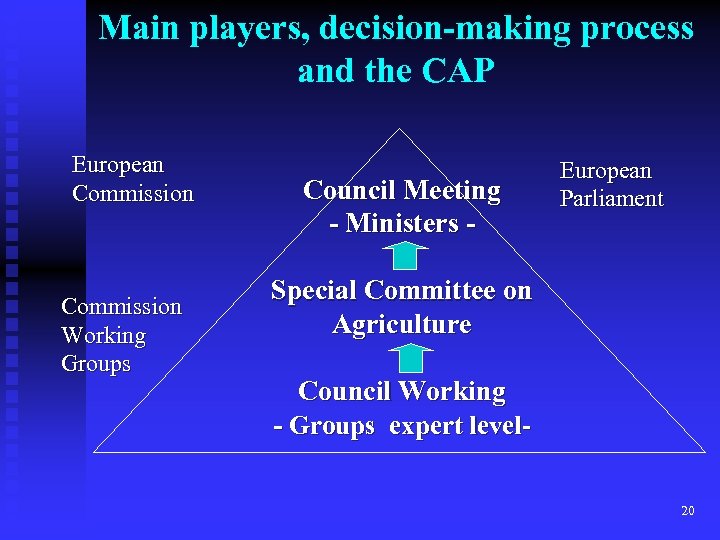 Main players, decision-making process and the CAP European Commission Working Groups Council Meeting - Ministers - European Parliament Special Committee on Agriculture Council Working - Groups expert level 20
 Main players, decision-making process and the CAP § § § European Commission - DG AGRI European Council - Meetings of ministers European Parliament (Lisbon Treaty)- Agri-COM. HU Ministry of Rural Development § Department of EU Coordination § Coordination – mandates, participation at Commission Working Groups, Council Working Groups and SCA § PRESIDENCY I. half of 2011 21
 Main players, decision-making process and the CAP Council Meetings § the body for decision making § Minister is the spokesman § Important characteristics § preparation § attitude § approach § no „real” voting ministers’ contribution (opinion) 22
 Main players, decision-making process and the CAP Council Meetings Importance of the involving partners, and communication § bilateral, trilateral, multilateral § HU – V 4 MS (PL, CZ, SK, HU + RO + BG) § other groups - alliance (G 22) § COM, EC, PRES § Lisbon Treaty: EP § NGO’s – national and EU (COPA, COGECA, CEJA) 23
 Main players, decision-making process and the CAP SCA • For decision making • Between Council meeting of minister and Council Working Groups -„Filtering”, preparing decisions • Decisions – mostly political decisions but decisions on administrative, professional basis • SCA spokesmen: high-level officials supported by a staff: team from the Permanent Representation in Brussels and from the national ministry 24
 Main players, decision-making process and the CAP SCA n Voting system – qualified majority decisionmaking n Get compromise for majority – before, during the SCA-meetings n If no compromise – decision will be made at the Council meeting of Ministers 25
 Main players, decision-making process and the CAP Working Groups - European Council and the European Commission n Expert’s meeting n Professional discussions on specific issues (market measures e. g. quota, intervention, animal health and welfare, plant protection, rural development etc. ) n Council Working Group- more professional specific topics to discuss – REPORTING TO SCA 26
 Experiences, practises n n n Influencing decision-making Political steps, action taken by high-level officials, state of secretary, minister Already in the preparation phase – meeting with COM Directorate General for Agriculture and Rural Development Before decision-making – SCA-meeting, meeting with representatives of the Council The European Parliament can influence the decision-making too 27
 Experiences, practises Making compromises n Preparatory meetings – SCA, SCA spokesman, agricultural group at the Permanent Representation – flexible, efficient n Meetings of ministers – not only Council meetings, bilateral meetings in a member state, multilateral meetings, eg. Visegrad countries n Hungarian experiences in 2005 Sugar reform, 2007 Wine reform, 2009 State aid to buy lands 28
 Conclusion/messages n n n For making compromises – be flexible To be aware of national minimum – room for manoeuvres In Brussels administration people are working – contacts to people, personal-, working contacts People in Brussels are not enemies, they are partners in achieving common goals Be well-trained – physically too negotiations after midnight Be well-informed, to know people, to know the issue up-dated 29
 Thank you for your attention! Dr. Laszlo Flamm Head of EU Unit Ministry of Agriculture and Rural Development, Hungary Tel: + 36 1 301 40 54 Email: laszlo. flamm@fvm. gov. hu 30