

Decision environment Certainty Risk Uncertainty Knowledge degree of







 Скачать презентацию Decision environment Certainty Risk Uncertainty Knowledge degree of
1018-4_risk_decision_environment_expected_value_degree_of_risk.ppt
- Количество слайдов: 23
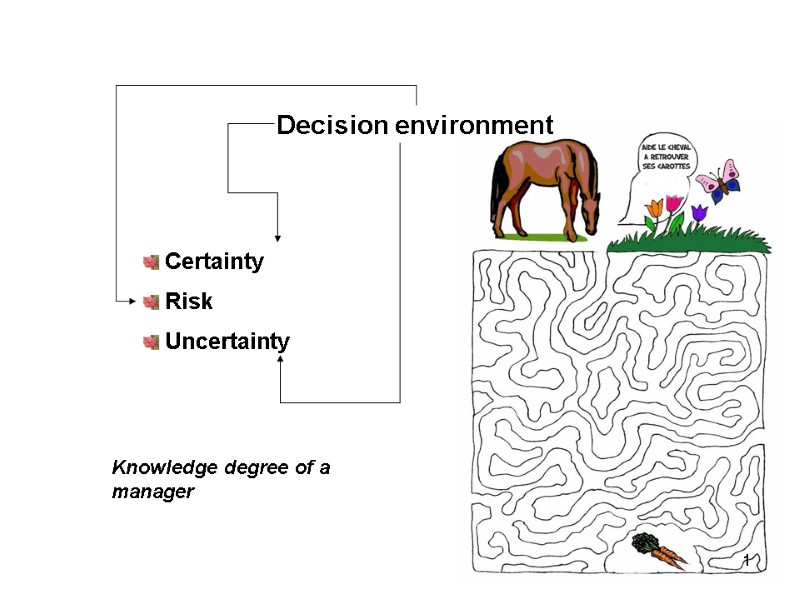
Decision environment Certainty Risk Uncertainty Knowledge degree of a manager 1
3 How managers can make a decision in certainty environment? Search for options with the maximum benefit or minimum costs is called the optimization analysis 3 optimization methods: marginal analysis linear programming Incremental profit analysis
4 How managers can make a decision in risk – and uncertainty environment?
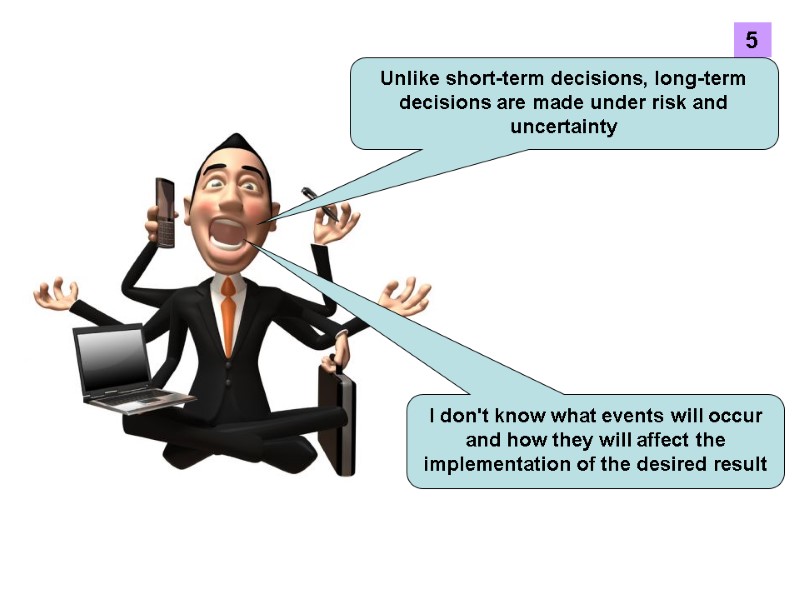
Unlike short-term decisions, long-term decisions are made under risk and uncertainty I don't know what events will occur and how they will affect the implementation of the desired result 5
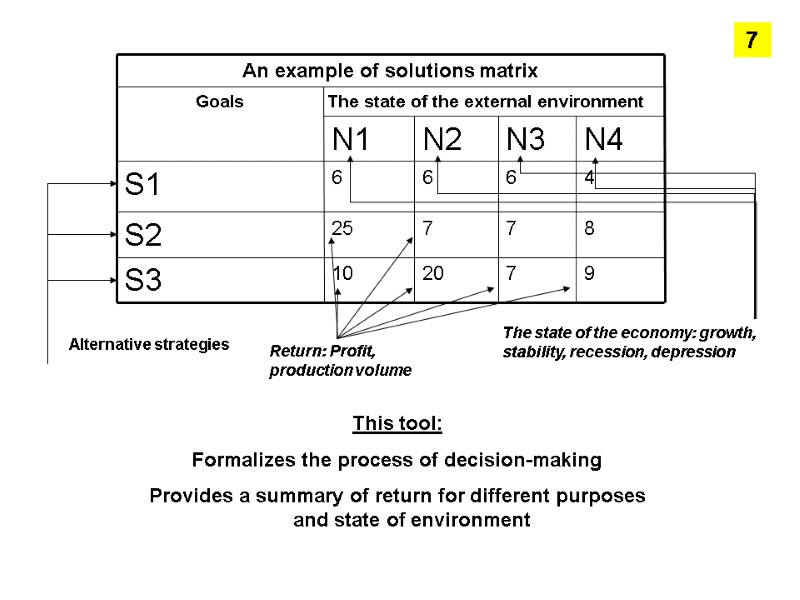
Solutions matrix I wonder, what is it? Payment matrix In conditions of risk and uncertainty typical decision task is quite difficult, because there are many possible outcomes Necessary systematization 6
This tool: Formalizes the process of decision-making Provides a summary of return for different purposes and state of environment Alternative strategies Return: Profit, production volume The state of the economy: growth, stability, recession, depression 7
Decision-making in terms of risk
Methods of risk evaluation: (Risk – probability of undesired occurense) 9
2 approach to objective measurement of probability (degree of risk) A priori (deductive method) Aposteriori (statistical analysis of empirical data) 10
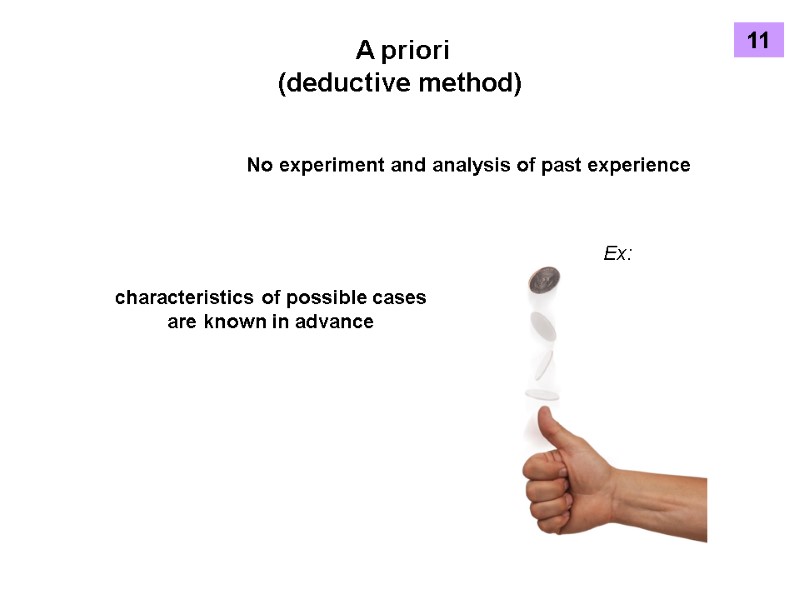
A priori (deductive method) No experiment and analysis of past experience characteristics of possible cases are known in advance Ex: 11
Aposteriori (statistical analysis of empirical data) past experience will continue in the future Watch the frequency of occurrence of the event Understand the frequency distribution for the total number of observations Predict the probability distribution 12
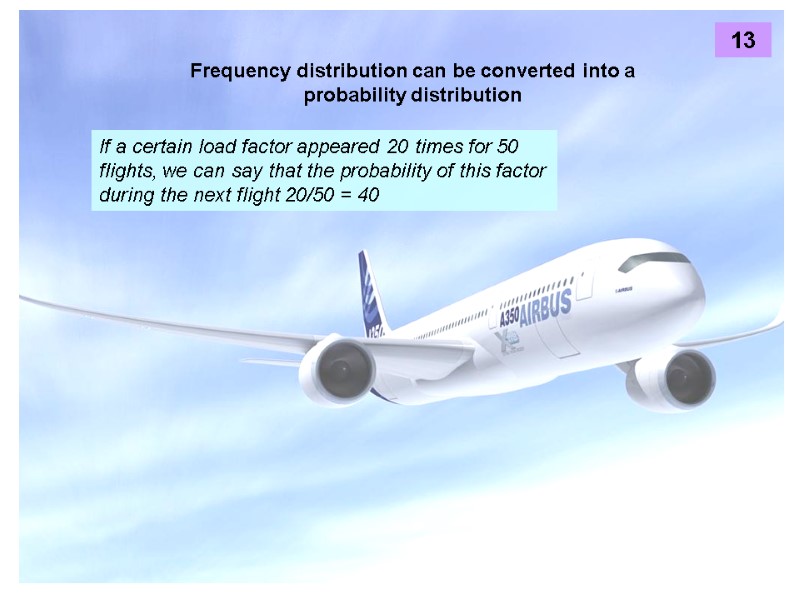
Frequency distribution can be converted into a probability distribution 13 If a certain load factor appeared 20 times for 50 flights, we can say that the probability of this factor during the next flight 20/50 = 40
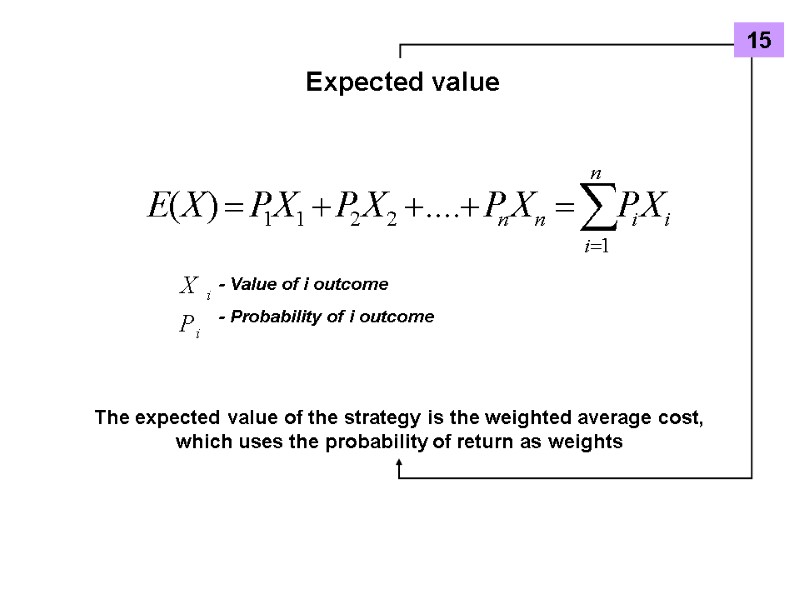
Determine and minimize the risks inherent to a particular project One of the methods: the calculation of the probability distribution of possible outcomes, then the calculation of expected value 14
Expected value - Value of i outcome - Probability of i outcome The expected value of the strategy is the weighted average cost, which uses the probability of return as weights 15
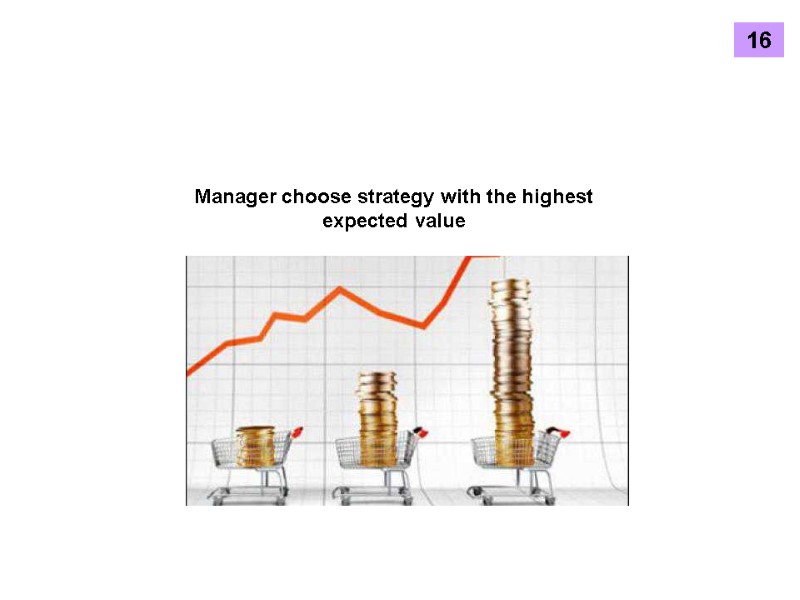
Manager choose strategy with the highest expected value 16
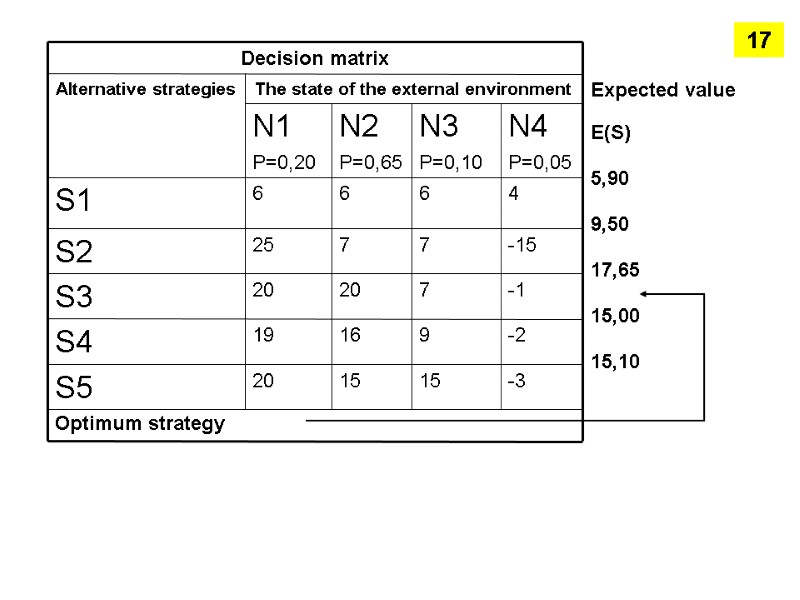
Expected value E(S) 5,90 9,50 17,65 15,00 15,10 Optimum strategy 17
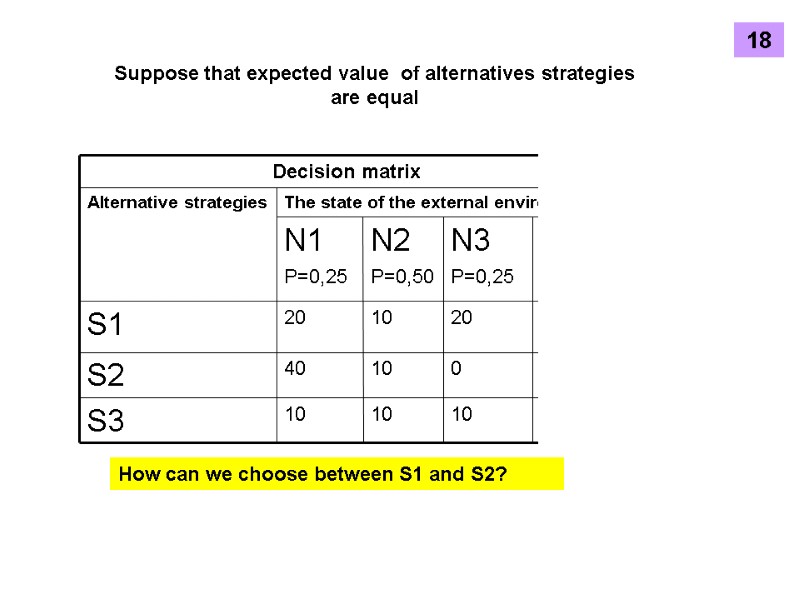
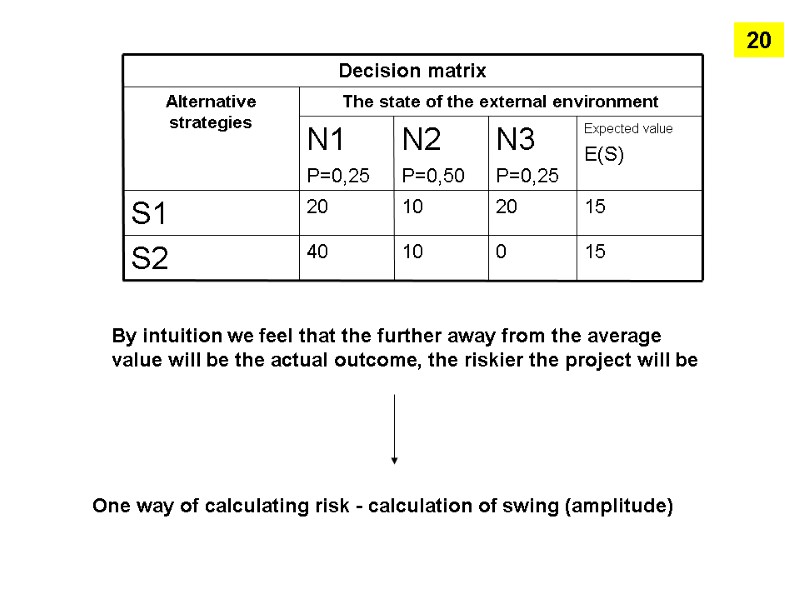
Suppose that expected value of alternatives strategies are equal How can we choose between S1 and S2? 18
New criteria – degree of risk May be determined as deviation scope of probable outcome from expected value 19
By intuition we feel that the further away from the average value will be the actual outcome, the riskier the project will be One way of calculating risk - calculation of swing (amplitude) 20
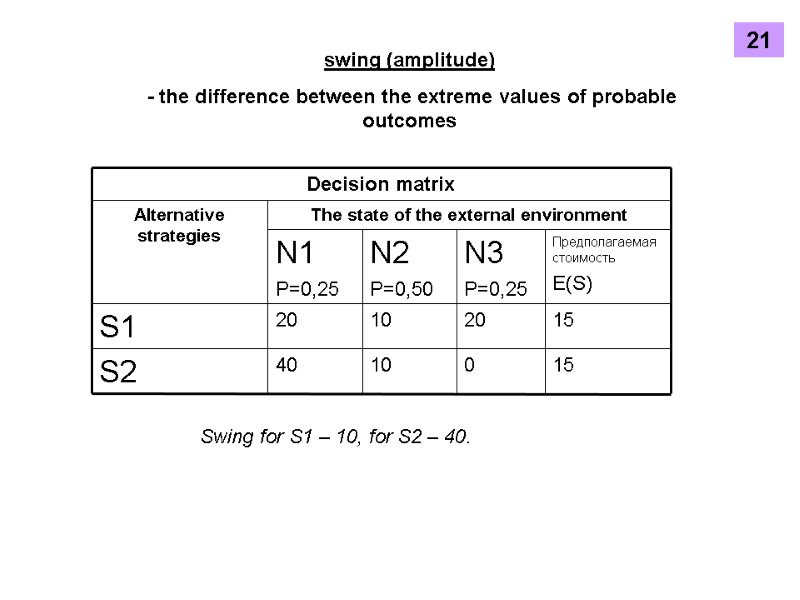
swing (amplitude) - the difference between the extreme values of probable outcomes Swing for S1 – 10, for S2 – 40. 21
root-mean-square deviation The higher root-mean-square deviation - the higher risk 22
Calculation of the root-mean-square deviation: 23
Вычисление среднего квадратичного отклонения S2 is 3 times more risky than S1 24