 Скачать презентацию December 9 2008 Indiana Crane Energy Project presented to
120ffee4bcdecec0724874147f9f446f.ppt
- Количество слайдов: 18



December 9, 2008 Indiana/Crane Energy Project presented to Indiana Society of Mining and Reclamation
Disclaimer This Document was prepared as an account of work cosponsored by the Indiana Center for Coal Technology Research (CCTR) and SAIC. Neither the CCTR nor SAIC nor any of their employees, makes any warranty, express or implied, or assumes any legal liability or responsibility for the accuracy, completeness, or usefulness of any information, apparatus, product, or process disclosed, or represents that its use would not infringe privately owned rights. Reference herein to any specific commercial product, process, or service by trade name, trademark, manufacturer, or otherwise, does not necessarily constitute or imply its endorsement, recommendation, or favoring by CCTR or SAIC, and shall not be used for advertising or product endorsement purposes. 2 SAIC Proprietary Information
WHO IS SAIC? ¾ History and Energy Focus Founded by a small group of scientists in 1969 Fortune 500® company, and its subsidiaries now have approximately 44, 000 employees with offices in more than 150 cities worldwide. 7 th largest defense contractor Despite unprecedented volatility and change in the energy industry, energy continues to drive world economic growth and development. To help foster this progress, we integrate solutions that enable our customers to reduce costs, streamline operations, and operate more effectively. Sponsor of the 2008 World Energy Engineering Conference ¾ SAIC Energy Focus Business Units Bloomfield, IN • Provides technical integration support for energy technology match to commercial customer requirements • Full service environmental capability Do. E NETL primary support contractor • Provides scientific support for coal to product research including liquid fuels and hydrogen • Provides support for the Do. E Renewable Energy Lab Benham, wholly owned subsidiary • A/E with in house Design/Build capability • Energy focus • Power plant and refinery design and construction experience • Facility/Building LEED energy management 3 SAIC Proprietary Information
SAIC Bloomfield Energy Projects ¾ Energy Independence for Do. D Installations – ¾ ¾ ¾ 4 Defense Science Board Recommendation - NSA Crane example Power Natural Gas Clean Coal technology Pre-combustion cleaning of feedstock Post-combustion cleanup of flue gas Diesel engine efficiency Hydrogen booster CNG mix with diesel Coal to liquid transportation fuel – including battlefield fuel and JP-8 Coal to Synthetic natural Gas Coal bed and shale bed methane Bio-mass to power Bio-mass to bio-diesel Portable battlefield installation Municipal waste Solar power collection and battery storage Ordnance disposal Future transportation Diesel with battery assist Hydrogen SAIC Proprietary Information
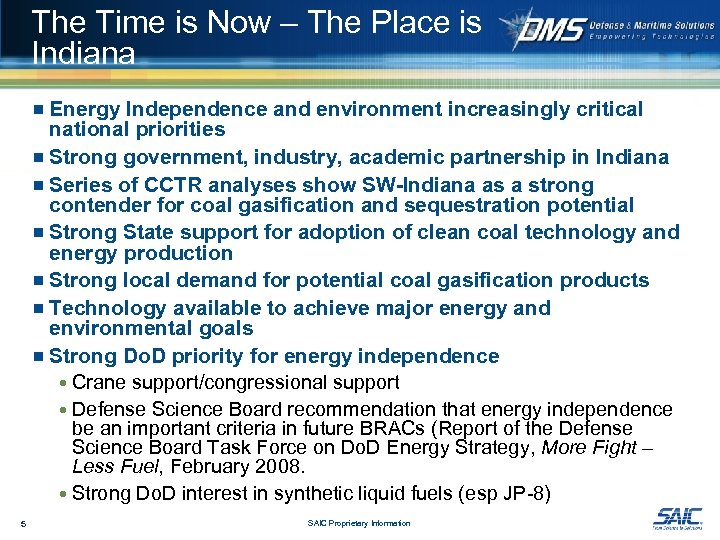
The Time is Now – The Place is Indiana ¾ Energy Independence and environment increasingly critical national priorities ¾ Strong government, industry, academic partnership in Indiana ¾ Series of CCTR analyses show SW-Indiana as a strong contender for coal gasification and sequestration potential ¾ Strong State support for adoption of clean coal technology and energy production ¾ Strong local demand for potential coal gasification products ¾ Technology available to achieve major energy and environmental goals ¾ Strong Do. D priority for energy independence Crane support/congressional support Defense Science Board recommendation that energy independence be an important criteria in future BRACs (Report of the Defense Science Board Task Force on Do. D Energy Strategy, More Fight – Less Fuel, February 2008. Strong Do. D interest in synthetic liquid fuels (esp JP-8) 5 SAIC Proprietary Information
State Program Goals ¾Create a focused approach to solve the “clean coal” problem ¾Achieve energy independence for NSWC Crane and enhance Crane’s value to Do. D ¾Enable growth in Indiana Energy Industry by developing commercially viable technologies 6 SAIC Proprietary Information
Primary Team Objectives ¾ Create a focused approach to enhance economically viable “clean coal” opportunities for Indiana ¾ Commercial viability Enable growth in Indiana energy industry Increase the use of Indiana coal Design-in a capacity to blend biomass into coal gasification Product mix tailored to regional demand requirements Modular design that could be scaled and modified to other locations and conditions Design as close to zero emissions as possible Design to CO 2 sequestration ready specifications and maximize commercial CO 2 use Achieve “Crane energy independence” and enhance Crane’s value to Do. D Ability to provide adequate net electric power to support Crane in an emergency And/or the potential ability to supply Crane’s natural gas requirements with Synthetic Natural Gas Located on or near the Crane Division, Naval Surface Warfare Center in Southwestern Indiana to enhance “physical security” Concept is designed to encourage Do. D/DOE to support this project as a pilot for replication in other locations to provide small scale distributed electric power/F-T liquids/SNG to meet Do. D energy independence goals. 7 SAIC Proprietary Information
Accomplishments and Milestones I Indiana State funding $150, 000 through the Center for Coal Technology Research (CCTR) – Authority to proceed Jan. 2008 ¾ SAIC funding $300, 000 to date – project launch September 2007 ¾ ¾ Tiger Team kick-off meeting at Hoosier Energy – October 24, 2007 Tiger Team design review meeting in Pittsburg – January 7 -10, 2008 ¾ Facility design meetings in Tulsa OK, with SAIC Utility/Refinery design subsidiary (December 2007 and February 2008) ¾ Gov/Lt Gov conversation with Navy/OSD on Crane Energy Independence ¾ Military Energy and Fuels Conference, 28 -29 April 08 (Sasol, Shell) ¾ Gasification Technology Workshop & Tour of Polk Power IGCC, Tampa, FL, 13 -14 March 08 ¾ Eastern Coal Council Conference & Tour of Eastman Coal to Chemicals Facility, Kingsport, TN, 19 May 08 ¾ Discussion with Battelle via National Rural Electric Cooperative Association on CSS initiative ¾ 8 SAIC Proprietary Information
Accomplishments and Milestones II ¾ Phase 1 Report completed July 2008 Posted on CCTR web site https: //www. purdue. edu/dp/energy/CCTR/research. Reports. php ¾ Indiana State Phase 2 funding $200, 000 through the Center for Coal Technology Research (CCTR) – Authority to proceed Sept. 2008, completion due July 2009 ¾ Indiana Governor’s Carbon Capture & Sequestration Summit, Indianapolis 3 -4 Sept 08 ¾ Gasification Technology Conference, Washington, DC, 6 -8 Oct 08 ¾ Brief LT Governor Skillman, 10 Oct 08 ¾ Coal to Liquids Conference, Houston, TX, 30 -31 Oct 08 ¾ Regular communications with Marty Irwin, Director CCTR 9 SAIC Proprietary Information
Accomplishments and Milestones: III ¾ Site visits Wabash IGCC Hoosier pulverized coal and peaking plants Air Liquide/GPC carbon capture facility (Daviess County) ¾ Potential Customer/Partner Communications Air Force Air Liquide American Patriot Energy LLC Battelle Bechtel Conoco Phillips Country. Mark Crane/NAVFAC Cummins Denbury Resources Delphi DOE General Electric Hoosier Energy National Rural Electric Cooperative Association Wabash River Power ¾ Key teaming and external support communications Purdue University/Indiana University Members of Indiana Congressional delegation (Lugar, Bayh, Ellsworth, Buyer, Hill, Visclosky) 10 SAIC Proprietary Information
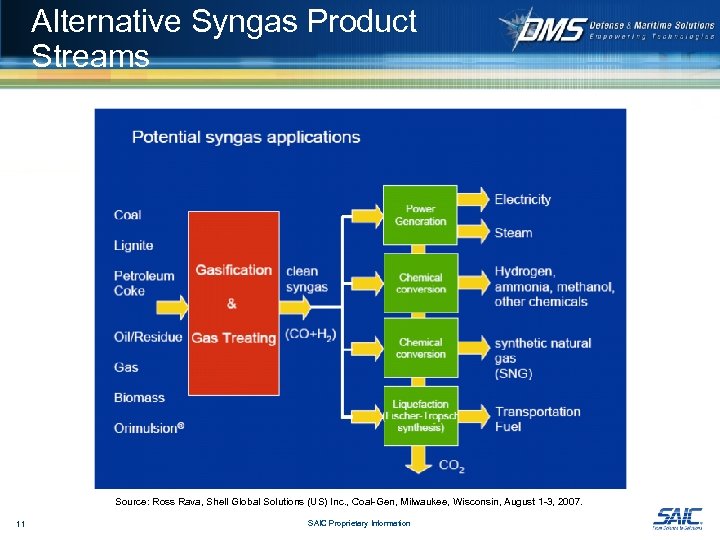
Alternative Syngas Product Streams Source: Ross Rava, Shell Global Solutions (US) Inc. , Coal-Gen, Milwaukee, Wisconsin, August 1 -3, 2007. 11 SAIC Proprietary Information
Preliminary Design Considerations ¾Product options drive capital cost Product mix choice significantly affects plant design Three primary product options best fit Indiana market conditions • IGCC to pipeline quality SNG • IGCC to anhydrous ammonia for fertilizer production • IGCC to Fischer-Tropsch for ultra low sulfur diesel and related distillates IGCC + F-T is highest capital cost option but best fits full range of State planning goals ¾Scale economies are significant for all options Reference design was selected based on minimum commercially viable sized plant that best met the full range of State planning goals Using the best available engineering design and cost information on IGCC and F-T facilities, SAIC developed a decision model to generate preliminary design, scale and cost estimates ¾Engineering cost estimates for the detailed Reference Design are being generated A economic analysis of costs and revenues will follow 12 SAIC Proprietary Information
Technology and Plant Design ¾ Selected design concept: a 2000 to 3000 ton/day Coal to Liquids facility (IGCC to Fischer-Tropsch) 25 MW continuous electric power (Crane grid independence) 4500 -6000 b/day FT liquids CO 2 capture and sale or sequestration ready By product capture/sale Facility design maximized to support clean coal R&D and commercialization Optimize the ability to meet or exceed all current and expected environmental regulations ¾ If implemented could be the first commercially viable Coal to Liquids facility in the US ¾ Design concept is innovative in the integration of commercially available technologies, combined with the ability to perform R&D on products, processes and sequestration 13 SAIC Proprietary Information
Research, Development & Training Platform and Facility ¾ Modular plant with each island sized and plumbed to permit R&D interfaces Alternative materials storage, processing, and handling technologies (coal and biomass) Space and “port” for an additional gasifier Syngas slipstream (raw and clean) for industry and university product & process testing Potential hydrogen slipstream F-T liquid distillate slipstreams (raw distillate and/or refined distillate) Grid and grid interface access for grid management and stability testing CO 2 slipstream for other technology testing and alternative sequestration technologies ¾ Extensive sensor and data capture systems for research, simulation, and training (on-site and remote) ¾ Labs and meeting/class rooms for training and short/long term university 14 and industry R&D teams SAIC Proprietary Information
Location Options ¾ On or off Crane On-Crane: Unable to pay more for power without high-level policy decision: strict use restrictions on commercial activity Off-Crane superior due to internal Navy approval and environmental processes, facility scaling, and operational flexibility • Contiguous w/ Crane border provides superior physical security • Non-contiguous site w/in 20 miles of Crane improves access to water and reduces transportation costs for coal input and liquid fuel export, while still providing Crane energy independence but at lower levels of physical security ¾ All options near adequate water, coal, and good infrastructure (refined petroleum pipeline, rail, road, power lines) Non-contiguous option superior on all logistics criteria 15 SAIC Proprietary Information
Risks and Risk Mitigation ¾ CO 2 management and sequestration ¾ Collapse in market price of oil ¾ Political/policy ¾ Design/build changes cost risk ¾ Competitive technology risk (alternate processes for synthetic liquid fuels, electric vehicles, hydrogen) 16 SAIC Proprietary Information
Recent Events ¾ Drop in crude oil prices ¾ Duke Edwardsport IGCC plant wins most recent permit appeal and continues construction ¾ Indiana Coal to Synthetic Natural Gas put on hold, withdraws application with IN Utility Regulatory Commission 17 SAIC Proprietary Information
Contact Information ¾ For Further Information Contact: Jerry Hill gerald. k. hill@saic. com 18 SAIC Proprietary Information
Скачать презентацию December 9 2008 Indiana Crane Energy Project presented to
120ffee4bcdecec0724874147f9f446f.ppt