 Скачать презентацию December 5 2007 Webinar Critical Year-End Strategies S
46cab2772427186653fd9a5a5dcfa1d9.ppt
- Количество слайдов: 15



December 5, 2007 Webinar “Critical Year-End Strategies” S. James Park, J. D. , LL. M. Mat Sorensen, J. D. Hosted By: Mark J. Kohler, CPA, JD www. kkolawyers. com 856 South Sage Dr. , Suite 2, Cedar City, Utah Telephone 435. 586. 9366 / Facsimile 435. 586. 9491 © Kyler Kohler & Ostermiller, LLP 2006
Instructor Notes Disclaimer- Although the information contained in this Presentation may be extremely useful and helpful, please understand that the presentation of this information does not constitute an attorney-client relationship. Moreover, the information contained in this Presentation is for general guidance only. It is strongly recommended that each individual or entity obtain their own legal advice, particularly applied to their own set of circumstances, facts and specific situation. Kyler Kohler & Ostermiller, LLP is not responsible or liable for any advice that is taken and applied in a situation without direct consultation and representation specific to that individual’s or company’s needs. © Kyler Kohler & Ostermiller, LLP 2006

Understanding the Power of Book Keeping at Year End 1. 2. Get Organized. Get your Quick. Books files up to date and your checkbooks are reconciled. This will give you the opportunity to take advantage of many of the tax planning techniques discussed below. 3. Do not co-mingle your funds. 4. Do not forget your quarterly and annual filings. 5. Get ready for tax season and save yourself hundreds if not thousands.
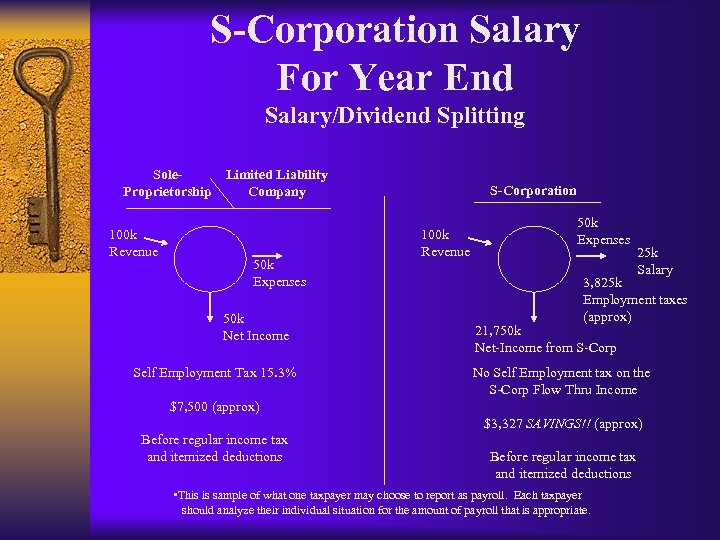
S-Corporation Salary For Year End Salary/Dividend Splitting Sole. Limited Liability Proprietorship Company 100 k Revenue 50 k Expenses 50 k Net Income Self Employment Tax 15. 3% S-Corporation 100 k Revenue 50 k Expenses 25 k Salary 3, 825 k Employment taxes (approx) 21, 750 k Net-Income from S-Corp No Self Employment tax on the S-Corp Flow Thru Income $7, 500 (approx) $3, 327 SAVINGS!! (approx) Before regular income tax and itemized deductions • This is sample of what one taxpayer may choose to report as payroll. Each taxpayer should analyze their individual situation for the amount of payroll that is appropriate.

Maximize Your Retirement Plan Contribution / Deduction • IRA (Traditional/Roth): $4, 000 - $5, 000 if you are over 50 years old. • SIMPLE Plan: $10, 500 - $12, 500 • 401(k), 403(b), 457 Plans: $15, 500 with 25% match up to $45, 000 • SEP: Maximum $45, 000 or 25% of compensation • Other Defined Benefit Plans: From $ 50, 000 to $300, 000 Phase out limitations/Minimum Payroll amounts • Single AGI Phase out: 52 k – 62 k • Roth 99 k – 114 k • Married AGI Phase out: 83 k – 103 k • Roth 156 k – 166 k • Equal to Salary amount, not to $12, 500, or $15, 000 if using catch up provisions • Catch up provision of $5, 000 • Equal to Salary amount, not to exceed $45, 000 • Salary Calculations will be specific to each plan using the participant’s age and salary
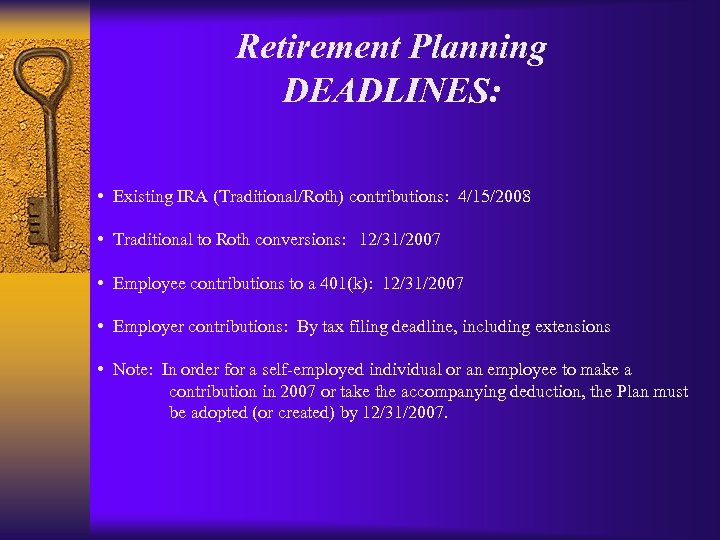
Retirement Planning DEADLINES: • Existing IRA (Traditional/Roth) contributions: 4/15/2008 • Traditional to Roth conversions: 12/31/2007 • Employee contributions to a 401(k): 12/31/2007 • Employer contributions: By tax filing deadline, including extensions • Note: In order for a self-employed individual or an employee to make a contribution in 2007 or take the accompanying deduction, the Plan must be adopted (or created) by 12/31/2007.
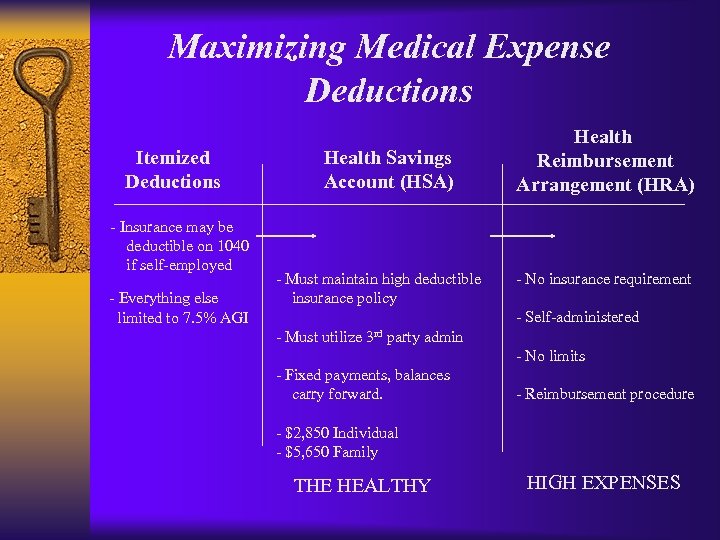
Maximizing Medical Expense Deductions Itemized Deductions - Insurance may be deductible on 1040 if self-employed - Everything else limited to 7. 5% AGI Health Savings Account (HSA) - Must maintain high deductible insurance policy Health Reimbursement Arrangement (HRA) - No insurance requirement - Self-administered - Must utilize 3 rd party admin - No limits - Fixed payments, balances carry forward. - Reimbursement procedure - $2, 850 Individual - $5, 650 Family THE HEALTHY HIGH EXPENSES
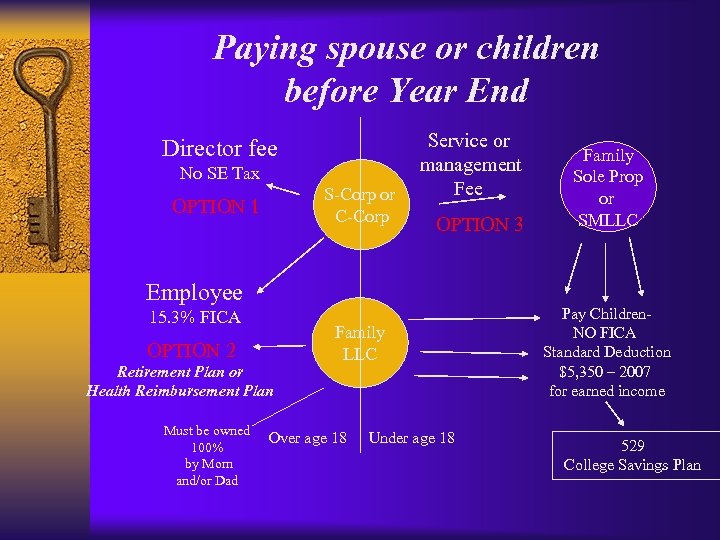
Paying spouse or children before Year End Director fee No SE Tax S-Corp or C-Corp OPTION 1 Service or management Fee OPTION 3 Employee 15. 3% FICA OPTION 2 Retirement Plan or Health Reimbursement Plan Must be owned 100% by Mom and/or Dad Family LLC Over age 18 Under age 18 Family Sole Prop or SMLLC Pay Children. NO FICA Standard Deduction $5, 350 – 2007 for earned income 529 College Savings Plan
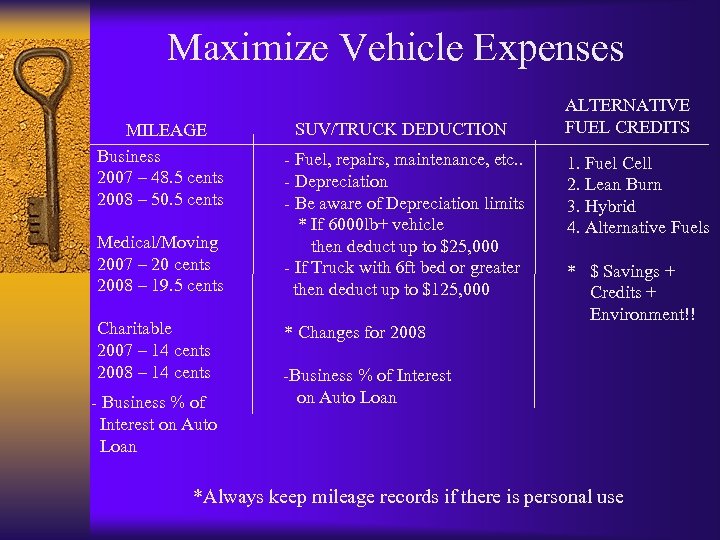
Maximize Vehicle Expenses MILEAGE Business 2007 – 48. 5 cents 2008 – 50. 5 cents Medical/Moving 2007 – 20 cents 2008 – 19. 5 cents Charitable 2007 – 14 cents 2008 – 14 cents - Business % of Interest on Auto Loan SUV/TRUCK DEDUCTION - Fuel, repairs, maintenance, etc. . - Depreciation - Be aware of Depreciation limits * If 6000 lb+ vehicle then deduct up to $25, 000 - If Truck with 6 ft bed or greater then deduct up to $125, 000 * Changes for 2008 ALTERNATIVE FUEL CREDITS 1. Fuel Cell 2. Lean Burn 3. Hybrid 4. Alternative Fuels * $ Savings + Credits + Environment!! -Business % of Interest on Auto Loan *Always keep mileage records if there is personal use

Understanding Acceleration or Deferral of Income/Expenses Generally, you should defer income if at all possible. But in certain instances it may pay to accelerate income, for example: • Too many deductions: If your itemized deductions exceed your taxable income, you should accelerate as much income as possible to fully utilize them. • Change in income level: Anticipated changes in employment or gains from the sale of assets, etc. next year that could bump you into a higher bracket, making the tax on the accelerated income lower this year. • Change in filing status: An upcoming marriage or divorce that will put you in a higher tax bracket may warrant the acceleration of income this year.
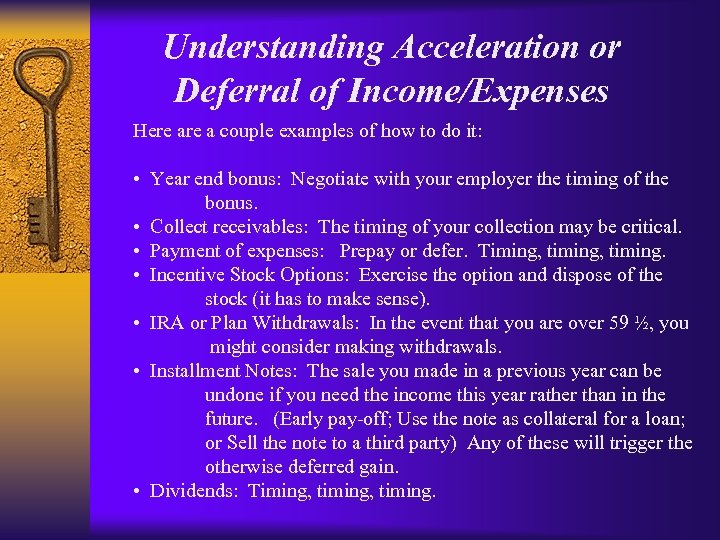
Understanding Acceleration or Deferral of Income/Expenses Here a couple examples of how to do it: • Year end bonus: Negotiate with your employer the timing of the bonus. • Collect receivables: The timing of your collection may be critical. • Payment of expenses: Prepay or defer. Timing, timing. • Incentive Stock Options: Exercise the option and dispose of the stock (it has to make sense). • IRA or Plan Withdrawals: In the event that you are over 59 ½, you might consider making withdrawals. • Installment Notes: The sale you made in a previous year can be undone if you need the income this year rather than in the future. (Early pay-off; Use the note as collateral for a loan; or Sell the note to a third party) Any of these will trigger the otherwise deferred gain. • Dividends: Timing, timing.
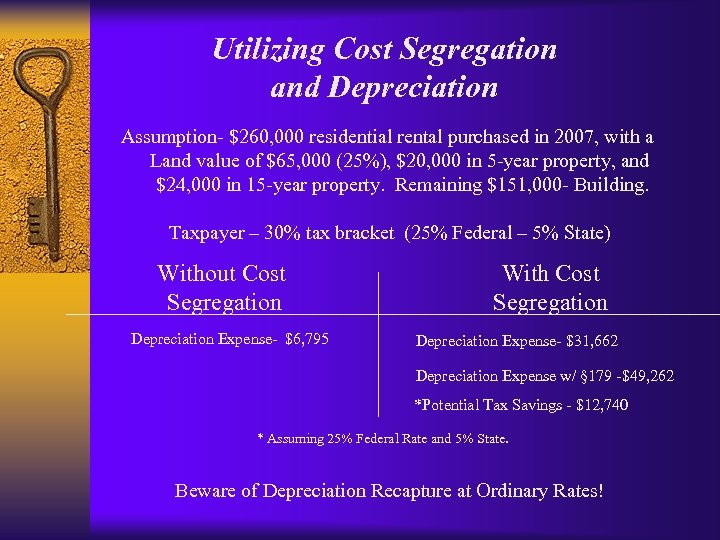
Utilizing Cost Segregation and Depreciation Assumption- $260, 000 residential rental purchased in 2007, with a Land value of $65, 000 (25%), $20, 000 in 5 -year property, and $24, 000 in 15 -year property. Remaining $151, 000 - Building. Taxpayer – 30% tax bracket (25% Federal – 5% State) Without Cost Segregation Depreciation Expense- $6, 795 With Cost Segregation Depreciation Expense- $31, 662 Depreciation Expense w/ § 179 -$49, 262 *Potential Tax Savings - $12, 740 * Assuming 25% Federal Rate and 5% State. Beware of Depreciation Recapture at Ordinary Rates!

Intangible Oil and Gas Drilling Cost Tax Deduction (“IDCs”) - Invest in a “Drilling Program” on U. S. Soil - Find a project with Diversity and beware of Exploratory Projects - 90% to 100% dollar for dollar tax write off - On going cash flow - Liquidity to sell interest in years to come - 1031 Exchange into the investment if you choose

EDUCATIONAL EXPENSE: Buy Mark Kohler’s NEW BOOK Before year end!!! Visit www. lawyersareliars. com for more information

THANK YOU For more information, please contact us at: KYLER, KOHLER & OSTERMILLER, LLP 856 South Sage Dr. , Suite 300 Cedar City, Utah 84720 Tel: 435. 586. 9366 Fax: 435. 586. 9491 www. kkolawyers. com
Скачать презентацию December 5 2007 Webinar Critical Year-End Strategies S
46cab2772427186653fd9a5a5dcfa1d9.ppt