 Скачать презентацию Debt Instruments Qualitative Aspects Chapter 8 Sources of
344795c20d82cf64969fd6b9e140a456.ppt
- Количество слайдов: 31



Debt Instruments: Qualitative Aspects Chapter 8 Sources of Risk Non Marketable vs. Marketable Short-Term, Long-Term Instruments Mortgage Backed Securities Bankruptcy 1
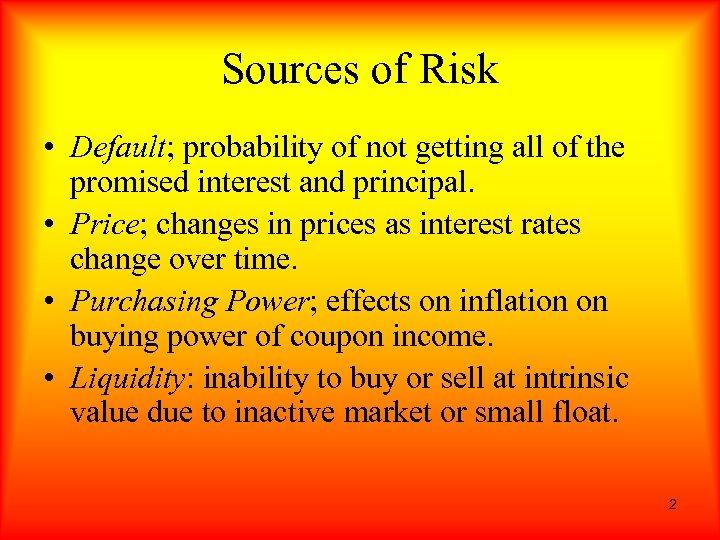
Sources of Risk • Default; probability of not getting all of the promised interest and principal. • Price; changes in prices as interest rates change over time. • Purchasing Power; effects on inflation on buying power of coupon income. • Liquidity: inability to buy or sell at intrinsic value due to inactive market or small float. 2
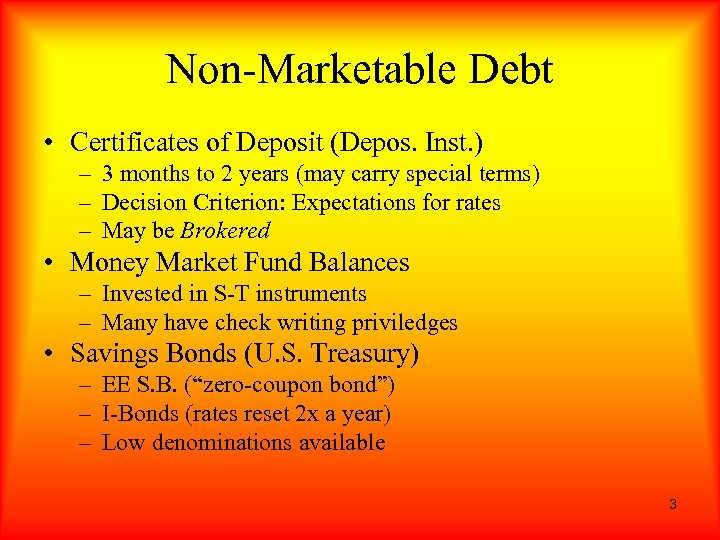
Non-Marketable Debt • Certificates of Deposit (Depos. Inst. ) – 3 months to 2 years (may carry special terms) – Decision Criterion: Expectations for rates – May be Brokered • Money Market Fund Balances – Invested in S-T instruments – Many have check writing priviledges • Savings Bonds (U. S. Treasury) – EE S. B. (“zero-coupon bond”) – I-Bonds (rates reset 2 x a year) – Low denominations available 3
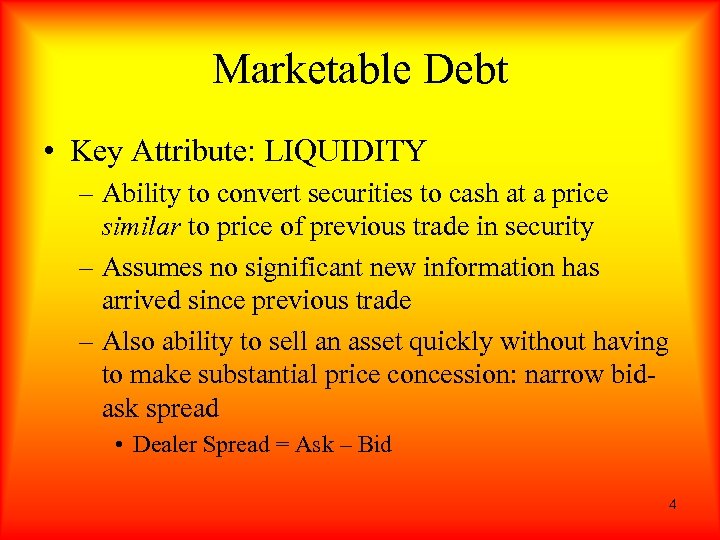
Marketable Debt • Key Attribute: LIQUIDITY – Ability to convert securities to cash at a price similar to price of previous trade in security – Assumes no significant new information has arrived since previous trade – Also ability to sell an asset quickly without having to make substantial price concession: narrow bidask spread • Dealer Spread = Ask – Bid 4
Marketable Debt • Treasury Bills – 13 - and 26 -week maturities sold weekly – 52 -week bills once a month – Buy from treasury, online, or from bank – Sold at a discount • competitive and non competitive bids – Dealer-dominated secondary market – BDY = [(Face – Price)/Face] * (360/DTM) – BEY = [(Face – Price)/Price] * (365/DTM) 5
Marketable Debt • Commercial Paper – 270 day max maturity – Sold at discount – $1, 000 is typical Face Value – Financial companies are biggest issuers – Money market funds most significant buyers • Negotiable CD – May be bearer or registered – Partially insured by BIF 6
Marketable Debt • Bankers’ Acceptances – Finance imports – Significant documentation – Traded in secondary markets • Eurodollar Deposits – USD-denominated liabilities of foreign banks – Rates paid typically > US rates – Narrow spreads: rate paid vs loan rate – Repatriation risks, lower regulatory oversight 7
Term Structure http: //online. wsj. com/mdc/public/page/2_3020 -moneyrate. html • Discount Rate – Charged by Federal Reserve Bank on loans to banks • Federal Funds Rate – Charged by banks to each other for lending excess reserves (“Fed Funds”) • LIBOR – Charged by London banks on loans to each other • Prime Rate – Indexed – Used by banks to price loans 8
Other MM Arrangements • Repurchase Agreements (Repos) and Reverse Repos – Repo effectively a short term loan – Reverse Repo – buy for resale contract • Short-term Municipals • Money Market Mutual Funds • Short-Term Unit Investment Trusts 9
US Government Debt Securities • Notes – Max maturities = 10 years • Bonds – Max maturities = 30 years • General Features – Very liquid – Registered – Semi-annual interest payments 10
US Government Debt Securities • STRIPS – Separate Trading of Registered Interest & Principal Securities – Sell semi-annual coupons as one security and sell maturity value as separate security. – Prices set by YTM • TIPS – Treasury Inflation-Protected Securities – Lower coupon rates - $ coupon fixed – Par values adjusted – vary yields 11
Off Balance Sheet Debt • GSE Issuers (largest) – FNMA (fannie mae) – FHLMC (freddie mac) • Federal Agencies (Guaranteed by US) – EXIM Bank – GNMA – TVA 12
Municipal Debt • Issued by State, County, or City Gov’t – General Obligation Bonds – Revenue Bonds – Tax preferences (interest exempt from Fed taxes) 13
Corporate Debt • Indenture Agreement – Agreement between lender and borrower • Specifies and Restrictive Covenants • May require sinking funds or serial redemption • Grace period specified (curing a default) – Appoints the trustee; a fiduciary responsible for guarding the lenders' interests. – Provides for legal remedies if terms & conditions of indenture are not met. – Sets timing and rate of interest payments 14
Corporate Debt • Market Trading – OTC dominates – Quotes include: • • • Coupon rate Maturity Current Yield Volume Last price (change) 15
Corporate Debt • Collateralized Debt – Mortgage Bonds – Equipment Trust Certificates • Un-Collateralized Debt – Debentures • Senior • Subordinated – Notes (promissory) • Fixed or floating rate 16
Corporate Debt Issues • Other Important Features – Callable bonds • Call price includes premium • Yield-to-First-Call – impact of call premium – Convertible bonds • Convertible to common stock • C-bond is may be characterized as an interest-paying call option on the underlying stock • Conversions may be forced – Trading Flat: price does not include accrued interest – Zero Coupon Bonds (pure discount bonds) 17
Corporate Debt Issues • Other Important Features (continued) – Original-issue discount bonds • “Zero” + coupon rate below market – Split coupon bonds: from Zero to “regular” – Floating rate securities (notes, bonds) – Step-up notes: scheduled changes in rate paid – Sinking Funds: Indenture requires issuer to set aside funds each year – assures payoff funds available at maturity. 18
Credit Ratings • Several Companies specialize in rating debt issues • Ratings (S&P schema) – Prime or High Quality (AAA) – Investment Grade (meets legal list requirements) • AA, A, & BBB – Speculative Grade • BB, B – High Risk • CCC, C – Default • DDD, etc. 19
Corporate Bankruptcy • Definitions of Failure – Economic Failure; revenues do not cover expenses – Business Failure; termination resulting in loss to creditors – Technical Insolvency: firm cannot meet maturing obligations – Technical Bankruptcy: Value of assets < value of liabilities, • Legal Bankruptcy: Acts of Bankruptcy – Firm admits inability to pay (voluntary). – Composition of creditors petitions court (involuntary). – Concealment or improper transfer of assets to avoid attachment or repossession. 20
Corporate Bankruptcy • Out-of-Court Remedies – Extension; postpone due date. – Composition; creditors agree to take less. – Necessary conditions; • Debtor is good moral risk. • Debtor must show ability to make a recovery. • General business conditions must be favorable. – Creditor committees; lenders assume management. – Assignment; Requires agreement as to liquidation values, and priority. 21
Corporate Bankruptcy • Rule of Absolute Priority; Chapter 5, Section 507 (1978 law) – – – – Secured creditors Trustee expenses Back wages for employees (max $2000) Customer deposits (unsecured – max $900) Federal and State taxes Unfunded Pension Liabilities General (unsecured) creditors Stockholders (preferred, common) 22
Corporate Bankruptcy • Chapter 7; Liquidation – Provide safeguards against fraud during liquidation. – Provide equitable distribution of assets to creditors. – Discharge all obligations: debtors can restart without burden of former debt. – Some claims settled in cash, others in assignment of assets. 23
Corporate Bankruptcy • Chapter 11; Reorganization – Reorganization of repayment schedules; lengthen maturities – Some debt may be permanently dismissed. – Debt frequently has interest rates lowered. – Evaluates current management. – Determining if merger with healthy firm is best. 24
Asset/Mortgage Backed Securities • Securitization – Turning non-marketable securities into marketable • Example: mortgages, credit card balances, accounts receivable – Provides claims on assets not otherwise available to ordinary investors • Mortgage-backed Securities (MBS) – Cash flows to investors = principal & interest – VA and FHA are insured 25
Mortgage Backed Securities • Pass-Throughs – P&I less fee sent to investor – Many issuers: Fannie, Freddie, Ginnie • Collateralized Mortgage Obligations – Cash flows are sequenced (Tranches) – More risk for buyers of later tranches 26
Other Debt Securities • Foreign Bonds – State-issued – Corporate issues – Forex and Political risk important factors • Insurance Investments – Guaranteed Investment Contracts – Annuities • Single-premium deferred • Flexible-premium deferred 27
Guaranteed Investment Contracts • Stable value contract • Available in 401(k) retirement plans, profit-sharing plans, IRAs, and mutual funds • Investment choice provided by plan sponsor, but contract between insurance company and employee • Specified maturity date and rate of return guaranteed through maturity by insurance company • Not insured 28
Annuities • Qualified Annuity is purchased through a tax sheltered program • Non-qualified annuity is purchased outside a tax-sheltered program • Accumulation value is the annuity value before any surrender charges have been deducted • Surrender value is the account value after surrender charges have been deducted 29
Types of Annuities • • Single premium deferred annuities (SPDAs) Flexible premium deferred annuities (FPDAs) CD-type annuities Single premium immediate annuities (SPIAs) 30
Annuity Payout Options • • • Straight life annuity Life income with period certain annuity Life with cash or installment refund annuity Joint and survivor life annuity Fixed period annuity Fixed amount annuity 31
Скачать презентацию Debt Instruments Qualitative Aspects Chapter 8 Sources of
344795c20d82cf64969fd6b9e140a456.ppt