 Скачать презентацию Debate re diagnostic criteria Please email your comments
2c03a71fd76e81cdcdf52859a5a82b22.ppt
- Количество слайдов: 18



Debate re diagnostic criteria Please email your comments to: helen. chapel@ndm. ox. ac. uk QLQ 1 -CT-2001 -01395
Validation of criteria for CVID diagnosis In relation to ESID / PAGID criteria in Conley et al 1999 QLQ 1 -CT-2001 -01395
Data from the pan-European registry 1992 - 2004 1294 “CVI” patients entered into the registry in Stockholm (Hammarstrom) QLQ 1 -CT-2001 -01395
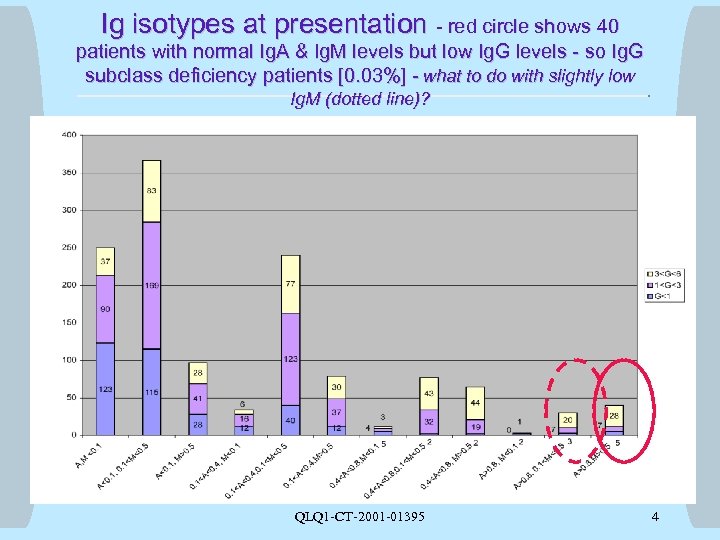
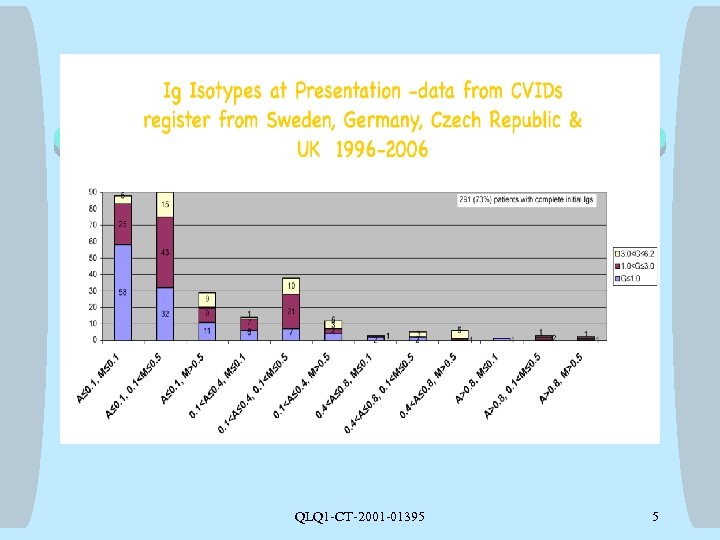
Ig isotypes at presentation - red circle shows 40 patients with normal Ig. A & Ig. M levels but low Ig. G levels - so Ig. G subclass deficiency patients [0. 03%] - what to do with slightly low Ig. M (dotted line)? QLQ 1 -CT-2001 -01395 4
QLQ 1 -CT-2001 -01395 5
New proposals for partial antibody deficiencies Helen Chapel, Janne Bjorkander, Mary-Ellen Conley, Teresa Espanol, Amos Etzioni, Bodo Grimacher, Lennart Hammarstrom, Maria Kanariou, Luigi Notarangelo, David Webster on behalf of ESID and the EUROPID group Funded by a grant from the EU - QLQ 1 -CT-2001 -01395
Criteria General points: • Criteria for diagnosis: studies/registers etc • agreed by ESID & PAGID • Definite = 98% probability that same diagnosis in 20 years; gene mutation & clinical features • Probable = 85% probability that same diagnosis in 20 years; clinical & lab features as no known single gene defect QLQ 1 -CT-2001 -01395 7
![Common Variable Immune Deficiency Disorders [CVIDs] Probable: male/female patient with all of: • Aged](https://present5.com/presentation/2c03a71fd76e81cdcdf52859a5a82b22/image-8.jpg "Common Variable Immune Deficiency Disorders [CVIDs] Probable: male/female patient with all of: • Aged")
Common Variable Immune Deficiency Disorders [CVIDs] Probable: male/female patient with all of: • Aged > 4 years • Serum Ig. G and Ig. A more than 2 SD below mean for age • Poor response to all vaccines • Causes of secondary antibody deficiencies excluded (eg lymphoma, medications) QLQ 1 -CT-2001 -01395 8
Ig. A with Ig. G subclass deficiencies DRAFT Male or female patient with recurrent/ severe infections and all the following: • Aged > 7 years • Marked decrease in Ig. A [ie <0. 05 g/l] and at least one of Ig. G 1 -3 subclasses less than the 5 th centile for age • Poor responses to some vaccines QLQ 1 -CT-2001 -01395 9
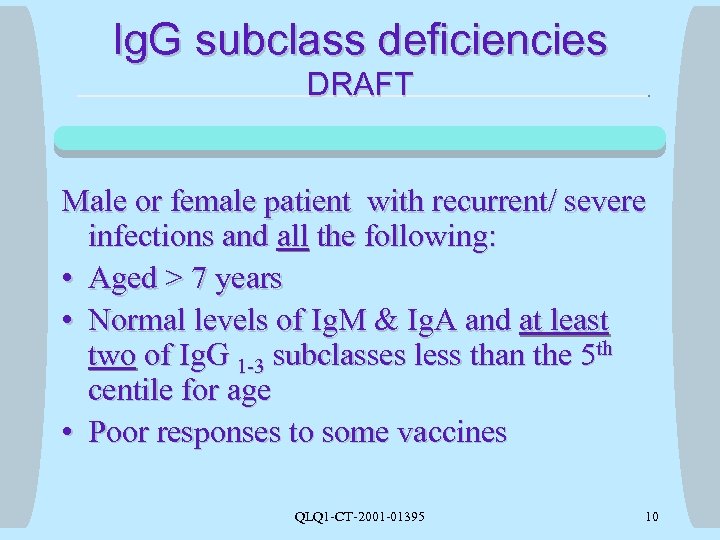
Ig. G subclass deficiencies DRAFT Male or female patient with recurrent/ severe infections and all the following: • Aged > 7 years • Normal levels of Ig. M & Ig. A and at least two of Ig. G 1 -3 subclasses less than the 5 th centile for age • Poor responses to some vaccines QLQ 1 -CT-2001 -01395 10
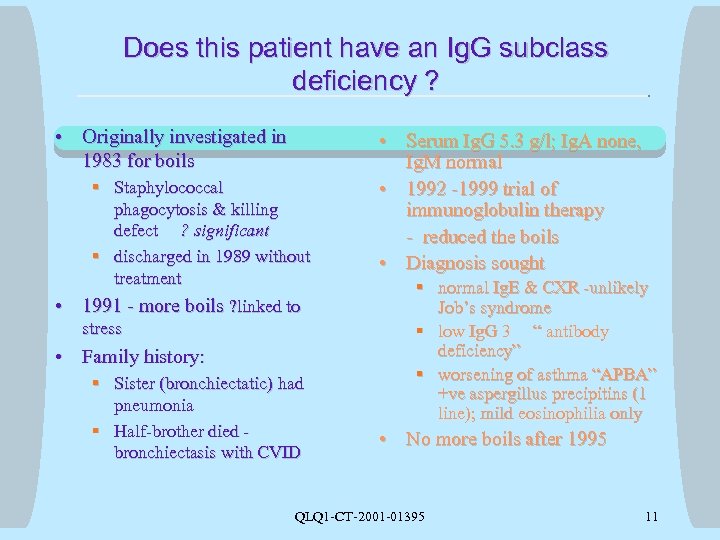
Does this patient have an Ig. G subclass deficiency ? • Originally investigated in 1983 for boils • § Staphylococcal phagocytosis & killing defect ? significant § discharged in 1989 without treatment 1991 - more boils ? linked to stress • Family history: § Sister (bronchiectatic) had pneumonia § Half-brother died bronchiectasis with CVID • Serum Ig. G 5. 3 g/l; Ig. A none, Ig. M normal • 1992 -1999 trial of immunoglobulin therapy - reduced the boils • Diagnosis sought § normal Ig. E & CXR -unlikely Job’s syndrome § low Ig. G 3 “ antibody deficiency” § worsening of asthma “APBA” +ve aspergillus precipitins (1 line); mild eosinophilia only • No more boils after 1995 QLQ 1 -CT-2001 -01395 11
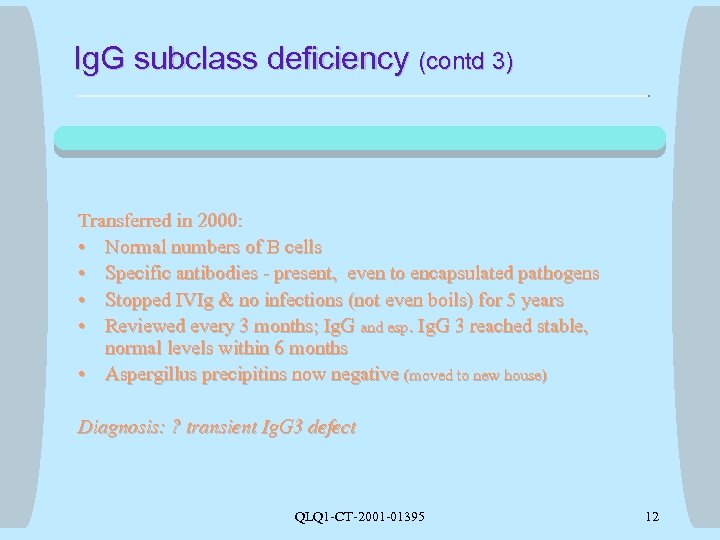
Ig. G subclass deficiency (contd 3) Transferred in 2000: • Normal numbers of B cells • Specific antibodies - present, even to encapsulated pathogens • Stopped IVIg & no infections (not even boils) for 5 years • Reviewed every 3 months; Ig. G and esp. Ig. G 3 reached stable, normal levels within 6 months • Aspergillus precipitins now negative (moved to new house) Diagnosis: ? transient Ig. G 3 defect QLQ 1 -CT-2001 -01395 12
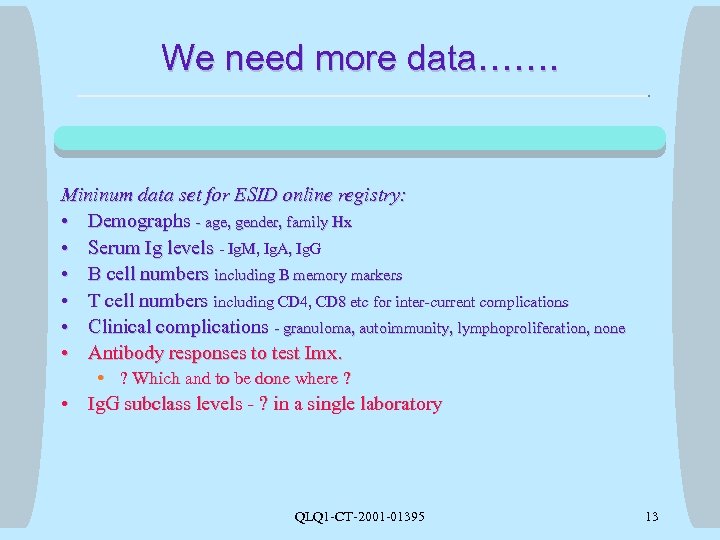
We need more data……. Mininum data set for ESID online registry: • Demographs - age, gender, family Hx • Serum Ig levels - Ig. M, Ig. A, Ig. G • B cell numbers including B memory markers • T cell numbers including CD 4, CD 8 etc for inter-current complications • Clinical complications - granuloma, autoimmunity, lymphoproliferation, none • Antibody responses to test Imx. • ? Which and to be done where ? • Ig. G subclass levels - ? in a single laboratory QLQ 1 -CT-2001 -01395 13
Conclusions re testing Currently we need to: • Do test Imx responses to standard protein / carbohydrate antigens for all new patients to distinguish CVIDs from partial antibody failures • Role for new vaccines/assays • Add neoantigen test Imx for existing/ treated patients in order to categorise them more precisely • Quality assurance and reference preparations QLQ 1 -CT-2001 -01395 14
![Extra essential data • Antibody [ Ig. G] responses to which test Imx. §](https://present5.com/presentation/2c03a71fd76e81cdcdf52859a5a82b22/image-15.jpg "Extra essential data • Antibody [ Ig. G] responses to which test Imx. §")
Extra essential data • Antibody [ Ig. G] responses to which test Imx. § § § Proteins - tetanus, diphtheria, Hib, rabies, Carbohydrates - Pneumovax, Typhim Vi, new vaccine? Neoantigens - Tick-borne encephalitis vaccine Reference preparations from …. . Whom? Reference assays for Consensus to be done……. where ? • Ig. G subclass levels § ? in a single laboratory ? in Sweden QLQ 1 -CT-2001 -01395 15
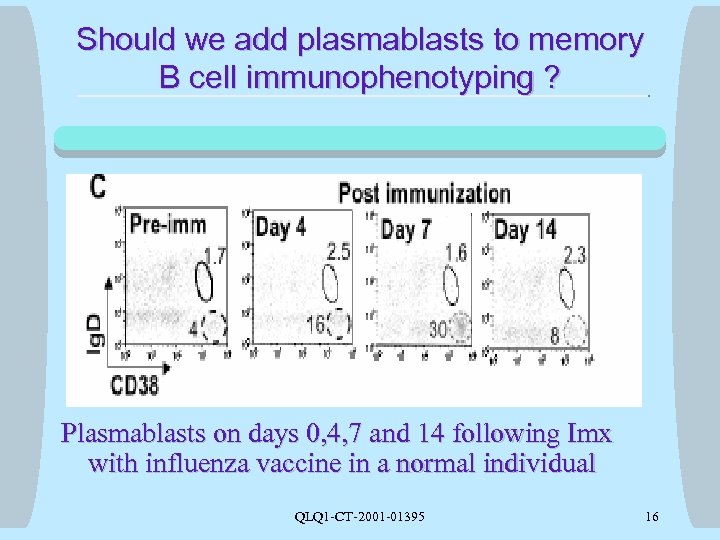
Should we add plasmablasts to memory B cell immunophenotyping ? Plasmablasts on days 0, 4, 7 and 14 following Imx with influenza vaccine in a normal individual QLQ 1 -CT-2001 -01395 16
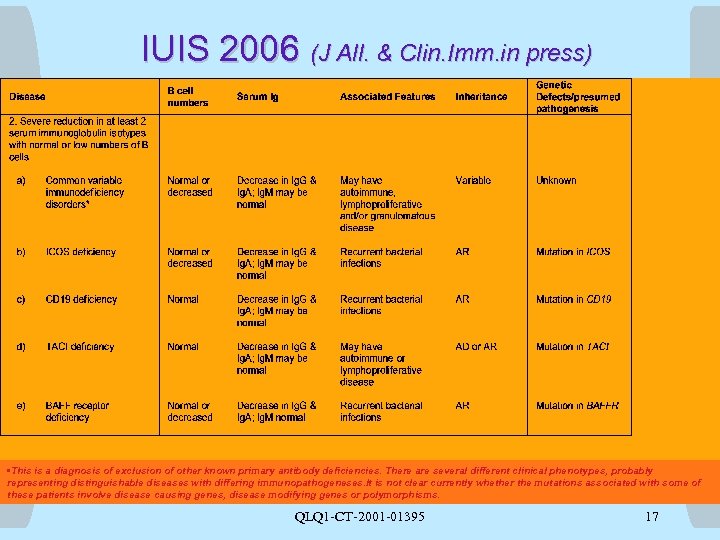
IUIS 2006 (J All. & Clin. Imm. in press) • This is a diagnosis of exclusion of other known primary antibody deficiencies. There are several different clinical phenotypes, probably representing distinguishable diseases with differing immunopathogeneses. It is not clear currently whether the mutations associated with some of these patients involve disease causing genes, disease modifying genes or polymorphisms. QLQ 1 -CT-2001 -01395 17
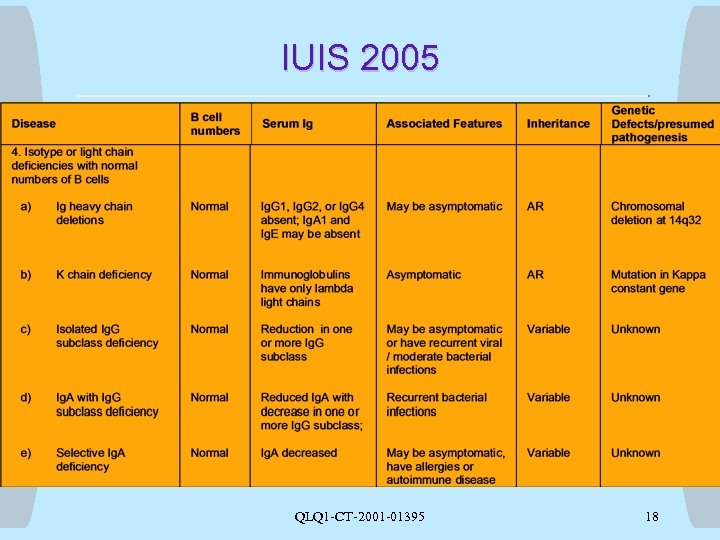
IUIS 2005 QLQ 1 -CT-2001 -01395 18
Скачать презентацию Debate re diagnostic criteria Please email your comments
2c03a71fd76e81cdcdf52859a5a82b22.ppt