


 Скачать презентацию Deadlock CSE 410 Spring 2008 Computer Systems http
f08dcf1a014f73299c99499cc51a26b3.ppt
- Количество слайдов: 20
 Deadlock CSE 410, Spring 2008 Computer Systems http: //www. cs. washington. edu/410 3/19/2018 cse 410 -25 -deadlock © 2006 -07 Perkins, DW Johnson and University of Washington 1
 Readings and References • Reading » Chapter 8, Operating System Concepts, Silberschatz, Galvin, and Gagne • Other References 3/19/2018 cse 410 -25 -deadlock © 2006 -07 Perkins, DW Johnson and University of Washington 2
 Deadlock Example • “When two trains approach each other at a crossing, both shall come to a full stop and neither shall start up again until the other has gone. ” » A Treasury of Railroad Folklore, B. A. Botkin & A. F. Harlow, p. 381 3/19/2018 cse 410 -25 -deadlock © 2006 -07 Perkins, DW Johnson and University of Washington 3
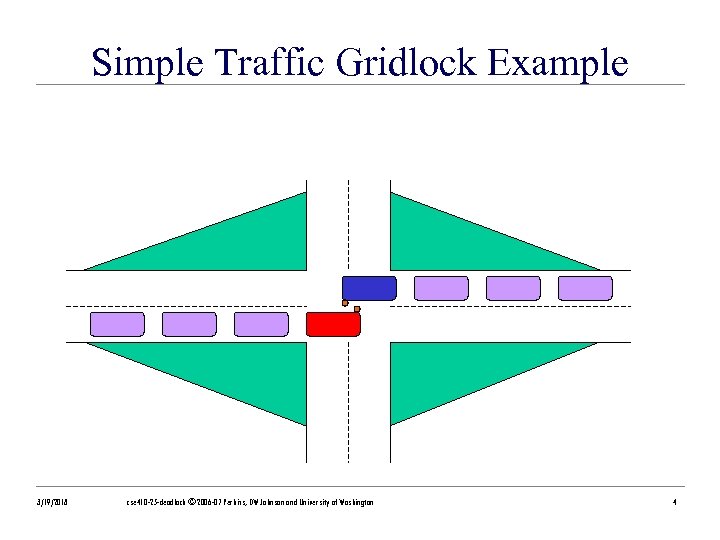 Simple Traffic Gridlock Example 3/19/2018 cse 410 -25 -deadlock © 2006 -07 Perkins, DW Johnson and University of Washington 4
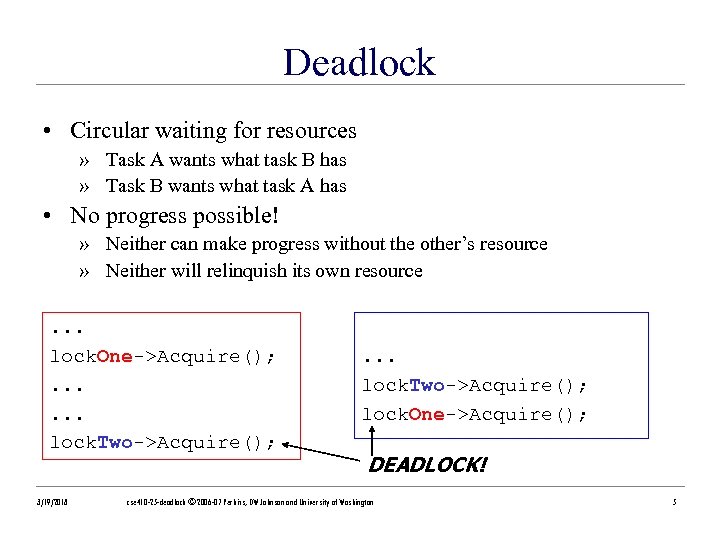 Deadlock • Circular waiting for resources » Task A wants what task B has » Task B wants what task A has • No progress possible! » Neither can make progress without the other’s resource » Neither will relinquish its own resource. . . lock. One->Acquire(); . . . lock. Two->Acquire(); 3/19/2018 . . . lock. Two->Acquire(); lock. One->Acquire(); DEADLOCK! cse 410 -25 -deadlock © 2006 -07 Perkins, DW Johnson and University of Washington 5
 System Model • There are tasks and resources » Resources can be logical or physical • A task follows these steps to utilize a resource » Acquire the resource • If the resource is unavailable, block » Use the resource » Release the resource 3/19/2018 cse 410 -25 -deadlock © 2006 -07 Perkins, DW Johnson and University of Washington 6
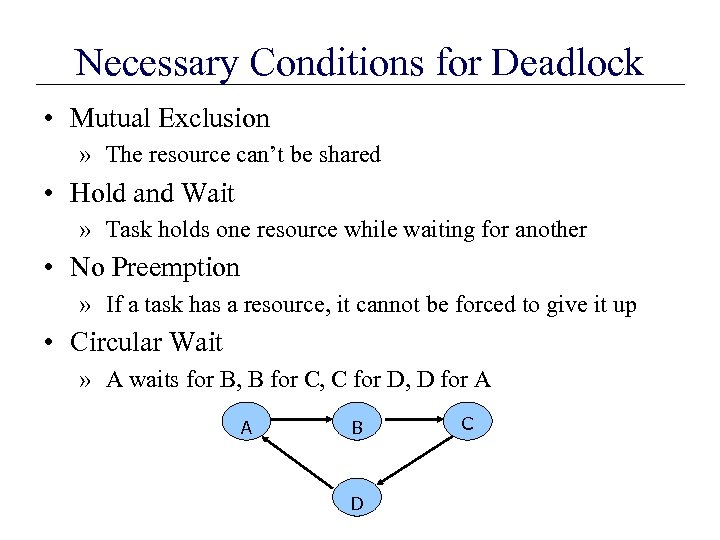 Necessary Conditions for Deadlock • Mutual Exclusion » The resource can’t be shared • Hold and Wait » Task holds one resource while waiting for another • No Preemption » If a task has a resource, it cannot be forced to give it up • Circular Wait » A waits for B, B for C, C for D, D for A A B D C
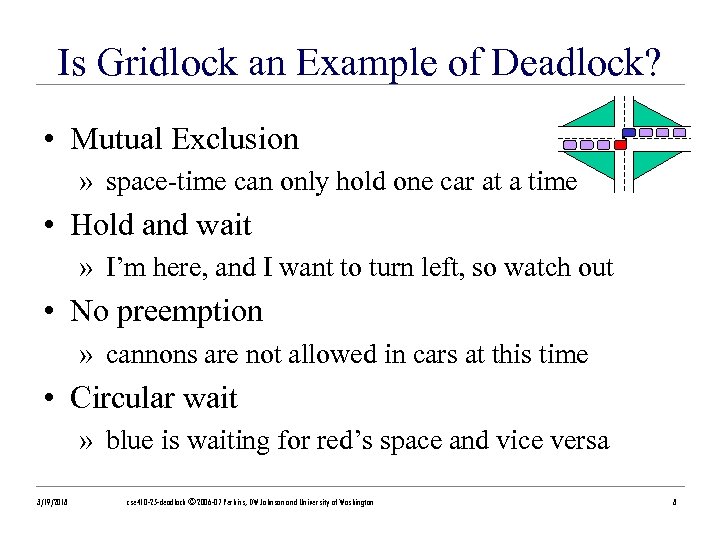 Is Gridlock an Example of Deadlock? • Mutual Exclusion » space-time can only hold one car at a time • Hold and wait » I’m here, and I want to turn left, so watch out • No preemption » cannons are not allowed in cars at this time • Circular wait » blue is waiting for red’s space and vice versa 3/19/2018 cse 410 -25 -deadlock © 2006 -07 Perkins, DW Johnson and University of Washington 8
 Dealing with Deadlock • Deadlock Prevention » Ensure statically that deadlock is impossible • Deadlock Avoidance » Ensure dynamically that deadlock is impossible • Deadlock Detection and Recovery » Allow deadlock to occur, but notice when it does and try to recover • Ignore the Problem » Let the operator untangle it, that's what they're paid for 3/19/2018 cse 410 -25 -deadlock © 2006 -07 Perkins, DW Johnson and University of Washington 9
 Deadlock Prevention • There are four necessary conditions for deadlock • Take any one of them away and deadlock is impossible • Let’s attack deadlock by » examining each of the conditions » considering what would happen if we threw it out 3/19/2018 cse 410 -25 -deadlock © 2006 -07 Perkins, DW Johnson and University of Washington 10
 Condition: Mutual Exclusion • Usually can't eliminate this condition » some resources are intrinsically non-sharable • Examples include printer, write access to a file or record, entry into a section of code • However, you can often mitigate this by adding a layer of abstraction » For example, write to a queue of jobs for a shared resource instead of locking the resource to write 3/19/2018 cse 410 -25 -deadlock © 2006 -07 Perkins, DW Johnson and University of Washington 11
 Condition: Hold and Wait • Eliminate partial acquisition of resources • Task must acquire all the resources it needs before it does anything » if it can’t get them all, then it gets none • Issue: Resource utilization may be low » If you need P for a long time and Q only at the end, you still have to hold Q’s lock the whole time • Issue: Starvation prone » May have to wait indefinitely before popular resources are all available at the same time 3/19/2018 cse 410 -25 -deadlock © 2006 -07 Perkins, DW Johnson and University of Washington 12
 Condition: No Preemption • Allow preemption » If a process asks for a resource not currently available, block it and take away all of its other resources » Add the preempted resources to the list of resources the process is waiting for • This strategy works for some resources: » CPU state (contents of registers can be spilled to memory) » memory (can be spilled to disk) • But not for others: » printer - rip off the existing printout and tape it on later? 3/19/2018 cse 410 -25 -deadlock © 2006 -07 Perkins, DW Johnson and University of Washington 13
 Condition: Circular Wait • To attack the circular wait condition: » Assign each resource a priority » Make processes acquire resources in priority order • Two processes need the printer and the scanner, both must acquire the printer (higher priority) before the scanner • This is a common form of deadlock prevention • The only problem: sometimes forced to relinquish a resource that you thought you had locked up 3/19/2018 cse 410 -25 -deadlock © 2006 -07 Perkins, DW Johnson and University of Washington 14
 Deadlock Avoidance • Deadlock prevention is often too strict » low device utilization » reduced system throughput • If the OS had more information, it could do more sophisticated things to avoid deadlock and keep the system in a safe state » “If” is a little word, but it packs a big punch » predicting all needed resources a priori is hard 3/19/2018 cse 410 -25 -deadlock © 2006 -07 Perkins, DW Johnson and University of Washington 15
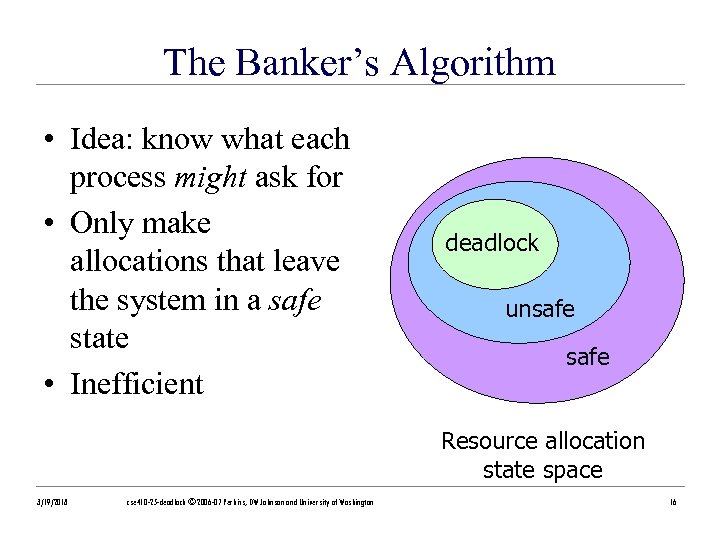 The Banker’s Algorithm • Idea: know what each process might ask for • Only make allocations that leave the system in a safe state • Inefficient deadlock unsafe Resource allocation state space 3/19/2018 cse 410 -25 -deadlock © 2006 -07 Perkins, DW Johnson and University of Washington 16
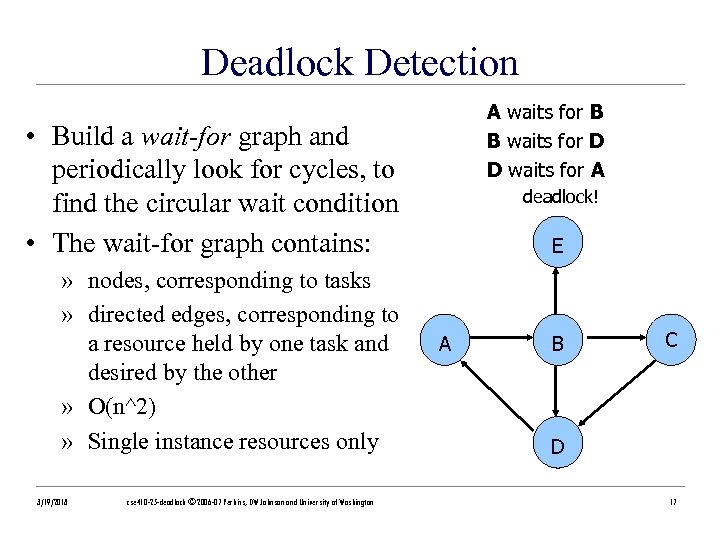 Deadlock Detection A waits for B B waits for D D waits for A • Build a wait-for graph and periodically look for cycles, to find the circular wait condition • The wait-for graph contains: » nodes, corresponding to tasks » directed edges, corresponding to a resource held by one task and desired by the other » O(n^2) » Single instance resources only 3/19/2018 cse 410 -25 -deadlock © 2006 -07 Perkins, DW Johnson and University of Washington deadlock! E A B C D 17
 Deadlock Recovery • Once you’ve discovered deadlock, what next? • Terminate one of the tasks to stop circular wait? » Task will likely have to start over from scratch » Which task should you choose? • Take a resource away from a task? » Again, which task should you choose? » How can you roll back the task to the state before it had the coveted resource? » Make sure you don’t keep on preempting from the same task: avoid starvation 3/19/2018 cse 410 -25 -deadlock © 2006 -07 Perkins, DW Johnson and University of Washington 18
 Ignoring Deadlock • Not a bad policy for operating systems • The mechanisms outlined previously for handling deadlock may be expensive » if the alternative is to have a forced reboot once a year, that might be acceptable • However, for thread deadlocks, your users may not be quite so tolerant » “the program only locks up once in a while” 3/19/2018 cse 410 -25 -deadlock © 2006 -07 Perkins, DW Johnson and University of Washington 19
 Edsger Djikstra • Shortest Path Algorithm » A specific case of A* • Banker’s Algorithm research • Contributed to threading safety, routing, etc. 3/19/2018 cse 410 -25 -deadlock © 2006 -07 Perkins, DW Johnson and University of Washington 20