


 Скачать презентацию De-escalation Workplace Violence The Swedish Perspective Stacia Gloman CHSP
be83e55dcf8e6cea6556ee2a7123c823.ppt
- Количество слайдов: 19
 De-escalation/Workplace Violence The Swedish Perspective… Stacia Gloman, CHSP Safety Officer for Swedish First Hill, Issaquah, and Metropolitan Park
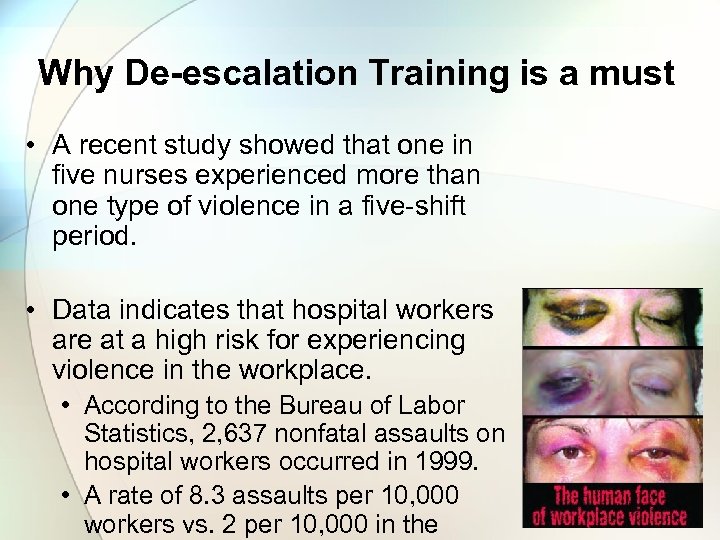 Why De-escalation Training is a must • A recent study showed that one in five nurses experienced more than one type of violence in a five-shift period. • Data indicates that hospital workers are at a high risk for experiencing violence in the workplace. • According to the Bureau of Labor Statistics, 2, 637 nonfatal assaults on hospital workers occurred in 1999. • A rate of 8. 3 assaults per 10, 000 workers vs. 2 per 10, 000 in the
 Tipping Point for Swedish • Typical morning in the ED • Patient had been discharged from the ED the night before; came back in pain. Staff thought possible drug seeker • Patient was being very verbally abusive to registration staff; charge nurse looked at security officer and said “Deal with It” • Security dealt with it • Very public display of moving the patient out of the ED with on-lookers and staff
 A Bad Situation • Perception is reality. • There was a lack of communication between the ED staff and Security. • Lack of expectations between hospital and patient. • Lack of understanding between each others’ duties and expectations.
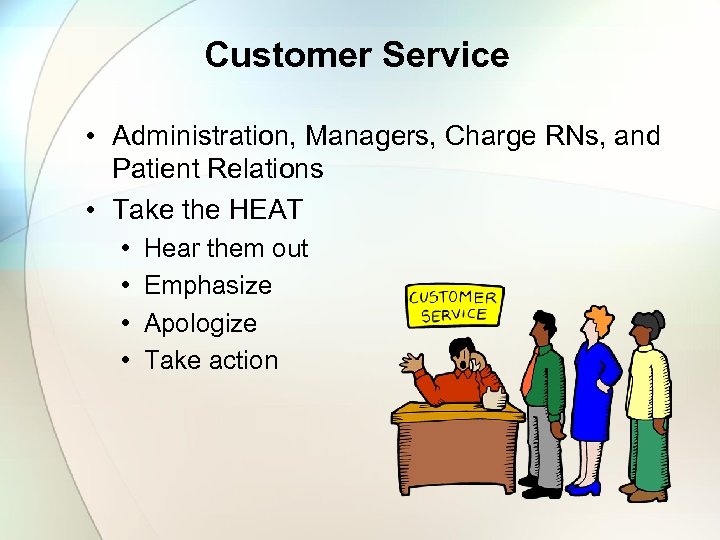 Customer Service • Administration, Managers, Charge RNs, and Patient Relations • Take the HEAT • • Hear them out Emphasize Apologize Take action
 De-escalation at Swedish Past • Swedish has tried to implement most, if not all, of the major de-escalation programs. • CPI (Crisis Prevention Institute) • MOAB (Management of Aggressive Behavior) • Unable to customize these programs to allow for time constraints and risk management issues • Unable to maintain competency of trainers • Unable to provide time for trainers to train (mandatory= pay staff) • Unable to get buy-in from Senior Leaders
 De-escalation at Swedish Present • Trainers with law enforcement background created a program based off of “Verbal Judo” by Dr. George Thompson (Insight) • Approximately 300 staff were trained systemwide • 4 hour training: • 1 ½ hours of didactic training • 2 ½ hours of mock scene training • Key success was getting the different departments to interact and create the scenarios that were worked through.
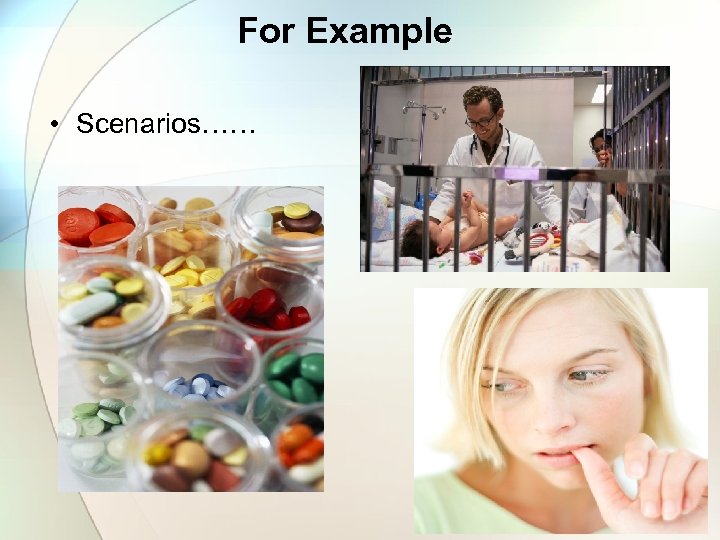 For Example • Scenarios……
 De-escalation at Swedish Future • All new staff will receive education in deescalation and restraining patients in new employee education (NEO) • Will back-fill the NEO with current staff to make sure that everyone who comes or will come in contact with a patient knows how to de-escalate and restrain when necessary • The plan is to meld a couple of the approaches to create a “swedishized” deescalation program • Continuous work…constantly re-evaluating based on needs
 De-escalation Made Easy 5 Easy Steps • • Ask Explain Options (2, one good and one bad) Confirm Choice* • * ask… Is there anything I can do to earn your cooperation… • * also a tip off to co-workers that we are close to going hands on • Act
 Dealing with Insults “Strip” Phrase • A two-part response to insults • Part 1 - Acknowledge the insult • Part 2 - Refocus; get them back on task • Example • (Patient): You are an evil nurse… • (Nurse): I understand you are upset but we still need to get your blood drawn. • By acknowledging, we strip the insult of the power; by ignoring, the patient will keep hurling insults.
 Goals of our New Employee Education • • • Discuss (verbal, non-verbal, and physical) techniques to provide for the care, welfare, safety, and security of ALL involved in a crisis situation. Identify behavior levels that contribute to the development of a crisis and choose an appropriate staff intervention for each level. Identify useful nonverbal techniques which can help to prevent acting-out behavior. Use verbal techniques to de-escalate behavior. Identify resources to utilize in crisis situation. Demonstrate correct application of restraints.
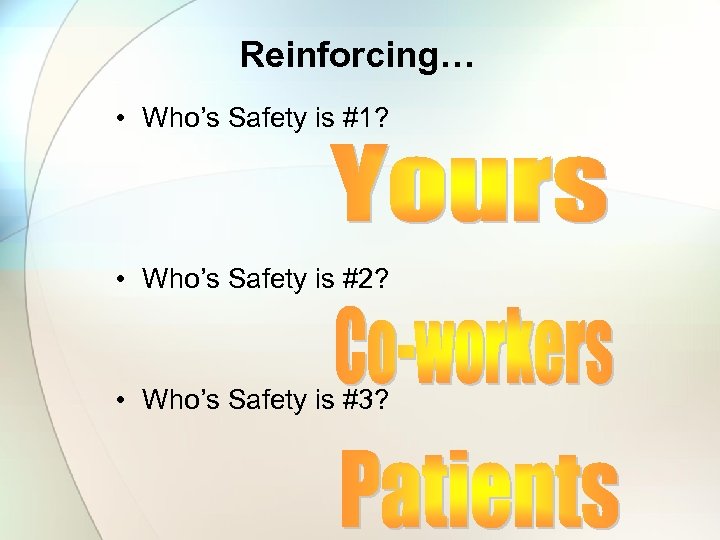 Reinforcing… • Who’s Safety is #1? • Who’s Safety is #2? • Who’s Safety is #3?
 Our Numbers Since Starting Training
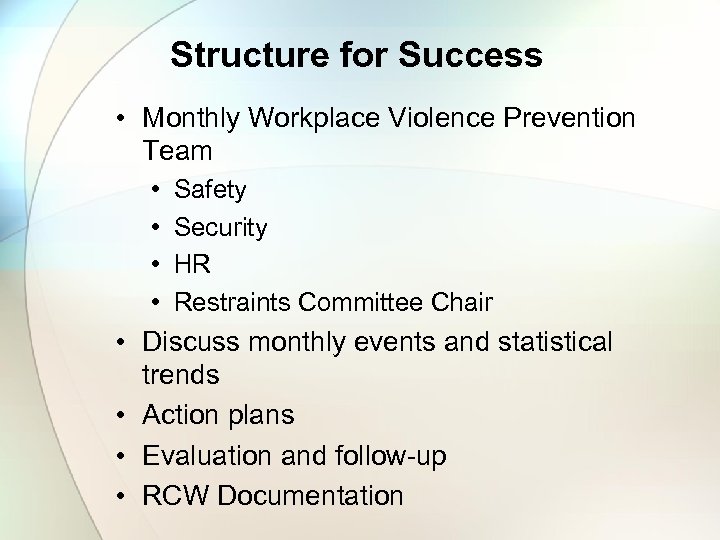 Structure for Success • Monthly Workplace Violence Prevention Team • • Safety Security HR Restraints Committee Chair • Discuss monthly events and statistical trends • Action plans • Evaluation and follow-up • RCW Documentation
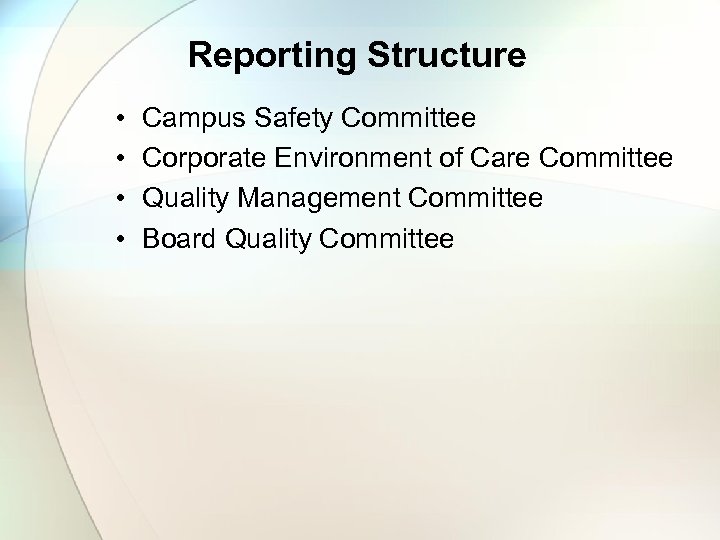 Reporting Structure • • Campus Safety Committee Corporate Environment of Care Committee Quality Management Committee Board Quality Committee
 Supporting Policies/Procedures • Complex Behavior Management • Behavior Agreement Form • Discharging Patient • Using Medical Officer of the Day if needed • • Workplace Violence Prevention Dismissing a Visitor Dismissing an Outpatient Actual or Potential Patient Leaving Against Medical Advice Search and Seizure Security Standby Forensics- Patient Guarding Chain of Custody
 Questions? ? ?
 THANK YOU! Be Safe! Stacia Gloman, CHSP Stacia. Gloman@swedish. org 206 -386 -2915