 Скачать презентацию DC Systems Working Group EFCOG ESSG National Renewable
aa7b11ade742868954d6548d2afaa933.ppt
- Количество слайдов: 41



DC Systems Working Group EFCOG ESSG National Renewable Energy Laboratory July 14 -18, 2014
Best Practices n DC Arc Flash WG Phase I – 10/2010 n n n DC Systems WG Phase II – 10/2012 n n n Basis –Proposal Status Basis – Need for AHJ Decision for DC Systems Product – Consensus Paper DC Systems WG Phase III – 7/2014 n n n Proposal to restructure part of Chapter 3 of 70 E Compare DC Arc Flash calculation approaches Provide a Battery Flowchart for Risk Assessment
DC Arc Flash WG 2010 Members n Cliff Ashley, Andrew Burbelo, Sjef Bennink, Todd Bischoff, Jeremy Bynum, Douglas Coffland, Gary Dreifuerst, Jim Durnan, Lloyd Gordon, Kurt Kranz, Jerry Lane, Mark Mathews, Bert Manzlak, Troy Mc. Cuskey, Jacqueline Mirabal, Earl Myott, Thomas Nehring, Sanjay Sanan, Joshua Siems, Bobby Sparks, Richard Waters
DC Arc Flash WG Deliverables – Phase I n Best Practices n n n DOE Handbook – R&D Station Power – 125 Vdc Research Recommendations Field Measurements on existing systems n Skunk Works n n New Proposals for NFPA 70 E - 2012
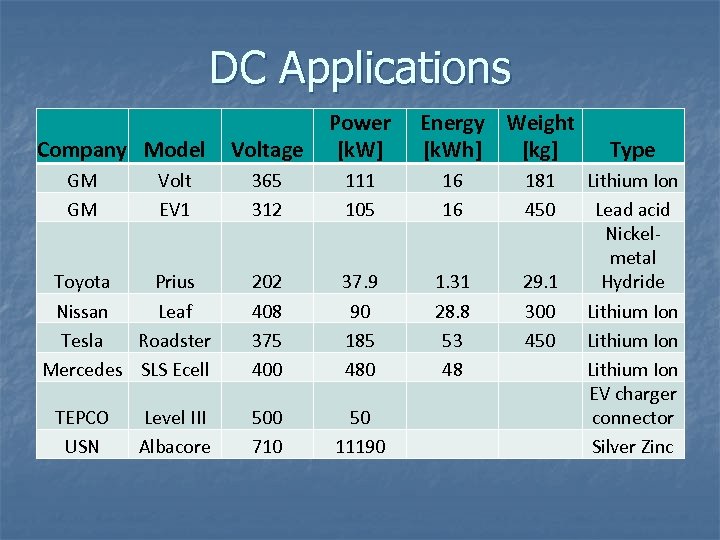
DC Applications Company Model GM GM Volt EV 1 Toyota Prius Nissan Leaf Tesla Roadster Mercedes SLS Ecell TEPCO USN Level III Albacore Voltage Power [k. W] Energy Weight [k. Wh] [kg] 365 312 111 105 16 16 181 450 202 408 375 400 37. 9 90 185 480 1. 31 28. 8 53 48 29. 1 300 450 500 710 50 11190 Type Lithium Ion Lead acid Nickelmetal Hydride Lithium Ion EV charger connector Silver Zinc
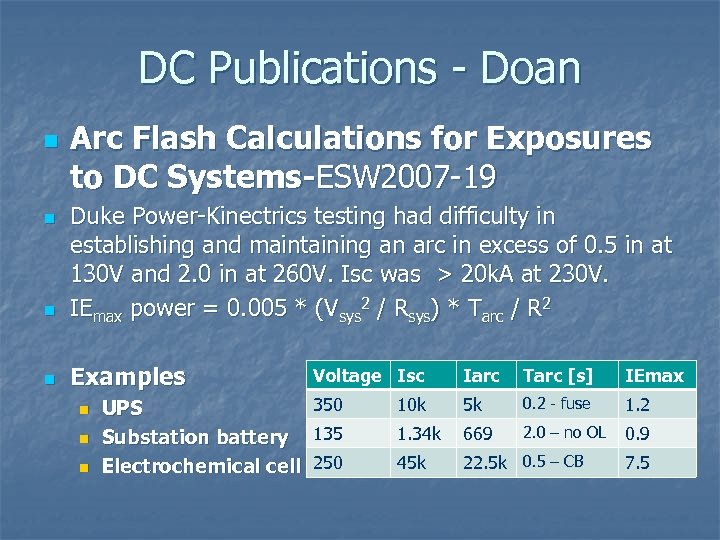
DC Publications - Doan n Arc Flash Calculations for Exposures to DC Systems-ESW 2007 -19 n Duke Power-Kinectrics testing had difficulty in establishing and maintaining an arc in excess of 0. 5 in at 130 V and 2. 0 in at 260 V. Isc was > 20 k. A at 230 V. IEmax power = 0. 005 * (Vsys 2 / Rsys) * Tarc / R 2 n Examples n n Voltage Isc 350 UPS Substation battery 135 Electrochemical cell 250 Iarc Tarc [s] IEmax 10 k 5 k 0. 2 - fuse 1. 2 1. 34 k 669 2. 0 – no OL 0. 9 45 k 22. 5 k 0. 5 – CB 7. 5
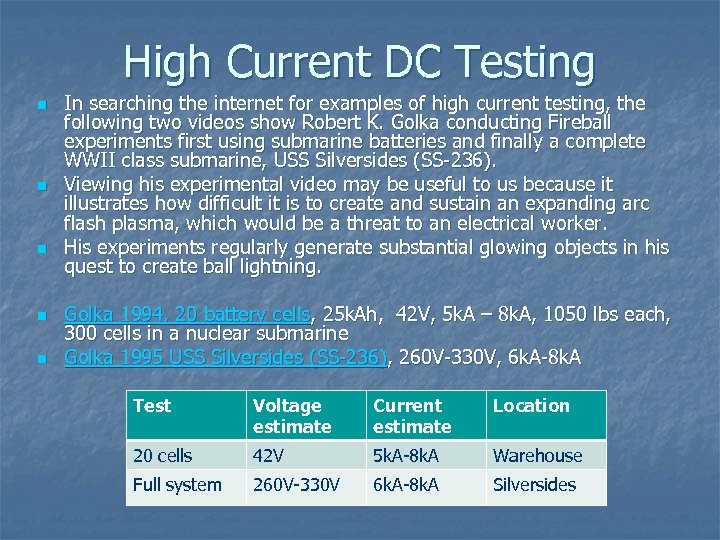
High Current DC Testing n n n In searching the internet for examples of high current testing, the following two videos show Robert K. Golka conducting Fireball experiments first using submarine batteries and finally a complete WWII class submarine, USS Silversides (SS-236). Viewing his experimental video may be useful to us because it illustrates how difficult it is to create and sustain an expanding arc flash plasma, which would be a threat to an electrical worker. His experiments regularly generate substantial glowing objects in his quest to create ball lightning. Golka 1994, 20 battery cells, 25 k. Ah, 42 V, 5 k. A – 8 k. A, 1050 lbs each, 300 cells in a nuclear submarine Golka 1995 USS Silversides (SS-236), 260 V-330 V, 6 k. A-8 k. A Test Voltage estimate Current estimate Location 20 cells 42 V 5 k. A-8 k. A Warehouse Full system 260 V-330 V 6 k. A-8 k. A Silversides
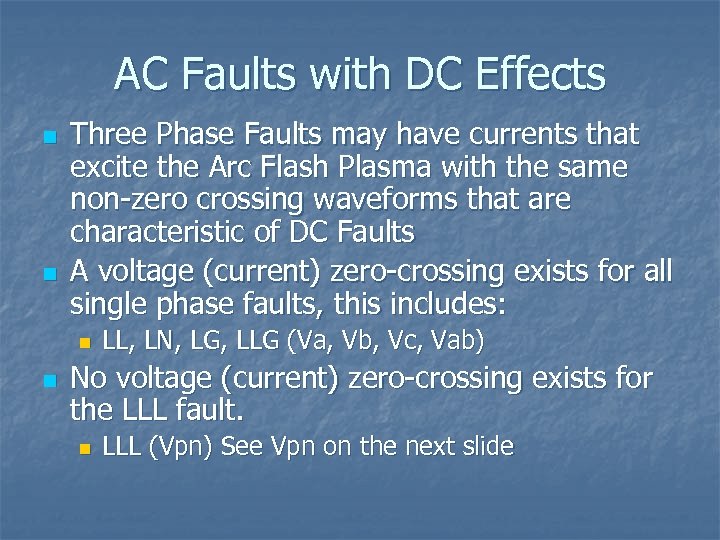
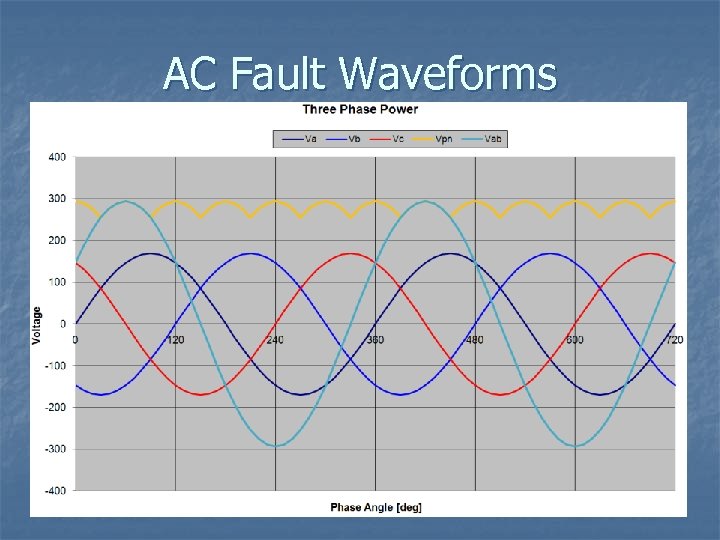
AC Faults with DC Effects n n Three Phase Faults may have currents that excite the Arc Flash Plasma with the same non-zero crossing waveforms that are characteristic of DC Faults A voltage (current) zero-crossing exists for all single phase faults, this includes: n n LL, LN, LG, LLG (Va, Vb, Vc, Vab) No voltage (current) zero-crossing exists for the LLL fault. n LLL (Vpn) See Vpn on the next slide
AC Fault Waveforms
DC WG 2012 Members n Les Bermudez, Stan Berry, Stuart Bloom, Nasser Dehkordi, Terry Dembrowski, Gary Dreifuerst, Kevin Dressman, Tom Duran, John Franchere, Chuck Gaus, Bobby Gray, Lloyd Gordon, Kurt Kranz, John Lacenere, Mark Mathews, George Powell, Lynn Ribaud, Sal Sferrazza, Bobby Sparks, Robert Spang, Gary Sundby, Pat Tran, Mike Utes
DC Systems Working Group Phase II n n n Best Practices - EFCOG Website The fundamental principle of this best practice is based on the general approach: “work controls, such as engineering & administrative controls will yield better protection for workers than a singular focus on calculations. ” Recommendations of Working Group “NFPA 70 E 2012 provides the reference model for working on DC battery systems safely. It uses the best available information to quantify and mitigate the risk. It is what we have to work with and it should be used. When more research is done, that information will be used to improve the model as appropriate. 2 seconds is a reasonable starting point for exposure to an arc incident. Sound professional judgment needs to be used when applying the 2 second exposure time. For example, if the worker is a highly confined space, 2 seconds is likely not appropriate. Finally, we all need to keep in mind that there has never been a documented sustained arc flash incident involving a DC battery system. In light of this fact, 2 seconds is a very conservative factor and should be considered safe until research or an event proves otherwise. ”
DC Systems Working Group Phase II n n Arc Flash - Incident Energy Calculation Hazard Classification Analysis n Issues covered Arc Flash n Molten Ejected Metal, primary hazard for low voltage high current banks (Welding PPE) n Thermal Contact Burn (Heavy duty leather gloves) n n Issues not covered Arc Blast, Electrical Shock, Weight (Lifting) n Chemical, Battery Gas Explosion n
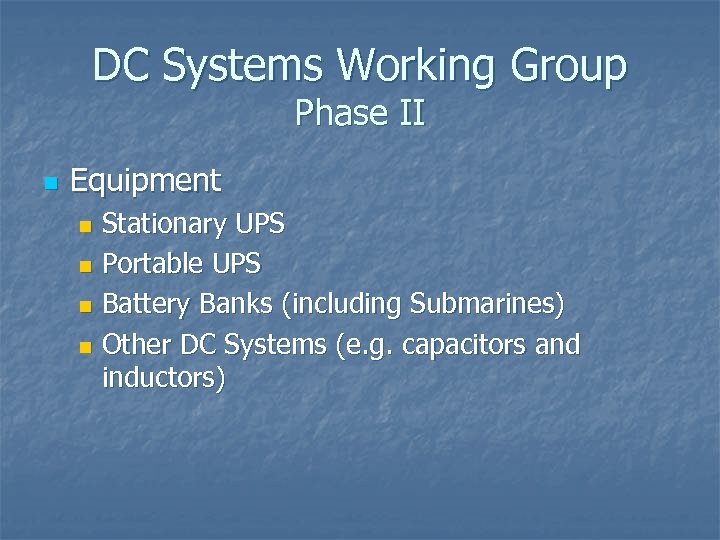
DC Systems Working Group Phase II n Equipment Stationary UPS n Portable UPS n Battery Banks (including Submarines) n Other DC Systems (e. g. capacitors and inductors) n
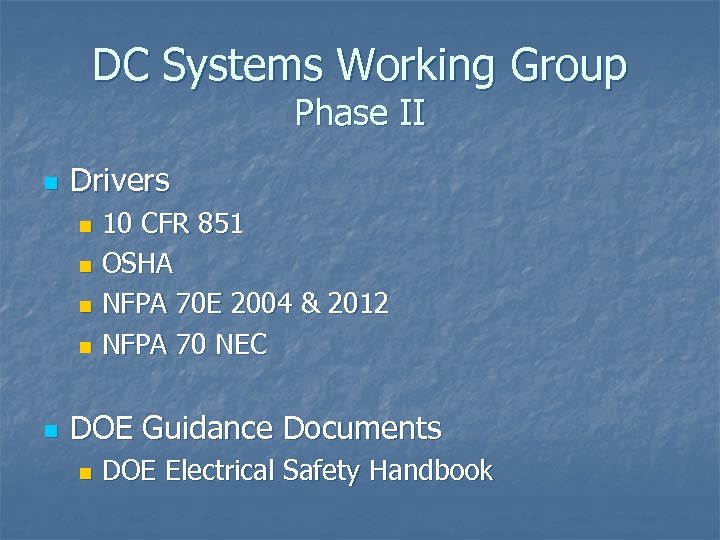
DC Systems Working Group Phase II n Drivers 10 CFR 851 n OSHA n NFPA 70 E 2004 & 2012 n NFPA 70 NEC n n DOE Guidance Documents n DOE Electrical Safety Handbook
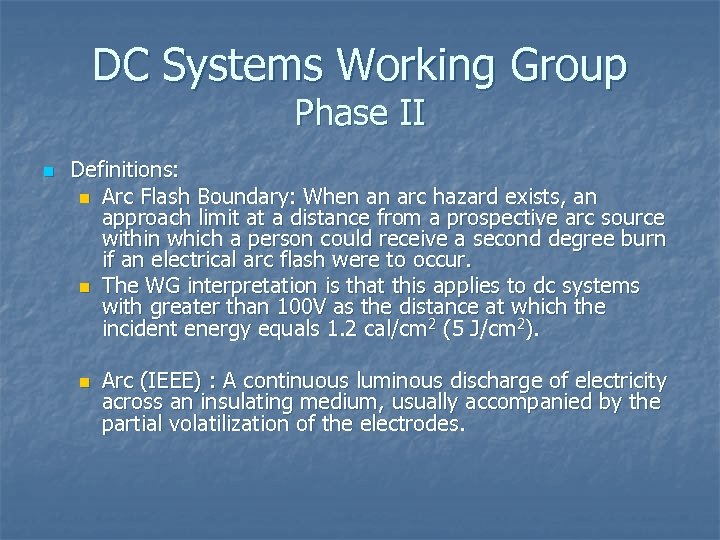
DC Systems Working Group Phase II n Definitions: n Arc Flash Boundary: When an arc hazard exists, an approach limit at a distance from a prospective arc source within which a person could receive a second degree burn if an electrical arc flash were to occur. n The WG interpretation is that this applies to dc systems with greater than 100 V as the distance at which the incident energy equals 1. 2 cal/cm 2 (5 J/cm 2). n Arc (IEEE) : A continuous luminous discharge of electricity across an insulating medium, usually accompanied by the partial volatilization of the electrodes.
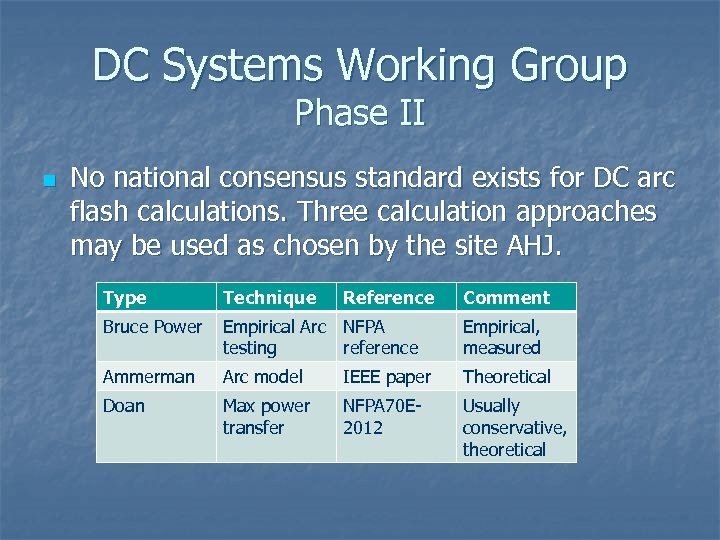
DC Systems Working Group Phase II n No national consensus standard exists for DC arc flash calculations. Three calculation approaches may be used as chosen by the site AHJ. Type Technique Reference Comment Bruce Power Empirical Arc NFPA testing reference Empirical, measured Ammerman Arc model IEEE paper Theoretical Doan Max power transfer NFPA 70 E 2012 Usually conservative, theoretical
DC Systems Working Group Phase II n DC Hazard assessment tools IEEE Stationary Battery Working Group, Flowchart n Doan’s Excel calculator based on NFPA 70 E 2012 n Example Battery planning packages LANL and PNNL n Separate Best Practice (ISA) n n Capacitor & Inductor arc flash boundary calculations.
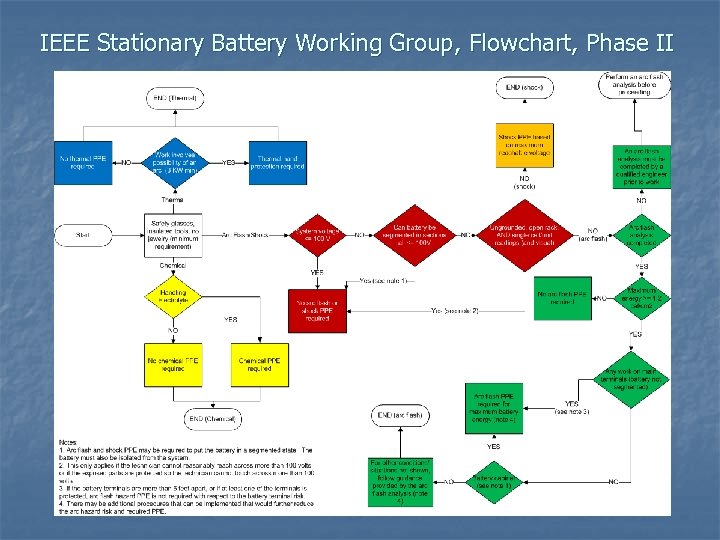
IEEE Stationary Battery Working Group, Flowchart, Phase II
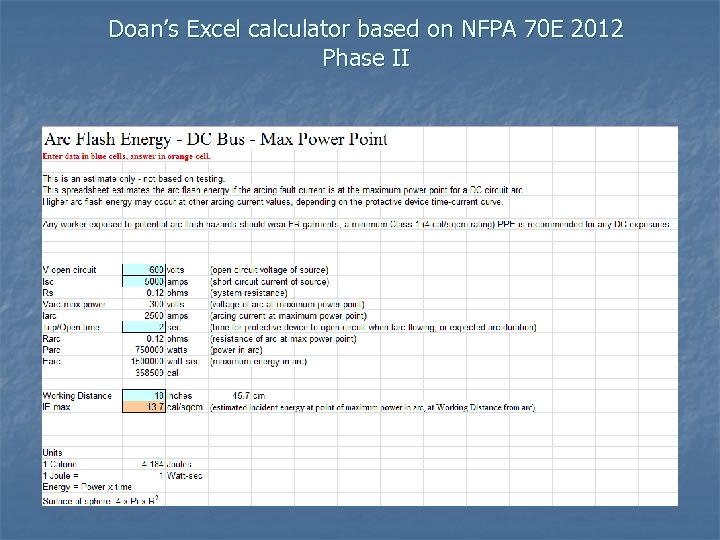
Doan’s Excel calculator based on NFPA 70 E 2012 Phase II
DC Systems Working Group Phase II n Arc Flash Calculations assumptions n n 100% State of Charge of Battery Use the manufacturer’s short circuit rating (< 1 second rate), if not available estimate the short circuit current at 20 x 1 hour rate, or (battery voltage)/(internal resistance) Batteries in equipment use factor of 3 x (arc-in-a-box), on a rack use factor of 1 x Fuse or circuit breaker characteristics must include DC rating
References, Phase II n n “DC Arc Flash, The Implications of the NFPA 70 E 2012 on Battery Maintenance”, W. Cantor, P. Zakielarz, M. Spina 2012 “Arc flash calculations for exposures to DC systems”, Doan, D. R. 2007 “DC arc models and incident energy calculations”, Ammerman, R. F. 2009 IEEE Stationary Battery Working Group, Flowchart
DC Systems Working Group Phase II n Future topics for next EFCOG Draft white paper (capacitors & inductors) sent out for WG peer review n White paper-Using NFPA 70 E 2012 and UPS safe work practices posted on EFCOG web-site n
DC Systems Working Group Phase II n Topics for next EFCOG (Phase III) R&D Equipment n PVs & Fuel Cells n Power backup battery systems n EVs n Charging Stations for EVs n Used vehicle batteries in power utility n n Installation requirements for batteries into NEC?
DC Arc Flash WG 2014 Members n Gerald Alfano, Erika Barraza, Stan Berry, Christopher Brooks, Dwight Clayton, Gary Dreifuerst, Andrew Drutel, Patrick Foy, Lloyd Gordon, Adam Green, Kurt Kranz, John Lacenere, Eugene Ormond, John Scott, Mariko Shirazi, John Sines, Alan Tatum, Joshua Usher, James Wright
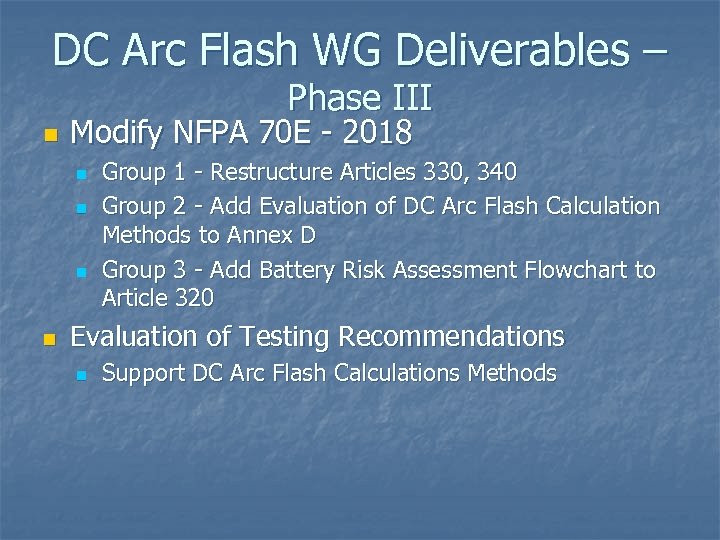
DC Arc Flash WG Deliverables – Phase III n Modify NFPA 70 E - 2018 n n Group 1 - Restructure Articles 330, 340 Group 2 - Add Evaluation of DC Arc Flash Calculation Methods to Annex D Group 3 - Add Battery Risk Assessment Flowchart to Article 320 Evaluation of Testing Recommendations n Support DC Arc Flash Calculations Methods
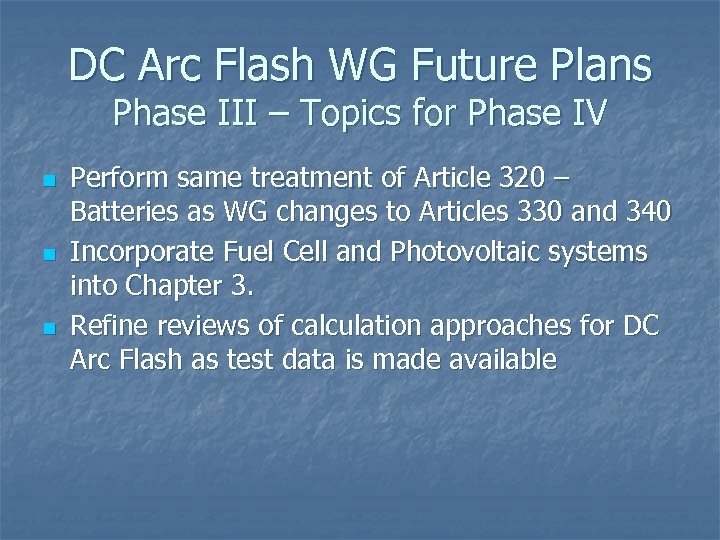
DC Arc Flash WG Future Plans Phase III – Topics for Phase IV n n n Perform same treatment of Article 320 – Batteries as WG changes to Articles 330 and 340 Incorporate Fuel Cell and Photovoltaic systems into Chapter 3. Refine reviews of calculation approaches for DC Arc Flash as test data is made available
EFCOG DC Working Group 1: Modify NFPA 70 E Erika Barraza Dwight Clayton Gary Dreifuerst Patrick Foy Lloyd Gordon Eugene Ormond Alan Tatum
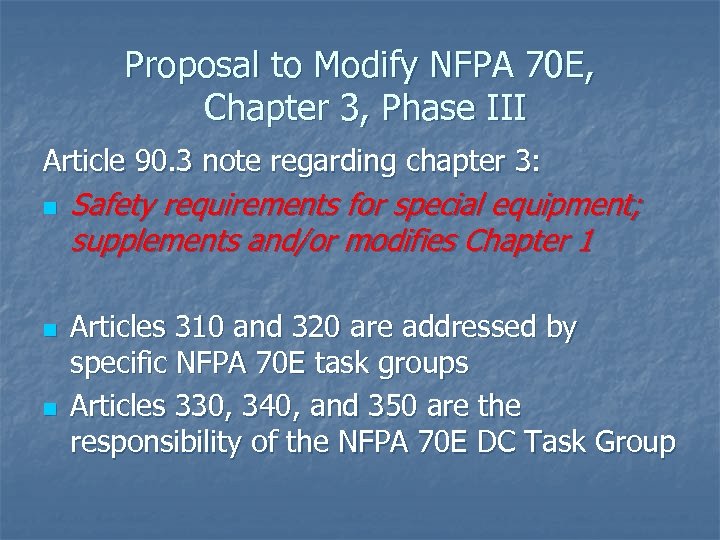
Proposal to Modify NFPA 70 E, Chapter 3, Phase III Article 90. 3 note regarding chapter 3: n n n Safety requirements for special equipment; supplements and/or modifies Chapter 1 Articles 310 and 320 are addressed by specific NFPA 70 E task groups Articles 330, 340, and 350 are the responsibility of the NFPA 70 E DC Task Group
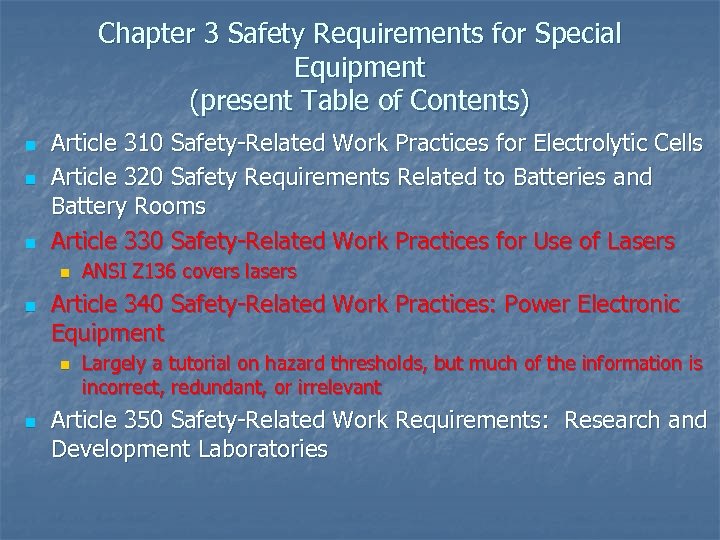
Chapter 3 Safety Requirements for Special Equipment (present Table of Contents) n n n Article 310 Safety-Related Work Practices for Electrolytic Cells Article 320 Safety Requirements Related to Batteries and Battery Rooms Article 330 Safety-Related Work Practices for Use of Lasers n n Article 340 Safety-Related Work Practices: Power Electronic Equipment n n ANSI Z 136 covers lasers Largely a tutorial on hazard thresholds, but much of the information is incorrect, redundant, or irrelevant Article 350 Safety-Related Work Requirements: Research and Development Laboratories
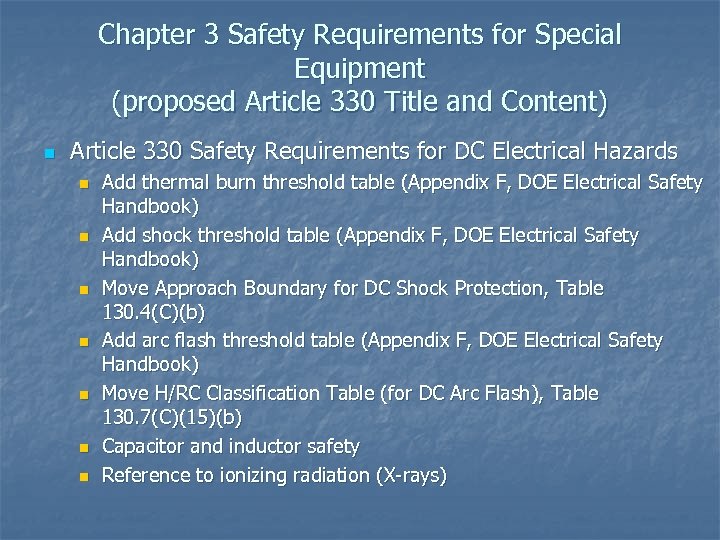
Chapter 3 Safety Requirements for Special Equipment (proposed Article 330 Title and Content) n Article 330 Safety Requirements for DC Electrical Hazards n n n n Add thermal burn threshold table (Appendix F, DOE Electrical Safety Handbook) Add shock threshold table (Appendix F, DOE Electrical Safety Handbook) Move Approach Boundary for DC Shock Protection, Table 130. 4(C)(b) Add arc flash threshold table (Appendix F, DOE Electrical Safety Handbook) Move H/RC Classification Table (for DC Arc Flash), Table 130. 7(C)(15)(b) Capacitor and inductor safety Reference to ionizing radiation (X-rays)
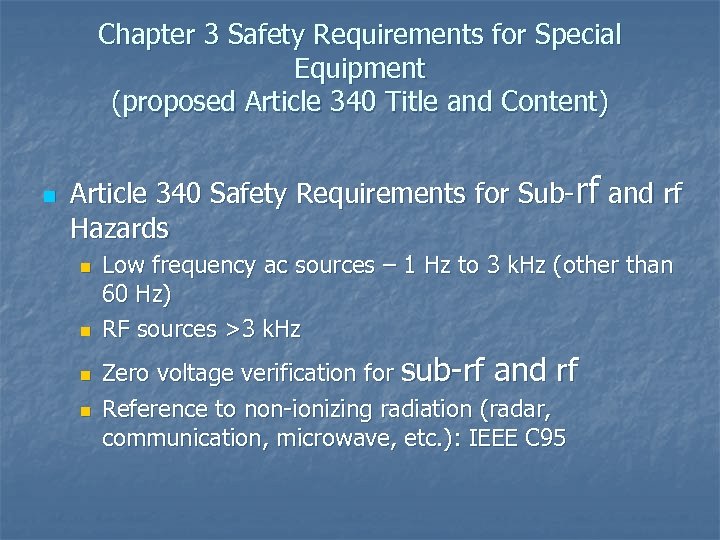
Chapter 3 Safety Requirements for Special Equipment (proposed Article 340 Title and Content) n Article 340 Safety Requirements for Sub-rf and rf Hazards n n Low frequency ac sources – 1 Hz to 3 k. Hz (other than 60 Hz) RF sources >3 k. Hz Zero voltage verification for sub-rf and rf Reference to non-ionizing radiation (radar, communication, microwave, etc. ): IEEE C 95
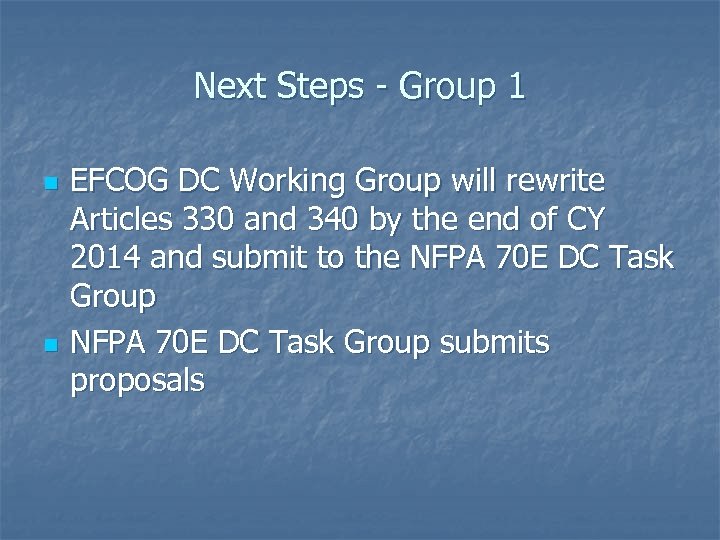
Next Steps - Group 1 n n EFCOG DC Working Group will rewrite Articles 330 and 340 by the end of CY 2014 and submit to the NFPA 70 E DC Task Group submits proposals
DC Arc Hazard Evaluation Methods - Team Members Best Practices – Working Group 2 n n n n John Lacenere - Facilitator Kurt Kranz Adam Green James Wright Andrew Drutel Mariko Shirazi John Scott
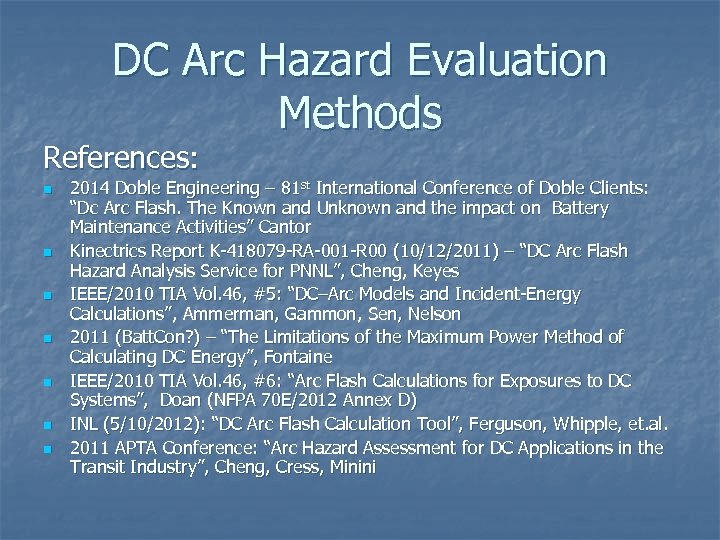
DC Arc Hazard Evaluation Methods References: n n n n 2014 Doble Engineering – 81 st International Conference of Doble Clients: “Dc Arc Flash. The Known and Unknown and the impact on Battery Maintenance Activities” Cantor Kinectrics Report K-418079 -RA-001 -R 00 (10/12/2011) – “DC Arc Flash Hazard Analysis Service for PNNL”, Cheng, Keyes IEEE/2010 TIA Vol. 46, #5: “DC–Arc Models and Incident-Energy Calculations”, Ammerman, Gammon, Sen, Nelson 2011 (Batt. Con? ) – “The Limitations of the Maximum Power Method of Calculating DC Energy”, Fontaine IEEE/2010 TIA Vol. 46, #6: “Arc Flash Calculations for Exposures to DC Systems”, Doan (NFPA 70 E/2012 Annex D) INL (5/10/2012): “DC Arc Flash Calculation Tool”, Ferguson, Whipple, et. al. 2011 APTA Conference: “Arc Hazard Assessment for DC Applications in the Transit Industry”, Cheng, Cress, Minini
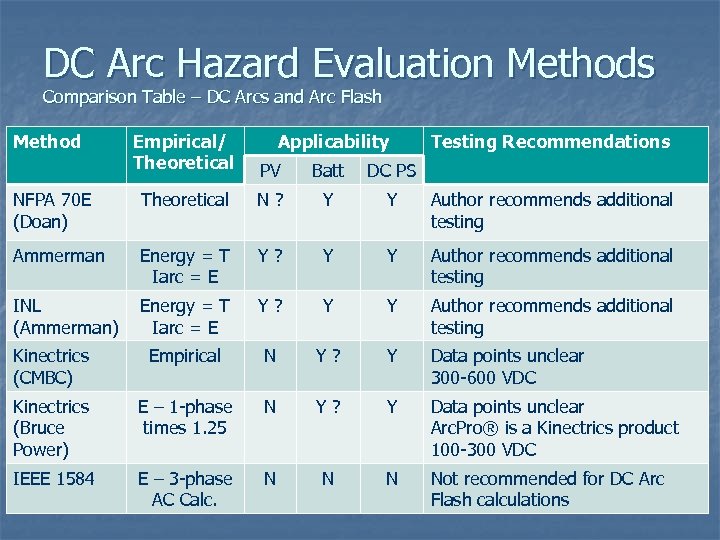
DC Arc Hazard Evaluation Methods Comparison Table – DC Arcs and Arc Flash Method Empirical/ Theoretical Applicability Testing Recommendations PV Batt DC PS NFPA 70 E (Doan) Theoretical N? Y Y Author recommends additional testing Ammerman Energy = T Iarc = E Y? Y Y Author recommends additional testing INL (Ammerman) Energy = T Iarc = E Y? Y Y Author recommends additional testing Kinectrics (CMBC) Empirical N Y? Y Data points unclear 300 -600 VDC Kinectrics (Bruce Power) E – 1 -phase times 1. 25 N Y? Y Data points unclear Arc. Pro® is a Kinectrics product 100 -300 VDC IEEE 1584 E – 3 -phase AC Calc. N Not recommended for DC Arc Flash calculations
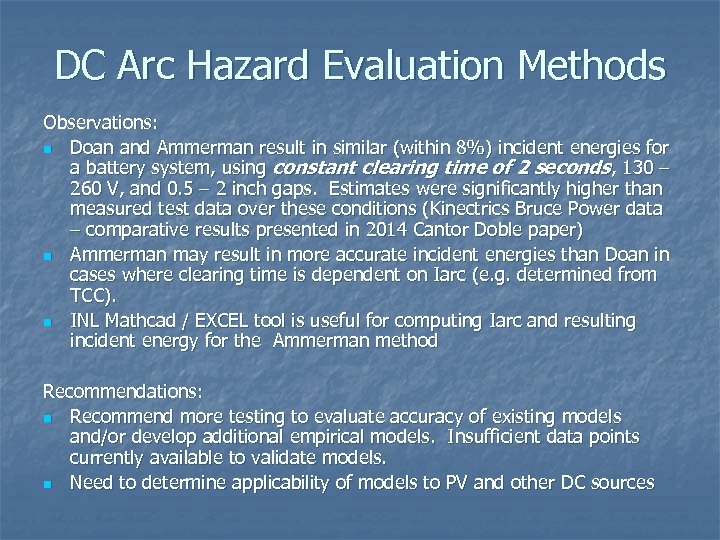
DC Arc Hazard Evaluation Methods Observations: n Doan and Ammerman result in similar (within 8%) incident energies for a battery system, using constant clearing time of 2 seconds, 130 – 260 V, and 0. 5 – 2 inch gaps. Estimates were significantly higher than measured test data over these conditions (Kinectrics Bruce Power data – comparative results presented in 2014 Cantor Doble paper) n Ammerman may result in more accurate incident energies than Doan in cases where clearing time is dependent on Iarc (e. g. determined from TCC). n INL Mathcad / EXCEL tool is useful for computing Iarc and resulting incident energy for the Ammerman method Recommendations: n Recommend more testing to evaluate accuracy of existing models and/or develop additional empirical models. Insufficient data points currently available to validate models. n Need to determine applicability of models to PV and other DC sources
Battery Risk Assessment Group 3 n Stan Berry n n Stan Berry John Sines Gerald Alfano Joshua Usher
Battery Risk Assessment Flowchart n References for Flowchart n n n DC Arc Flash. The Known and Unknown and the Impact on Battery Maintenance Activities, Cantor, 2014. DC Working Group 20121001 d DC Arc Flash. 2013 Regulatory Updates and Recommended Battery Risk Assessment Guidelines, Canto and Mc. Cluer, 2013
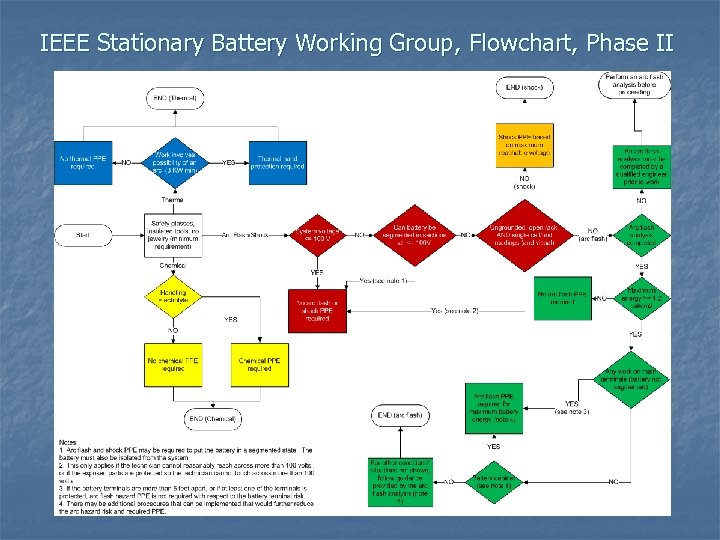
IEEE Stationary Battery Working Group, Flowchart, Phase II
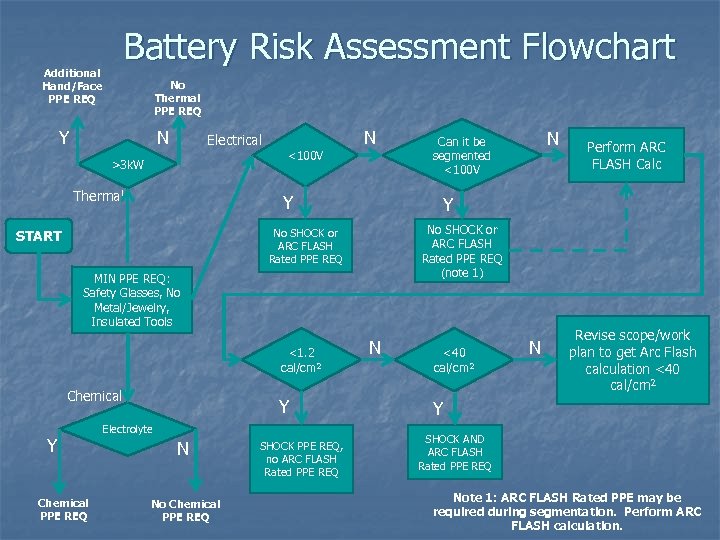
Battery Risk Assessment Flowchart Additional Hand/Face PPE REQ No Thermal PPE REQ Y N N Electrical <100 V >3 k. W Thermal Y No SHOCK or ARC FLASH Rated PPE REQ (note 1) MIN PPE REQ: Safety Glasses, No Metal/Jewelry, Insulated Tools <1. 2 cal/cm² Chemical Y Chemical PPE REQ Y Electrolyte N No Chemical PPE REQ SHOCK PPE REQ, no ARC FLASH Rated PPE REQ Perform ARC FLASH Calc Y No SHOCK or ARC FLASH Rated PPE REQ START N Can it be segmented <100 V N <40 cal/cm² N Revise scope/work plan to get Arc Flash calculation <40 cal/cm 2 Y SHOCK AND ARC FLASH Rated PPE REQ Note 1: ARC FLASH Rated PPE may be required during segmentation. Perform ARC FLASH calculation.
Battery Risk Assessment Group 3 n Future Work n Incorporate testing data as refinement of the DC voltage limit for the threshold of DC Arc Flash
Скачать презентацию DC Systems Working Group EFCOG ESSG National Renewable
aa7b11ade742868954d6548d2afaa933.ppt