


 Скачать презентацию David Keyes project lead http www tops-scidac org
c6b9ba466cef3dc52cc5246a384d5871.ppt
- Количество слайдов: 43
 David Keyes, project lead http: //www. tops-scidac. org Sci. DAC PI Meeting 22 March 2004
 Plan l What TOPS aims to provide l Some uses of TOPS solver software l TOPS posters: what to find Tues. aft. l TOPS attendees: who to meet Tues. aft. l Preview of TOPS’ linear solver interface l How to work with TOPS l Virtually no technical reporting here; please see our eight posters Tue. and seven 2 -pagers on-line Get you to lunch on time! Sci. DAC PI Meeting 22 March 2004
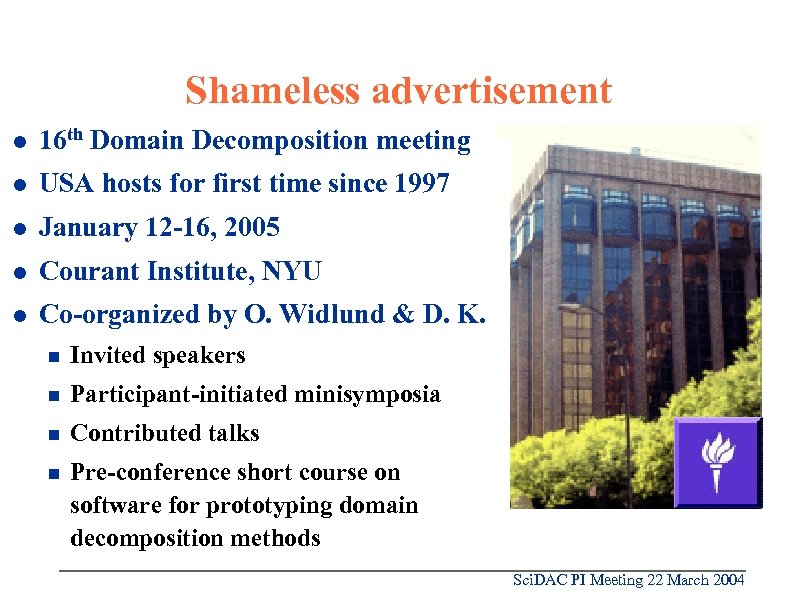 Shameless advertisement l 16 th Domain Decomposition meeting l USA hosts for first time since 1997 l January 12 -16, 2005 l Courant Institute, NYU l Co-organized by O. Widlund & D. K. n Invited speakers n Participant-initiated minisymposia n Contributed talks n Pre-conference short course on software for prototyping domain decomposition methods Sci. DAC PI Meeting 22 March 2004
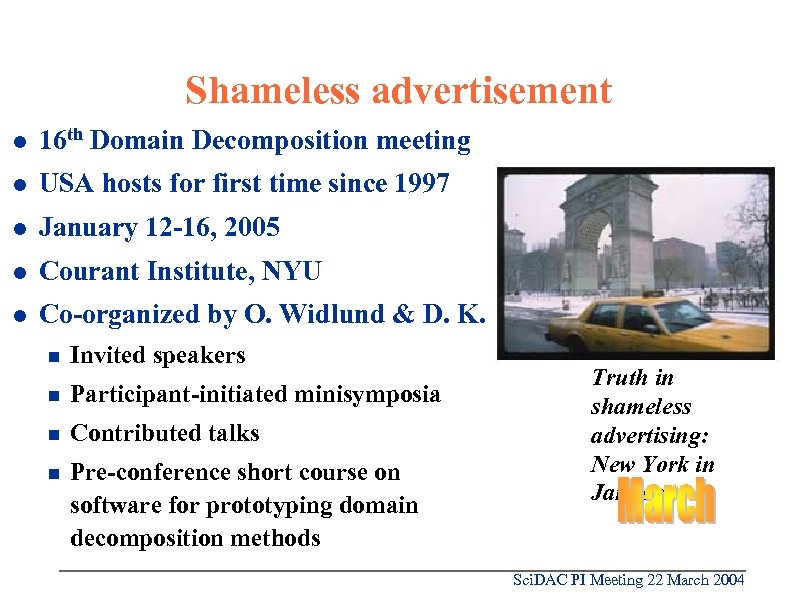 Shameless advertisement l 16 th Domain Decomposition meeting l USA hosts for first time since 1997 l January 12 -16, 2005 l Courant Institute, NYU l Co-organized by O. Widlund & D. K. n Invited speakers n Participant-initiated minisymposia n Contributed talks n Pre-conference short course on software for prototyping domain decomposition methods Truth in shameless advertising: New York in January Sci. DAC PI Meeting 22 March 2004
 Who we are… … the PETSc and TAO people … the hypre and Sundials people … the Super. LU and PARPACK people Sci. DAC PI Meeting 22 March 2004
 Plus some university collaborators … … with a history of lab collaborations in high performance computing Sci. DAC PI Meeting 22 March 2004
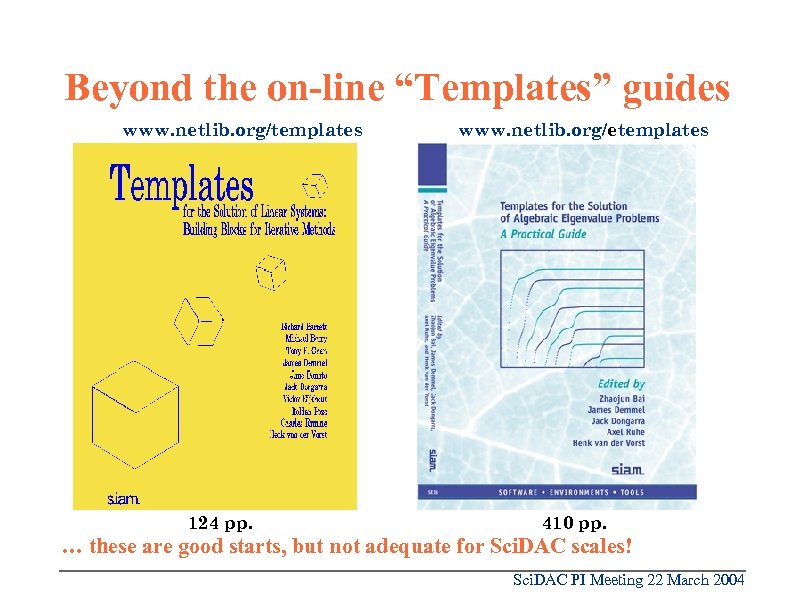 Beyond the on-line “Templates” guides www. netlib. org/templates 124 pp. www. netlib. org/etemplates 410 pp. … these are good starts, but not adequate for Sci. DAC scales! Sci. DAC PI Meeting 22 March 2004
 Themes affirmed in our May’ 03 review l Central concept: software “toolchain” n n l l solutions sensitivity, stability, optimization modules are nested the greatest coding work is in the distributed data structures and should be leveraged users deal with mathematical objects throughout; software hides the MPI and ugly details for performance Ordered goals: usability, robustness, algorithmic efficiency, and performance efficiency Growth industry: multirate problems are forcing applications codes into implicitness Sci. DAC PI Meeting 22 March 2004
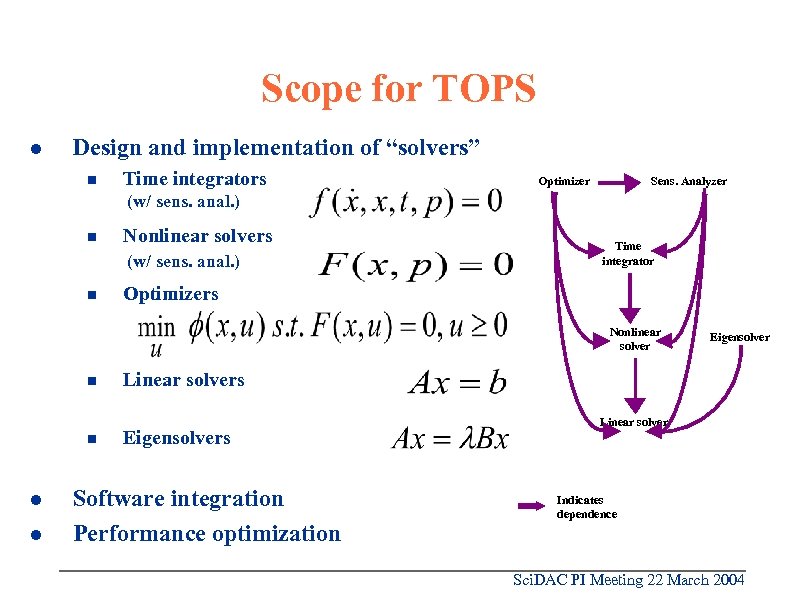 Scope for TOPS l Design and implementation of “solvers” n Time integrators Optimizer Sens. Analyzer (w/ sens. anal. ) n Nonlinear solvers (w/ sens. anal. ) n Time integrator Optimizers Nonlinear solver n n l l Eigensolver Linear solvers Eigensolvers Software integration Performance optimization Linear solver Indicates dependence Sci. DAC PI Meeting 22 March 2004
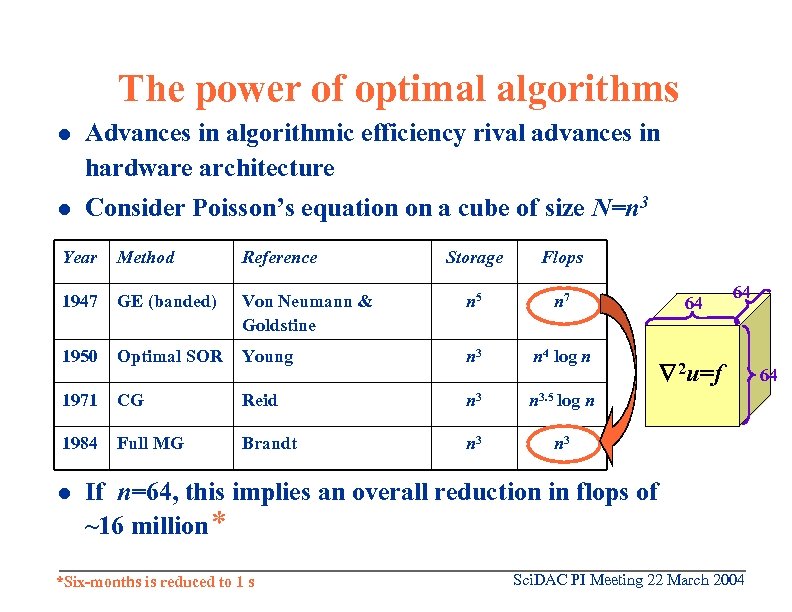 The power of optimal algorithms l Advances in algorithmic efficiency rival advances in hardware architecture l Consider Poisson’s equation on a cube of size N=n 3 Year Method Reference Storage Flops 1947 GE (banded) Von Neumann & Goldstine n 5 n 7 1950 Optimal SOR Young n 3 n 4 log n 1971 CG Reid n 3. 5 log n 1984 Full MG Brandt n 3 l 64 64 2 u=f If n=64, this implies an overall reduction in flops of ~16 million * *Six-months is reduced to 1 s Sci. DAC PI Meeting 22 March 2004 64
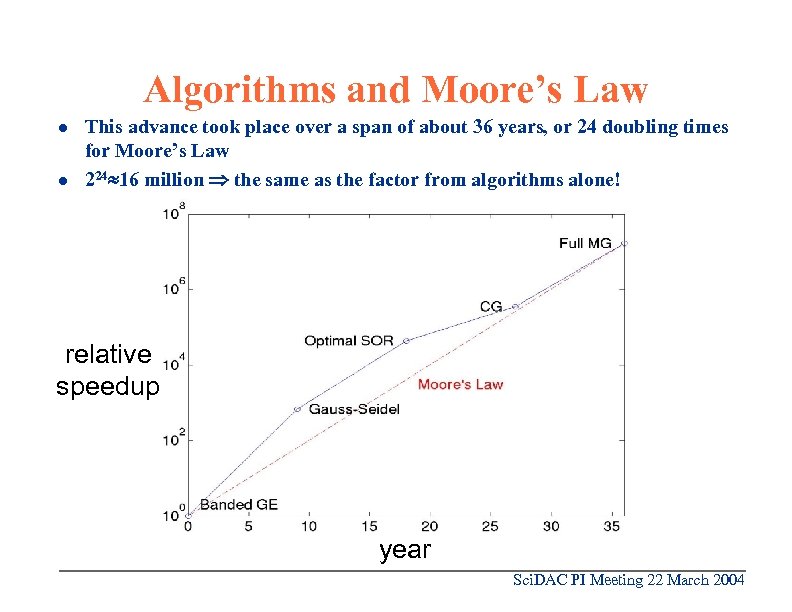 Algorithms and Moore’s Law l l This advance took place over a span of about 36 years, or 24 doubling times for Moore’s Law 224 16 million the same as the factor from algorithms alone! relative speedup year Sci. DAC PI Meeting 22 March 2004
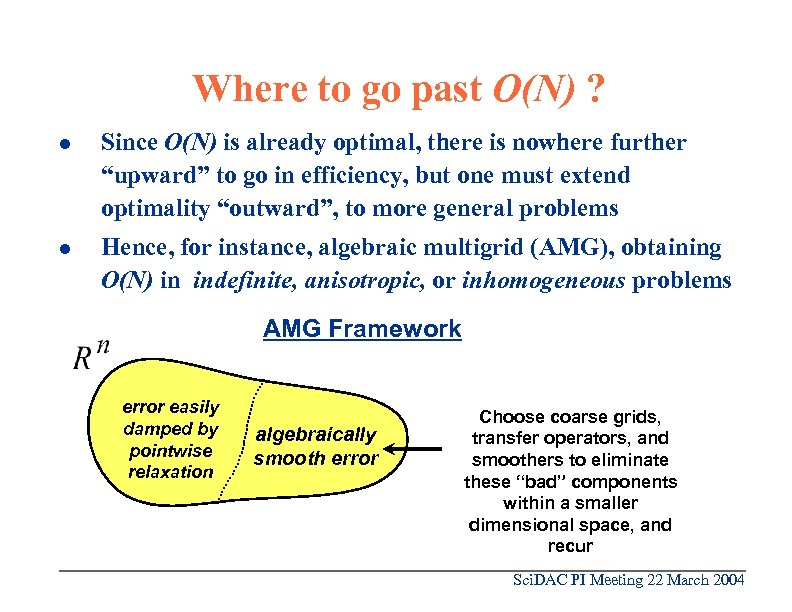 Where to go past O(N) ? l Since O(N) is already optimal, there is nowhere further “upward” to go in efficiency, but one must extend optimality “outward”, to more general problems l Hence, for instance, algebraic multigrid (AMG), obtaining O(N) in indefinite, anisotropic, or inhomogeneous problems AMG Framework error easily damped by pointwise relaxation algebraically smooth error Choose coarse grids, transfer operators, and smoothers to eliminate these “bad” components within a smaller dimensional space, and recur Sci. DAC PI Meeting 22 March 2004
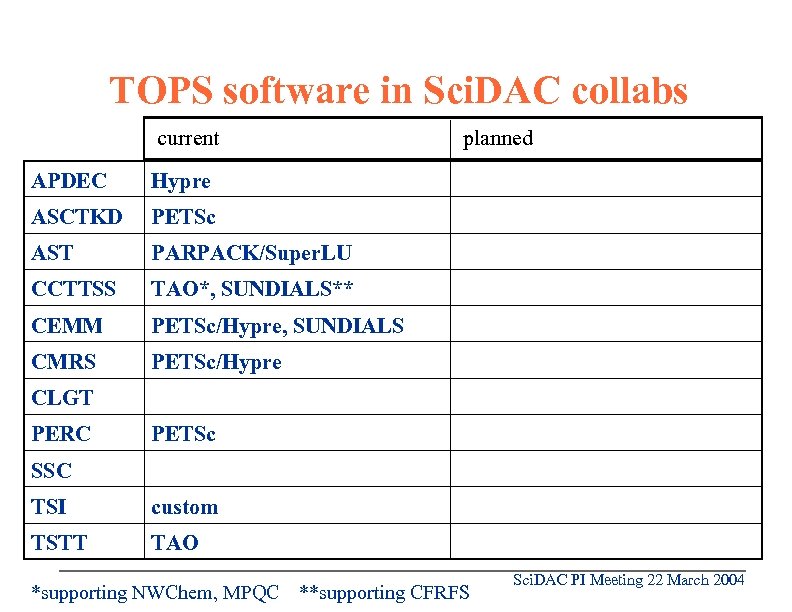 TOPS software in Sci. DAC collabs current planned APDEC Hypre ASCTKD PETSc AST PARPACK/Super. LU CCTTSS TAO*, SUNDIALS** CEMM PETSc/Hypre, SUNDIALS CMRS PETSc/Hypre CLGT PERC PETSc SSC TSI custom TSTT TAO *supporting NWChem, MPQC **supporting CFRFS Sci. DAC PI Meeting 22 March 2004
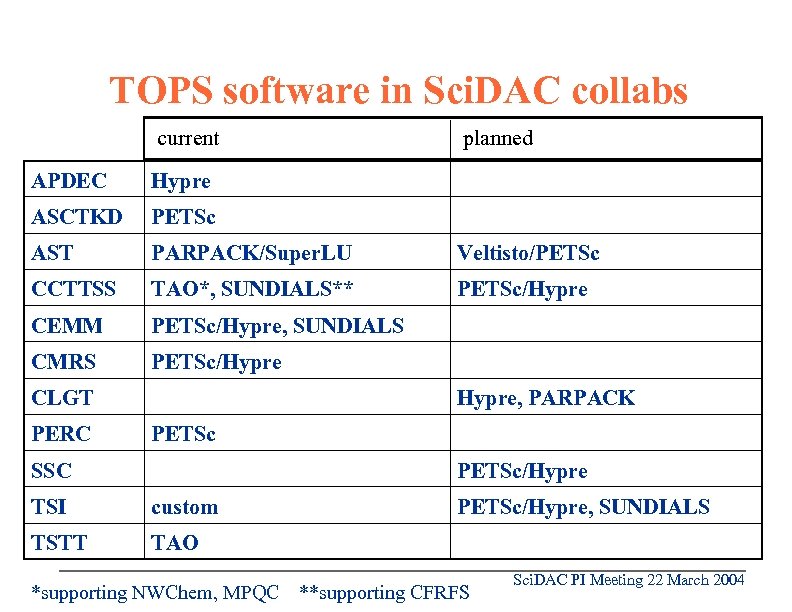 TOPS software in Sci. DAC collabs current planned APDEC Hypre ASCTKD PETSc AST PARPACK/Super. LU Veltisto/PETSc CCTTSS TAO*, SUNDIALS** PETSc/Hypre CEMM PETSc/Hypre, SUNDIALS CMRS PETSc/Hypre CLGT PERC Hypre, PARPACK PETSc SSC PETSc/Hypre TSI custom TSTT TAO *supporting NWChem, MPQC PETSc/Hypre, SUNDIALS **supporting CFRFS Sci. DAC PI Meeting 22 March 2004
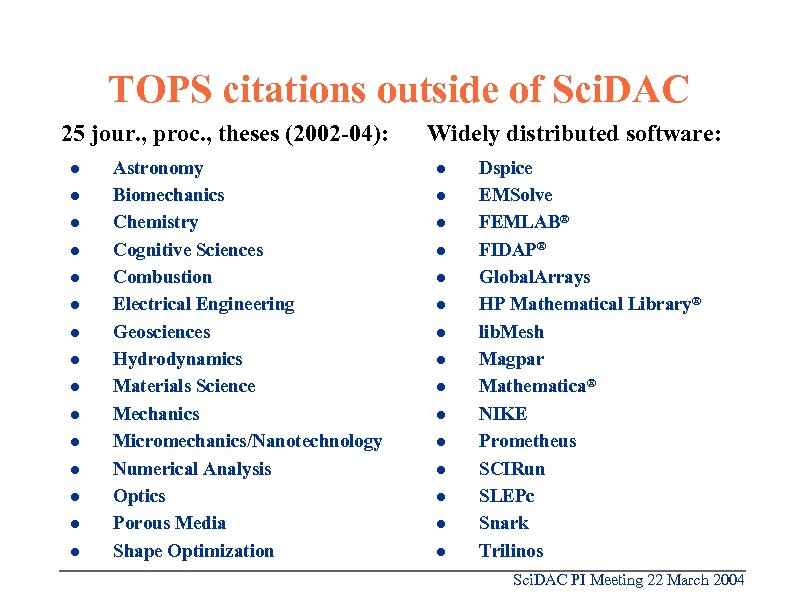 TOPS citations outside of Sci. DAC 25 jour. , proc. , theses (2002 -04): l l l l Astronomy Biomechanics Chemistry Cognitive Sciences Combustion Electrical Engineering Geosciences Hydrodynamics Materials Science Mechanics Micromechanics/Nanotechnology Numerical Analysis Optics Porous Media Shape Optimization Widely distributed software: l l l l Dspice EMSolve FEMLAB® FIDAP® Global. Arrays HP Mathematical Library® lib. Mesh Magpar Mathematica® NIKE Prometheus SCIRun SLEPc Snark Trilinos Sci. DAC PI Meeting 22 March 2004
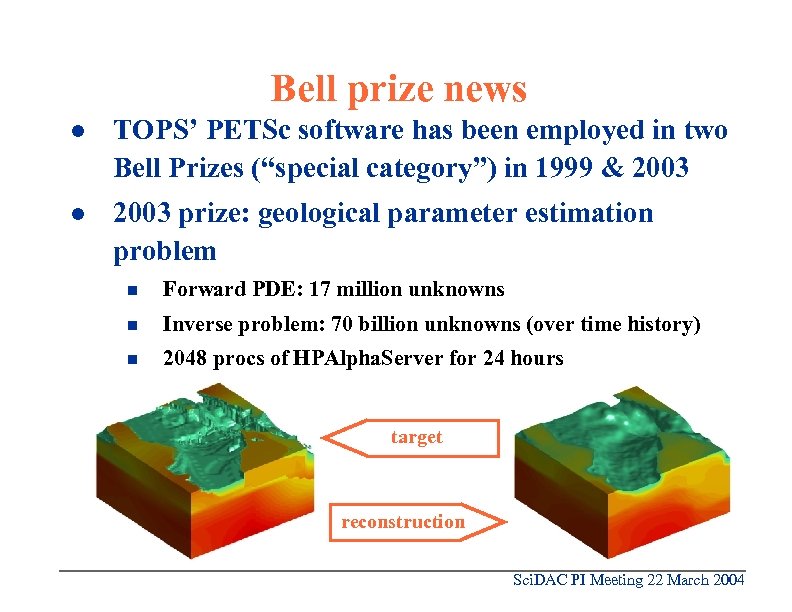 Bell prize news l TOPS’ PETSc software has been employed in two Bell Prizes (“special category”) in 1999 & 2003 l 2003 prize: geological parameter estimation problem n Forward PDE: 17 million unknowns n Inverse problem: 70 billion unknowns (over time history) n 2048 procs of HPAlpha. Server for 24 hours target reconstruction Sci. DAC PI Meeting 22 March 2004
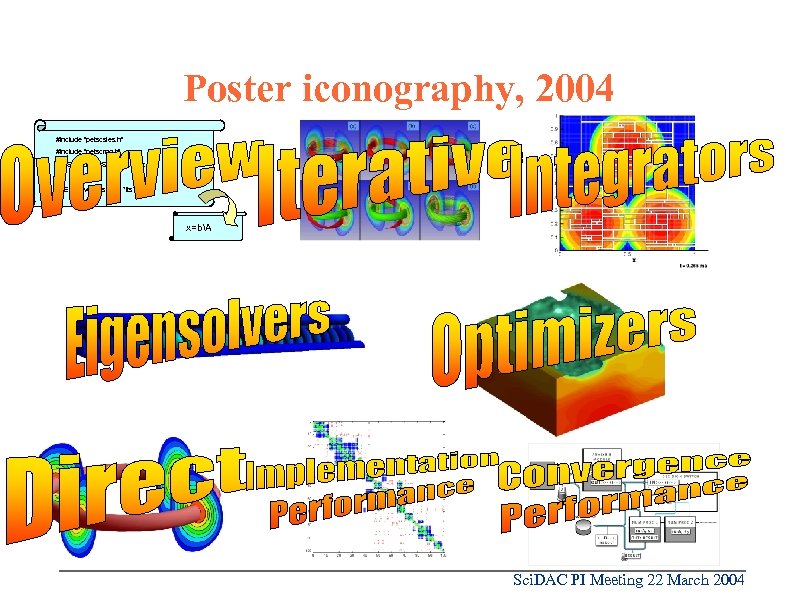 Poster iconography, 2004 #include "petscsles. h" #include "petscmg. h" MGSet. Number. Smooth. Up(pc, n) … SLESSolve(sles, b, x, *its) x=bA Sci. DAC PI Meeting 22 March 2004
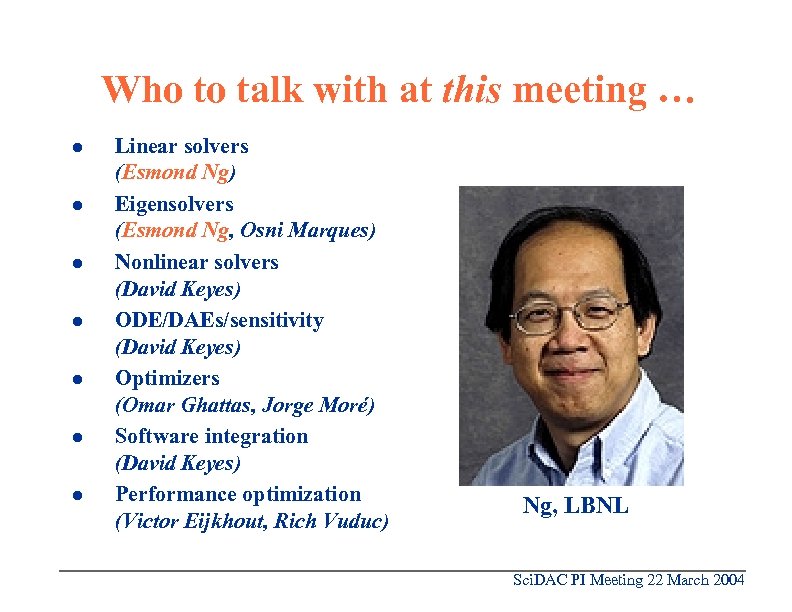 Who to talk with at this meeting … l l l l Linear solvers (Esmond Ng) Eigensolvers (Esmond Ng, Osni Marques) Nonlinear solvers (David Keyes) ODE/DAEs/sensitivity (David Keyes) Optimizers (Omar Ghattas, Jorge Moré) Software integration (David Keyes) Performance optimization (Victor Eijkhout, Rich Vuduc) Ng, LBNL Sci. DAC PI Meeting 22 March 2004
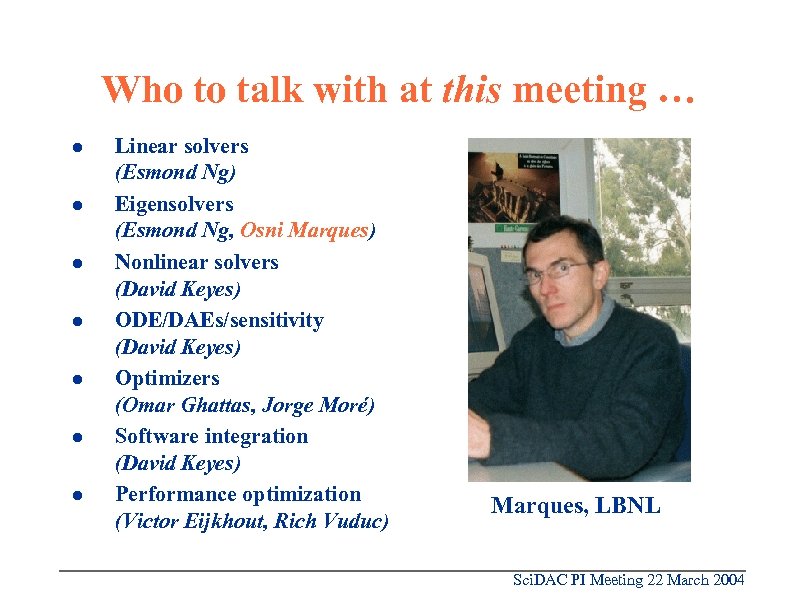 Who to talk with at this meeting … l l l l Linear solvers (Esmond Ng) Eigensolvers (Esmond Ng, Osni Marques) Nonlinear solvers (David Keyes) ODE/DAEs/sensitivity (David Keyes) Optimizers (Omar Ghattas, Jorge Moré) Software integration (David Keyes) Performance optimization (Victor Eijkhout, Rich Vuduc) Marques, LBNL Sci. DAC PI Meeting 22 March 2004
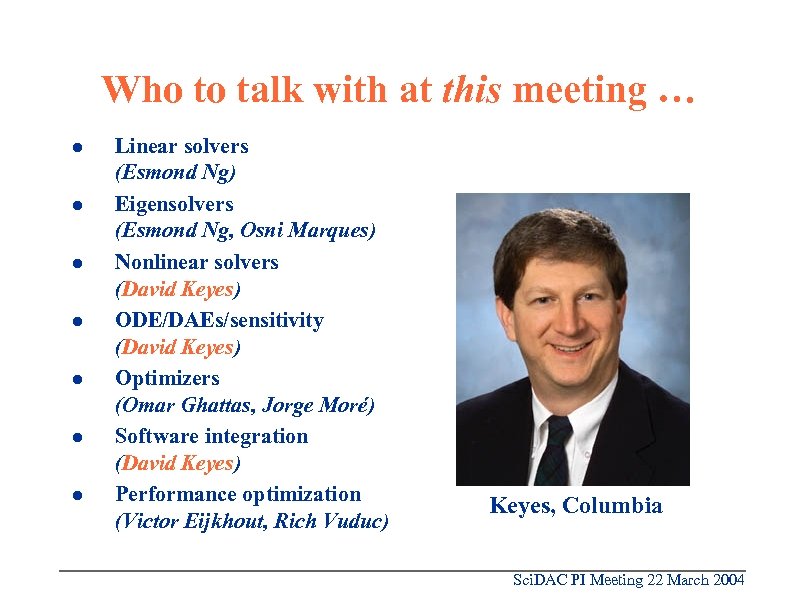 Who to talk with at this meeting … l l l l Linear solvers (Esmond Ng) Eigensolvers (Esmond Ng, Osni Marques) Nonlinear solvers (David Keyes) ODE/DAEs/sensitivity (David Keyes) Optimizers (Omar Ghattas, Jorge Moré) Software integration (David Keyes) Performance optimization (Victor Eijkhout, Rich Vuduc) Keyes, Columbia Sci. DAC PI Meeting 22 March 2004
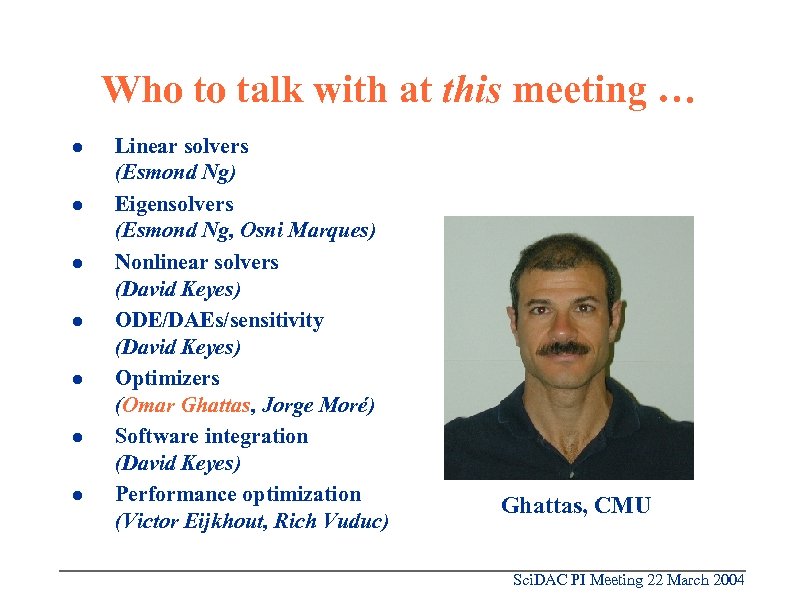 Who to talk with at this meeting … l l l l Linear solvers (Esmond Ng) Eigensolvers (Esmond Ng, Osni Marques) Nonlinear solvers (David Keyes) ODE/DAEs/sensitivity (David Keyes) Optimizers (Omar Ghattas, Jorge Moré) Software integration (David Keyes) Performance optimization (Victor Eijkhout, Rich Vuduc) Ghattas, CMU Sci. DAC PI Meeting 22 March 2004
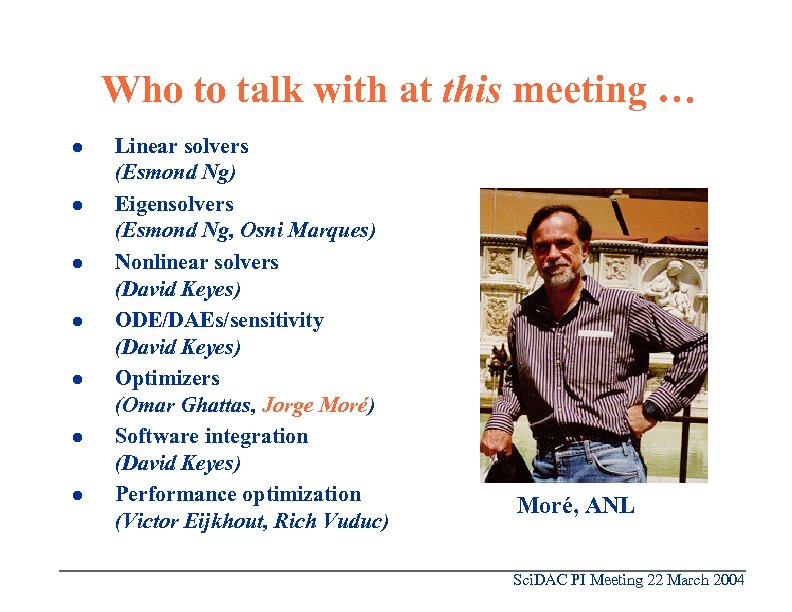 Who to talk with at this meeting … l l l l Linear solvers (Esmond Ng) Eigensolvers (Esmond Ng, Osni Marques) Nonlinear solvers (David Keyes) ODE/DAEs/sensitivity (David Keyes) Optimizers (Omar Ghattas, Jorge Moré) Software integration (David Keyes) Performance optimization (Victor Eijkhout, Rich Vuduc) Moré, ANL Sci. DAC PI Meeting 22 March 2004
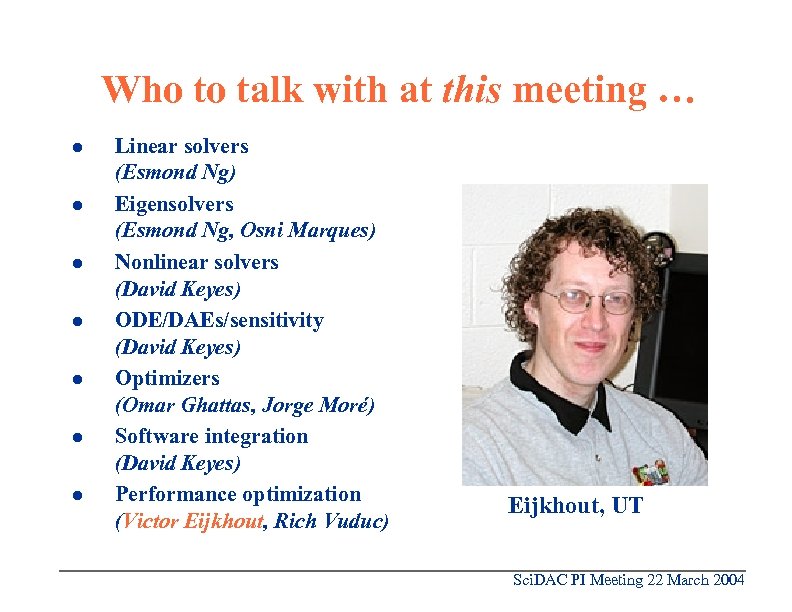 Who to talk with at this meeting … l l l l Linear solvers (Esmond Ng) Eigensolvers (Esmond Ng, Osni Marques) Nonlinear solvers (David Keyes) ODE/DAEs/sensitivity (David Keyes) Optimizers (Omar Ghattas, Jorge Moré) Software integration (David Keyes) Performance optimization (Victor Eijkhout, Rich Vuduc) Eijkhout, UT Sci. DAC PI Meeting 22 March 2004
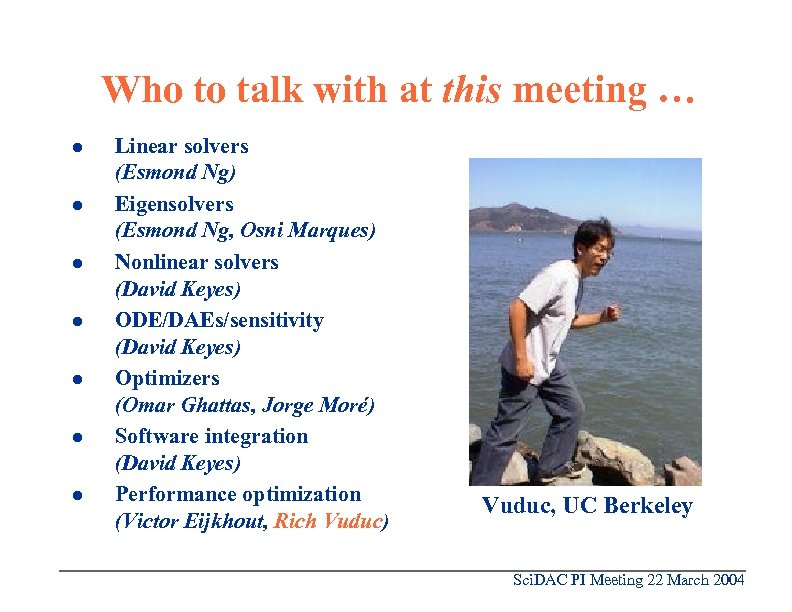 Who to talk with at this meeting … l l l l Linear solvers (Esmond Ng) Eigensolvers (Esmond Ng, Osni Marques) Nonlinear solvers (David Keyes) ODE/DAEs/sensitivity (David Keyes) Optimizers (Omar Ghattas, Jorge Moré) Software integration (David Keyes) Performance optimization (Victor Eijkhout, Rich Vuduc) Vuduc, UC Berkeley Sci. DAC PI Meeting 22 March 2004
 TOPS Solver Interface Nonscalable solution!
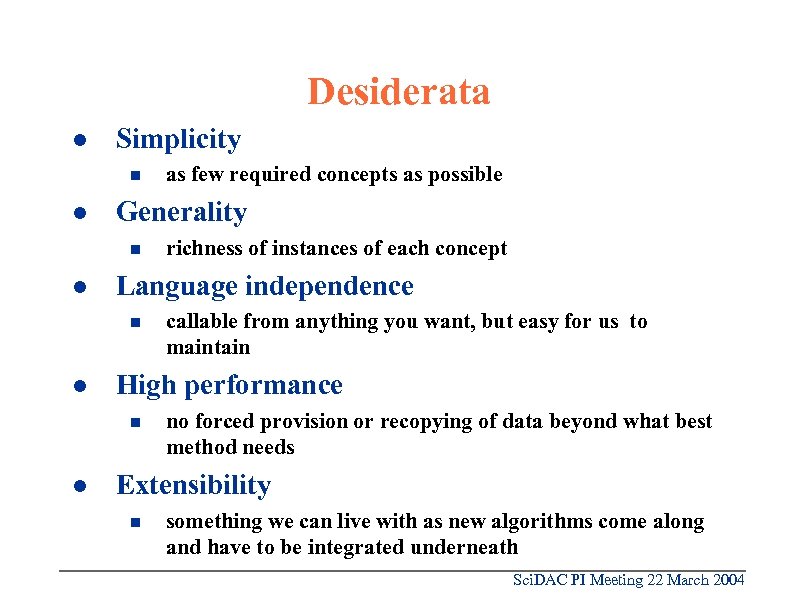 Desiderata l Simplicity n l Generality n l callable from anything you want, but easy for us to maintain High performance n l richness of instances of each concept Language independence n l as few required concepts as possible no forced provision or recopying of data beyond what best method needs Extensibility n something we can live with as new algorithms come along and have to be integrated underneath Sci. DAC PI Meeting 22 March 2004
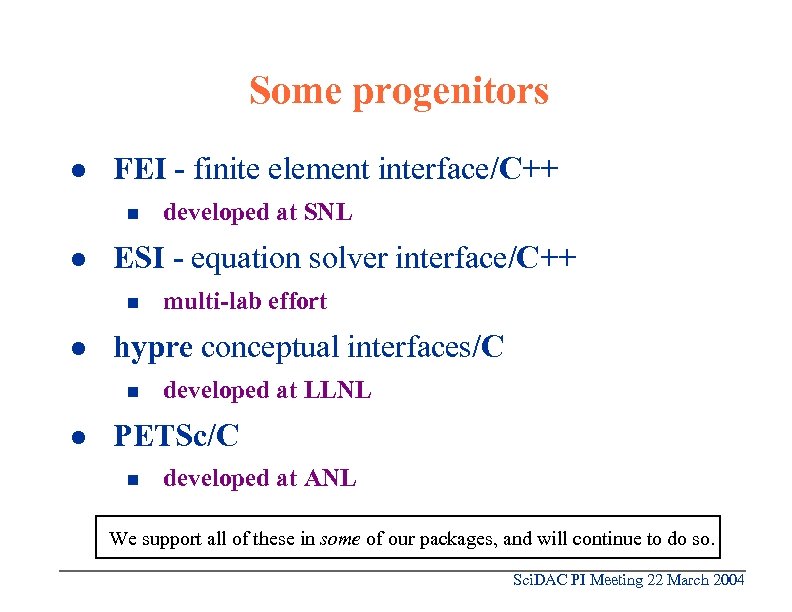 Some progenitors l FEI - finite element interface/C++ n l ESI - equation solver interface/C++ n l multi-lab effort hypre conceptual interfaces/C n l developed at SNL developed at LLNL PETSc/C n developed at ANL We support all of these in some of our packages, and will continue to do so. Sci. DAC PI Meeting 22 March 2004
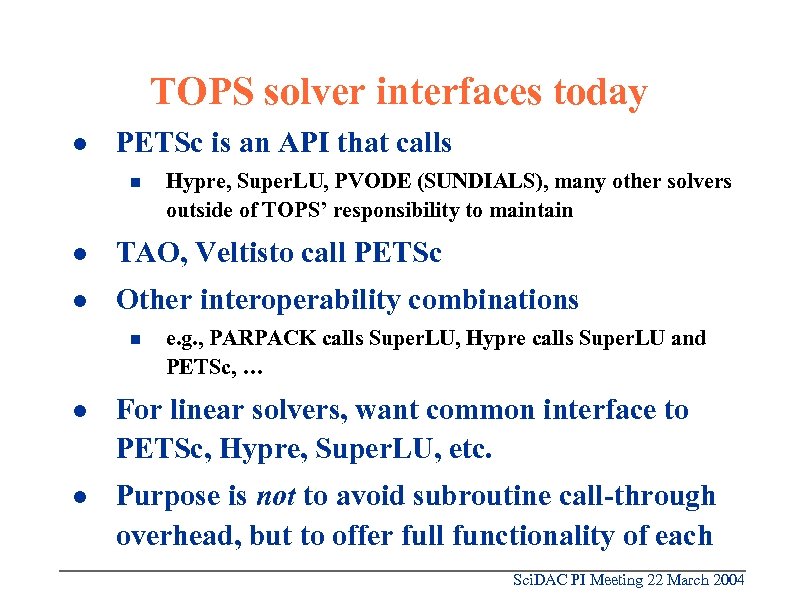 TOPS solver interfaces today l PETSc is an API that calls n Hypre, Super. LU, PVODE (SUNDIALS), many other solvers outside of TOPS’ responsibility to maintain l TAO, Veltisto call PETSc l Other interoperability combinations n e. g. , PARPACK calls Super. LU, Hypre calls Super. LU and PETSc, … l For linear solvers, want common interface to PETSc, Hypre, Super. LU, etc. l Purpose is not to avoid subroutine call-through overhead, but to offer full functionality of each Sci. DAC PI Meeting 22 March 2004
 Language independence l Implemented using LLNL’s SIDL (Scientific Interface Definition Language), a winning card of CCTTSS l Will not require additional packages l Does not require learning a new programming language n F 77/F 90, C/C++, Python Sci. DAC PI Meeting 22 March 2004
 Abstract interface concepts l Solver is a labeled object that contains visible operator and vector(s), and invisible associated storage n A given application code may have dozens of persistent solver objects, each with reusable factorizations, preconditioners, coarse grid hierarchies, etc. l Vector represents field data l Operators and vectors can be accessed with a viewer l Operators and vectors have distributed, blocked layouts Sci. DAC PI Meeting 22 March 2004
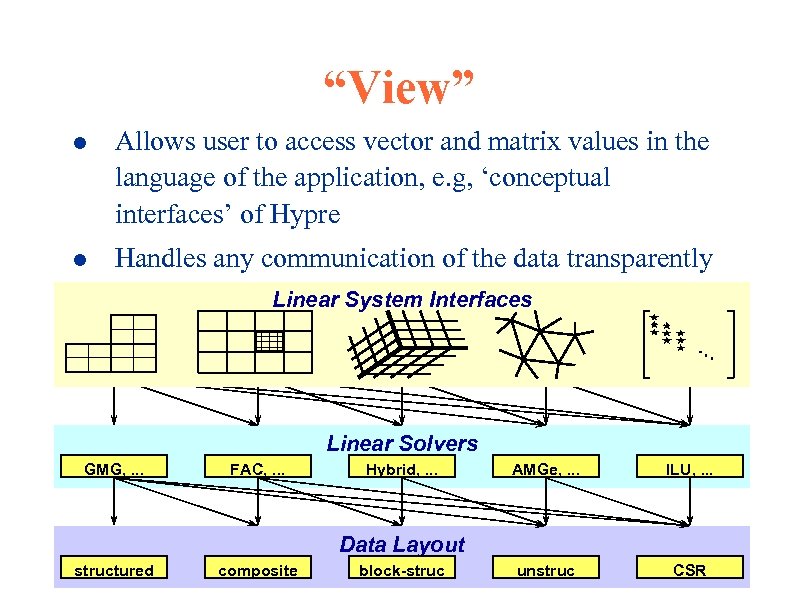 “View” l Allows user to access vector and matrix values in the language of the application, e. g, ‘conceptual interfaces’ of Hypre l Handles any communication of the data transparently Linear System Interfaces Linear Solvers GMG, . . . FAC, . . . Hybrid, . . . AMGe, . . . ILU, . . . Data Layout structured composite block-struc unstruc CSR Sci. DAC PI Meeting 22 March 2004
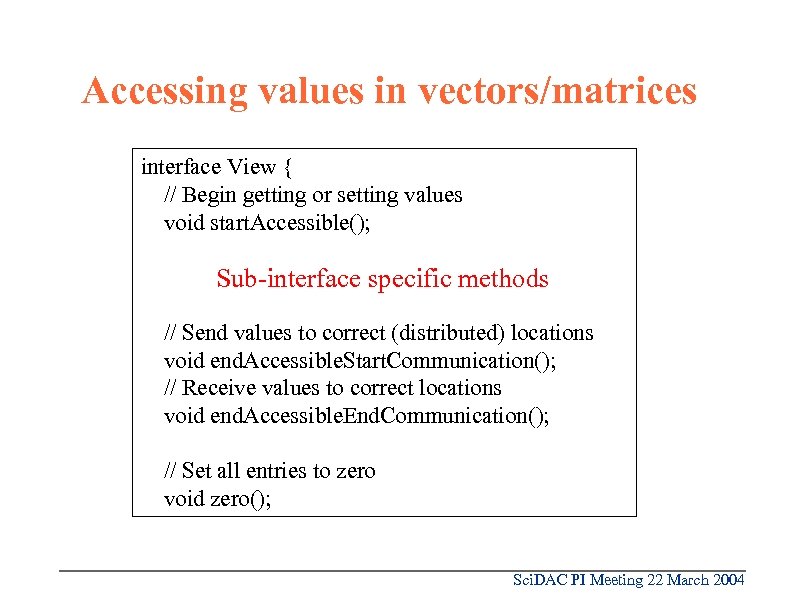 Accessing values in vectors/matrices interface View { // Begin getting or setting values void start. Accessible(); Sub-interface specific methods // Send values to correct (distributed) locations void end. Accessible. Start. Communication(); // Receive values to correct locations void end. Accessible. End. Communication(); // Set all entries to zero void zero(); Sci. DAC PI Meeting 22 March 2004
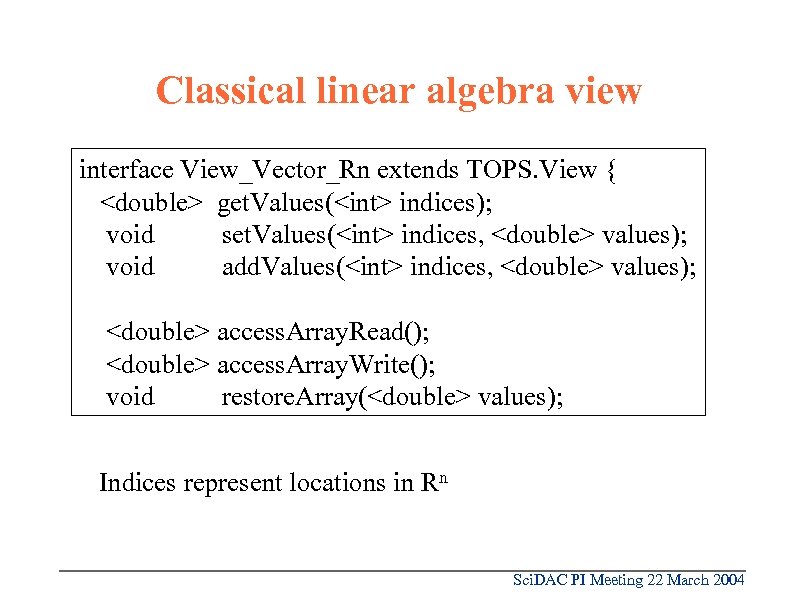 Classical linear algebra view interface View_Vector_Rn extends TOPS. View {
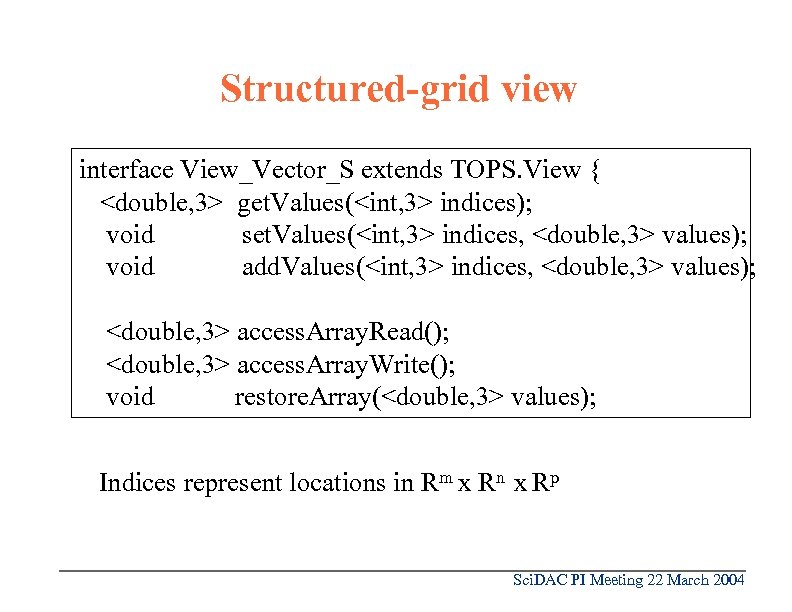 Structured-grid view interface View_Vector_S extends TOPS. View {
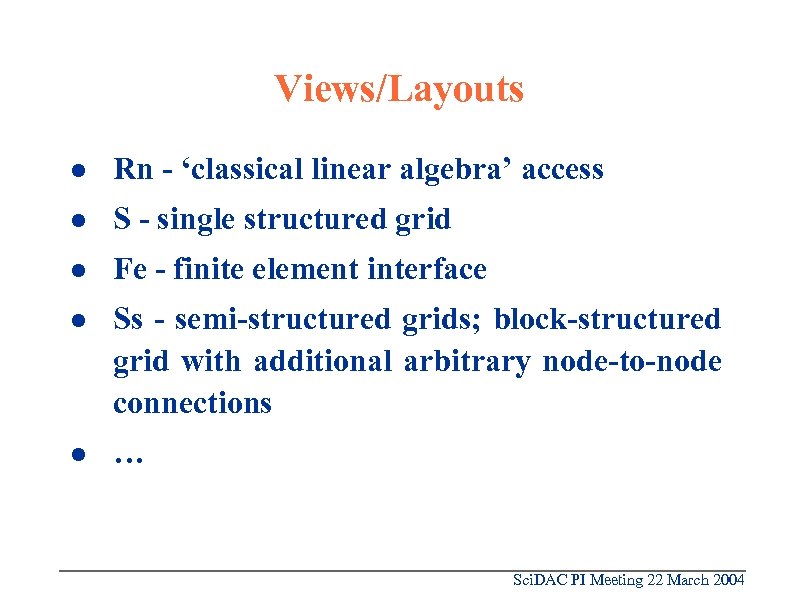 Views/Layouts l Rn - ‘classical linear algebra’ access l S - single structured grid l Fe - finite element interface l Ss - semi-structured grids; block-structured grid with additional arbitrary node-to-node connections l … Sci. DAC PI Meeting 22 March 2004
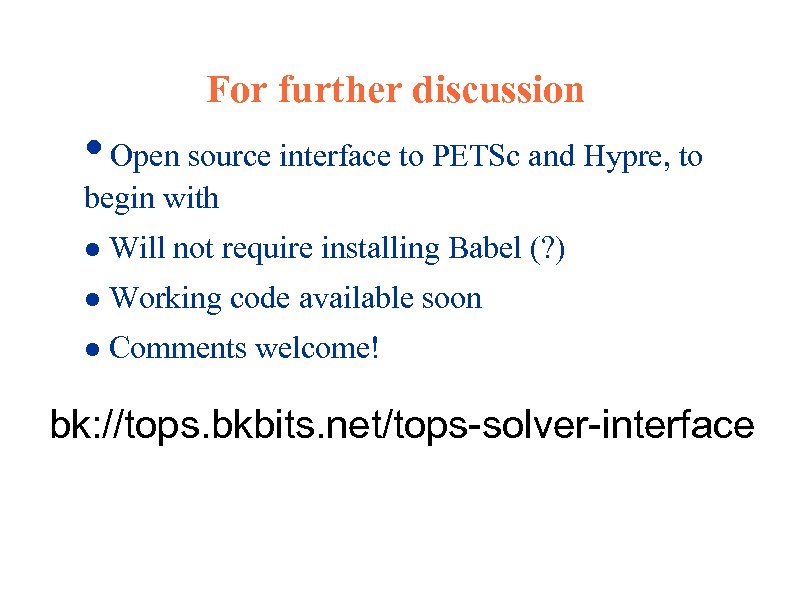 For further discussion • Open source interface to PETSc and Hypre, to begin with l Will not require installing Babel (? ) l Working code available soon l Comments welcome! bk: //tops. bkbits. net/tops-solver-interface
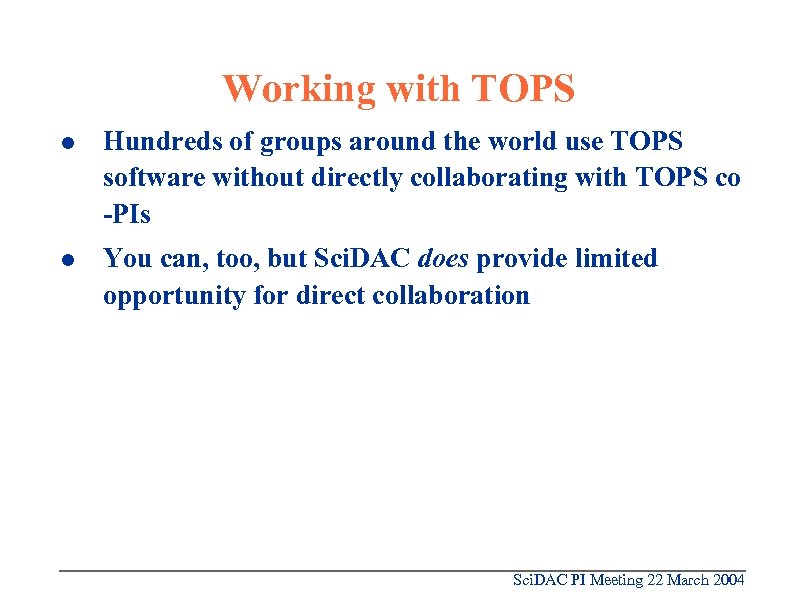 Working with TOPS l Hundreds of groups around the world use TOPS software without directly collaborating with TOPS co -PIs l You can, too, but Sci. DAC does provide limited opportunity for direct collaboration Sci. DAC PI Meeting 22 March 2004
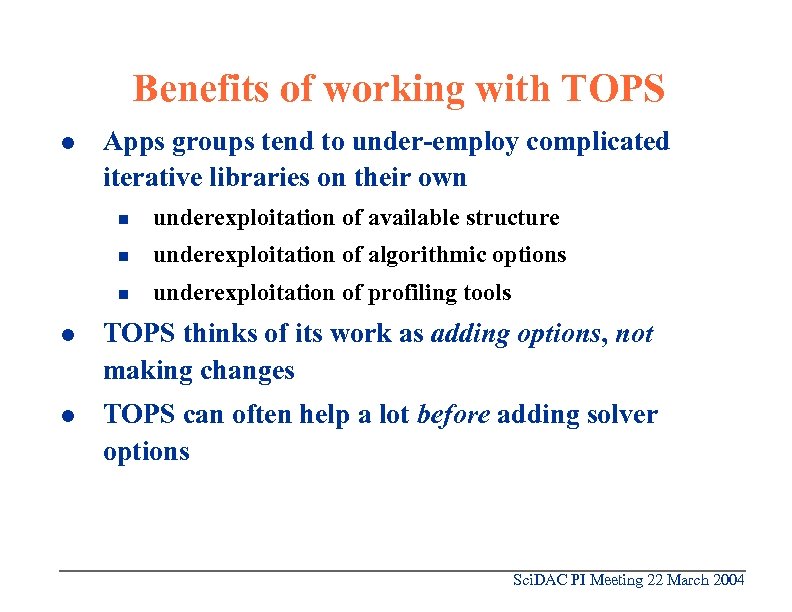 Benefits of working with TOPS l Apps groups tend to under-employ complicated iterative libraries on their own n underexploitation of available structure n underexploitation of algorithmic options n underexploitation of profiling tools l TOPS thinks of its work as adding options, not making changes l TOPS can often help a lot before adding solver options Sci. DAC PI Meeting 22 March 2004
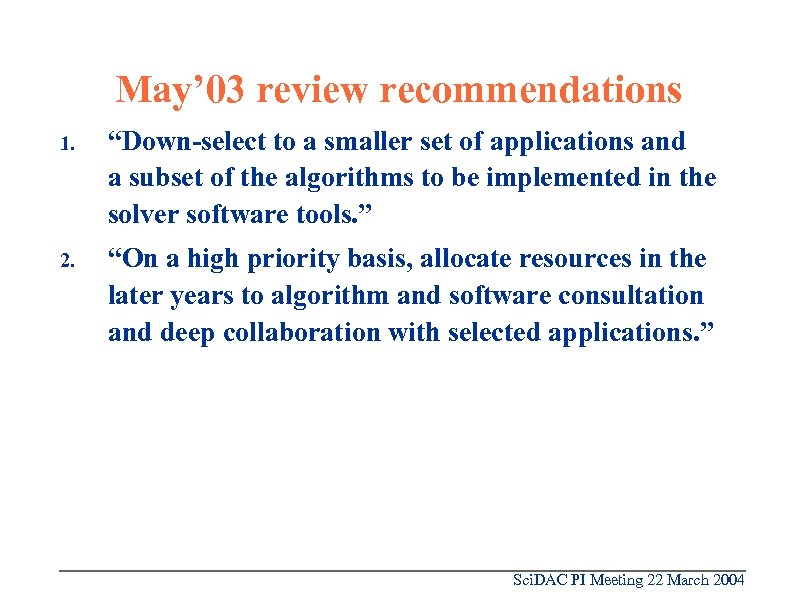 May’ 03 review recommendations 1. “Down-select to a smaller set of applications and a subset of the algorithms to be implemented in the solver software tools. ” 2. “On a high priority basis, allocate resources in the later years to algorithm and software consultation and deep collaboration with selected applications. ” Sci. DAC PI Meeting 22 March 2004
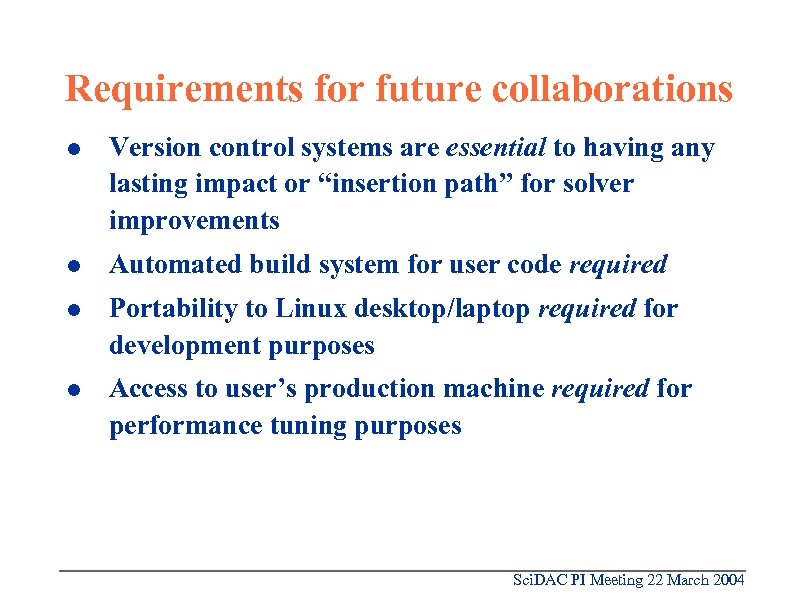 Requirements for future collaborations l Version control systems are essential to having any lasting impact or “insertion path” for solver improvements l Automated build system for user code required l Portability to Linux desktop/laptop required for development purposes l Access to user’s production machine required for performance tuning purposes Sci. DAC PI Meeting 22 March 2004
 Expectations TOPS has of users l l l Be willing to experiment with novel algorithmic choices – optimality is rarely achieved (beyond model problems) without interplay between physics and algorithmics! Adopt flexible, extensible programming styles in which solver algorithms and data structures are not hardwired Be willing to let us play with the real code you care about, but be willing, if appropriate, to abstract out relevant compact tests Sci. DAC PI Meeting 22 March 2004
 TOPS success metrics TOPS users — l Understand range of algorithmic options and their tradeoffs (e. g. , memory vs. time, inner iteration work vs. outer) l Can try all reasonable options easily without recoding or extensive recompilation l Know how their solvers are performing l Spend more time in their physics than in their solvers l Are intelligently driving solver research, and publishing joint papers with TOPS researchers l Can simulate truly new physics, as solver limits are steadily pushed back (finer meshes, complex coupling, etc. ) Sci. DAC PI Meeting 22 March 2004
 For more information. . . http: //www. tops-scidac. org Sci. DAC PI Meeting 22 March 2004