


 Скачать презентацию Datakommunikasjon høsten 2002 Forelesning 1 12 august Datakom
56e39c6b7c0560b88a288a2811085b64.ppt
- Количество слайдов: 59
 Datakommunikasjon høsten 2002 Forelesning 1, 12. august Datakom høsten 2002 1
 Generell introduksjon z Om foreleser: y Bjørn-Arild Kydland, sivilingeniør fra NTH 1984 y Ansatt hos Scandpower Information Technology. y Tidligere Telenor og IBM. z Om kurset y 13 forelesninger á 3 timer. Siste forelesning 11. Ingen forelesning 19. 08 y Repitisjon 18. 11 y 2 obligatoriske oppgaver y Forelesningsnotater på norsk og engelsk y Hjelpelærer: Ikke bestemt ennå. z Pensum y Computer Networking, A top-down Approach Featuring the Internet, Kurose & Ross, Addison-Wesley, ISBN: 0 -201 -47711 -4 y Ny lærebok i år y Forelesningsnotater y Pesumliste er ikke klar ennå Datakom høsten 2002 2
 Generell intro forts. z Informasjonsutveksling y epost y www y news bak@scandpower. com ref hjemmeside z Krav til studentene y Still spørsmål - gode spørsmål og dumme spørsmål y 3 vekttall er mer enn en full arbeidsdag per uke. z Målsetning y Bygge opp et begrepsapparat rundt datakommunikasjon. y Vekt på praktiske eksempler knyttet til Internett Datakom høsten 2002 3
 Foreløpig pensumliste z Datakom høsten 2002 4
 Hva skal dere lære? z Nettverkskort z Protokoller z Adressering z Applikasjoner z ISDN z LAN z WAN z ISP z ASP z Ethernet z ARP z TCP/IP z Bro z Svitsj z Ruter z FW z DNS z SNMP z SMTP Datakom høsten 2002 5
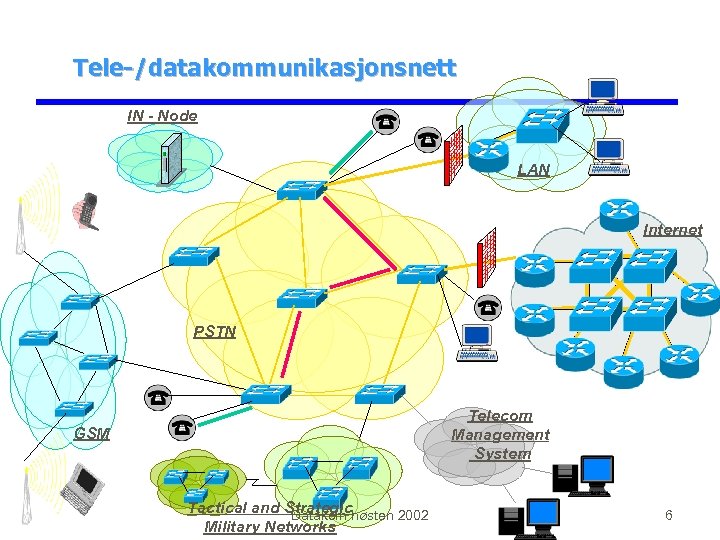 Tele-/datakommunikasjonsnett IN - Node LAN Internet PSTN Telecom Management System GSM Tactical and Strategichøsten 2002 Datakom Military Networks 6
 A Communications Model z Source y. Generates data to be transmitted z Transmitter y. Converts data into transmittable signals z Transmission System y. Carries data z Receiver y. Converts received signal into data z Destination y. Takes incoming data Datakom høsten 2002 7
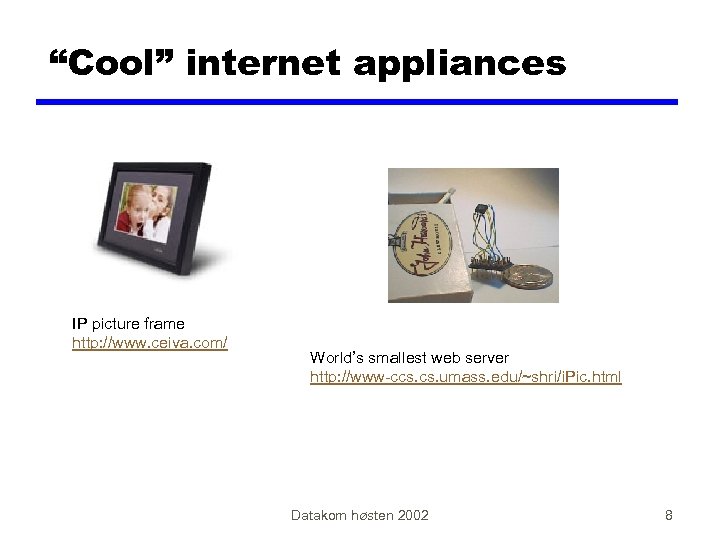 “Cool” internet appliances IP picture frame http: //www. ceiva. com/ World’s smallest web server http: //www-ccs. umass. edu/~shri/i. Pic. html Datakom høsten 2002 8
 Datakom høsten 2002 9
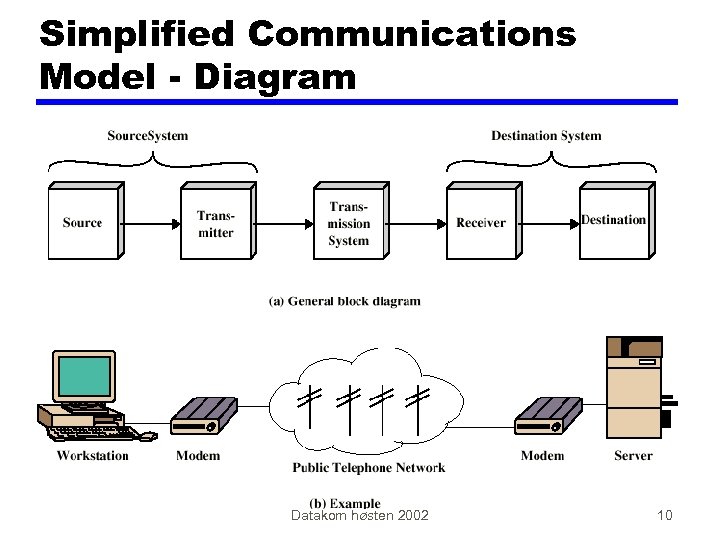 Simplified Communications Model - Diagram Datakom høsten 2002 10
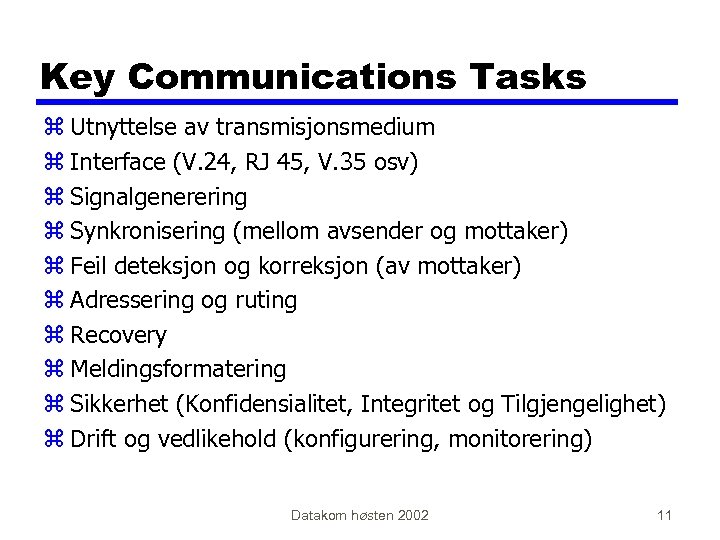 Key Communications Tasks z Utnyttelse av transmisjonsmedium z Interface (V. 24, RJ 45, V. 35 osv) z Signalgenerering z Synkronisering (mellom avsender og mottaker) z Feil deteksjon og korreksjon (av mottaker) z Adressering og ruting z Recovery z Meldingsformatering z Sikkerhet (Konfidensialitet, Integritet og Tilgjengelighet) z Drift og vedlikehold (konfigurering, monitorering) Datakom høsten 2002 11
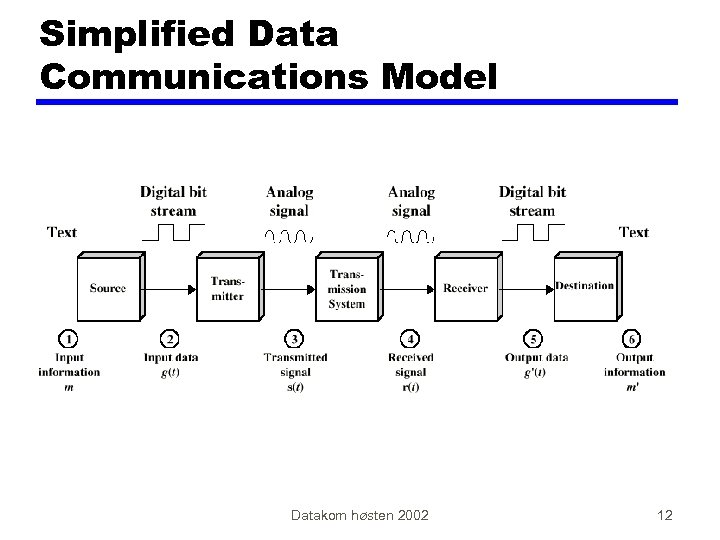 Simplified Data Communications Model Datakom høsten 2002 12
 Networking z Point to point communication not usually practical y. Devices are too far apart y. Large set of devices would need impractical number of connections z Solution is a communications network Datakom høsten 2002 13
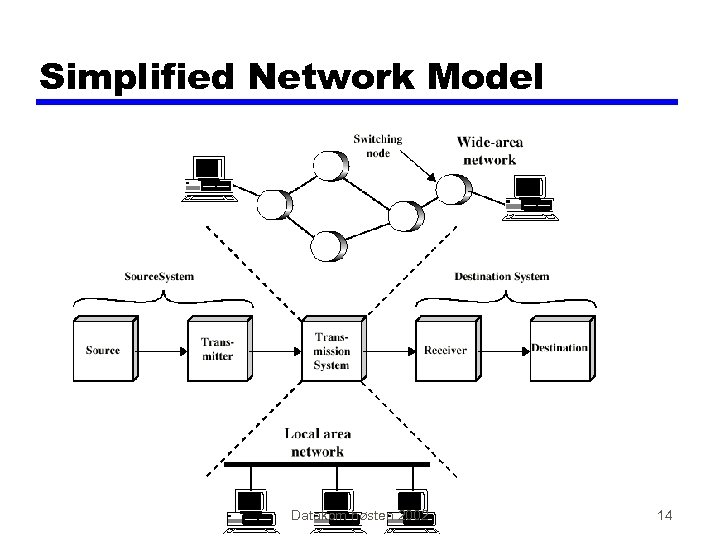 Simplified Network Model Datakom høsten 2002 14
 WAN - Wide Area Networks z Store geografiske områder z Består av en rekke noder z Alternative teknologier y. Linesvitsjing (Circuit switching) y. Pakkesvitsjing (Packet switching) y. Frame relay y. Asynchronous Transfer Mode (ATM) Datakom høsten 2002 15
 Circuit Switching z Dedikert kommunikasjonsvei mellom partene så lenge kommunikasjonen pågår. z Eksempel: Telefonnettet Datakom høsten 2002 16
 Packet Switching z Datapakker sendes enkeltvis z Datapakkene behøver ikke ta samme vei gjennom nettet z Datapakkene sendes fra node til node mellom avsender og mottaker z Brukes mellom datamaskiner z Eksempel: Datapak basert på X. 25 Datakom høsten 2002 17
 Frame Relay z Pakksvitsjing systemer har stor overhead for å kompensere for feil z Moderne systemer er mer pålitlige z Feil kan håndteres i endesysteme z Det meste av overhead for feilkontroll er tatt vekk z Hastigheter fra 64 kbit/s til 2 Mbit/s Datakom høsten 2002 18
 Asynchronous Transfer Mode z ATM z Videreutvikling av Frame relay z Little overhead for error control z Fixed packet (called cell) length z Anything from 10 Mbps to Gbps z Constant data rate using packet switching technique Datakom høsten 2002 19
 Integrated Services Digital Network z ISDN z Laget for å erstatte PSTN, dvs analog telefoni z Prøveprosjekt i Norge høsten 1989 z Ble først populært når det kunne benyttes for å koble seg mot Internett z Utvidet aksess y 30 tale/datakanaler, hver på 64 kbit/s y 1 signaleringskanal på 64 kbit/s z Grunnaksess y 2 tale/datakanaler, hver på 64 kbit/s y 1 signaleringskanal på 16 kbit/s Datakom høsten 2002 20
 ADSL – Assymetric Digital Subscriber Line z Telenor tilbyr (hastighet inn/ut): y 384 / 128 Kb/s laste ned lyd og bilde, samt gjøre flere ting på en gang (kostnad pr. måned 450, - kr) y 704 / 128 Kb/s laste ned filmklipp, programvare og andre store filer (kostnad pr. måned 550, - kr) y 1024 / 256 Kb/s laste ned og sende ut store filer raskt og effektivt (kostnad pr. måned 750, - kr) Datakom høsten 2002 21
 LAN - Local Area Networks z En eller fler bygninger z Eies vanligvis av den som henger utstyr på lokalnettet z Høyere datahastigheter enn WAN y. Ethernet 10 eller 100 Mbit/s z Tidligere kun kringasting, dvs alle kan lytte på nettet z Nå mer og mer svitsjede systemer + noe bruk av ATM Datakom høsten 2002 22
 Protocols z Used for communications between entities in a system z Must speak the same language z Entities y. User applications ye-mail facilities yterminals z Systems y. Computer y. Terminal y. Remote sensor Datakom høsten 2002 23
 Key Elements of a Protocol z Syntax y. Data formats y. Signal levels z Semantics y. Control information y. Error handling z Timing y. Speed matching y. Sequencing Datakom høsten 2002 24
 Protocol Architecture z Task of communication broken up into modules z For example file transfer could use three modules y. File transfer application y. Communication service module y. Network access module Datakom høsten 2002 25
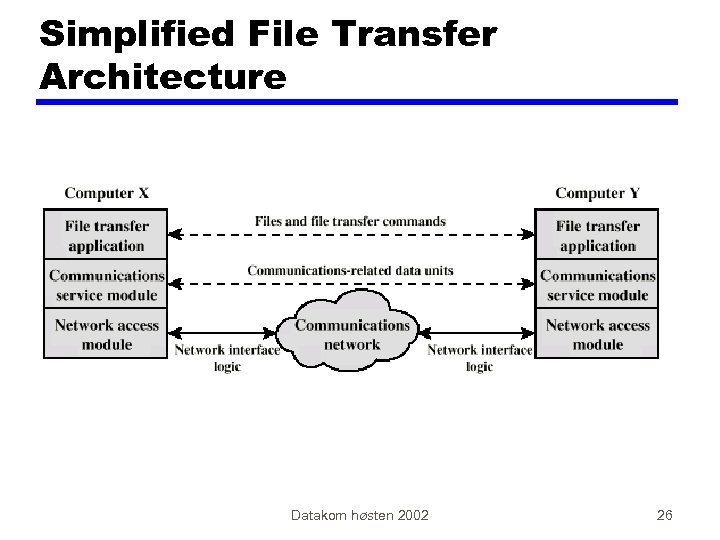 Simplified File Transfer Architecture Datakom høsten 2002 26
 A Three Layer Model z Network Access Layer z Transport Layer z Application Layer Datakom høsten 2002 27
 Network Access Layer z Exchange of data between the computer and the network z Sending computer provides address of destination z May invoke levels of service z Dependent on type of network used (LAN, packet switched etc. ) Datakom høsten 2002 28
 Transport Layer z Reliable data exchange z Independent of network being used z Independent of application Datakom høsten 2002 29
 Application Layer z Support for different user applications z e. g. e-mail, file transfer Datakom høsten 2002 30
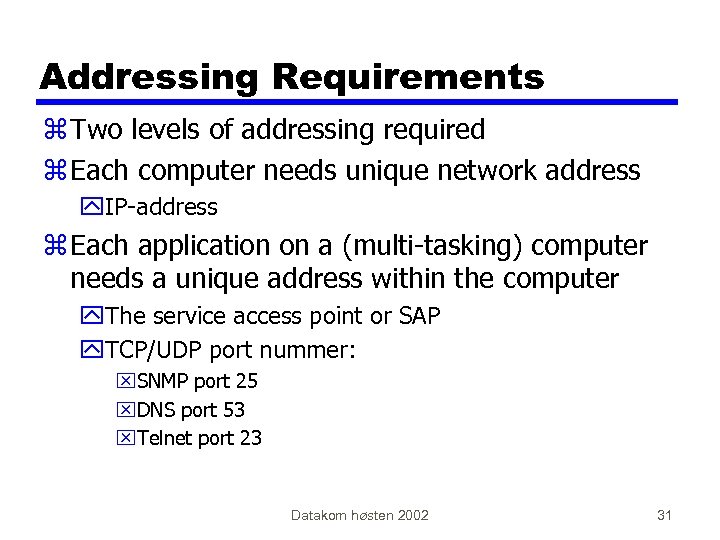 Addressing Requirements z Two levels of addressing required z Each computer needs unique network address y. IP-address z Each application on a (multi-tasking) computer needs a unique address within the computer y. The service access point or SAP y. TCP/UDP port nummer: x. SNMP port 25 x. DNS port 53 x. Telnet port 23 Datakom høsten 2002 31
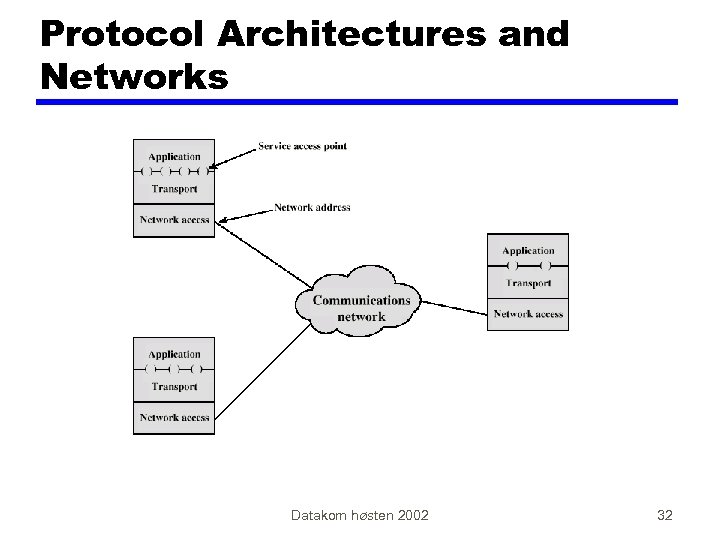 Protocol Architectures and Networks Datakom høsten 2002 32
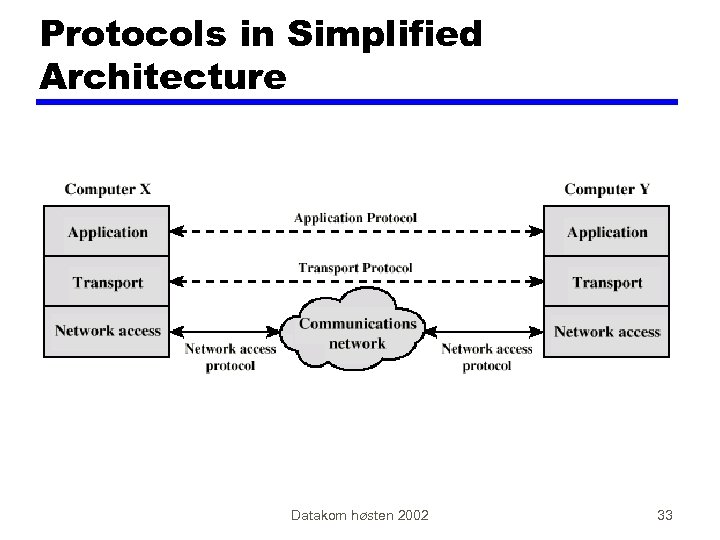 Protocols in Simplified Architecture Datakom høsten 2002 33
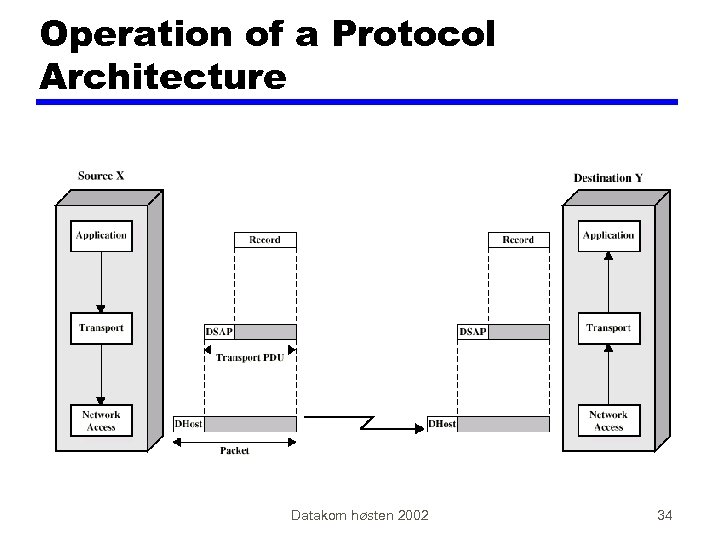 Operation of a Protocol Architecture Datakom høsten 2002 34
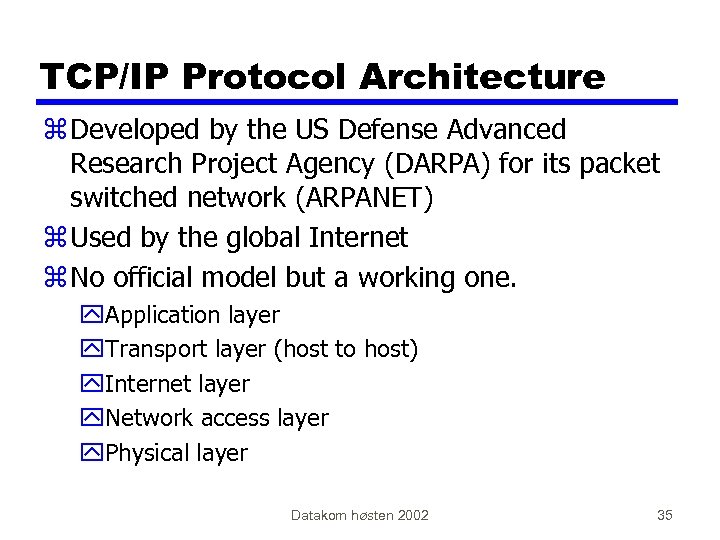 TCP/IP Protocol Architecture z Developed by the US Defense Advanced Research Project Agency (DARPA) for its packet switched network (ARPANET) z Used by the global Internet z No official model but a working one. y. Application layer y. Transport layer (host to host) y. Internet layer y. Network access layer y. Physical layer Datakom høsten 2002 35
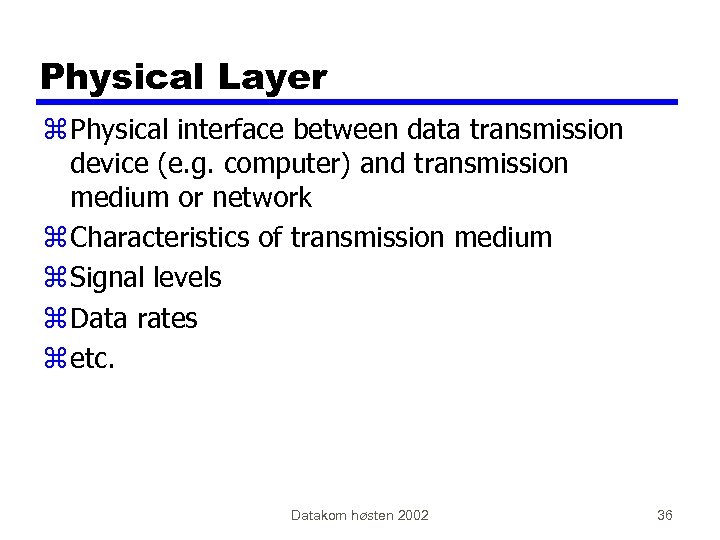 Physical Layer z Physical interface between data transmission device (e. g. computer) and transmission medium or network z Characteristics of transmission medium z Signal levels z Data rates z etc. Datakom høsten 2002 36
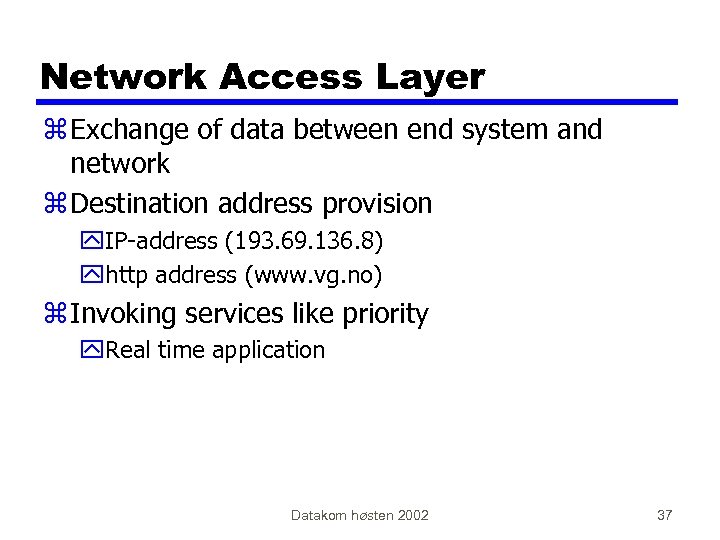 Network Access Layer z Exchange of data between end system and network z Destination address provision y. IP-address (193. 69. 136. 8) yhttp address (www. vg. no) z Invoking services like priority y. Real time application Datakom høsten 2002 37
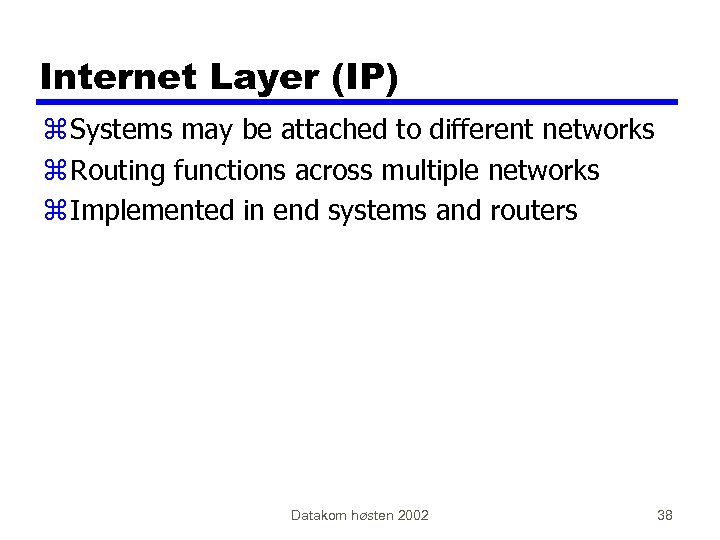 Internet Layer (IP) z Systems may be attached to different networks z Routing functions across multiple networks z Implemented in end systems and routers Datakom høsten 2002 38
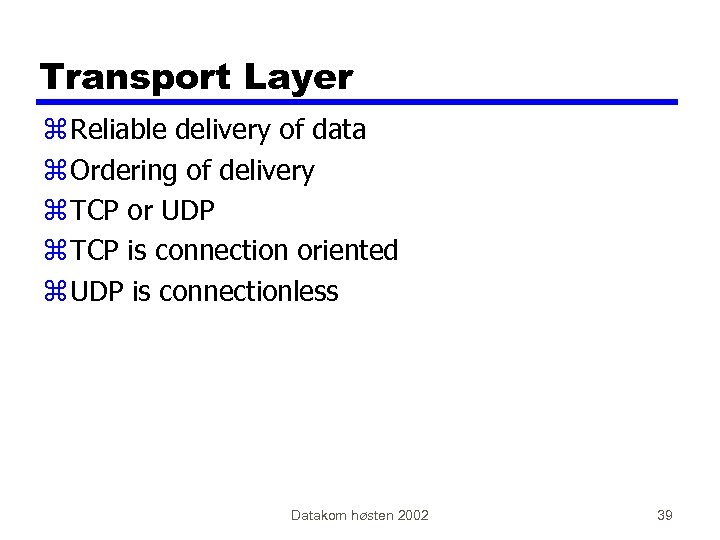 Transport Layer z Reliable delivery of data z Ordering of delivery z TCP or UDP z TCP is connection oriented z UDP is connectionless Datakom høsten 2002 39
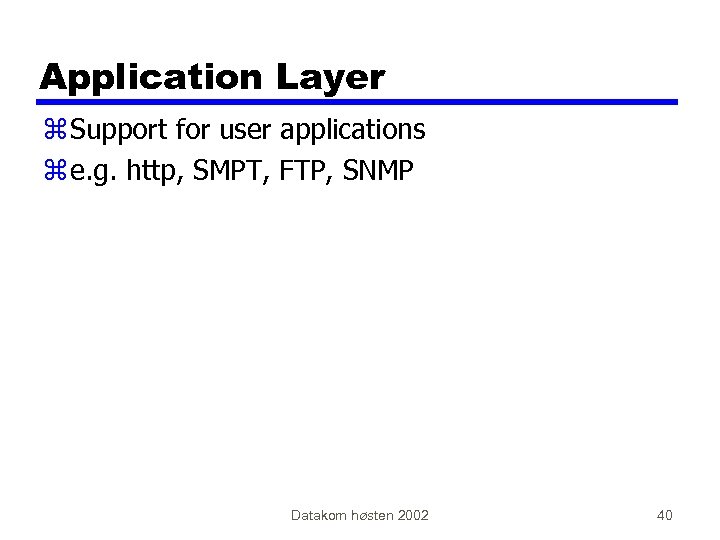 Application Layer z Support for user applications z e. g. http, SMPT, FTP, SNMP Datakom høsten 2002 40
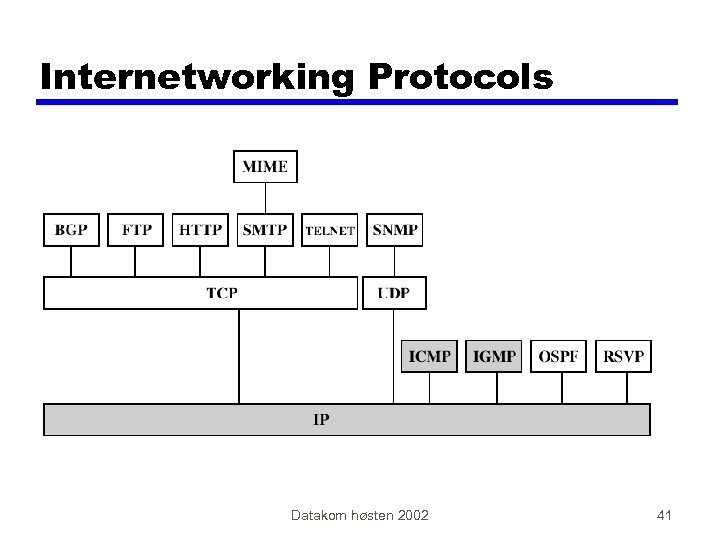 Internetworking Protocols Datakom høsten 2002 41
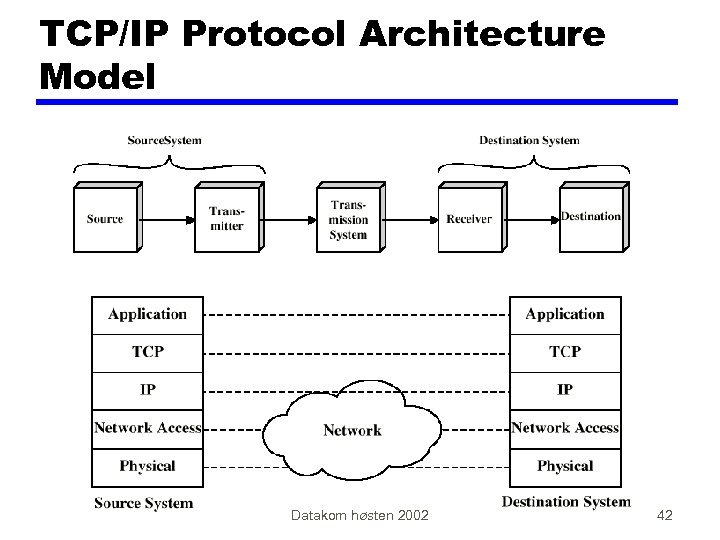 TCP/IP Protocol Architecture Model Datakom høsten 2002 42
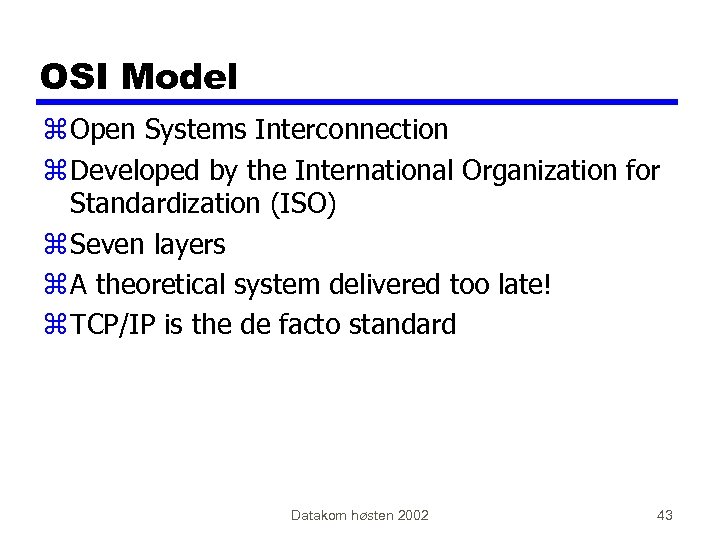 OSI Model z Open Systems Interconnection z Developed by the International Organization for Standardization (ISO) z Seven layers z A theoretical system delivered too late! z TCP/IP is the de facto standard Datakom høsten 2002 43
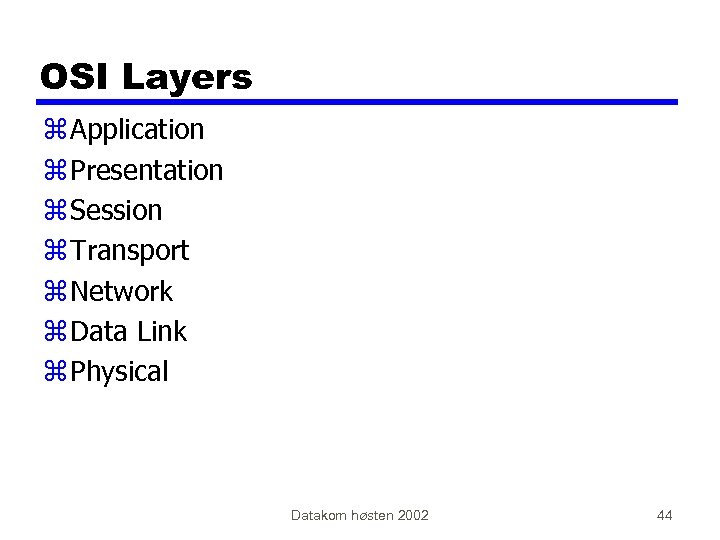 OSI Layers z Application z Presentation z Session z Transport z Network z Data Link z Physical Datakom høsten 2002 44
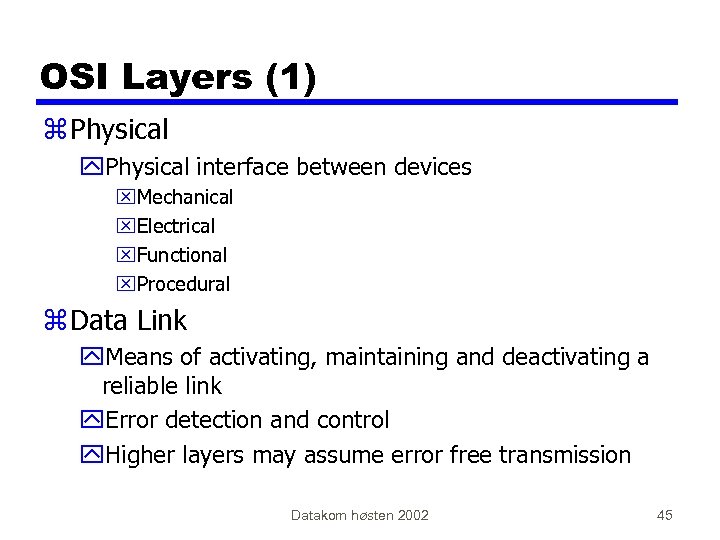 OSI Layers (1) z Physical y. Physical interface between devices x. Mechanical x. Electrical x. Functional x. Procedural z Data Link y. Means of activating, maintaining and deactivating a reliable link y. Error detection and control y. Higher layers may assume error free transmission Datakom høsten 2002 45
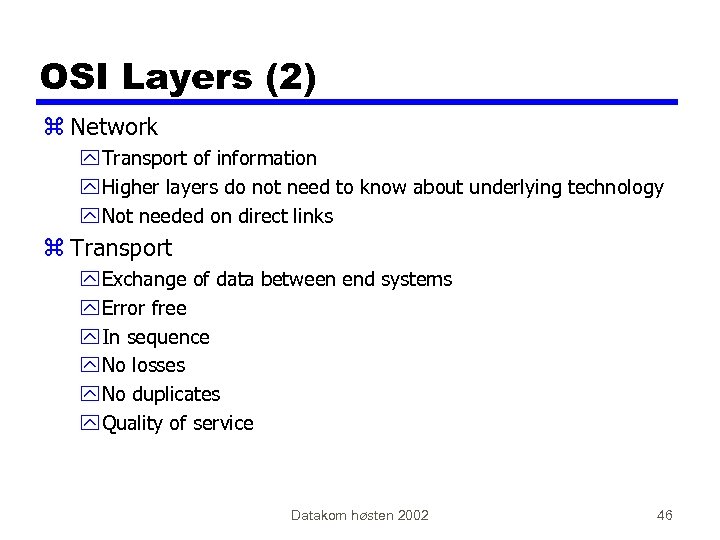 OSI Layers (2) z Network y Transport of information y Higher layers do not need to know about underlying technology y Not needed on direct links z Transport y Exchange of data between end systems y Error free y In sequence y No losses y No duplicates y Quality of service Datakom høsten 2002 46
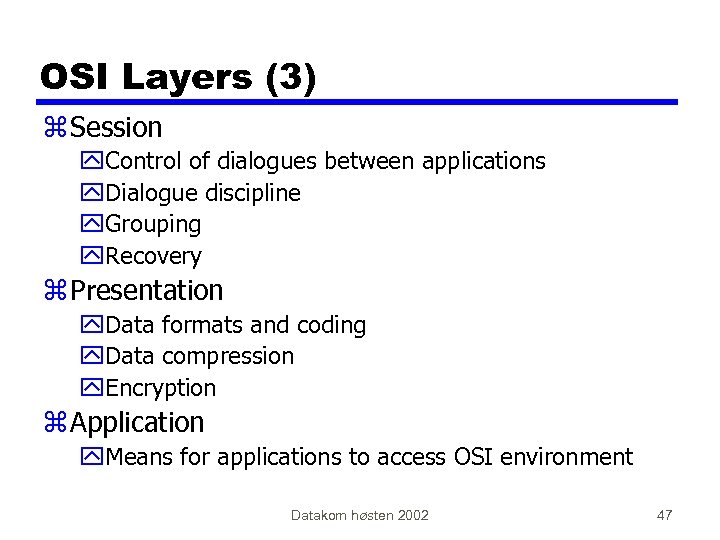 OSI Layers (3) z Session y. Control of dialogues between applications y. Dialogue discipline y. Grouping y. Recovery z Presentation y. Data formats and coding y. Data compression y. Encryption z Application y. Means for applications to access OSI environment Datakom høsten 2002 47
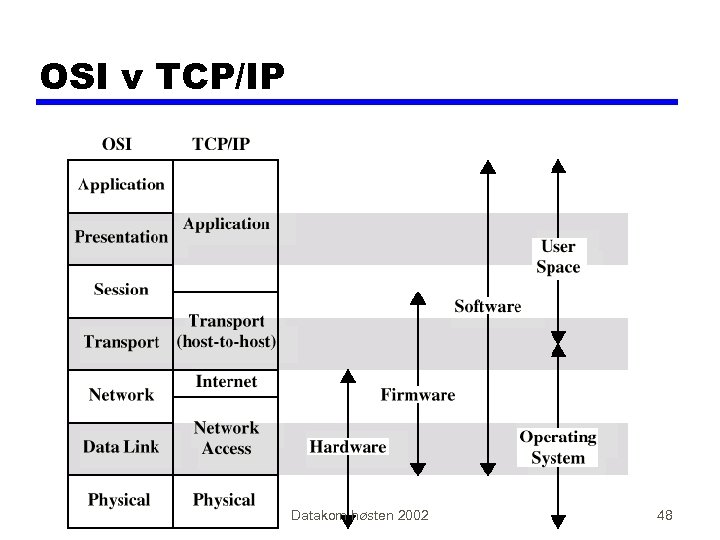 OSI v TCP/IP Datakom høsten 2002 48
 Standards z Required to allow for interoperability between equipment z Advantages y. Ensures a large market for equipment and software y. Allows products from different vendors to communicate z Disadvantages y. Freeze technology y. May be multiple standards for the same thing Datakom høsten 2002 49
 Standards Organizations z Internet Society y. Internet Architecture Board (IAB) y. Internet Engineering Task Force (IETF) y. Internet Engineering Steering Group (IESG) z ISO - International Standard for Organization y. JTC – Joint Technical Committee z ITU-T (tidligere CCITT) y. ITU- International Telecommunication Union y 14 study groups z ATM forum Datakom høsten 2002 50
 Further Reading z Stallings, W. Data and Computer Communications (6 th edition), Prentice Hall 1999 chapter 1 z Web site for Stallings book ywww. shore. net/~ws/DCC 6 e. html z Web sites for IETF, IEEE, ITU-T, ISO z Internet Requests for Comment (RFCs) z Usenet News groups ycomp. dcom. * ycomp. protocols. tcp-ip Datakom høsten 2002 51
 Internet History 1961 -1972: Early packet-switching principles z 1961: Kleinrock - queueing theory shows effectiveness of packet-switching z 1964: Baran - packetswitching in military nets z 1967: ARPAnet conceived by Advanced Research Projects Agency z 1969: first ARPAnet node operational z 1972: y ARPAnet demonstrated publicly y NCP (Network Control Protocol) first host-host protocol y first e-mail program y ARPAnet has 15 nodes Datakom høsten 2002 52
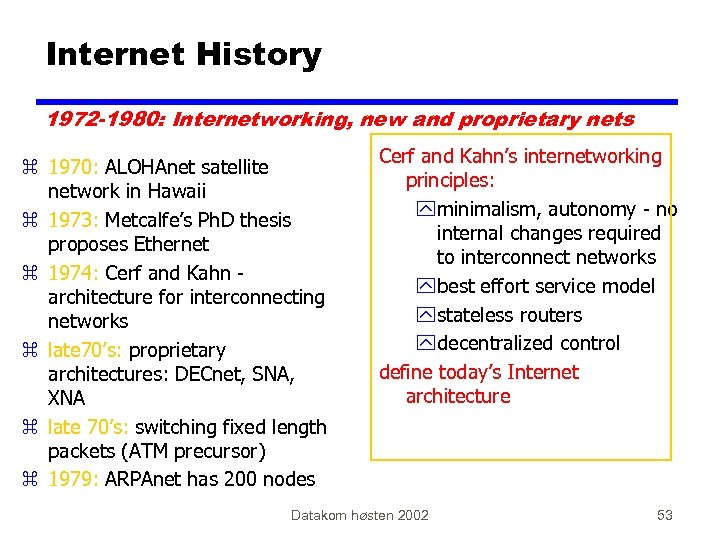 Internet History 1972 -1980: Internetworking, new and proprietary nets z 1970: ALOHAnet satellite network in Hawaii z 1973: Metcalfe’s Ph. D thesis proposes Ethernet z 1974: Cerf and Kahn - architecture for interconnecting networks z late 70’s: proprietary architectures: DECnet, SNA, XNA z late 70’s: switching fixed length packets (ATM precursor) z 1979: ARPAnet has 200 nodes Cerf and Kahn’s internetworking principles: y minimalism, autonomy - no internal changes required to interconnect networks y best effort service model y stateless routers y decentralized control define today’s Internet architecture Datakom høsten 2002 53
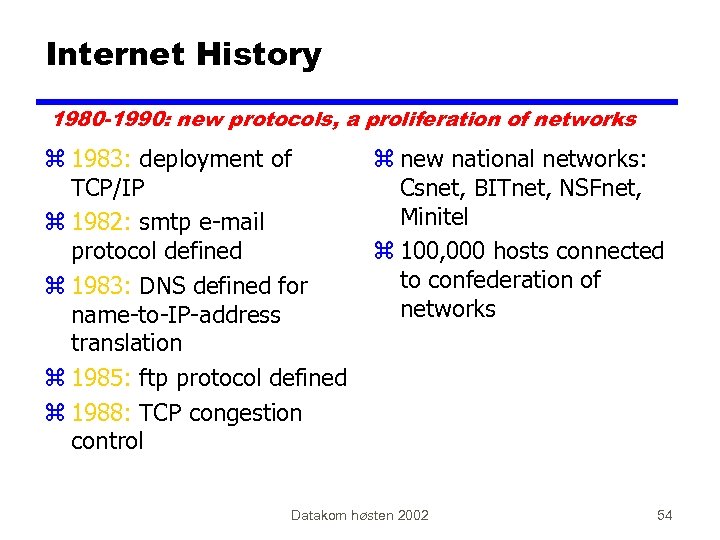 Internet History 1980 -1990: new protocols, a proliferation of networks z 1983: deployment of TCP/IP z 1982: smtp e-mail protocol defined z 1983: DNS defined for name-to-IP-address translation z 1985: ftp protocol defined z 1988: TCP congestion control z new national networks: Csnet, BITnet, NSFnet, Minitel z 100, 000 hosts connected to confederation of networks Datakom høsten 2002 54
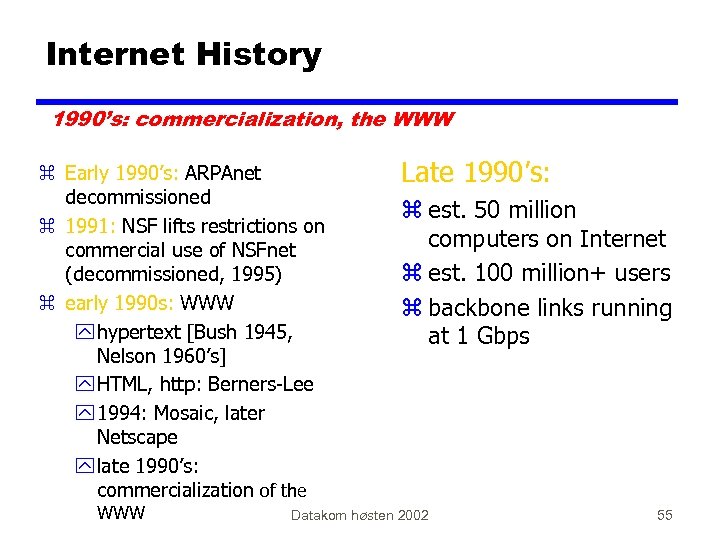 Internet History 1990’s: commercialization, the WWW z Early 1990’s: ARPAnet decommissioned z 1991: NSF lifts restrictions on commercial use of NSFnet (decommissioned, 1995) z early 1990 s: WWW y hypertext [Bush 1945, Nelson 1960’s] y HTML, http: Berners-Lee y 1994: Mosaic, later Netscape y late 1990’s: commercialization of the WWW Late 1990’s: z est. 50 million computers on Internet z est. 100 million+ users z backbone links running at 1 Gbps Datakom høsten 2002 55
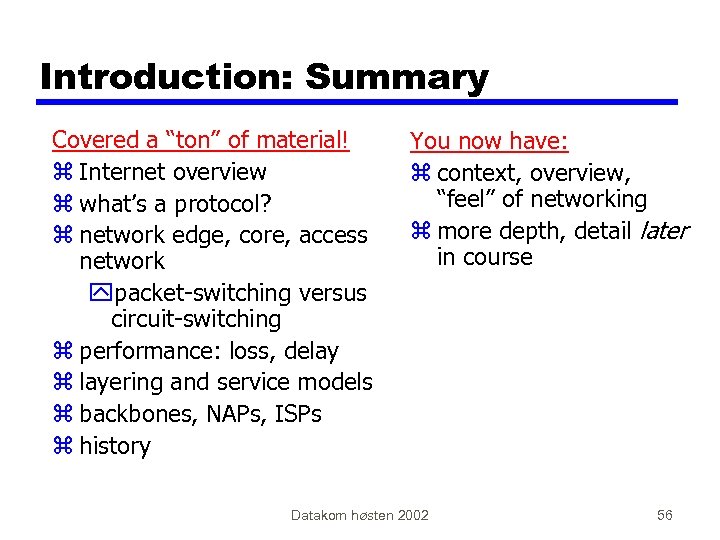 Introduction: Summary Covered a “ton” of material! z Internet overview z what’s a protocol? z network edge, core, access network ypacket-switching versus circuit-switching z performance: loss, delay z layering and service models z backbones, NAPs, ISPs z history You now have: z context, overview, “feel” of networking z more depth, detail later in course Datakom høsten 2002 56
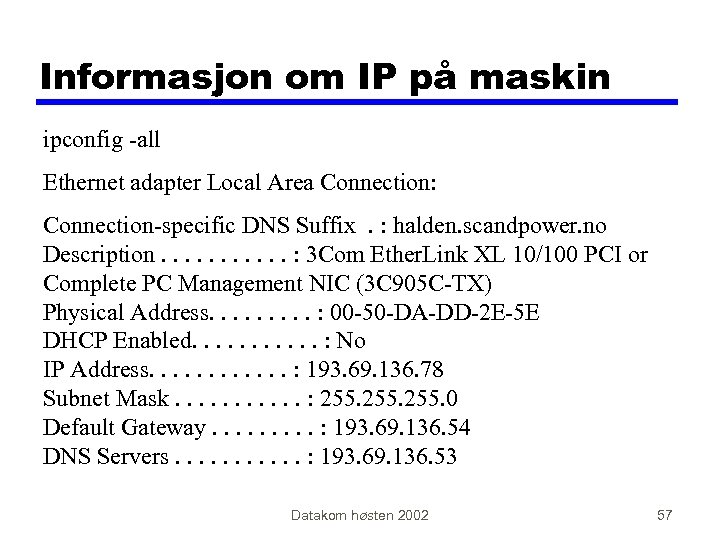 Informasjon om IP på maskin ipconfig -all Ethernet adapter Local Area Connection: Connection-specific DNS Suffix. : halden. scandpower. no Description. . . : 3 Com Ether. Link XL 10/100 PCI or Complete PC Management NIC (3 C 905 C-TX) Physical Address. . : 00 -50 -DA-DD-2 E-5 E DHCP Enabled. . . : No IP Address. . . : 193. 69. 136. 78 Subnet Mask. . . : 255. 0 Default Gateway. . : 193. 69. 136. 54 DNS Servers. . . : 193. 69. 136. 53 Datakom høsten 2002 57
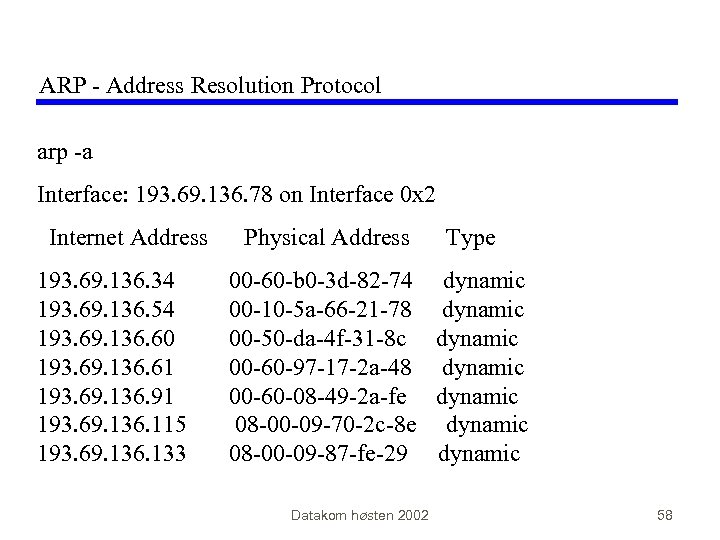 ARP - Address Resolution Protocol arp -a Interface: 193. 69. 136. 78 on Interface 0 x 2 Internet Address 193. 69. 136. 34 193. 69. 136. 54 193. 69. 136. 60 193. 69. 136. 61 193. 69. 136. 91 193. 69. 136. 115 193. 69. 136. 133 Physical Address Type 00 -60 -b 0 -3 d-82 -74 dynamic 00 -10 -5 a-66 -21 -78 dynamic 00 -50 -da-4 f-31 -8 c dynamic 00 -60 -97 -17 -2 a-48 dynamic 00 -60 -08 -49 -2 a-fe dynamic 08 -00 -09 -70 -2 c-8 e dynamic 08 -00 -09 -87 -fe-29 dynamic Datakom høsten 2002 58
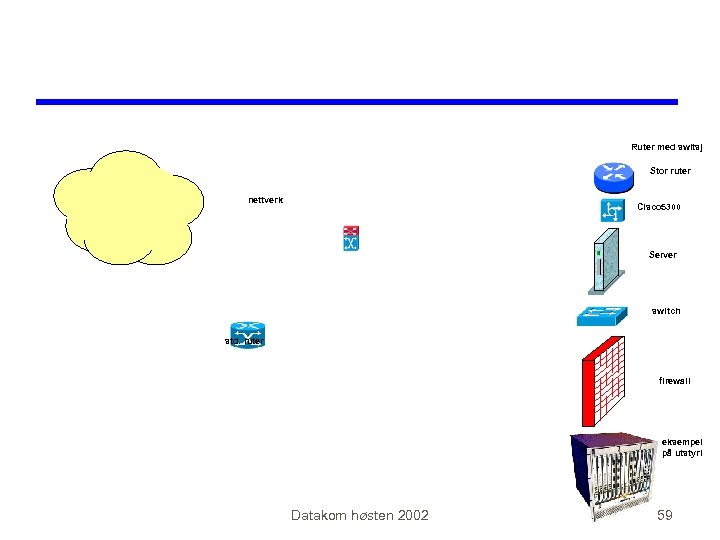 Ruter med switsj Stor ruter nettverk Cisco 5300 Server switch std. ruter firewall eksempel på utstyrl Datakom høsten 2002 59