 Скачать презентацию Database Management System Chapter 1 An Overview
fb4b85ecd2a49b3d1f4839737b5252b8.ppt
- Количество слайдов: 35



Database Management System Chapter 1 – An Overview
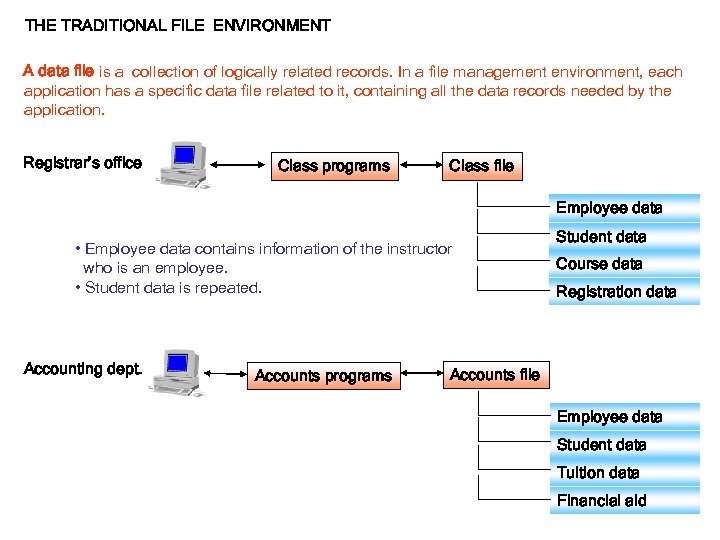
THE TRADITIONAL FILE ENVIRONMENT A data file is a collection of logically related records. In a file management environment, each application has a specific data file related to it, containing all the data records needed by the application. Registrar’s office Class programs Class file Employee data • Employee data contains information of the instructor who is an employee. • Student data is repeated. Accounting dept. Accounts programs Student data Course data Registration data Accounts file Employee data Student data Tuition data Financial aid
Problems with the File processing Program – Data Dependence is the tight relationship between data stored in various files and the specific programming language used to access or execute them. Every traditional computer program has to describe the input file format with which it works. Program – Data Dependence leads to the potential for Data redundancy. Data Redundancy is the presence of duplicate data in multiple data files. Data redundancy occurs when different divisions, functional areas, and groups in an organization independently collect the same piece of data and build separately their own systems with different languages, platforms, and data file format. Data Redundancy leads to the potential for data inconsistency.
Data Isolation : File processing can leads to difficulty in accessing data from different applications. (Data can not be shared). With applications uniquely designed and implemented, data are scattered in various files, and files may be in different formats. Integrity problems : The data values stored in the database must satisfy certain types of consistency constraints. Developers enforce these constraints in the system by adding appropriate code in the various application programs. However, when new constraints are added, it is difficult to change the programs to enforce them. Security problems: Enforcing security constraints in the application is much more difficult than that of in the database environment. Not every user of the database system should be able to access all the data. Applications should not have to be developed with regard to how the data are stored. That is, the applications and data in computer systems should be independent - a characteristic called application/data independence.
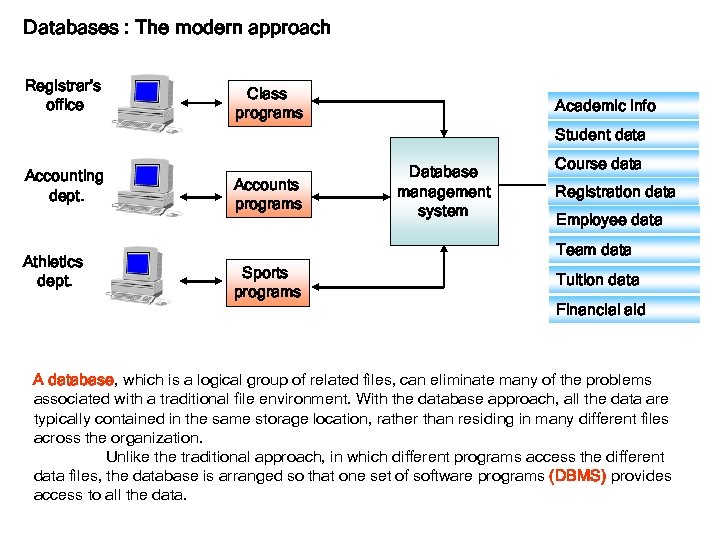
Databases : The modern approach Registrar’s office Class programs Academic info Student data Accounting dept. Athletics dept. Accounts programs Database management system Course data Registration data Employee data Team data Sports programs Tuition data Financial aid A database, which is a logical group of related files, can eliminate many of the problems associated with a traditional file environment. With the database approach, all the data are typically contained in the same storage location, rather than residing in many different files across the organization. Unlike the traditional approach, in which different programs access the different data files, the database is arranged so that one set of software programs (DBMS) provides access to all the data.
DBMS: Database Management System DBMS consists of a collection of interrelated data and a set of programs to access those data. The primary goal of DBMS is to provide an environment that is both convenient and efficient to use in retrieving and storing database information. DBMS acts as the interface software between users and data stored in the database by hiding the detail of internal
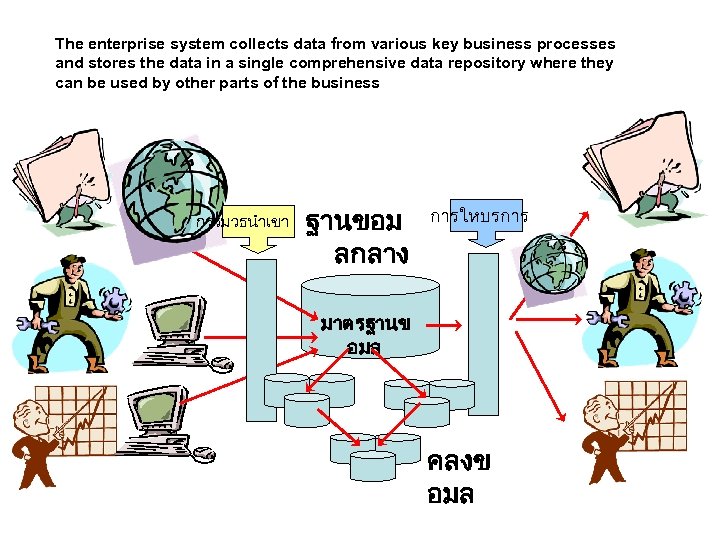
The enterprise system collects data from various key business processes and stores the data in a single comprehensive data repository where they can be used by other parts of the business กรรมวธนำเขา ฐานขอม ลกลาง การใหบรการ มาตรฐานข อมล คลงข อมล
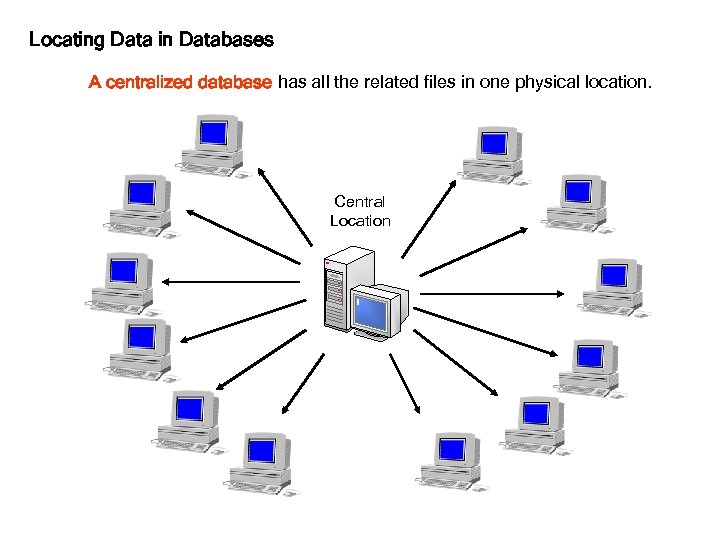
Locating Data in Databases A centralized database has all the related files in one physical location. Central Location
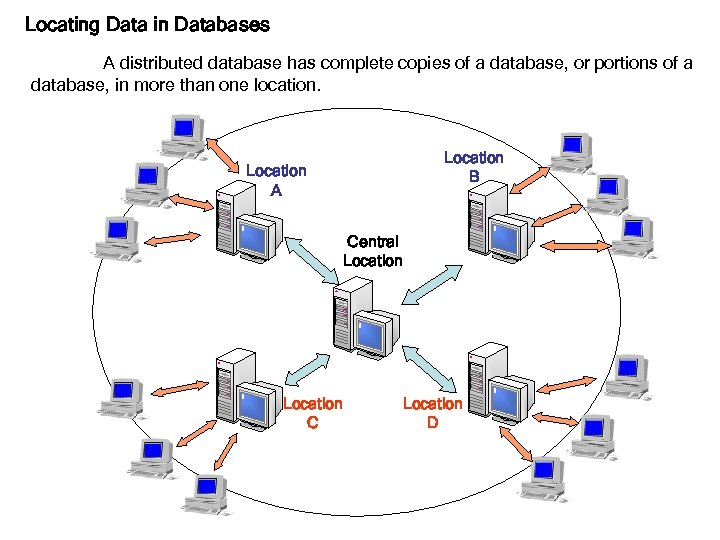
Locating Data in Databases A distributed database has complete copies of a database, or portions of a database, in more than one location. Location B Location A Central Location C Location D
There are two types of distributed databases: • replicated • partitioned A replicated database has complete copies of the entire database in many locations, primarily to alleviate the single-point-of-failure problems of a centralized database as well as to increase user access responsiveness. A partitioned database is subdivided, so that each location has a portion of the entire database (usually the portion that meets users’ local needs). This type of database provides the response speed of localized files without the need to replicate all changes in multiple locations.
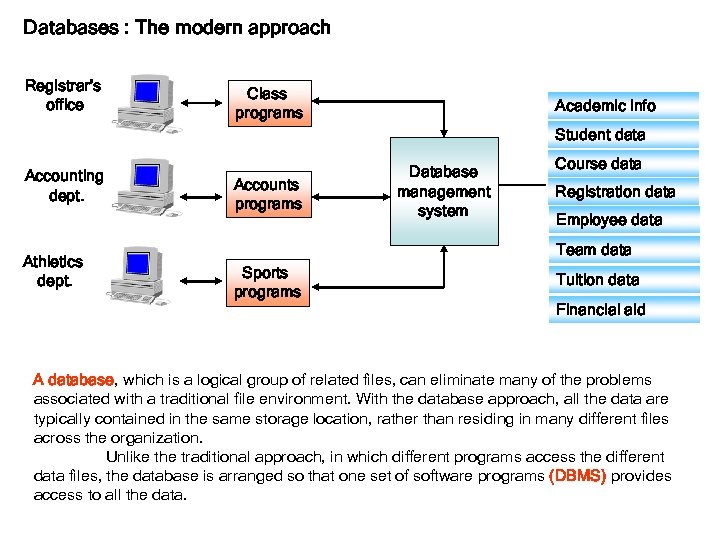
Databases : The modern approach Registrar’s office Class programs Academic info Student data Accounting dept. Athletics dept. Accounts programs Database management system Course data Registration data Employee data Team data Sports programs Tuition data Financial aid A database, which is a logical group of related files, can eliminate many of the problems associated with a traditional file environment. With the database approach, all the data are typically contained in the same storage location, rather than residing in many different files across the organization. Unlike the traditional approach, in which different programs access the different data files, the database is arranged so that one set of software programs (DBMS) provides access to all the data.
Abstract View of Data DBMS provides the ability for many different users to share data and process resources. How can a single, unified database meet the differing requirements of so many users? That is, the system hides certain details of how the data are stored and maintained. A DBMS minimizes these problems by providing 3 views of the database data: (Since many database-systems users are not computer trained, developers hide the complexity from users through several levels of abstraction : A physical view : The lowest level of abstraction describes how the data are actually stored. It deals with the actual, physical arrangement and location of data in the direct access storage devices (DASDs). A logical view The next higher level of abstraction describes what data are stored in the database, and what relationships exist among those data. The logical describes the entire database in terms of a small number of relatively simple structures. (Users may not want to know all the technical details of physical storage. An external view : The higher level of abstraction describes only part of the entire database. Many users of the database do not need all this information; instead, they need to access only a part of the database.
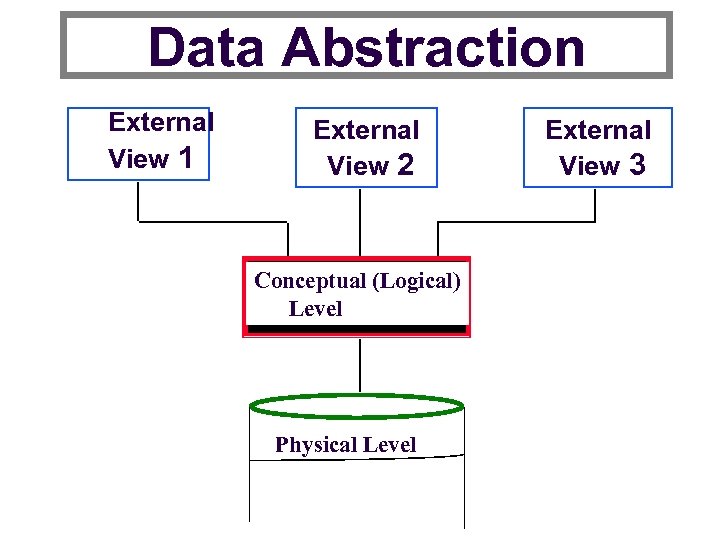
Data Abstraction External View 1 External View 2 Conceptual (Logical) Level Physical Level External View 3
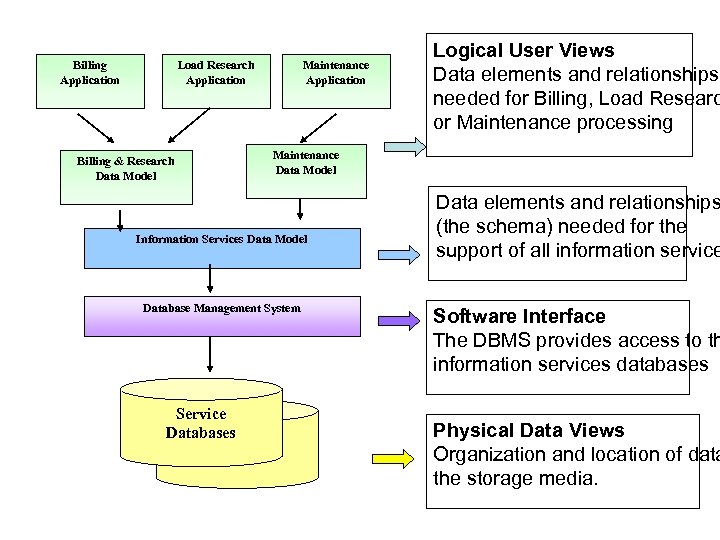
Billing Application Load Research Application Billing & Research Data Model Maintenance Application Maintenance Data Model Information Services Data Model Database Management System Service Databases Logical User Views Data elements and relationships needed for Billing, Load Researc or Maintenance processing Data elements and relationships (the schema) needed for the support of all information service Software Interface The DBMS provides access to th information services databases Physical Data Views Organization and location of data the storage media.
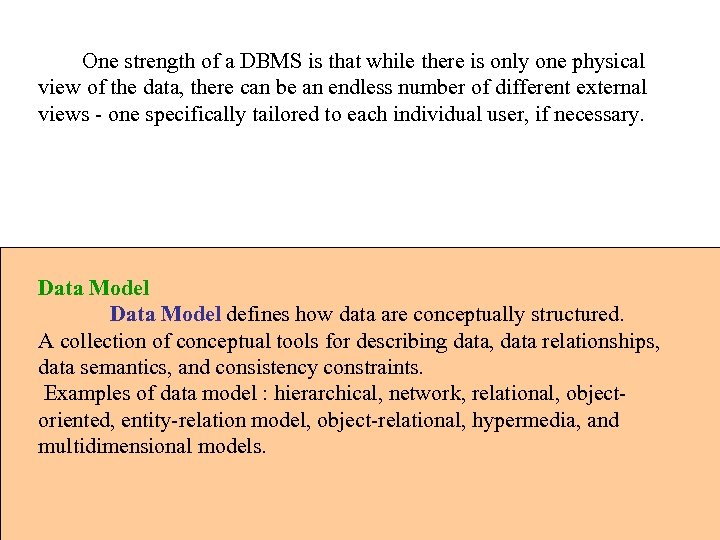
One strength of a DBMS is that while there is only one physical view of the data, there can be an endless number of different external views - one specifically tailored to each individual user, if necessary. Data Model defines how data are conceptually structured. A collection of conceptual tools for describing data, data relationships, data semantics, and consistency constraints. Examples of data model : hierarchical, network, relational, objectoriented, entity-relation model, object-relational, hypermedia, and multidimensional models.
Instance และ Schema Instance ของฐานขอมล : เหลาขอมลทถกจดเกบในฐานขอม ลในขณะใดขณะหนง ดงนน Instance จงเปรยบเสมอนกบคาของตวแปรในข ณะใดขณะหนงใน Programming Language การเปลยนแปลงขอมลในระบบฐานขอม ล มสาเหตมาจากการทขอมลมการ Insert, Delete หรอ Update เกดขนตลอดเวลา
Instance and Schema Instance of Database : The collection of information stored in the database at a particular moment. Instance of Database change over time as information is inserted and deleted. The concept of instances can be understood by analogy to a program written in a programming language. Each variable has a particular value at any given instant of time. Schema : The overall design of the database which must be specified as following : What files are included in a database? What fields are included in each file? How those files are related? A database schema corresponds to the variable declarations in a program.
Database Language A database system provides a Data Definition Language (DDL) to specify the database schema and a Data Manipulation Language (DML) to express database queries and updates. Data Definition Language (DDL) A database schema can be specified by a set of definitions expressed by a special language called a Data-Definition Language. DDL defines what types of information are in the database and how they will be structured. The DDL defines each data element as it appears in the database before that data element is translated into the forms required by the applications.
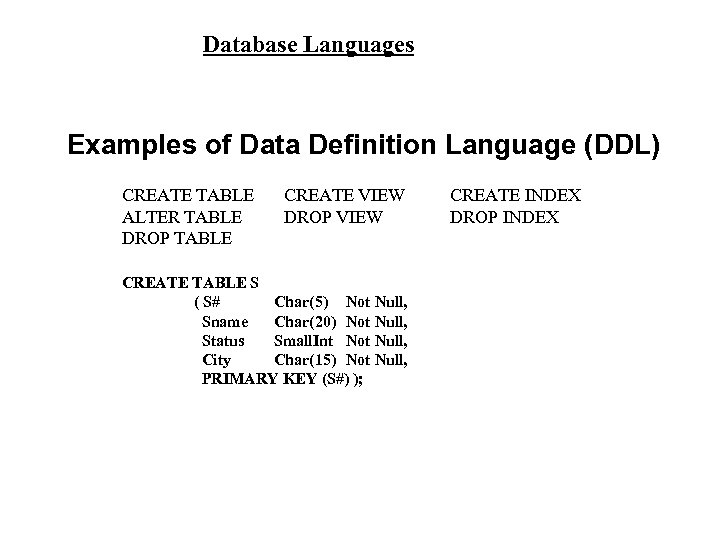
Database Languages Examples of Data Definition Language (DDL) CREATE TABLE ALTER TABLE DROP TABLE CREATE VIEW DROP VIEW CREATE TABLE S ( S# Char(5) Not Null, Sname Char(20) Not Null, Status Small. Int Not Null, City Char(15) Not Null, PRIMARY KEY (S#) ); CREATE INDEX DROP INDEX
After DDL statement has been interpreted, DBMS generates a special set of tables called the data dictionary or data directory. A data dictionary contains metadata – that is, data about data. The schema of a table is an example of metadata. A database system consults the data dictionary before reading or modifying actual data. ผลจากการคอมไพลประโยคทเขยนดวย DDL (DDL Interpreter) จะทำใหเกดตารางทจะจดเกบในไฟลชนดหนงทเรยกวา พจนานกรมขอมล (Data Dictionary) ซงเกบขอมลทเกยวกบ โครงสรางทไดจากการออกแบบฐานขอมลนน ๆ และถามการเปลยนแปลงแกไข หรอ เรยกใชขอมล DBMS ตองอาศยขอมลของโครงสรางจากไฟลนเสมอ The data values stored in the database must satisfy certain consistency constraints. The database systems check these constraints every time the database is updated.
Data Manipulation Language (DML) การใชขอมลในระบบฐานขอมล อาจจำแนกไดเปน - การเรยกดขอมล (Retrieve. Data) - การเพมขอมลใหม (Insert Records) - การลบขอมลเดม (Delete Records) - การเปลยนแปลงแกไขขอมลเดม (Update Fields) การใชขอมลในระดบของผใชนน ซงไดเตร ยมภาษาสำหรบการใชขอมล สามารถกระทำไดโ (DML is a lang users to access or manipulate data as ornagized by data model. )
Database Access from Application Programs Application Program are written in a Host Language. To access the database, DML statements need to be executed from the hose language by • Providing an application program interface (API) that can be used to send DML and DDL statements to the database, and retrieve the result. Ex. ODBC, JDBC. • Extending the host language syntax to embed DML calls within Host Language program. . However, DML syntax is different from syntax of Host Language, Query Processor of DBMS consists of : DDL Interpreter DML Compiler Query Evaluation Engine
DDL Interpreter : แปล (interpret) ประโยคคำสงทเขยนดวย และบนทกผลการแปลคำสงลงใน data dictionary DDL DML Compiler : แปล (translate) ประโยคคำสง DML ซงเปนภาษาทใชในการสบคน (structure query language) ไปเปน low-level instructions ท Query Evaluation Engine สามารถเขาใจได (คำสง query 1 คำสง อาจถกแปลออกมาไดมากกวา 1 query evaluation plans ทใหผลลพธทเหมอนกน ดงนน เปนหนาทของ DML compiler ทจะตองทำ query optimization เพอเลอก query evaluation plans ทประมวลผลไดเรวทสด (The DML compler also performs query optimization; that is, it picks the lowest cost evaluation plan from among the alternatives. )
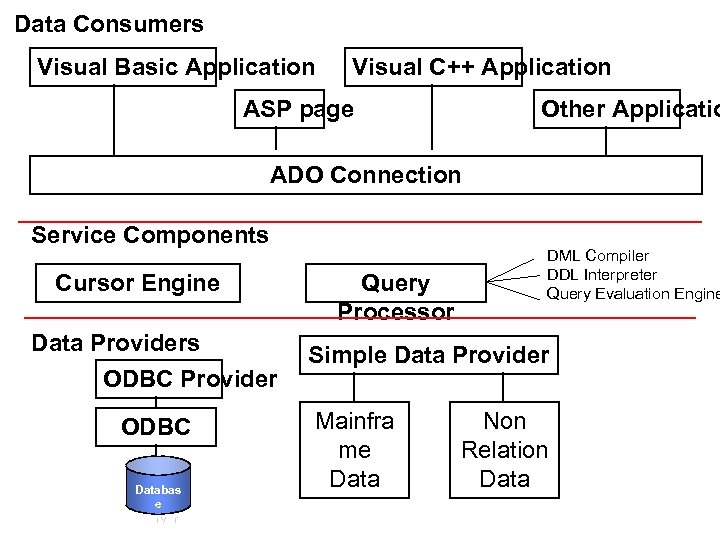
Data Consumers Visual Basic Application Visual C++ Application ASP page Other Applicatio ADO Connection Service Components Cursor Engine Data Providers ODBC Provider ODBC Databas e Server Query Processor DML Compiler DDL Interpreter Query Evaluation Engine Simple Data Provider Mainfra me Data Non Relation Data
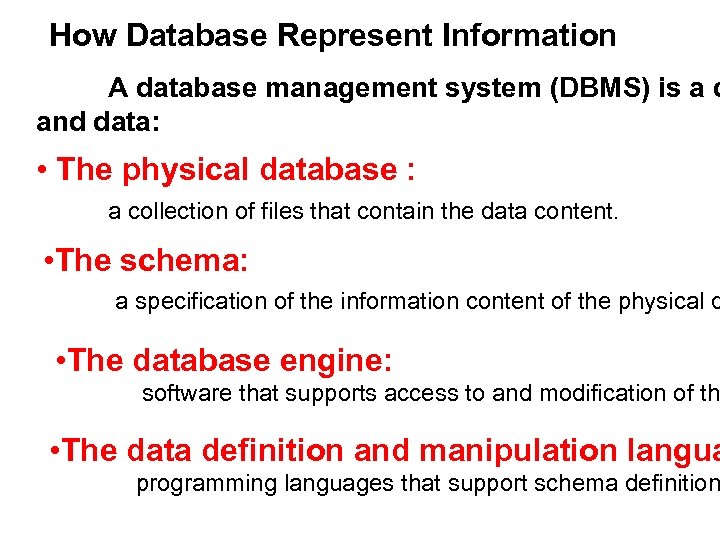
How Database Represent Information A database management system (DBMS) is a c and data: • The physical database : a collection of files that contain the data content. • The schema: a specification of the information content of the physical d • The database engine: software that supports access to and modification of th • The data definition and manipulation langua programming languages that support schema definition

Overall System Structure Query processor components • DML compiler • DDL interpreter • Query evaluation engine Storage manager components : provides the interface between the low level data stored in the database and the application programs and queries submitted to the system • Authorization and integrity manager : tests for the satisfaction of integrity constraints and checks the authority of users to access data. • Transaction manager : ensures that the database remains in a consistent state despite system failures and that concurrent transaction executions proceed without
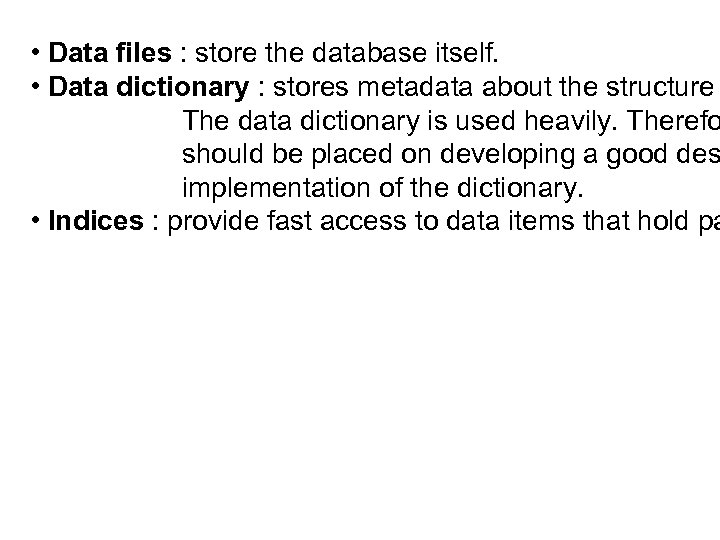
• Data files : store the database itself. • Data dictionary : stores metadata about the structure The data dictionary is used heavily. Therefo should be placed on developing a good des implementation of the dictionary. • Indices : provide fast access to data items that hold pa
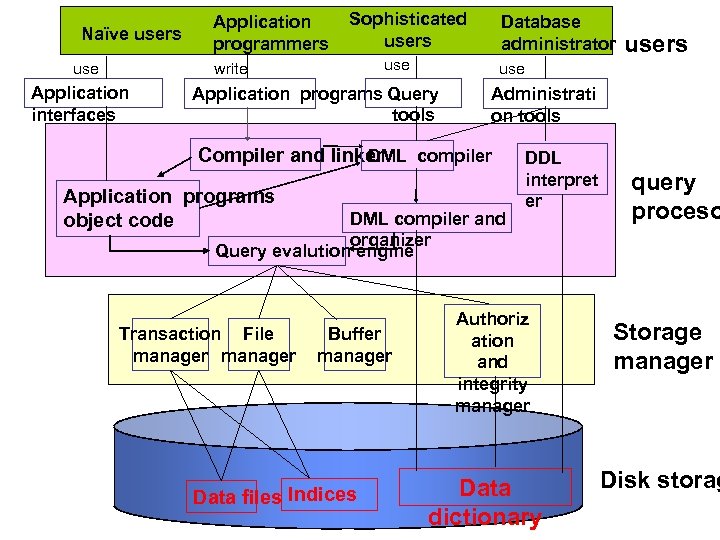
Naïve users use Application programmers Sophisticated users use write Application interfaces Database administrator use Application programs Query tools Administrati on tools Compiler and linker DML compiler Application programs object code DML compiler and organizer Query evalution engine Transaction File manager Buffer manager Data files Indices users DDL interpret er Authoriz ation and integrity manager Data dictionary query proceso Storage manager Disk storag
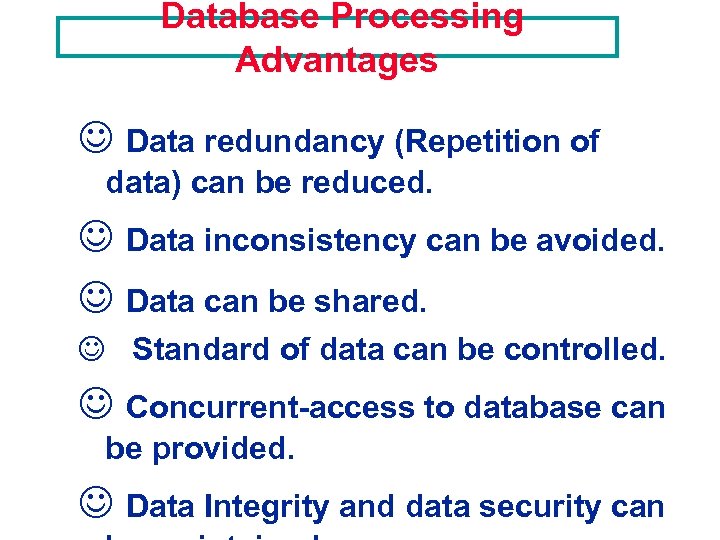
Database Processing Advantages J Data redundancy (Repetition of data) can be reduced. J Data inconsistency can be avoided. J Data can be shared. J Standard of data can be controlled. J Concurrent-access to database can be provided. J Data Integrity and data security can
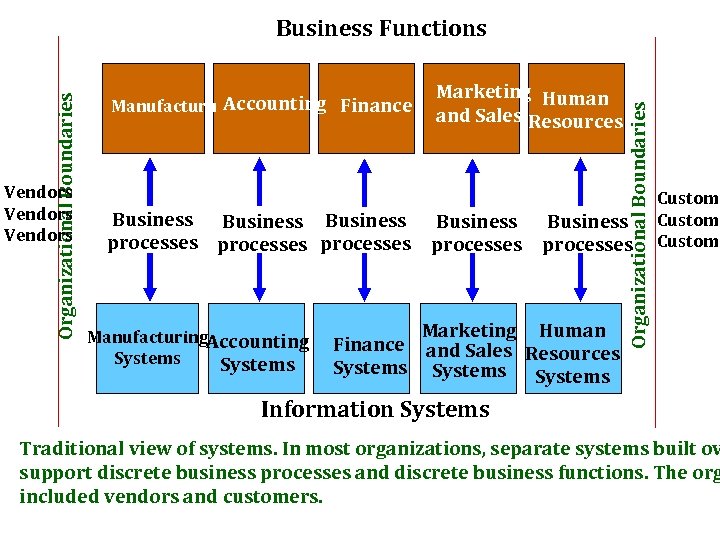
Vendors A Manufacturing ccounting Finance Business processes Manufacturing. Accounting Systems Marketing Human and Sales Resources Business processes Organizational Boundaries Business Functions Business processes Marketing Human Finance and Sales Resources Systems Custome Information Systems Traditional view of systems. In most organizations, separate systems built ov support discrete business processes and discrete business functions. The org included vendors and customers.
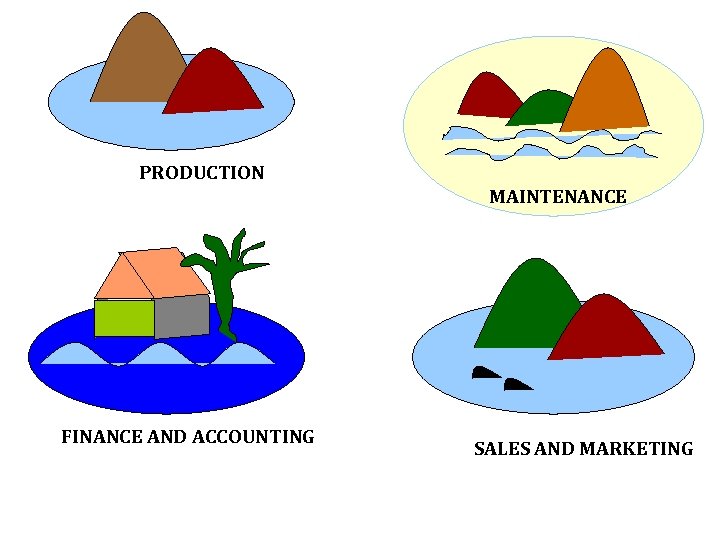
PRODUCTION MAINTENANCE FINANCE AND ACCOUNTING SALES AND MARKETING
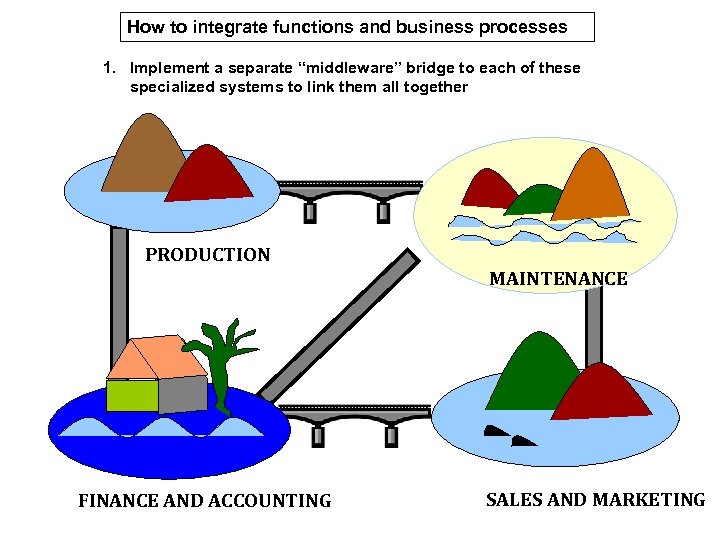
How to integrate functions and business processes 1. Implement a separate “middleware” bridge to each of these specialized systems to link them all together PRODUCTION MAINTENANCE FINANCE AND ACCOUNTING SALES AND MARKETING
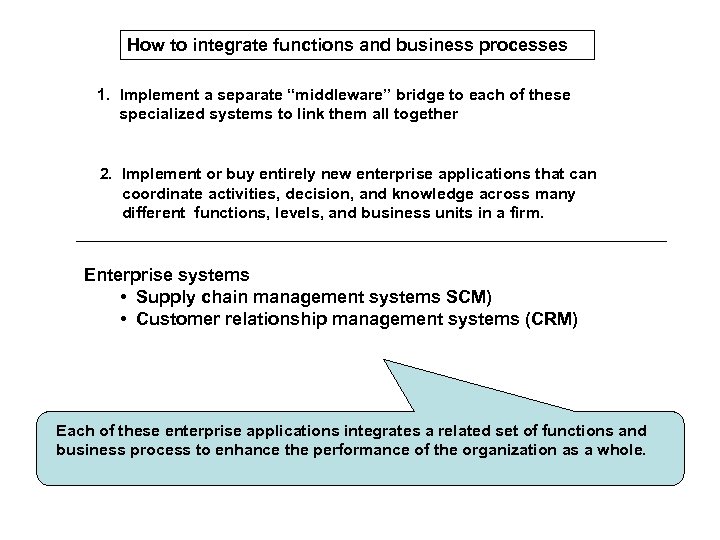
How to integrate functions and business processes 1. Implement a separate “middleware” bridge to each of these specialized systems to link them all together 2. Implement or buy entirely new enterprise applications that can coordinate activities, decision, and knowledge across many different functions, levels, and business units in a firm. Enterprise systems • Supply chain management systems SCM) • Customer relationship management systems (CRM) Each of these enterprise applications integrates a related set of functions and business process to enhance the performance of the organization as a whole.
Enterprise systems also known as enterprise resource planning (ERP) The enterprise systems, designed to support organization- wide, coordinates and integrates a related set of major internal functions and business processes to enhance the performance of the organization as a whole. They solve the problem of organizational inefficiencies created by isolated islands of information, business processes, and technology.
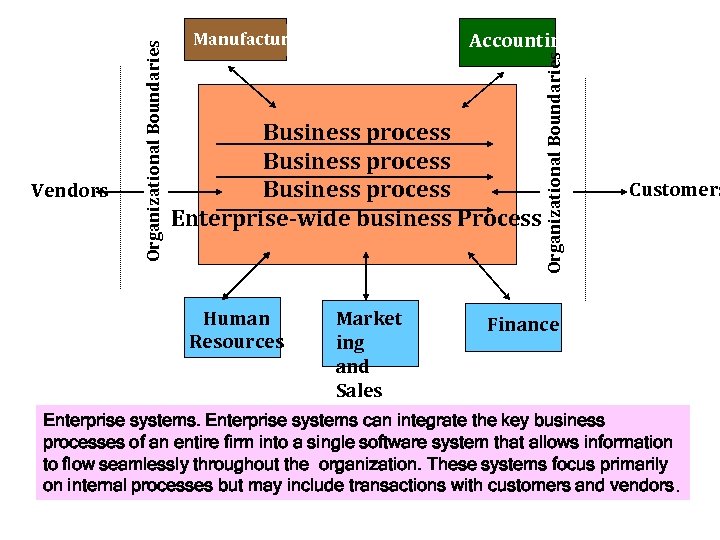
Accounting Business process Enterprise-wide business Process Human Resources Market ing and Sales Organizational Boundaries Vendors Manufacturing Customers Finance Enterprise systems can integrate the key business processes of an entire firm into a single software system that allows information to flow seamlessly throughout the organization. These systems focus primarily on internal processes but may include transactions with customers and vendors.
Скачать презентацию Database Management System Chapter 1 An Overview
fb4b85ecd2a49b3d1f4839737b5252b8.ppt