 Скачать презентацию Data Warehousing Mining with Business Intelligence Principles
abd34081ad49101206cb2f4fdc2bbd29.ppt
- Количество слайдов: 53




Data Warehousing & Mining with Business Intelligence: Principles and Algorithms Overview Of Text Mining 1
Motivation Text mining is well motivated, due to the fact that much of the world’s data can be found in free text form (newspaper articles, emails, literature, etc. ). While mining free text has the same goals as data mining in general (extracting useful knowledge/stats/trends), text mining must overcome a major difficulty – there is no explicit structure. Machines can reason will relational data well since schemas are explicitly available. Free text, however, encodes all semantic information within natural language. Text mining algorithms, then, must make some sense out of this natural language representation. Humans are great at doing this, but this has proved to be a 2 problem for machines.
Sources Of data Letters Emails Phone recordings Contracts Technical documents Patents Web pages Articles 3
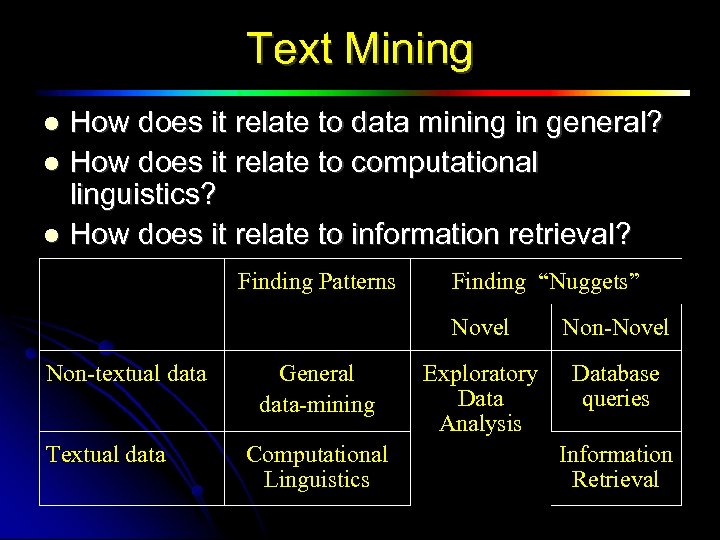
Text Mining How does it relate to data mining in general? How does it relate to computational linguistics? How does it relate to information retrieval? Finding Patterns Finding “Nuggets” Novel Non-textual data Textual data General data-mining Computational Linguistics Non-Novel Exploratory Data Analysis Database queries Information Retrieval
Typical Applications Summarizing documents Discovering/monitoring relations among people, places, organizations, etc Customer profile analysis Trend analysis Documents summarization Spam Identification Public health early warning Event tracks
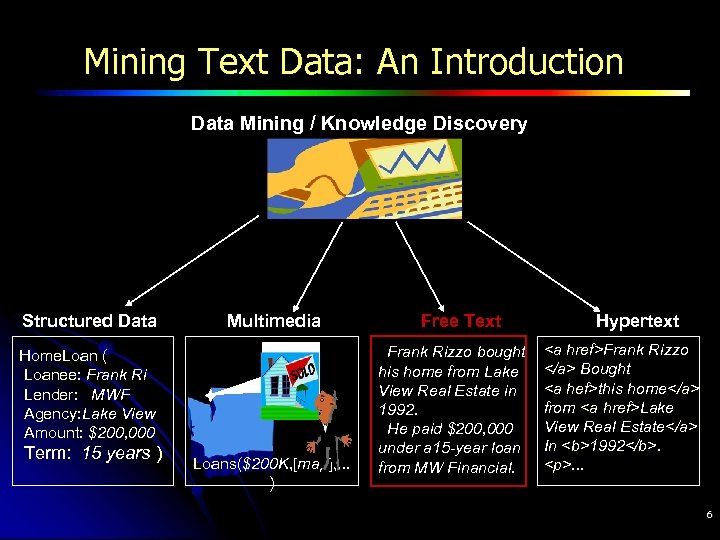
Mining Text Data: An Introduction Data Mining / Knowledge Discovery Structured Data Multimedia Free Text Hypertext Home. Loan ( Loanee: Frank Ri Lender: MWF Agency: Lake View Amount: $200, 000 Term: 15 years ) Loans($200 K, [map], . . . ) Frank Rizzo bought his home from Lake View Real Estate in 1992. He paid $200, 000 under a 15 -year loan from MW Financial. <a href>Frank Rizzo </a> Bought <a hef>this home</a> from <a href>Lake View Real Estate</a> In <b>1992</b>. <p>. . . 6
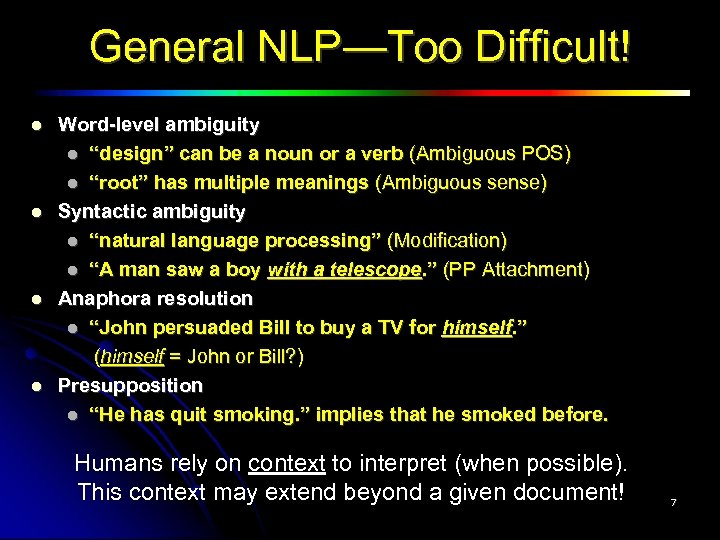
General NLP—Too Difficult! Word-level ambiguity “design” can be a noun or a verb (Ambiguous POS) “root” has multiple meanings (Ambiguous sense) Syntactic ambiguity “natural language processing” (Modification) “A man saw a boy with a telescope. ” (PP Attachment) Anaphora resolution “John persuaded Bill to buy a TV for himself. ” (himself = John or Bill? ) Presupposition “He has quit smoking. ” implies that he smoked before. Humans rely on context to interpret (when possible). This context may extend beyond a given document! 7
Text Databases and IR Text databases (document databases) Large collections of documents from various sources: news articles, research papers, books, digital libraries, e-mail messages, and Web pages Data stored is usually semi-structured Traditional IR techniques become inadequate for the increasingly vast amounts of text data Information retrieval A field developed in parallel with database systems Information is organized into (a large number of) documents Information retrieval problem: locating relevant documents based on user input, such as keywords or example documents 8
Information Retrieval Typical IR systems Online library catalogs Online document management systems Information retrieval vs. database systems Some DB problems are not present in IR, e. g. , update, transaction management, complex objects Some IR problems are not addressed well in DBMS, e. g. , unstructured documents, approximate search using keywords and relevance 9
Some “Basic” IR Techniques Stemming Stop words Weighting of terms (e. g. , TF-IDF) Vector/Unigram representation of text Text similarity (e. g. , cosine, KL-div) Relevance/pseudo feedback 10
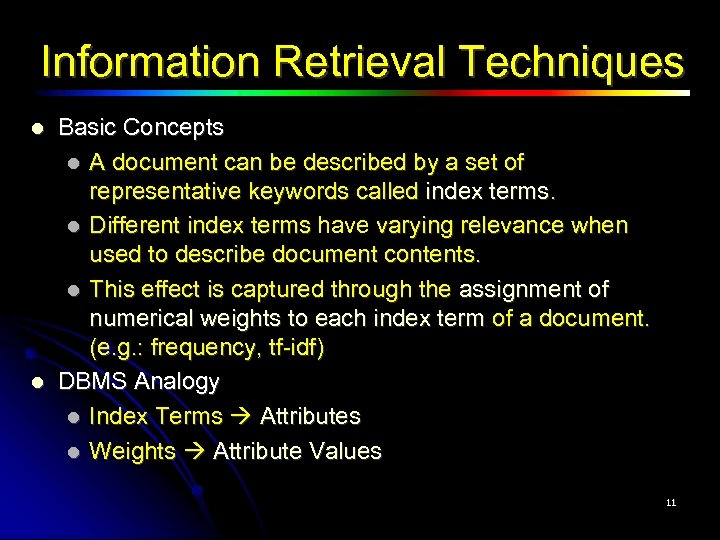
Information Retrieval Techniques Basic Concepts A document can be described by a set of representative keywords called index terms. Different index terms have varying relevance when Different index terms used to describe document contents. This effect is captured through the assignment of numerical weights to each index term of a document. (e. g. : frequency, tf-idf) DBMS Analogy Index Terms Attributes Weights Attribute Values 11
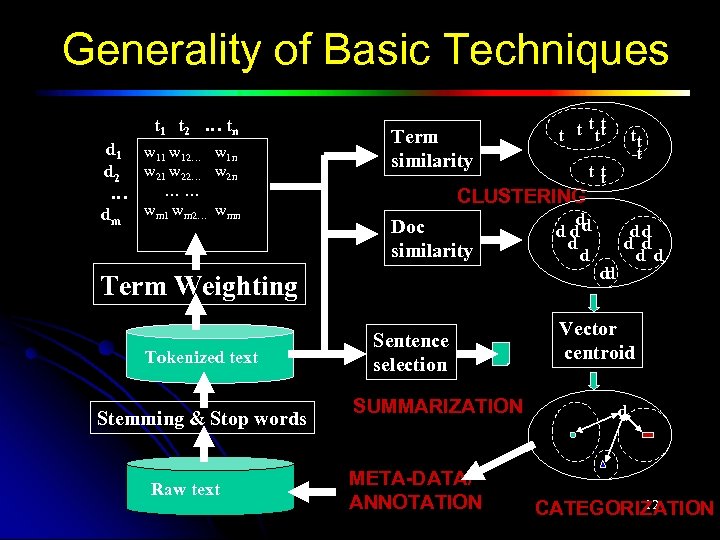
Generality of Basic Techniques t 1 t 2 … tn d 1 w 12… w 1 n d 2 w 21 w 22… w 2 n …… … dm wm 1 wm 2… wmn Term similarity CLUSTERING Doc similarity Term Weighting Tokenized text Stemming & Stop words Raw text tt t t tt Sentence selection SUMMARIZATION META-DATA/ ANNOTATION tt t d d dd d d d d Vector centroid d 12 CATEGORIZATION
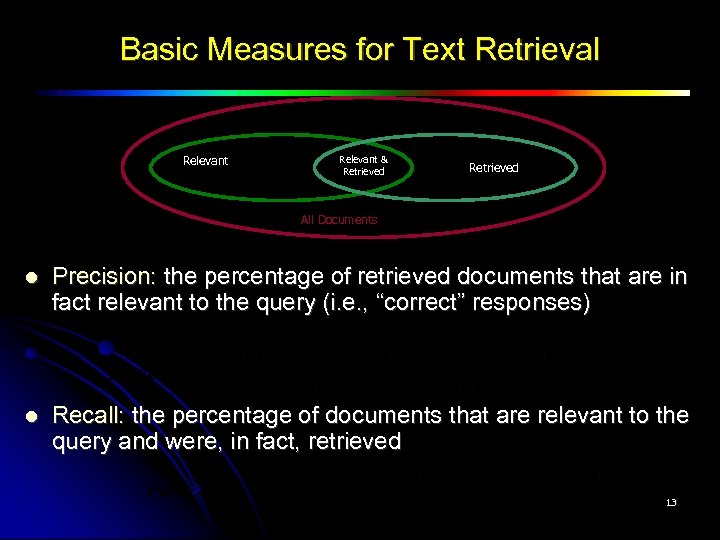
Basic Measures for Text Retrieval Relevant & Retrieved All Documents Precision: the percentage of retrieved documents that are in fact relevant to the query (i. e. , “correct” responses) Recall: the percentage of documents that are relevant to the query and were, in fact, retrieved 13
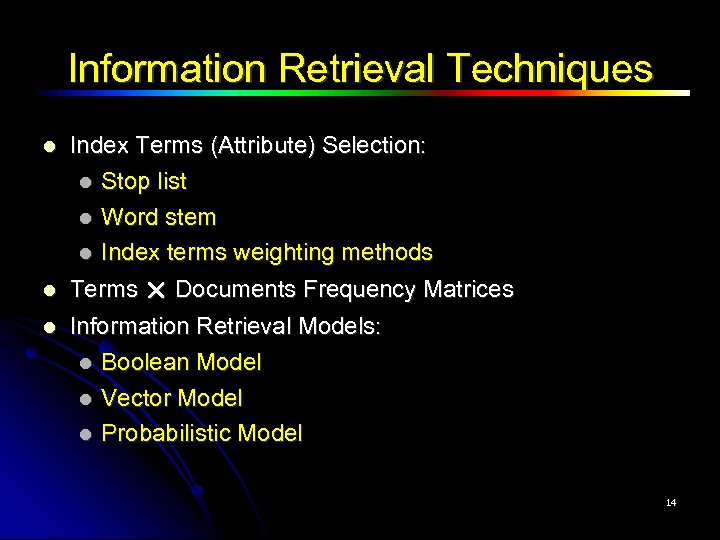
Information Retrieval Techniques Index Terms (Attribute) Selection: Stop list Word stem Index terms weighting methods Terms Documents Frequency Matrices Information Retrieval Models: Boolean Model Vector Model Probabilistic Model 14
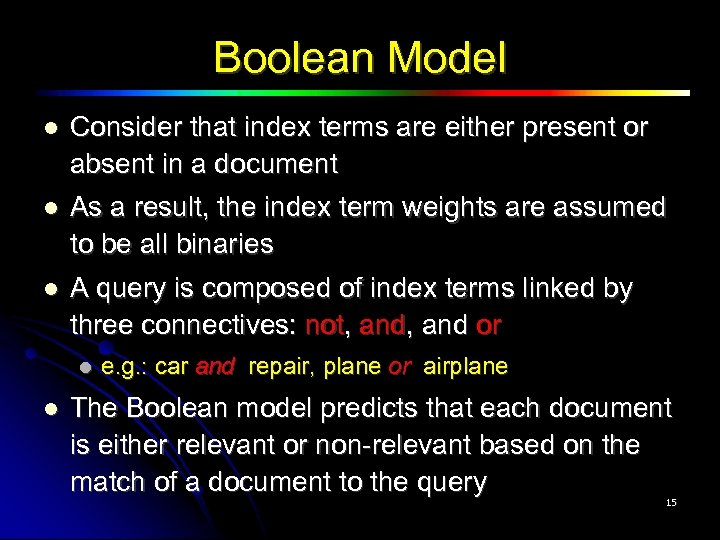
Boolean Model Consider that index terms are either present or absent in a document As a result, the index term weights are assumed to be all binaries A query is composed of index terms linked by three connectives: not, and or e. g. : car and repair, plane or airplane The Boolean model predicts that each document is either relevant or non-relevant based on the match of a document to the query 15
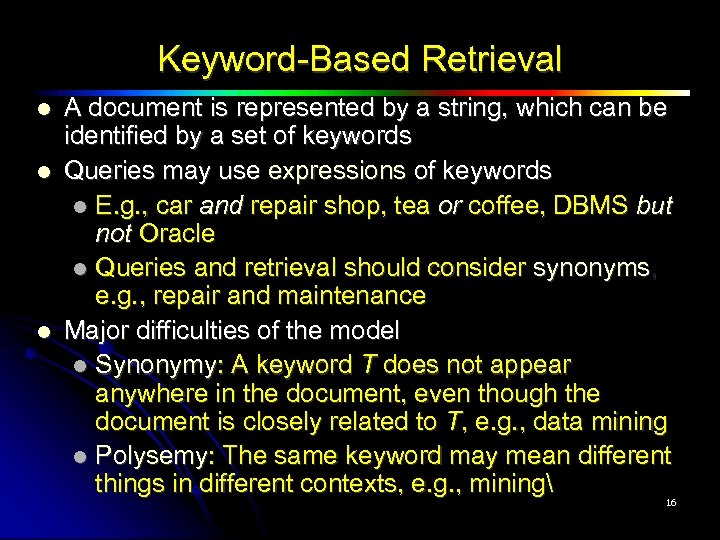
Keyword-Based Retrieval A document is represented by a string, which can be identified by a set of keywords Queries may use expressions of keywords E. g. , car and repair shop, tea or coffee, DBMS but not Oracle Queries and retrieval should consider synonyms, e. g. , repair and maintenance Major difficulties of the model Synonymy: A keyword T does not appear anywhere in the document, even though the document is closely related to T, e. g. , data mining Polysemy: The same keyword may mean different things in different contexts, e. g. , mining 16
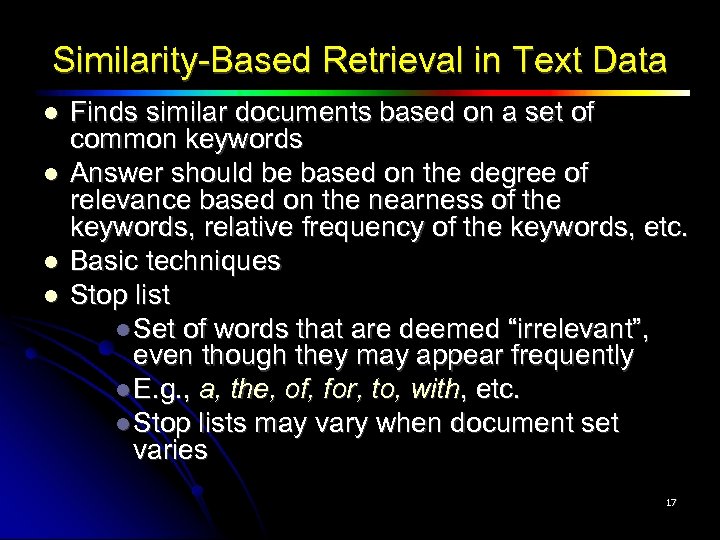
Similarity-Based Retrieval in Text Data Finds similar documents based on a set of common keywords Answer should be based on the degree of relevance based on the nearness of the keywords, relative frequency of the keywords, etc. Basic techniques Stop list Set of words that are deemed “irrelevant”, even though they may appear frequently E. g. , a, the, of, for, to, with, etc. Stop lists may vary when document set varies 17
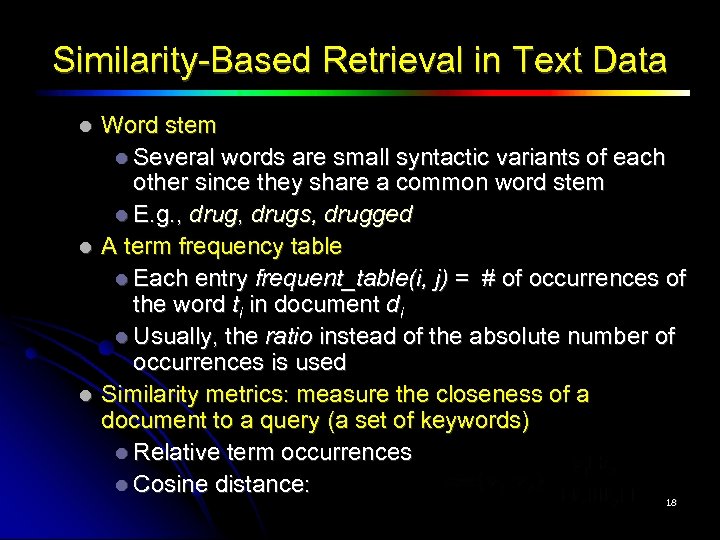
Similarity-Based Retrieval in Text Data Word stem Several words are small syntactic variants of each other since they share a common word stem E. g. , drugs, drugged A term frequency table Each entry frequent_table(i, j) = # of occurrences of the word ti in document di Usually, the ratio instead of the absolute number of occurrences is used Similarity metrics: measure the closeness of a document to a query (a set of keywords) Relative term occurrences Cosine distance: 18
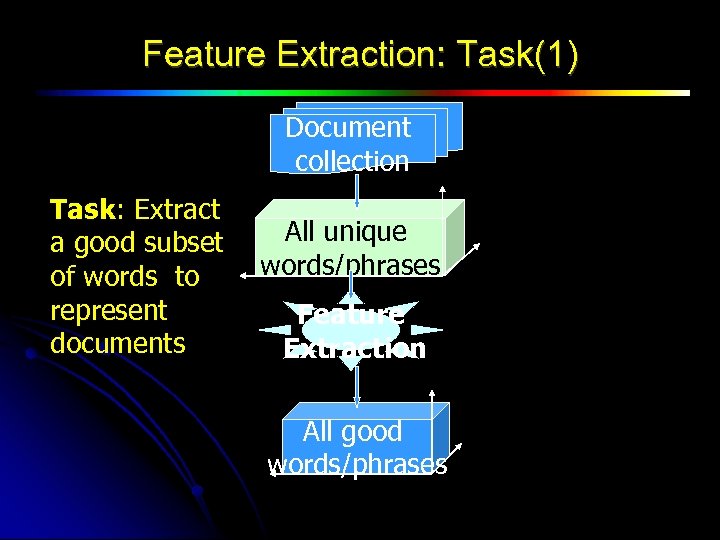
Feature Extraction: Task(1) Document collection Task: Extract a good subset of words to represent documents All unique words/phrases Feature Extraction All good words/phrases
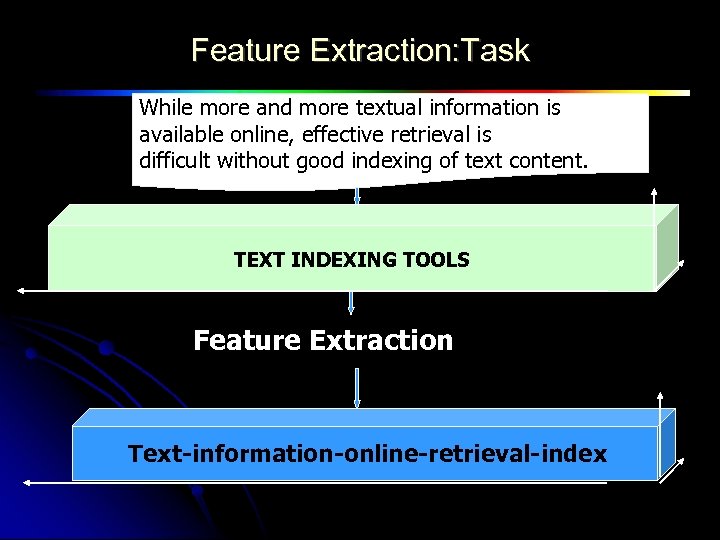
Feature Extraction: Task While more and more textual information is available online, effective retrieval is difficult without good indexing of text content. TEXT INDEXING TOOLS Feature Extraction Text-information-online-retrieval-index
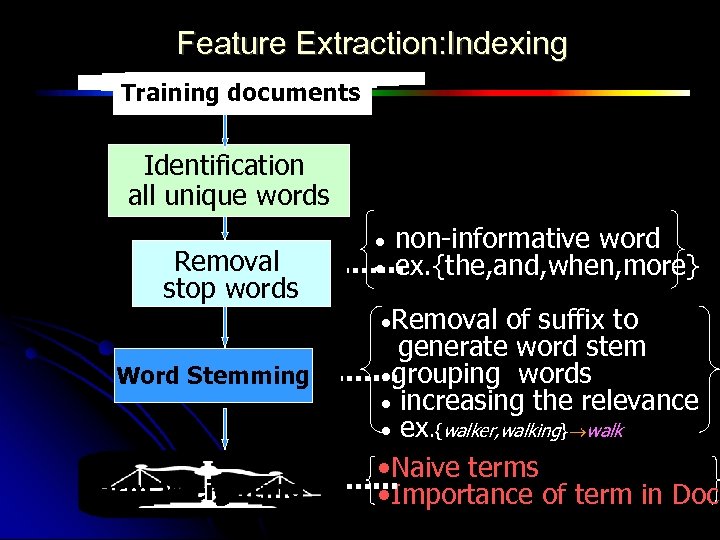
Feature Extraction: Indexing Training documents Identification all unique words Removal stop words Word Stemming Term Weighting non-informative word ex. {the, and, when, more} Removal of suffix to generate word stem grouping words increasing the relevance ex. {walker, walking} walk • Naive terms • Importance of term in Doc
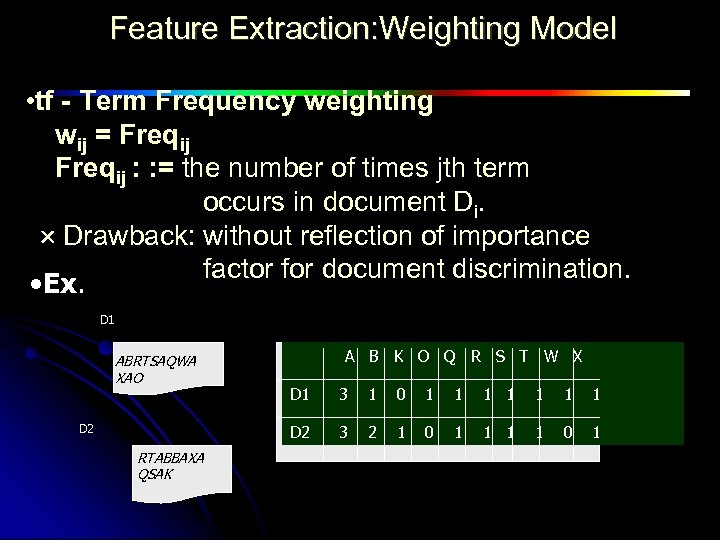
Feature Extraction: Weighting Model • tf - Term Frequency weighting wij = Freqij : : = the number of times jth term occurs in document Di. Drawback: without reflection of importance factor for document discrimination. • Ex. D 1 ABRTSAQWA XAO A B K O Q R S T W X RTABBAXA QSAK 3 1 0 1 1 1 1 D 2 D 1 3 2 1 0 1
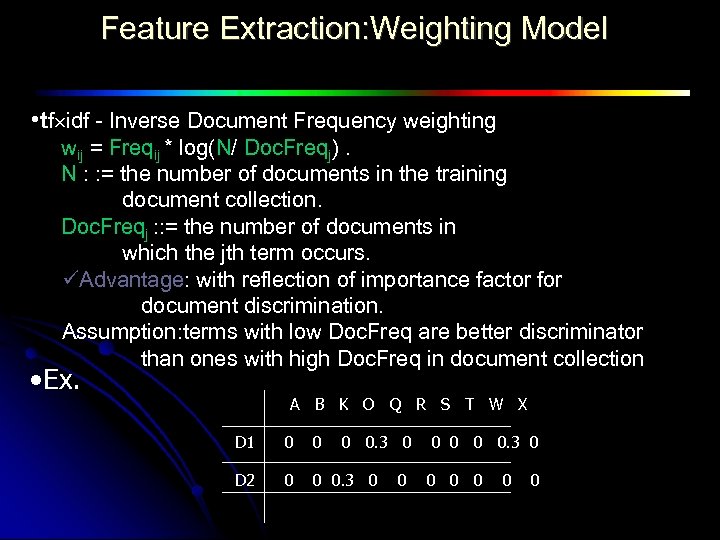
Feature Extraction: Weighting Model • tf idf - Inverse Document Frequency weighting wij = Freqij * log(N/ Doc. Freqj). N : : = the number of documents in the training document collection. Doc. Freqj : : = the number of documents in which the jth term occurs. Advantage: with reflection of importance factor for document discrimination. Assumption: terms with low Doc. Freq are better discriminator than ones with high Doc. Freq in document collection • Ex. A B K O Q R S T W X D 1 0 0. 3 0 D 2 0 0 0. 3 0 0 0
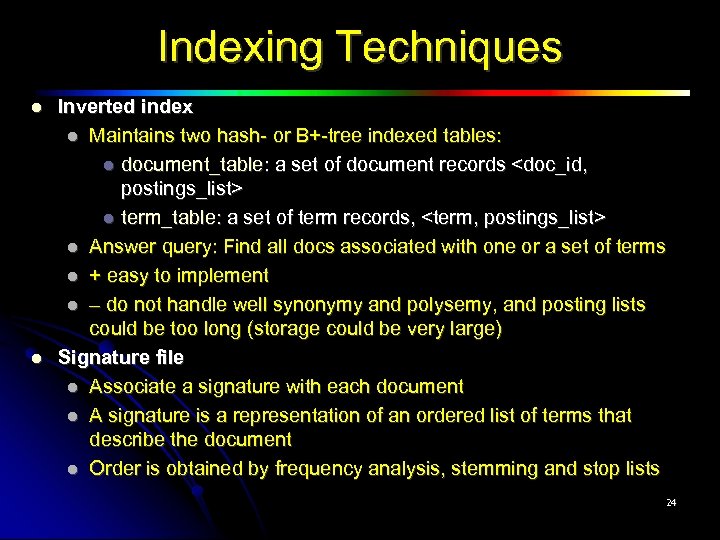
Indexing Techniques Inverted index Maintains two hash- or B+-tree indexed tables: document_table: a set of document records <doc_id, postings_list> term_table: a set of term records, <term, postings_list> Answer query: Find all docs associated with one or a set of terms + easy to implement – do not handle well synonymy and polysemy, and posting lists could be too long (storage could be very large) Signature file Associate a signature with each document A signature is a representation of an ordered list of terms that describe the document Order is obtained by frequency analysis, stemming and stop lists 24
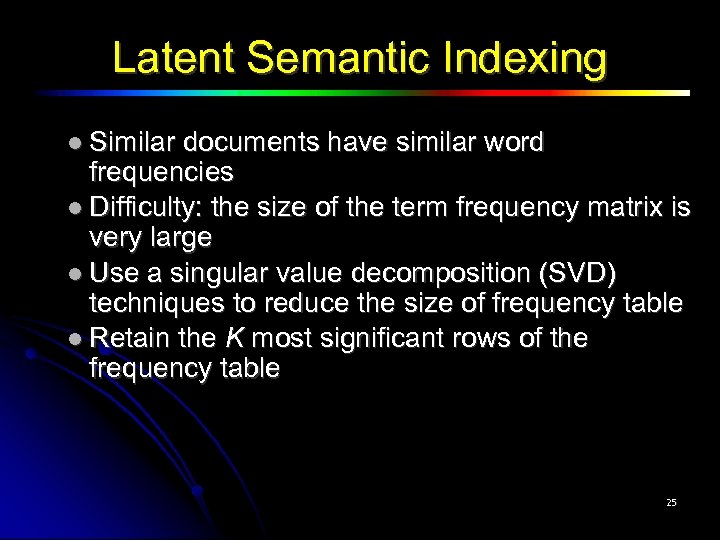
Latent Semantic Indexing Similar documents have similar word frequencies Difficulty: the size of the term frequency matrix is very large Use a singular value decomposition (SVD) techniques to reduce the size of frequency table Retain the K most significant rows of the frequency table 25
Probabilistic Model Basic assumption: Given a user query, there is a set of documents which contains exactly the relevant documents and no other (ideal answer set) Querying process as a process of specifying the properties of an ideal answer set. Since these properties are not known at query time, an initial guess is made This initial guess allows the generation of a preliminary probabilistic description of the ideal answer set which is used to retrieve the first set of documents An interaction with the user is then initiated with the purpose of improving the probabilistic description of the answer set 26
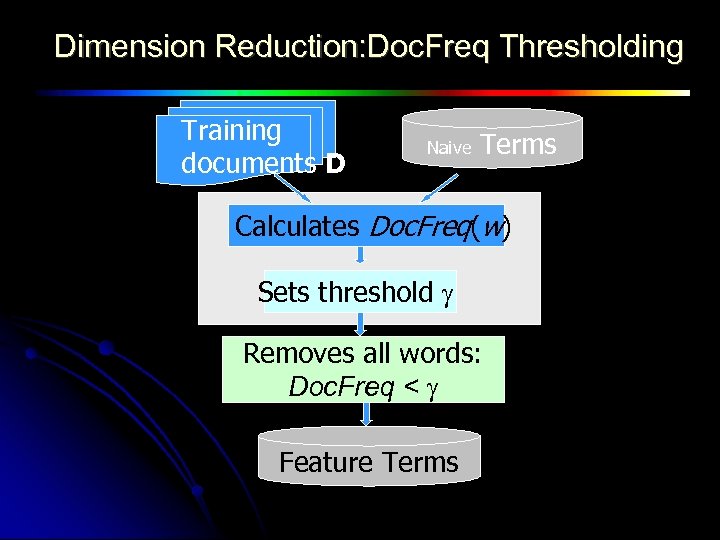
Dimension Reduction: Doc. Freq Thresholding Training documents D Naive Terms Calculates Doc. Freq(w) Sets threshold Removes all words: Doc. Freq < Feature Terms
Types of Text Data Mining Keyword-based association analysis Automatic document classification Similarity detection Cluster documents by a common author Cluster documents containing information from a common source Link analysis: unusual correlation between entities Sequence analysis: predicting a recurring event Anomaly detection: find information that violates usual patterns Hypertext analysis Patterns in anchors/links Anchor text correlations with linked objects 28
Keyword-Based Association Analysis Motivation: Collect sets of keywords or terms that occur frequently together and then find the association or correlationships among them Association Analysis Process: Preprocess the text data by parsing, stemming, removing stop words, etc. Evoke association mining algorithms: Consider each document as a transaction & View a set of keywords in the document as a set of items in the transaction Term level association mining No need for human effort in tagging documents The number of meaningless results and the execution time is greatly reduced 29
Text Classification Automatic classification for the large number of on-line text documents (Web pages, e-mails, intranets, etc. ) Classification Process Data preprocessing Definition of training set and test sets Creation of the classification model using the selected classification algorithm Classification model validation Classification of new/unknown text documents Text document classification differs from the classification of relational data Document databases are not structured according to attribute-value pairs 30
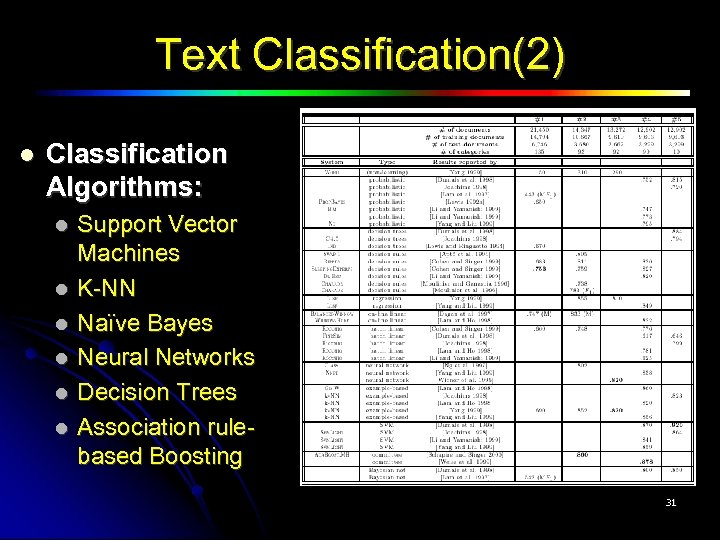
Text Classification(2) Classification Algorithms: Support Vector Machines K-NN Naïve Bayes Neural Networks Decision Trees Association rulebased Boosting 31
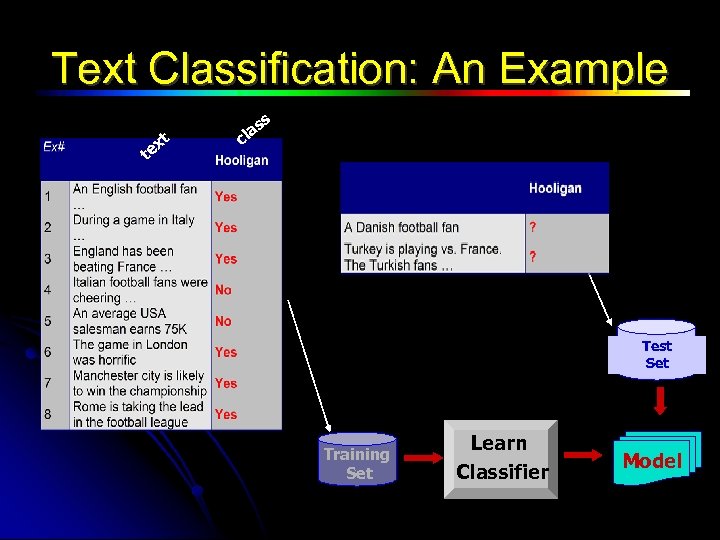
Text Classification: An Example t x te s s la c Test Set Training Set Learn Classifier Model
Document Clustering Motivation No predetermined training sets or taxonomies Automatically group related documents based on their contents Generate a taxonomy at runtime Clustering Process Data preprocessing: remove stop words, stem, feature extraction, lexical analysis, etc. Hierarchical clustering: compute similarities applying clustering algorithms. Model-Based clustering (Neural Network Approach): clusters are represented by “exemplars”. (e. g. : SOM) 33
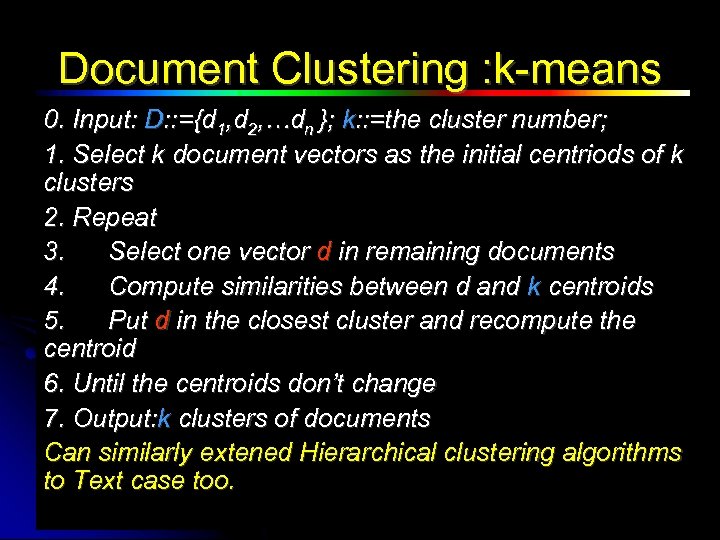
Document Clustering : k-means 0. Input: D: : ={d 1, d 2, …dn }; k: : =the cluster number; 1. Select k document vectors as the initial centriods of k clusters 2. Repeat 3. Select one vector d in remaining documents 4. Compute similarities between d and k centroids 5. Put d in the closest cluster and recompute the centroid 6. Until the centroids don’t change 7. Output: k clusters of documents Can similarly extened Hierarchical clustering algorithms to Text case too. 34
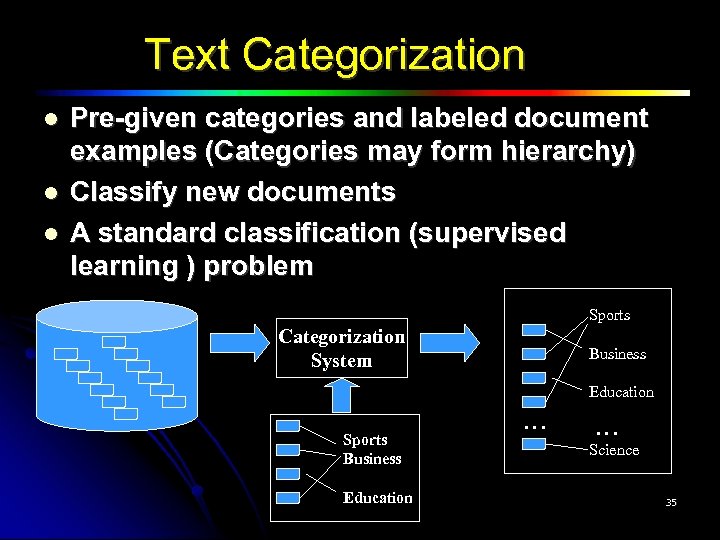
Text Categorization Pre-given categories and labeled document examples (Categories may form hierarchy) Classify new documents A standard classification (supervised learning ) problem Sports Categorization System Business Education Sports Business Education … … Science 35
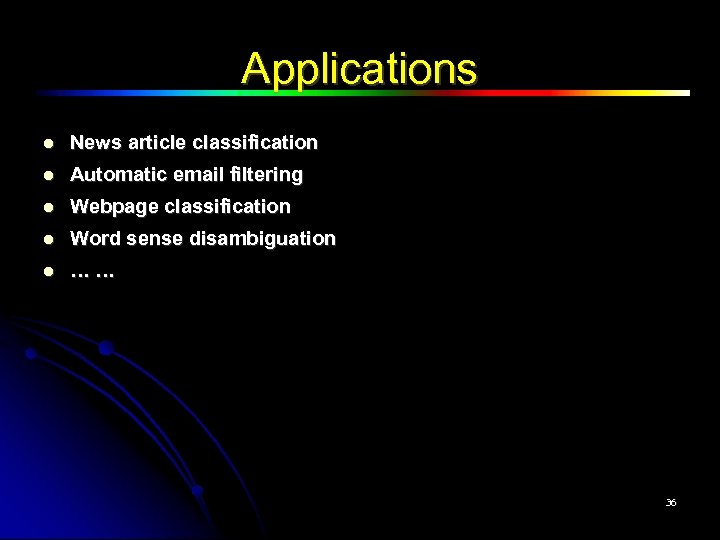
Applications News article classification Automatic email filtering Webpage classification Word sense disambiguation … … 36
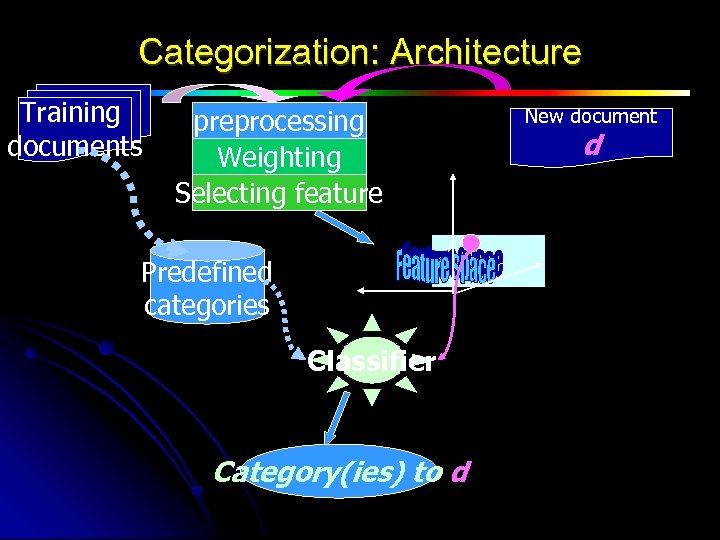
Categorization: Architecture Training documents preprocessing Weighting Selecting feature Predefined categories Classifier Category(ies) to d New document d
Categorization Classifiers Centroid-based Classifier k-Nearest Neighbor Classifier Naive Bayes Classifier
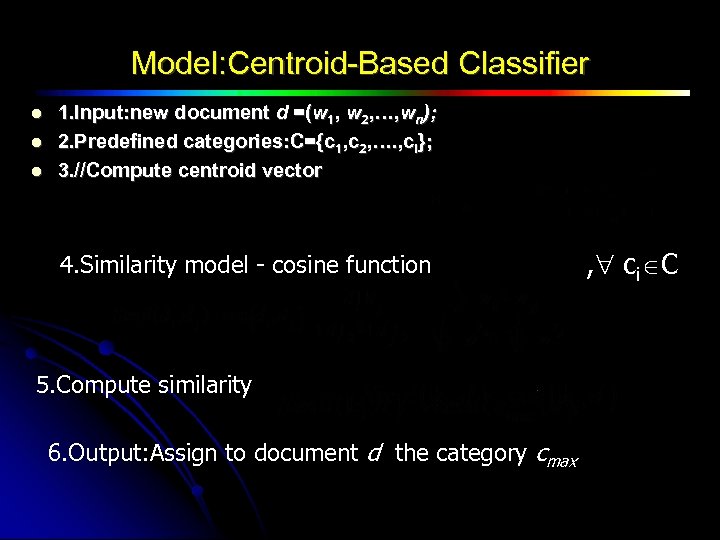
Model: Centroid-Based Classifier 1. Input: new document d =(w 1, w 2, …, wn); 2. Predefined categories: C={c 1, c 2, …. , cl}; 3. //Compute centroid vector 4. Similarity model - cosine function 5. Compute similarity 6. Output: Assign to document d the category cmax , ci C
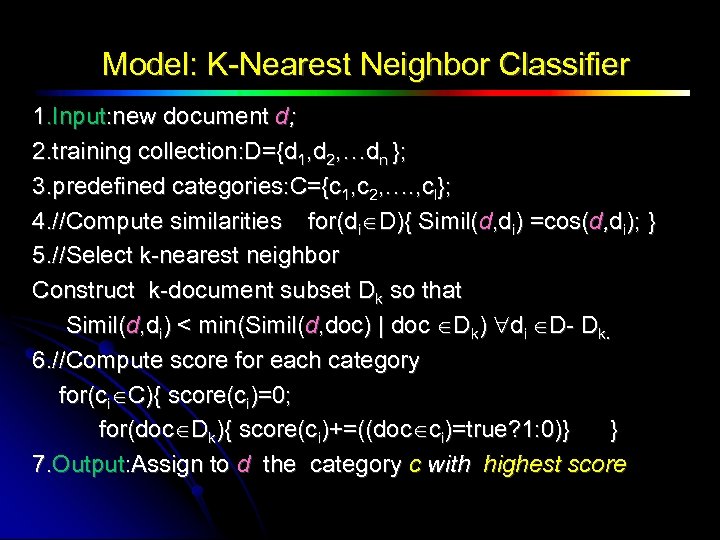
Model: K-Nearest Neighbor Classifier 1. Input: new document d; 2. training collection: D={d 1, d 2, …dn }; 3. predefined categories: C={c 1, c 2, …. , cl}; 4. //Compute similarities for(di D){ Simil(d, di) =cos(d, di); } 5. //Select k-nearest neighbor Construct k-document subset Dk so that Simil(d, di) < min(Simil(d, doc) | doc Dk) di D- Dk. 6. //Compute score for each category for(ci C){ score(ci)=0; for(doc Dk){ score(ci)+=((doc ci)=true? 1: 0)} } 7. Output: Assign to d the category c with highest score
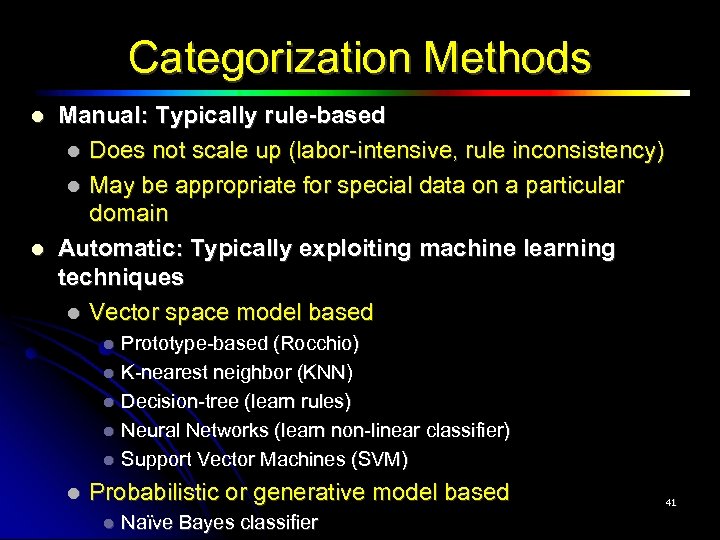
Categorization Methods Manual: Typically rule-based Does not scale up (labor-intensive, rule inconsistency) May be appropriate for special data on a particular domain Automatic: Typically exploiting machine learning techniques Vector space model based Prototype-based (Rocchio) K-nearest neighbor (KNN) Decision-tree (learn rules) Neural Networks (learn non-linear classifier) Support Vector Machines (SVM) Probabilistic or generative model based Naïve Bayes classifier 41
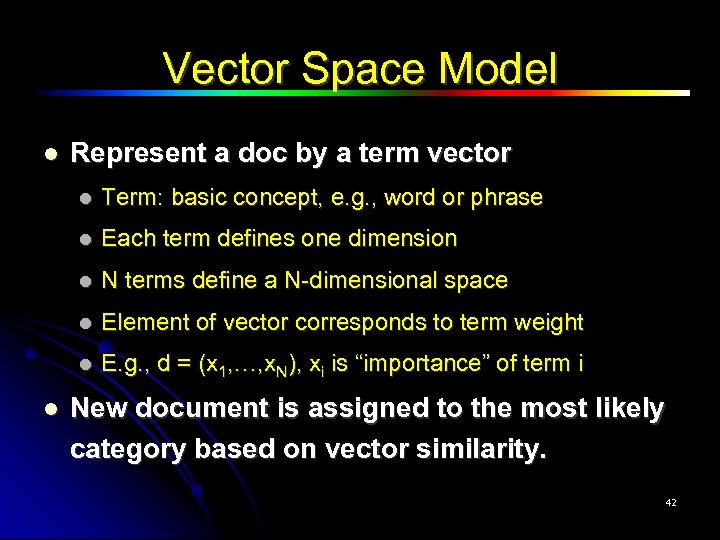
Vector Space Model Represent a doc by a term vector Each term defines one dimension N terms define a N-dimensional space Element of vector corresponds to term weight Term: basic concept, e. g. , word or phrase E. g. , d = (x 1, …, x. N), xi is “importance” of term i New document is assigned to the most likely category based on vector similarity. 42
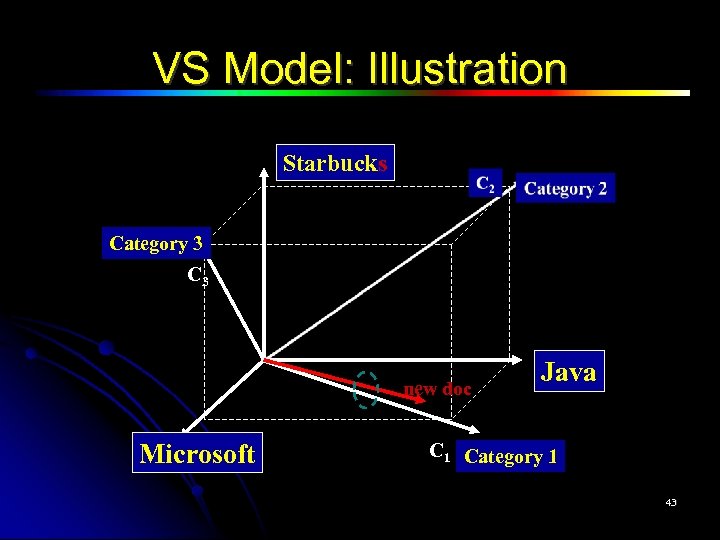
VS Model: Illustration Starbucks Category 3 C 3 new doc Microsoft Java C 1 Category 1 43
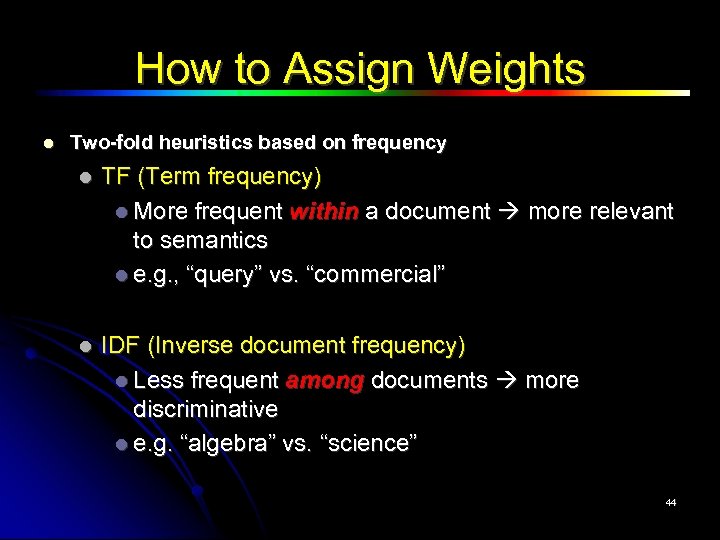
How to Assign Weights Two-fold heuristics based on frequency TF (Term frequency) More frequent within a document more relevant to semantics e. g. , “query” vs. “commercial” IDF (Inverse document frequency) Less frequent among documents more discriminative e. g. “algebra” vs. “science” 44
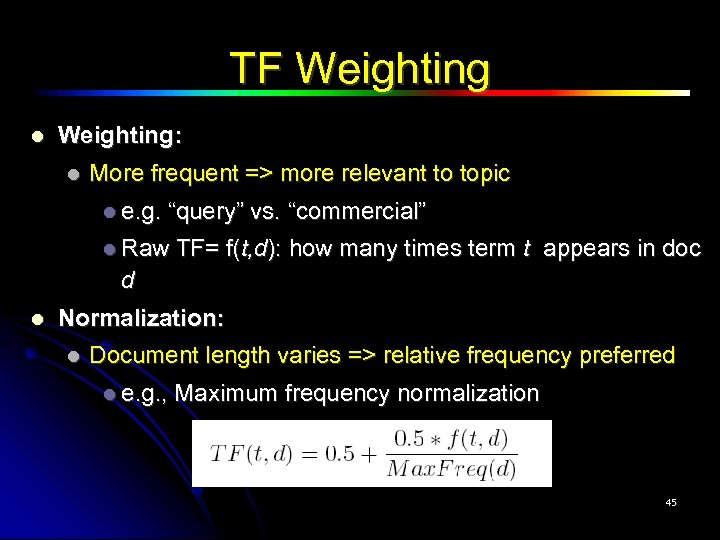
TF Weighting: More frequent => more relevant to topic e. g. “query” vs. “commercial” Raw TF= f(t, d): how many times term t appears in doc d Normalization: Document length varies => relative frequency preferred e. g. , Maximum frequency normalization 45
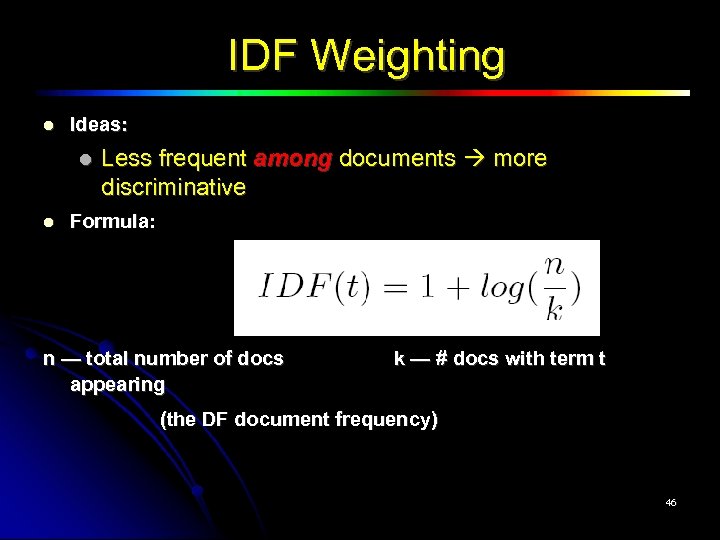
IDF Weighting Ideas: Less frequent among documents more discriminative Formula: n — total number of docs k — # docs with term t appearing (the DF document frequency) 46
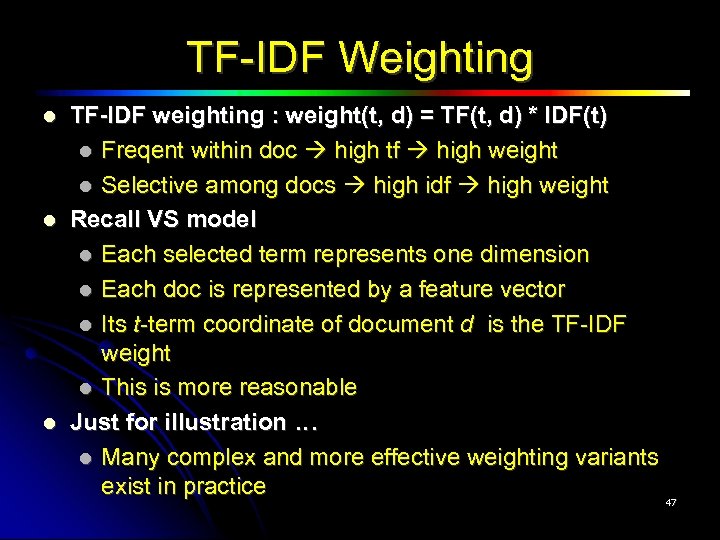
TF-IDF Weighting TF-IDF weighting : weight(t, d) = TF(t, d) * IDF(t) Freqent within doc high tf high weight Selective among docs high idf high weight Recall VS model Each selected term represents one dimension Each doc is represented by a feature vector Its t-term coordinate of document d is the TF-IDF weight This is more reasonable Just for illustration … Many complex and more effective weighting variants exist in practice 47
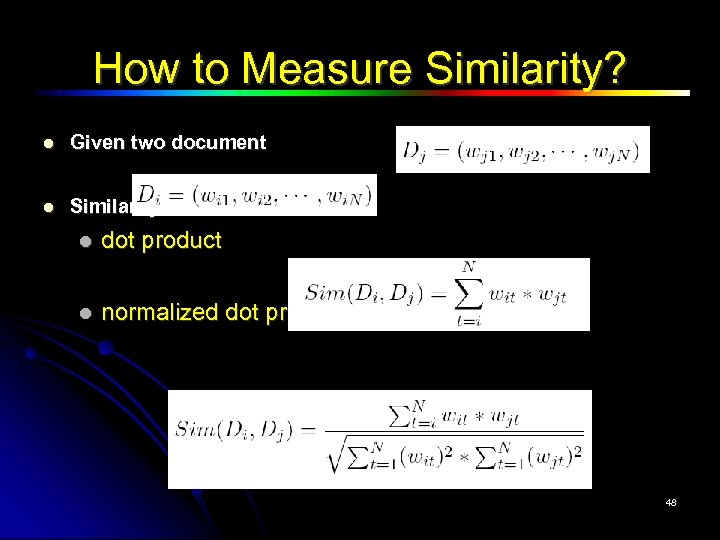
How to Measure Similarity? Given two document Similarity definition dot product normalized dot product (or cosine) 48
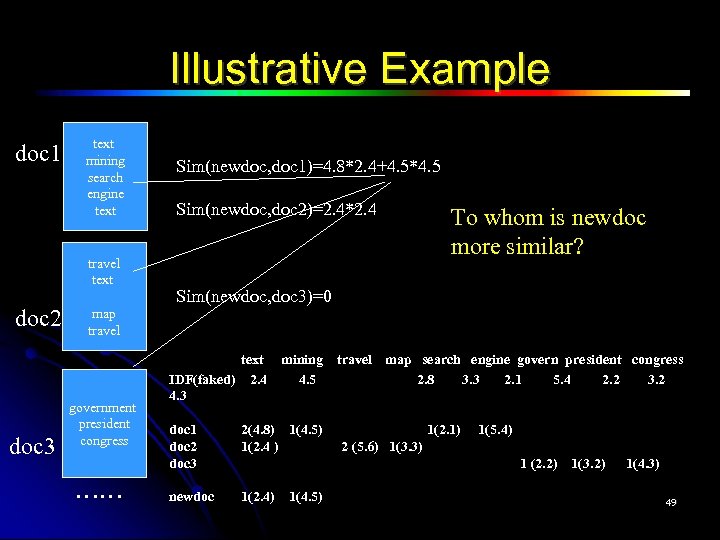
Illustrative Example doc 1 text mining search engine text travel text doc 2 doc 3 Sim(newdoc, doc 1)=4. 8*2. 4+4. 5*4. 5 Sim(newdoc, doc 2)=2. 4*2. 4 To whom is newdoc more similar? Sim(newdoc, doc 3)=0 map travel government president congress …… text mining IDF(faked) 2. 4 4. 5 4. 3 doc 1 doc 2 doc 3 2(4. 8) 1(4. 5) 1(2. 4 ) newdoc 1(2. 4) travel map search engine govern president congress 2. 8 3. 3 2. 1 5. 4 2. 2 3. 2 1(2. 1) 1(5. 4) 2 (5. 6) 1(3. 3) 1 (2. 2) 1(3. 2) 1(4. 5) 1(4. 3) 49
Probabilistic Model Category C is modeled as a probability distribution of pre-defined random events Random events model the process of generating documents Therefore, how likely a document d belongs to category C is measured through the probability for category C to generate d. 50
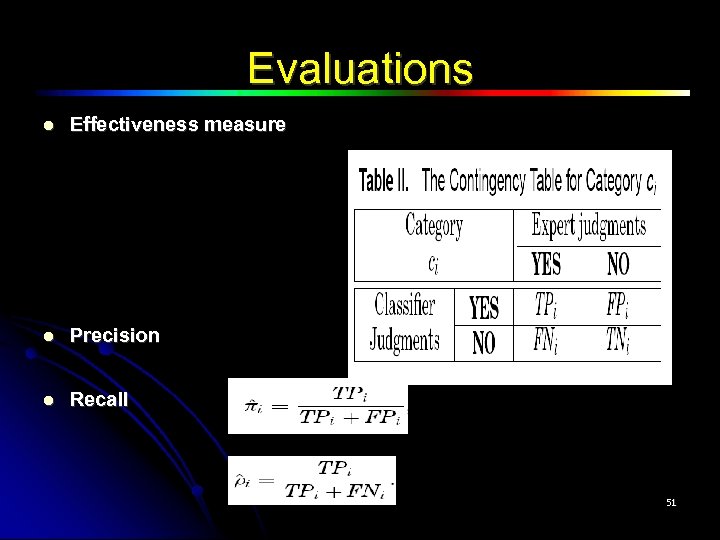
Evaluations Effectiveness measure Precision Recall 51
Evaluation (con’t) Benchmarks Classic: Reuters collection A set of newswire stories classified under categories related to economics. Effectiveness Difficulties of strict comparison different “split” (or selection) between training and testing different parameter setting various optimizations … … However widely recognizable Best: Boosting-based committee classifier & SVM Worst: Naïve Bayes classifier Need to consider other factors, especially efficiency 52
Summary: Text Categorization Wide application domain Comparable effectiveness to professionals Manual TC is not 100% and unlikely to improve substantially. A. T. C. is growing at a steady pace Prospects and extensions Very noisy text, such as text from O. C. R. Speech transcripts 53
Скачать презентацию Data Warehousing Mining with Business Intelligence Principles
abd34081ad49101206cb2f4fdc2bbd29.ppt