 Скачать презентацию Data Warehousing l Data l l Database l
6909618929e84ba9fcbcdc542e4e974c.ppt
- Количество слайдов: 70



Data Warehousing l Data l l Database l l Raw piece of information that is capable of being moved and store. An organized collection of such data in which data are managed in tabular form with relationship. Data Warehouse l System that organizes all the data available in an organization, makes it accessible & usable for the all kinds of data analysis and also allows to create a lots of reports by the use of mining tools. CH#2, Data Warehousing By: Babu Ram Dawadi
Data Warehouse… l l “A data warehouse is a subject-oriented, integrated, time-variant, and nonvolatile collection of data in support of management’s decisionmaking process. ” Data warehousing: l l The process of constructing and using data warehouses. Is the process of extracting & transferring operational data into informational data & loading it into a central data store (warehouse) CH#2, Data Warehousing By: Babu Ram Dawadi
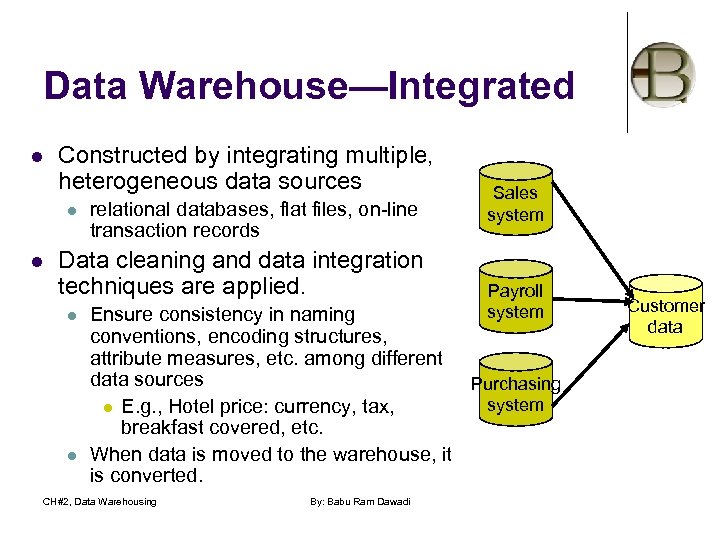
Data Warehouse—Integrated l Constructed by integrating multiple, heterogeneous data sources l l relational databases, flat files, on-line transaction records Data cleaning and data integration techniques are applied. l l Sales system Payroll system Ensure consistency in naming conventions, encoding structures, attribute measures, etc. among different data sources Purchasing system l E. g. , Hotel price: currency, tax, breakfast covered, etc. When data is moved to the warehouse, it is converted. CH#2, Data Warehousing By: Babu Ram Dawadi Customer data
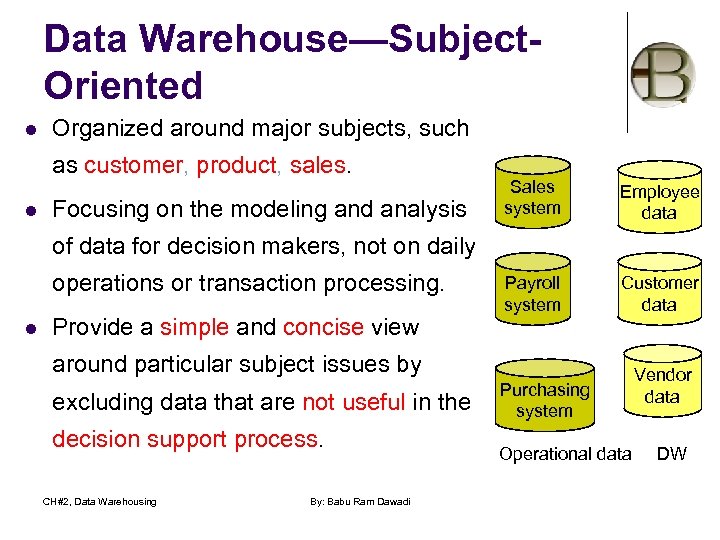
Data Warehouse—Subject. Oriented l Organized around major subjects, such as customer, product, sales. l Focusing on the modeling and analysis Sales system Employee data Payroll system Customer data of data for decision makers, not on daily operations or transaction processing. l Provide a simple and concise view around particular subject issues by excluding data that are not useful in the decision support process. CH#2, Data Warehousing By: Babu Ram Dawadi Purchasing system Operational data Vendor data DW
Data Warehouse—Time Variant l The time horizon for the data warehouse is significantly longer than that of operational systems. l l l Operational database: current value data. Data warehouse data: provide information from a historical perspective (e. g. , past 5 -10 years) Every key structure in the data warehouse l Contains an element of time, explicitly or implicitly l But the key of operational data may or may not contain “time element”. CH#2, Data Warehousing By: Babu Ram Dawadi
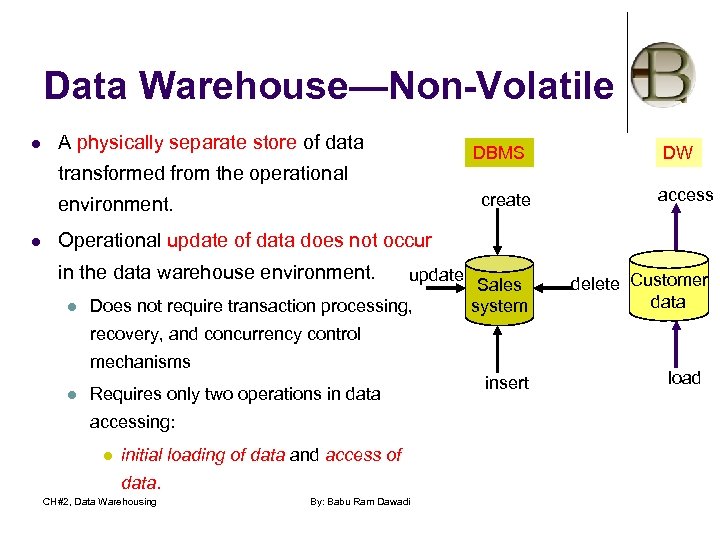
Data Warehouse—Non-Volatile l A physically separate store of data DBMS transformed from the operational create environment. l DW access Operational update of data does not occur in the data warehouse environment. l update Does not require transaction processing, Sales system delete Customer data recovery, and concurrency control mechanisms l Requires only two operations in data accessing: l initial loading of data and access of data. CH#2, Data Warehousing By: Babu Ram Dawadi insert load
Data Warehouse Usage l Three kinds of data warehouse applications l Information processing supports querying, basic statistical analysis, and reporting using crosstabs, tables, charts and graphs Analytical processing l l l multidimensional analysis of data warehouse data supports basic OLAP operations, slice-dice, drilling, pivoting Data mining l l l knowledge discovery from hidden patterns l supports associations, constructing analytical models, performing classification and prediction, and presenting the mining results using visualization tools. CH#2, Data Warehousing By: Babu Ram Dawadi
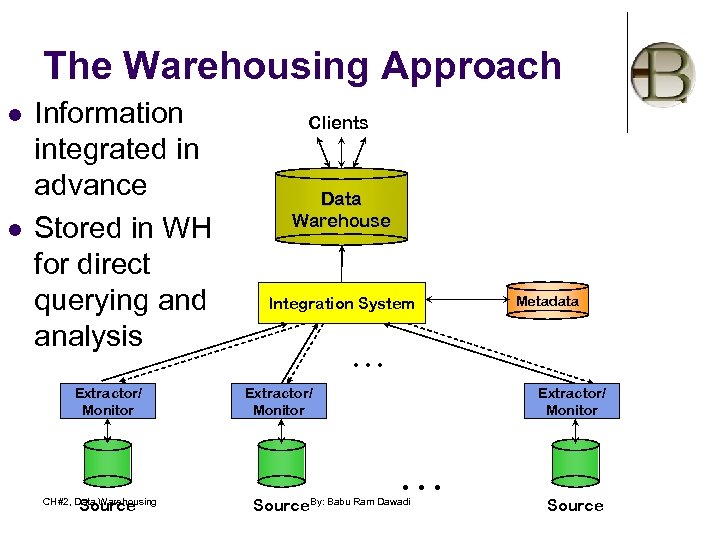
The Warehousing Approach l l Information integrated in advance Stored in WH for direct querying and analysis Extractor/ Monitor Source CH#2, Data Warehousing Clients Data Warehouse Integration System Metadata . . . Extractor/ Monitor . . . Source. By: Babu Ram Dawadi Source
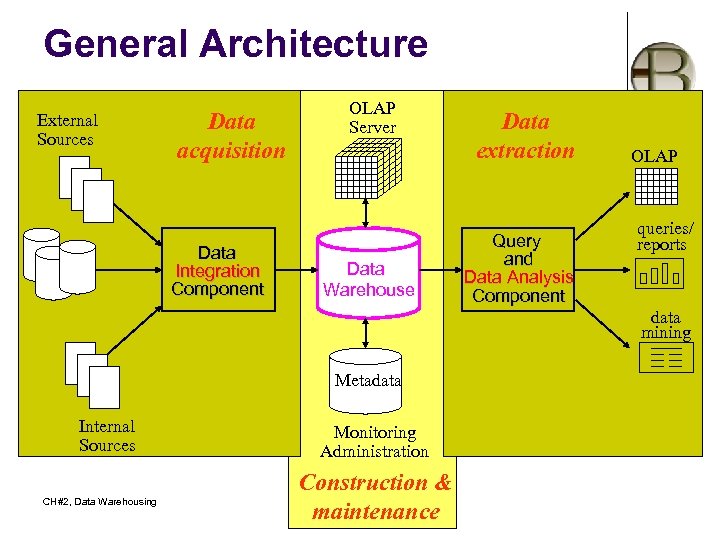
General Architecture External Sources Data acquisition Data Integration Component OLAP Server Data Warehouse Data extraction Query and Data Analysis Component OLAP queries/ reports data mining Metadata Internal Sources CH#2, Data Warehousing Monitoring Administration Construction & By: Babu Ram Dawadi maintenance
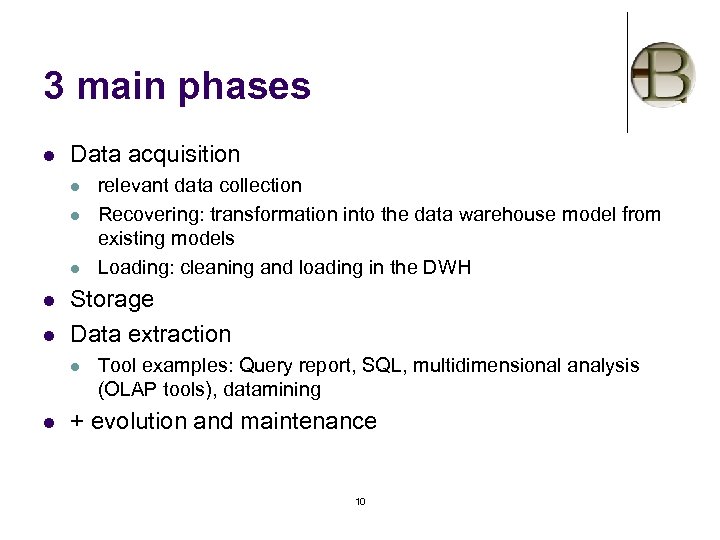
3 main phases l Data acquisition l l l Storage Data extraction l l relevant data collection Recovering: transformation into the data warehouse model from existing models Loading: cleaning and loading in the DWH Tool examples: Query report, SQL, multidimensional analysis (OLAP tools), datamining + evolution and maintenance 10
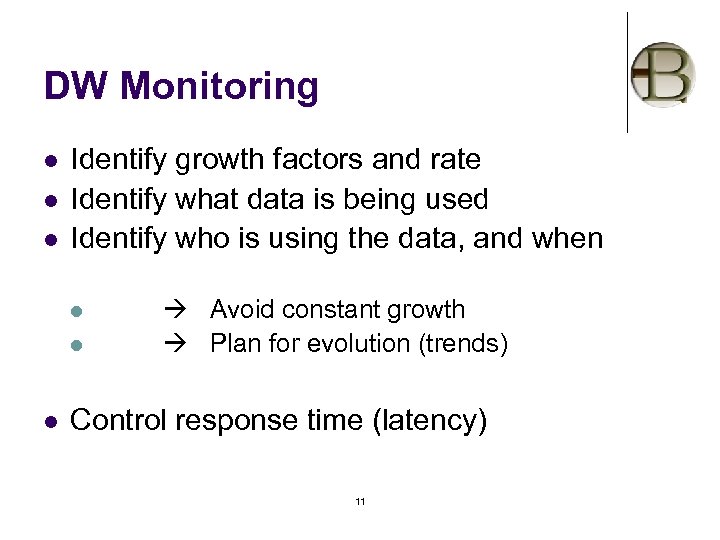
DW Monitoring l l l Identify growth factors and rate Identify what data is being used Identify who is using the data, and when l l l Avoid constant growth Plan for evolution (trends) Control response time (latency) 11
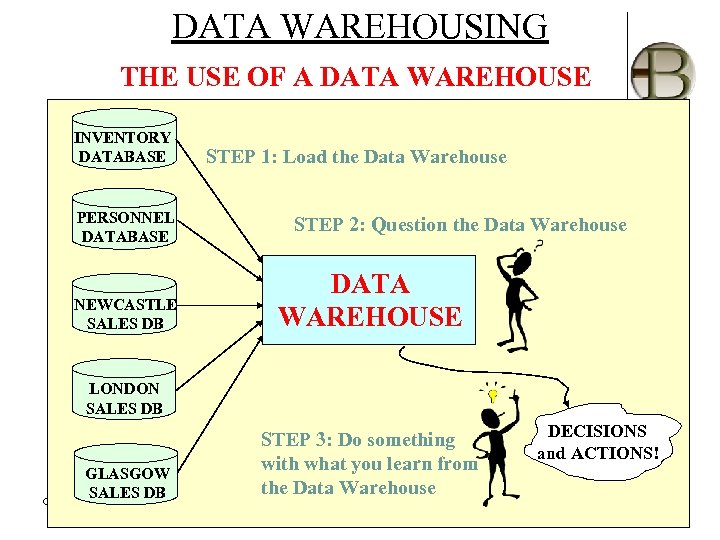
DATA WAREHOUSING THE USE OF A DATA WAREHOUSE INVENTORY DATABASE PERSONNEL DATABASE NEWCASTLE SALES DB STEP 1: Load the Data Warehouse STEP 2: Question the Data Warehouse DATA WAREHOUSE LONDON SALES DB GLASGOW SALES DB CH#2, Data Warehousing STEP 3: Do something with what you learn from the Data Warehouse By: Babu Ram Dawadi DECISIONS and ACTIONS!
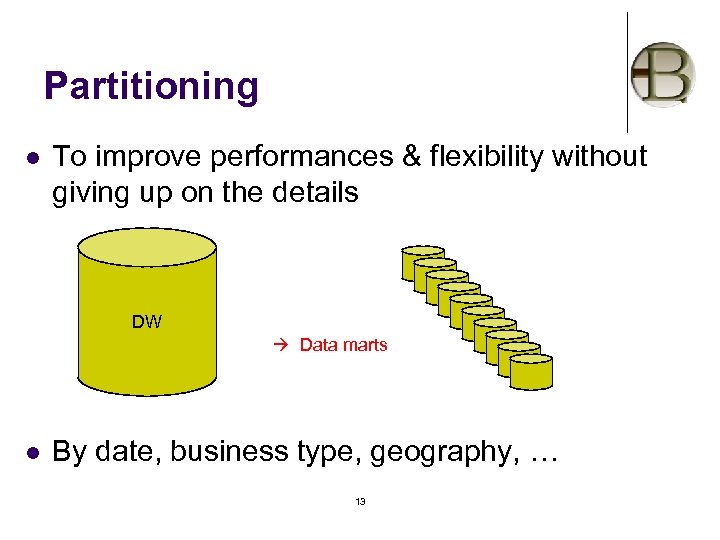
Partitioning l To improve performances & flexibility without giving up on the details DW Data marts l By date, business type, geography, … 13
The Need for Data Analysis l Managers must be able to track daily transactions to evaluate how the business is performing l By tapping into the operational database, management can develop strategies to meet organizational goals l Data analysis can provide information about short -term tactical evaluations and strategies CH#2, Data Warehousing By: Babu Ram Dawadi
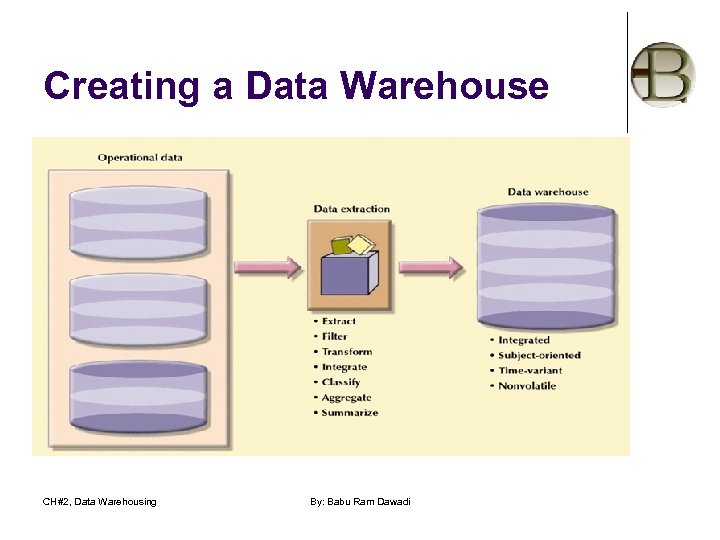
Creating a Data Warehouse CH#2, Data Warehousing By: Babu Ram Dawadi
Factors Common to Data Warehousing l l Dynamic framework for decision support that is always a work in progress Must satisfy: l l Data integration and loading criteria Data analysis capabilities with acceptable query performance End-user data analysis needs Apply database design procedures CH#2, Data Warehousing By: Babu Ram Dawadi
Why Separate Data Warehouse? l l High performance for both systems l DBMS— tuned for OLTP: access methods, indexing, concurrency control, recovery l Warehouse—tuned for OLAP: complex OLAP queries, multidimensional view, consolidation(aggregation). Different functions and different data: l missing data: Decision support requires historical data which operational DBs do not typically maintain l data consolidation: Decision Support requires consolidation (aggregation, summarization) of data from heterogeneous sources l data quality: different sources typically use inconsistent data representations, codes and formats 17
Decision Support Systems l Methodology (or series of methodologies) designed to extract information from data and to use such information as a basis for decision making l Decision support system (DSS): l l l Arrangement of computerized tools used to assist managerial decision making within a business Usually requires extensive data “massaging” to produce information Used at all levels within an organization Often tailored to focus on specific business areas Provides ad hoc query tools to retrieve data and to display data in different formats CH#2, Data Warehousing By: Babu Ram Dawadi
Decision Support Systems (continued) l Composed of four main components: l Data store component l l Data extraction and filtering component l l Used to extract and validate data taken from operational database and external data sources End-user query tool l l Basically a DSS database Used to create queries that access database End-user presentation tool l Used to organize and present data CH#2, Data Warehousing By: Babu Ram Dawadi
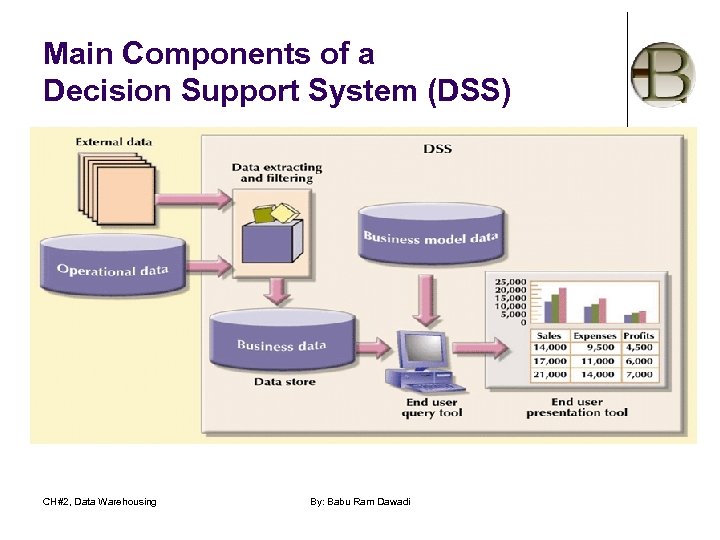
Main Components of a Decision Support System (DSS) CH#2, Data Warehousing By: Babu Ram Dawadi
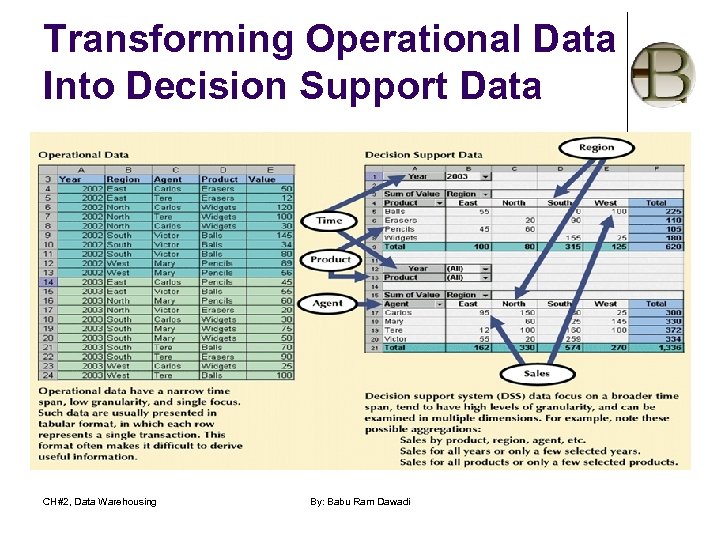
Transforming Operational Data Into Decision Support Data CH#2, Data Warehousing By: Babu Ram Dawadi
Designing DSS l DSS is the more general term referring to all kinds of analysis of existing data in order to make better decisions, like: data mining, OLAP, Simulation etc… l DSS design differs considerably from that of an online transaction processing (OLTP). In contrast to OLTP, DSS are used only for queries. CH#2, Data Warehousing By: Babu Ram Dawadi
Designing DSS l Designing a DSS seeks particular importance on: l l Requirement of the end user Software requirement Hardware requirement End user requirement l l l Discuss with the end user People who need to use DSS produce a huge variety of queries Some are interested only on a particular part of the information so that they may prefer to optimize the application completely in order to speed up the query process. CH#2, Data Warehousing By: Babu Ram Dawadi
DSS … l Software Requirement l l l Type of software depends very much on the requirement of the end user. Working on a client/server environment allows flexibility in choosing the appropriate software for end users. For data mining, software can be split into two parts: l l The first works with the algorithms on the database server The second work on the local workstation. CH#2, Data Warehousing By: Babu Ram Dawadi
DSS… l Hardware Requirement l A large DW can contain hundreds of thousands of giga bytes. l l So DW is designed by Engineer with knowledge of both hardware and software For data mining, it is not always necessary to have a very large database and a large database server. CH#2, Data Warehousing By: Babu Ram Dawadi
ON-LINE ANALYTICAL PROCESSING (OLAP) CH#2, Data Warehousing By: Babu Ram Dawadi
OLAP WHAT IS OLAP? DEFINITION : ‘OLAP applications and tools are those that are designed to ask ad hoc, complex queries of large multidimensional collections of data. It is for this reason that OLAP is often mentioned in the context of Data Warehouses’. CH#2, Data Warehousing By: Babu Ram Dawadi
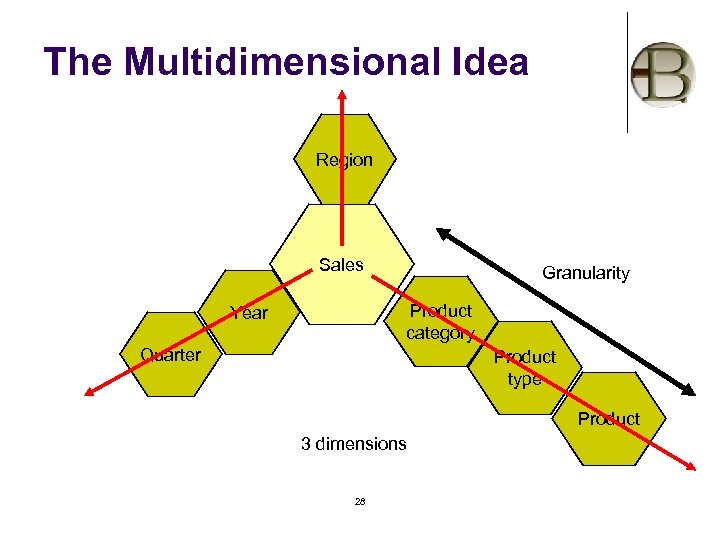
The Multidimensional Idea Region Sales Granularity Product category Year Quarter Product type Product 3 dimensions 28
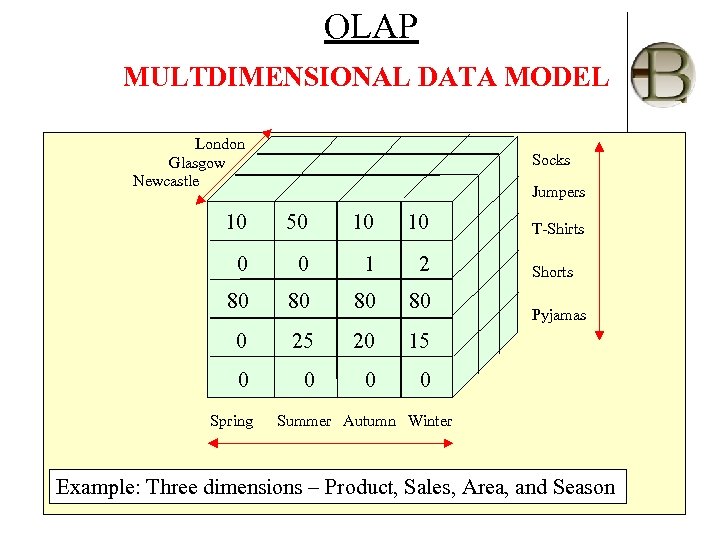
OLAP MULTDIMENSIONAL DATA MODEL London Glasgow Newcastle Socks Jumpers 10 50 10 10 0 0 1 2 80 80 0 25 20 15 0 0 Spring T-Shirts Shorts Pyjamas Summer Autumn Winter Example: Three dimensions – Product, Sales, Area, and Season By: Babu Ram Dawadi CH#2, Data Warehousing
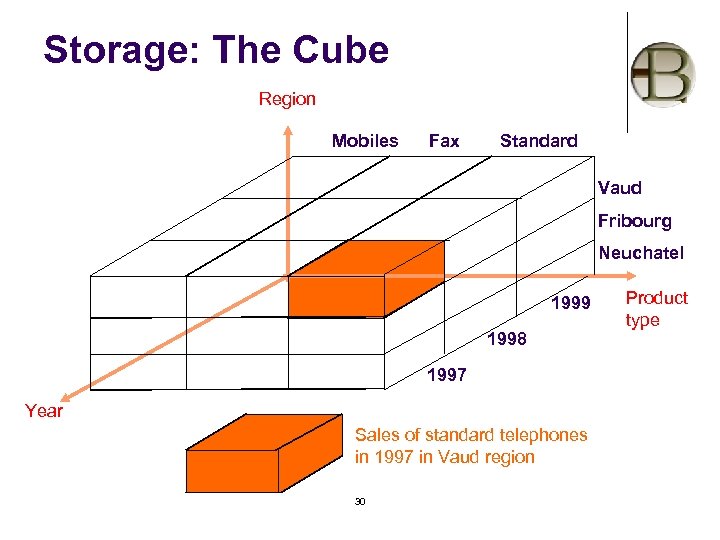
Storage: The Cube Region Mobiles Fax Standard Vaud Fribourg Neuchatel 1999 1998 1997 Year Sales of standard telephones in 1997 in Vaud region 30 Product type
OLAP Terminology l A data cube supports viewing/modelling of a variable (a set of variables) of interest. Measures are used to report the values of the particular variable with respect to a given set of dimensions. l A fact table stores measures as well as keys representing relationships to various dimensions. l Dimensions are perspectives with respect to which an organization wants to keep record. l A star schema defines a fact table and its associated dimensions. 31
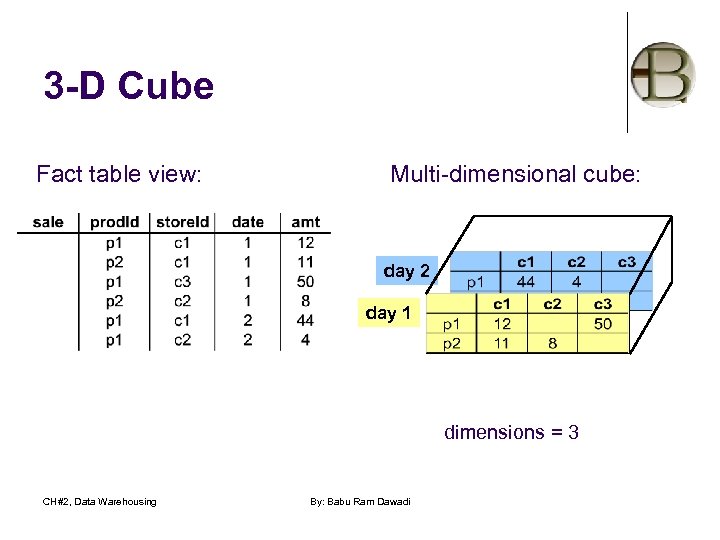
3 -D Cube Fact table view: Multi-dimensional cube: day 2 day 1 dimensions = 3 CH#2, Data Warehousing By: Babu Ram Dawadi
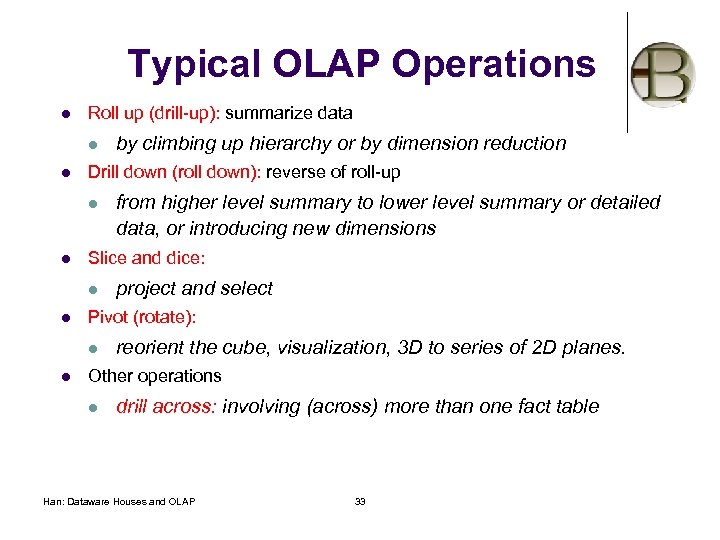
Typical OLAP Operations l Roll up (drill-up): summarize data l l Drill down (roll down): reverse of roll-up l l project and select Pivot (rotate): l l from higher level summary to lower level summary or detailed data, or introducing new dimensions Slice and dice: l l by climbing up hierarchy or by dimension reduction reorient the cube, visualization, 3 D to series of 2 D planes. Other operations l drill across: involving (across) more than one fact table Han: Dataware Houses and OLAP 33
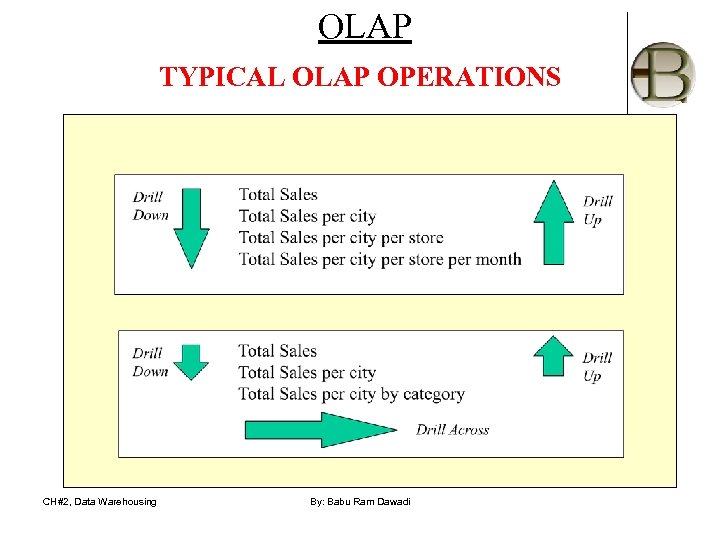
OLAP TYPICAL OLAP OPERATIONS CH#2, Data Warehousing By: Babu Ram Dawadi
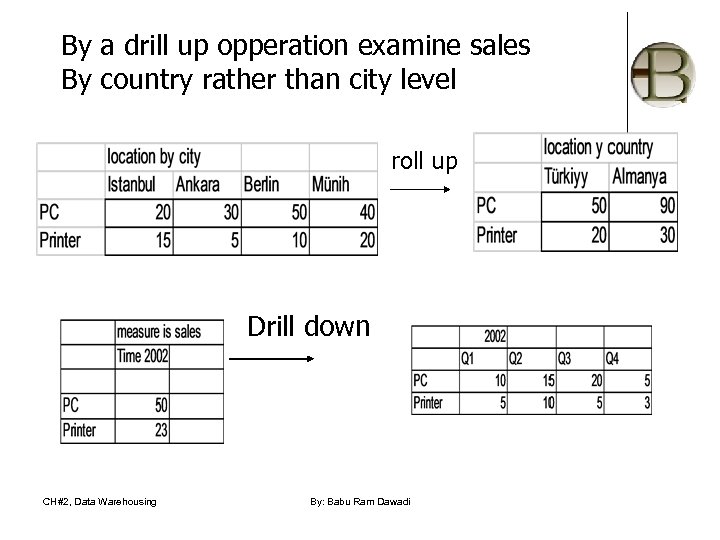
By a drill up opperation examine sales By country rather than city level roll up Drill down CH#2, Data Warehousing By: Babu Ram Dawadi
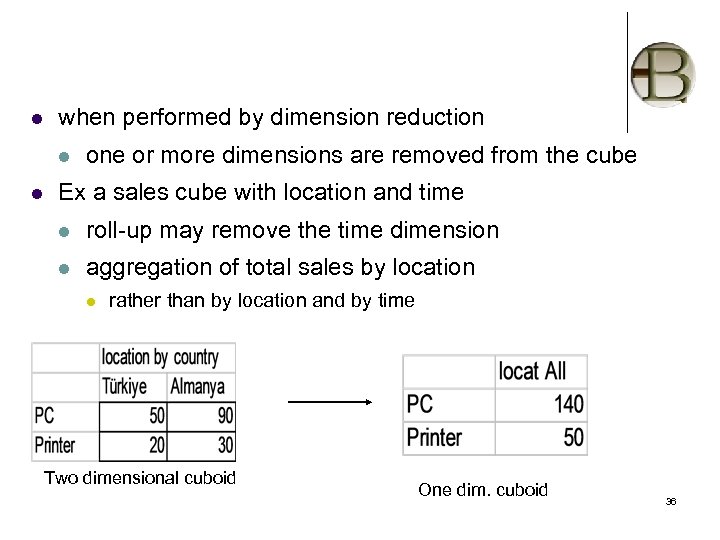
l when performed by dimension reduction l l one or more dimensions are removed from the cube Ex a sales cube with location and time l roll-up may remove the time dimension l aggregation of total sales by location l rather than by location and by time Two dimensional cuboid One dim. cuboid 36
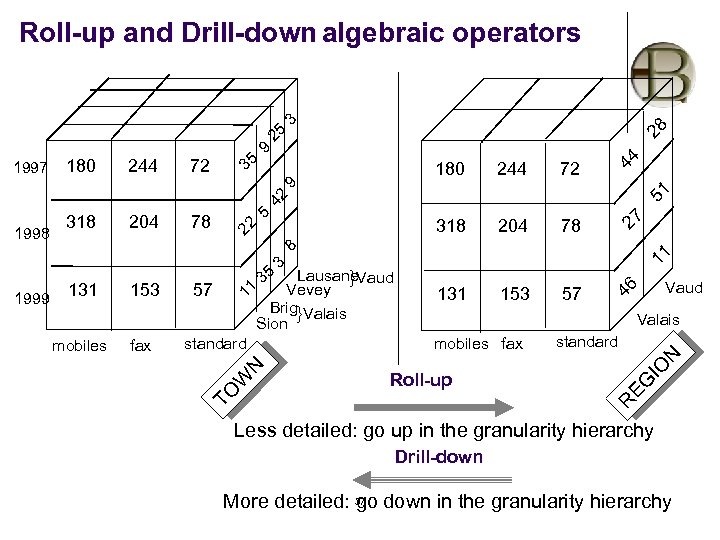
Roll-up and Drill-down algebraic operators 5 35 1 180 9 318 3 244 204 44 72 51 27 78 8 131 153 46 57 Vaud Valais mobiles fax standard N Lausane. Vaud } Vevey 57 1 Brig}Valais Sion standard 11 Roll-up IO fax 22 42 28 EG mobiles 153 78 9 3 R 131 204 72 N 1999 318 244 W 1998 180 TO 1997 35 25 Less detailed: go up in the granularity hierarchy Drill-down More detailed: 37 down in the granularity hierarchy go
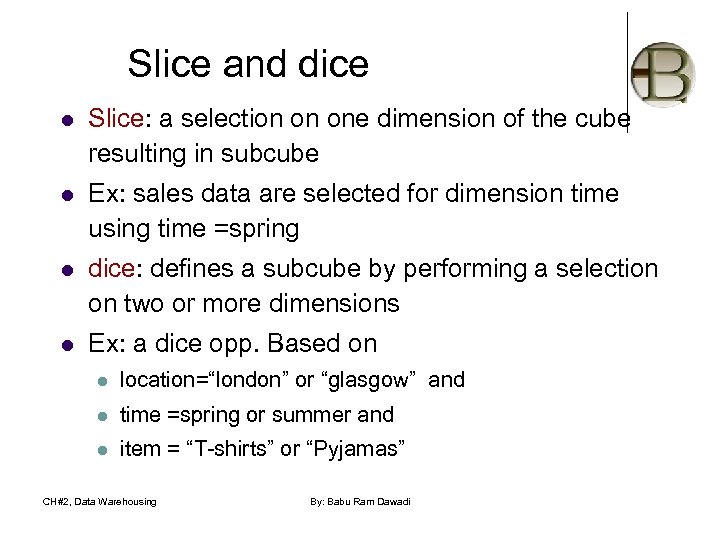
Slice and dice l Slice: a selection on one dimension of the cube resulting in subcube l Ex: sales data are selected for dimension time using time =spring l dice: defines a subcube by performing a selection on two or more dimensions l Ex: a dice opp. Based on l location=“london” or “glasgow” and l time =spring or summer and l item = “T-shirts” or “Pyjamas” CH#2, Data Warehousing By: Babu Ram Dawadi
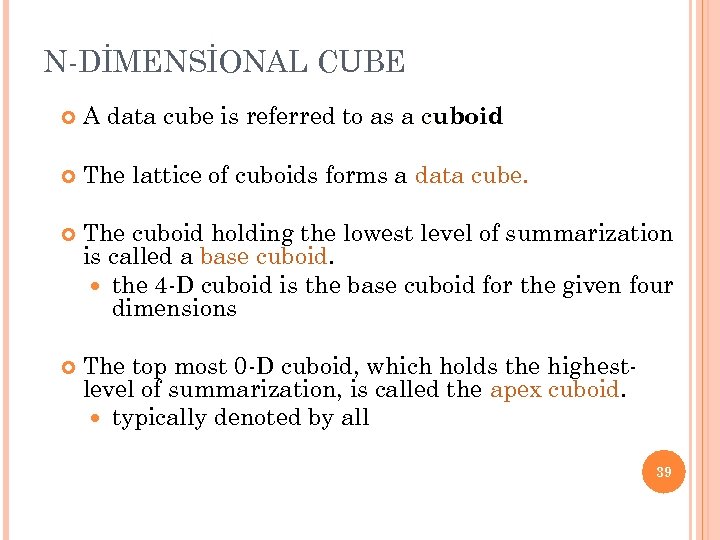
N-DİMENSİONAL CUBE A data cube is referred to as a cuboid The lattice of cuboids forms a data cube. The cuboid holding the lowest level of summarization is called a base cuboid. the 4 -D cuboid is the base cuboid for the given four dimensions The top most 0 -D cuboid, which holds the highestlevel of summarization, is called the apex cuboid. typically denoted by all 39
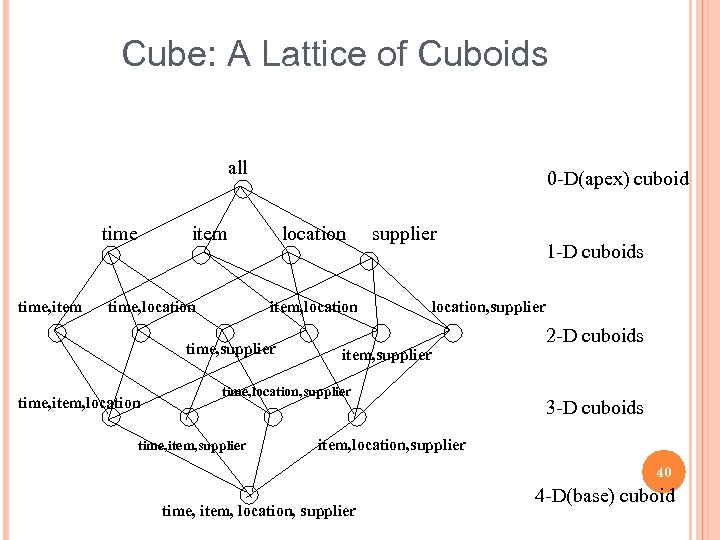
Cube: A Lattice of Cuboids all time, item 0 -D(apex) cuboid item time, location item, location time, supplier time, item, location supplier location, supplier item, supplier time, location, supplier time, item, supplier 1 -D cuboids 2 -D cuboids 3 -D cuboids item, location, supplier 40 time, item, location, supplier 4 -D(base) cuboid
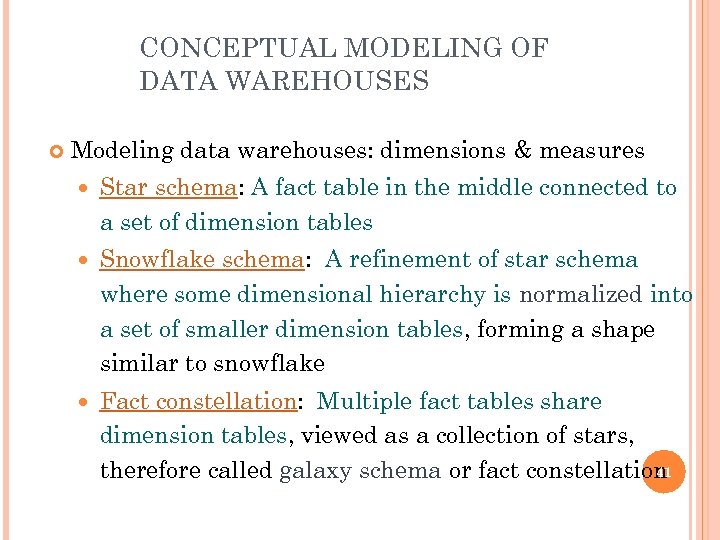
CONCEPTUAL MODELING OF DATA WAREHOUSES Modeling data warehouses: dimensions & measures Star schema: A fact table in the middle connected to a set of dimension tables Snowflake schema: A refinement of star schema where some dimensional hierarchy is normalized into a set of smaller dimension tables, forming a shape similar to snowflake Fact constellation: Multiple fact tables share dimension tables, viewed as a collection of stars, 41 therefore called galaxy schema or fact constellation
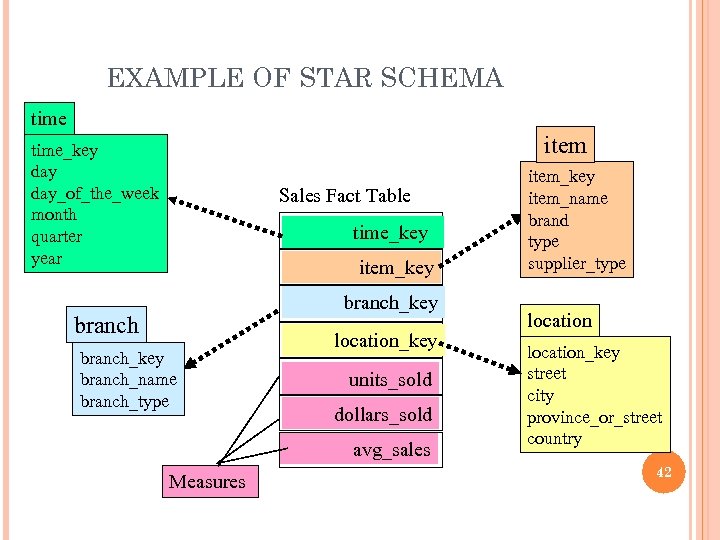
EXAMPLE OF STAR SCHEMA time item time_key day_of_the_week month quarter year Sales Fact Table time_key item_key branch_key branch_name branch_type location_key units_sold dollars_sold avg_sales Measures item_key item_name brand type supplier_type location_key street city province_or_street country 42
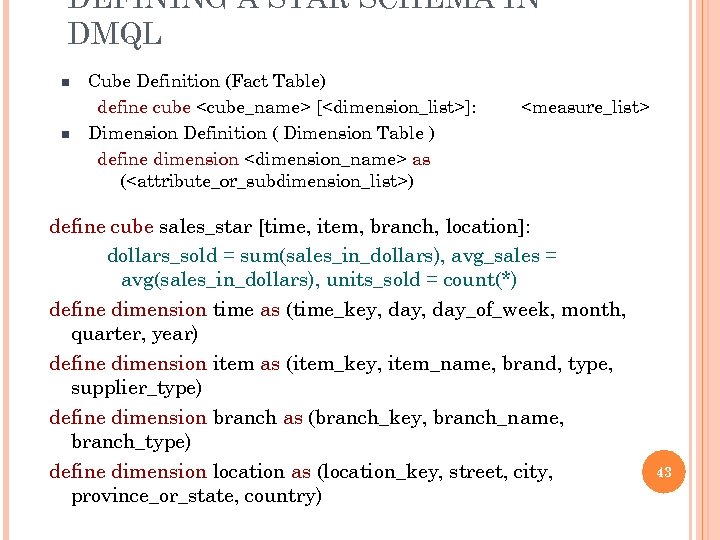
DEFINING A STAR SCHEMA IN DMQL n n Cube Definition (Fact Table) define cube <cube_name> [<dimension_list>]: Dimension Definition ( Dimension Table ) define dimension <dimension_name> as (<attribute_or_subdimension_list>) <measure_list> define cube sales_star [time, item, branch, location]: dollars_sold = sum(sales_in_dollars), avg_sales = avg(sales_in_dollars), units_sold = count(*) define dimension time as (time_key, day_of_week, month, quarter, year) define dimension item as (item_key, item_name, brand, type, supplier_type) define dimension branch as (branch_key, branch_name, branch_type) define dimension location as (location_key, street, city, province_or_state, country) 43
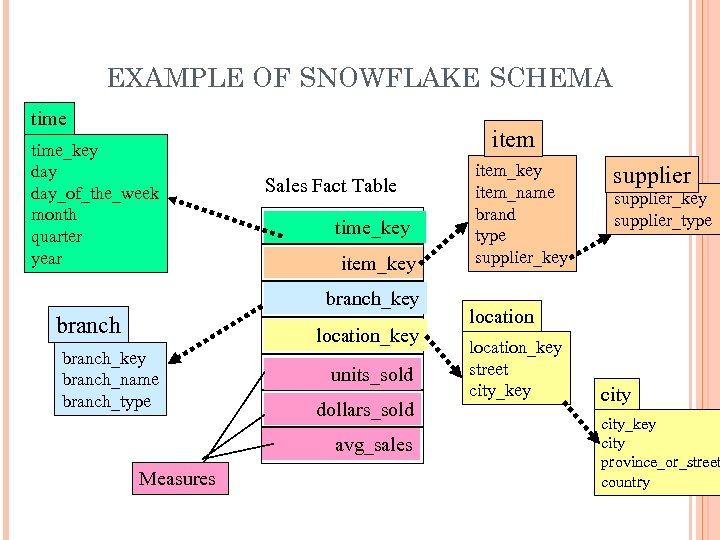
EXAMPLE OF SNOWFLAKE SCHEMA time_key day_of_the_week month quarter year item Sales Fact Table time_key item_key branch location_key branch_name branch_type units_sold dollars_sold avg_sales Measures item_key item_name brand type supplier_key supplier_type location_key street city_key city province_or_street 44 country
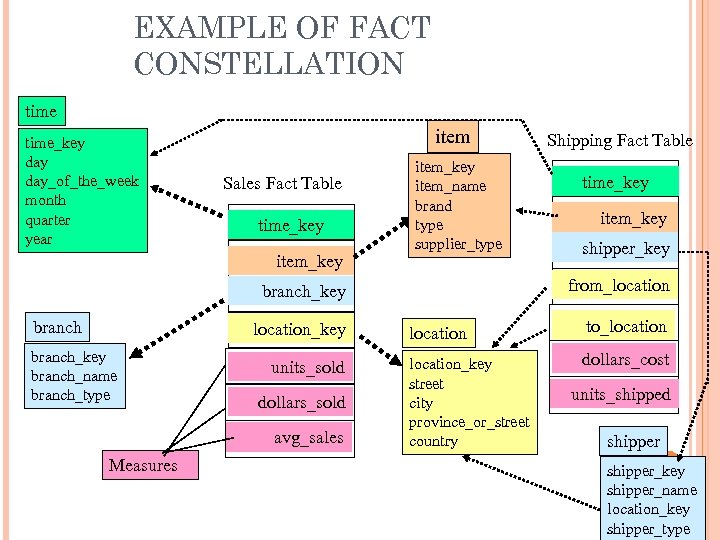
EXAMPLE OF FACT CONSTELLATION time_key day_of_the_week month quarter year item Sales Fact Table time_key item_key item_name brand type supplier_type location_key branch_name branch_type units_sold dollars_sold avg_sales Measures time_key item_key shipper_key from_location branch_key branch Shipping Fact Table location to_location_key street city province_or_street country dollars_cost units_shipped shipper_key 45 shipper_name location_key shipper_type
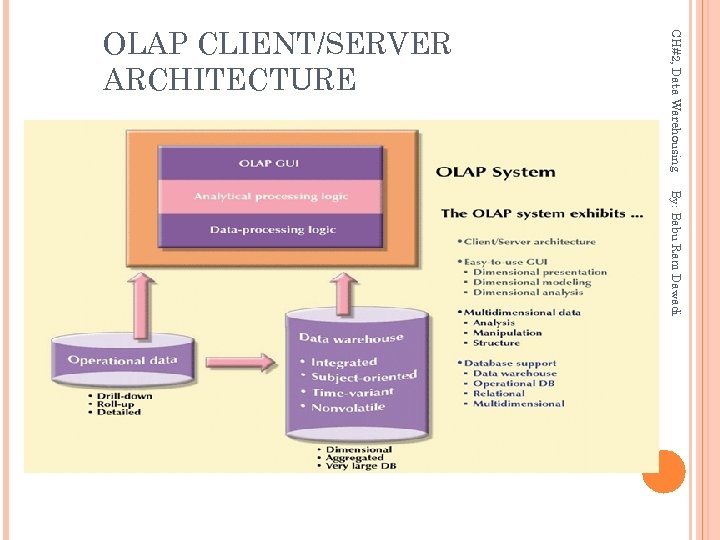
CH#2, Data Warehousing OLAP CLIENT/SERVER ARCHITECTURE By: Babu Ram Dawadi
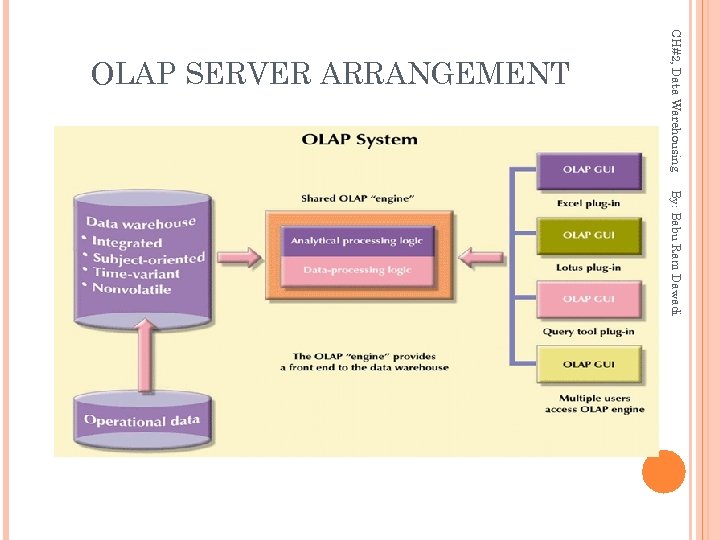
CH#2, Data Warehousing OLAP SERVER ARRANGEMENT By: Babu Ram Dawadi
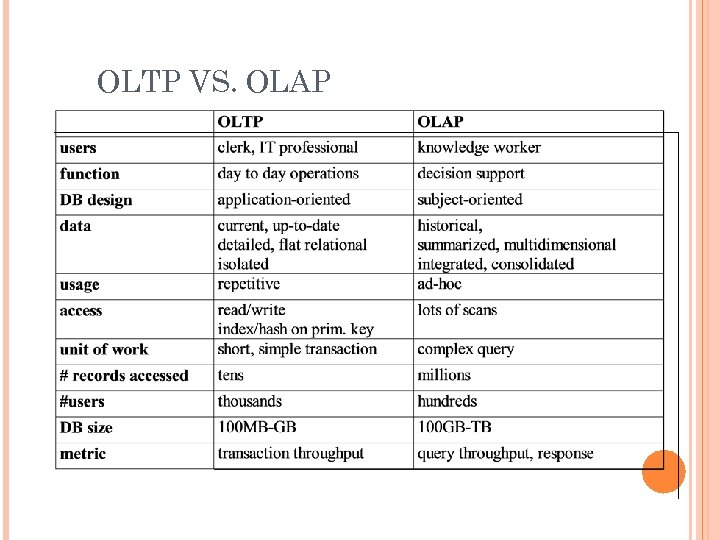
OLTP VS. OLAP 48
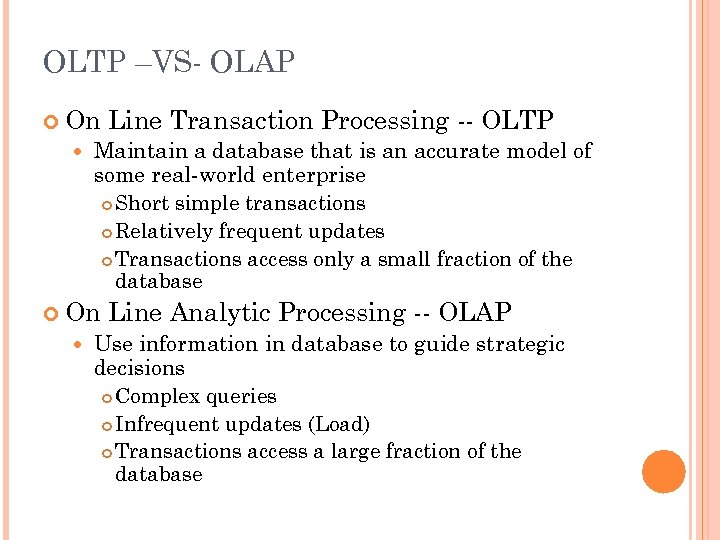
OLTP –VS- OLAP On Maintain a database that is an accurate model of some real-world enterprise Short simple transactions Relatively frequent updates Transactions access only a small fraction of the database On Line Transaction Processing -- OLTP Line Analytic Processing -- OLAP Use information in database to guide strategic decisions Complex queries Infrequent updates (Load) Transactions access a large fraction of the database
Business Information: “How you gather, manage, and use information will determine whether you win or lose. ” – Bill Gates CH#2, Data Warehousing By: Babu Ram Dawadi
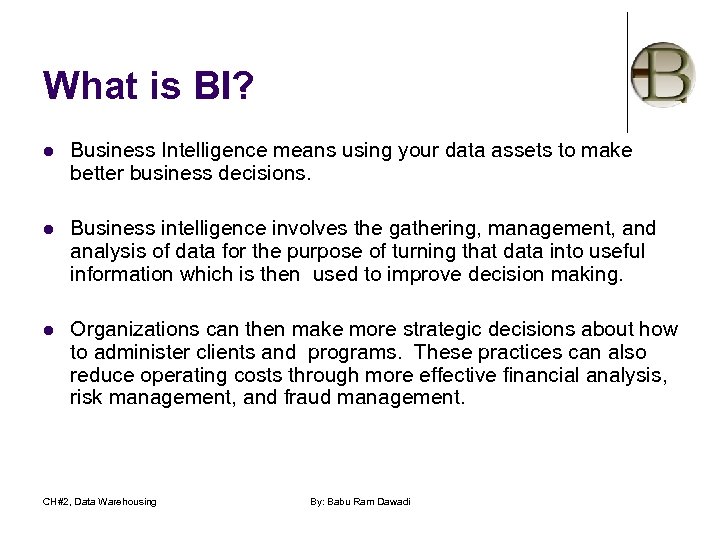
What is BI? l Business Intelligence means using your data assets to make better business decisions. l Business intelligence involves the gathering, management, and analysis of data for the purpose of turning that data into useful information which is then used to improve decision making. l Organizations can then make more strategic decisions about how to administer clients and programs. These practices can also reduce operating costs through more effective financial analysis, risk management, and fraud management. CH#2, Data Warehousing By: Babu Ram Dawadi
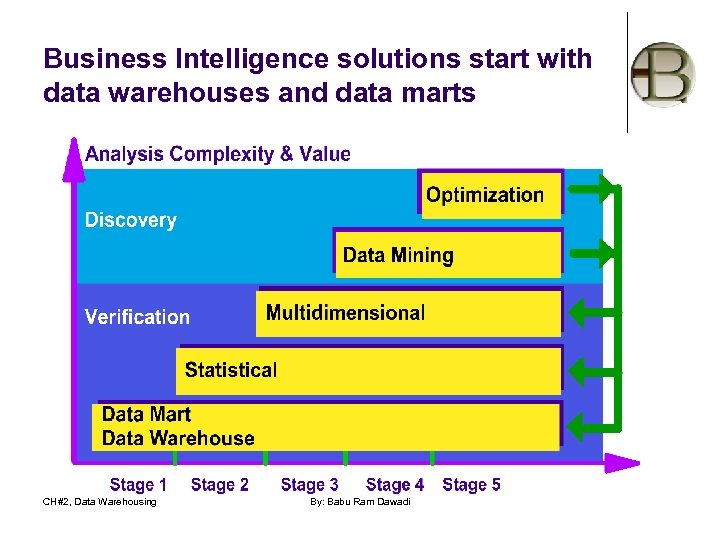
Business Intelligence solutions start with data warehouses and data marts CH#2, Data Warehousing By: Babu Ram Dawadi
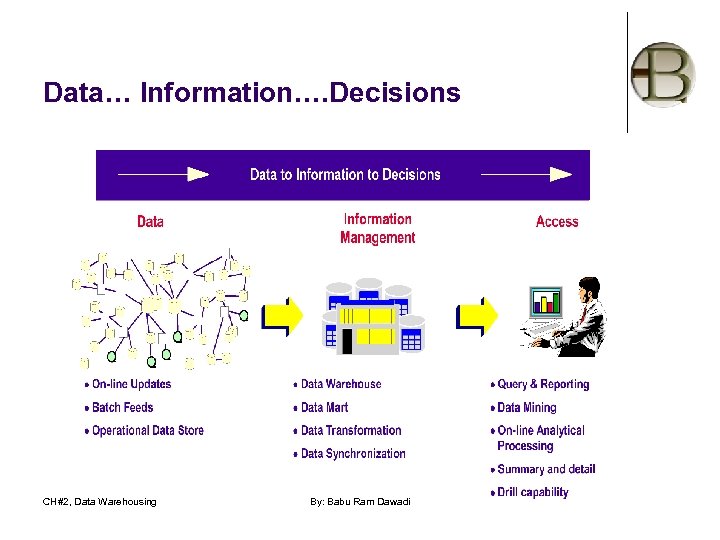
Data… Information…. Decisions CH#2, Data Warehousing By: Babu Ram Dawadi
Knowledge discovery in databases l KDD is the process of identifying valid, potentially useful and understandable patterns & relationships in data Knowledge = patterns & relationships knowledge discovery = data preparation + data mining + evaluation/interpretation of discovered patterns/relationships l Nowadays, KDD = data mining CH#2, Data Warehousing By: Babu Ram Dawadi
Knowledge Discovery in Database Environment (Stages) l There are six stages of KDD which are: l l l Data selection Cleaning Enrichment Coding Data mining reporting CH#2, Data Warehousing By: Babu Ram Dawadi
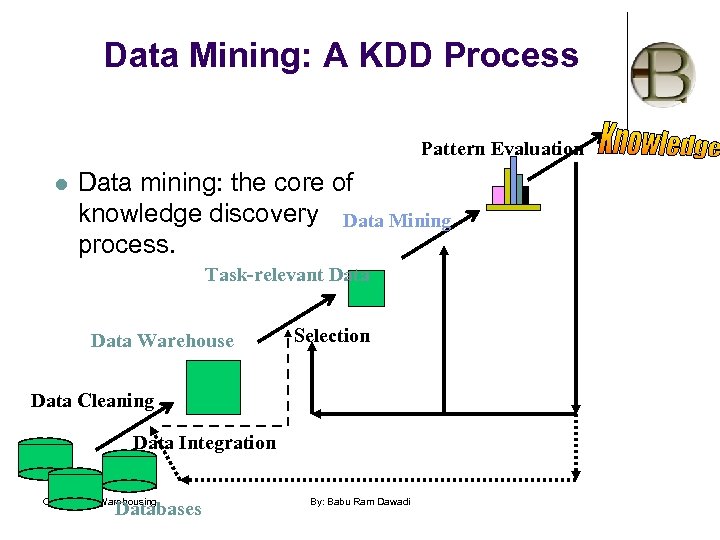
Data Mining: A KDD Process Pattern Evaluation l Data mining: the core of knowledge discovery Data Mining process. Task-relevant Data Warehouse Selection Data Cleaning Data Integration CH#2, Data Warehousing Databases By: Babu Ram Dawadi
KDD : Data selection l Data Selection l It is the first stage of KDD process in which we collect and select the data set or database required to work with l Data sets are obtained from operational databases l Obtaining information from centralized databases can be difficult, reasons may be: l Data set may need conversion from one format to another § Eg: Excel files to access files CH#2, Data Warehousing By: Babu Ram Dawadi
KDD: Data selection l Different quality of data in different parts are available l Making choice on right data is important Investigations should be made on any data warehouses available in an organization. A well maintained DW helps to make data selection job convenient by providing right data set necessary for analysis. l l l Data Cleaning l l l This is the second stage of KDD. Data set obtained is never perfectly cleaned. We may not be aware of to what extent it is polluted. CH#2, Data Warehousing By: Babu Ram Dawadi
KDD: Data selection l Data in real world is dirty: l Incomplete: lack attribute values l Noisy: contains errors § § § Human errors Not available when collected Not entered due to misunderstanding Malfunction of hardware/software Mistake data entry Inconsistent: contains discrepancies codes The cleaning phenomena should try to eliminate all the above mentioned defects by the stage of de-duplication, domain consistency, disambiguation l l CH#2, Data Warehousing By: Babu Ram Dawadi
KDD … l Enrichment is the process of adding additional information to the databases or accessing additional databases to obtain extra information. l Eg: an airline company might cooperate with telephone company to enhance its marketing policy. A telephone company maintains large databases comprising the call behavior of customers & create telephone profiles of the basis of these data. CH#2, Data Warehousing By: Babu Ram Dawadi
KDD … l l So data miners can collect all the necessary information from additional bought – in databases. l l These telephone profiles could be used by airlines to identify interesting new groups of target customers Obtaining information from other organizations may involve some tedious procedures. Coding: l Coding is one of the most important stage where further cleaning and transformation of data is done. CH#2, Data Warehousing By: Babu Ram Dawadi
KDD … l Coding… l It can range from simple SQL Queries to using sophisticated high level languages depending upon requirement. l Some polluted records can be easily filtered out by using SQL queries. (Eg: Records with most of the field empty can be easily traced and removed) l Coding is the creative activity which involves creative transformation of data. l It can be used to obtained more simpler form of the complete, detailed database. CH#2, Data Warehousing By: Babu Ram Dawadi
KDD: Coding l Coding… l Example: to the table of the magazine publisher, we can apply following coding steps: l l l l Convert address to region (area codes) Birth date to age Divide income by 1000 Divide credit by 1000 Convert owners yes/no to 1/0 Convert purchase date to month starting from 1990 Perform filtering CH#2, Data Warehousing By: Babu Ram Dawadi
KDD: Coding l Coding: applying steps 1 to 6 Client No Age income Credit Car owner H. Woner Region Month Mag. of purchas purch ed ase 203 20 18. 5 17. 8 0 0 1 52 Car 203 20 18. 5 17. 8 0 0 1 42 Music 209 25 36. 0 26. 6 1 0 1 Null Comic 203 20 18. 5 17. 8 0 0 1 48 house CH#2, Data Warehousing By: Babu Ram Dawadi
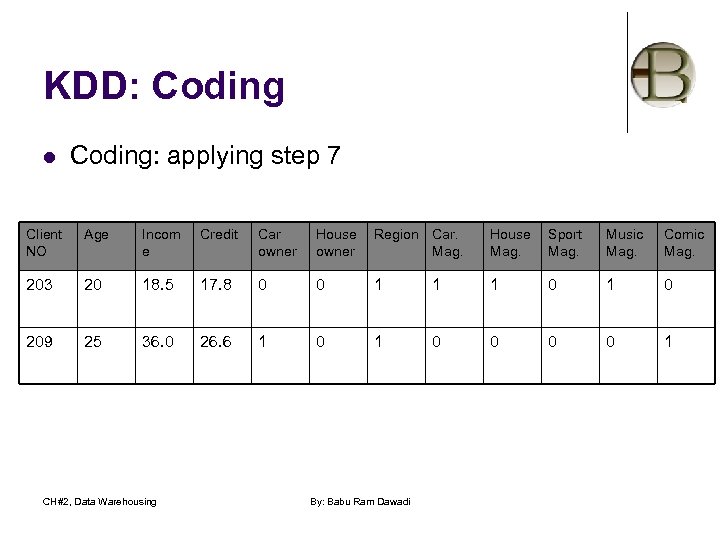
KDD: Coding l Coding: applying step 7 Client NO Age Incom e Credit Car owner House owner Region Car. Mag. House Mag. Sport Mag. Music Mag. Comic Mag. 203 20 18. 5 17. 8 0 0 1 1 1 0 209 25 36. 0 26. 6 1 0 0 0 0 1 CH#2, Data Warehousing By: Babu Ram Dawadi
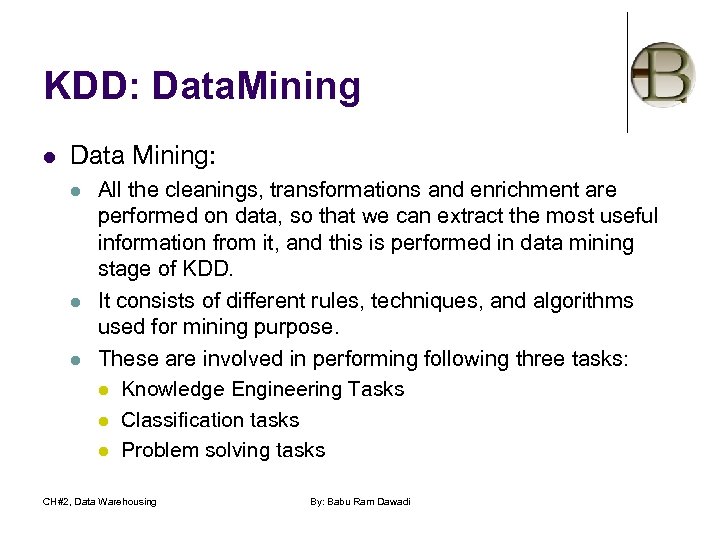
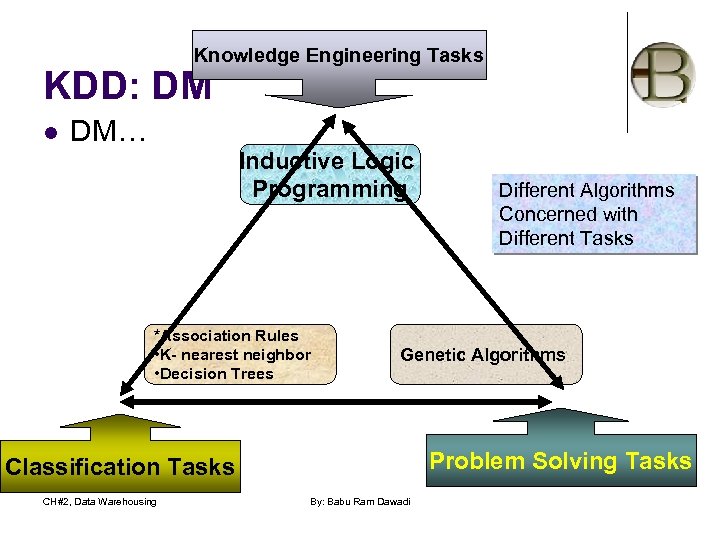
KDD: Data. Mining l Data Mining: l l l All the cleanings, transformations and enrichment are performed on data, so that we can extract the most useful information from it, and this is performed in data mining stage of KDD. It consists of different rules, techniques, and algorithms used for mining purpose. These are involved in performing following three tasks: l Knowledge Engineering Tasks l Classification tasks l Problem solving tasks CH#2, Data Warehousing By: Babu Ram Dawadi
Knowledge Engineering Tasks KDD: DM l DM… Inductive Logic Programming *Association Rules • K- nearest neighbor • Decision Trees Genetic Algorithms Problem Solving Tasks Classification Tasks CH#2, Data Warehousing Different Algorithms Concerned with Different Tasks By: Babu Ram Dawadi
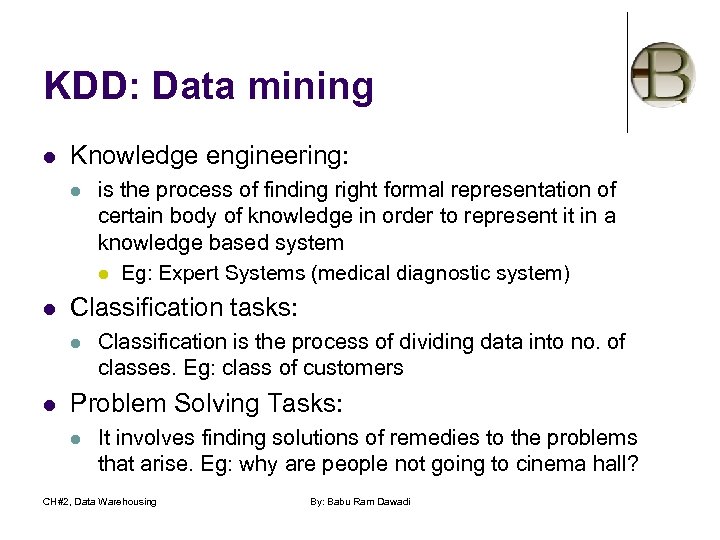
KDD: Data mining l Knowledge engineering: l l Classification tasks: l l is the process of finding right formal representation of certain body of knowledge in order to represent it in a knowledge based system l Eg: Expert Systems (medical diagnostic system) Classification is the process of dividing data into no. of classes. Eg: class of customers Problem Solving Tasks: l It involves finding solutions of remedies to the problems that arise. Eg: why are people not going to cinema hall? CH#2, Data Warehousing By: Babu Ram Dawadi
KDD… l For finding useful patterns in databases, it is necessary to choose right algorithms and right tools. l For choosing right data mining algorithms following three points should be considered: l l l Quality of input [No. of records, attributes, numeric] Quality of output [yes/no results, statistics] Performance [CPU load] CH#2, Data Warehousing By: Babu Ram Dawadi
KDD: Reporting l This stage involves documenting the results obtained from learning algorithms. l Any report writer or graphical tools can be used l It basically combines two functions: l l l Analysis of results obtained from mining. Application of results to new data Different data visualization tools like scatter diagrams available for showing different patterns or clusters of data can be used. CH#2, Data Warehousing By: Babu Ram Dawadi
Скачать презентацию Data Warehousing l Data l l Database l
6909618929e84ba9fcbcdc542e4e974c.ppt