


 Скачать презентацию Data Unification on ATLASTGC production A Proposal of
c95bf29def87ef4ee3a83261f0ba42f5.ppt
- Количество слайдов: 9
 Data Unification on ATLASTGC production A Proposal of A New Database Form Yoshiki Nakashima
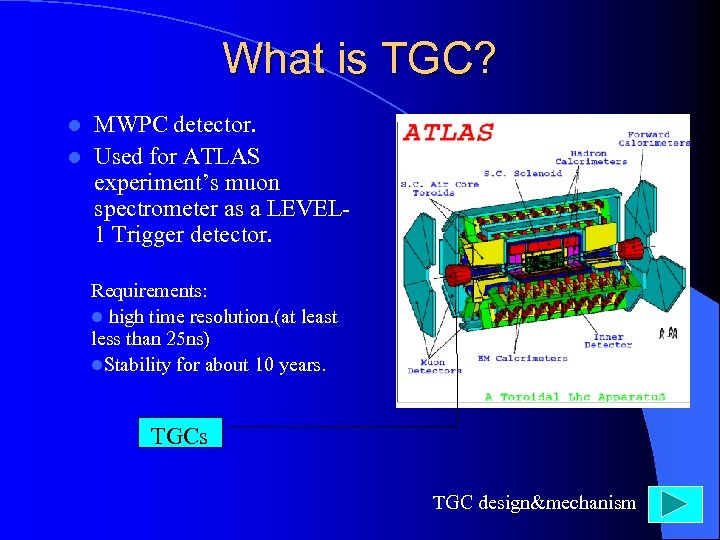 What is TGC? MWPC detector. l Used for ATLAS experiment’s muon spectrometer as a LEVEL 1 Trigger detector. l Requirements: l high time resolution. (at least less than 25 ns) l. Stability for about 10 years. TGCs TGC design&mechanism
 We are checking TGCs’ quality l High Voltage tests To check the stability etc… l 2. 9 k. V for 1 day. l l Cosmic Ray tests To check the time resolution etc… l Using cosmic rays (mainly muons) l 10 seconds at +/- 80 m. V threshold l Check whether they ‘trip’(current Check whethere are flow between the gap) or not ‘noisy’ channels Test’s physical motivations (for example, about detectors’ flatness) High voltage ‘trip’ will happen when the detector’s board is not so flat and some points’ gap is comparably thin. l Comic ray signals will be noisy when the detector’s board is not so flat and some points’ gap is comparably thin. (It means electrons and ions will feel more strong electric fields, and are more strongly accelerated. =Geiger-Mueler Mode=Noisy!!) l Other physical conditions like cathode carbon resistance, will also affect the quality…
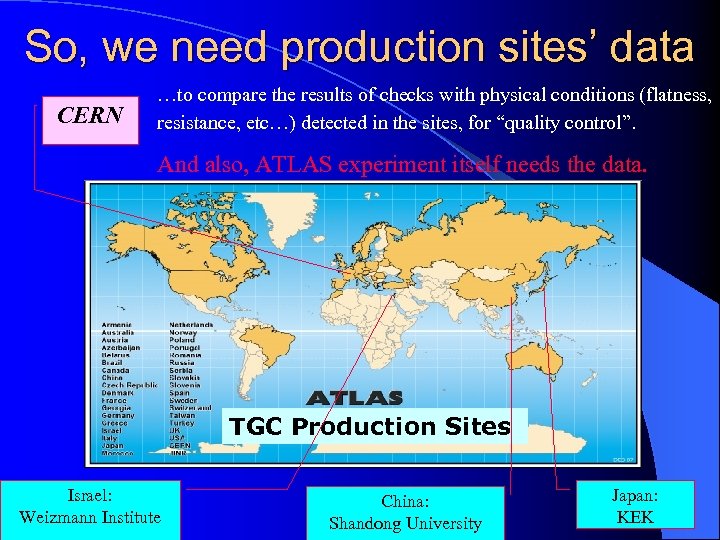 So, we need production sites’ data CERN …to compare the results of checks with physical conditions (flatness, resistance, etc…) detected in the sites, for “quality control”. And also, ATLAS experiment itself needs the data. TGC Production Sites Israel: Weizmann Institute China: Shandong University Japan: KEK
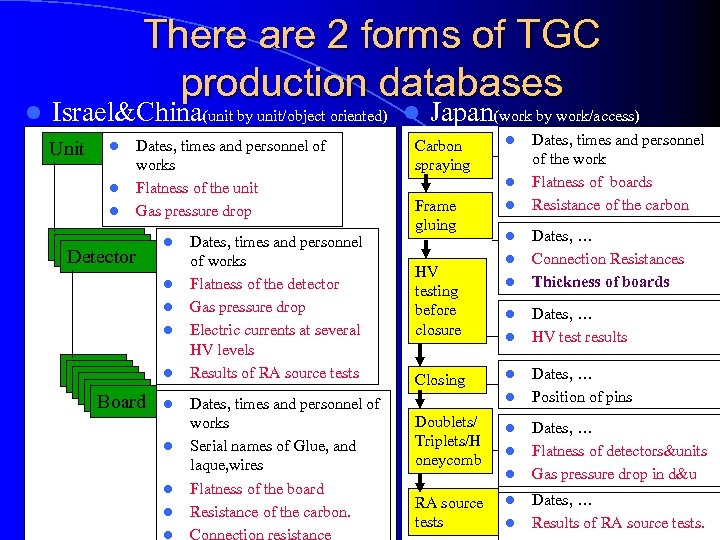 l There are 2 forms of TGC production databases Israel&China(unit by unit/object oriented) l Japan(work by work/access) Unit l l l Dates, times and personnel of works Flatness of the unit Gas pressure drop Detector l l Board Board l l l Dates, times and personnel of works Flatness of the detector Gas pressure drop Electric currents at several HV levels Results of RA source tests Dates, times and personnel of works Serial names of Glue, and laque, wires Flatness of the board Resistance of the carbon. Connection resistance Carbon spraying l l Frame gluing HV testing before closure Closing l l l l Doublets/ Triplets/H oneycomb RA source tests l l l Dates, times and personnel of the work Flatness of boards Resistance of the carbon Dates, … Connection Resistances Thickness of boards Dates, … HV test results Dates, … Position of pins Dates, … Flatness of detectors&units Gas pressure drop in d&u Dates, … Results of RA source tests.
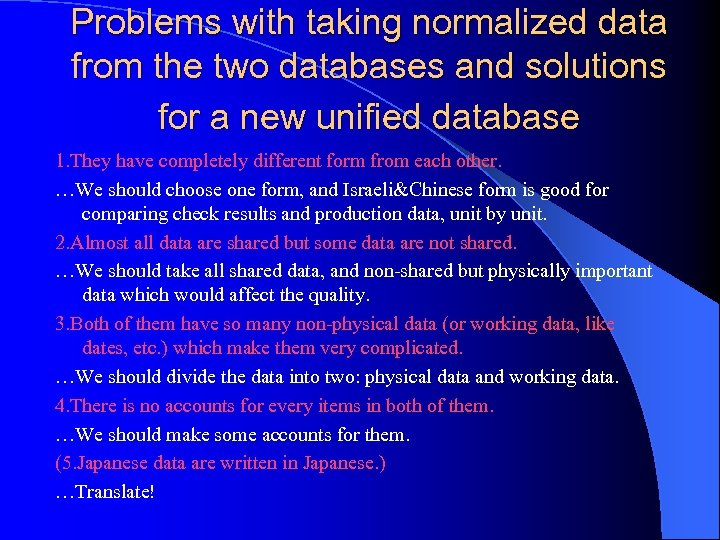 Problems with taking normalized data from the two databases and solutions for a new unified database 1. They have completely different form from each other. …We should choose one form, and Israeli&Chinese form is good for comparing check results and production data, unit by unit. 2. Almost all data are shared but some data are not shared. …We should take all shared data, and non-shared but physically important data which would affect the quality. 3. Both of them have so many non-physical data (or working data, like dates, etc. ) which make them very complicated. …We should divide the data into two: physical data and working data. 4. There is no accounts for every items in both of them. …We should make some accounts for them. (5. Japanese data are written in Japanese. ) …Translate!
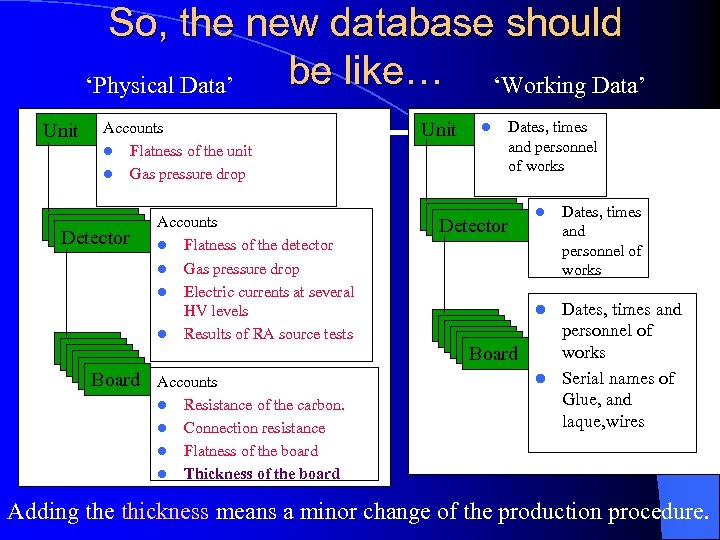 So, the new database should be like… ‘Working Data’ ‘Physical Data’ Unit Accounts l Flatness of the unit l Gas pressure drop Detector Board Board Accounts l Flatness of the detector l Gas pressure drop l Electric currents at several HV levels l Results of RA source tests Accounts l Resistance of the carbon. l Connection resistance l Flatness of the board l Thickness of the board Unit l Detector Dates, times and personnel of works l Dates, times and personnel of works Dates, times and Board personnel of Board works Board l Serial names of Glue, and laque, wires l Adding the thickness means a minor change of the production procedure.
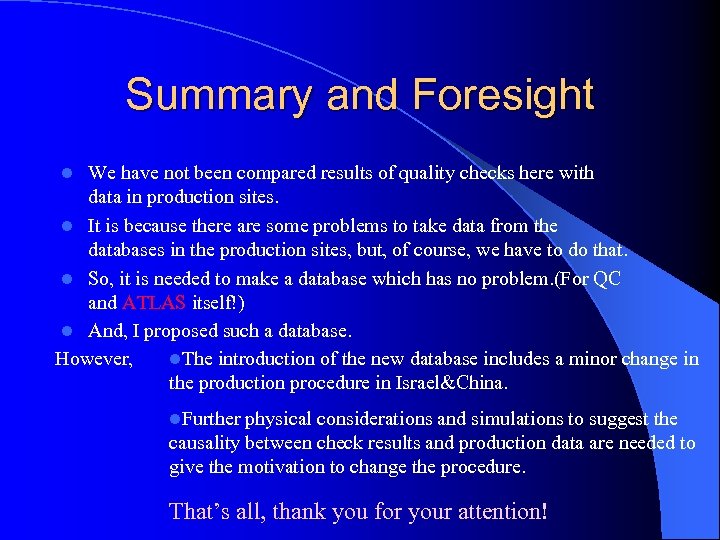 Summary and Foresight We have not been compared results of quality checks here with data in production sites. l It is because there are some problems to take data from the databases in the production sites, but, of course, we have to do that. l So, it is needed to make a database which has no problem. (For QC and ATLAS itself!) l And, I proposed such a database. However, l. The introduction of the new database includes a minor change in the production procedure in Israel&China. l l. Further physical considerations and simulations to suggest the causality between check results and production data are needed to give the motivation to change the procedure. That’s all, thank you for your attention!
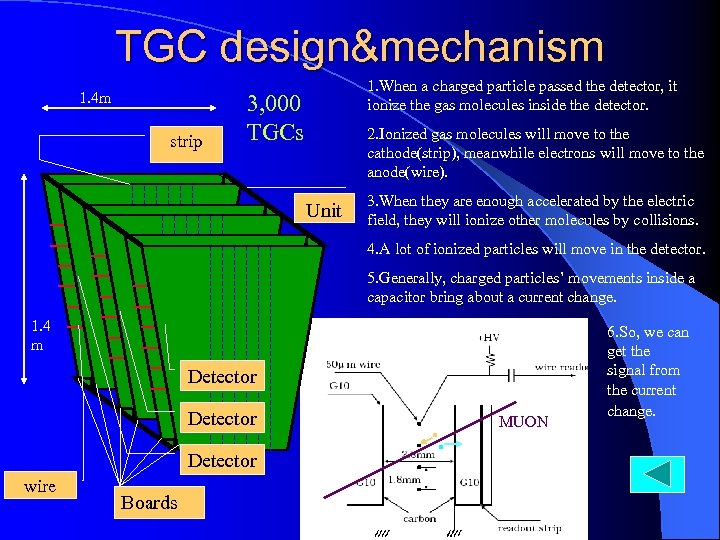 TGC design&mechanism 1. 4 m strip 1. When a charged particle passed the detector, it ionize the gas molecules inside the detector. 3, 000 TGCs 2. Ionized gas molecules will move to the cathode(strip), meanwhile electrons will move to the anode(wire). Unit 3. When they are enough accelerated by the electric field, they will ionize other molecules by collisions. 4. A lot of ionized particles will move in the detector. 5. Generally, charged particles’ movements inside a capacitor bring about a current change. 1. 4 m Detector wire Boards MUON 6. So, we can get the signal from the current change.