


 Скачать презентацию Data Security and Encryption CSE 348 1
d6ae6593af76b30395b8ac8c9ed4ecc4.ppt
- Количество слайдов: 59
 Data Security and Encryption (CSE 348) 1
 Lecture # 22 2
 Review • have considered: – symmetric key distribution using symmetric encryption – symmetric key distribution using public-key encryption – distribution of public keys • announcement, directory, authrority, CA – X. 509 authentication and certificates 3
 Chapter 15 – User Authentication 4
 We cannot enter into alliance with neighboring princes until we are acquainted with their designs. —The Art of War, Sun Tzu 5
 User Authentication • This chapter examines some of the authentication functions that have been developed to support network-based use authentication • User authentication is the fundamental building block and the primary line of defense • User authentication is the basis for most types of access control and for user accountability 6
 User Authentication • RFC 2828 defines user authentication as the process of verifying an identity claimed by or for a system entity • An authentication process consists of two steps: • Identification step • Verification step 7
 User Authentication • Identification step: Presenting an identifier to the security system • Identifiers should be assigned carefully • Because authenticated identities are the basis for other security services • Such as access control service 8
 User Authentication • Verification step: Presenting or generating authentication information • That corroborates the binding between the entity and the identifier 9
 User Authentication • In essence, identification is the means by which a user provides a claimed identity to the system • User authentication is the means of establishing the validity of the claim • User authentication is distinct from message authentication 10
 User Authentication Ø Fundamental security building block l basis of access control & user accountability Ø Process of verifying an identity claimed by or for a system entity Ø Has two steps: l identification - specify identifier l verification - bind entity (person) and identifier Ø Distinct from message authentication 11
 Means of User Authentication Ø Four means of authenticating user's identity Ø Based one something the individual l knows - e. g. password, PIN l possesses - e. g. key, token, smartcard l is (static biometrics) - e. g. fingerprint, retina l does (dynamic biometrics) - e. g. voice, sign Ø Can use alone or combined Ø All can provide user authentication Ø All have issues 12
 Authentication Protocols • An important application area is that of mutual authentication protocols • Such protocols enable communicating parties to satisfy themselves mutually about each other's identity and to exchange session keys • Central to the problem of authenticated key exchange are two issues: confidentiality and timeliness 13
 Authentication Protocols • To prevent masquerade and to prevent compromise of session keys • Essential identification and session key information must be communicated in encrypted form • This requires the prior existence of secret or public keys that can be used for this purpose • The second issue, timeliness, is important because of the threat of message replays 14
 Authentication Protocols • Used to convince parties of each others identity and to exchange session keys • May be one-way or mutual • Key issues are – confidentiality – to protect session keys – timeliness – to prevent replay attacks 15
 Replay Attacks • Replay Attacks are where a valid signed message is copied and later resent • Such replays, at worst, could allow an opponent to compromise a session key or successfully impersonate another party • At minimum, a successful replay can disrupt operations by presenting parties with messages that appear genuine but are not 16
![Replay Attacks • [GONG 93] lists the examples above of replay attacks • Possible](https://present5.com/presentation/d6ae6593af76b30395b8ac8c9ed4ecc4/image-17.jpg "Replay Attacks • [GONG 93] lists the examples above of replay attacks • Possible") Replay Attacks • [GONG 93] lists the examples above of replay attacks • Possible countermeasures include the use of: • Sequence numbers (generally impractical since must remember last number used with every communicating party) • Timestamps (needs synchronized clocks amongst all parties involved, which can be problematic) 17
Replay Attacks • [GONG 93] lists the examples above of replay attacks • Possible countermeasures include the use of: • Sequence numbers (generally impractical since must remember last number used with every communicating party) • Timestamps (needs synchronized clocks amongst all parties involved, which can be problematic) 17
 Replay Attacks • Challenge/response (using unique, random, unpredictable nonce) • But not suitable for connectionless applications because of handshake overhead 18
 Replay Attacks • Where a valid signed message is copied and later resent – – simple replay repetition that can be logged repetition that cannot be detected backward replay without modification • Countermeasures include – use of sequence numbers (generally impractical) – timestamps (needs synchronized clocks) – challenge/response (using unique nonce) 19
 One-Way Authentication • One application for which encryption is growing in popularity is electronic mail (e-mail) • The very nature of electronic mail, and its chief benefit, is that it is not necessary for the sender and receiver to be online at the same time • Instead, the e-mail message is forwarded to the receiver’s electronic mailbox, where it is buffered until the receiver is available to read it 20
 One-Way Authentication • The "envelope" or header of the e-mail message must be in the clear • So that the message can be handled by the store-and -forward e-mail protocol, such as the Simple Mail Transfer Protocol (SMTP) or X. 400 • However, it is often desirable that the mail-handling protocol not require access to the plaintext form of the message 21
 One-Way Authentication • Because that would require trusting the mailhandling mechanism • Accordingly, the e-mail message should be encrypted such that the mail- handling system is not in possession of the decryption key • A second requirement is that of authentication • Typically, the recipient wants some assurance that the message is from the alleged sender 22
 One-Way Authentication • Required when sender & receiver are not in communications at same time (eg. email) • Have header in clear so can be delivered by email system • May want contents of body protected & sender authenticated 23
 Using Symmetric Encryption • As discussed previously can use a two-level hierarchy of keys • Usually with a trusted Key Distribution Center (KDC) – each party shares own master key with KDC – KDC generates session keys used for connections between parties – master keys used to distribute these to them 24
 Needham-Schroeder Protocol • The Needham-Schroeder Protocol is the original • Basic key exchange protocol, as was shown in Stallings Figure 14. 3 (previous chapter) • Used by 2 parties who both trusted a common key server • It gives one party the info needed to establish a session key with the other 25
 Needham-Schroeder Protocol • That since the key server chooses the session key • It is capable of reading/forging any messages between A&B, which is why they need to trust it absolutely • All communications is between A&KDC and A&B, B&KDC don't talk directly 26
 Needham-Schroeder Protocol • Though indirectly a message passes from KDC via A to B, encrypted in B's key so that A is unable to read or alter it • Other variations of key distribution protocols can involve direct communications between B&KDC 27
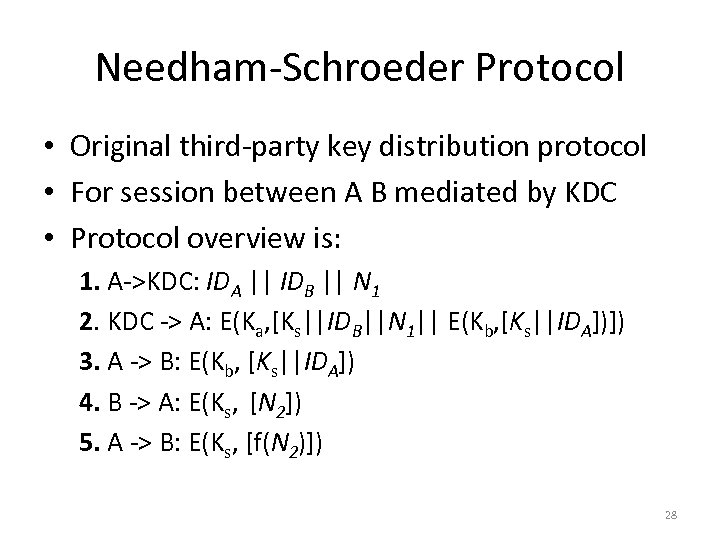 Needham-Schroeder Protocol • Original third-party key distribution protocol • For session between A B mediated by KDC • Protocol overview is: 1. A->KDC: IDA || IDB || N 1 2. KDC -> A: E(Ka, [Ks||IDB||N 1|| E(Kb, [Ks||IDA])]) 3. A -> B: E(Kb, [Ks||IDA]) 4. B -> A: E(Ks, [N 2]) 5. A -> B: E(Ks, [f(N 2)]) 28
 Needham-Schroeder Protocol • There is a critical flaw in the protocol, as shown • The message in step 3 can be decrypted, and hence understood, supposedly only by B • But if an opponent, X, has been able to compromise an old session key 29
 Needham-Schroeder Protocol • Then X can impersonate A and trick B into using the old key by simply replaying step 3 • Admittedly, this is a much more unlikely occurrence than that an opponent has simply observed and recorded step 3 • It can however be corrected by either using timestamps, or an additional nonce, with respective advantages and limitations 30
 Needham-Schroeder Protocol • This example emphasizes the need to be extremely careful in codifying assumptions • And tracking the timeliness of the flow of info in protocols • Designing secure protocols is not easy, and should not be done lightly • Great care and analysis is needed 31
 Needham-Schroeder Protocol • Used to securely distribute a new session key for communications between A & B • But is vulnerable to a replay attack if an old session key has been compromised – then message 3 can be resent convincing B that is communicating with A • Modifications to address this require: – timestamps in steps 2 & 3 (Denning 81) – using an extra nonce (Neuman 93) 32
 One-Way Authentication • With some refinement, the KDC strategy illustrated in Stallings Figure 14. 3 (previous chapter) is a candidate for securing electronic mail • Because we wish to avoid requiring that the recipient (B) be on line at the same time as the sender (A), steps 4 and 5 must be eliminated • For a message with content M, the sequence is as shown next 33
 One-Way Authentication • This approach guarantees that only the intended recipient of a message will be able to read it • It also provides a level of authentication that the sender is A • As specified, the protocol does not protect against replays 34
 One-Way Authentication • Some measure of defense could be provided by including a timestamp with the message • However, because of the potential delays in the email process • Such timestamps may have limited usefulness 35
 One-Way Authentication • Use refinement of KDC to secure email – since B no online, drop steps 4 & 5 • Protocol becomes: 1. A->KDC: IDA || IDB || N 1 2. KDC -> A: E(Ka, [Ks||IDB||N 1 || E(Kb, [Ks||IDA])]) 3. A -> B: E(Kb, [Ks||IDA]) || E(Ks, M) • Provides encryption & some authentication • Does not protect from replay attack 36
 Kerberos • Kerberos is an authentication service developed as part of Project Athena at MIT • One of the best known and most widely implemented trusted third party key distribution systems • Kerberos provides a centralized authentication server whose function is to authenticate users to servers and servers to users 37
 Kerberos • Unlike most other authentication schemes, Kerberos relies exclusively on symmetric encryption, making no use of public-key encryption • Two versions of Kerberos are in common use: v 4 & v 5 38
 Kerberos Ø Trusted key server system from MIT Ø Provides centralised private-key third-party authentication in a distributed network l allows users access to services distributed through network l without needing to trust all workstations l rather all trust a central authentication server Ø Two versions in use: 4 & 5 39
 Kerberos Requirements • Its first report identified requirements as: – secure – reliable – transparent – scalable • implemented using an authentication protocol based on Needham-Schroeder 40
 Kerberos Requirements • In a more open environment, in which network connections to other machines are supported • An approach that requires the user to prove his or her identity for each service invoked • And also require that servers prove their identity to clients, is needed to protect user information and resources housed at the server 41
 Kerberos Requirements • Kerberos supports this approach, and assumes a distributed client/server architecture • That employs one or more Kerberos servers to provide an authentication service • The first published report on Kerberos [STEI 88] listed the following requirements 42
 Kerberos Requirements • Secure: A network eavesdropper should not be able to obtain the necessary information to impersonate a user • More generally, Kerberos should be strong enough • That a potential opponent does not find it to be the weak link 43
 Kerberos Requirements • Reliable: For all services that rely on Kerberos for access control • Lack of availability of the Kerberos service means lack of availability of the supported services • Hence, Kerberos should be highly reliable • And should employ a distributed server architecture, with one system able to back up another 44
 Kerberos Requirements • Transparent: Ideally, the user should not be aware that authentication is taking place • Beyond the requirement to enter a password 45
 Kerberos Requirements • Scalable: The system should be capable of supporting large numbers of clients and servers • This suggests a modular, distributed architecture • To support these requirements, Kerberos is a trusted third-party authentication service • That uses a protocol based on that proposed by Needham and Schroeder 46
 Kerberos v 4 Overview Ø A basic third-party authentication scheme Ø Have an Authentication Server (AS) l users initially negotiate with AS to identify self l AS provides a non-corruptible authentication credential (ticket granting ticket TGT) 47
 Kerberos v 4 Overview Ø Have a Ticket Granting server (TGS) l users subsequently request access to other services from TGS on basis of users TGT Ø Using a complex protocol using DES 48
 Kerberos Realms • A Kerberos environment consists of: – a Kerberos server – a number of clients, all registered with server – application servers, sharing keys with server • This is termed a realm – typically a single administrative domain • If have multiple realms, their Kerberos servers must share keys and trust 49
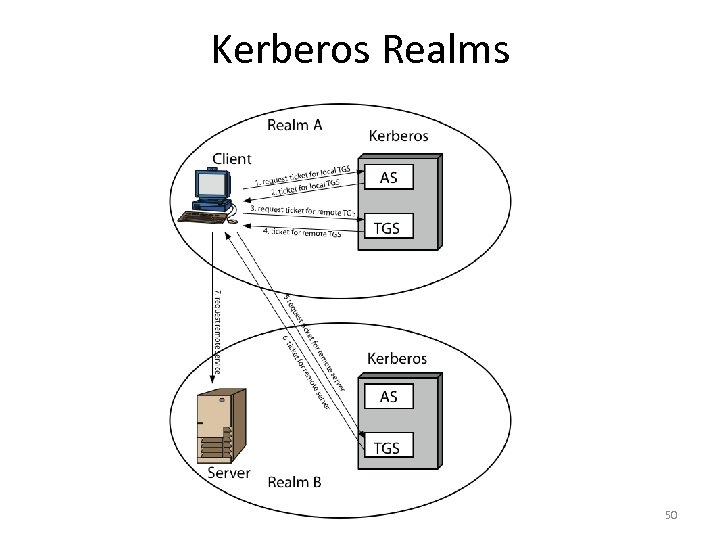 Kerberos Realms 50
 Kerberos Version 5 • Developed in mid 1990’s • Specified as Internet standard RFC 1510 • Provides improvements over v 4 – addresses environmental shortcomings • encryption algo, network protocol, byte order, ticket lifetime, authentication forwarding, interrealm auth – and technical deficiencies • double encryption, non-std mode of use, session keys, password attacks 51
 Federated Identity Management • Federated identity management is a relatively new concept • Dealing with the use of a common identity management scheme across multiple enterprises • And numerous applications and supporting many thousands, even millions of users 52
 Federated Identity Management • Identity management is a centralized, automated approach • To provide enterprise-wide access to resources by employees and other authorized individuals • Defining an identity for each user (human or process), associating attributes with the identity, and enforcing a means by which a user can verify identity 53
 Federated Identity Management • Its principal elements are: • Authentication: confirmating user corresponds to the user name provided • Authorization: granting access to services/resources given user authentication • Accounting: process for logging access and authorization 54
 Federated Identity Management • Provisioning: enrollment of users in the system • Workflow automation: movement of data in a business process • Delegated administration: use of role-based access control to grant permissions • Password synchronization: Creating a process for single sign-on (SSO) or reduced sign-on (RSO) 55
 Federated Identity Management • Self-service password reset: enable user to modify their password • Federation: process where authentication and permission will be passed on from one system to another • Usually across multiple enterprises, reducing the number of authentications needed by the user • Kerberos contains a number of the elements of an identity management system 56
 Federated Identity Management Ø Use of common identity management scheme l across multiple enterprises & numerous applications l supporting many thousands, even millions of users Ø Principal elements are: l authentication, authorization, accounting, provisioning, workflow automation, delegated administration, password synchronization, selfservice password reset, federation Ø Kerberos contains many of these elements 57
 Standards Used Ø Security Assertion Markup Language (SAML) l XML-based language for exchange of security information between online business partners Ø Part of OASIS (Organization for the Advancement of Structured Information Standards) standards for federated identity management l e. g. WS-Federation for browser-based federation Ø Need a few mature industry standards 58
 Summary Ø have considered: l remote user authentication issues l authentication using symmetric encryption l the Kerberos trusted key server system l authentication using asymmetric encryption l federated identity management 59