


 Скачать презентацию Data Science in Social Media Naveen Kumar Sridhar
afaf8b13ff56b73b4515a69987810e4a.ppt
- Количество слайдов: 22
 Data Science in Social Media Naveen Kumar Sridhar
 Agenda Data Reliability Trust Relation between Reliability and Trust Ontologies SPARQL Future work
 Motivation One of my friends posted a status message on Facebook, No classes today. Thank you Irene. First question that came to my mind, Is this person reliable?
 Data Reliability Definition: Reliable data is evidence you can trust. Example: If two people are doing the experiment and the result is almost same most of the time, then we consider the data to be reliable. In social network like Facebook, data can be classified as reliable data based on the trust on a person who posts the data.
 Evidence Definition ‘Evidence’ is data which is judged to be relevant. Example: When you investigate cooling, temperature data is relevant, so it is evidence. The length of thermometer is not relevant, so it is not evidence.
 Trust Definition: Trust in a person is a commitment to an action based on a belief that the future actions of that person will lead to good outcome. (Golbeck and Hendler) Example: A believes in B expecting that B provides certain information which are correct to the context.
 Trust Types Direct Trust Relational Trust System Trust
 Direct Trust Scenarios: You know a mechanic who has already repaired your car. You know a friend who lives in Chennai. He posts a status message Weather is pretty cool Do not forget that trust is contextual
 Relational Trust Scenarios You are new to Troy. You have to buy some apples. Your friend says ‘Price Chopper is the right place’ Your friend likes a status message of his friend in Facebook ‘There is a DJ tonite @ Brown’s’
 System Trust Scenarios You are going to a small town which has a small grocery store. They have only nameless toothpaste. You can see a FDA approval over the label. You see a message posted by some person you don’t know. You can see that he is from RPI or Stanford.
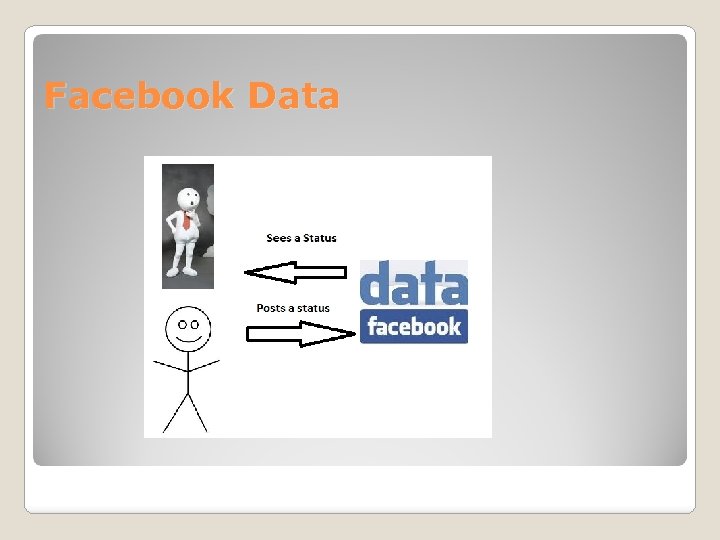 Facebook Data
 Ontology Definition An ontology is an explicit specification of a conceptualization Tools: Protégé 4. 2. 0 Link: https: //dlweb. dropbox. com/get/Independent%20 Study/Ontology Trust. Facebook. owl? w=3 db 9 b 219
 SPARQL stands for SPARQL Protocol and RDF Query Language. Used SPARQL to query the data obtained from Facebook which was in the RDF form. This can be integrated later with the ontology so that we can infer trust values directly.
 Ontology Explanation Trustor is someone who must choose whether, and how much, to trust. Trustee is someone or something that is to be trusted The ontology is designed to find the different forms of trusted Trustees.
 Ontology Explanation Trustee class is divided into five sub-classes Completely Trusted Somewhat Untrusted Completely Untrusted Don’t know
 Ontology Explanation Trust classes are Association – To find out whethere is an association between trustor and trustee Prior. Knowledge – To find out whether the trustee has prior knowledge Metadata Source – To find out whether Trustee has valid IP address Source. Of. Data – To find out whether trustee has mentioned the links of the source
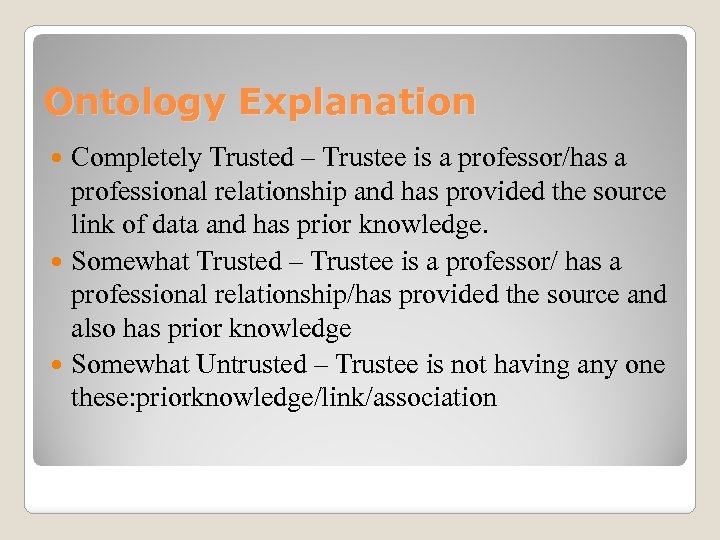 Ontology Explanation Completely Trusted – Trustee is a professor/has a professional relationship and has provided the source link of data and has prior knowledge. Somewhat Trusted – Trustee is a professor/ has a professional relationship/has provided the source and also has prior knowledge Somewhat Untrusted – Trustee is not having any one these: priorknowledge/link/association
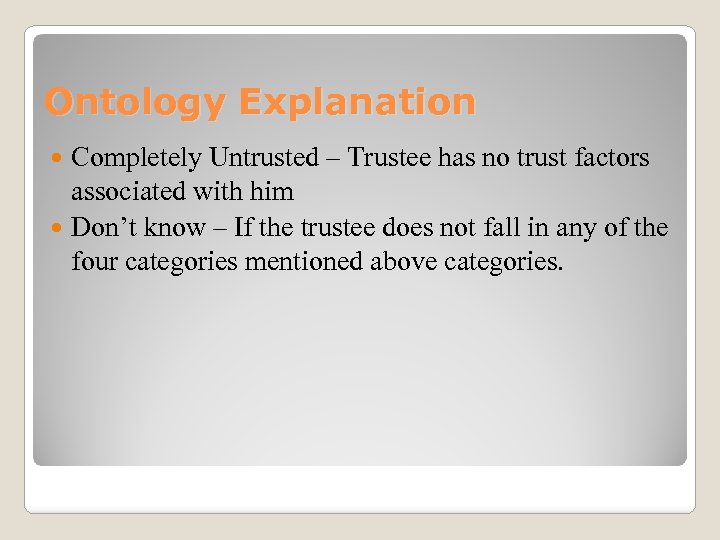 Ontology Explanation Completely Untrusted – Trustee has no trust factors associated with him Don’t know – If the trustee does not fall in any of the four categories mentioned above categories.
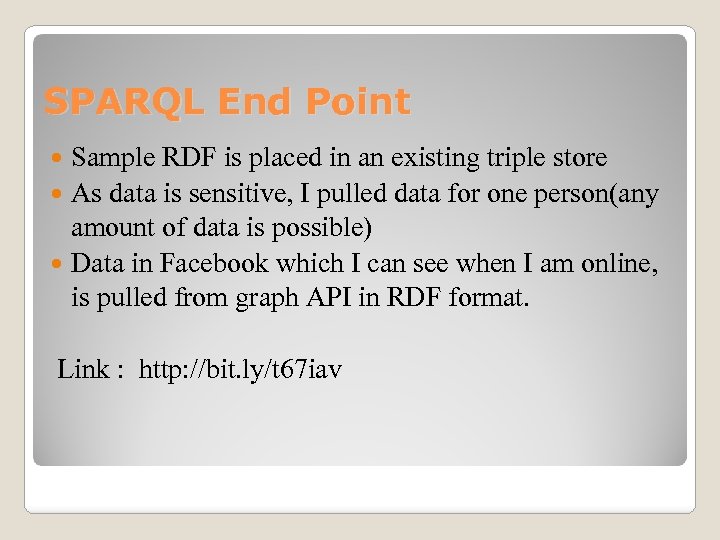 SPARQL End Point Sample RDF is placed in an existing triple store As data is sensitive, I pulled data for one person(any amount of data is possible) Data in Facebook which I can see when I am online, is pulled from graph API in RDF format. Link : http: //bit. ly/t 67 iav
 Future Work Ontology will be used to infer trust of the data from Facebook(complete model) PML Trust Ontology can be created for Social Networks.
 References http: //www. ci. austin. tx. us/auditor/downloads/testing. pdf http: //dig. csail. mit. edu/2011/Papers/ruleml/paper. pdf http: //www. cs. helsinki. fi/group/cinco/publications/pdfs/viljanen 05 towards. pd f http: //www. ai. sri. com/daml/services/owl-s/security/context/Toi. Den 04. pdf http: //www. cs. st-andrews. ac. uk/~tristan/pubs/sn 2011. pdf http: //www. cypherpunks. ca/~iang/pubs/tep. pdf http: //www. justice. gov/ag/annualreports/pr 2009/sect 1/data. pdfhttp: //www. jus tice. gov/ag/annualreports/pr 2009/sect 1/data. pdf http: //www-ksl. stanford. edu/kst/what-is-an-ontology. html http: //owl. cs. manchester. ac. uk/tutorials/protegeowltutorial/resources/Protege OWLTutorial. P 4_v 1_3. pdf
 References http: //www. seco. tkk. fi/publications/2011/laurenne-et-al-envirofi-2011. pdf http: //www. hipertext. net/english/pag 1031. htm http: //www. iti. illinois. edu/sites/www. iti. illinois. edu/files/docs/profiles/trust-icec 06. pdf http: //www-ksl. stanford. edu/kst/what-is-an-ontology. html