


 Скачать презентацию Data recording for success rate College MI Discussion
a07a47140a786d5a48b4b94cb5818601.ppt
- Количество слайдов: 30
 Data recording for success rate College MI Discussion Event Nick Linford 16 th November 2009 Aston University - Birmingham
 Plan for the day 10. 00 10. 10 10. 30 11. 15 Welcome and introductions The background Data recording examples – can we categorise? Break for drinks and biscuits 11. 30 12. 30 Data recording and audit experiences Lunch 13. 30 Warm welcome to Pete Ashton from The IA 14. 30 Launch of ADa. M, then break for cake 15. 00 More time with Pete (incl. 2010/11 changes) 16. 00 End
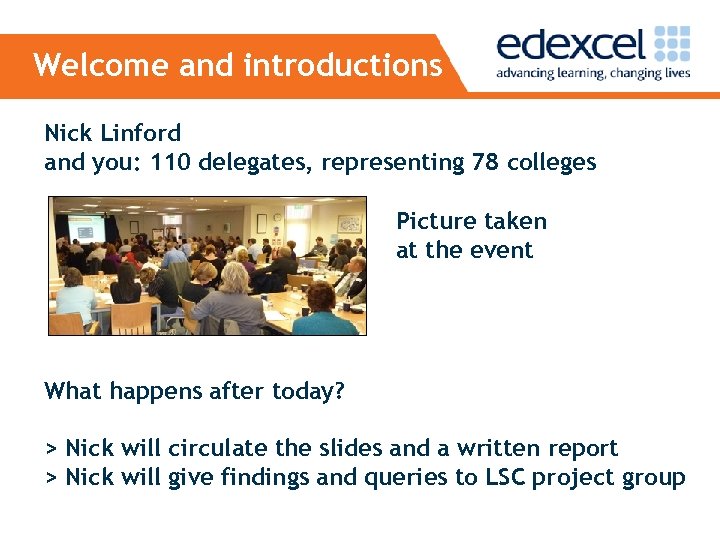 Welcome and introductions Nick Linford and you: 110 delegates, representing 78 colleges Picture taken at the event What happens after today? > Nick will circulate the slides and a written report > Nick will give findings and queries to LSC project group
 The background
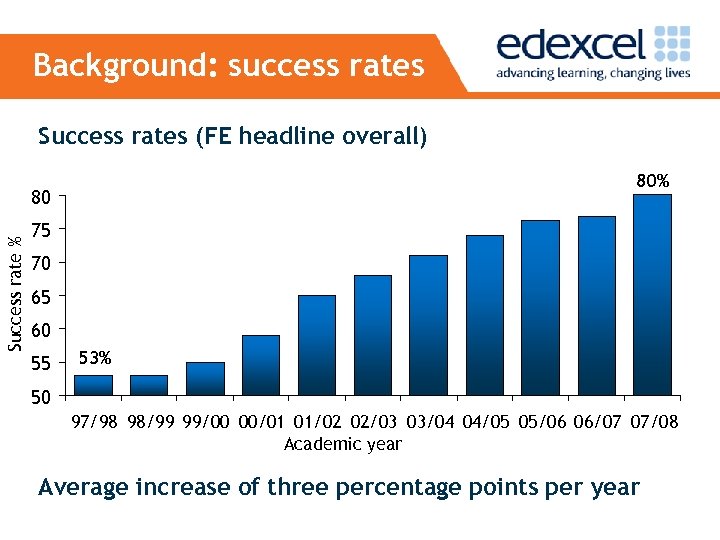 Background: success rates Success rates (FE headline overall) 80% Success rate % 80 75 70 65 60 55 53% 50 97/98 98/99 99/00 00/01 01/02 02/03 03/04 04/05 05/06 06/07 07/08 Academic year Average increase of three percentage points per year
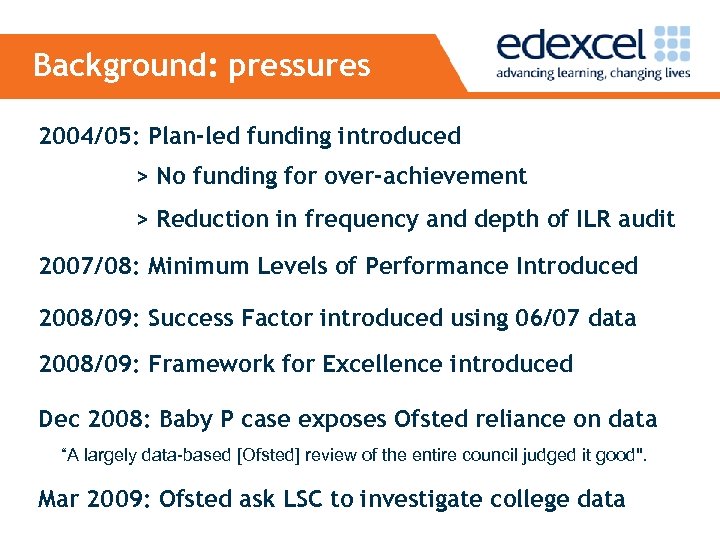 Background: pressures 2004/05: Plan-led funding introduced > No funding for over-achievement > Reduction in frequency and depth of ILR audit 2007/08: Minimum Levels of Performance Introduced 2008/09: Success Factor introduced using 06/07 data 2008/09: Framework for Excellence introduced Dec 2008: Baby P case exposes Ofsted reliance on data “A largely data-based [Ofsted] review of the entire council judged it good". Mar 2009: Ofsted ask LSC to investigate college data
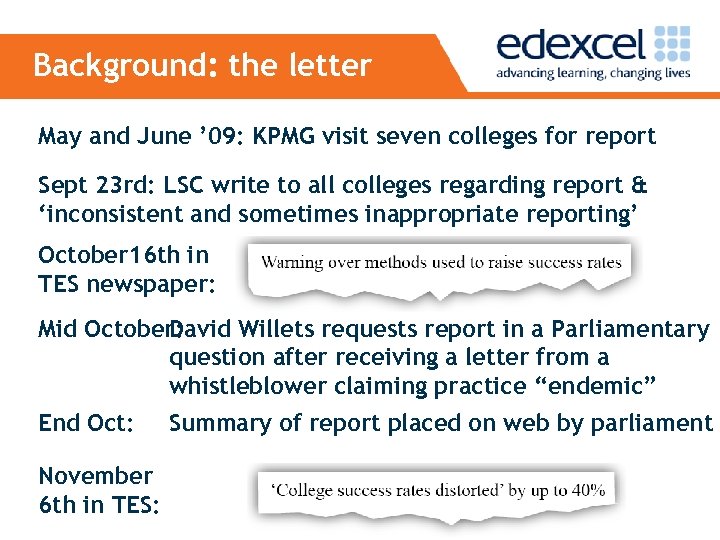 Background: the letter May and June ’ 09: KPMG visit seven colleges for report Sept 23 rd: LSC write to all colleges regarding report & ‘inconsistent and sometimes inappropriate reporting’ October 16 th in TES newspaper: Mid October: David Willets requests report in a Parliamentary question after receiving a letter from a whistleblower claiming practice “endemic” End Oct: November 6 th in TES: Summary of report placed on web by parliament
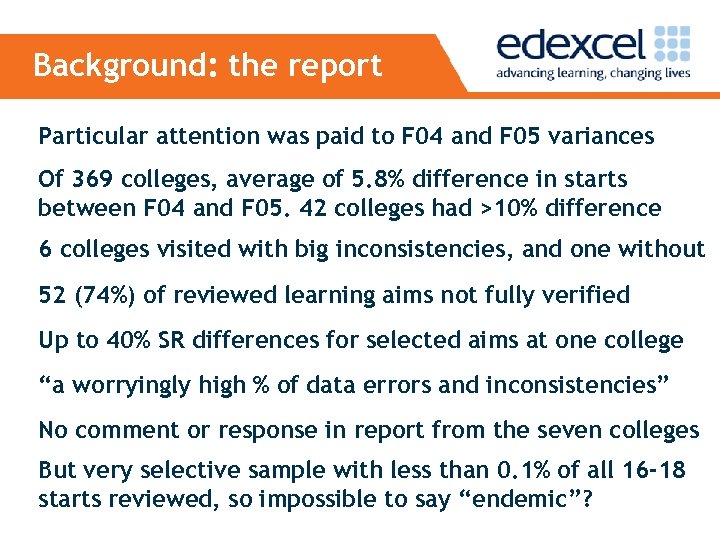 Background: the report Particular attention was paid to F 04 and F 05 variances Of 369 colleges, average of 5. 8% difference in starts between F 04 and F 05. 42 colleges had >10% difference 6 colleges visited with big inconsistencies, and one without 52 (74%) of reviewed learning aims not fully verified Up to 40% SR differences for selected aims at one college “a worryingly high % of data errors and inconsistencies” No comment or response in report from the seven colleges But very selective sample with less than 0. 1% of all 16 -18 starts reviewed, so impossible to say “endemic”?
 Data recording examples
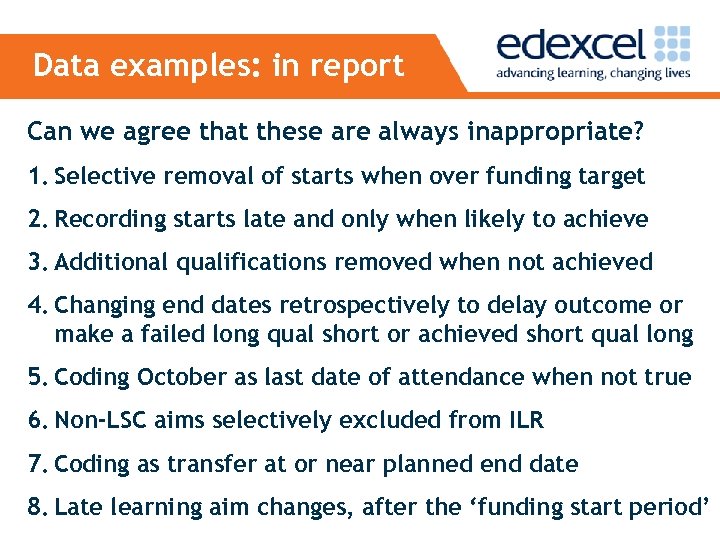 Data examples: in report Can we agree that these are always inappropriate? 1. Selective removal of starts when over funding target 2. Recording starts late and only when likely to achieve 3. Additional qualifications removed when not achieved 4. Changing end dates retrospectively to delay outcome or make a failed long qual short or achieved short qual long 5. Coding October as last date of attendance when not true 6. Non-LSC aims selectively excluded from ILR 7. Coding as transfer at or near planned end date 8. Late learning aim changes, after the ‘funding start period’
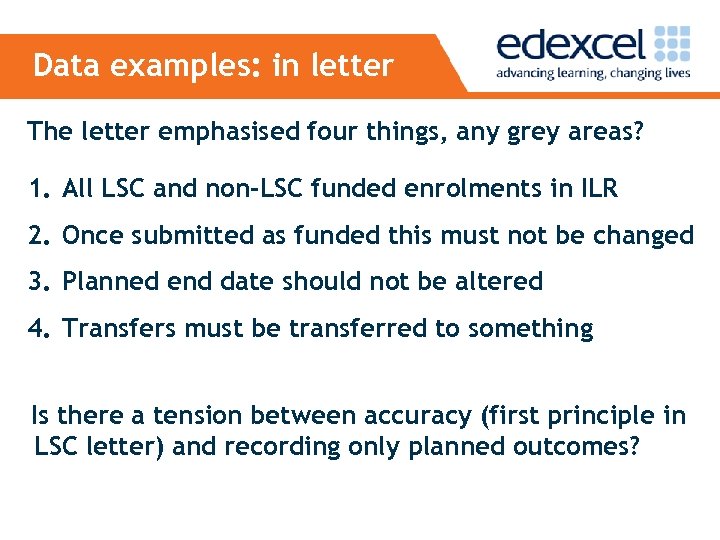 Data examples: in letter The letter emphasised four things, any grey areas? 1. All LSC and non-LSC funded enrolments in ILR 2. Once submitted as funded this must not be changed 3. Planned end date should not be altered 4. Transfers must be transferred to something Is there a tension between accuracy (first principle in LSC letter) and recording only planned outcomes?
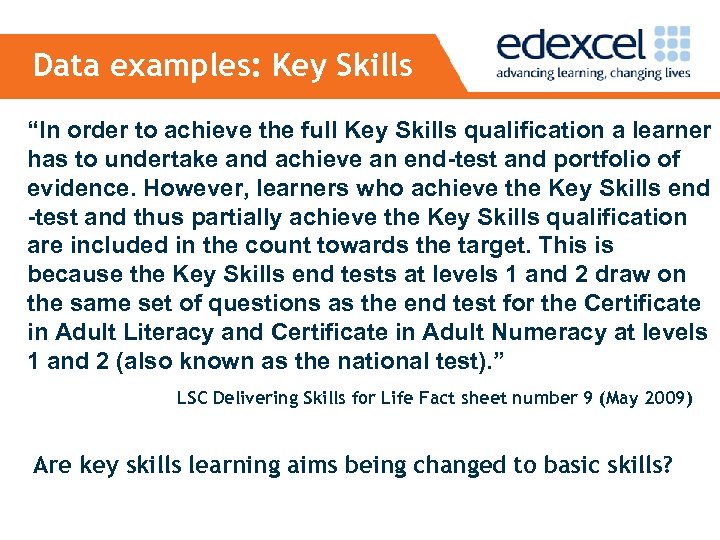 Data examples: Key Skills “In order to achieve the full Key Skills qualification a learner has to undertake and achieve an end-test and portfolio of evidence. However, learners who achieve the Key Skills end -test and thus partially achieve the Key Skills qualification are included in the count towards the target. This is because the Key Skills end tests at levels 1 and 2 draw on the same set of questions as the end test for the Certificate in Adult Literacy and Certificate in Adult Numeracy at levels 1 and 2 (also known as the national test). ” LSC Delivering Skills for Life Fact sheet number 9 (May 2009) Are key skills learning aims being changed to basic skills?
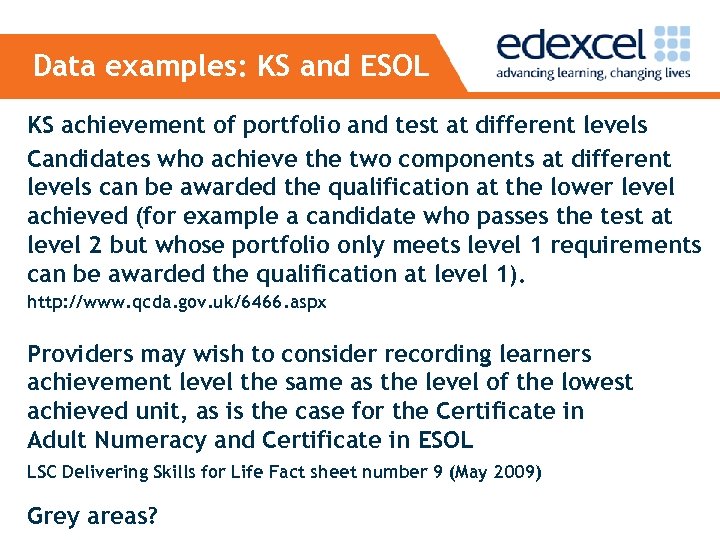 Data examples: KS and ESOL KS achievement of portfolio and test at different levels Candidates who achieve the two components at different levels can be awarded the qualification at the lower level achieved (for example a candidate who passes the test at level 2 but whose portfolio only meets level 1 requirements can be awarded the qualification at level 1). http: //www. qcda. gov. uk/6466. aspx Providers may wish to consider recording learners achievement level the same as the level of the lowest achieved unit, as is the case for the Certificate in Adult Numeracy and Certificate in ESOL LSC Delivering Skills for Life Fact sheet number 9 (May 2009) Grey areas?
 Data issues, Ofsted and Audit
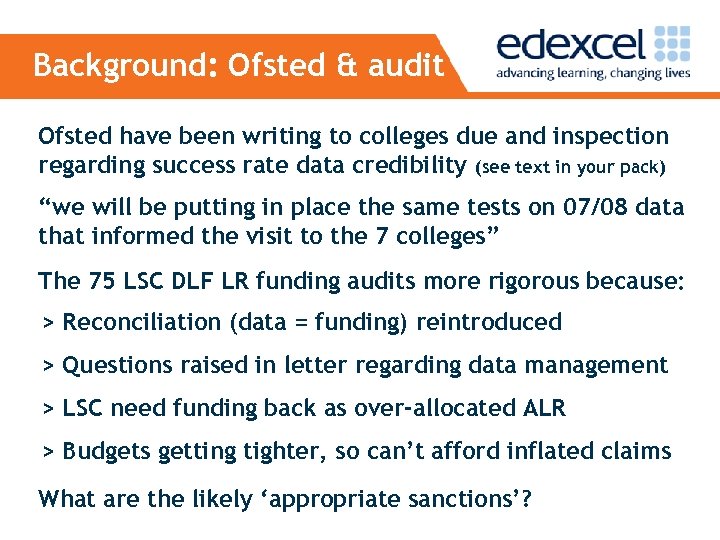 Background: Ofsted & audit Ofsted have been writing to colleges due and inspection regarding success rate data credibility (see text in your pack) “we will be putting in place the same tests on 07/08 data that informed the visit to the 7 colleges” The 75 LSC DLF LR funding audits more rigorous because: > Reconciliation (data = funding) reintroduced > Questions raised in letter regarding data management > LSC need funding back as over-allocated ALR > Budgets getting tighter, so can’t afford inflated claims What are the likely ‘appropriate sanctions’?
 Welcome Pete Ashton & Ed Drake
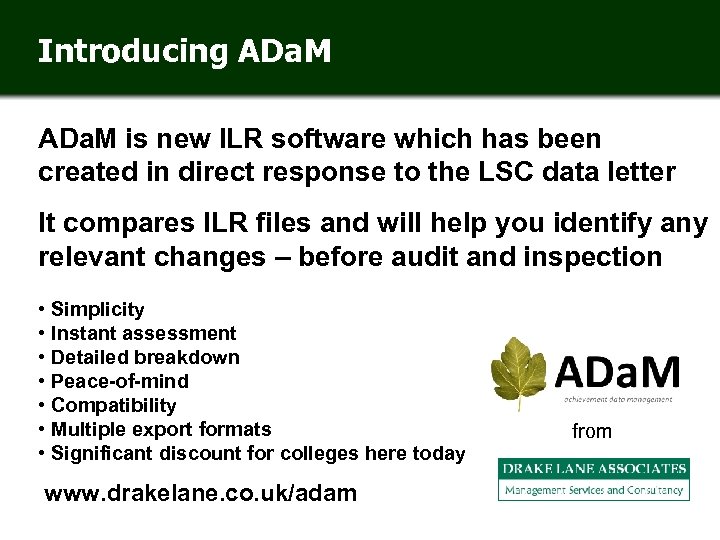 Introducing ADa. M is new ILR software which has been created in direct response to the LSC data letter It compares ILR files and will help you identify any relevant changes – before audit and inspection • Simplicity • Instant assessment • Detailed breakdown • Peace-of-mind • Compatibility • Multiple export formats • Significant discount for colleges here today www. drakelane. co. uk/adam from
 Break – return at 15. 00 Note: Delegates returned questionnaires before lunch and the results were reviewed in the afternoon. The numbers her have been updated to include additional questionnaires returned at the end of the day.
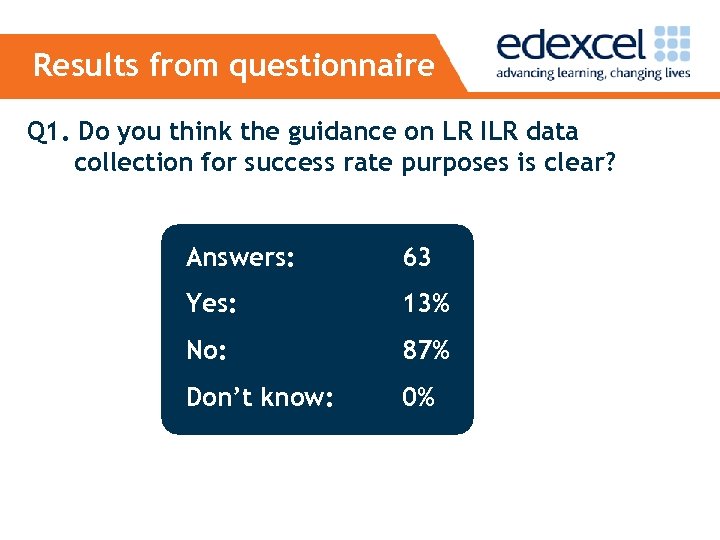 Results from questionnaire Q 1. Do you think the guidance on LR ILR data collection for success rate purposes is clear? Answers: 63 Yes: 13% No: 87% Don’t know: 0%
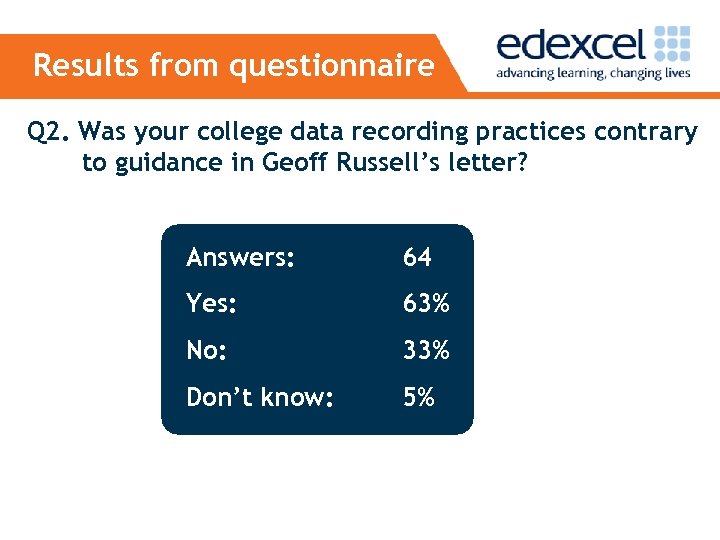 Results from questionnaire Q 2. Was your college data recording practices contrary to guidance in Geoff Russell’s letter? Answers: 64 Yes: 63% No: 33% Don’t know: 5%
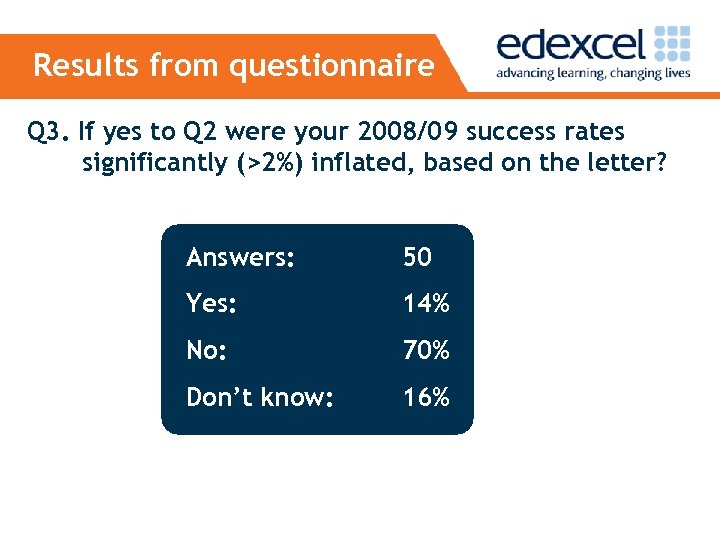 Results from questionnaire Q 3. If yes to Q 2 were your 2008/09 success rates significantly (>2%) inflated, based on the letter? Answers: 50 Yes: 14% No: 70% Don’t know: 16%
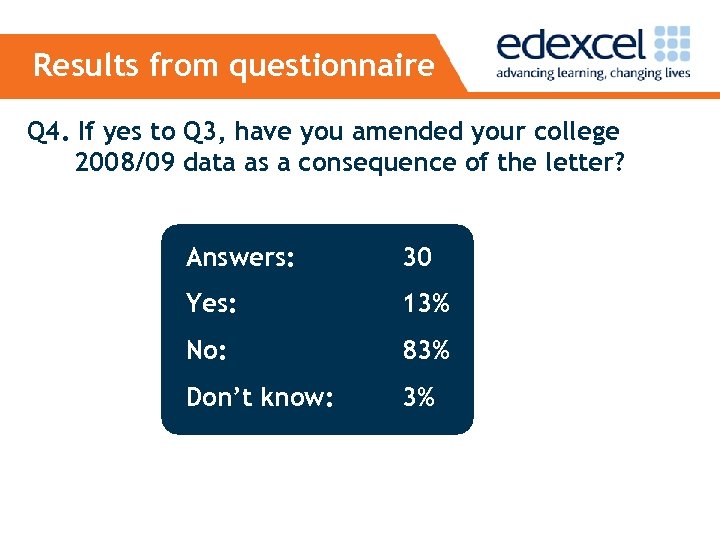 Results from questionnaire Q 4. If yes to Q 3, have you amended your college 2008/09 data as a consequence of the letter? Answers: 30 Yes: 13% No: 83% Don’t know: 3%
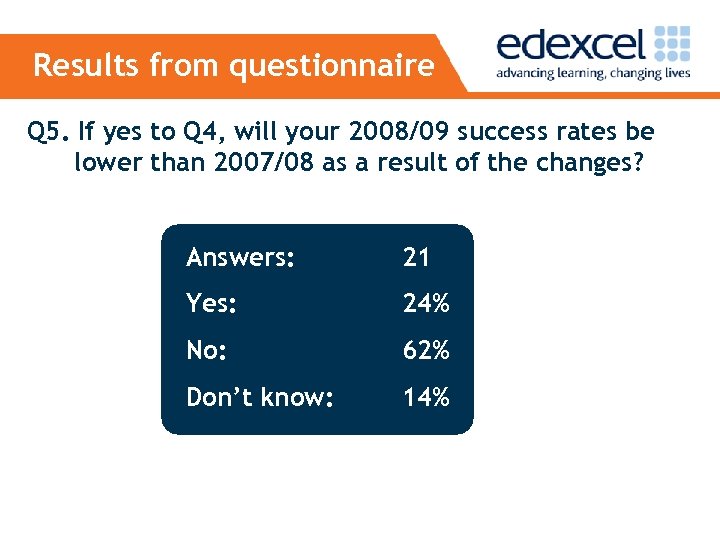 Results from questionnaire Q 5. If yes to Q 4, will your 2008/09 success rates be lower than 2007/08 as a result of the changes? Answers: 21 Yes: 24% No: 62% Don’t know: 14%
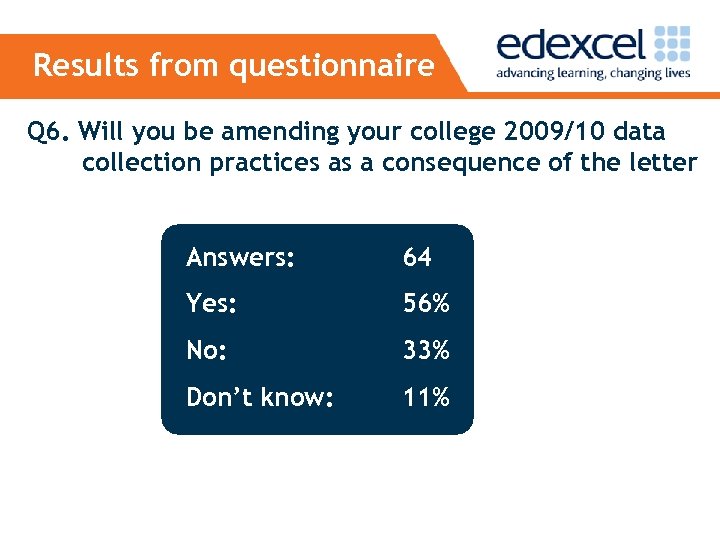 Results from questionnaire Q 6. Will you be amending your college 2009/10 data collection practices as a consequence of the letter Answers: 64 Yes: 56% No: 33% Don’t know: 11%
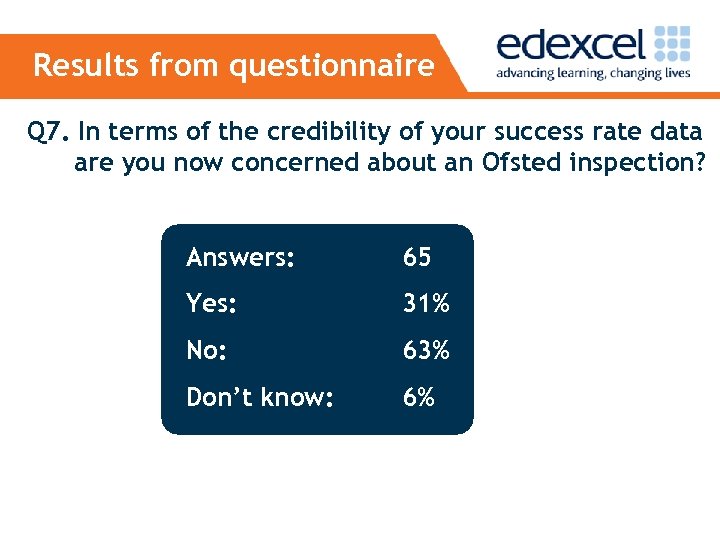 Results from questionnaire Q 7. In terms of the credibility of your success rate data are you now concerned about an Ofsted inspection? Answers: 65 Yes: 31% No: 63% Don’t know: 6%
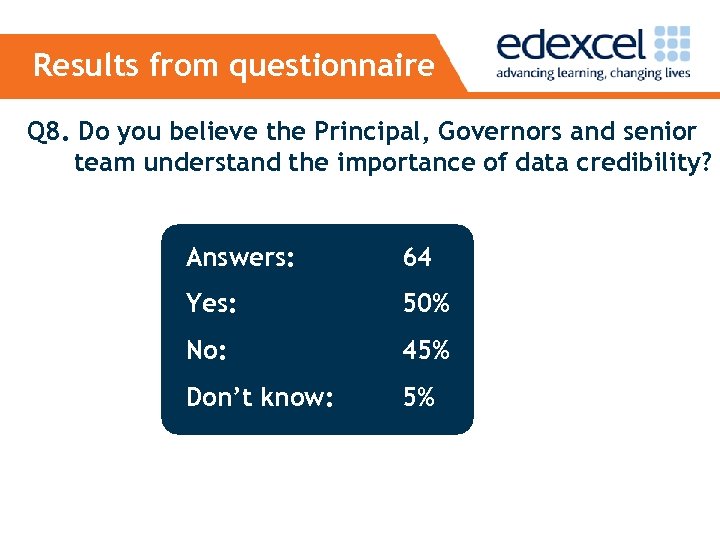 Results from questionnaire Q 8. Do you believe the Principal, Governors and senior team understand the importance of data credibility? Answers: 64 Yes: 50% No: 45% Don’t know: 5%
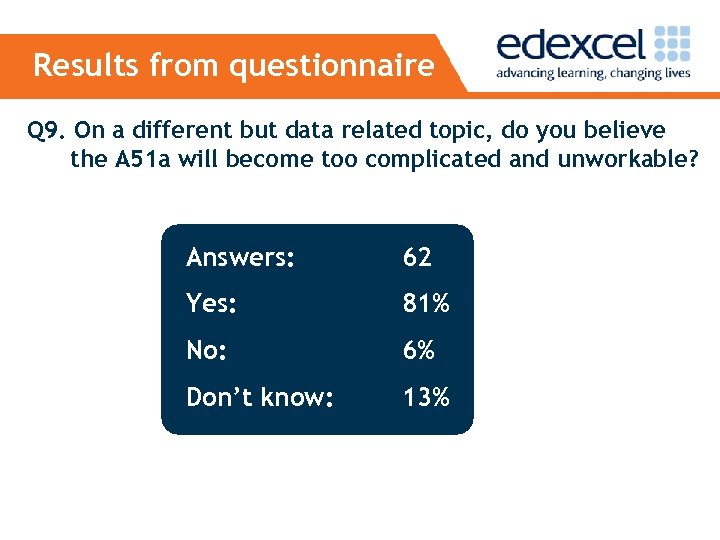 Results from questionnaire Q 9. On a different but data related topic, do you believe the A 51 a will become too complicated and unworkable? Answers: 62 Yes: 81% No: 6% Don’t know: 13%
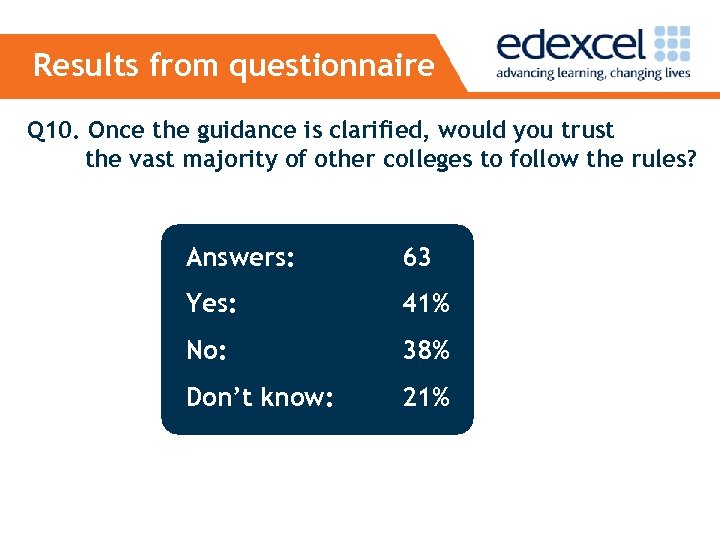 Results from questionnaire Q 10. Once the guidance is clarified, would you trust the vast majority of other colleges to follow the rules? Answers: 63 Yes: 41% No: 38% Don’t know: 21%
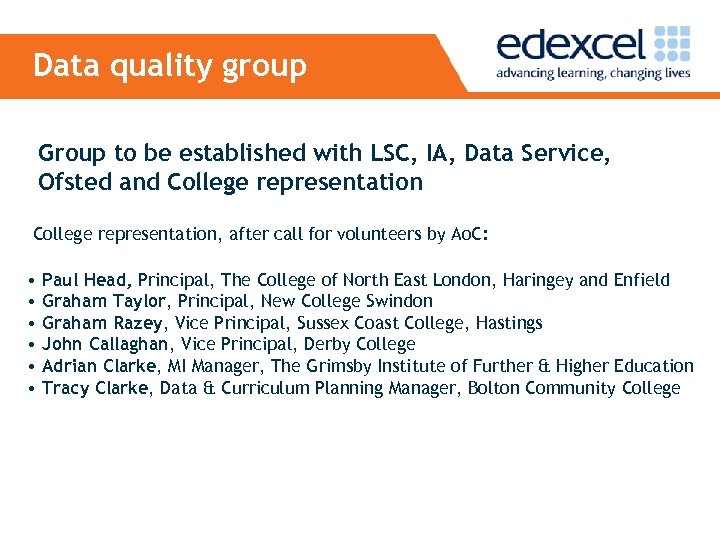 Data quality group Group to be established with LSC, IA, Data Service, Ofsted and College representation, after call for volunteers by Ao. C: • Paul Head, Principal, The College of North East London, Haringey and Enfield • Graham Taylor, Principal, New College Swindon • Graham Razey, Vice Principal, Sussex Coast College, Hastings • John Callaghan, Vice Principal, Derby College • Adrian Clarke, MI Manager, The Grimsby Institute of Further & Higher Education • Tracy Clarke, Data & Curriculum Planning Manager, Bolton Community College
 Any further questions? Stay in touch via www. twitter. com/nicklinford