


 Скачать презентацию data Privacy Partners Ltd 4 th Annual Privacy
96171783e6b40f220b1fe8b71d1b1416.ppt
- Количество слайдов: 68
 data. Privacy Partners Ltd. 4 th Annual Privacy & Security Workshop From Anonymisation to Identification: The Technologies of Today and Tomorrow Peter Hope-Tindall Chief Privacy Architect™ data. Privacy Partners Ltd. pht@dataprivacy. com November 7, 2003 1 Privacy by Design ® © 2003 data. Privacy Partners Ltd.
 data. Privacy Partners Ltd. Agenda • Biometrics and Privacy • Privacy Concerns • Design & Implementation Issues • Technology to protect Privacy 2 Biometrics Presentation © 2003 data. Privacy Partners Ltd.
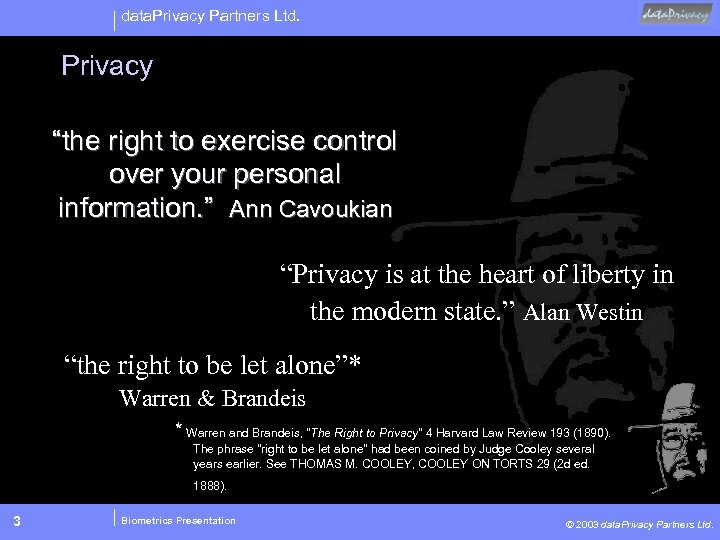 data. Privacy Partners Ltd. Privacy “the right to exercise control over your personal information. ” Ann Cavoukian “Privacy is at the heart of liberty in the modern state. ” Alan Westin “the right to be let alone”* Warren & Brandeis * Warren and Brandeis, "The Right to Privacy" 4 Harvard Law Review 193 (1890). The phrase "right to be let alone" had been coined by Judge Cooley several years earlier. See THOMAS M. COOLEY, COOLEY ON TORTS 29 (2 d ed. 1888). 3 Biometrics Presentation © 2003 data. Privacy Partners Ltd.
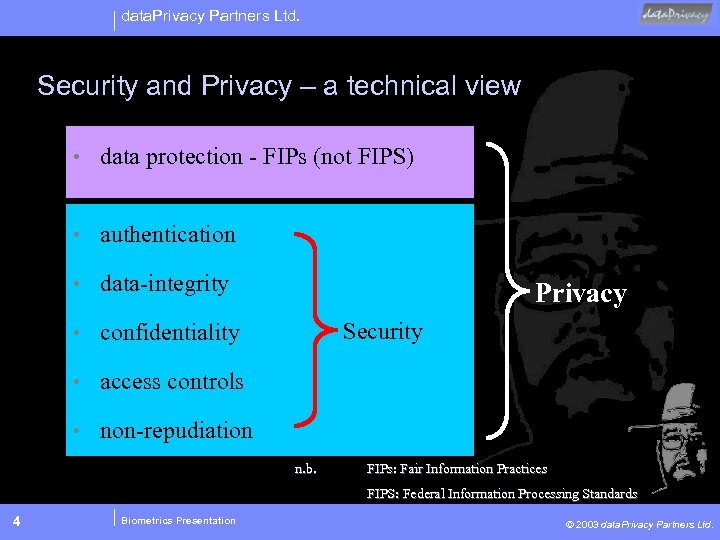 data. Privacy Partners Ltd. Security and Privacy – a technical view • data protection - FIPs (not FIPS) • authentication • data-integrity Privacy Security • confidentiality • access controls • non-repudiation n. b. FIPs: Fair Information Practices FIPS: Federal Information Processing Standards 4 Biometrics Presentation © 2003 data. Privacy Partners Ltd.
 data. Privacy Partners Ltd. Security • • 5 vs. Privacy Accountable to President/CEO Board of Directors. Risk based assessment. (how likely is it? ) Access and use controls defined by the system owner. Has been focused on protecting against outsiders. Biometrics Presentation • • Accountable to the data subject. Capabilities based assessment. (is it possible? ) Access and use controls defined by use limitation and consent of data subject and legislation. Protecting against outsiders, insiders and system owner. © 2003 data. Privacy Partners Ltd.
 data. Privacy Partners Ltd. The Complex nature of Privacy • • • Identity • Measures the degree to which information is personally identifiable. Linkability • Measures the degree to which data tuples or transactions are linked to each other. Observability • Measures the degree to which identity or linkability may be impacted from the use of a system. Which other data elements are visible; implicitly or explicitly. With thanks and apologies to the Common Criteria 6 Biometrics Presentation © 2003 data. Privacy Partners Ltd.
 data. Privacy Partners Ltd. Biometrics • Biometric is derived from the Greek words bio (life) and metric (the measure of). • “The automated use of Physiological or Behavioral Characteristics to determine or verify identity” International Biometric Group (IBG) • 7 “‘Biometrics’ are unique, measurable characteristics or traits of a human being for automatically recognizing or verifying identity. ” Biometrics Presentation © 2003 data. Privacy Partners Ltd.
 data. Privacy Partners Ltd. Biometrics Schmetrics? • Biometric: (noun) - one of various technologies that utilize behavioral or physiological characteristics to determine or verify identity. “Finger-scanning is a commonly used biometric. ” Plural form also acceptable: “Retina-scan and irisscan are eye-based biometrics. " • Biometrics: (noun) - Field relating to biometric identification. “What is the future of biometrics? ” • Biometric: (adjective) - Of or pertaining to technologies that utilize behavioral or physiological characteristics to determine or verify identity. “Do you plan to use biometric identification or older types of identification? ” 8 Biometrics Presentation © 2003 data. Privacy Partners Ltd.
 data. Privacy Partners Ltd. Biometric Template • Distinctive encoded files derived and encoded from the unique features of a biometric sample • A basic element of biometric systems • Templates, not samples, are used in biometric matching • Much smaller amount of data than sample (1/100 th, 1/1000 th) • Vendor specific • Different templates are generated each time an individual provides a biometric sample. 9 Biometrics Presentation © 2003 data. Privacy Partners Ltd.
 data. Privacy Partners Ltd. Verification • Also called 1: 1 ‘Authentication’ • Performs comparison against a single biometric record • Answers question: “Am I who I say I am? ” 10 Biometrics Presentation © 2003 data. Privacy Partners Ltd.
 data. Privacy Partners Ltd. Identification • Also called 1: N Search • Performs comparison against entire biometric database • Answers question: “Who am I? ” 11 Biometrics Presentation © 2003 data. Privacy Partners Ltd.
 data. Privacy Partners Ltd. Is DNA a biometric? • • 12 DNA requires actual physical sample DNA matching is not performed in real time DNA matching does not employ templates or feature extraction however – Policy issues and risks are identical Biometrics Presentation © 2003 data. Privacy Partners Ltd.
 data. Privacy Partners Ltd. In a strict sense then, DNA matching is not a biometric in the same way that traditional forensic fingerprint examination is not a biometric. Regardless of these distinctions, we believe that DNAbased technologies should be discussed alongside other biometric-based technologies inasmuch as they make use of a physiological characteristic to verify or determine identity. Beyond the definition, to most observers DNA looks, acts and may be used like other biometrics. The policy ramifications, while much more serious for DNA-based technologies share some common attributes with other biometrics. 13 Biometrics Presentation © 2003 data. Privacy Partners Ltd.
 data. Privacy Partners Ltd. Taxonomy Physiological Biometrics Behavioral Biometrics • Finger Scanning • Hand Geometry • Facial Recognition • Iris Scanning • Retinal Scanning • Finger Geometry • • • Voice Recognition Dynamic Signature Verification Keystroke Dynamics (In reality all biometrics are both physiological and behavioral to some degree. ) 14 Biometrics Presentation © 2003 data. Privacy Partners Ltd.
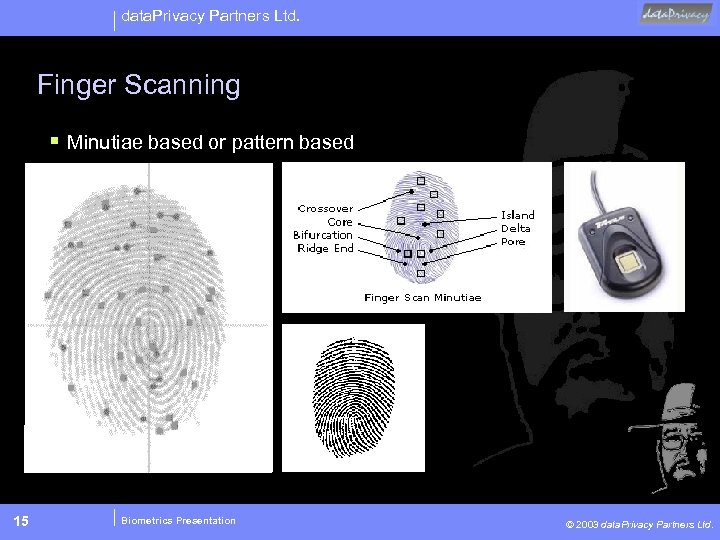 data. Privacy Partners Ltd. Finger Scanning § Minutiae based or pattern based 15 Biometrics Presentation © 2003 data. Privacy Partners Ltd.
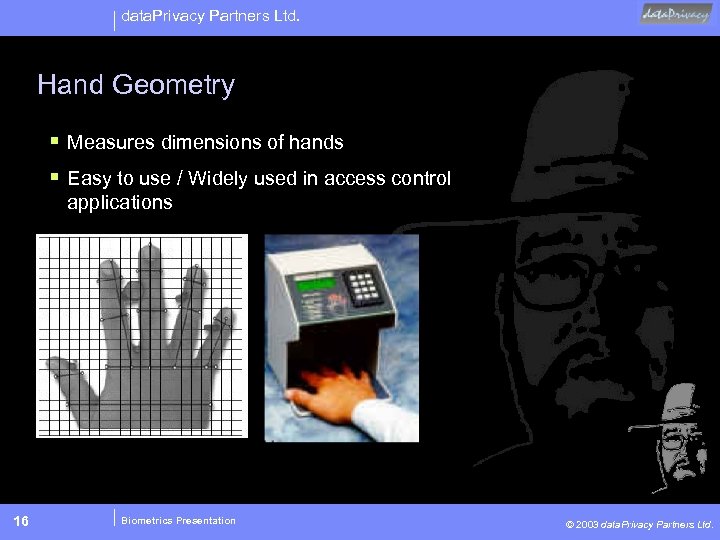 data. Privacy Partners Ltd. Hand Geometry § Measures dimensions of hands § Easy to use / Widely used in access control applications 16 Biometrics Presentation © 2003 data. Privacy Partners Ltd.
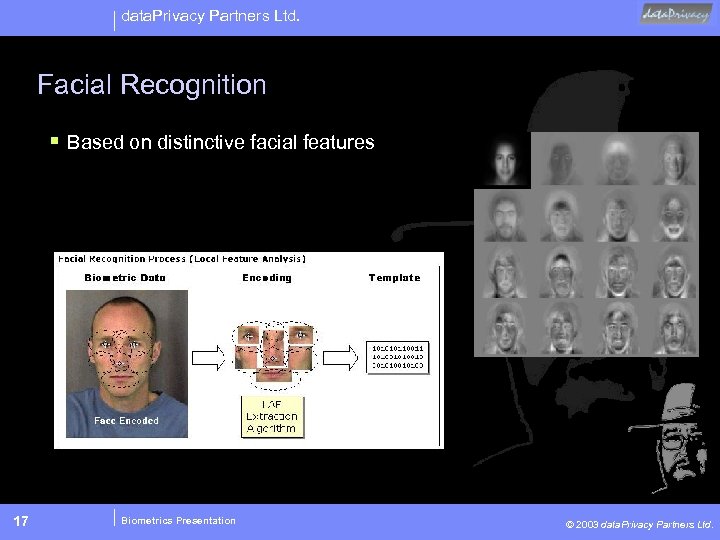 data. Privacy Partners Ltd. Facial Recognition § Based on distinctive facial features 17 Biometrics Presentation © 2003 data. Privacy Partners Ltd.
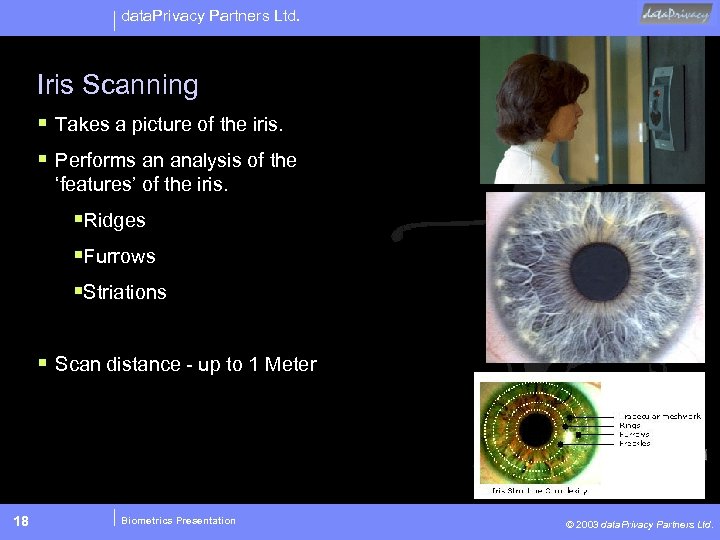 data. Privacy Partners Ltd. Iris Scanning § Takes a picture of the iris. § Performs an analysis of the ‘features’ of the iris. §Ridges §Furrows §Striations § Scan distance - up to 1 Meter 18 Biometrics Presentation © 2003 data. Privacy Partners Ltd.
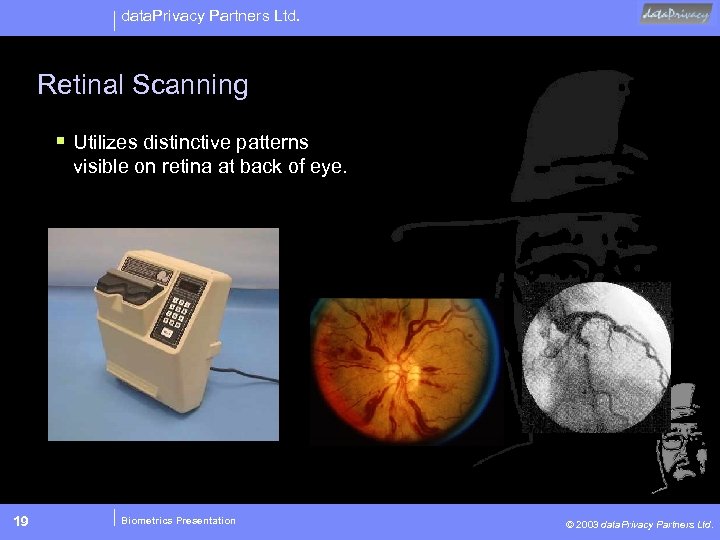 data. Privacy Partners Ltd. Retinal Scanning § Utilizes distinctive patterns visible on retina at back of eye. 19 Biometrics Presentation © 2003 data. Privacy Partners Ltd.
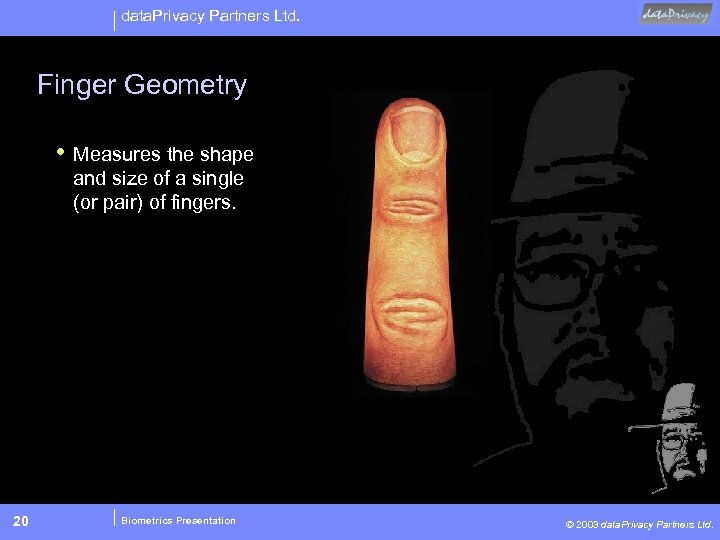 data. Privacy Partners Ltd. Finger Geometry • Measures the shape and size of a single (or pair) of fingers. 20 Biometrics Presentation © 2003 data. Privacy Partners Ltd.
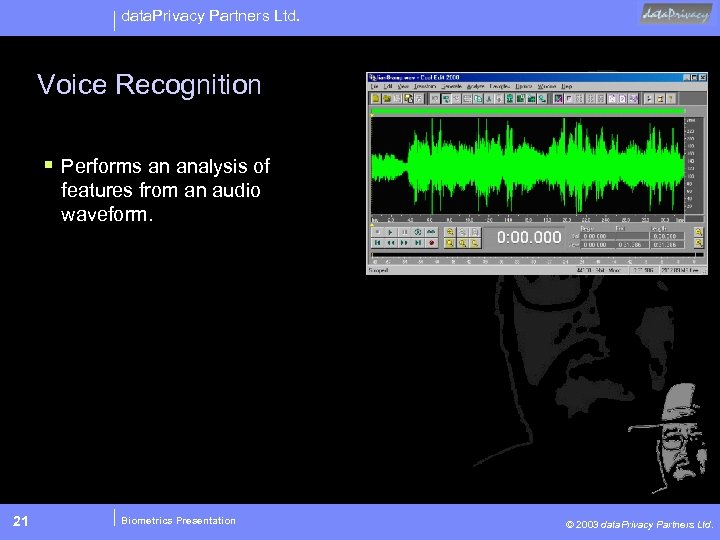 data. Privacy Partners Ltd. Voice Recognition § Performs an analysis of features from an audio waveform. 21 Biometrics Presentation © 2003 data. Privacy Partners Ltd.
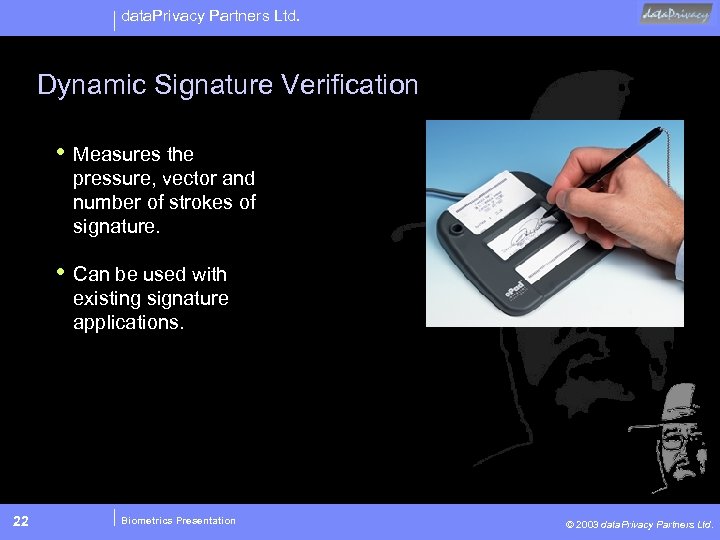 data. Privacy Partners Ltd. Dynamic Signature Verification • Measures the pressure, vector and number of strokes of signature. • Can be used with existing signature applications. 22 Biometrics Presentation © 2003 data. Privacy Partners Ltd.
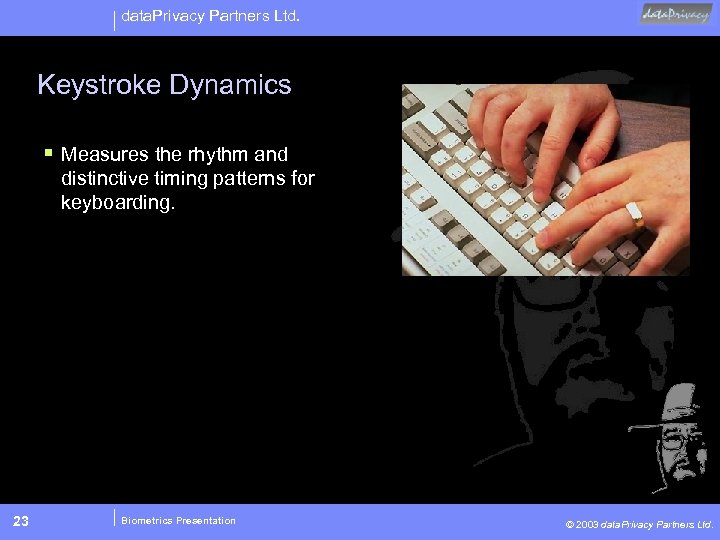 data. Privacy Partners Ltd. Keystroke Dynamics § Measures the rhythm and distinctive timing patterns for keyboarding. 23 Biometrics Presentation © 2003 data. Privacy Partners Ltd.
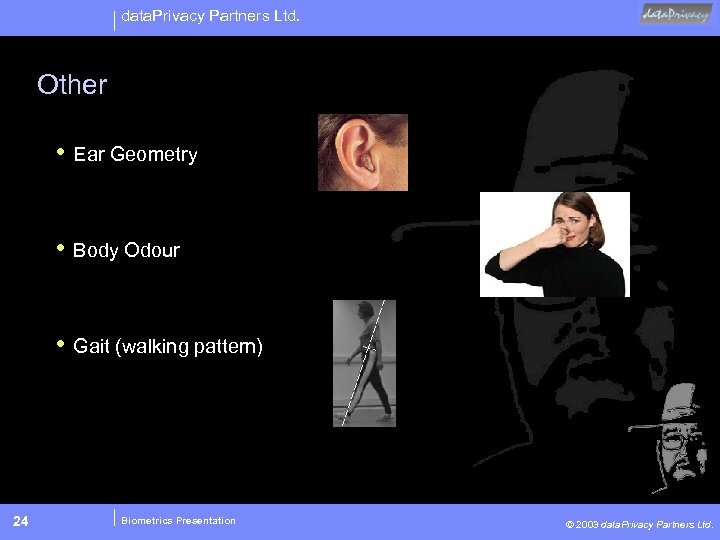 data. Privacy Partners Ltd. Other • Ear Geometry • Body Odour • Gait (walking pattern) 24 Biometrics Presentation © 2003 data. Privacy Partners Ltd.
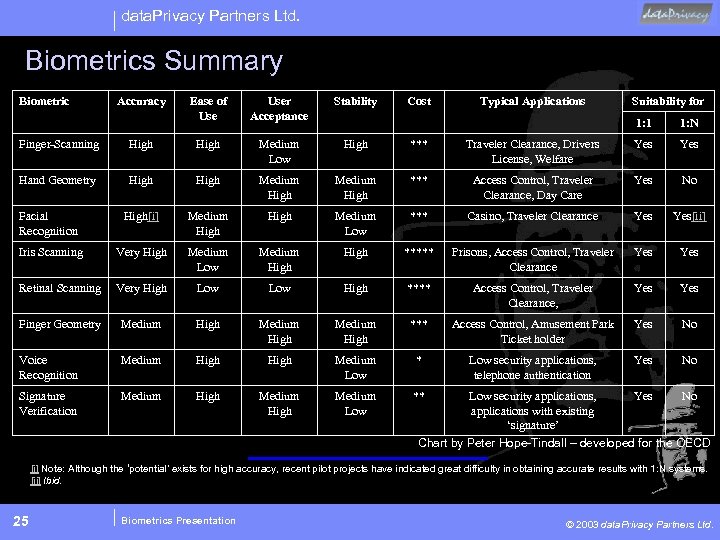 data. Privacy Partners Ltd. Biometrics Summary Biometric Accuracy Ease of User Acceptance Stability Cost Typical Applications Suitability for 1: 1 1: N Finger-Scanning High Medium Low High *** Traveler Clearance, Drivers License, Welfare Yes Hand Geometry High Medium High *** Access Control, Traveler Clearance, Day Care Yes No Facial Recognition High[i] Medium High Medium Low *** Casino, Traveler Clearance Yes[ii] Iris Scanning Very High Medium Low Medium High ***** Prisons, Access Control, Traveler Clearance Yes Retinal Scanning Very High Low High **** Access Control, Traveler Clearance, Yes Finger Geometry Medium High *** Access Control, Amusement Park Ticket holder Yes No Voice Recognition Medium High Medium Low * Low security applications, telephone authentication Yes No Signature Verification Medium High Medium Low ** Low security applications, applications with existing ‘signature’ Yes No Chart by Peter Hope-Tindall – developed for the OECD [i] Note: Although the ‘potential’ exists for high accuracy, recent pilot projects have indicated great difficulty in obtaining accurate results with 1: N systems. [ii] Ibid. 25 Biometrics Presentation © 2003 data. Privacy Partners Ltd.
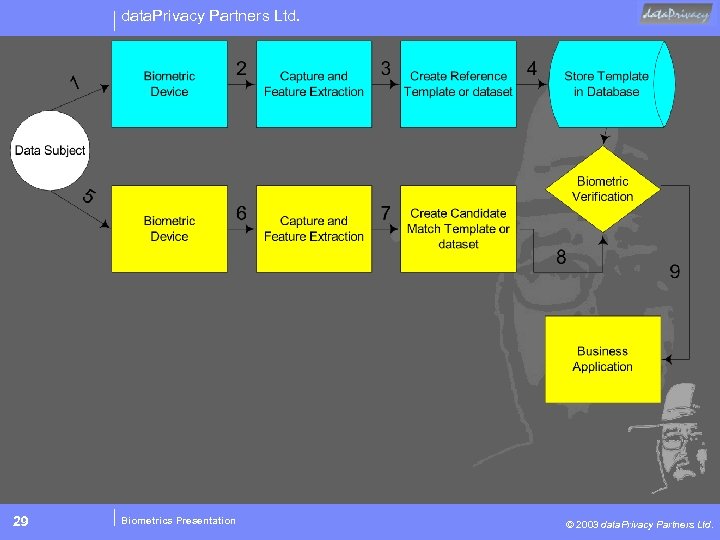
 data. Privacy Partners Ltd. How does a biometric system work? • Scanning / Collection of Sample • Feature Extraction • Biometric template creation • Biometric template matching • Many vendors have proprietary searching subsystems and optimized hardware 26 Biometrics Presentation © 2003 data. Privacy Partners Ltd.
 data. Privacy Partners Ltd. Types of Function • Identification (1: N) • Submission of sample as a search candidate against entire database • Verification (1: 1) • Validation of sample against a presumed identity 27 Biometrics Presentation © 2003 data. Privacy Partners Ltd.
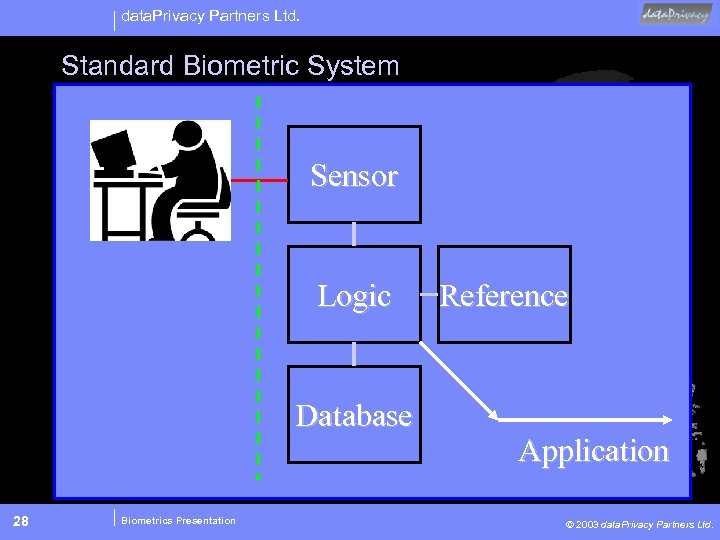 data. Privacy Partners Ltd. Standard Biometric System Sensor Logic Database 28 Biometrics Presentation Reference Application © 2003 data. Privacy Partners Ltd.
 data. Privacy Partners Ltd. 29 Biometrics Presentation © 2003 data. Privacy Partners Ltd.
 data. Privacy Partners Ltd. Metrics • Scientific Method / Biometric Testing “The real purpose of the scientific method is to make sure Nature hasn't misled you into thinking you know something you don't actually know. ” Robert M. Pirsig, Zen and the Art of Motorcycle Maintenance 30 Biometrics Presentation © 2003 data. Privacy Partners Ltd.
 data. Privacy Partners Ltd. Perceptions • • • 31 Public perceptions • Looking for a magic solution • Feel safe technology Post terrorism opportunism Limited information Biometrics Presentation © 2003 data. Privacy Partners Ltd.
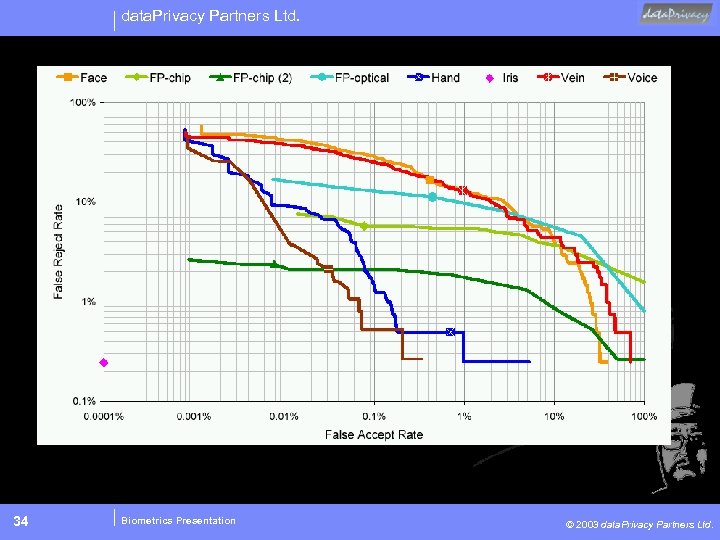
 data. Privacy Partners Ltd. Biometric Performance • • 32 “False Reject Rate” a. k. a. False Non-Match Rate (FNMR) “False Acceptance Rate” a. k. a. False Match Rate (FMR) “Equal Error Rate” Biometric System Error Trade-off Biometrics Presentation © 2003 data. Privacy Partners Ltd.
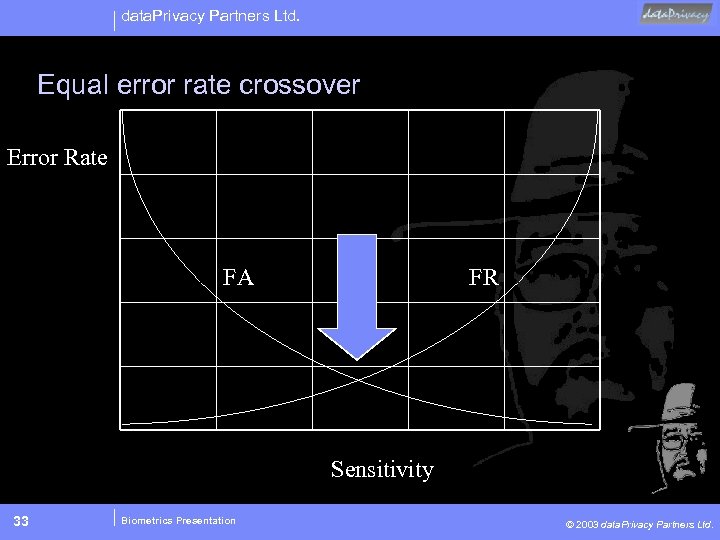 data. Privacy Partners Ltd. Equal error rate crossover Error Rate FA FR Sensitivity 33 Biometrics Presentation © 2003 data. Privacy Partners Ltd.
 data. Privacy Partners Ltd. 34 Biometrics Presentation © 2003 data. Privacy Partners Ltd.
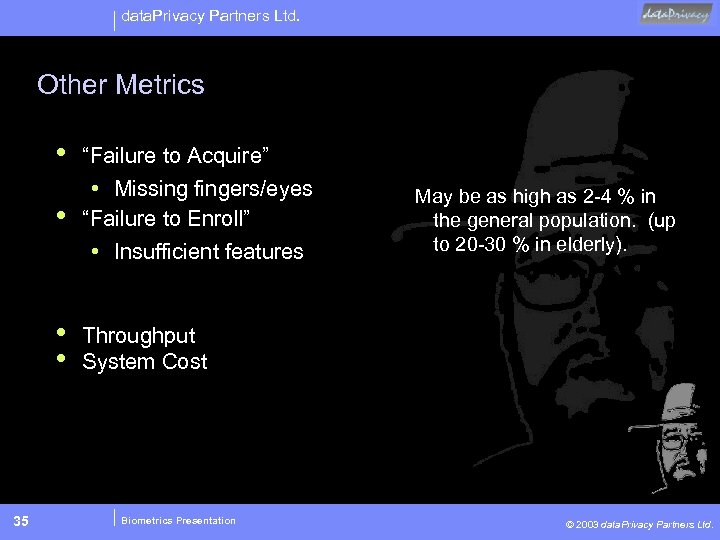 data. Privacy Partners Ltd. Other Metrics • • 35 “Failure to Acquire” • Missing fingers/eyes “Failure to Enroll” • Insufficient features May be as high as 2 -4 % in the general population. (up to 20 -30 % in elderly). Throughput System Cost Biometrics Presentation © 2003 data. Privacy Partners Ltd.
 data. Privacy Partners Ltd. Publicly Available Independent Evaluations • CESG • http: //www. cesg. gov. uk/site/ast/index. cfm? menu. Select ed=4&display. Page=4 • Face Recognition Vendor Test • http: //www. frvt. org • Fingerprint Verification Competition • http: //bias. csr. unibo. it/fvc 2002 • US National Biometric Test Center • http: //www. engr. sjsu. edu/biometrics/nbtccw. pdf 36 Biometrics Presentation © 2003 data. Privacy Partners Ltd.
 data. Privacy Partners Ltd. Security Concerns related to Biometrics • Spoofing • Countermeasures • Replay Attacks • Cannot revoke a biometric • Improper Reliance • Insufficient Enrolment Rigour 37 Biometrics Presentation © 2003 data. Privacy Partners Ltd.
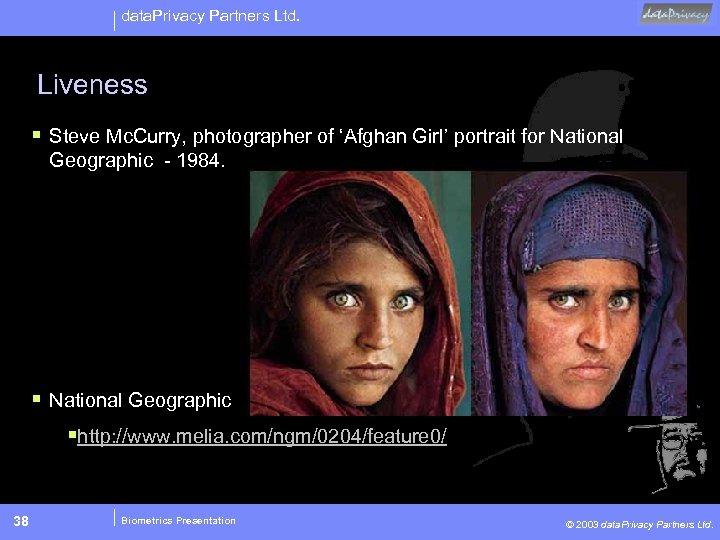 data. Privacy Partners Ltd. Liveness § Steve Mc. Curry, photographer of ‘Afghan Girl’ portrait for National Geographic - 1984. § National Geographic §http: //www. melia. com/ngm/0204/feature 0/ 38 Biometrics Presentation © 2003 data. Privacy Partners Ltd.
 data. Privacy Partners Ltd. Concerns about Biometric systems • Rigour of enrollment process • Lack of independent performance metrics • No very-large population biometric system examples • Failure-to-enroll and Failure-to-acquire • • • 39 underclass (maybe as high as 2 -4% to even 20 -30%) Post terrorism opportunism Technology panacea Large scale biometric system failure Biometrics Presentation © 2003 data. Privacy Partners Ltd.
 data. Privacy Partners Ltd. Privacy Concerns 1. Function Creep 2. Infrastructure of Surveillance/Unique Identifier • Default method of identification • Used inappropriately 3. Consent/Transparency • Information Leakage • • 40 Glaucoma DNA Profiling Biometrics Presentation © 2003 data. Privacy Partners Ltd.
 data. Privacy Partners Ltd. Function Creep/Finality • ‘Function Creep’ (also known as ‘purpose creep’) is the term used to describe the expansion of a process or system, where data collected for one specific purpose is subsequently used for another unintended or unauthorized purpose. • In fair information practice terms, we may think of function creep as the subsequent use, retention or disclosure or data without the consent of the individual and of unauthorized changes in the purpose specification for a given data collection. 41 Biometrics Presentation © 2003 data. Privacy Partners Ltd.
 data. Privacy Partners Ltd. Function Creep/Finality Example • As an example, we may think of a social service (welfare) system that requires a finger scan to enroll. Let us assume that undertakings were made at enrollment to the user that the finger scan is being collected solely for the purposes of guarding against ‘double dipping’ (ensuring that the user is not already registered for welfare). If the finger scan were subsequently used for another purpose (e. g. a law enforcement purpose, something not described in the initial purpose specification) then we have ‘function creep’. 42 Biometrics Presentation © 2003 data. Privacy Partners Ltd.
 data. Privacy Partners Ltd. Infrastructure of Surveillance/Unique identifier • An overarching concern for some people is that biometrics will become a technology of surveillance and social control. Perhaps as the ultimate personal identifier, they may be seen to facilitate all the ominous and dehumanizing aspects of an information society -- a society in which unparalleled amounts of personal information may be collected and used on a systematic basis. see O’Connor, “Collected, Tagged, and Archived. ” 43 Biometrics Presentation © 2003 data. Privacy Partners Ltd.
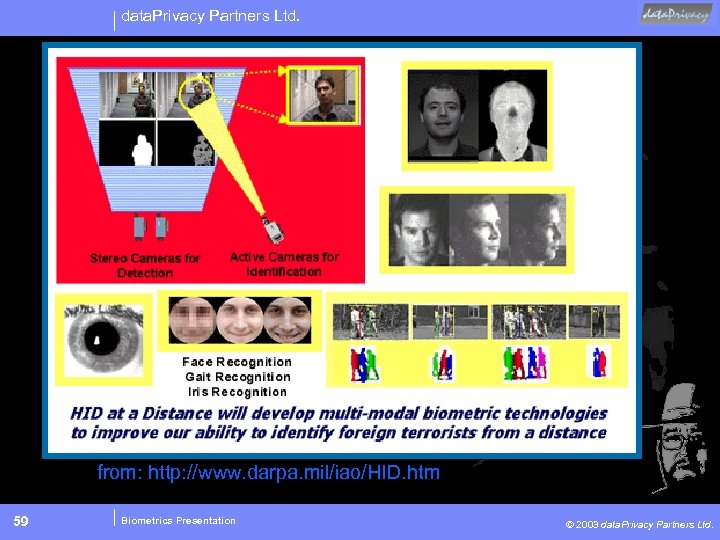
 data. Privacy Partners Ltd. Consent/Transparency • Certain biometrics may be used without the consent or active participation (or indeed even the knowledge) of the individual. • Iris scanning can already be performed at a substantial distance (a range of 18 to 24 inches)[i] from the subject. As the technology improves, it is quite likely that iris acquisition may take place from even greater distances and without any user involvement whatsoever. • From a privacy perspective these situations can conflict with the collection limitation, openness and purpose specification principles. [i] http: //www. eweek. com/article 2/0, 3959, 115743, 00. asp 44 Biometrics Presentation © 2003 data. Privacy Partners Ltd.
 data. Privacy Partners Ltd. Implementation Modalities to Protect Privacy • • Statutory Policy • Privacy Impact Assessment • Threat Risk Assessment • Common Criteria Scheme • 45 • Standards Technology • Tamper proof hardware Biometrics Presentation © 2003 data. Privacy Partners Ltd.
 data. Privacy Partners Ltd. Statutory • In some jurisdictions, generalized or specific criminal sanction may be used to provide security protection for biometric systems and to outlaw certain activities to bypass security controls. • Ontario Works Act http: //www. e-laws. gov. on. ca/DBLaws/Statutes/English/97 o 25 a_e. htm • Biometric Identifier Privacy Act – State of New Jersey http: //www. njleg. state. nj. us/2002/Bills/A 2500/2448_I 1. HTM 46 Biometrics Presentation © 2003 data. Privacy Partners Ltd.
 data. Privacy Partners Ltd. Statutory • Statutory proscription and prohibition • Problem; may always be modified or interpreted by the Government of the day. • Example: Statistics Canada 1906 -1911 Census 47 Biometrics Presentation © 2003 data. Privacy Partners Ltd.
 data. Privacy Partners Ltd. Policy • The Privacy Impact Assessment (PIA) and privacy audits can ensure that privacy policies are followed and to ensure that the policies meet the needs of a given level of privacy protection or compliance. Although these techniques are commonplace within government, they are just starting to appear in the private sector. • Depends of rigour and independence of PIA process. 48 Biometrics Presentation © 2003 data. Privacy Partners Ltd.
 data. Privacy Partners Ltd. Technology • STEPS - Security Technology Enabling Privacy • Build security systems that are privacy enabled • Meet both Security and Privacy requirements • Privacy Architecture • De-Identification • De-Linkability • De-Observability • Divide and conquer (similar to SIGINT) 49 Biometrics Presentation © 2003 data. Privacy Partners Ltd.
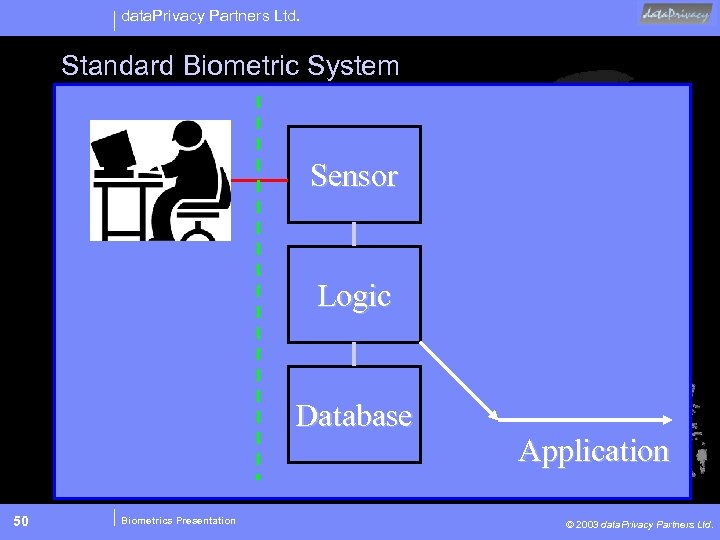 data. Privacy Partners Ltd. Standard Biometric System Sensor Logic Database 50 Biometrics Presentation Application © 2003 data. Privacy Partners Ltd.
 data. Privacy Partners Ltd. Standard Biometric System • 1: 1 and 1: N Functionality • Maximizes Control for System Owner • No Cards to lose • Back End Database Model • Potential for Surveillance • Greatest Potential for abuse 51 Biometrics Presentation © 2003 data. Privacy Partners Ltd.
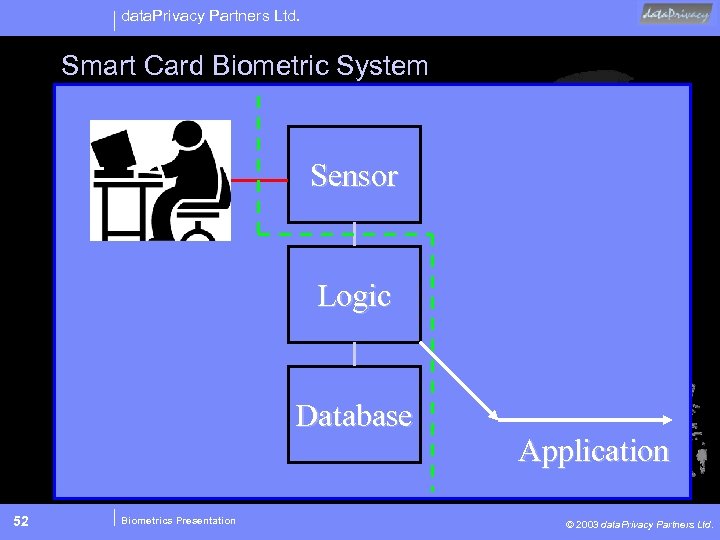 data. Privacy Partners Ltd. Smart Card Biometric System Sensor Logic Database 52 Biometrics Presentation Application © 2003 data. Privacy Partners Ltd.
 data. Privacy Partners Ltd. Smart Card Biometric System • 1: 1 Functionality • Balance of Control between System Owner and Data Subject • Lost Card Issues • Card Failure Issues • Smart Card Infrastructure has Surveillance Potential 53 Biometrics Presentation © 2003 data. Privacy Partners Ltd.
 data. Privacy Partners Ltd. Privacy Hardened Biometric System • Designed for Toronto CIBS Project - 1997 • Tamperproof tokens in scanner to prevent device substitution/direct image injection • FPGA logic to restrict use of system within preprogrammed guidelines • Must be a live finger on the authorized scanner • Discourage systematic ‘dumping’ of identity database • Keys required for identity resolution 54 Biometrics Presentation © 2003 data. Privacy Partners Ltd.
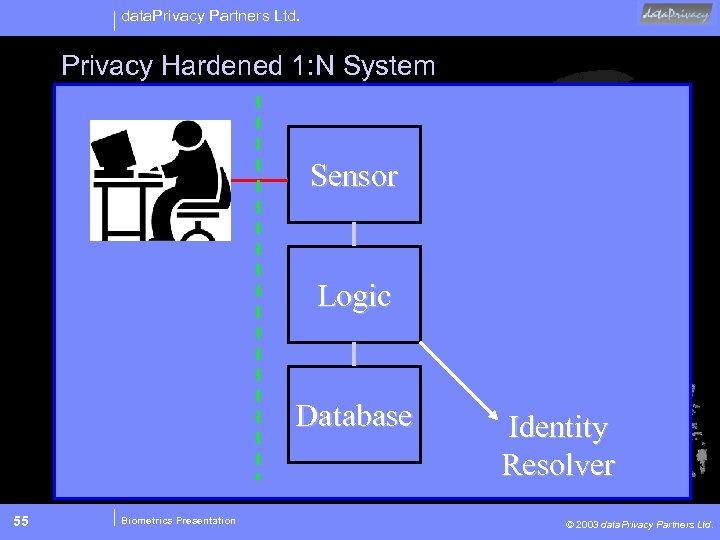 data. Privacy Partners Ltd. Privacy Hardened 1: N System Sensor Logic Database 55 Biometrics Presentation Identity Resolver © 2003 data. Privacy Partners Ltd.
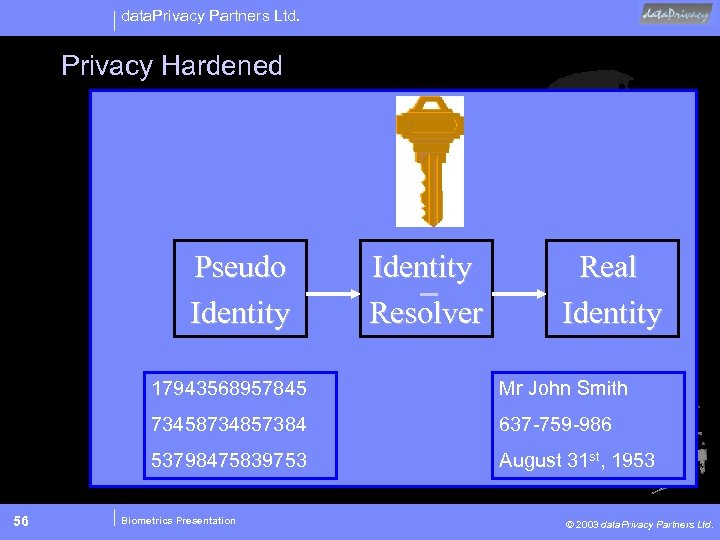 data. Privacy Partners Ltd. Privacy Hardened Pseudo Identity Resolver Real Identity 17943568957845 73458734857384 637 -759 -986 53798475839753 56 Mr John Smith August 31 st, 1953 Biometrics Presentation © 2003 data. Privacy Partners Ltd.
 data. Privacy Partners Ltd. Wildcard Option - Biometric Encryption • Biometric Encryption • Feature Extraction provides an encryption/decryption key • Promising techniques • Optical Feature Extraction • Fourier Transform of ‘visual’ plaintext using Biometric Feature data resulting in ‘visual’ ciphertext • One Installed site in Canada • Needs further research to bring to market 57 Biometrics Presentation © 2003 data. Privacy Partners Ltd.
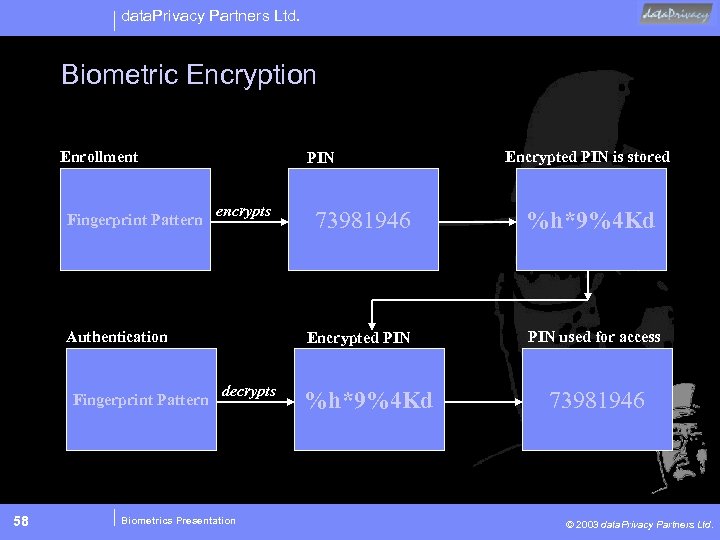 data. Privacy Partners Ltd. Biometric Encryption Enrollment Fingerprint Pattern PIN encrypts 58 decrypts Biometrics Presentation 73981946 %h*9%4 Kd Encrypted PIN Authentication Fingerprint Pattern Encrypted PIN is stored PIN used for access %h*9%4 Kd 73981946 © 2003 data. Privacy Partners Ltd.
 data. Privacy Partners Ltd. from: http: //www. darpa. mil/iao/HID. htm 59 Biometrics Presentation © 2003 data. Privacy Partners Ltd.
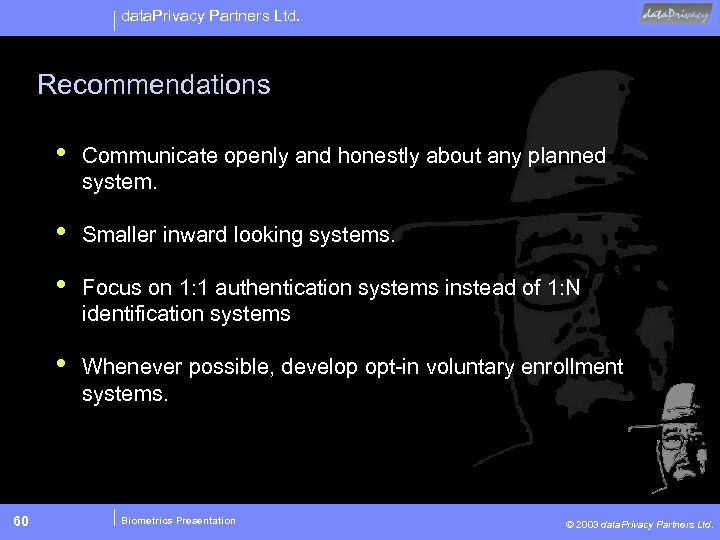 data. Privacy Partners Ltd. Recommendations • • Smaller inward looking systems. • Focus on 1: 1 authentication systems instead of 1: N identification systems • 60 Communicate openly and honestly about any planned system. Whenever possible, develop opt-in voluntary enrollment systems. Biometrics Presentation © 2003 data. Privacy Partners Ltd.
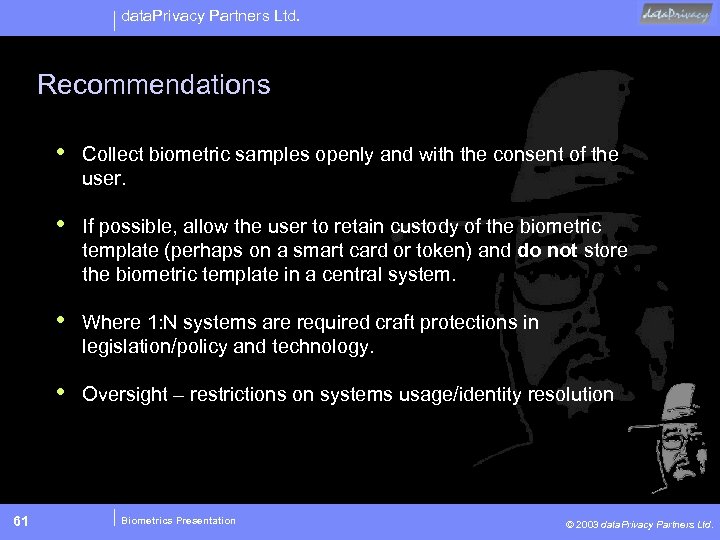 data. Privacy Partners Ltd. Recommendations • • If possible, allow the user to retain custody of the biometric template (perhaps on a smart card or token) and do not store the biometric template in a central system. • Where 1: N systems are required craft protections in legislation/policy and technology. • 61 Collect biometric samples openly and with the consent of the user. Oversight – restrictions on systems usage/identity resolution Biometrics Presentation © 2003 data. Privacy Partners Ltd.
 data. Privacy Partners Ltd. Hope for the future • • Biometric sensor on a card • Credential vs. Certificate (Brands) • 62 Biometric Encryption Trusted Extension of Self Biometrics Presentation © 2003 data. Privacy Partners Ltd.
 data. Privacy Partners Ltd. Conclusions • • Engage the issues honestly and openly. • 63 We need to incorporate statutory, policy and technological controls. Don’t use a hammer to kill a fly. Biometrics Presentation © 2003 data. Privacy Partners Ltd.
 data. Privacy Partners Ltd. Our Challenge • • 64 Open discussion The technology is not evil Develop the best Technology Develop the best Policy Develop the best Statutory Protections Raise the bar Search for improvement Biometrics Presentation © 2003 data. Privacy Partners Ltd.
 data. Privacy Partners Ltd. Epilogue • Objectivity of privacy • Question the appropriateness of ‘Public Acceptance’ as a measurement of anything. • Useful at telling us what is wrong. • Not so useful at telling us what is right. • 65 Storing Template/Minutiae/Image • Privacy Concerns are identical Biometrics Presentation © 2003 data. Privacy Partners Ltd.
 data. Privacy Partners Ltd. Resources • OECD • • • 66 • http: //www. oecd. org Information and Privacy Commission/Ontario • http: //www. ipc. on. ca data. Privacy Partners Ltd. • http: //www. dataprivacy. com Roger Clarke • http: //www. anu. edu. au/people/Roger. Clarke/ Biometric Consortium - US • http: //www. biometrics. org CATA Biometrics Group - Canada • http: //www. cata. ca/biometrics/ Biometrics Presentation © 2003 data. Privacy Partners Ltd.
 data. Privacy Partners Ltd. Contact Information Peter Hope-Tindall data. Privacy Partners Ltd. 5744 Prairie Circle. Mississauga, ON L 5 N 6 B 5 +1 (416) 410 -0240 pht@dataprivacy. com 67 Biometrics Presentation © 2003 data. Privacy Partners Ltd.
 data. Privacy Partners Ltd. pht@dataprivacy. com http: //www. dataprivacy. com 68 Biometrics Presentation © 2003 data. Privacy Partners Ltd.