


 Скачать презентацию Data Mining IS 698 Min Song 1
8a5317885165dae025958554cf17449b.ppt
- Количество слайдов: 45
 Data Mining IS 698 Min Song 1
 Introduction o Motivation: Why data mining? o What is data mining? o Data Mining: On what kind of data? o Data mining functionality o Are all the patterns interesting? o Classification of data mining systems o Data Mining Task Primitives o Integration of data mining system with a DB and DW System o Major issues in data mining 2
 Why Data Mining? o The Explosive Growth of Data o Data collection and data availability o Automated data collection tools, database systems, Web, computerized society n Major sources of abundant data o Business: Web, e-commerce, transactions, stocks, … o Science: Remote sensing, bioinformatics, scientific simulation, … o Society and everyone: news, digital cameras, o We are drowning in data, but starving for knowledge! o “Necessity is the mother of invention”—Data mining—Automated analysis of massive data sets 3
 Evolution of Database Technology o 1960 s: n o 1970 s: n o Data collection, database creation, IMS and network DBMS Relational data model, relational DBMS implementation 1980 s: n n o RDBMS, advanced data models (extended-relational, OO, deductive, etc. ) Application-oriented DBMS (spatial, scientific, engineering, etc. ) 1990 s: n o Data mining, data warehousing, multimedia databases, and Web databases 2000 s n Stream data management and mining n Data mining and its applications n Web technology (XML, data integration) and global information systems 4
 What Is Data Mining? o Data mining (knowledge discovery from data) n n o Extraction of interesting (non-trivial, implicit, previously unknown and potentially useful) patterns or knowledge from huge amount of data Data mining: a misnomer? Alternative names n o Knowledge discovery (mining) in databases (KDD), knowledge extraction, data/pattern analysis, data archeology, data dredging, information harvesting, business intelligence, etc. Watch out: Is everything “data mining”? n Simple search and query processing n (Deductive) expert systems 5
 Why Data Mining? —Potential Applications o Data analysis and decision support n Market analysis and management o Target marketing, customer relationship management (CRM), market basket analysis, cross selling, market segmentation n Risk analysis and management o Forecasting, customer retention, improved underwriting, quality control, competitive analysis n o Fraud detection and detection of unusual patterns (outliers) Other Applications n Text mining (news group, email, documents) and Web mining n Stream data mining n Bioinformatics and bio-data analysis 6
 Ex. 1: Market Analysis and Management o Where does the data come from? —Credit card transactions, loyalty cards, discount coupons, customer complaint calls, plus (public) lifestyle studies o Target marketing n Find clusters of “model” customers who share the same characteristics: interest, income level, spending habits, etc. , n Determine customer purchasing patterns over time o Cross-market analysis—Find associations/co-relations between product sales, & predict based on such association o Customer profiling—What types of customers buy what products (clustering or classification) o Customer requirement analysis n n o Identify the best products for different customers Predict what factors will attract new customers Provision of summary information n Multidimensional summary reports n Statistical summary information (data central tendency and variation) 7
 Ex. 2: Corporate Analysis & Risk Management o Finance planning and asset evaluation n cash flow analysis and prediction n contingent claim analysis to evaluate assets n cross-sectional and time series analysis (financial-ratio, trend analysis, etc. ) o Resource planning n o summarize and compare the resources and spending Competition n monitor competitors and market directions n group customers into classes and a class-based pricing procedure n set pricing strategy in a highly competitive market 8
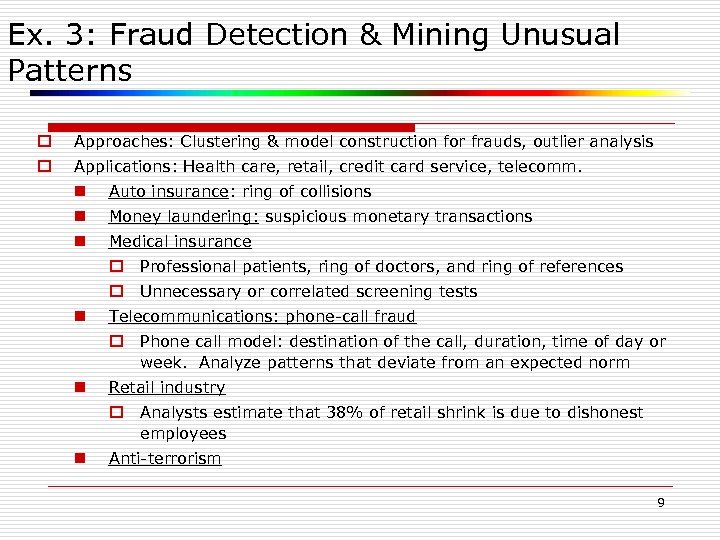 Ex. 3: Fraud Detection & Mining Unusual Patterns o Approaches: Clustering & model construction for frauds, outlier analysis o Applications: Health care, retail, credit card service, telecomm. n Auto insurance: ring of collisions n Money laundering: suspicious monetary transactions n Medical insurance o Professional patients, ring of doctors, and ring of references o Unnecessary or correlated screening tests n Telecommunications: phone-call fraud o Phone call model: destination of the call, duration, time of day or week. Analyze patterns that deviate from an expected norm n Retail industry o Analysts estimate that 38% of retail shrink is due to dishonest employees n Anti-terrorism 9
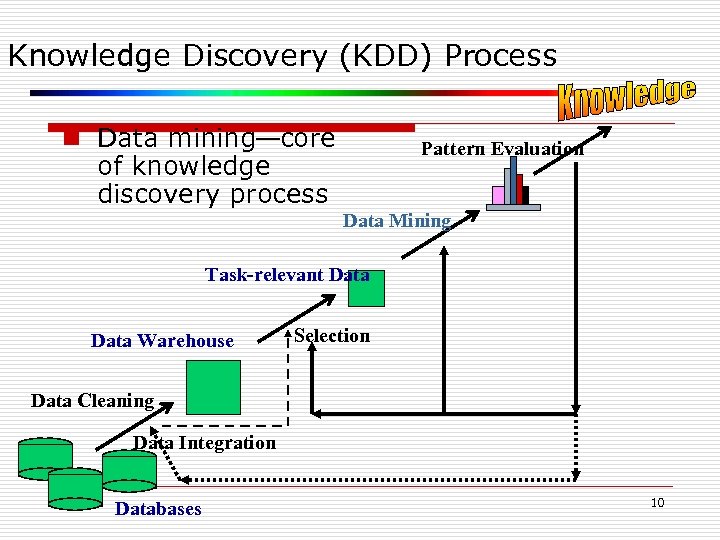 Knowledge Discovery (KDD) Process n Data mining—core of knowledge discovery process Pattern Evaluation Data Mining Task-relevant Data Warehouse Selection Data Cleaning Data Integration Databases 10
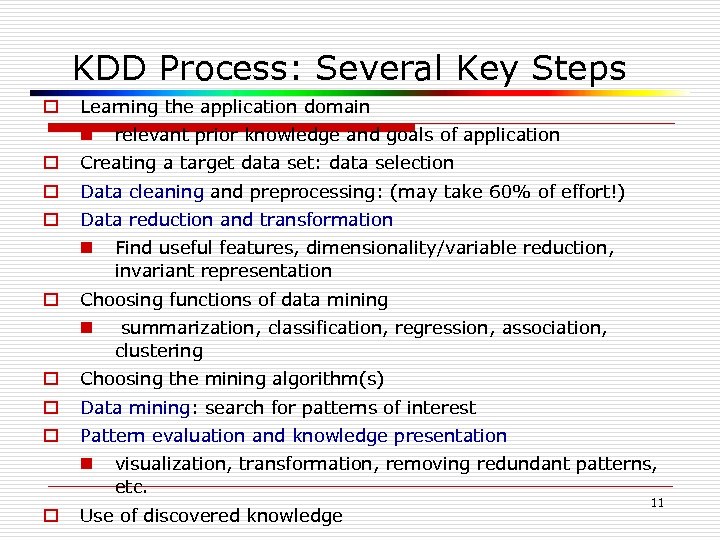 KDD Process: Several Key Steps o Learning the application domain n relevant prior knowledge and goals of application o Creating a target data set: data selection o Data cleaning and preprocessing: (may take 60% of effort!) o Data reduction and transformation n o Find useful features, dimensionality/variable reduction, invariant representation Choosing functions of data mining n summarization, classification, regression, association, clustering o Choosing the mining algorithm(s) o Data mining: search for patterns of interest o Pattern evaluation and knowledge presentation n o visualization, transformation, removing redundant patterns, etc. Use of discovered knowledge 11
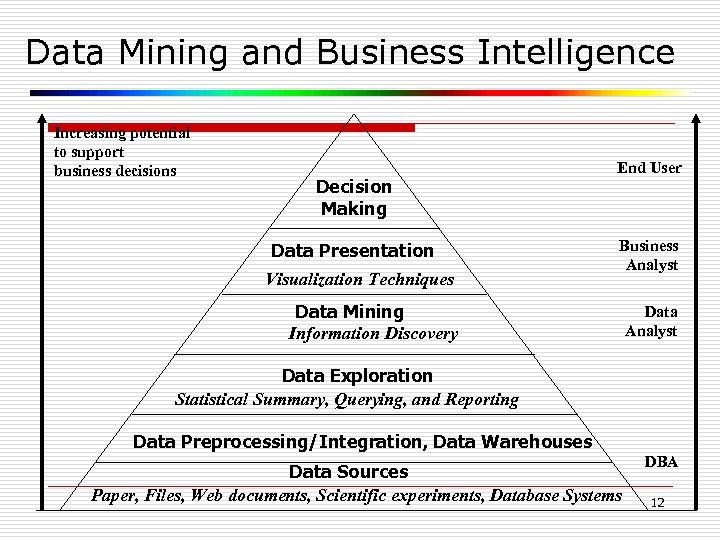 Data Mining and Business Intelligence Increasing potential to support business decisions Decision Making Data Presentation Visualization Techniques End User Business Analyst Data Mining Information Discovery Data Analyst Data Exploration Statistical Summary, Querying, and Reporting Data Preprocessing/Integration, Data Warehouses Data Sources Paper, Files, Web documents, Scientific experiments, Database Systems DBA 12
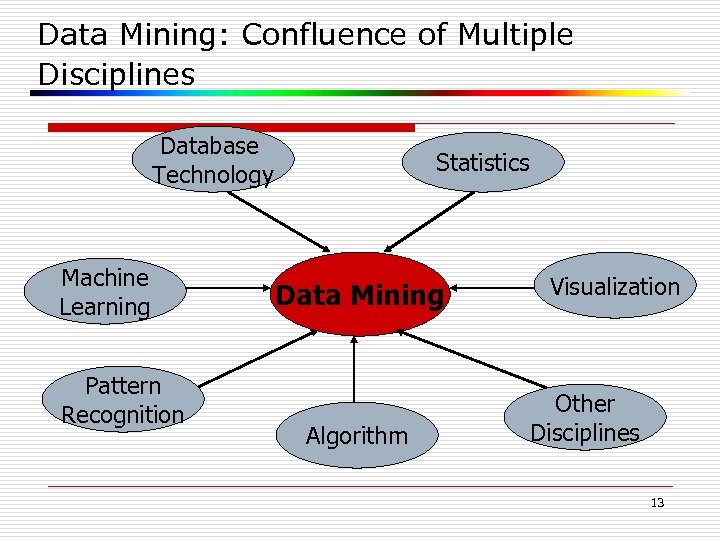 Data Mining: Confluence of Multiple Disciplines Database Technology Machine Learning Pattern Recognition Statistics Data Mining Algorithm Visualization Other Disciplines 13
 Why Not Traditional Data Analysis? o Tremendous amount of data n o High-dimensionality of data n o Algorithms must be highly scalable to handle such as tera-bytes of data Micro-array may have tens of thousands of dimensions High complexity of data n n Time-series data, temporal data, sequence data n Structure data, graphs, social networks and multi-linked data n Heterogeneous databases and legacy databases n Spatial, spatiotemporal, multimedia, text and Web data n o Data streams and sensor data Software programs, scientific simulations New and sophisticated applications 14
 Multi-Dimensional View of Data Mining o Data to be mined n o Relational, data warehouse, transactional, stream, objectoriented/relational, active, spatial, time-series, text, multi-media, heterogeneous, legacy, WWW Knowledge to be mined n n o Characterization, discrimination, association, classification, clustering, trend/deviation, outlier analysis, etc. Multiple/integrated functions and mining at multiple levels Techniques utilized n o Database-oriented, data warehouse (OLAP), machine learning, statistics, visualization, etc. Applications adapted n Retail, telecommunication, banking, fraud analysis, bio-data mining, stock market analysis, text mining, Web mining, etc. 15
 Data Mining: Classification Schemes o General functionality n Descriptive data mining n Predictive data mining o Different views lead to different classifications n Data view: Kinds of data to be mined n Knowledge view: Kinds of knowledge to be discovered n Method view: Kinds of techniques utilized n Application view: Kinds of applications adapted 16
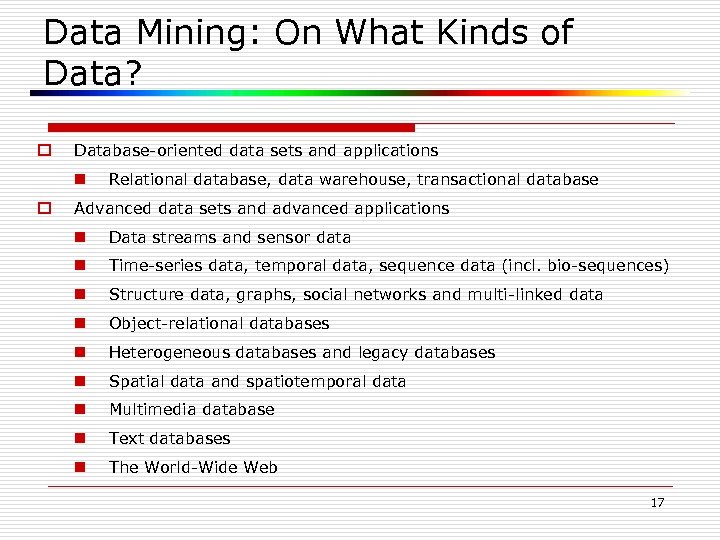 Data Mining: On What Kinds of Data? o Database-oriented data sets and applications n o Relational database, data warehouse, transactional database Advanced data sets and advanced applications n Data streams and sensor data n Time-series data, temporal data, sequence data (incl. bio-sequences) n Structure data, graphs, social networks and multi-linked data n Object-relational databases n Heterogeneous databases and legacy databases n Spatial data and spatiotemporal data n Multimedia database n Text databases n The World-Wide Web 17
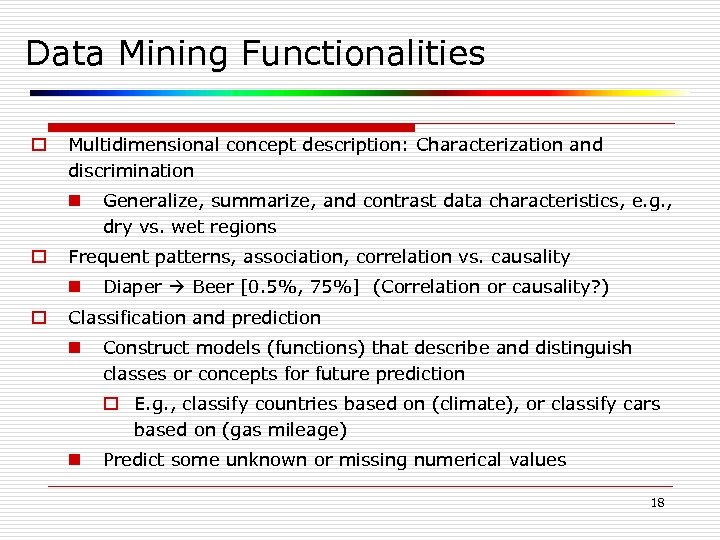 Data Mining Functionalities o Multidimensional concept description: Characterization and discrimination n o Frequent patterns, association, correlation vs. causality n o Generalize, summarize, and contrast data characteristics, e. g. , dry vs. wet regions Diaper Beer [0. 5%, 75%] (Correlation or causality? ) Classification and prediction n Construct models (functions) that describe and distinguish classes or concepts for future prediction o E. g. , classify countries based on (climate), or classify cars based on (gas mileage) n Predict some unknown or missing numerical values 18
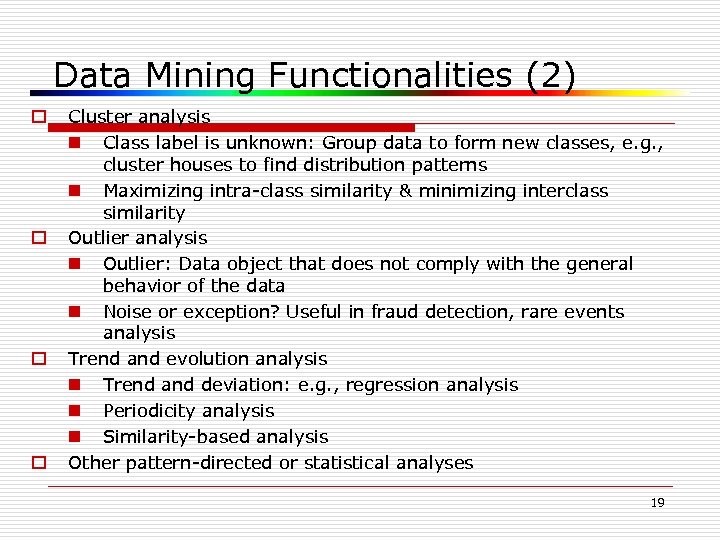 Data Mining Functionalities (2) o o Cluster analysis n Class label is unknown: Group data to form new classes, e. g. , cluster houses to find distribution patterns n Maximizing intra-class similarity & minimizing interclass similarity Outlier analysis n Outlier: Data object that does not comply with the general behavior of the data n Noise or exception? Useful in fraud detection, rare events analysis Trend and evolution analysis n Trend and deviation: e. g. , regression analysis n Periodicity analysis n Similarity-based analysis Other pattern-directed or statistical analyses 19
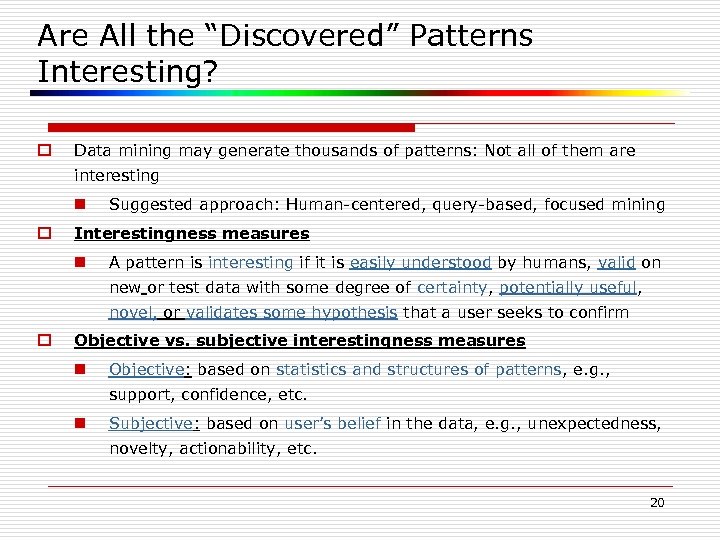 Are All the “Discovered” Patterns Interesting? o Data mining may generate thousands of patterns: Not all of them are interesting n o Suggested approach: Human-centered, query-based, focused mining Interestingness measures n A pattern is interesting if it is easily understood by humans, valid on new or test data with some degree of certainty, potentially useful, novel, or validates some hypothesis that a user seeks to confirm o Objective vs. subjective interestingness measures n Objective: based on statistics and structures of patterns, e. g. , support, confidence, etc. n Subjective: based on user’s belief in the data, e. g. , unexpectedness, novelty, actionability, etc. 20
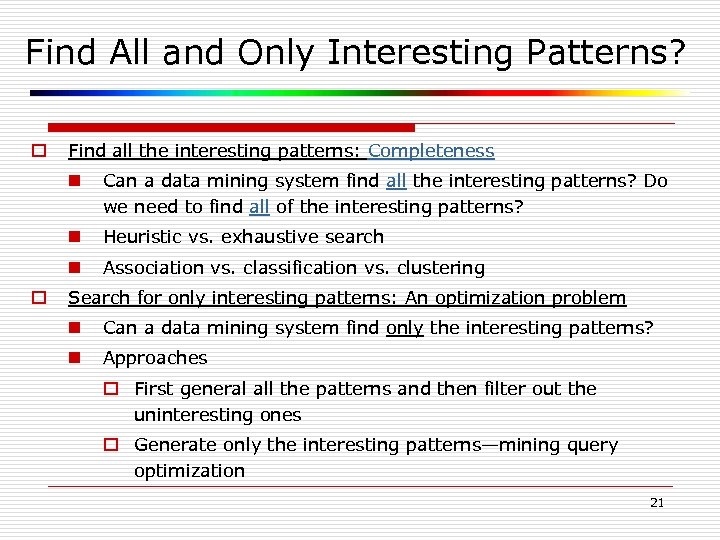 Find All and Only Interesting Patterns? o Find all the interesting patterns: Completeness n n Heuristic vs. exhaustive search n o Can a data mining system find all the interesting patterns? Do we need to find all of the interesting patterns? Association vs. classification vs. clustering Search for only interesting patterns: An optimization problem n Can a data mining system find only the interesting patterns? n Approaches o First general all the patterns and then filter out the uninteresting ones o Generate only the interesting patterns—mining query optimization 21
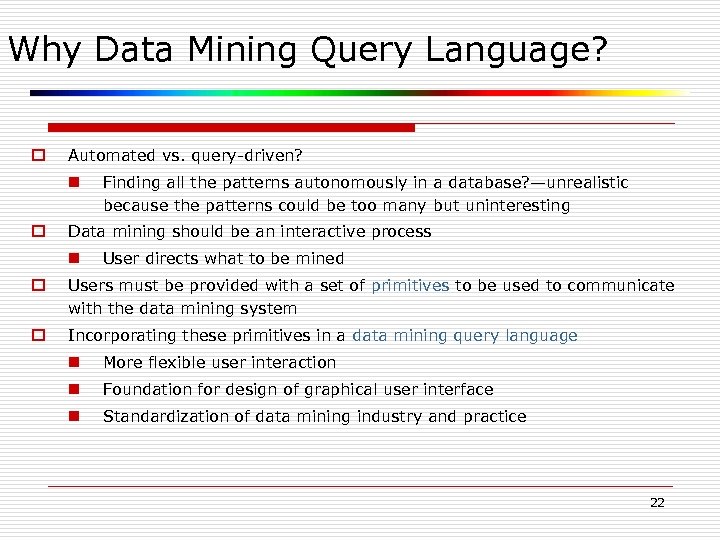 Why Data Mining Query Language? o Automated vs. query-driven? n o Finding all the patterns autonomously in a database? —unrealistic because the patterns could be too many but uninteresting Data mining should be an interactive process n User directs what to be mined o Users must be provided with a set of primitives to be used to communicate with the data mining system o Incorporating these primitives in a data mining query language n More flexible user interaction n Foundation for design of graphical user interface n Standardization of data mining industry and practice 22
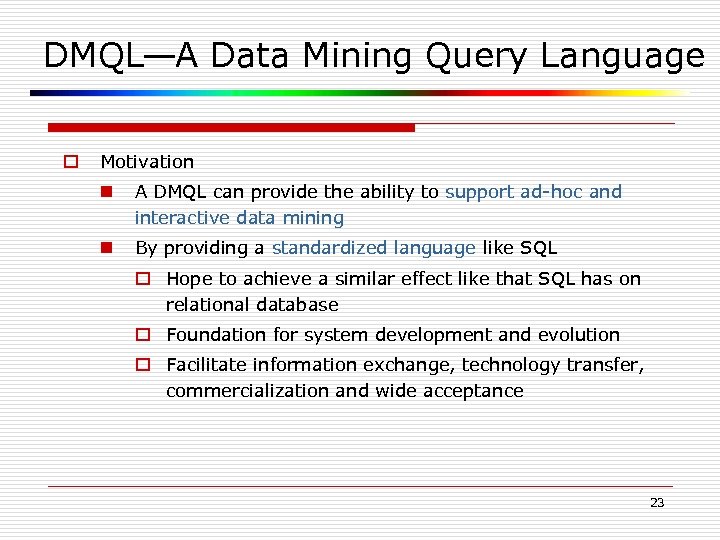 DMQL—A Data Mining Query Language o Motivation n A DMQL can provide the ability to support ad-hoc and interactive data mining n By providing a standardized language like SQL o Hope to achieve a similar effect like that SQL has on relational database o Foundation for system development and evolution o Facilitate information exchange, technology transfer, commercialization and wide acceptance 23
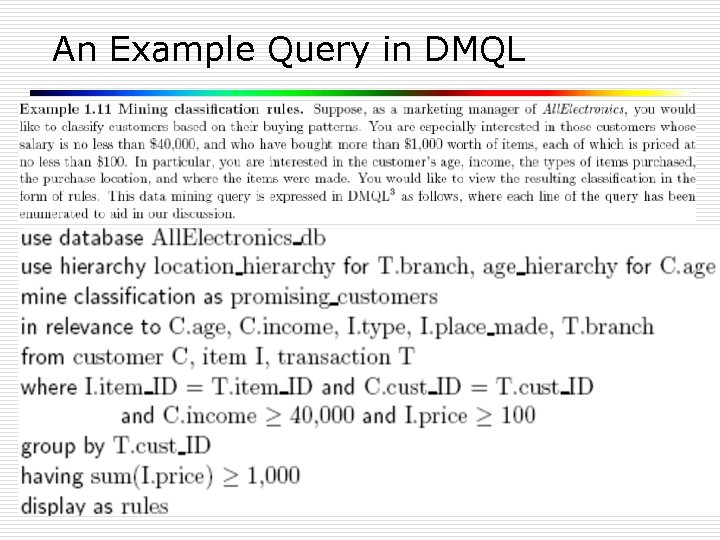 An Example Query in DMQL 24
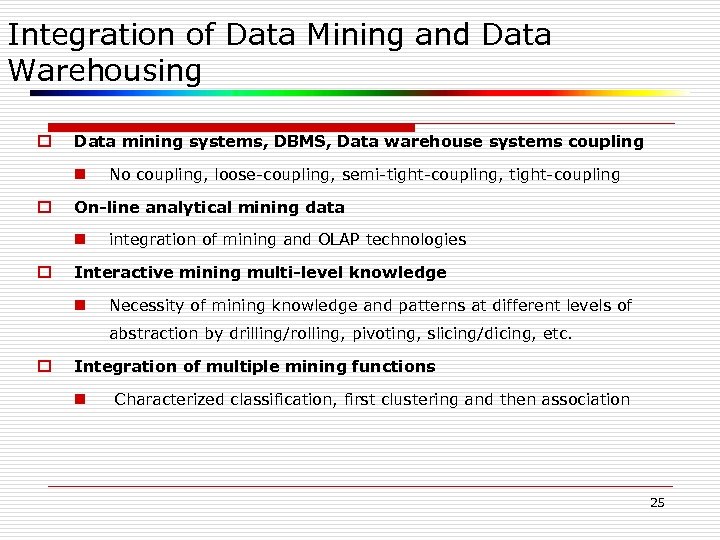 Integration of Data Mining and Data Warehousing o Data mining systems, DBMS, Data warehouse systems coupling n o On-line analytical mining data n o No coupling, loose-coupling, semi-tight-coupling, tight-coupling integration of mining and OLAP technologies Interactive mining multi-level knowledge n Necessity of mining knowledge and patterns at different levels of abstraction by drilling/rolling, pivoting, slicing/dicing, etc. o Integration of multiple mining functions n Characterized classification, first clustering and then association 25
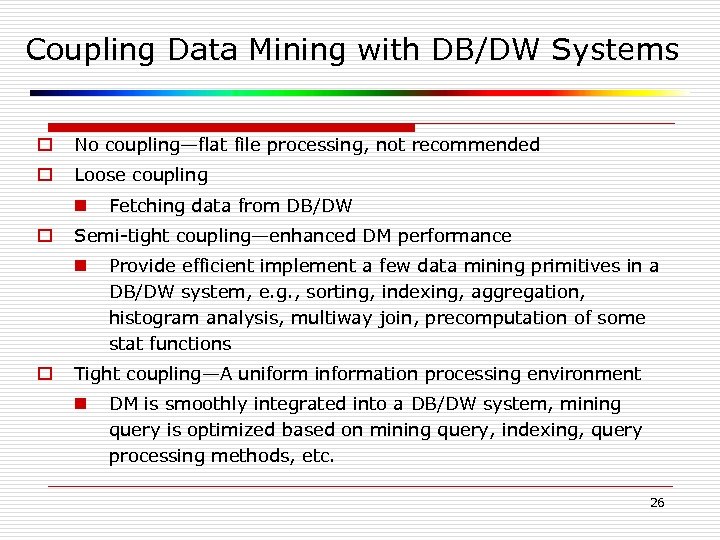 Coupling Data Mining with DB/DW Systems o No coupling—flat file processing, not recommended o Loose coupling n o Semi-tight coupling—enhanced DM performance n o Fetching data from DB/DW Provide efficient implement a few data mining primitives in a DB/DW system, e. g. , sorting, indexing, aggregation, histogram analysis, multiway join, precomputation of some stat functions Tight coupling—A uniform information processing environment n DM is smoothly integrated into a DB/DW system, mining query is optimized based on mining query, indexing, query processing methods, etc. 26
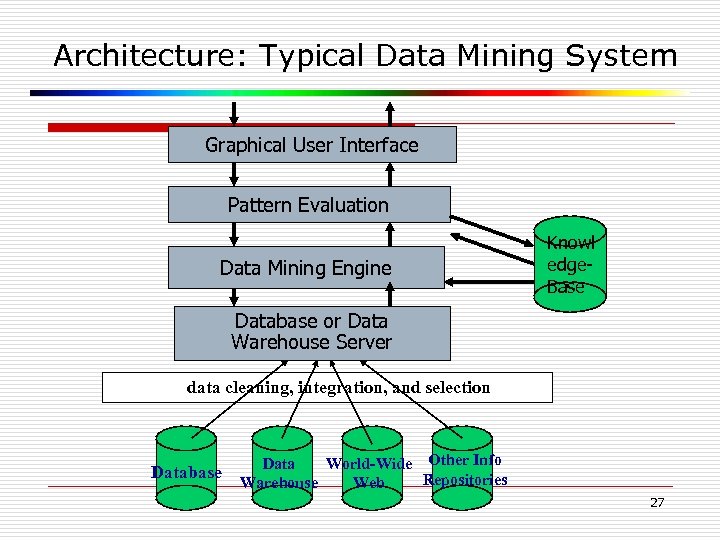 Architecture: Typical Data Mining System Graphical User Interface Pattern Evaluation Data Mining Engine Knowl edge. Base Database or Data Warehouse Server data cleaning, integration, and selection Database Data World-Wide Other Info Repositories Warehouse Web 27
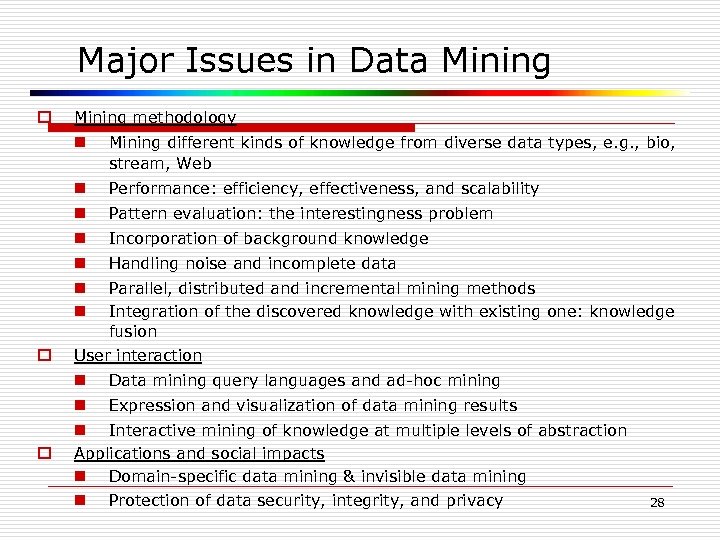 Major Issues in Data Mining o Mining methodology n n Performance: efficiency, effectiveness, and scalability n Pattern evaluation: the interestingness problem n Incorporation of background knowledge n Handling noise and incomplete data n n o Mining different kinds of knowledge from diverse data types, e. g. , bio, stream, Web Parallel, distributed and incremental mining methods Integration of the discovered knowledge with existing one: knowledge fusion User interaction n n o Data mining query languages and ad-hoc mining Expression and visualization of data mining results n Interactive mining of knowledge at multiple levels of abstraction Applications and social impacts n Domain-specific data mining & invisible data mining n Protection of data security, integrity, and privacy 28
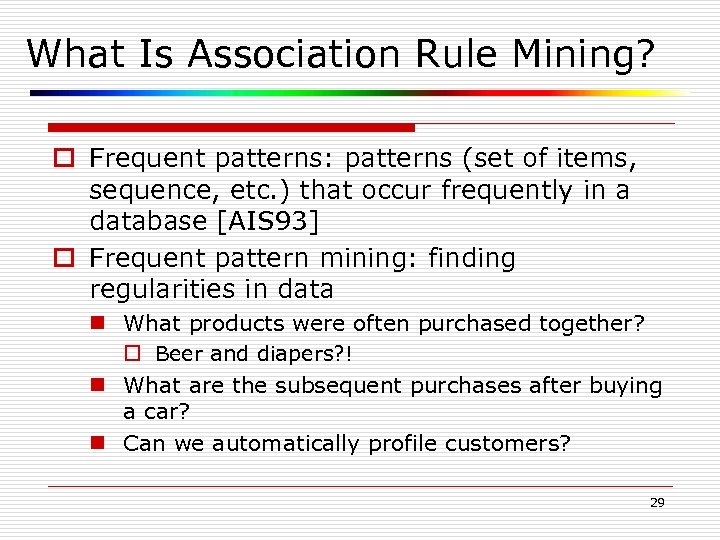 What Is Association Rule Mining? o Frequent patterns: patterns (set of items, sequence, etc. ) that occur frequently in a database [AIS 93] o Frequent pattern mining: finding regularities in data n What products were often purchased together? o Beer and diapers? ! n What are the subsequent purchases after buying a car? n Can we automatically profile customers? 29
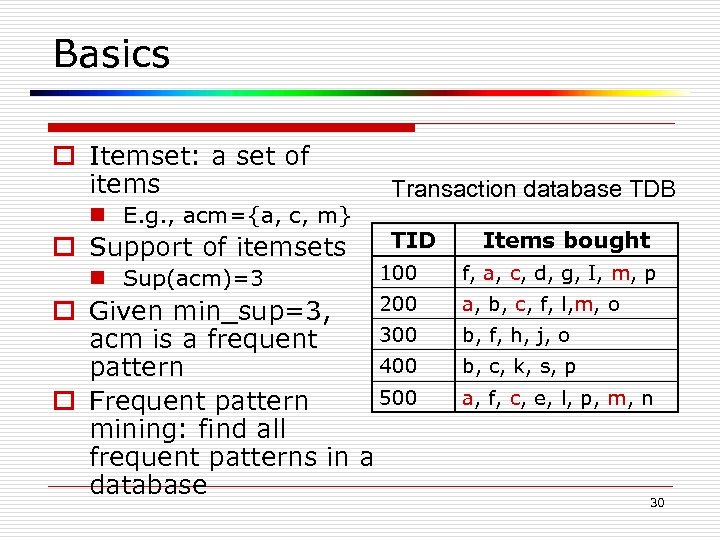 Basics o Itemset: a set of items n E. g. , acm={a, c, m} o Support of itemsets n Sup(acm)=3 Transaction database TDB TID 100 200 o Given min_sup=3, 300 acm is a frequent 400 pattern 500 o Frequent pattern mining: find all frequent patterns in a database Items bought f, a, c, d, g, I, m, p a, b, c, f, l, m, o b, f, h, j, o b, c, k, s, p a, f, c, e, l, p, m, n 30
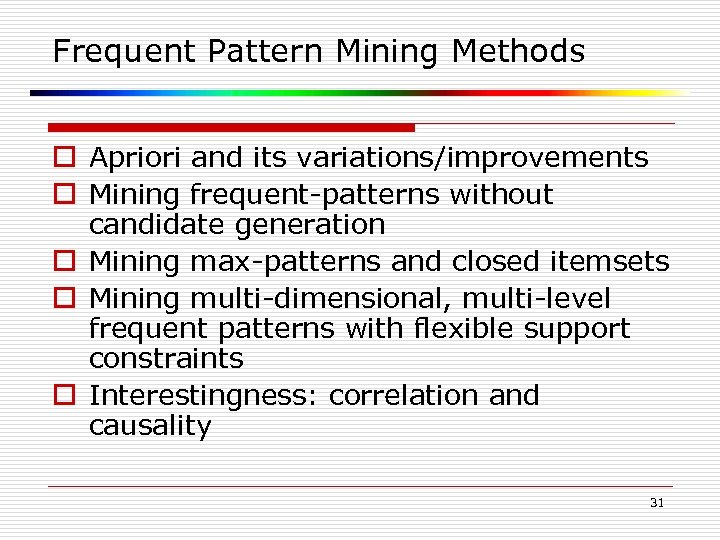 Frequent Pattern Mining Methods o Apriori and its variations/improvements o Mining frequent-patterns without candidate generation o Mining max-patterns and closed itemsets o Mining multi-dimensional, multi-level frequent patterns with flexible support constraints o Interestingness: correlation and causality 31
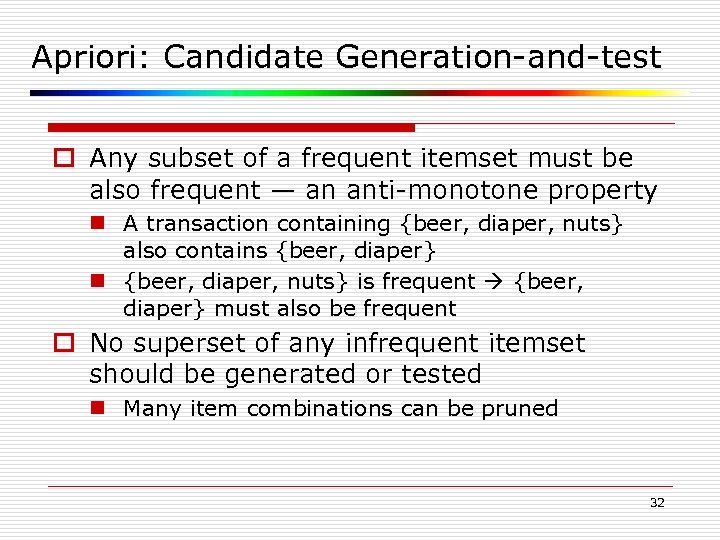 Apriori: Candidate Generation-and-test o Any subset of a frequent itemset must be also frequent — an anti-monotone property n A transaction containing {beer, diaper, nuts} also contains {beer, diaper} n {beer, diaper, nuts} is frequent {beer, diaper} must also be frequent o No superset of any infrequent itemset should be generated or tested n Many item combinations can be pruned 32
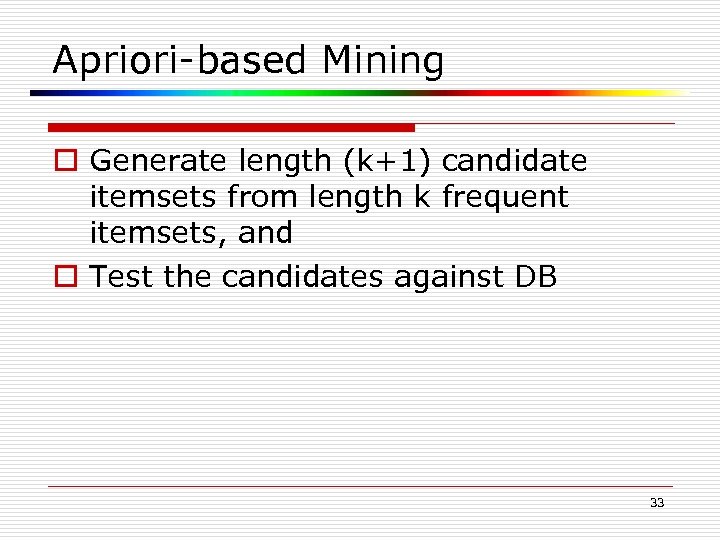 Apriori-based Mining o Generate length (k+1) candidate itemsets from length k frequent itemsets, and o Test the candidates against DB 33
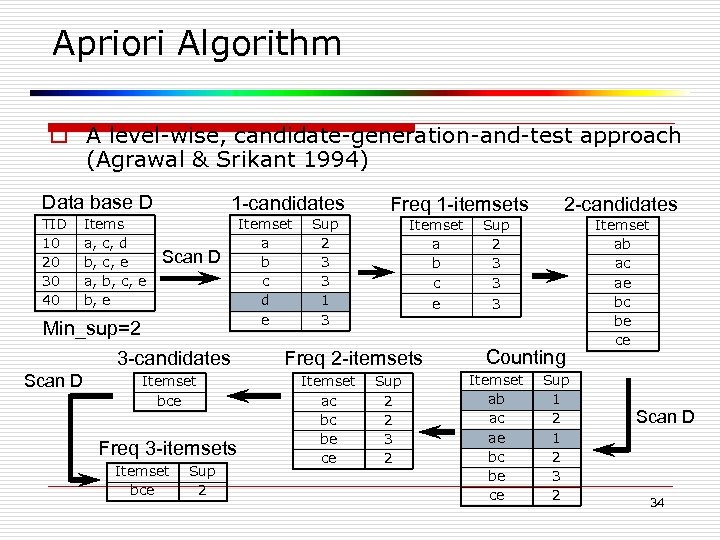 Apriori Algorithm o A level-wise, candidate-generation-and-test approach (Agrawal & Srikant 1994) Data base D TID 10 20 30 40 Items a, c, d b, c, e a, b, c, e b, e 1 -candidates Scan D Min_sup=2 3 -candidates Scan D Itemset bce Freq 3 -itemsets Itemset bce Sup 2 Itemset a b c d e Sup 2 3 3 1 3 Freq 1 -itemsets Itemset a b c Sup 2 3 3 e 3 Freq 2 -itemsets Itemset ac bc be ce Sup 2 2 3 2 2 -candidates Counting Itemset ab ac ae bc be ce Sup 1 2 3 2 Itemset ab ac ae bc be ce Scan D 34
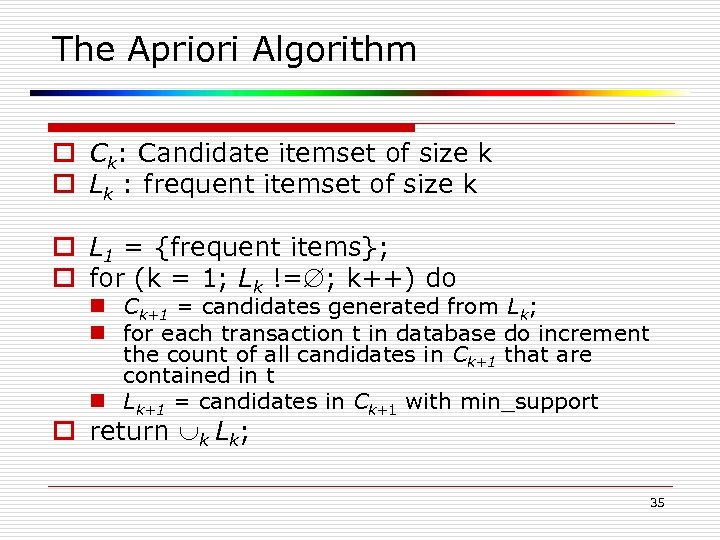 The Apriori Algorithm o Ck: Candidate itemset of size k o Lk : frequent itemset of size k o L 1 = {frequent items}; o for (k = 1; Lk != ; k++) do n Ck+1 = candidates generated from Lk; n for each transaction t in database do increment the count of all candidates in Ck+1 that are contained in t n Lk+1 = candidates in Ck+1 with min_support o return k Lk; 35
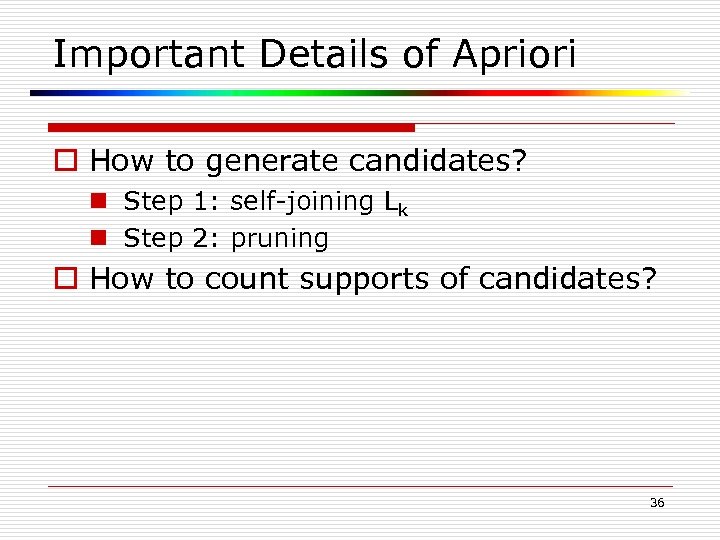 Important Details of Apriori o How to generate candidates? n Step 1: self-joining Lk n Step 2: pruning o How to count supports of candidates? 36
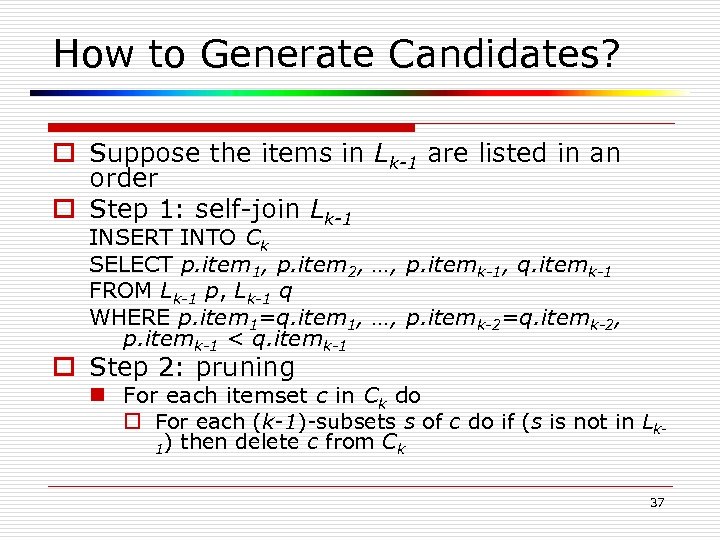 How to Generate Candidates? o Suppose the items in Lk-1 are listed in an order o Step 1: self-join Lk-1 INSERT INTO Ck SELECT p. item 1, p. item 2, …, p. itemk-1, q. itemk-1 FROM Lk-1 p, Lk-1 q WHERE p. item 1=q. item 1, …, p. itemk-2=q. itemk-2, p. itemk-1 < q. itemk-1 o Step 2: pruning n For each itemset c in Ck do o For each (k-1)-subsets s of c do if (s is not in Lk 1) then delete c from Ck 37
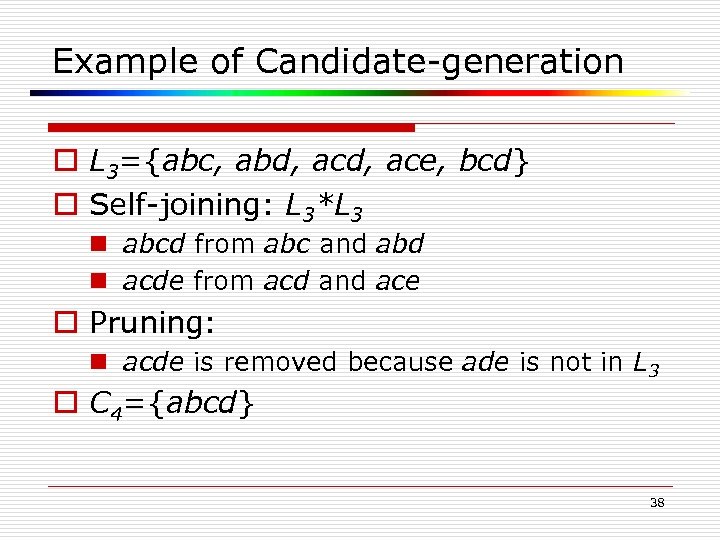 Example of Candidate-generation o L 3={abc, abd, ace, bcd} o Self-joining: L 3*L 3 n abcd from abc and abd n acde from acd and ace o Pruning: n acde is removed because ade is not in L 3 o C 4={abcd} 38
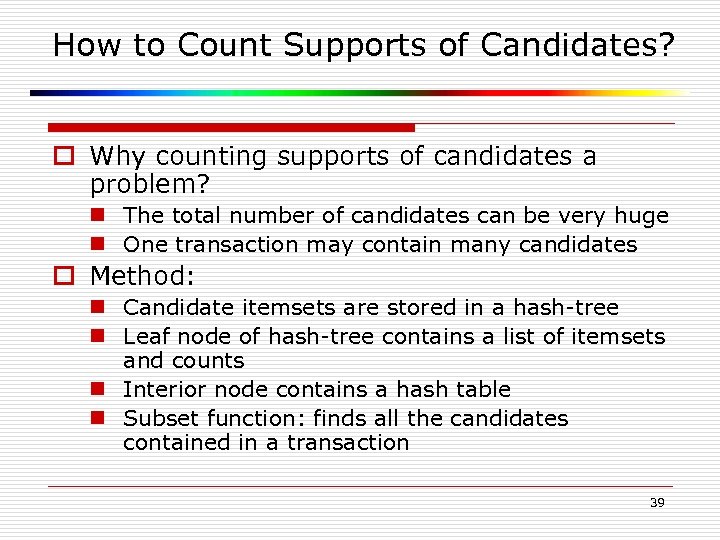 How to Count Supports of Candidates? o Why counting supports of candidates a problem? n The total number of candidates can be very huge n One transaction may contain many candidates o Method: n Candidate itemsets are stored in a hash-tree n Leaf node of hash-tree contains a list of itemsets and counts n Interior node contains a hash table n Subset function: finds all the candidates contained in a transaction 39
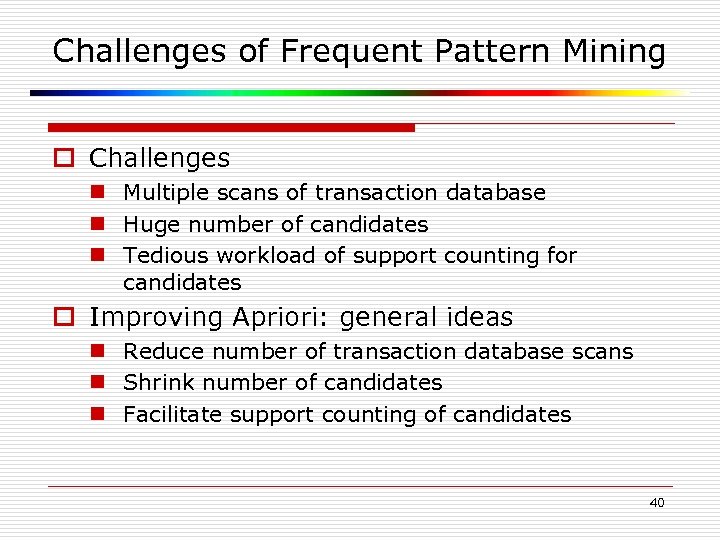 Challenges of Frequent Pattern Mining o Challenges n Multiple scans of transaction database n Huge number of candidates n Tedious workload of support counting for candidates o Improving Apriori: general ideas n Reduce number of transaction database scans n Shrink number of candidates n Facilitate support counting of candidates 40
 Summary o Data mining: Discovering interesting patterns from large amounts of data o A natural evolution of database technology, in great demand, with wide applications o A KDD process includes data cleaning, data integration, data selection, transformation, data mining, pattern evaluation, and knowledge presentation o Mining can be performed in a variety of information repositories o Data mining functionalities: characterization, discrimination, association, classification, clustering, outlier and trend analysis, etc. o Data mining systems and architectures o Major issues in data mining 41
 A Brief History of Data Mining Society o 1989 IJCAI Workshop on Knowledge Discovery in Databases n o 1991 -1994 Workshops on Knowledge Discovery in Databases n o Knowledge Discovery in Databases (G. Piatetsky-Shapiro and W. Frawley, 1991) Advances in Knowledge Discovery and Data Mining (U. Fayyad, G. Piatetsky-Shapiro, P. Smyth, and R. Uthurusamy, 1996) 1995 -1998 International Conferences on Knowledge Discovery in Databases and Data Mining (KDD’ 95 -98) n Journal of Data Mining and Knowledge Discovery (1997) o ACM SIGKDD conferences since 1998 and SIGKDD Explorations o More conferences on data mining n o PAKDD (1997), PKDD (1997), SIAM-Data Mining (2001), (IEEE) ICDM (2001), etc. ACM Transactions on KDD starting in 2007 42
 Conferences and Journals on Data Mining o o KDD Conferences n ACM SIGKDD Int. Conf. on Knowledge Discovery in Databases and Data Mining (KDD) n SIAM Data Mining Conf. (SDM) n (IEEE) Int. Conf. on Data Mining o (ICDM) n Conf. on Principles and practices of Knowledge Discovery and Data Mining (PKDD) n Pacific-Asia Conf. on Knowledge Discovery and Data Mining (PAKDD) Other related conferences n ACM SIGMOD n VLDB n (IEEE) ICDE n WWW, SIGIR n ICML, CVPR, NIPS Journals n Data Mining and Knowledge Discovery (DAMI or DMKD) n IEEE Trans. On Knowledge and Data Eng. (TKDE) n KDD Explorations n ACM Trans. on KDD 43
 Where to Find References? DBLP, Cite. Seer, Google o o o Data mining and KDD (SIGKDD: CDROM) n Conferences: ACM-SIGKDD, IEEE-ICDM, SIAM-DM, PKDD, PAKDD, etc. n Journal: Data Mining and Knowledge Discovery, KDD Explorations, ACM TKDD Database systems (SIGMOD: ACM SIGMOD Anthology—CD ROM) n Conferences: ACM-SIGMOD, ACM-PODS, VLDB, IEEE-ICDE, EDBT, ICDT, DASFAA n Journals: IEEE-TKDE, ACM-TODS/TOIS, JIIS, J. ACM, VLDB J. , Info. Sys. , etc. AI & Machine Learning n Conferences: Machine learning (ML), AAAI, IJCAI, COLT (Learning Theory), CVPR, NIPS, etc. n Journals: Machine Learning, Artificial Intelligence, Knowledge and Information Systems, IEEE-PAMI, etc. Web and IR n Conferences: SIGIR, WWW, CIKM, etc. n Journals: WWW: Internet and Web Information Systems, Statistics n Conferences: Joint Stat. Meeting, etc. n Journals: Annals of statistics, etc. Visualization n Conference proceedings: CHI, ACM-SIGGraph, etc. n Journals: IEEE Trans. visualization and computer graphics, etc. 44
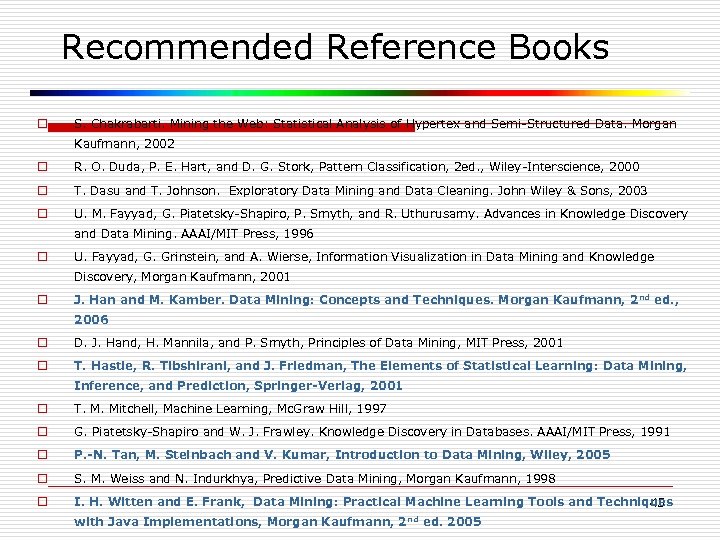 Recommended Reference Books o S. Chakrabarti. Mining the Web: Statistical Analysis of Hypertex and Semi-Structured Data. Morgan Kaufmann, 2002 o R. O. Duda, P. E. Hart, and D. G. Stork, Pattern Classification, 2 ed. , Wiley-Interscience, 2000 o T. Dasu and T. Johnson. Exploratory Data Mining and Data Cleaning. John Wiley & Sons, 2003 o U. M. Fayyad, G. Piatetsky-Shapiro, P. Smyth, and R. Uthurusamy. Advances in Knowledge Discovery and Data Mining. AAAI/MIT Press, 1996 o U. Fayyad, G. Grinstein, and A. Wierse, Information Visualization in Data Mining and Knowledge Discovery, Morgan Kaufmann, 2001 o J. Han and M. Kamber. Data Mining: Concepts and Techniques. Morgan Kaufmann, 2 nd ed. , 2006 o D. J. Hand, H. Mannila, and P. Smyth, Principles of Data Mining, MIT Press, 2001 o T. Hastie, R. Tibshirani, and J. Friedman, The Elements of Statistical Learning: Data Mining, Inference, and Prediction, Springer-Verlag, 2001 o T. M. Mitchell, Machine Learning, Mc. Graw Hill, 1997 o G. Piatetsky-Shapiro and W. J. Frawley. Knowledge Discovery in Databases. AAAI/MIT Press, 1991 o P. -N. Tan, M. Steinbach and V. Kumar, Introduction to Data Mining, Wiley, 2005 o S. M. Weiss and N. Indurkhya, Predictive Data Mining, Morgan Kaufmann, 1998 o I. H. Witten and E. Frank, Data Mining: Practical Machine Learning Tools and Techniques 45 with Java Implementations, Morgan Kaufmann, 2 nd ed. 2005