


 Скачать презентацию Data Mining in VAERS to Enhance Vaccine Safety
ac8a9a98b304681ac8ce0e8d918db7df.ppt
- Количество слайдов: 26
 Data Mining in VAERS to Enhance Vaccine Safety Monitoring at the FDA Robert Ball, MD, MPH, Sc. M Dale Burwen MD, MPH M. Miles Braun, MD, MPH Division of Epidemiology Office of Biostatistics and Epidemiology DIMACS, October 18, 2002
 What is the Vaccine Adverse Event Reporting System (VAERS)? – National system for surveillance of adverse events after vaccination initiated by National Childhood Vaccine Injury Act 1986 and established 1990 – Jointly managed by FDA and CDC – Reports received from health professionals, vaccine manufacturers, and the public
 Post-licensure Safety Monitoring • How we do it – VAERS • Potentially rapid detection of signal of new safety concern • Rarely allows determination of causality – Enhanced surveillance • Obtain standardized information on reports – Controlled studies of hypothesized causal relationships raised in surveillance – Communicate results
 Uses of VAERS • • Detecting unrecognized adverse events Monitoring known reactions Identifying possible risk factors Vaccine lot surveillance
 Limitations of VAERS • • Reported diagnoses are not verified Lack of consistent diagnostic criteria Wide range in data quality Underreporting Inadequate denominator data No unvaccinated control group Usually not possible to assess whether a vaccine caused the reported adverse event
 Analysis of VAERS Data • Describe characteristics and look for patterns to detect “signals” of adverse events plausibly linked to a vaccine • Signals detected through analysis of VAERS data almost always require confirmation through a controlled study
 Fundamental Problem in Assessing Spontaneous Reports • VAERS ~10 -15 K reports / year • AERS ~20 K reports / year (CBER) • How can a sensitive system to detect potential product problems not be overloaded and overwhelmed by information to which we have to respond?
 “Data Mining” • Identify events reported more commonly for one product than others – Proportional Reporting Ratios (PRR) – Empirical Bayesian Geometric Mean (EBGM) – Don’t account for medical knowledge or biases in reporting • EBGM algorithm implemented by Lincoln Technologies and PPD Informatics – VAERS Data Mining Environment (VDME) • PRR algorithm implemented in standard packages (e. g. SAS, STATA) on an ad hoc basis
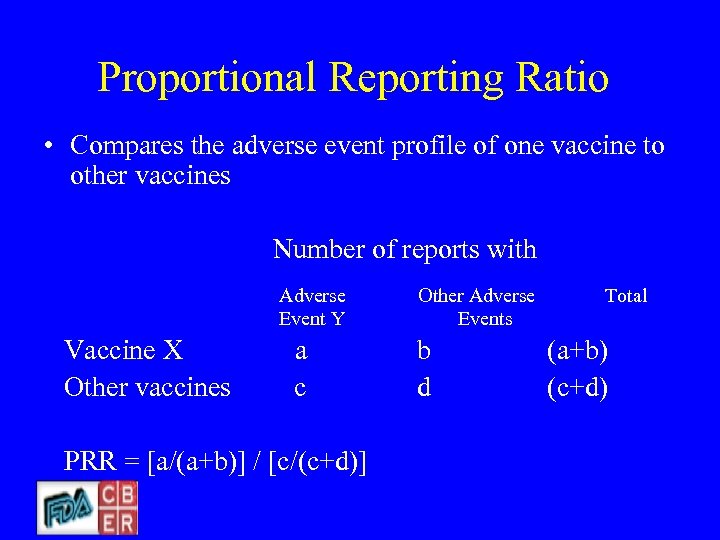 Proportional Reporting Ratio • Compares the adverse event profile of one vaccine to other vaccines Number of reports with Adverse Event Y Vaccine X Other vaccines a c PRR = [a/(a+b)] / [c/(c+d)] Other Adverse Events b d Total (a+b) (c+d)
 Proportional Reporting Ratio • Compares the adverse event profile of one vaccine to other vaccines • Evans has proposed using PRR 2, n 3, and chi square 4 as criteria for selecting pairs for further evaluation
 Background: Empirical Bayesian Data Mining • Similar to PRR in comparing one vaccine to others • Calculates observed and expected frequencies – Observed: # of reported events/vaccine – Expected: Based on overall frequency of the event for all vaccines, and the total # of reports of the vaccine of interest • Identifies cells with very small expected counts – accounts for the instability of the small number
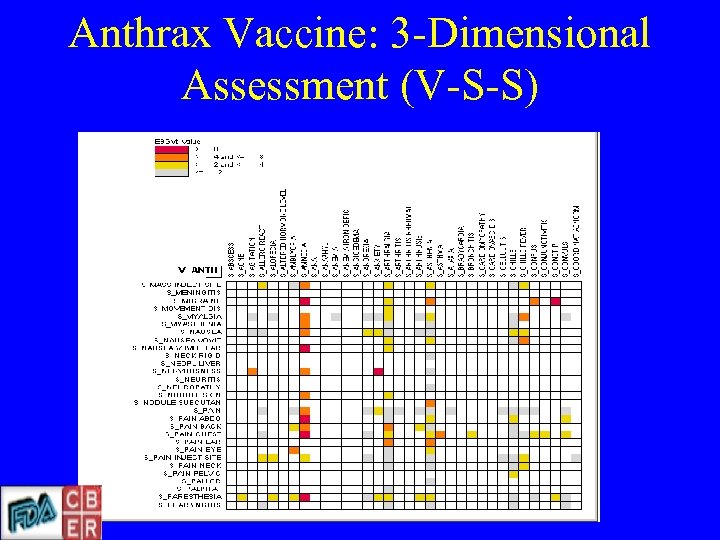
 Empirical Bayesian Data Mining • Ranks vaccine-event combinations by Empirical Bayesian Geometric Mean (EBGM) • Dumouchel has proposed EBGM 2 as criterion to select pairs for further evaluation • Multi-item Gamma Poisson Shrinkage (MGPS) algorithm detects multi-way combinations – V=vaccine; S=symptom • VSSS
 Rotavirus Vaccine. Intussusception • • Clinical Trials Signal Wild type RV & intussusception study FDA - licensure CDC - recommendations for use Post-marketing Surveillance (VAERS) Background rates Population-based incidence rates Withdrawal
 Rotavirus Vaccine and Intussusception: Signal Emergence
 Vaccine Profiles
 Anthrax Vaccine: 3 -Dimensional Assessment (V-S-S)
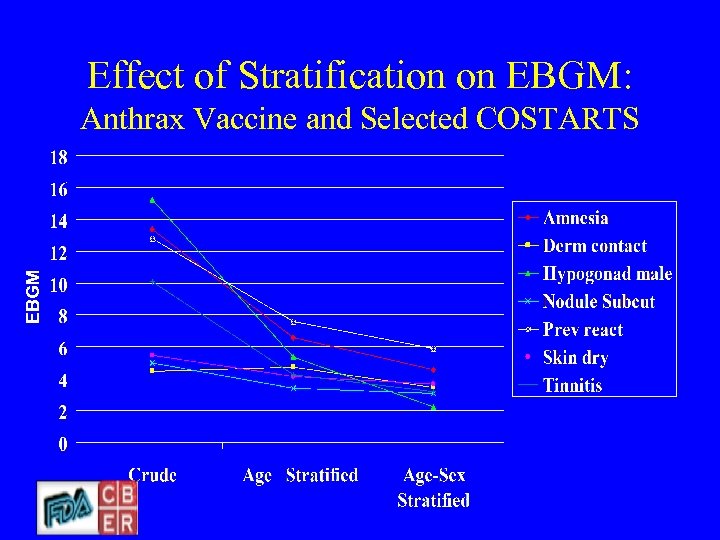 Effect of Stratification on EBGM: EBGM Anthrax Vaccine and Selected COSTARTS
 Selection of “Item Sets” for Empirical Bayesian Data Mining • The choice of “Item Sets” influences the Multi-item Gamma Poisson Shrinkage (MGPS) algorithm • Currently all combinations (e. g. 2 D v-v, s-s, v-s where v=vaccine; s=symptom) • If input is restricted to only v-s combinations the magnitude of the EBGM and rank for pairs with small numbers are affected • Appropriate selection of Item Sets needs systematic evaluation
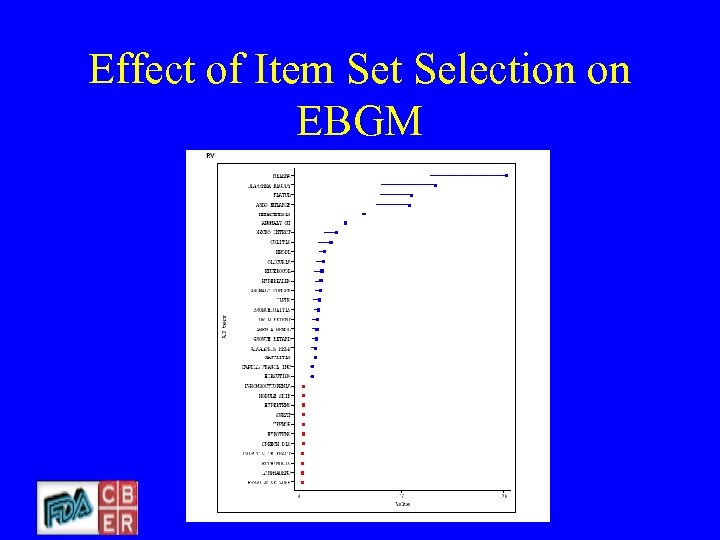 Effect of Item Set Selection on EBGM
 Challenges • What is the best method? – Bayesian vs. PRR vs. other? – What are criteria for making this decision? • How should each method be applied and interpreted? – What level of PRR/EBGM? – How should statistics be interpreted?
 Challenges • Should data mining methods be used for automated screening or as analytic tools? – Importance of stratification suggests need for intermediate level epi/stat sophistication in users – Users need training to properly interpret results • Computing resources – Substantial effort required for data preparation – Software needs user-friendly features to enhance end-user control over: • • Defining data subsets of interest Stratification Combining adverse event terms Selecting item sets prior to data mining
 Challenges • Usual method of monitoring for signals: • • Physician review of individual reports as they arrive Physician review of serious reports Committee review of serious reports at weekly meeting Physician review of monthly numerical summaries of selected vaccines • Periodic vaccine or disease-specific surveillance summaries • Where does data mining best fit in this process? • How can data mining results be best communicated to decision makers, health care providers, and the public?
 Next Steps and Future Challenges • Continue using PRR and Empirical Bayesian methods in routine practice • Systematic comparison of methods • Simulation study in collaboration with CDC • Large size of AERS database, especially with 2 way and 3 way interactions – Is simpler better? e. g. PRR with chi-square • Drug dictionary in AERS
 Summary • Automated summary of a large amount of data • Potential for improving usual methods of monitoring for signals – Other methods should also be considered • Further understanding and experience is needed
 Acknowledgments • FDA – Manette Niu, Phil Perucci, other CBER staff, Ana Szarfman and other CDER staff • CDC – Henry Rolka, Vitali Poole, Penina Haber, John Iskander, and other CDC staff • Others – Lincoln Technologies, Inc. – PPD Informatics – William Du. Mouchel
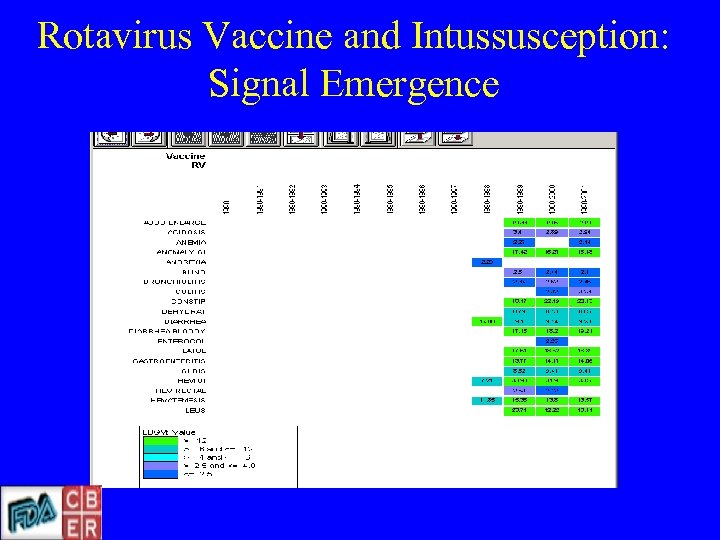
 Selected References • Dumouchel W. Bayesian data mining in large frequency tables, with an application to the FDA spontaneous reporting system. American Statistician 1999; 53: 177 -190. • Evans SW, Waller PC, Davis S. Use of proportional reporting ratios for signal generation from spontaneous adverse drug reaction reports. Pharmacoepidemiol Drug Saf 2001; 10: 483 -486. • Niu MT, Erwin DE, Braun MM. Data mining in the US Vaccine Adverse Event Reporting System (VAERS): early detection of intussusception and other events after rotavirus vaccination. Vaccine 2001; 19: 4627 -4634.