


 Скачать презентацию Data Mining Dr Mohsen Kahani Email kahani um ac
dd98946d4d405de1a301a489181ae0e9.ppt
- Количество слайдов: 75
 Data Mining Dr. Mohsen Kahani Email: kahani@um. ac. ir http: //www. um. ac. ir/~kahani/
 Overview z. Introduction z. Data Mining Functions and Models z. Data Mining Methodologies z. Data Mining Case Studies z. Final Remarks
 Motivation: “Necessity is the Mother of Invention” z. Data explosion problem: y. Automated data collection tools and mature database technology lead to tremendous amounts of data stored in databases, data warehouses and other information repositories z. We are drowning in data, but starving for knowledge!
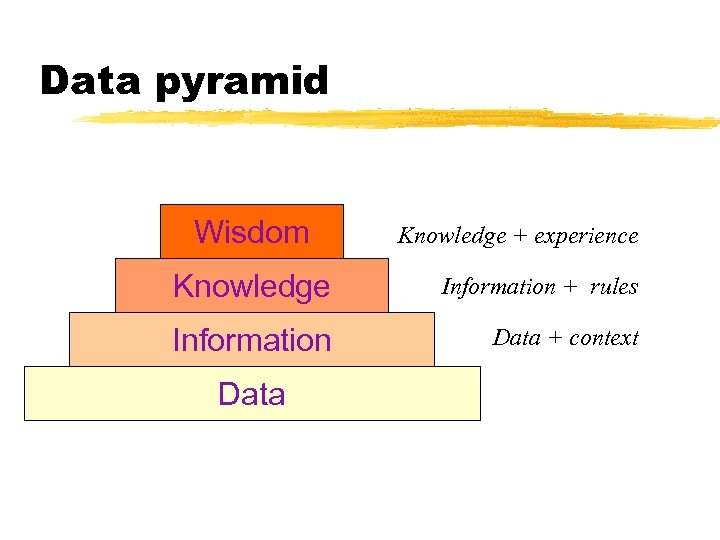 Data pyramid Wisdom Knowledge + experience Knowledge Information + rules Information Data + context Data
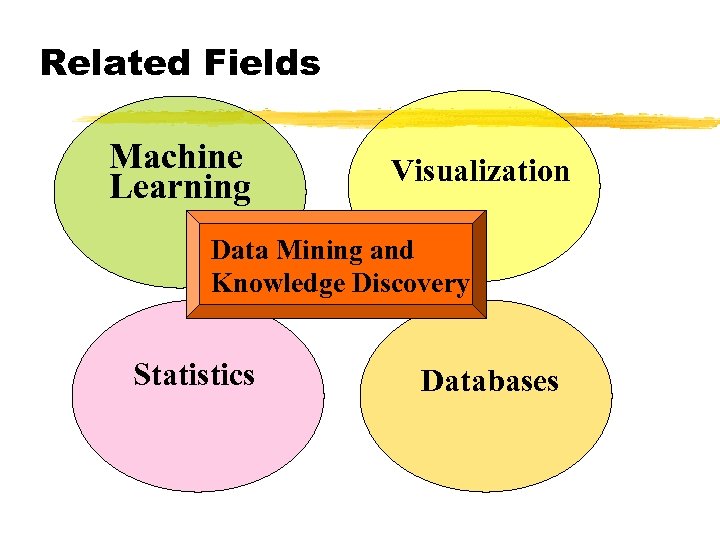 Related Fields Machine Learning Visualization Data Mining and Knowledge Discovery Statistics Databases
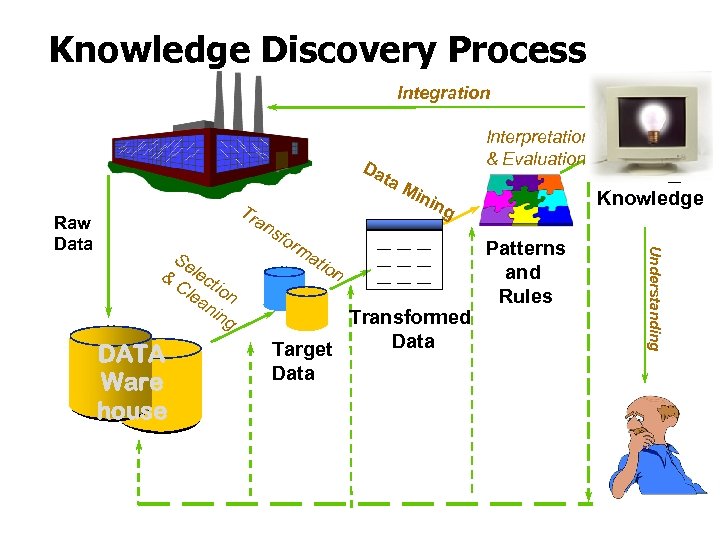 Knowledge Discovery Process Integration Da Tr an s & DATA Ware house Se lec Cl tio ea n nin g for ma tio n Mi nin Knowledge g __ __ __ Transformed Data Target Data Knowledge Patterns and Rules Understanding Raw Data ta Interpretation & Evaluation
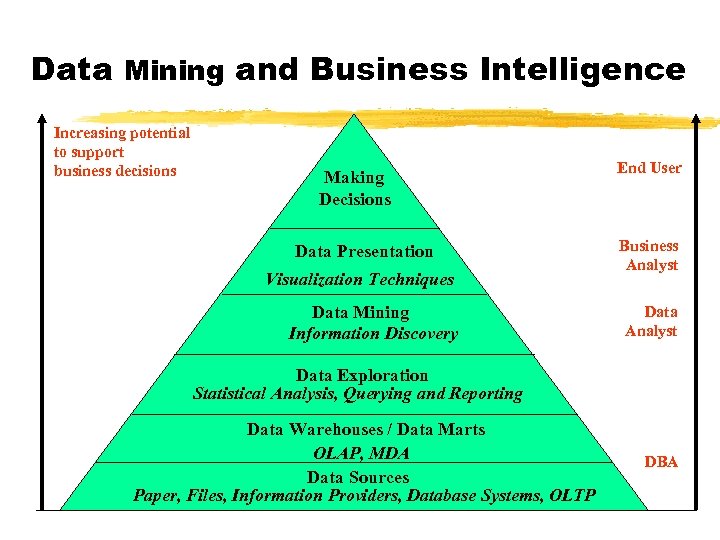 Data Mining and Business Intelligence Increasing potential to support business decisions Making Decisions Data Presentation Visualization Techniques Data Mining Information Discovery End User Business Analyst Data Exploration Statistical Analysis, Querying and Reporting Data Warehouses / Data Marts OLAP, MDA Data Sources Paper, Files, Information Providers, Database Systems, OLTP DBA
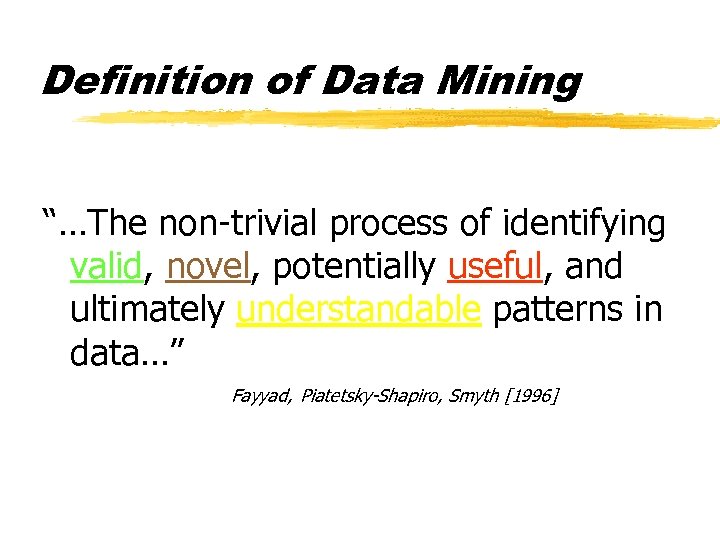 Definition of Data Mining “…The non-trivial process of identifying valid, novel, potentially useful, and ultimately understandable patterns in data…” Fayyad, Piatetsky-Shapiro, Smyth [1996]
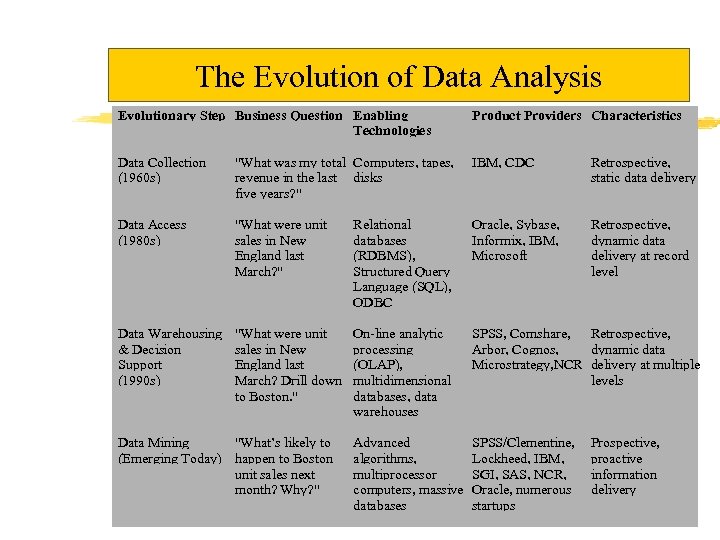 The Evolution of Data Analysis Evolutionary Step Business Question Enabling Technologies Product Providers Characteristics Data Collection (1960 s) "What was my total Computers, tapes, revenue in the last disks five years? " IBM, CDC Retrospective, static data delivery Data Access (1980 s) "What were unit sales in New England last March? " Relational databases (RDBMS), Structured Query Language (SQL), ODBC Oracle, Sybase, Informix, IBM, Microsoft Retrospective, dynamic data delivery at record level Data Warehousing & Decision Support (1990 s) "What were unit sales in New England last March? Drill down to Boston. " On-line analytic processing (OLAP), multidimensional databases, data warehouses SPSS, Comshare, Retrospective, Arbor, Cognos, dynamic data Microstrategy, NCR delivery at multiple levels Advanced algorithms, multiprocessor computers, massive databases SPSS/Clementine, Lockheed, IBM, SGI, SAS, NCR, Oracle, numerous startups Data Mining "What’s likely to (Emerging Today) happen to Boston unit sales next month? Why? " Prospective, proactive information delivery
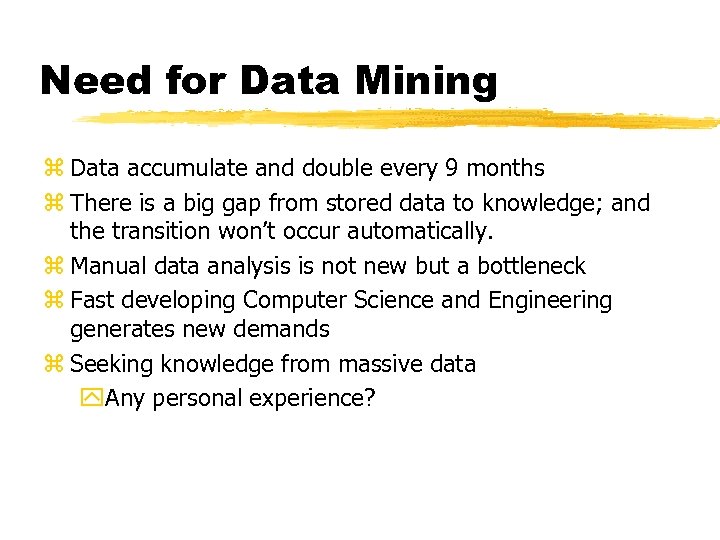 Need for Data Mining z Data accumulate and double every 9 months z There is a big gap from stored data to knowledge; and the transition won’t occur automatically. z Manual data analysis is not new but a bottleneck z Fast developing Computer Science and Engineering generates new demands z Seeking knowledge from massive data y. Any personal experience?
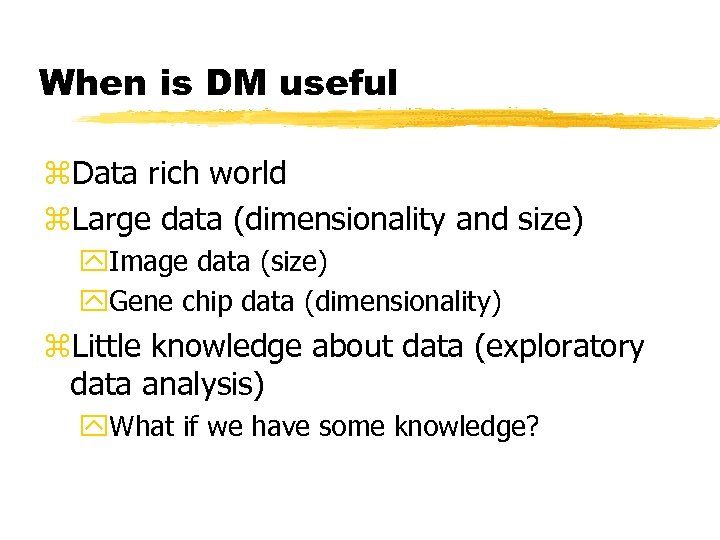 When is DM useful z. Data rich world z. Large data (dimensionality and size) y. Image data (size) y. Gene chip data (dimensionality) z. Little knowledge about data (exploratory data analysis) y. What if we have some knowledge?
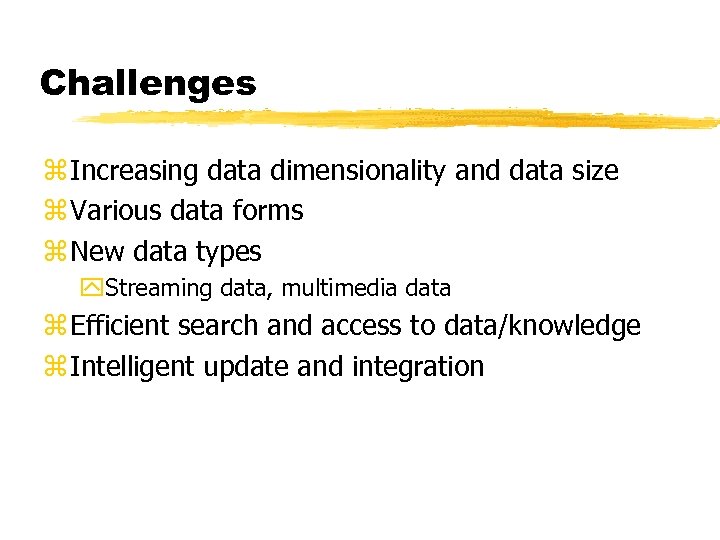 Challenges z Increasing data dimensionality and data size z Various data forms z New data types y. Streaming data, multimedia data z Efficient search and access to data/knowledge z Intelligent update and integration
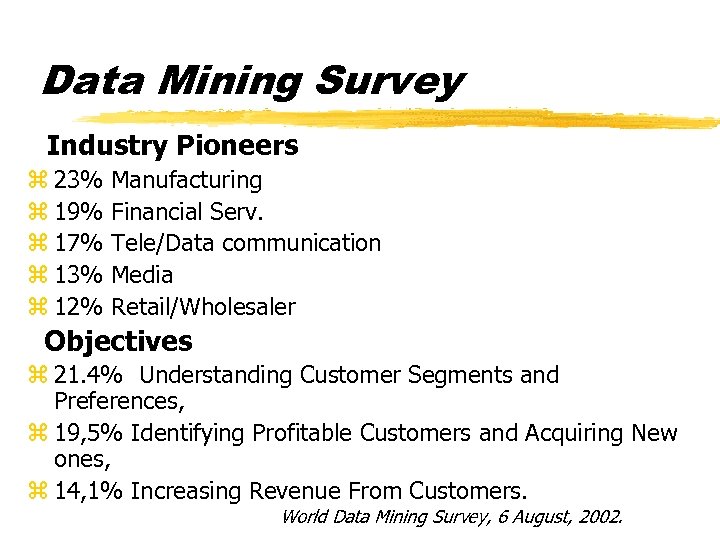 Data Mining Survey Industry Pioneers z 23% z 19% z 17% z 13% z 12% Manufacturing Financial Serv. Tele/Data communication Media Retail/Wholesaler Objectives z 21. 4% Understanding Customer Segments and Preferences, z 19, 5% Identifying Profitable Customers and Acquiring New ones, z 14, 1% Increasing Revenue From Customers. World Data Mining Survey, 6 August, 2002.
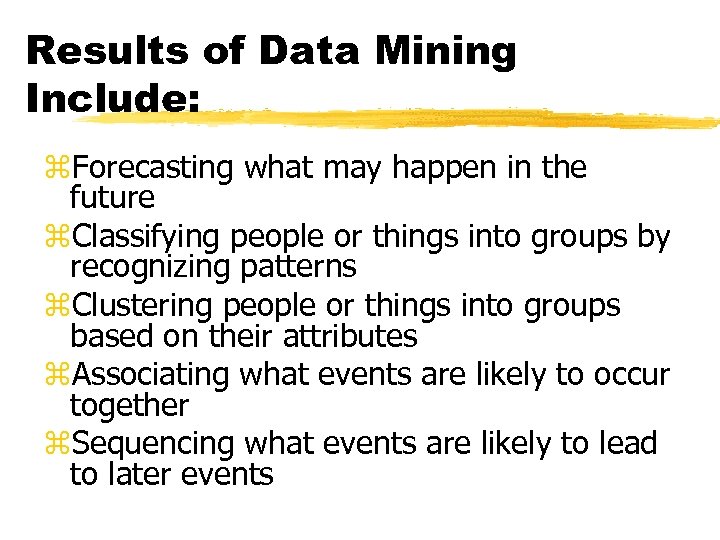 Results of Data Mining Include: z. Forecasting what may happen in the future z. Classifying people or things into groups by recognizing patterns z. Clustering people or things into groups based on their attributes z. Associating what events are likely to occur together z. Sequencing what events are likely to lead to later events
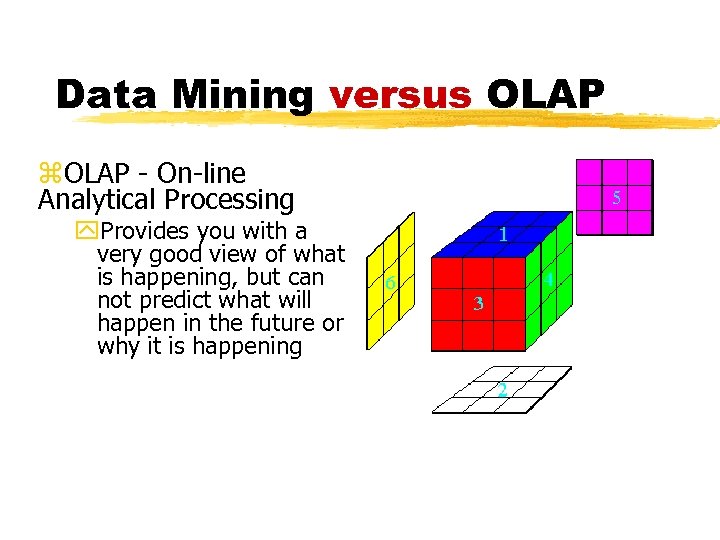 Data Mining versus OLAP z. OLAP - On-line Analytical Processing y. Provides you with a very good view of what is happening, but can not predict what will happen in the future or why it is happening
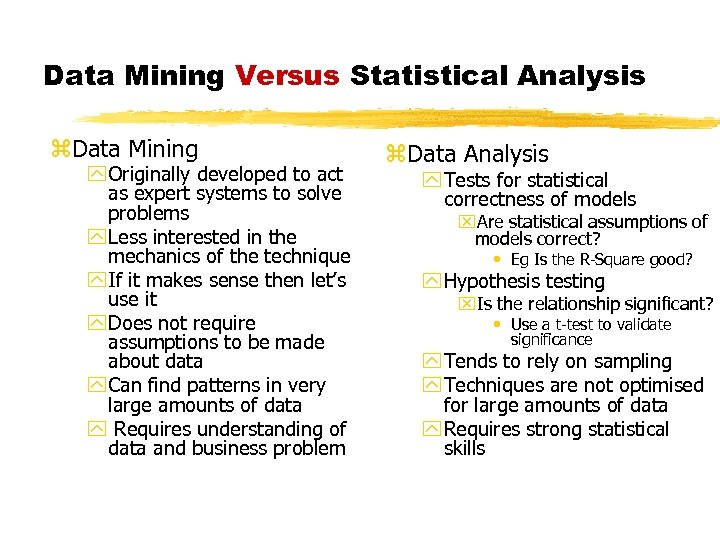 Data Mining Versus Statistical Analysis z. Data Mining y Originally developed to act as expert systems to solve problems y Less interested in the mechanics of the technique y If it makes sense then let’s use it y Does not require assumptions to be made about data y Can find patterns in very large amounts of data y Requires understanding of data and business problem z. Data Analysis y Tests for statistical correctness of models x. Are statistical assumptions of models correct? • Eg Is the R-Square good? y Hypothesis testing x. Is the relationship significant? • Use a t-test to validate significance y Tends to rely on sampling y Techniques are not optimised for large amounts of data y Requires strong statistical skills
 Data Mining Taxonomy Predictive Method - …predict the value of a particular attribute… Descriptive Method - …foundation of human-interpretable patterns that describe the data…
![Data Mining Tasks. . . z. Classification [Predictive] z. Clustering [Descriptive] z. Association Rule](https://present5.com/presentation/dd98946d4d405de1a301a489181ae0e9/image-18.jpg "Data Mining Tasks. . . z. Classification [Predictive] z. Clustering [Descriptive] z. Association Rule") Data Mining Tasks. . . z. Classification [Predictive] z. Clustering [Descriptive] z. Association Rule Discovery [Descriptive] z. Sequential Pattern Discovery [Descriptive] z. Deviation Detection [Predictive]
Data Mining Tasks. . . z. Classification [Predictive] z. Clustering [Descriptive] z. Association Rule Discovery [Descriptive] z. Sequential Pattern Discovery [Descriptive] z. Deviation Detection [Predictive]
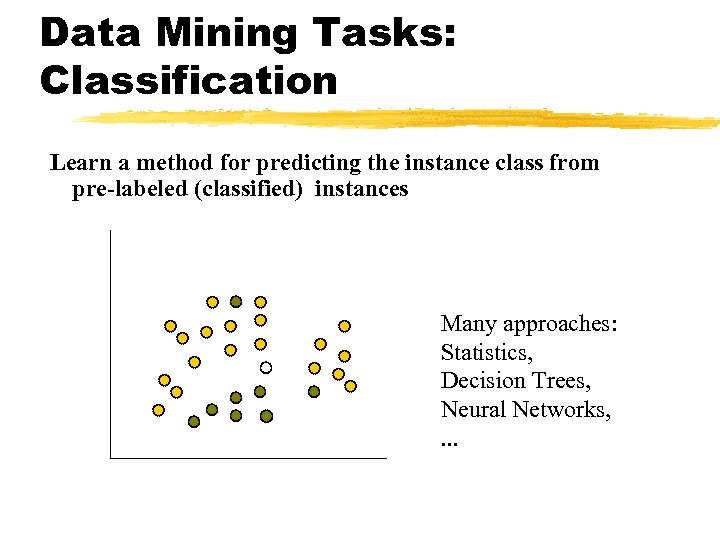 Data Mining Tasks: Classification Learn a method for predicting the instance class from pre-labeled (classified) instances Many approaches: Statistics, Decision Trees, Neural Networks, . . .
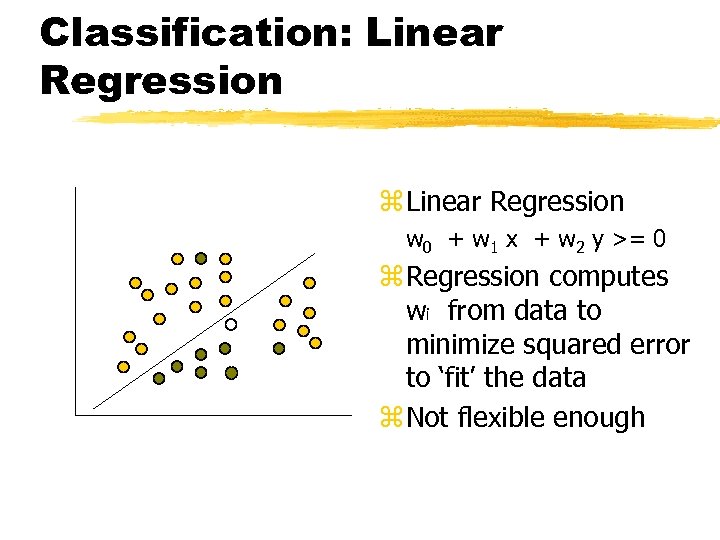 Classification: Linear Regression z Linear Regression w 0 + w 1 x + w 2 y >= 0 z Regression computes wi from data to minimize squared error to ‘fit’ the data z Not flexible enough
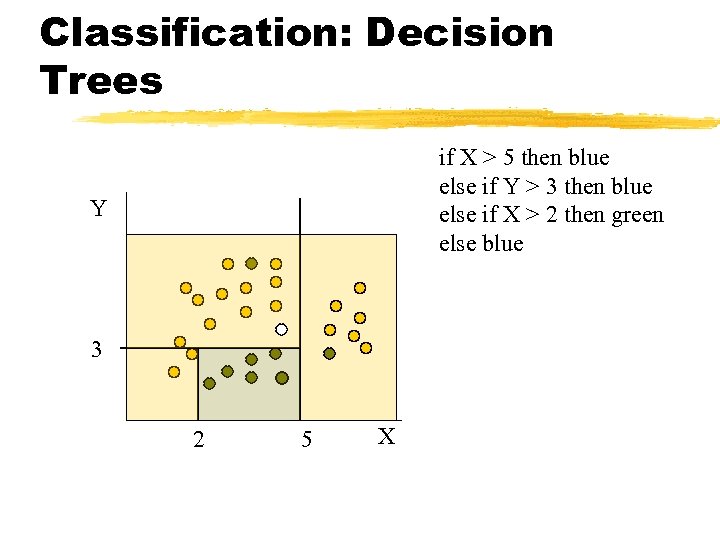 Classification: Decision Trees if X > 5 then blue else if Y > 3 then blue else if X > 2 then green else blue Y 3 2 5 X
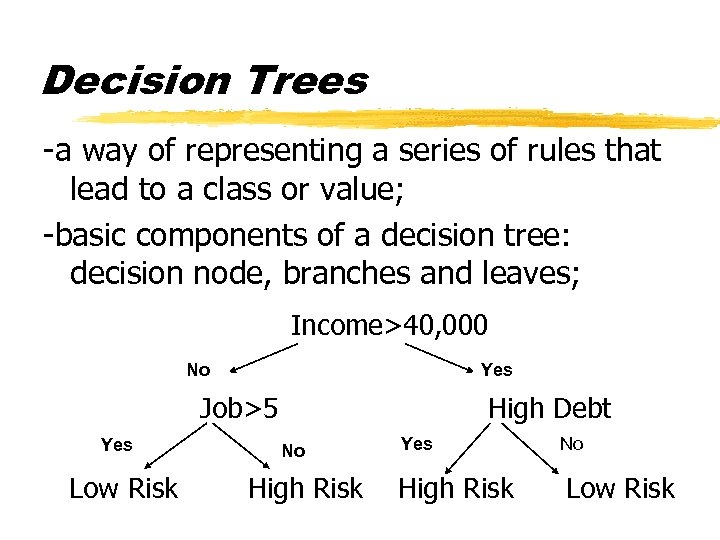 Decision Trees -a way of representing a series of rules that lead to a class or value; -basic components of a decision tree: decision node, branches and leaves; Income>40, 000 No Yes Job>5 Yes Low Risk High Debt No High Risk Yes High Risk No Low Risk
 Decision Trees (cont. ) - handle very well non-numeric data; - work best when the predictor variables are categorical;
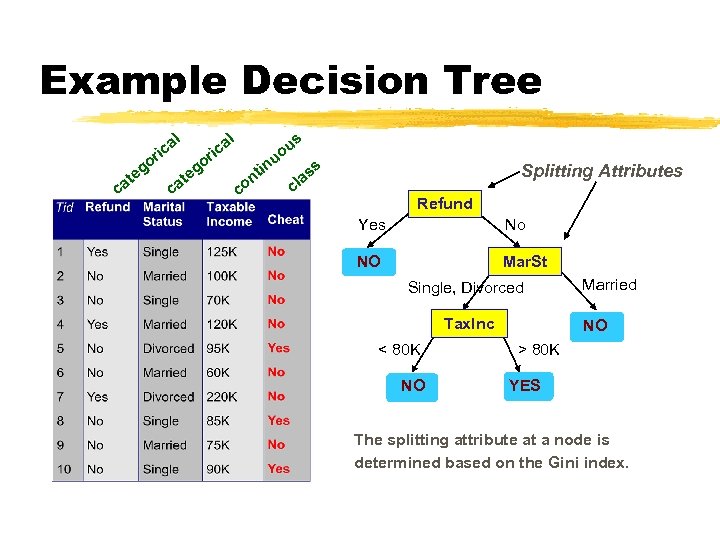 Example Decision Tree l l a ric go c e at a ric in c t on ou u s ss Splitting Attributes a cl Refund Yes No NO Mar. St Single, Divorced Tax. Inc < 80 K NO Married NO > 80 K YES The splitting attribute at a node is determined based on the Gini index.
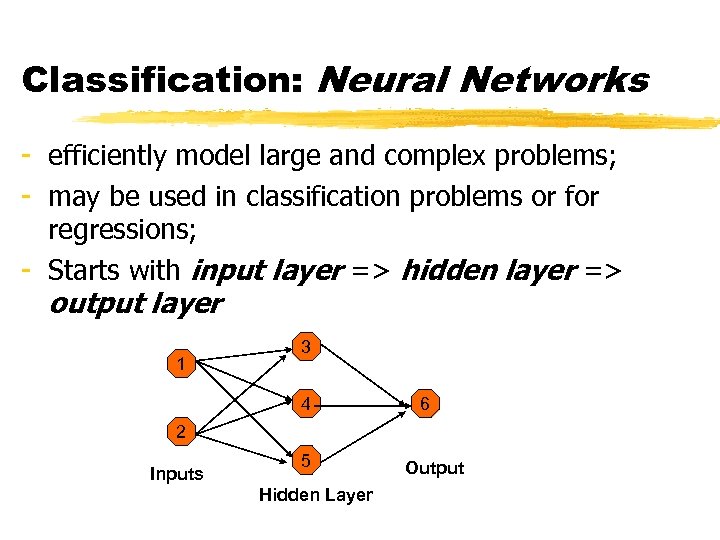 Classification: Neural Networks - efficiently model large and complex problems; - may be used in classification problems or for regressions; - Starts with input layer => hidden layer => output layer 1 3 4 6 2 Inputs 5 Hidden Layer Output
 Neural Networks (cont. ) - can be easily implemented to run on massively parallel computers; - can not be easily interpret; - require an extensive amount of training time; - require a lot of data preparation (involve very careful data cleansing, selection, preparation, and pre-processing); - require sufficiently large data set and high signal-to noise ratio.
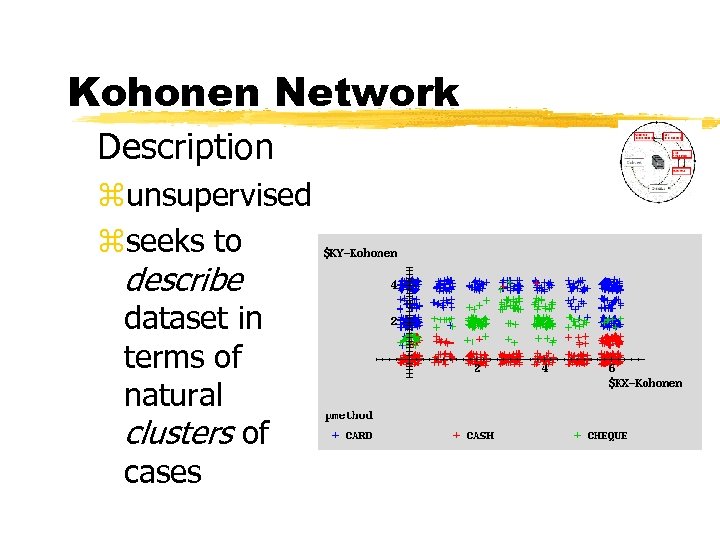 Kohonen Network Description zunsupervised zseeks to describe dataset in terms of natural clusters of cases
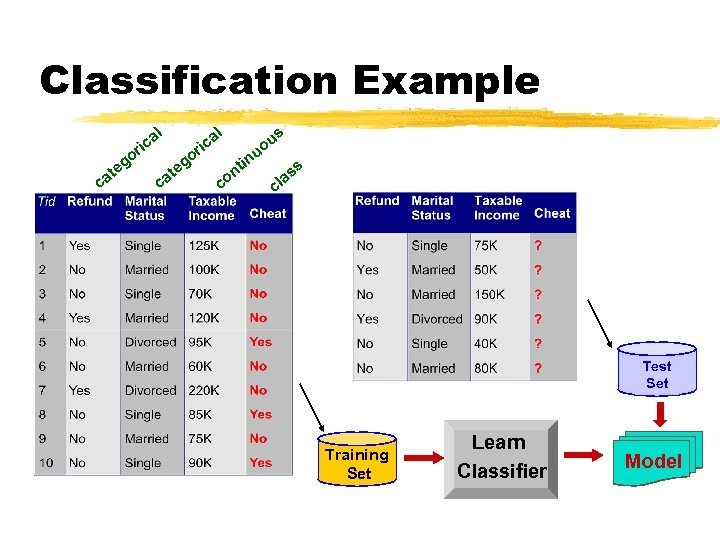 Classification Example al ric c o eg at t ca al o eg ric co in nt us o u ss a cl Test Set Training Set Learn Classifier Model
 Classification Application z. Direct Marketing z. Fraud Detection z. Customer Attrition/Churn z. Sky Survey Cataloging
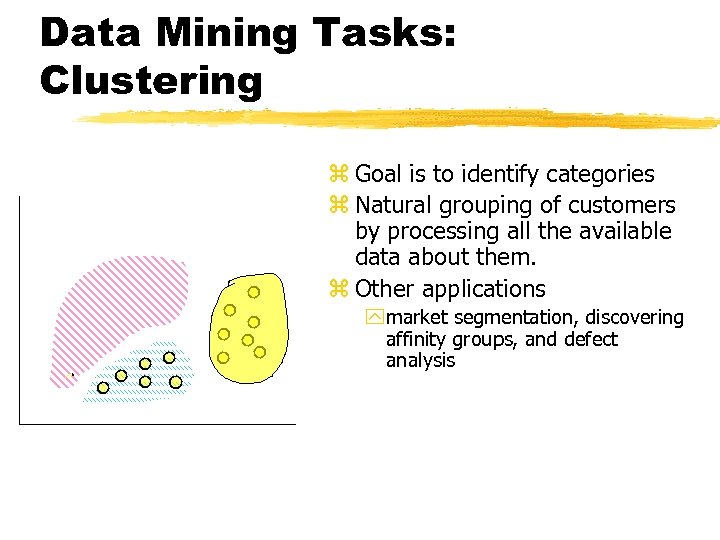 Data Mining Tasks: Clustering z Goal is to identify categories z Natural grouping of customers by processing all the available data about them. z Other applications y market segmentation, discovering affinity groups, and defect analysis
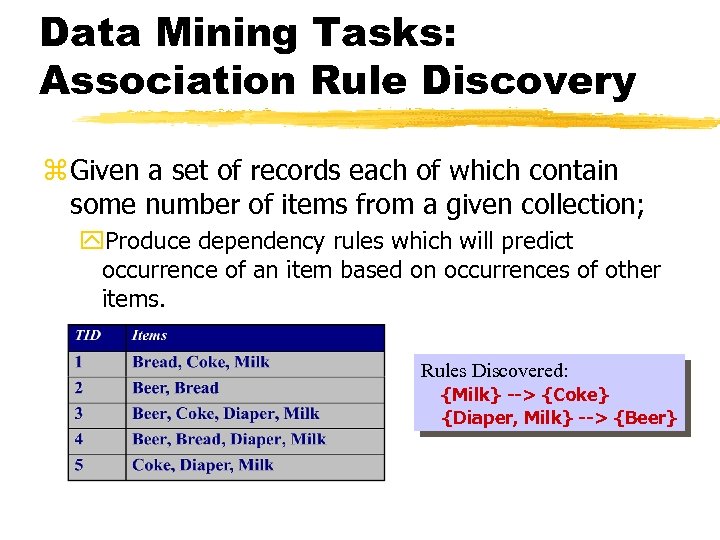 Data Mining Tasks: Association Rule Discovery z Given a set of records each of which contain some number of items from a given collection; y. Produce dependency rules which will predict occurrence of an item based on occurrences of other items. Rules Discovered: {Milk} --> {Coke} {Diaper, Milk} --> {Beer}
 Association Rule Discovery Application z. Marketing and Sales Promotion z. Supermarket Shelf Management z. Inventory Management
 Deviation Detection & Pattern Discovery Deviation Detection: …discovering most significant changes in data from previously measured or normative values… V. Kumar, M. Joshi, Tutorial on High Performance Data Mining. Sequential Pattern Discovery: …process of looking for patterns and rules that predict strong sequential dependencies among different events… V. Kumar, M. Joshi, Tutorial on High Performance Data Mining.
 Sequential Patterns z. Identify frequently occurring sequences from given records z 40 percent of female customers buy a gray skirt six months after buying a red jacket
 Data Mining Methodology: SAS z Sample y Extract a portion of the dataset for data mining z Explore z Modify y create, select and transform variables with the intention of building a model z Model y Specify a relationship of variables that reliably predicts a desired goal z Assess y Evaluate the practical value of the findings and the model resulting from the data mining effort
 Data Mining Methodology: CRISP-DM z. Data understanding z. Data preparation z. Modeling z. Evaluation z. Deployment
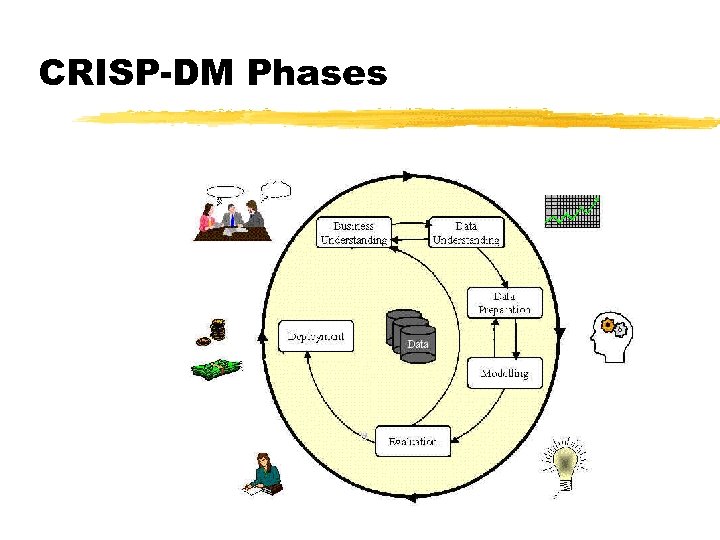 CRISP-DM Phases
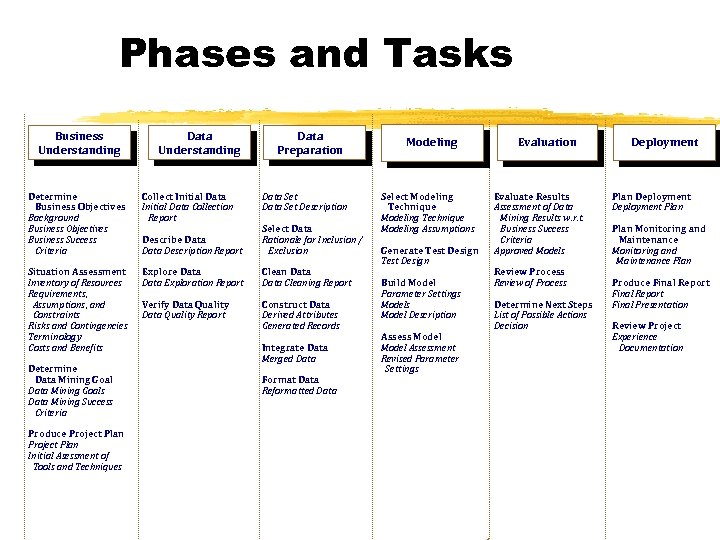 Phases and Tasks Business Understanding Data Preparation Determine Business Objectives Background Business Objectives Business Success Criteria Collect Initial Data Collection Report Describe Data Description Report Select Data Rationale for Inclusion / Exclusion Situation Assessment Inventory of Resources Requirements, Assumptions, and Constraints Risks and Contingencies Terminology Costs and Benefits Explore Data Exploration Report Clean Data Cleaning Report Verify Data Quality Report Construct Data Derived Attributes Generated Records Determine Data Mining Goals Data Mining Success Criteria Produce Project Plan Initial Asessment of Tools and Techniques Data Set Description Integrate Data Merged Data Format Data Reformatted Data Modeling Select Modeling Technique Modeling Assumptions Generate Test Design Build Model Parameter Settings Model Description Assess Model Assessment Revised Parameter Settings Evaluation Evaluate Results Assessment of Data Mining Results w. r. t. Business Success Criteria Approved Models Review Process Review of Process Determine Next Steps List of Possible Actions Decision Deployment Plan Monitoring and Maintenance Plan Produce Final Report Final Presentation Review Project Experience Documentation
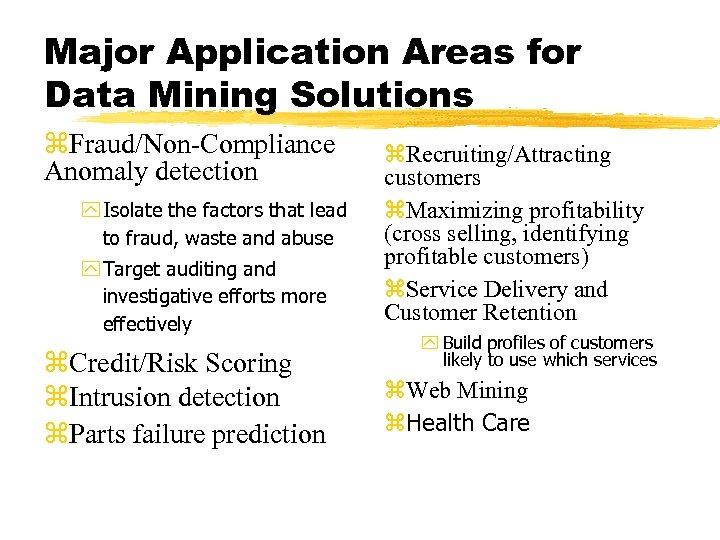 Major Application Areas for Data Mining Solutions z. Fraud/Non-Compliance Anomaly detection y Isolate the factors that lead to fraud, waste and abuse y Target auditing and investigative efforts more effectively z. Credit/Risk Scoring z. Intrusion detection z. Parts failure prediction z. Recruiting/Attracting customers z. Maximizing profitability (cross selling, identifying profitable customers) z. Service Delivery and Customer Retention y Build profiles of customers likely to use which services z. Web Mining z. Health Care
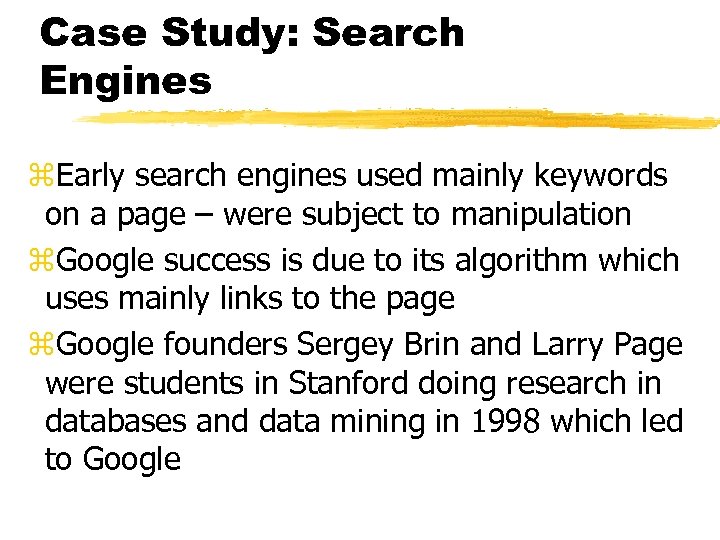 Case Study: Search Engines z. Early search engines used mainly keywords on a page – were subject to manipulation z. Google success is due to its algorithm which uses mainly links to the page z. Google founders Sergey Brin and Larry Page were students in Stanford doing research in databases and data mining in 1998 which led to Google
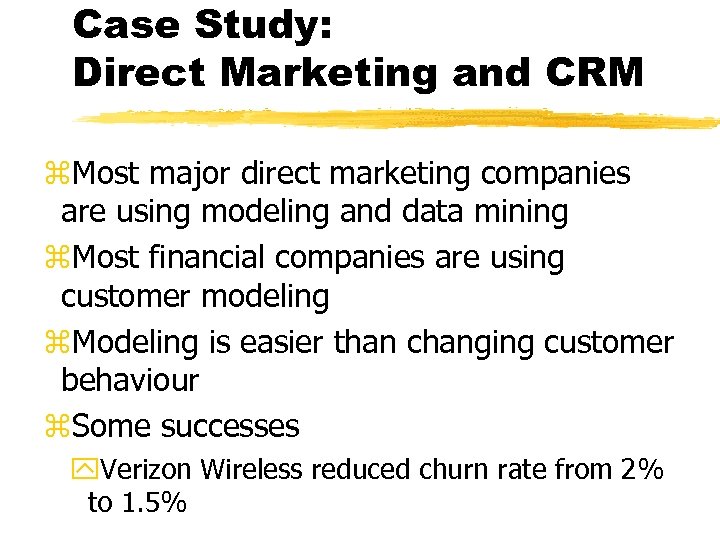 Case Study: Direct Marketing and CRM z. Most major direct marketing companies are using modeling and data mining z. Most financial companies are using customer modeling z. Modeling is easier than changing customer behaviour z. Some successes y. Verizon Wireless reduced churn rate from 2% to 1. 5%
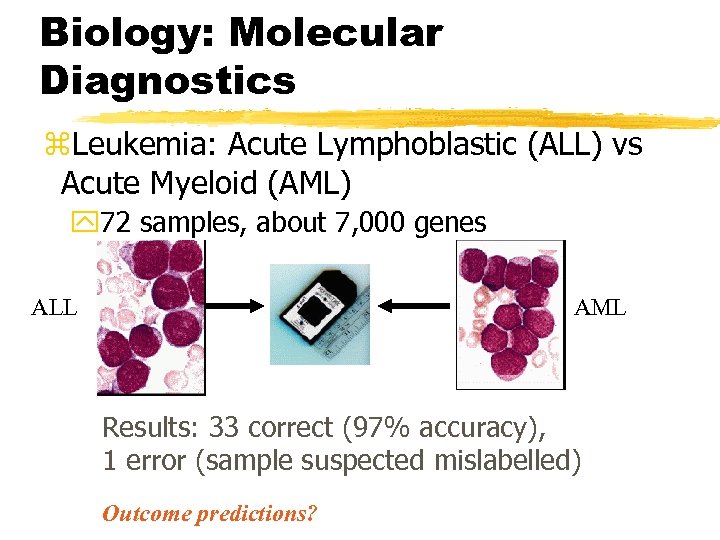 Biology: Molecular Diagnostics z. Leukemia: Acute Lymphoblastic (ALL) vs Acute Myeloid (AML) y 72 samples, about 7, 000 genes ALL AML Results: 33 correct (97% accuracy), 1 error (sample suspected mislabelled) Outcome predictions?
 Case Study: Security and Fraud Detection z. Credit Card Fraud Detection z. Money laundering y. FAIS (US Treasury) z. Securities Fraud y. NASDAQ Sonar system z. Phone fraud y. AT&T, Bell Atlantic, British Telecom/MCI z. Bio-terrorism detection at Salt Lake Olympics 2002
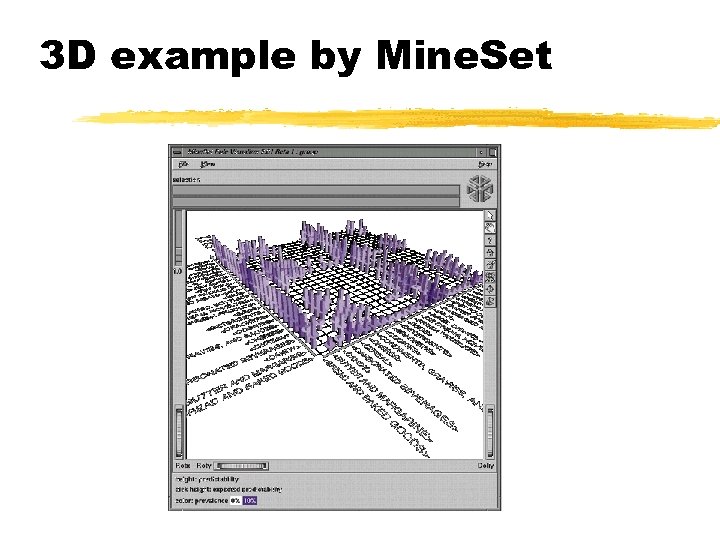 3 D example by Mine. Set
 Data Mining and Privacy z. Data Mining looks for patterns, not people! z. Technical solutions can limit privacy invasion y. Replacing sensitive personal data with anon. ID y. Give randomized outputs y. Multi-party computation – distributed data y…
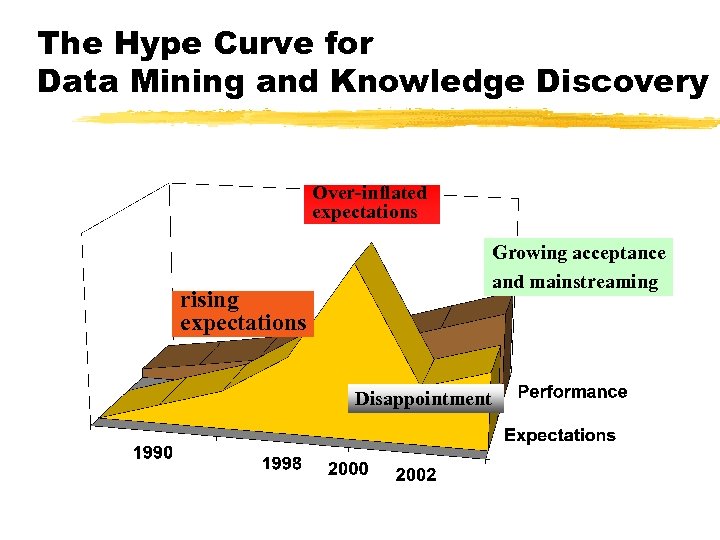 The Hype Curve for Data Mining and Knowledge Discovery Over-inflated expectations Growing acceptance and mainstreaming rising expectations Disappointment
 Final Remarks z. Data Mining can be utilized for any field that needs to find patterns or relationships in their data.
 Questions?
 Special Data Types z. Spatial Data z. Streamed Data z. Multimedia data
 Spatial Mining Spatial Data and Structures Images Spatial Mining Algorithms
 Definitions z. Spatial data is about instances located in a physical space z. Spatial data has location or georeferenced features z. Some of these features are: y. Address, latitude/longitude (explicit) y. Location-based partitions in databases (implicit)
 Applications and Problems z Geographic information systems (GIS) store information related to geographic locations on Earth y. Weather, community infrastructure needs, disaster management, and hazardous waste z Homeland security issues such as prediction of unexpected events and planning of evacuation z Remote sensing and image classification z Biomedical applications include medical imaging and illness diagnosis
 Use of Spatial Data z Map overlay – merging disparate data y. Different views of the same area: (Level 1) streets, power lines, phone lines, sewer lines, (Level 2) actual elevations, building locations, and rivers z Spatial selection – find all houses near WSU z Spatial join – nearest for points, intersection for areas z Other basic spatial operations y. Region/range query for objects intersecting a region y. Nearest neighbor query for objects closest to a given place y. Distance scan asking for objects within a certain radius
 Spatial Data Structures z. Minimum bounding rectangles (MBR) z. Different tree structures y. Quad tree y. R-Tree ykd-Tree z. Image databases
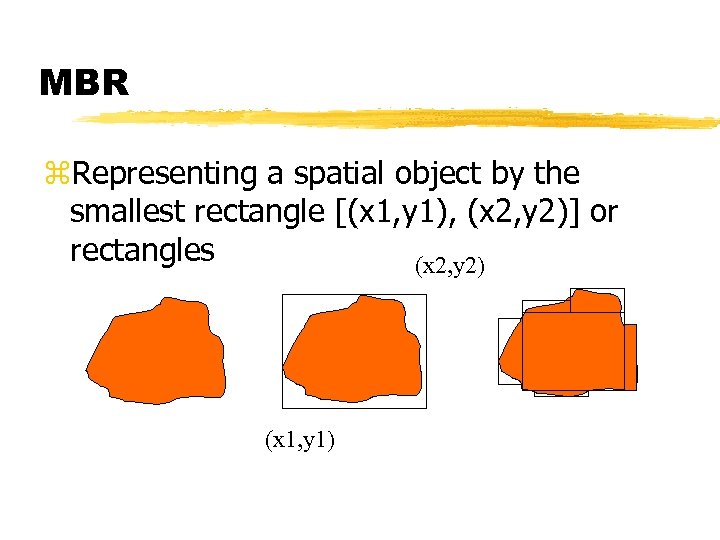 MBR z. Representing a spatial object by the smallest rectangle [(x 1, y 1), (x 2, y 2)] or rectangles (x 2, y 2) (x 1, y 1)
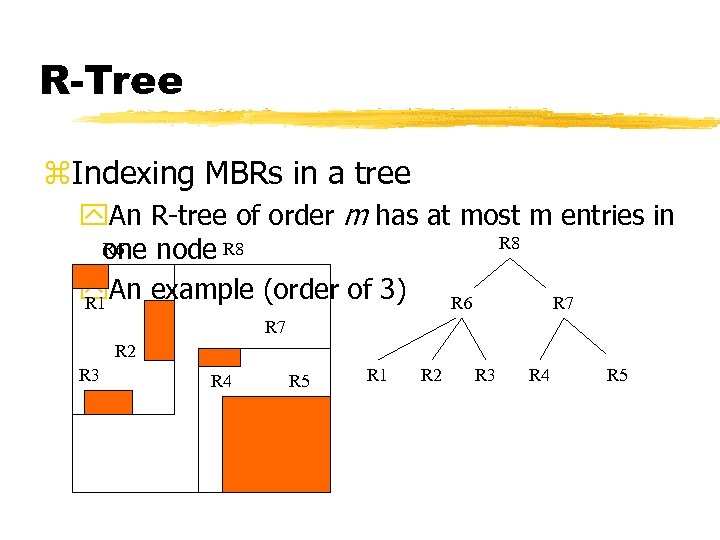 R-Tree z. Indexing MBRs in a tree y. An R-tree of order m has at most m entries in R 8 R 6 one node R 8 y. An example (order of 3) R 1 R 6 R 7 R 2 R 3 R 4 R 5 R 1 R 2 R 3 R 4 R 5
 Common Tasks dealing with Spatial Data z Data focusing y. Spatial queries y. Identifying interesting parts in spatial data y. Progress refinement can be applied in a tree structure z Feature extraction y. Extracting important/relevant features for an application z Classification or others y. Using training data to create classifiers y. Many mining algorithms can be used x. Classification, clustering, associations
 Spatial Mining Tasks z. Spatial classification z. Spatial clustering z. Spatial association rules
 Spatial Classification z. Use spatial information at different (coarse/fine) levels (different indexing trees) for data focusing z. Determine relevant spatial or non-spatial features z. Perform normal supervised learning algorithms ye. g. , Decision trees,
 Spatial Clustering z. Use tree structures to index spatial data z. DBSCAN: R-tree z. CLIQUE: Grid or Quad tree z. Clustering with spatial constraints (obstacles need to adjust notion of distance)
 Spatial Association Rules z. Spatial objects are of major interest, not transactions z. A B y. A, B can be either spatial or non-spatial (3 combinations) y. What is the fourth combination? z. Association rules can be found w. r. t. the 3 types
 Summary z Spatial data can contain both spatial and nonspatial features. z When spatial information becomes dominant interest, spatial data mining should be applied. z Spatial data structures can facilitate spatial mining. z Standard data mining algorithms can be modified for spatial data mining, with a substantial part of preprocessing to take into account of spatial information.
 Characteristics of Data Streams z Data Streams y. Data streams—continuous, ordered, changing, fast, huge amount y. Traditional DBMS—data stored in finite, persistent data sets z Characteristics y. Huge volumes of continuous data, possibly infinite y. Fast changing and requires fast, real-time response y. Data stream captures nicely our data processing needs of today y. Random access is expensive—single linear scan
 Stream Data Applications z Telecommunication calling records z Business: credit card transaction flows z Network monitoring and traffic engineering z Financial market: stock exchange z Engineering & industrial processes: power supply & manufacturing z Sensor, monitoring & surveillance: video streams z Security monitoring z Web logs and Web page click streams z Massive data sets (even saved but random access is too expensive)
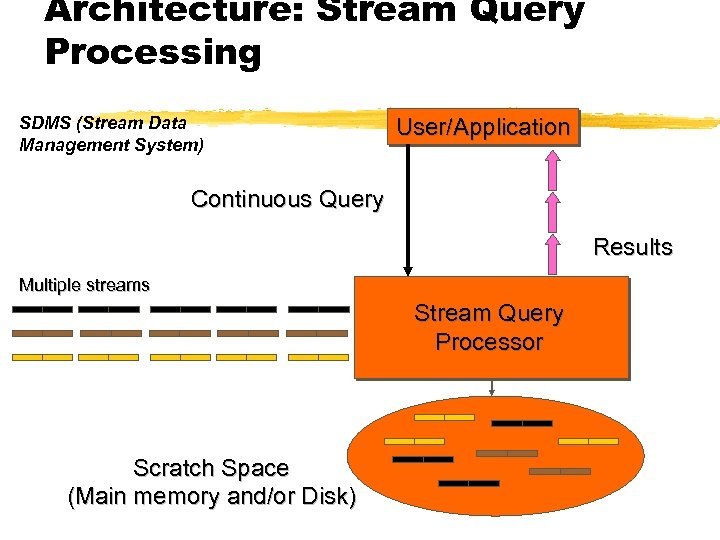 Architecture: Stream Query Processing SDMS (Stream Data Management System) User/Application Continuous Query Results Multiple streams Stream Query Processor Scratch Space (Main memory and/or Disk)
 Challenges of Stream Data Processing z Multiple, continuous, rapid, time-varying, ordered streams z Main memory computations z Queries are often continuous y. Evaluated continuously as stream data arrives y. Answer updated over time z Queries are often complex y. Beyond element-at-a-time processing y. Beyond stream-at-a-time processing y. Beyond relational queries (scientific, data mining,
 Processing Stream Queries z Query types y. One-time query vs. continuous query (being evaluated continuously as stream continues to arrive) y. Predefined query vs. ad-hoc query (issued on-line) z Unbounded memory requirements y. For real-time response, main memory algorithm should be used y. Memory requirement is unbounded if one will join future tuples z Approximate query answering y. With bounded memory, it is not always possible to
 Stream Data Mining vs. Stream Querying z. Stream mining—A more challenging task y. It shares most of the difficulties with stream querying y. Patterns are hidden and more general than querying y. It may require exploratory analysis x. Not necessarily continuous queries z. Stream data mining tasks y. Multi-dimensional on-line analysis of streams
 Stream Data Mining Tasks z Multi-dimensional (on-line) analysis of streams z Clustering data streams z Classification of data streams z Mining frequent patterns in data streams z Mining sequential patterns in data streams z Mining partial periodicity in data streams z Mining notable gradients in data streams z Mining outliers and unusual patterns in data streams
 Challenges for Mining Dynamics in Data Streams z Most stream data are at pretty low-level or multi-dimensional in nature: needs ML/MD processing z Analysis requirements y. Multi-dimensional trends and unusual patterns y. Capturing important changes at multidimensions/levels y. Fast, real-time detection and response
 Multi-Dimensional Stream Analysis: Examples z Analysis of Web click streams y. Raw data at low levels: seconds, web page addresses, user IP addresses, … y. Analysts want: changes, trends, unusual patterns, at reasonable levels of details y. E. g. , Average clicking traffic in North America on sports in the last 15 minutes is 40% higher than that in the last 24 hours. ” z Analysis of power consumption streams y. Raw data: power consumption flow for every household, every minute y. Patterns one may find: average hourly power
 A Key Step—Stream Data Reduction § Challenges of OLAPing stream data § Raw data cannot be stored § Simple aggregates are not powerful enough § History shape and patterns at different levels are desirable: multi-dimensional regression analysis § Proposal § A scalable multi-dimensional stream “data cube” that can aggregate regression model of stream data efficiently without accessing the raw data
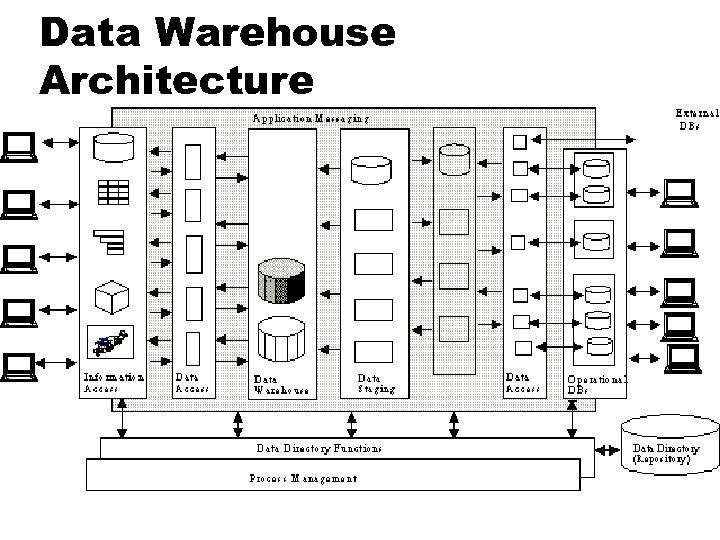
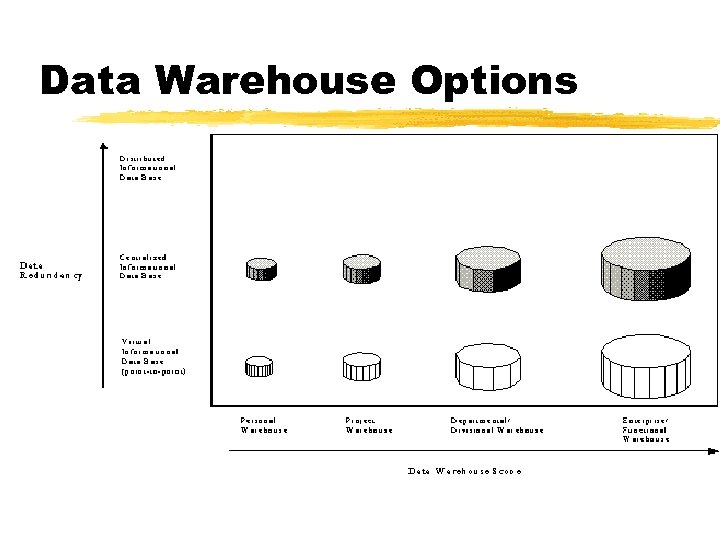
 Data Warehouse
 Data Warehouse Architecture
 Data Warehouse Options