


 Скачать презентацию Data Mining Concepts and Techniques Jianlin Cheng Department
0f9dda0a81fbdf75baf4bf3ab6f3367c.ppt
- Количество слайдов: 93
 Data Mining: Concepts and Techniques Jianlin Cheng Department of Computer Science University of Missouri, Columbia Adapted from © 2006 Jiawei Han and Micheline Kamber, All rights reserved 15 March 2018 Data Mining: Concepts and Techniques 1
 Chapter 2: Data Preprocessing n Why preprocess the data? n Descriptive data summarization n Data cleaning n Data integration and transformation n Data reduction n Discretization and concept hierarchy generation n Summary 15 March 2018 Data Mining: Concepts and Techniques 2
 Why Data Preprocessing? n Data in the real world is dirty n incomplete: lacking attribute values, lacking certain attributes of interest, or containing only aggregate data n n noisy: containing errors or outliers n n e. g. , Salary=“-10” inconsistent: containing discrepancies in codes or names n n n 15 March 2018 e. g. , occupation=“ ” e. g. , Age=“ 42” Birthday=“ 03/07/1997” e. g. , Was rating “ 1, 2, 3”, now rating “A, B, C” e. g. , discrepancy between duplicate records Data Mining: Concepts and Techniques 3
 Why Is Data Dirty? n Incomplete data may come from n n Noisy data (incorrect values) may come from n n Faulty data collection instruments Human or computer error at data entry Errors in data transmission Inconsistent data may come from n n n “Not applicable” data value when collected Different considerations between the time when the data was collected and when it is analyzed. Human/hardware/software problems Different data sources Functional dependency violation (e. g. , modify some linked data) Duplicate records also need data cleaning 15 March 2018 Data Mining: Concepts and Techniques 4
 Why Is Data Preprocessing Important? n No quality data, no quality mining results! n Quality decisions must be based on quality data n n n e. g. , duplicate or missing data may cause incorrect or even misleading statistics. Data warehouse needs consistent integration of quality data Data extraction, cleaning, and transformation comprises the majority of the work of building a data warehouse 15 March 2018 Data Mining: Concepts and Techniques 5
 Multi-Dimensional Measure of Data Quality n A well-accepted multidimensional view: n Accuracy n Completeness n Consistency n Timeliness n Believability n Value added n Interpretability n Accessibility 15 March 2018 Data Mining: Concepts and Techniques 6
 Major Tasks in Data Preprocessing n Data cleaning n n Data integration n n Normalization and aggregation Data reduction n n Integration of multiple databases, data cubes, or files Data transformation n n Fill in missing values, smooth noisy data, identify or remove outliers, and resolve inconsistencies Obtains reduced representation in volume but produces the same or similar analytical results Data discretization n Part of data reduction but with particular importance, especially for numerical data 15 March 2018 Data Mining: Concepts and Techniques 7
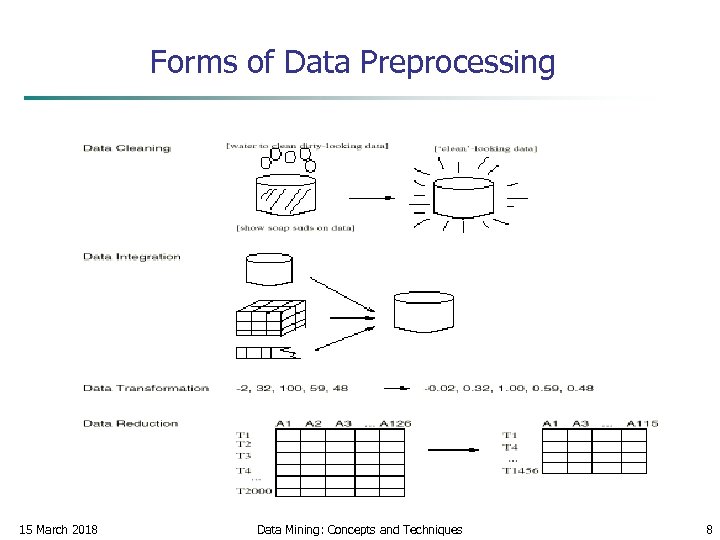 Forms of Data Preprocessing 15 March 2018 Data Mining: Concepts and Techniques 8
 Chapter 2: Data Preprocessing n Why preprocess the data? n Descriptive data summarization n Data cleaning n Data integration and transformation n Data reduction n Discretization and concept hierarchy generation n Summary 15 March 2018 Data Mining: Concepts and Techniques 9
 Mining Data Descriptive Characteristics n Motivation n n Data dispersion characteristics n n To better understand the data: central tendency, variation and spread median, mean, max, min, quantiles, outliers, variance, etc. Numerical dimensions correspond to sorted intervals n Data dispersion n Boxplot or quantile analysis on sorted intervals 15 March 2018 Data Mining: Concepts and Techniques 10
 Assignment 1 n n n Assignment 1 has been posted at the course web site. Due Feb. 4, 2013 Submit it to mudatamining@gmail. com 15 March 2018 Data Mining: Concepts and Techniques 11
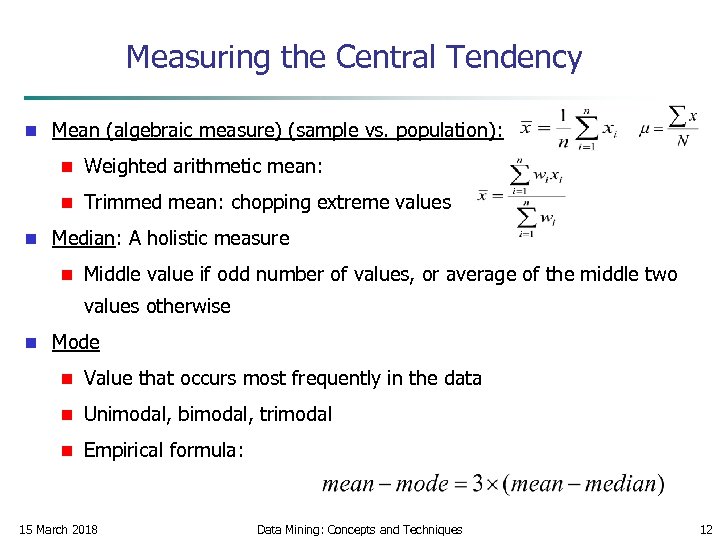 Measuring the Central Tendency n Mean (algebraic measure) (sample vs. population): n n n Weighted arithmetic mean: Trimmed mean: chopping extreme values Median: A holistic measure n Middle value if odd number of values, or average of the middle two values otherwise n Mode n Value that occurs most frequently in the data n Unimodal, bimodal, trimodal n Empirical formula: 15 March 2018 Data Mining: Concepts and Techniques 12
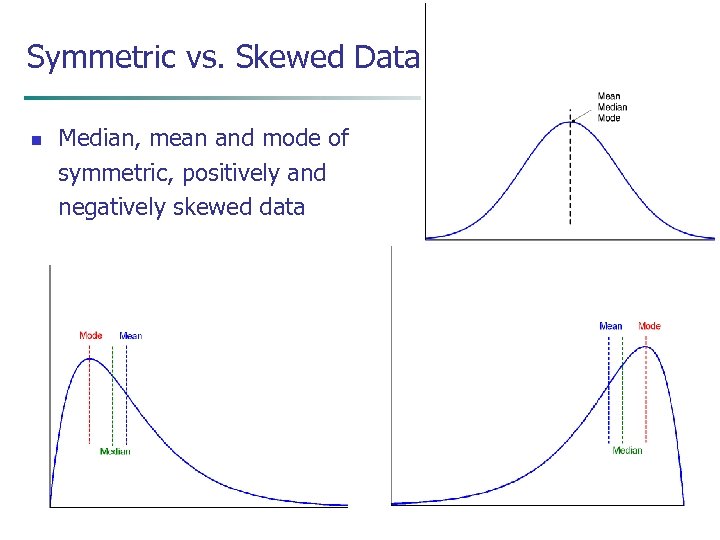 Symmetric vs. Skewed Data n Median, mean and mode of symmetric, positively and negatively skewed data 15 March 2018 Data Mining: Concepts and Techniques 13
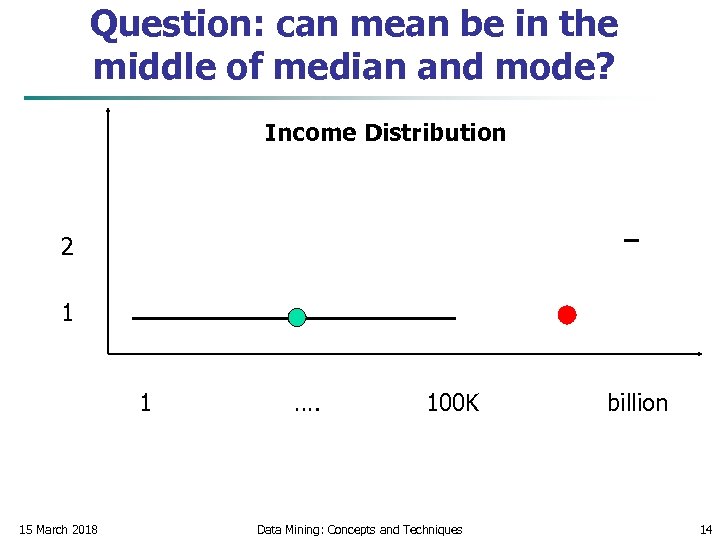 Question: can mean be in the middle of median and mode? Income Distribution 2 1 1 …. 100 K 15 March 2018 Data Mining: Concepts and Techniques billion 14
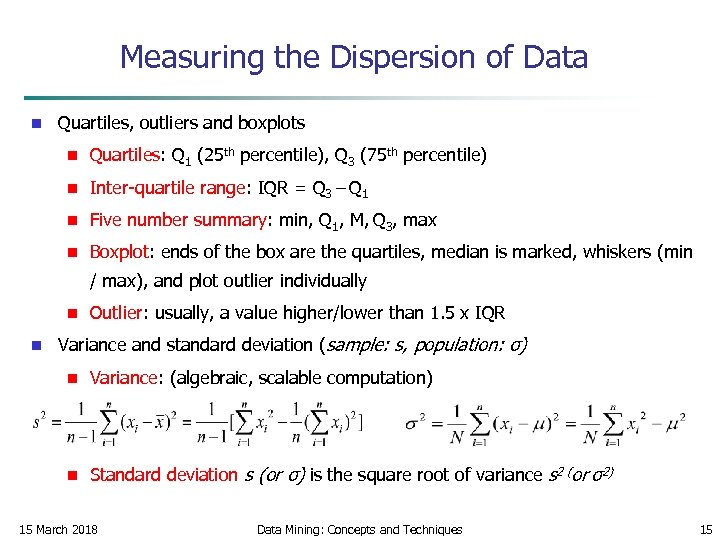 Measuring the Dispersion of Data n Quartiles, outliers and boxplots n Quartiles: Q 1 (25 th percentile), Q 3 (75 th percentile) n Inter-quartile range: IQR = Q 3 – Q 1 n Five number summary: min, Q 1, M, Q 3, max n Boxplot: ends of the box are the quartiles, median is marked, whiskers (min / max), and plot outlier individually n n Outlier: usually, a value higher/lower than 1. 5 x IQR Variance and standard deviation (sample: s, population: σ) n Variance: (algebraic, scalable computation) n Standard deviation s (or σ) is the square root of variance s 2 (or σ2) 15 March 2018 Data Mining: Concepts and Techniques 15
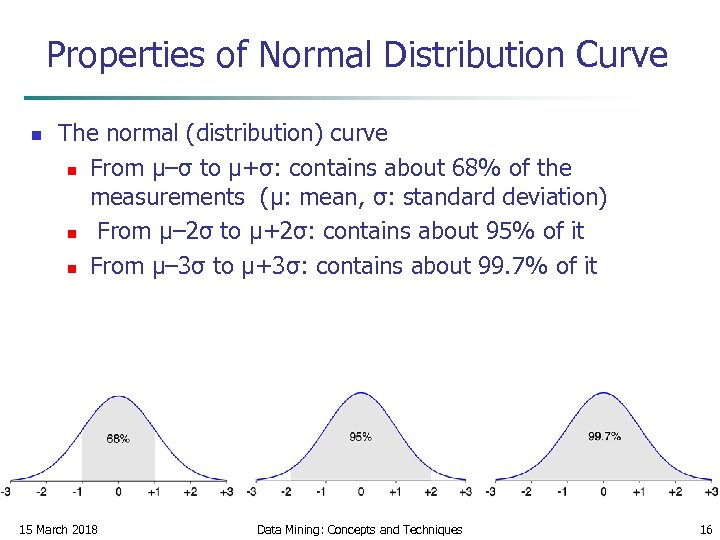 Properties of Normal Distribution Curve n The normal (distribution) curve n From μ–σ to μ+σ: contains about 68% of the measurements (μ: mean, σ: standard deviation) n From μ– 2σ to μ+2σ: contains about 95% of it n From μ– 3σ to μ+3σ: contains about 99. 7% of it 15 March 2018 Data Mining: Concepts and Techniques 16
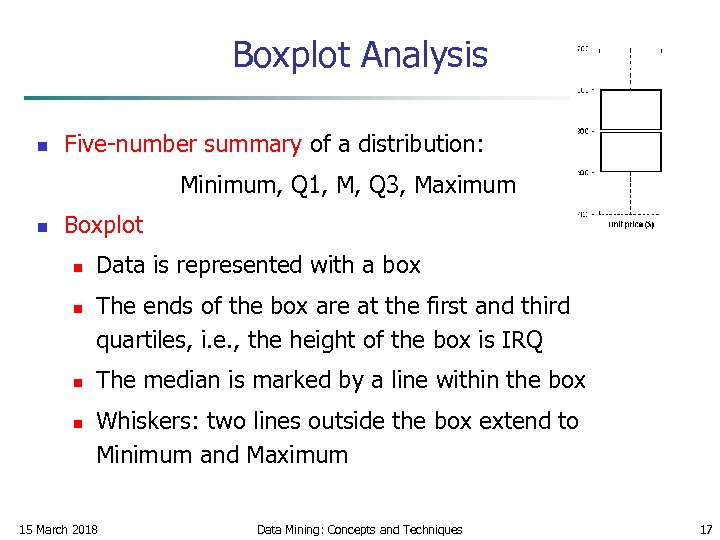 Boxplot Analysis n Five-number summary of a distribution: Minimum, Q 1, M, Q 3, Maximum n Boxplot n n Data is represented with a box The ends of the box are at the first and third quartiles, i. e. , the height of the box is IRQ The median is marked by a line within the box Whiskers: two lines outside the box extend to Minimum and Maximum 15 March 2018 Data Mining: Concepts and Techniques 17
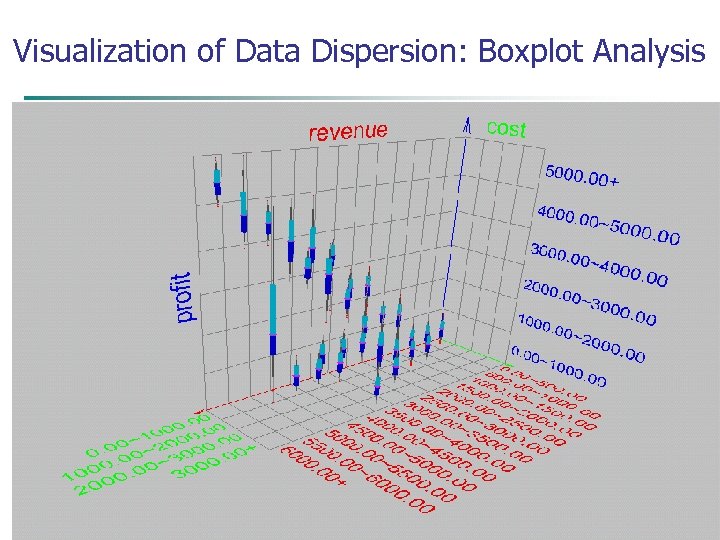 Visualization of Data Dispersion: Boxplot Analysis 15 March 2018 Data Mining: Concepts and Techniques 18
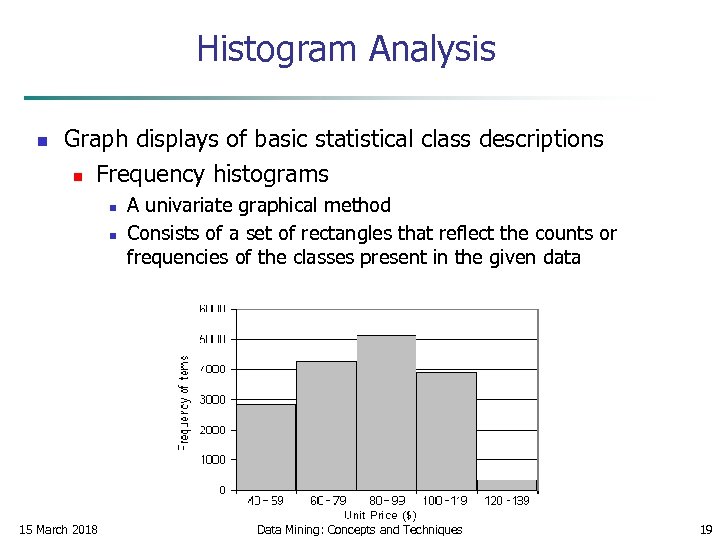 Histogram Analysis n Graph displays of basic statistical class descriptions n Frequency histograms n n 15 March 2018 A univariate graphical method Consists of a set of rectangles that reflect the counts or frequencies of the classes present in the given data Data Mining: Concepts and Techniques 19
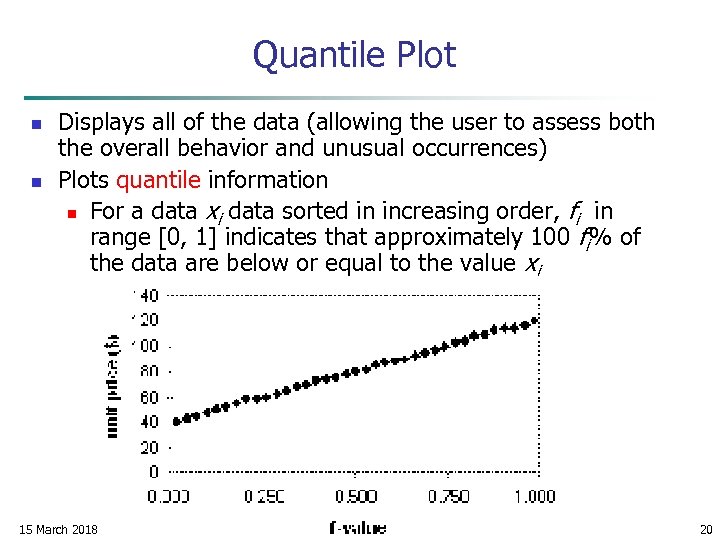 Quantile Plot n n Displays all of the data (allowing the user to assess both the overall behavior and unusual occurrences) Plots quantile information n For a data xi data sorted in increasing order, fi in range [0, 1] indicates that approximately 100 fi% of the data are below or equal to the value xi 15 March 2018 Data Mining: Concepts and Techniques 20
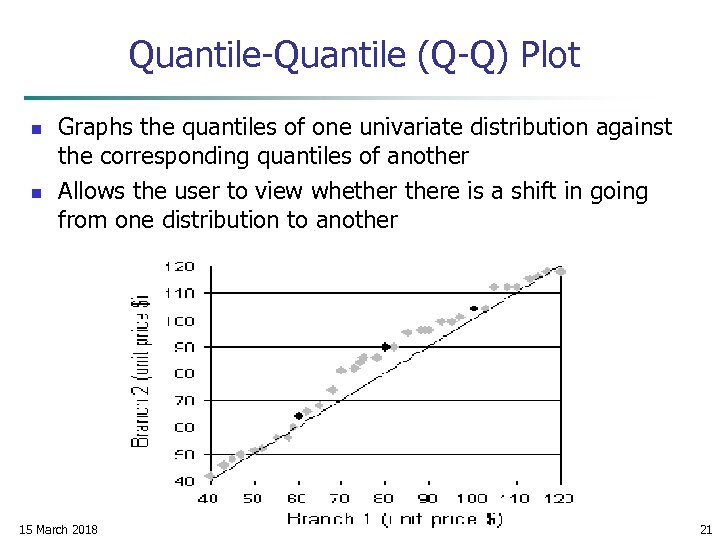 Quantile-Quantile (Q-Q) Plot n n Graphs the quantiles of one univariate distribution against the corresponding quantiles of another Allows the user to view whethere is a shift in going from one distribution to another 15 March 2018 Data Mining: Concepts and Techniques 21
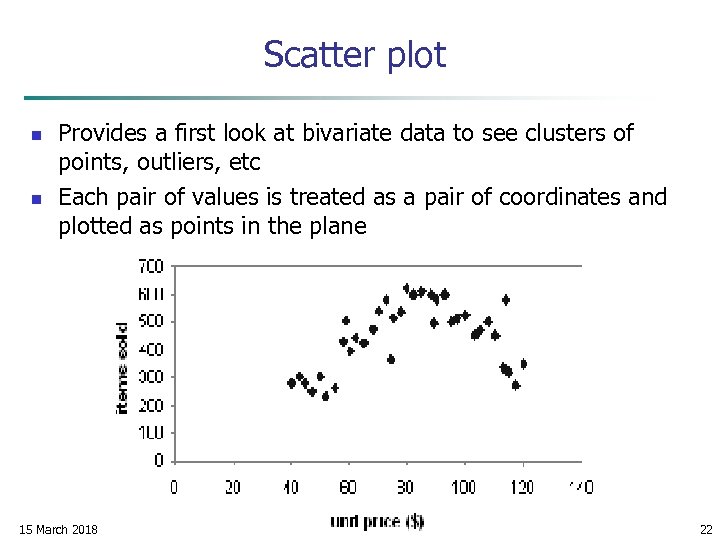 Scatter plot n n Provides a first look at bivariate data to see clusters of points, outliers, etc Each pair of values is treated as a pair of coordinates and plotted as points in the plane 15 March 2018 Data Mining: Concepts and Techniques 22
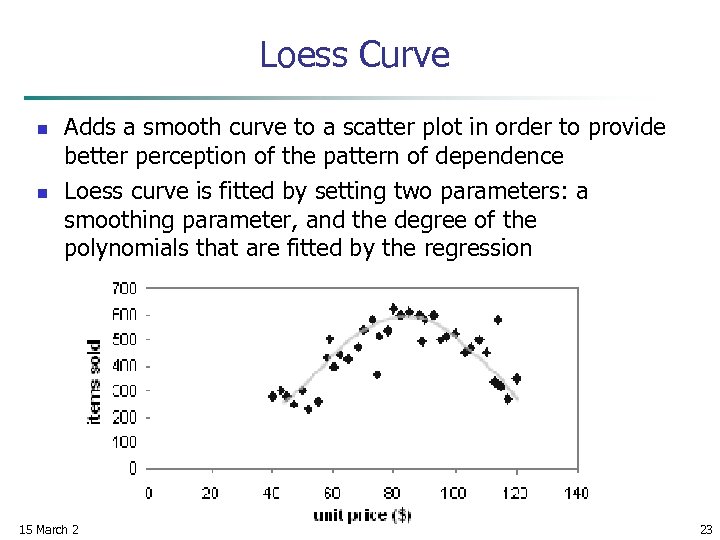 Loess Curve n n Adds a smooth curve to a scatter plot in order to provide better perception of the pattern of dependence Loess curve is fitted by setting two parameters: a smoothing parameter, and the degree of the polynomials that are fitted by the regression 15 March 2018 Data Mining: Concepts and Techniques 23
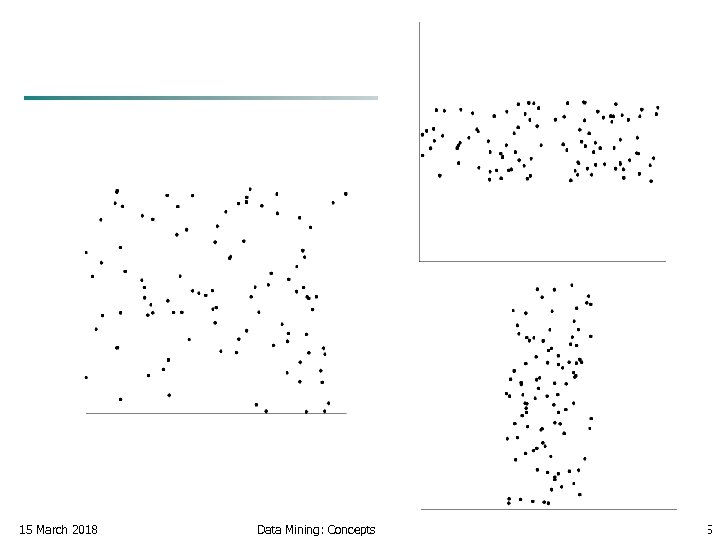
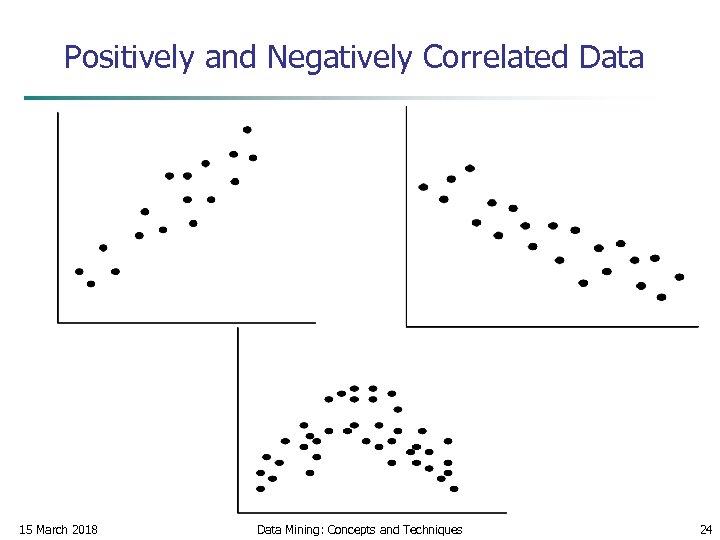 Positively and Negatively Correlated Data 15 March 2018 Data Mining: Concepts and Techniques 24
 15 March 2018 Data Mining: Concepts and Techniques 25
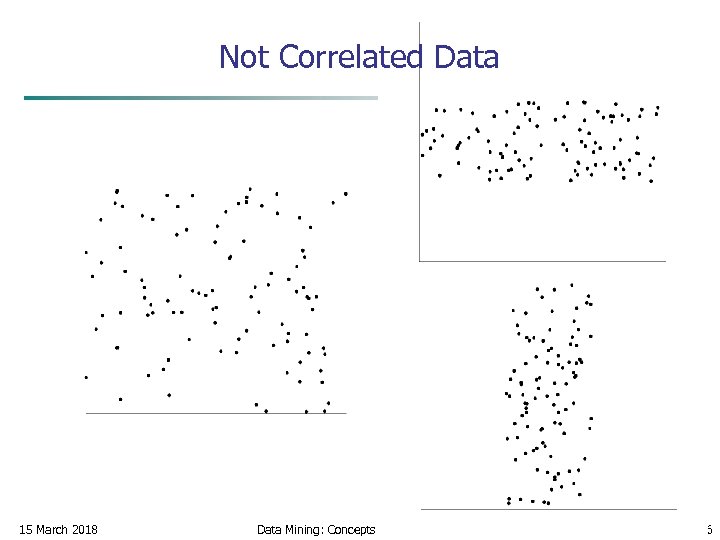 Not Correlated Data 15 March 2018 Data Mining: Concepts and Techniques 26
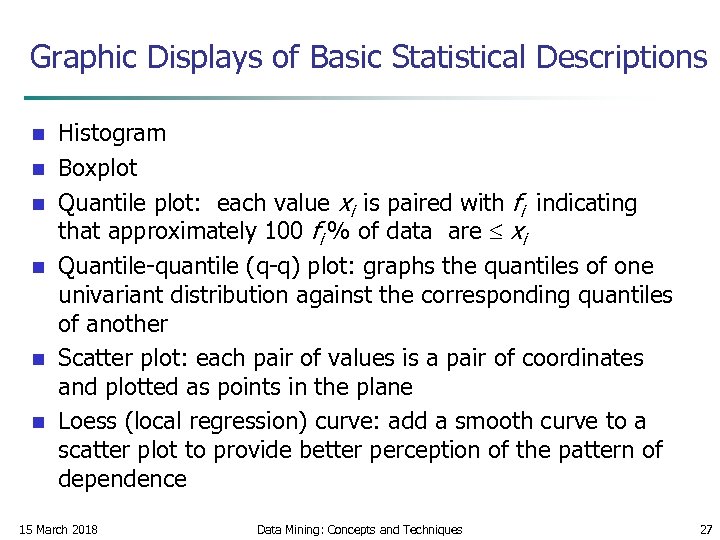 Graphic Displays of Basic Statistical Descriptions n n n Histogram Boxplot Quantile plot: each value xi is paired with fi indicating that approximately 100 fi % of data are xi Quantile-quantile (q-q) plot: graphs the quantiles of one univariant distribution against the corresponding quantiles of another Scatter plot: each pair of values is a pair of coordinates and plotted as points in the plane Loess (local regression) curve: add a smooth curve to a scatter plot to provide better perception of the pattern of dependence 15 March 2018 Data Mining: Concepts and Techniques 27
 Chapter 2: Data Preprocessing n Why preprocess the data? n Descriptive data summarization n Data cleaning n Data integration and transformation n Data reduction n Discretization and concept hierarchy generation n Summary 15 March 2018 Data Mining: Concepts and Techniques 28
 Data Cleaning n n Importance n “Data cleaning is one of the three biggest problems in data warehousing”—Ralph Kimball n “Data cleaning is the number one problem in data warehousing”—DCI survey Data cleaning tasks n Fill in missing values n Identify outliers and smooth out noisy data n Correct inconsistent data n Resolve redundancy caused by data integration 15 March 2018 Data Mining: Concepts and Techniques 29
 Missing Data n Data is not always available n n E. g. , many tuples have no recorded value for several attributes, such as customer income in sales data Missing data may be due to n equipment malfunction n inconsistent with other recorded data and thus deleted n data not entered due to misunderstanding n n certain data may not be considered important at the time of entry Missing data may need to be inferred. 15 March 2018 Data Mining: Concepts and Techniques 30
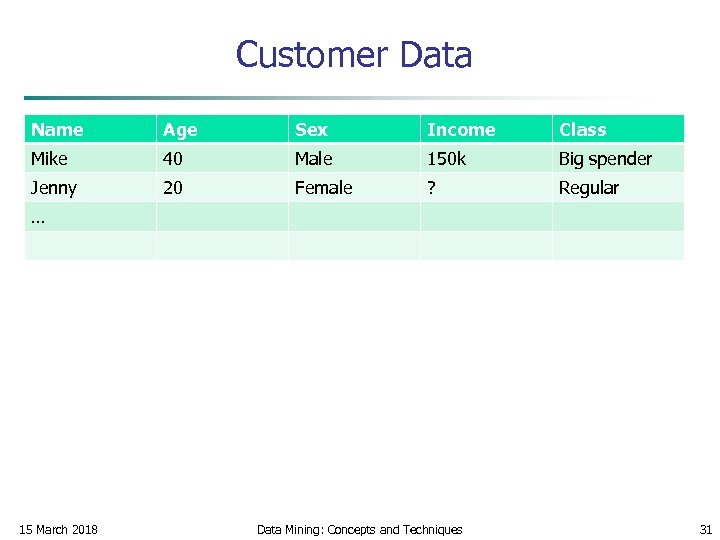 Customer Data Name Age Sex Income Class Mike 40 Male 150 k Big spender Jenny 20 Female ? Regular … 15 March 2018 Data Mining: Concepts and Techniques 31
 How to Handle Missing Data? n Ignore the tuple: usually done when class label is missing (assuming the tasks in classification—not effective when the percentage of missing values per attribute varies considerably. n Fill in the missing value manually: tedious + infeasible? n Fill in it automatically with n a global constant : e. g. , “unknown”, a new class? ! n the attribute mean for all samples belonging to the same class: smarter n the most probable value: inference-based such as Bayesian formula or decision tree (e. g. , predict my age based on the info at my web site? ) 15 March 2018 Data Mining: Concepts and Techniques 32
 Noisy Data n n Noise: random error or variance in a measured variable Incorrect attribute values may due to n faulty data collection instruments n data entry problems n data transmission problems n technology limitation n inconsistency in naming convention 15 March 2018 Data Mining: Concepts and Techniques 33
 How to Handle Noisy Data? n n Binning n first sort data and partition into (equal-frequency) bins n then one can smooth by bin means, smooth by bin median, smooth by bin boundaries, etc. Regression n smooth by fitting the data into regression functions Clustering n detect and remove outliers Combined computer and human inspection n detect suspicious values and check by human (e. g. , deal with possible outliers) 15 March 2018 Data Mining: Concepts and Techniques 34
 Simple Discretization Methods: Binning n Equal-width (distance) partitioning n Divides the range into N intervals of equal size: uniform grid n if A and B are the lowest and highest values of the attribute, the width of intervals will be: W = (B –A)/N. n n n The most straightforward, but outliers may dominate presentation Skewed data is not handled well Equal-depth (frequency) partitioning n Divides the range into N intervals, each containing approximately same number of samples n Good data scaling 15 March 2018 Data Mining: Concepts and Techniques 35
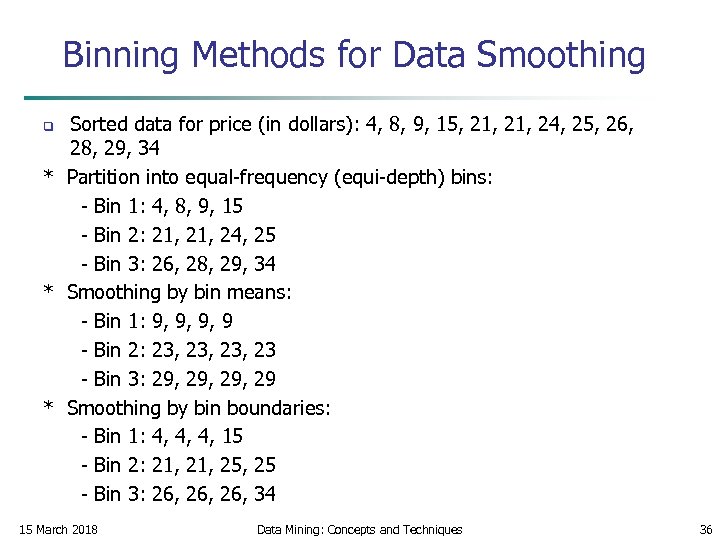 Binning Methods for Data Smoothing Sorted data for price (in dollars): 4, 8, 9, 15, 21, 24, 25, 26, 28, 29, 34 * Partition into equal-frequency (equi-depth) bins: - Bin 1: 4, 8, 9, 15 - Bin 2: 21, 24, 25 - Bin 3: 26, 28, 29, 34 * Smoothing by bin means: - Bin 1: 9, 9, 9, 9 - Bin 2: 23, 23, 23 - Bin 3: 29, 29, 29 * Smoothing by bin boundaries: - Bin 1: 4, 4, 4, 15 - Bin 2: 21, 25, 25 - Bin 3: 26, 26, 34 q 15 March 2018 Data Mining: Concepts and Techniques 36
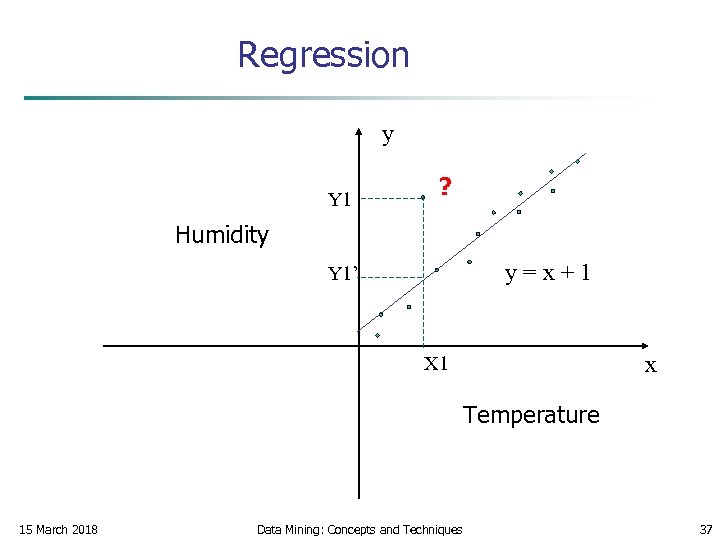 Regression y Y 1 ? Humidity y=x+1 Y 1’ x X 1 Temperature 15 March 2018 Data Mining: Concepts and Techniques 37
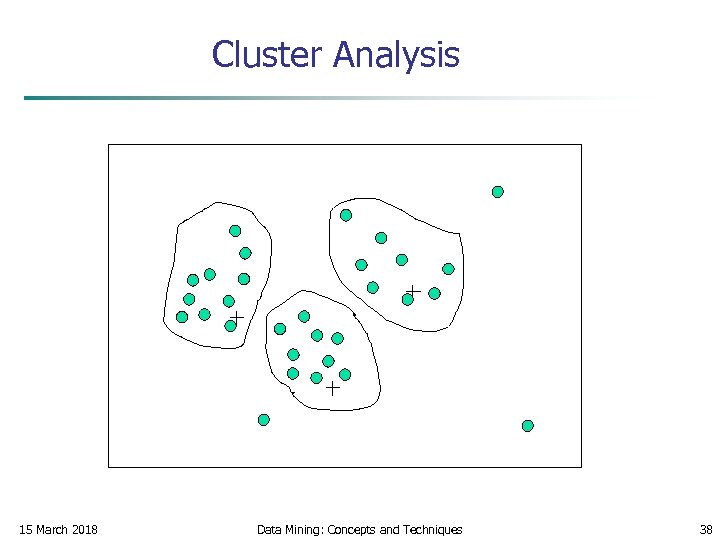 Cluster Analysis 15 March 2018 Data Mining: Concepts and Techniques 38
 Data Cleaning as a Process n Data discrepancy detection n Use metadata (e. g. , domain, range, dependency, distribution) (How many people are there in Nebraska? ) n n Check uniqueness rule, consecutive rule and null rule Use commercial tools n Data scrubbing: use simple domain knowledge (e. g. , postal code, spell-check) to detect errors and make corrections n Data auditing: by analyzing data to discover rules and relationship to detect violators (e. g. , correlation and clustering to find outliers) 15 March 2018 Data Mining: Concepts and Techniques 39
 Chapter 2: Data Preprocessing n Why preprocess the data? n Data cleaning n Data integration and transformation n Data reduction n Discretization and concept hierarchy generation n Summary 15 March 2018 Data Mining: Concepts and Techniques 40
 Data Integration n n Data integration: n Combines data from multiple sources into a coherent store Schema integration: e. g. , A. cust-id B. cust-# n Integrate metadata from different sources Entity identification problem: n Identify real world entities from multiple data sources, e. g. , Bill Clinton = William Clinton Detecting and resolving data value conflicts n For the same real world entity, attribute values from different sources are different n Possible reasons: different representations, different scales, e. g. , metric vs. British units (e. g. , GPA in US and China) 15 March 2018 Data Mining: Concepts and Techniques 41
 Handling Redundancy in Data Integration n Redundant data occur often when integration of multiple databases n Object identification: The same attribute or object may have different names in different databases n Derivable data: One attribute may be a “derived” attribute in another table, e. g. , annual revenue n Redundant attributes may be able to be detected by correlation analysis n Careful integration of the data from multiple sources may help reduce/avoid redundancies and inconsistencies and improve mining speed and quality 15 March 2018 Data Mining: Concepts and Techniques 42
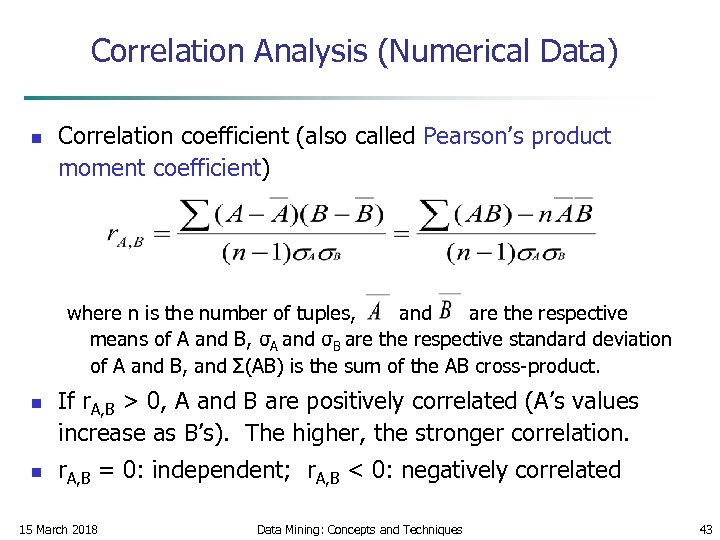 Correlation Analysis (Numerical Data) n Correlation coefficient (also called Pearson’s product moment coefficient) where n is the number of tuples, and are the respective means of A and B, σA and σB are the respective standard deviation of A and B, and Σ(AB) is the sum of the AB cross-product. n n If r. A, B > 0, A and B are positively correlated (A’s values increase as B’s). The higher, the stronger correlation. r. A, B = 0: independent; r. A, B < 0: negatively correlated 15 March 2018 Data Mining: Concepts and Techniques 43
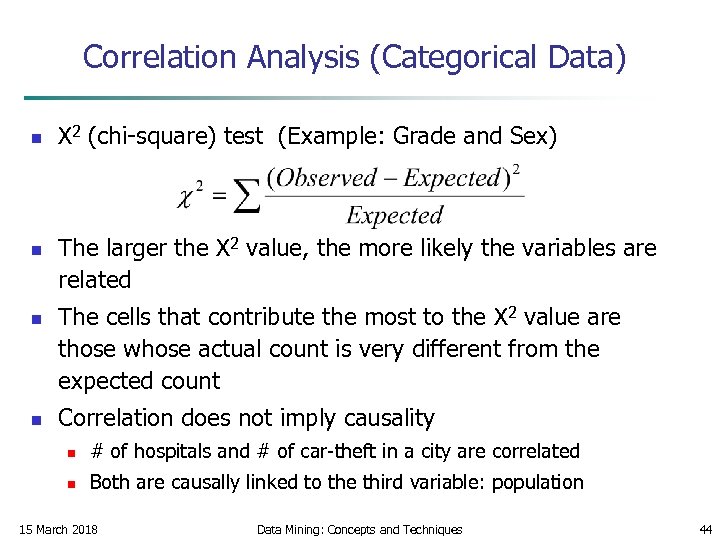 Correlation Analysis (Categorical Data) n n Χ 2 (chi-square) test (Example: Grade and Sex) The larger the Χ 2 value, the more likely the variables are related The cells that contribute the most to the Χ 2 value are those whose actual count is very different from the expected count Correlation does not imply causality n # of hospitals and # of car-theft in a city are correlated n Both are causally linked to the third variable: population 15 March 2018 Data Mining: Concepts and Techniques 44
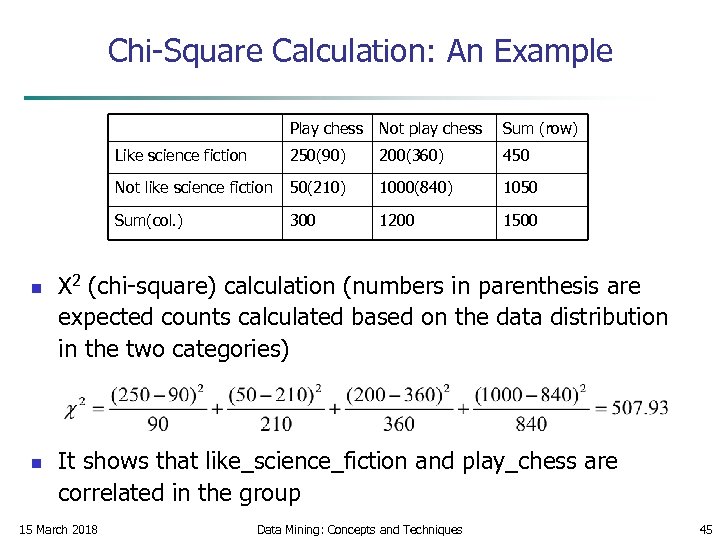 Chi-Square Calculation: An Example Play chess 250(90) 200(360) 450 Not like science fiction 50(210) 1000(840) 1050 Sum(col. ) n Sum (row) Like science fiction n Not play chess 300 1200 1500 Χ 2 (chi-square) calculation (numbers in parenthesis are expected counts calculated based on the data distribution in the two categories) It shows that like_science_fiction and play_chess are correlated in the group 15 March 2018 Data Mining: Concepts and Techniques 45
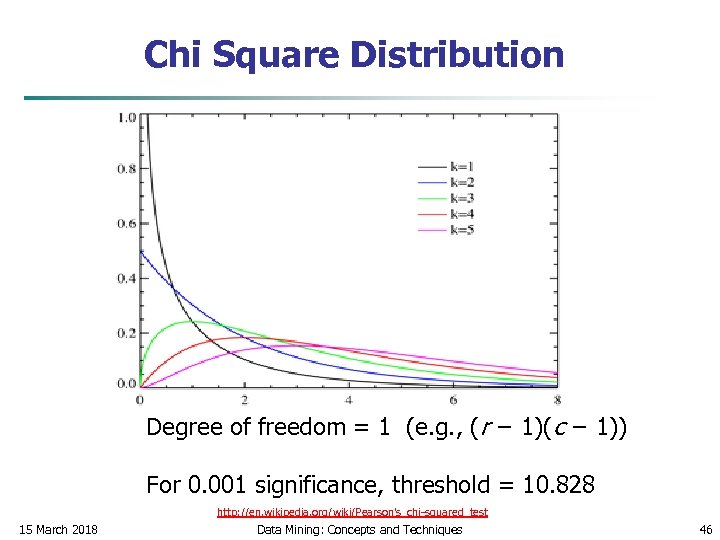 Chi Square Distribution Degree of freedom = 1 (e. g. , (r − 1)(c − 1)) For 0. 001 significance, threshold = 10. 828 http: //en. wikipedia. org/wiki/Pearson's_chi-squared_test 15 March 2018 Data Mining: Concepts and Techniques 46
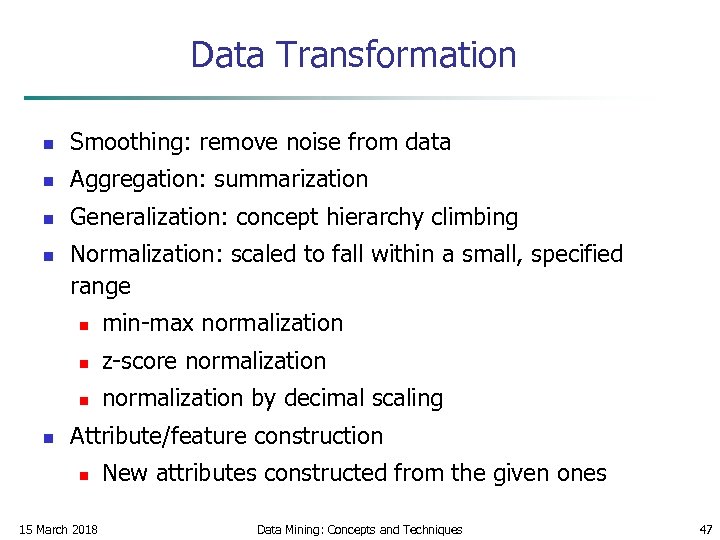 Data Transformation n Smoothing: remove noise from data n Aggregation: summarization n Generalization: concept hierarchy climbing n Normalization: scaled to fall within a small, specified range n n z-score normalization n n min-max normalization by decimal scaling Attribute/feature construction n 15 March 2018 New attributes constructed from the given ones Data Mining: Concepts and Techniques 47
![Data Transformation: Normalization n Min-max normalization: to [new_min. A, new_max. A] n n Z-score](https://present5.com/presentation/0f9dda0a81fbdf75baf4bf3ab6f3367c/image-48.jpg "Data Transformation: Normalization n Min-max normalization: to [new_min. A, new_max. A] n n Z-score") Data Transformation: Normalization n Min-max normalization: to [new_min. A, new_max. A] n n Z-score normalization (μ: mean, σ: standard deviation): n n Ex. Let income range $12, 000 to $98, 000 normalized to [0. 0, 1. 0]. Then $73, 000 is mapped to Ex. Let μ = 54, 000, σ = 16, 000. Then Normalization by decimal scaling Where j is the smallest integer such that Max(|ν’|) < 1 15 March 2018 Data Mining: Concepts and Techniques 48
Data Transformation: Normalization n Min-max normalization: to [new_min. A, new_max. A] n n Z-score normalization (μ: mean, σ: standard deviation): n n Ex. Let income range $12, 000 to $98, 000 normalized to [0. 0, 1. 0]. Then $73, 000 is mapped to Ex. Let μ = 54, 000, σ = 16, 000. Then Normalization by decimal scaling Where j is the smallest integer such that Max(|ν’|) < 1 15 March 2018 Data Mining: Concepts and Techniques 48
 Chapter 2: Data Preprocessing n Why preprocess the data? n Data cleaning n Data integration and transformation n Data reduction n Discretization and concept hierarchy generation n Summary 15 March 2018 Data Mining: Concepts and Techniques 49
 Data Reduction Strategies n n n Why data reduction? n A database/data warehouse may store terabytes of data n Complex data analysis/mining may take a very long time to run on the complete data set Data reduction n Obtain a reduced representation of the data set that is much smaller in volume but yet produce the same (or almost the same) analytical results Data reduction strategies n Data cube aggregation: n Dimensionality reduction — e. g. , remove unimportant attributes n Data Compression n Numerosity reduction — e. g. , fit data into models n Discretization and concept hierarchy generation 15 March 2018 Data Mining: Concepts and Techniques 50
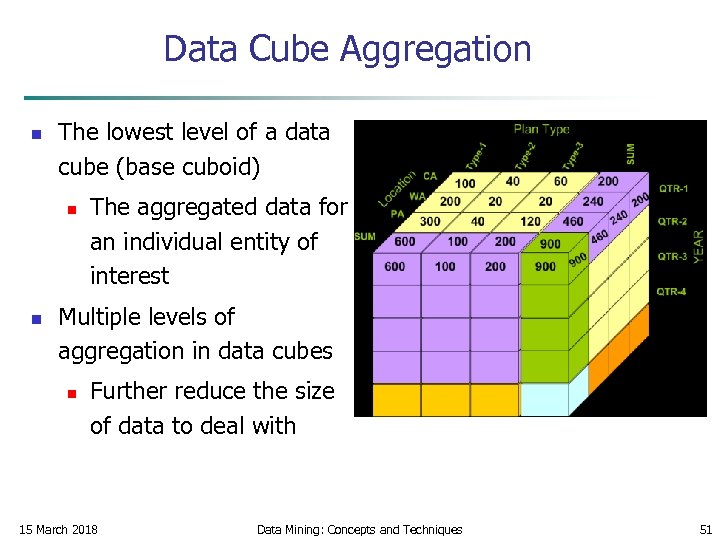 Data Cube Aggregation n The lowest level of a data cube (base cuboid) n n The aggregated data for an individual entity of interest Multiple levels of aggregation in data cubes n Further reduce the size of data to deal with 15 March 2018 Data Mining: Concepts and Techniques 51
 Attribute Subset Selection n n Feature selection (i. e. , attribute subset selection): n Select a minimum set of features such that the probability distribution of different classes given the values for those features is as close as possible to the original distribution given the values of all features n reduce # of patterns in the patterns, easier to understand Heuristic methods (due to exponential # of choices): n Step-wise forward selection n Step-wise backward elimination n Combining forward selection and backward elimination n Decision-tree induction 15 March 2018 Data Mining: Concepts and Techniques 52
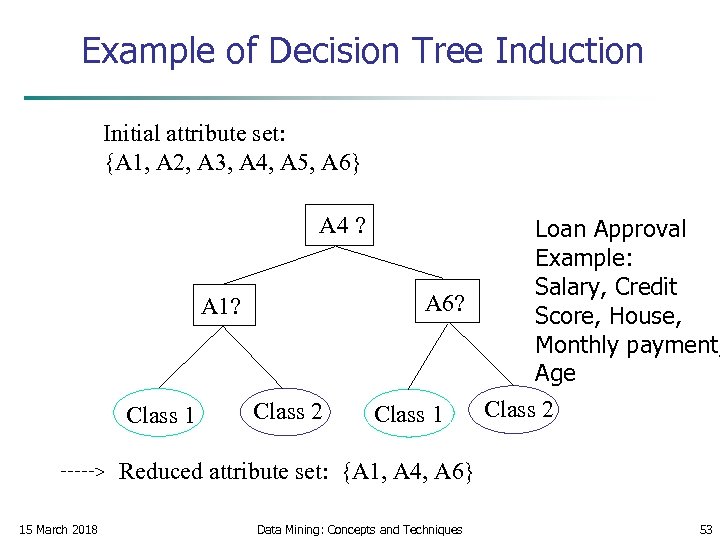 Example of Decision Tree Induction Initial attribute set: {A 1, A 2, A 3, A 4, A 5, A 6} A 4 ? A 1? Class 1 > 15 March 2018 Class 2 Loan Approval Example: Salary, Credit A 6? Score, House, Monthly payment, Age Class 2 Class 1 Reduced attribute set: {A 1, A 4, A 6} Data Mining: Concepts and Techniques 53
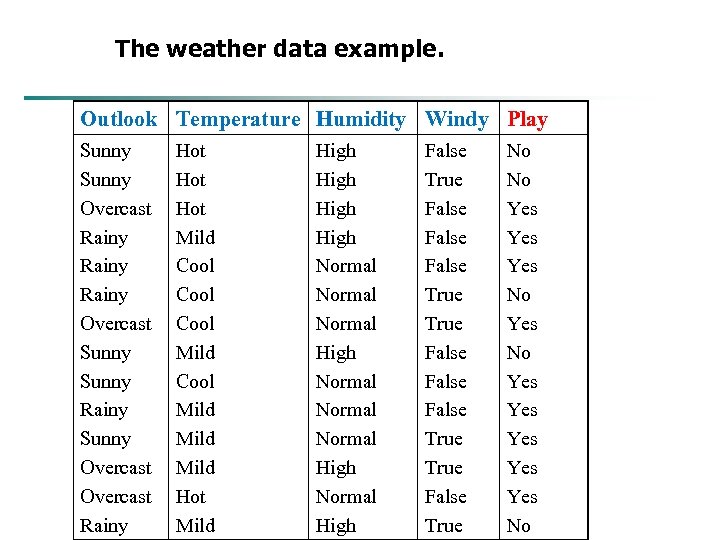 The weather data example. Outlook Temperature Humidity Windy Play Sunny Overcast Rainy Overcast Sunny Rainy Sunny Overcast Rainy Hot Hot Mild Cool Mild Hot Mild High Normal Normal High False True False False True False True No No Yes Yes Yes No
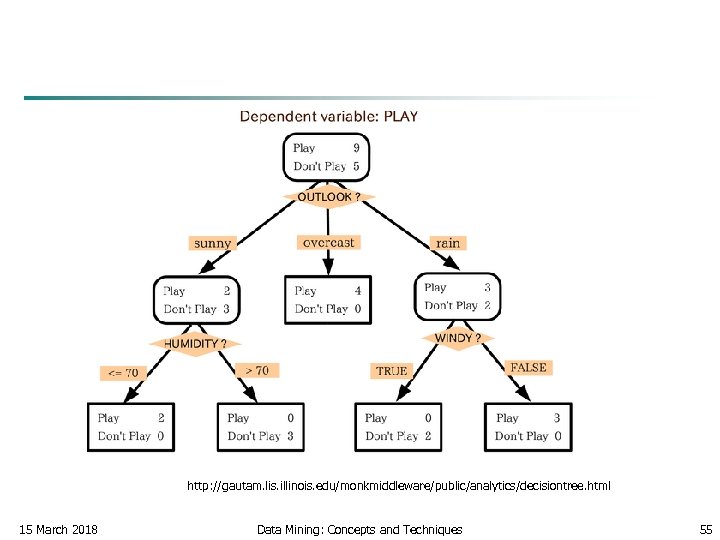 http: //gautam. lis. illinois. edu/monkmiddleware/public/analytics/decisiontree. html 15 March 2018 Data Mining: Concepts and Techniques 55
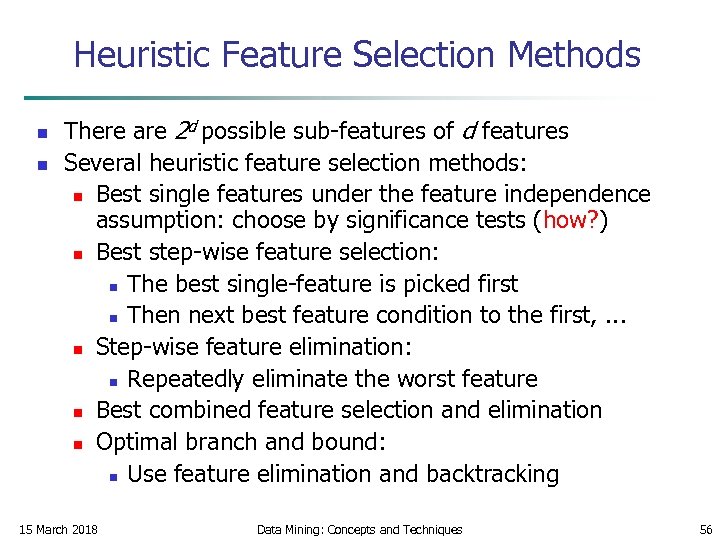 Heuristic Feature Selection Methods n n There are 2 d possible sub-features of d features Several heuristic feature selection methods: n Best single features under the feature independence assumption: choose by significance tests (how? ) n Best step-wise feature selection: n The best single-feature is picked first n Then next best feature condition to the first, . . . n Step-wise feature elimination: n Repeatedly eliminate the worst feature n Best combined feature selection and elimination n Optimal branch and bound: n Use feature elimination and backtracking 15 March 2018 Data Mining: Concepts and Techniques 56
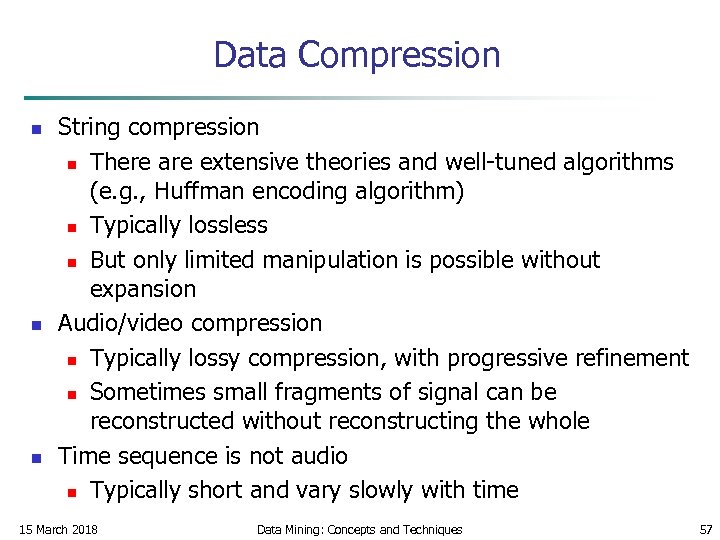 Data Compression n String compression n There are extensive theories and well-tuned algorithms (e. g. , Huffman encoding algorithm) n Typically lossless n But only limited manipulation is possible without expansion Audio/video compression n Typically lossy compression, with progressive refinement n Sometimes small fragments of signal can be reconstructed without reconstructing the whole Time sequence is not audio n Typically short and vary slowly with time 15 March 2018 Data Mining: Concepts and Techniques 57
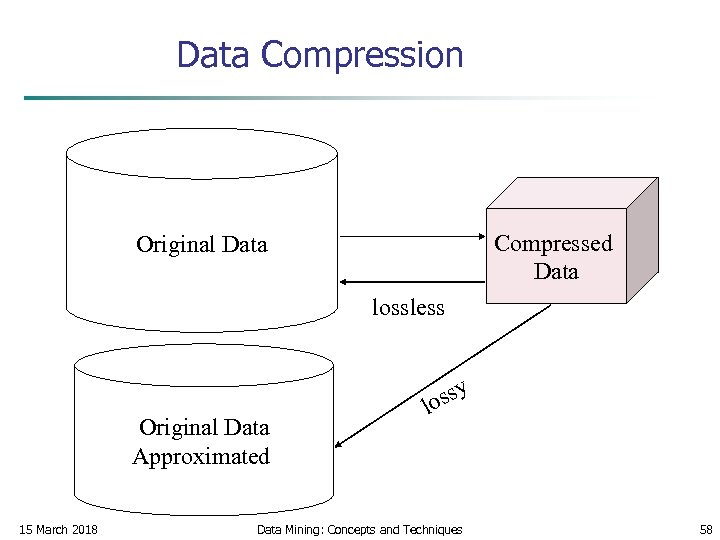 Data Compression Compressed Data Original Data lossless Original Data Approximated 15 March 2018 ssy lo Data Mining: Concepts and Techniques 58
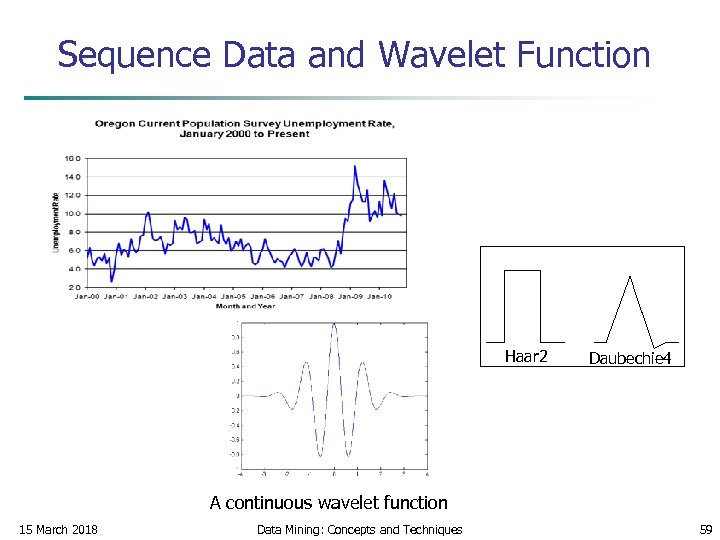 Sequence Data and Wavelet Function Haar 2 Daubechie 4 A continuous wavelet function 15 March 2018 Data Mining: Concepts and Techniques 59
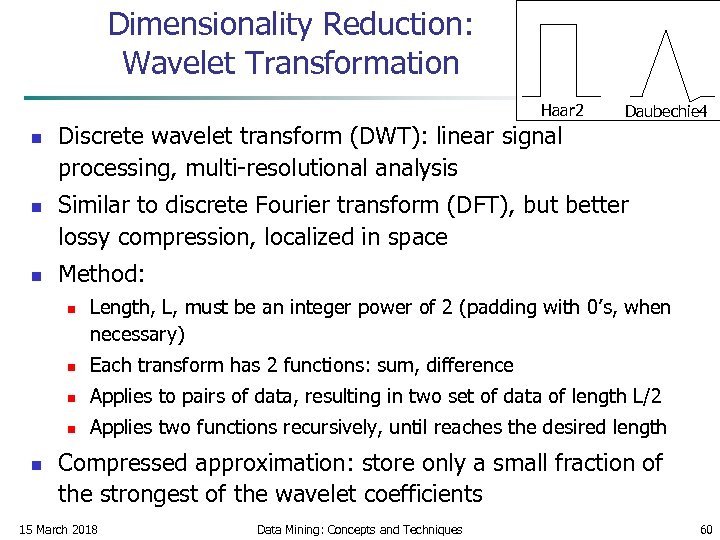 Dimensionality Reduction: Wavelet Transformation Haar 2 n n n Discrete wavelet transform (DWT): linear signal processing, multi-resolutional analysis Daubechie 4 Similar to discrete Fourier transform (DFT), but better lossy compression, localized in space Method: n Length, L, must be an integer power of 2 (padding with 0’s, when necessary) n n Applies to pairs of data, resulting in two set of data of length L/2 n n Each transform has 2 functions: sum, difference Applies two functions recursively, until reaches the desired length Compressed approximation: store only a small fraction of the strongest of the wavelet coefficients 15 March 2018 Data Mining: Concepts and Techniques 60
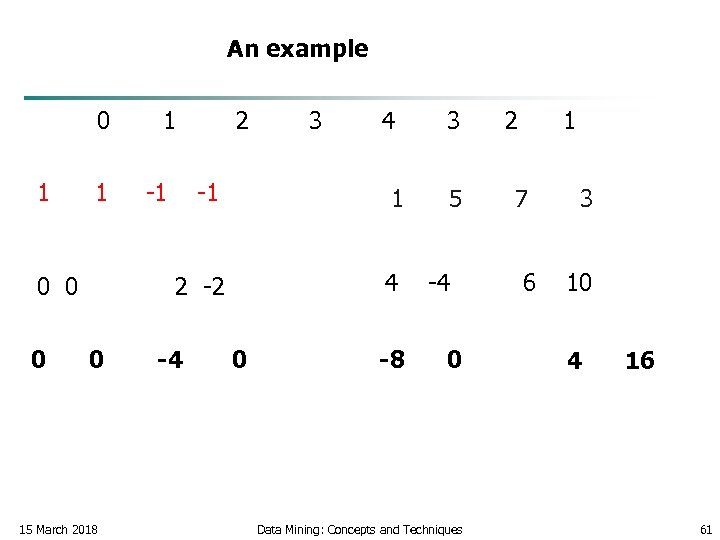 An example 0 1 2 3 4 3 2 1 1 1 -1 1 5 7 3 0 0 4 -4 0 2 -2 0 15 March 2018 -4 0 -8 0 Data Mining: Concepts and Techniques 6 10 4 16 61
 15 March 2018 Data Mining: Concepts and Techniques 62
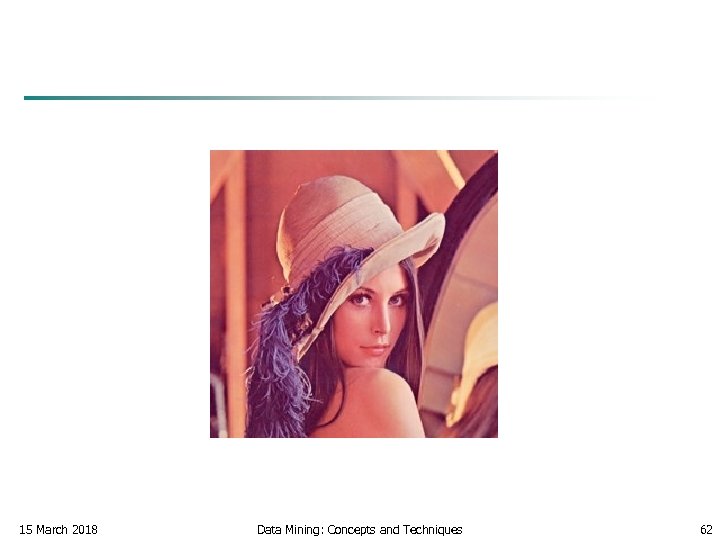
 History of Lena Image n Alexander Sawchuk estimates that it was in June or July of 1973 when he, then an assistant professor of electrical engineering at the University of Southern California Signal and Image Processing Institute (SIPI), was hurriedly searching the lab for a good image to scan for a colleague's conference paper. They wanted something glossy to ensure good output dynamic range, and they wanted a human face. Just then, somebody happened to walk in with a recent issue of Playboy. 15 March 2018 Data Mining: Concepts and Techniques 63
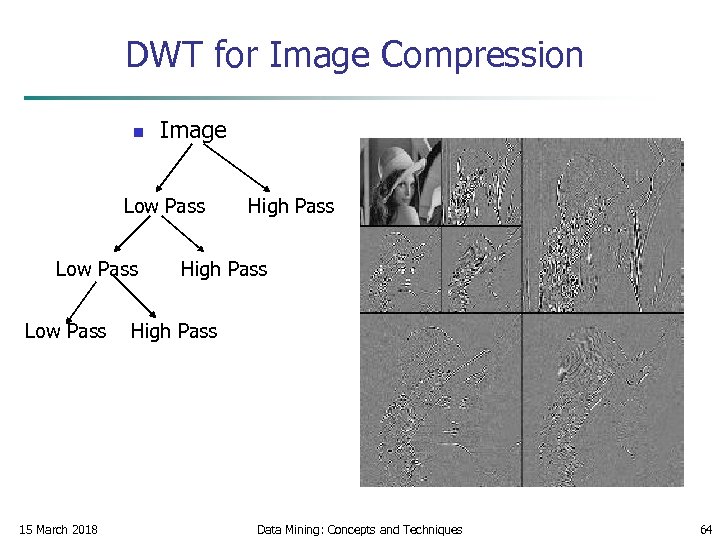 DWT for Image Compression n Image Low Pass High Pass 15 March 2018 Data Mining: Concepts and Techniques 64
 Wavelet Compression Demo http: //www. codeproject. com/Articles/20869/2 D-Fast-Wavelet-Transform-Library-for-Image-Proces 15 March 2018 Data Mining: Concepts and Techniques 65
 Dimensionality Reduction: Principal Component Analysis (PCA) n n n Given N data vectors from d-dimensions, find k ≤ d orthogonal vectors (principal components) that can be best used to represent data Steps n Normalize input data n Compute k orthonormal (unit) vectors, i. e. , principal components n The principal components are sorted in order of decreasing “significance” or strength n Since the components are sorted, the size of the data can be reduced by eliminating the weak components, i. e. , those with low variance. (i. e. , using the strongest principal components, it is possible to reconstruct a good approximation of the original data) Used when the number of dimensions is large 15 March 2018 Data Mining: Concepts and Techniques 66
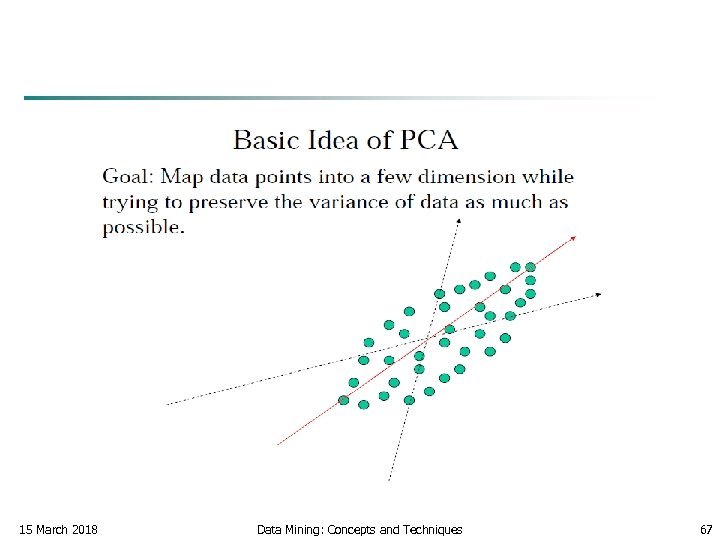 15 March 2018 Data Mining: Concepts and Techniques 67
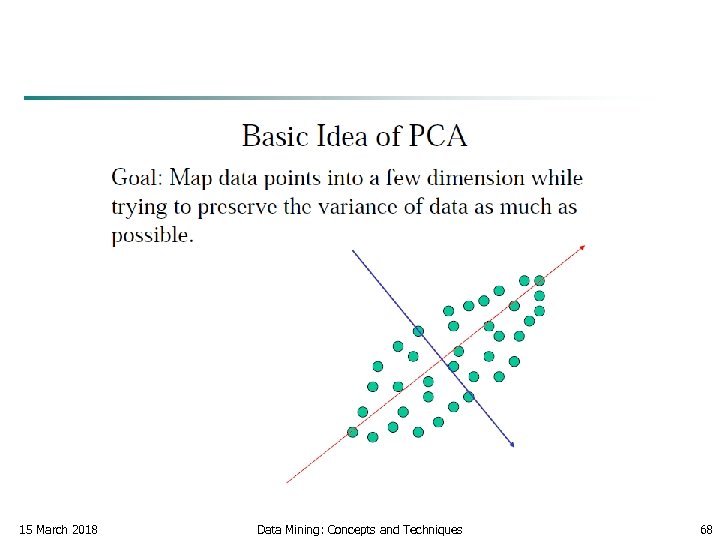 15 March 2018 Data Mining: Concepts and Techniques 68
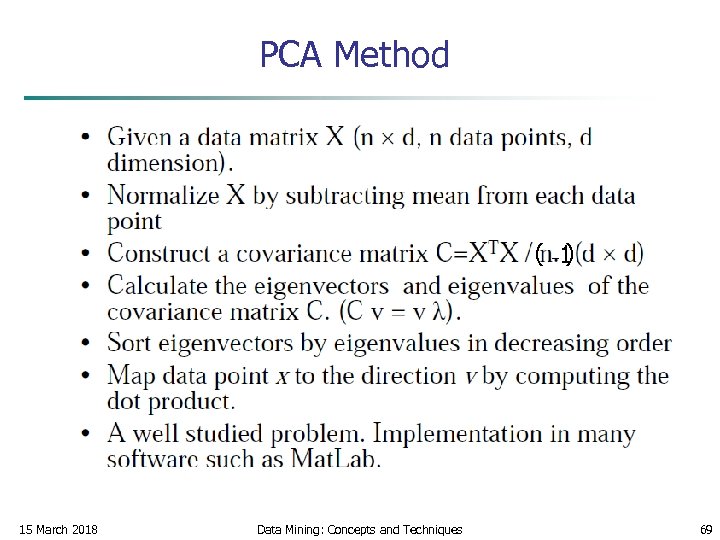 PCA Method ) ( 1 15 March 2018 Data Mining: Concepts and Techniques 69
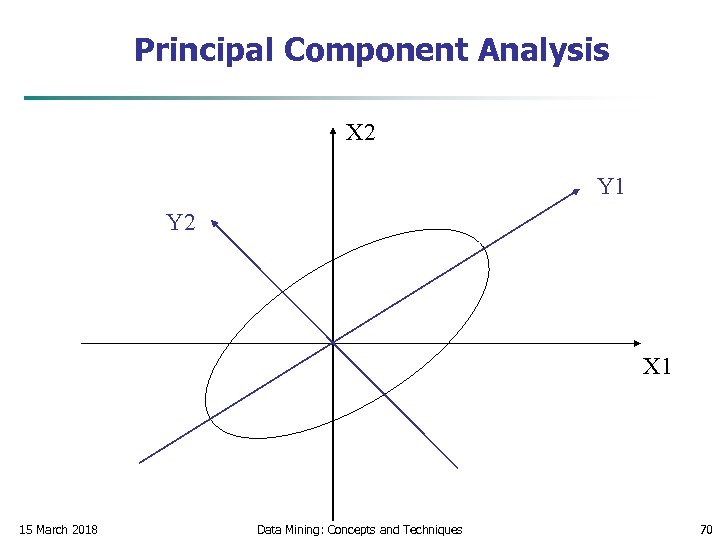 Principal Component Analysis X 2 Y 1 Y 2 X 1 15 March 2018 Data Mining: Concepts and Techniques 70
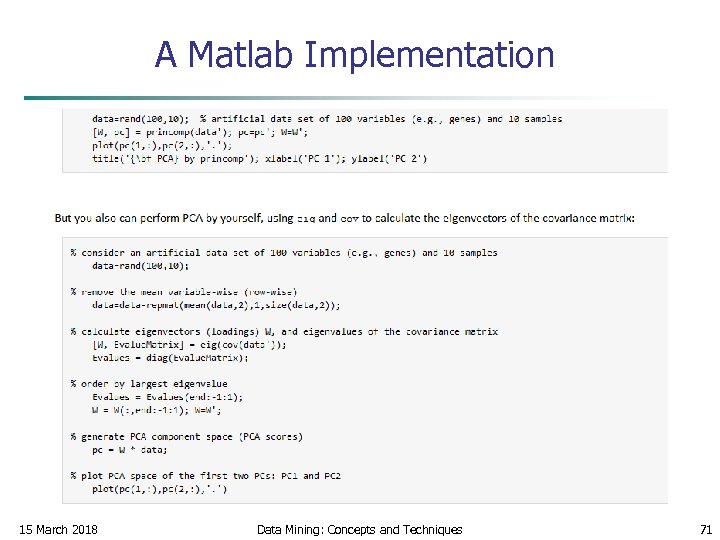 A Matlab Implementation 15 March 2018 Data Mining: Concepts and Techniques 71
 Numerosity Reduction n Reduce data volume by choosing alternative, smaller forms of data representation Parametric methods n Assume the data fits some model, estimate model parameters, store only the parameters, and discard the data (except possible outliers) Non-parametric methods n Do not assume models n Major families: histograms, clustering, sampling 15 March 2018 Data Mining: Concepts and Techniques 72
 Data Reduction Method (1): Regression Models n Linear regression: Data are modeled to fit a straight line n n Often uses the least-square method to fit the line Multiple regression: allows a response variable Y to be modeled as a linear function of multidimensional feature vector 15 March 2018 Data Mining: Concepts and Techniques 73
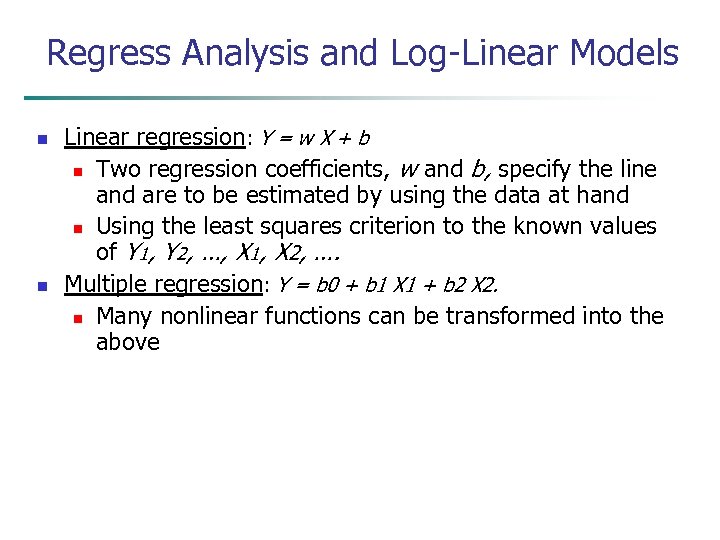 Regress Analysis and Log-Linear Models n n Linear regression: Y = w X + b n Two regression coefficients, w and b, specify the line and are to be estimated by using the data at hand n Using the least squares criterion to the known values of Y 1, Y 2, …, X 1, X 2, …. Multiple regression: Y = b 0 + b 1 X 1 + b 2 X 2. n Many nonlinear functions can be transformed into the above
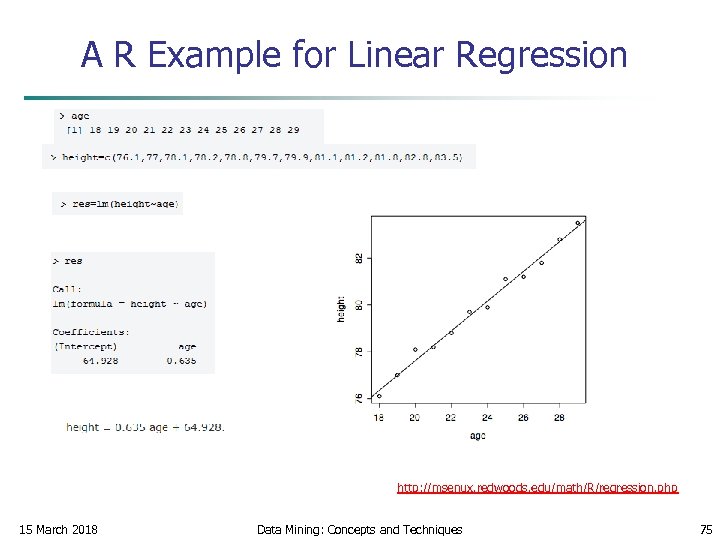 A R Example for Linear Regression http: //msenux. redwoods. edu/math/R/regression. php 15 March 2018 Data Mining: Concepts and Techniques 75
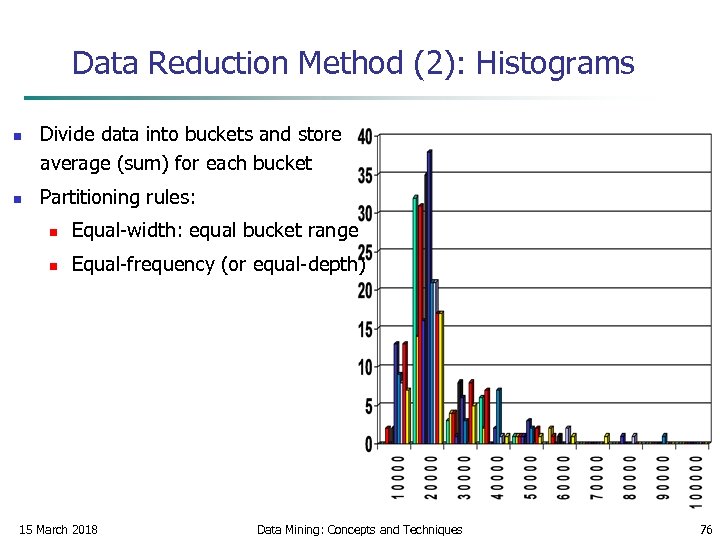 Data Reduction Method (2): Histograms n n Divide data into buckets and store average (sum) for each bucket Partitioning rules: n Equal-width: equal bucket range n Equal-frequency (or equal-depth) 15 March 2018 Data Mining: Concepts and Techniques 76
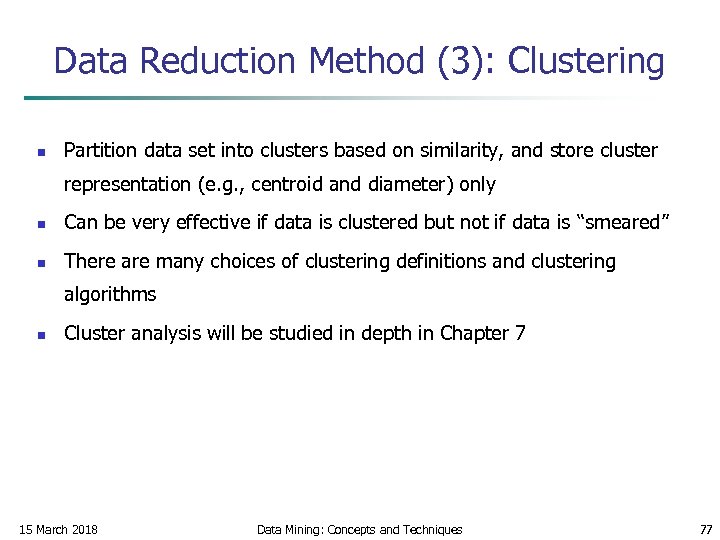 Data Reduction Method (3): Clustering n Partition data set into clusters based on similarity, and store cluster representation (e. g. , centroid and diameter) only n Can be very effective if data is clustered but not if data is “smeared” n There are many choices of clustering definitions and clustering algorithms n Cluster analysis will be studied in depth in Chapter 7 15 March 2018 Data Mining: Concepts and Techniques 77
 Data Reduction Method (4): Sampling n n Sampling: obtaining a small sample s to represent the whole data set N Allow a mining algorithm to run in complexity that is potentially sub-linear to the size of the data Choose a representative subset of the data n Simple random sampling may have very poor performance in the presence of skew Develop adaptive sampling methods n Stratified sampling: n Approximate the percentage of each class (or subpopulation of interest) in the overall database n Used in conjunction with skewed data 15 March 2018 Data Mining: Concepts and Techniques 78
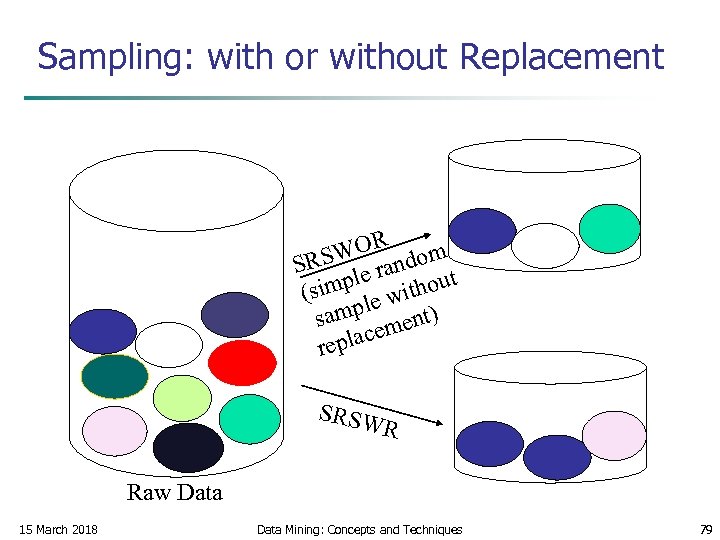 Sampling: with or without Replacement WOR ndom SRS le ra t simp e withou ( l samp ment) place re SRSW R Raw Data 15 March 2018 Data Mining: Concepts and Techniques 79
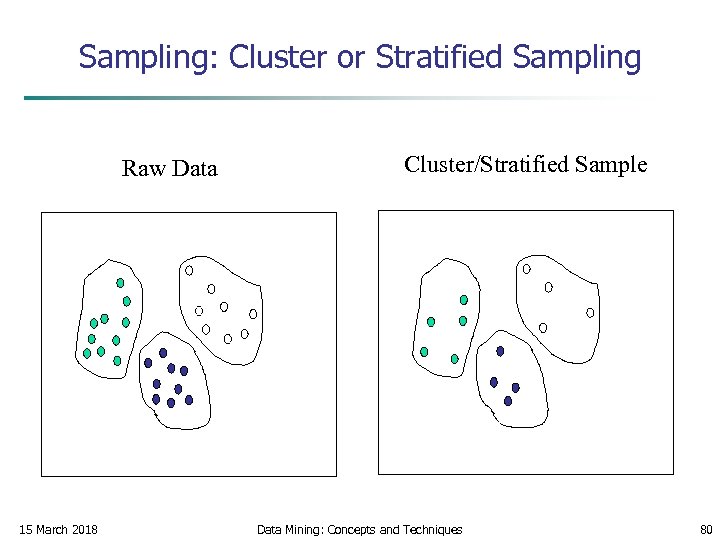 Sampling: Cluster or Stratified Sampling Raw Data 15 March 2018 Cluster/Stratified Sample Data Mining: Concepts and Techniques 80
 Chapter 2: Data Preprocessing n Why preprocess the data? n Data cleaning n Data integration and transformation n Data reduction n Discretization and concept hierarchy generation n Summary 15 March 2018 Data Mining: Concepts and Techniques 81
 Discretization n Three types of attributes: n Nominal — values from an unordered set, e. g. , color, profession n Ordinal — values from an ordered set, e. g. , military or academic rank n n Continuous — real numbers, e. g. , integer or real numbers Discretization: n Divide the range of a continuous attribute into intervals n Some classification algorithms only accept categorical attributes. n Reduce data size by discretization 15 March 2018 Data Mining: Concepts and Techniques 82
 Discretization and Concept Hierarchy n Discretization n Reduce the number of values for a given continuous attribute by dividing the range of the attribute into intervals n n Supervised vs. unsupervised n Split (top-down) vs. merge (bottom-up) n n Interval labels can then be used to replace actual data values Discretization can be performed recursively on an attribute Concept hierarchy formation n Recursively reduce the data by collecting and replacing low level concepts (such as numeric values for age) by higher level concepts (such as young, middle-aged, or senior) 15 March 2018 Data Mining: Concepts and Techniques 83
 Discretization and Concept Hierarchy Generation for Numeric Data n Typical methods: All the methods can be applied recursively n Binning n n Histogram analysis n n Top-down split, unsupervised, Top-down split, unsupervised Clustering analysis n Either top-down split or bottom-up merge, unsupervised n Entropy-based discretization: supervised, top-down split n Interval merging by 2 Analysis: supervised, bottom-up merge 15 March 2018 Data Mining: Concepts and Techniques 84
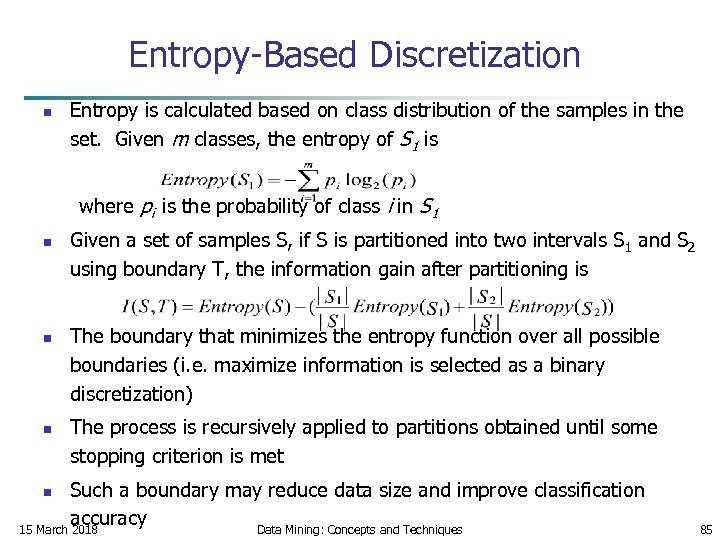 Entropy-Based Discretization n Entropy is calculated based on class distribution of the samples in the set. Given m classes, the entropy of S 1 is where pi is the probability of class i in S 1 n n n Given a set of samples S, if S is partitioned into two intervals S 1 and S 2 using boundary T, the information gain after partitioning is The boundary that minimizes the entropy function over all possible boundaries (i. e. maximize information is selected as a binary discretization) The process is recursively applied to partitions obtained until some stopping criterion is met Such a boundary may reduce data size and improve classification accuracy 15 March 2018 Data Mining: Concepts and Techniques n 85
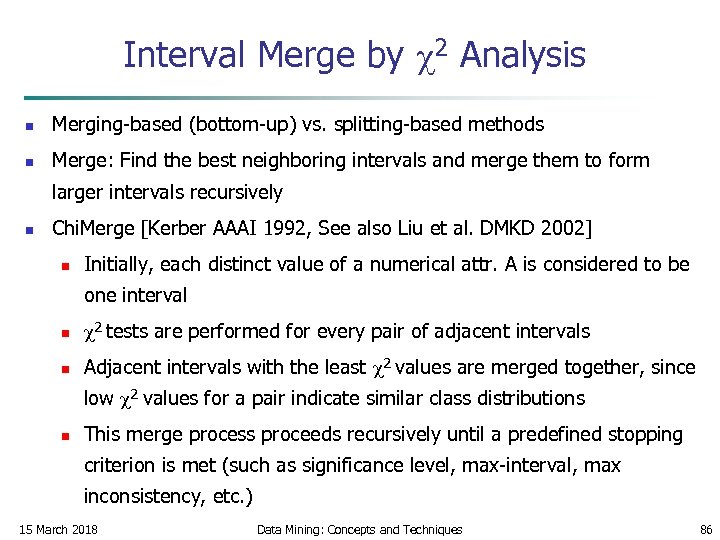 Interval Merge by 2 Analysis n Merging-based (bottom-up) vs. splitting-based methods n Merge: Find the best neighboring intervals and merge them to form larger intervals recursively n Chi. Merge [Kerber AAAI 1992, See also Liu et al. DMKD 2002] n Initially, each distinct value of a numerical attr. A is considered to be one interval n 2 tests are performed for every pair of adjacent intervals n Adjacent intervals with the least 2 values are merged together, since low 2 values for a pair indicate similar class distributions n This merge process proceeds recursively until a predefined stopping criterion is met (such as significance level, max-interval, max inconsistency, etc. ) 15 March 2018 Data Mining: Concepts and Techniques 86
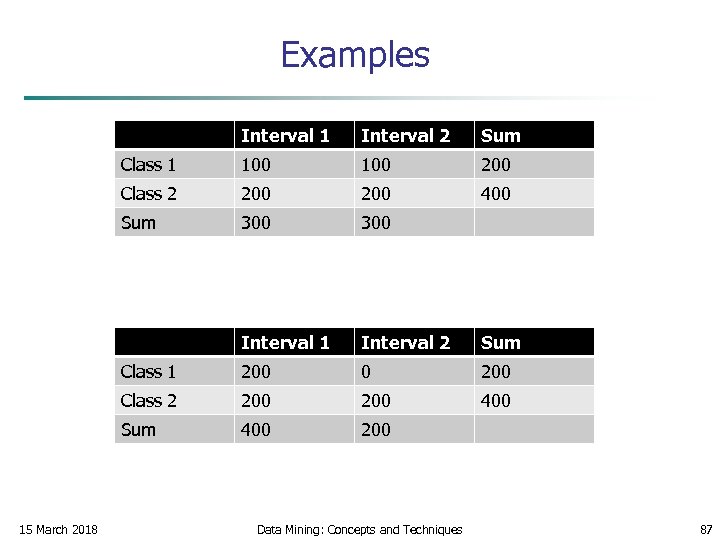 Examples Interval 1 Sum Class 1 100 200 Class 2 200 400 Sum 300 Interval 1 Interval 2 Sum Class 1 200 0 200 Class 2 200 400 Sum 15 March 2018 Interval 2 400 200 Data Mining: Concepts and Techniques 87
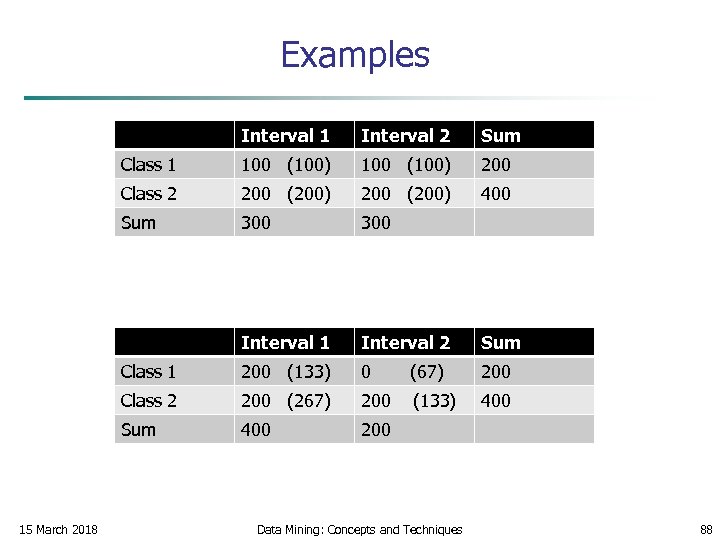 Examples Interval 1 Sum Class 1 100 (100) 200 Class 2 200 (200) 400 Sum 300 Interval 1 Interval 2 Sum Class 1 200 (133) 0 (67) 200 Class 2 200 (267) 200 (133) 400 Sum 15 March 2018 Interval 2 400 200 Data Mining: Concepts and Techniques 88
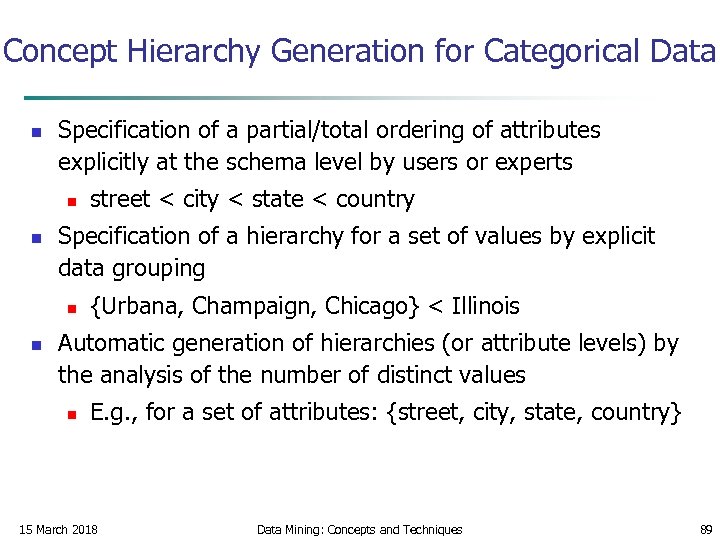 Concept Hierarchy Generation for Categorical Data n Specification of a partial/total ordering of attributes explicitly at the schema level by users or experts n n Specification of a hierarchy for a set of values by explicit data grouping n n street < city < state < country {Urbana, Champaign, Chicago} < Illinois Automatic generation of hierarchies (or attribute levels) by the analysis of the number of distinct values n E. g. , for a set of attributes: {street, city, state, country} 15 March 2018 Data Mining: Concepts and Techniques 89
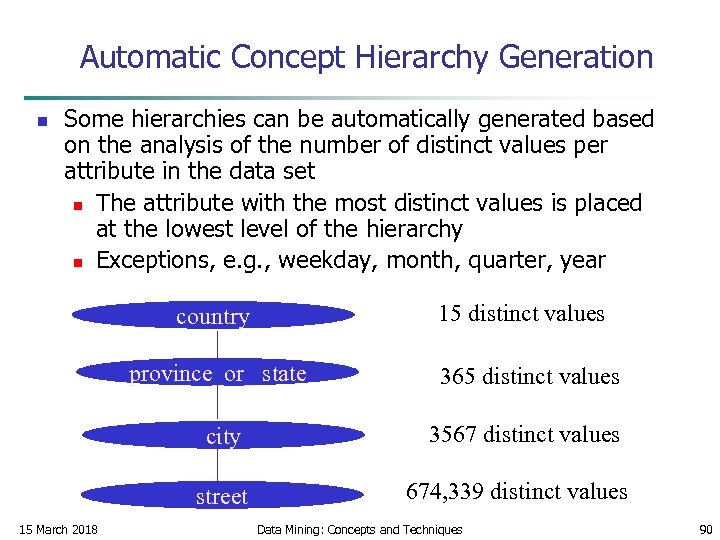 Automatic Concept Hierarchy Generation n Some hierarchies can be automatically generated based on the analysis of the number of distinct values per attribute in the data set n The attribute with the most distinct values is placed at the lowest level of the hierarchy n Exceptions, e. g. , weekday, month, quarter, year 15 distinct values country province_or_ state 365 distinct values city 3567 distinct values street 15 March 2018 674, 339 distinct values Data Mining: Concepts and Techniques 90
 Chapter 2: Data Preprocessing n Why preprocess the data? n Data cleaning n Data integration and transformation n Data reduction n Discretization and concept hierarchy generation n Summary 15 March 2018 Data Mining: Concepts and Techniques 91
 Summary n n n Data preparation or preprocessing is a big issue for both data warehousing and data mining Descriptive data summarization is needed for quality data preprocessing Data preparation includes n n Data reduction and feature selection n n Data cleaning and data integration Discretization A lot a methods have been developed but data preprocessing still an active area of research 15 March 2018 Data Mining: Concepts and Techniques 92
 References n D. P. Ballou and G. K. Tayi. Enhancing data quality in data warehouse environments. Communications of ACM, 42: 73 -78, 1999 n T. Dasu and T. Johnson. Exploratory Data Mining and Data Cleaning. John Wiley & Sons, 2003 n T. Dasu, T. Johnson, S. Muthukrishnan, V. Shkapenyuk. Mining Database Structure; Or, How to Build a Data Quality Browser. SIGMOD’ 02. n H. V. Jagadish et al. , Special Issue on Data Reduction Techniques. Bulletin of the Technical Committee on Data Engineering, 20(4), December 1997 n D. Pyle. Data Preparation for Data Mining. Morgan Kaufmann, 1999 n E. Rahm and H. H. Do. Data Cleaning: Problems and Current Approaches. IEEE Bulletin of the Technical Committee on Data Engineering. Vol. 23, No. 4 n V. Raman and J. Hellerstein. Potters Wheel: An Interactive Framework for Data Cleaning and Transformation, VLDB’ 2001 n T. Redman. Data Quality: Management and Technology. Bantam Books, 1992 n Y. Wand R. Wang. Anchoring data quality dimensions ontological foundations. Communications of ACM, 39: 86 -95, 1996 n R. Wang, V. Storey, and C. Firth. A framework for analysis of data quality research. IEEE Trans. Knowledge and Data Engineering, 7: 623 -640, 1995 15 March 2018 Data Mining: Concepts and Techniques 93