


 Скачать презентацию Data Mining Concepts and Techniques Jianlin Cheng Department
e18f442039ff1a641898d785365a3932.ppt
- Количество слайдов: 140
 Data Mining: Concepts and Techniques Jianlin Cheng Department of Computer Science University of Missouri, Columbia Customized and Revised from Slides of the Text Book © 2006 Jiawei Han and Micheline Kamber, All rights reserved 19 March 2018 Data Mining: Concepts and Techniques 1
 Chapter 7. Cluster Analysis 1. What is Cluster Analysis? 2. Types of Data in Cluster Analysis 3. A Categorization of Major Clustering Methods 4. Partitioning Methods 5. Hierarchical Methods 6. Density-Based Methods 7. Grid-Based Methods 8. Model-Based Methods 9. Clustering High-Dimensional Data 10. Constraint-Based Clustering 11. Outlier Analysis 12. Summary 19 March 2018 Data Mining: Concepts and Techniques 2
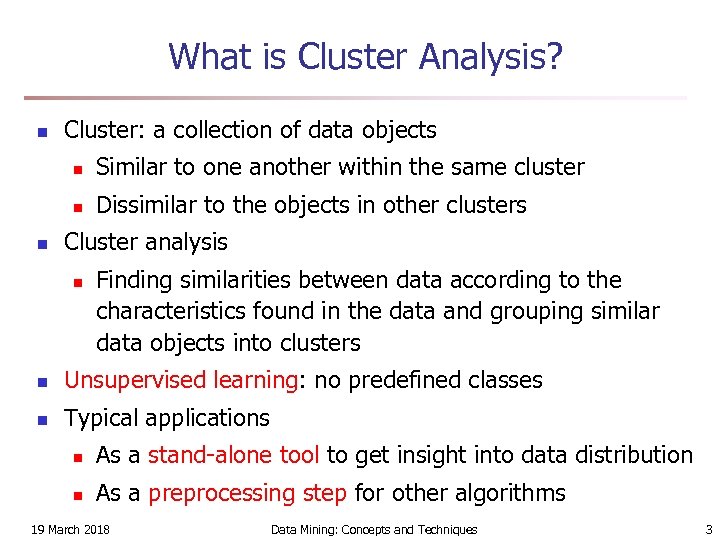 What is Cluster Analysis? n Cluster: a collection of data objects n n n Similar to one another within the same cluster Dissimilar to the objects in other clusters Cluster analysis n Finding similarities between data according to the characteristics found in the data and grouping similar data objects into clusters n Unsupervised learning: no predefined classes n Typical applications n As a stand-alone tool to get insight into data distribution n As a preprocessing step for other algorithms 19 March 2018 Data Mining: Concepts and Techniques 3
 Clustering: Rich Applications and Multidisciplinary Efforts n Pattern Recognition n Spatial Data Analysis n Detect spatial clusters or for spatial mining tasks n Image Processing n Economic Science (especially market research) n Bioinformatics (e. g. clustering gene expression data) n WWW n n Document classification Cluster Weblog data to discover groups of similar access patterns 19 March 2018 Data Mining: Concepts and Techniques 4
 Examples of Clustering Applications n Marketing: Help marketers discover distinct groups in their customer bases, and then use this knowledge to develop targeted marketing programs n Land use: Identification of areas of similar land use in an earth observation database n Insurance: Identifying groups of motor insurance policy holders with a high average claim cost n City-planning: Identifying groups of houses according to their house type, value, and geographical location n Earth-quake studies: Observed earth quake epicenters should be clustered along continent faults 19 March 2018 Data Mining: Concepts and Techniques 5
 Quality: What Is Good Clustering? n A good clustering method will produce high quality clusters with n n n high intra-class similarity low inter-class similarity The quality of a clustering result depends on both the similarity measure used by the method and its implementation n The quality of a clustering method is also measured by its ability to discover some or all of the hidden patterns 19 March 2018 Data Mining: Concepts and Techniques 6
 Measure the Quality of Clustering n n n Dissimilarity/Similarity metric: Similarity is expressed in terms of a distance function, typically metric: d(i, j) There is a separate “quality” function that measures the “goodness” of a cluster. The definitions of distance functions are usually very different for interval-scaled, boolean, categorical, ordinal ratio, and vector variables. Weights should be associated with different variables based on applications and data semantics. It is hard to define “similar enough” or “good enough” n the answer is typically highly subjective. 19 March 2018 Data Mining: Concepts and Techniques 7
 Requirements of Clustering in Data Mining n Scalability n Ability to deal with different types of attributes n Ability to handle dynamic data n Discovery of clusters with arbitrary shape n Minimal requirements for domain knowledge to determine input parameters n Able to deal with noise and outliers n Insensitive to order of input records n High dimensionality n Incorporation of user-specified constraints n Interpretability and usability 19 March 2018 Data Mining: Concepts and Techniques 8
 Chapter 7. Cluster Analysis 1. What is Cluster Analysis? 2. Types of Data in Cluster Analysis 3. A Categorization of Major Clustering Methods 4. Partitioning Methods 5. Hierarchical Methods 6. Density-Based Methods 7. Grid-Based Methods 8. Model-Based Methods 9. Clustering High-Dimensional Data 10. Constraint-Based Clustering 11. Outlier Analysis 12. Summary 19 March 2018 Data Mining: Concepts and Techniques 9
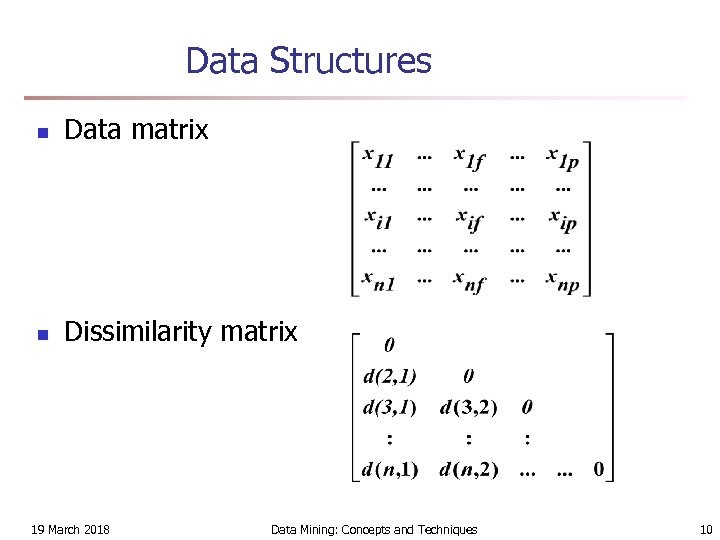 Data Structures n Data matrix n Dissimilarity matrix 19 March 2018 Data Mining: Concepts and Techniques 10
 Type of data in clustering analysis n Interval-scaled variables n Binary variables n Nominal, ordinal, and ratio variables n Variables of mixed types 19 March 2018 Data Mining: Concepts and Techniques 11
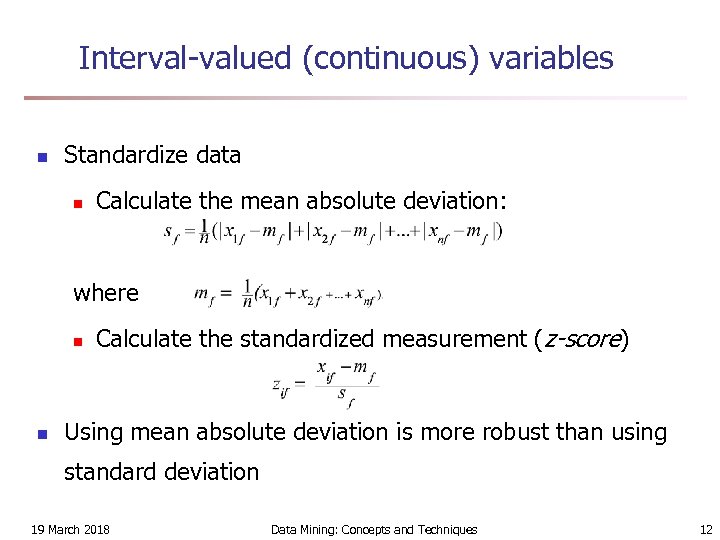 Interval-valued (continuous) variables n Standardize data n Calculate the mean absolute deviation: where n n Calculate the standardized measurement (z-score) Using mean absolute deviation is more robust than using standard deviation 19 March 2018 Data Mining: Concepts and Techniques 12
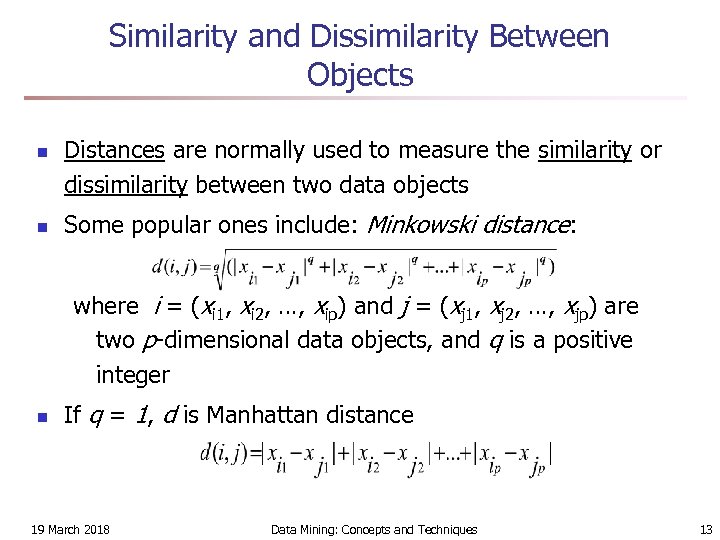 Similarity and Dissimilarity Between Objects n n Distances are normally used to measure the similarity or dissimilarity between two data objects Some popular ones include: Minkowski distance: where i = (xi 1, xi 2, …, xip) and j = (xj 1, xj 2, …, xjp) are two p-dimensional data objects, and q is a positive integer n If q = 1, d is Manhattan distance 19 March 2018 Data Mining: Concepts and Techniques 13
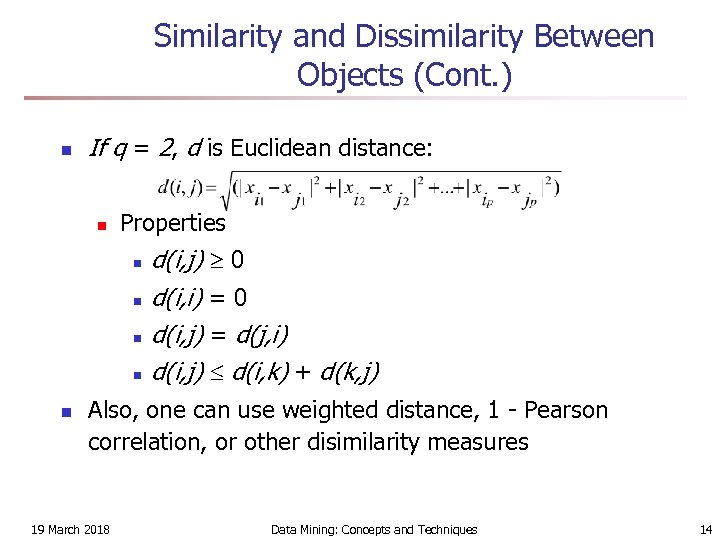 Similarity and Dissimilarity Between Objects (Cont. ) n If q = 2, d is Euclidean distance: n Properties n n n d(i, j) 0 d(i, i) = 0 d(i, j) = d(j, i) d(i, j) d(i, k) + d(k, j) Also, one can use weighted distance, 1 - Pearson correlation, or other disimilarity measures 19 March 2018 Data Mining: Concepts and Techniques 14
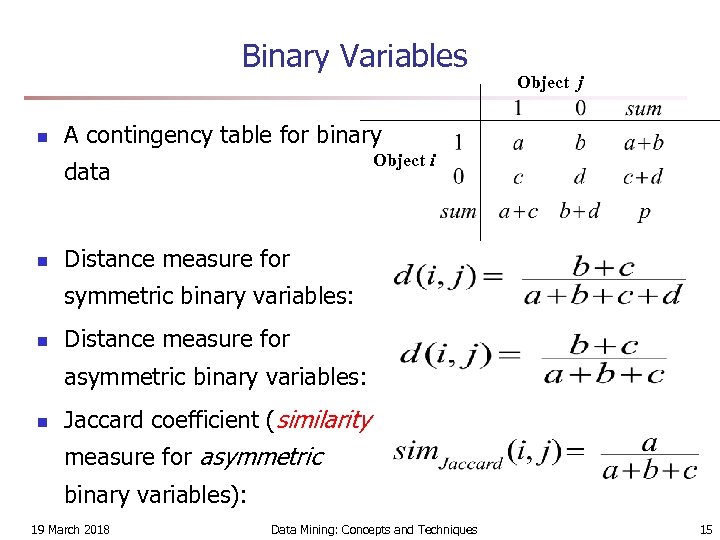 Binary Variables n A contingency table for binary Object i data n Object j Distance measure for symmetric binary variables: n Distance measure for asymmetric binary variables: n Jaccard coefficient (similarity measure for asymmetric binary variables): 19 March 2018 Data Mining: Concepts and Techniques 15
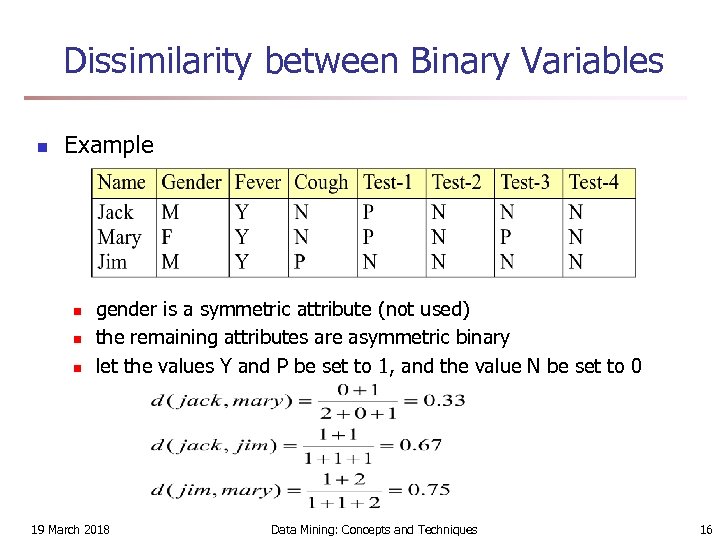 Dissimilarity between Binary Variables n Example n n n gender is a symmetric attribute (not used) the remaining attributes are asymmetric binary let the values Y and P be set to 1, and the value N be set to 0 19 March 2018 Data Mining: Concepts and Techniques 16
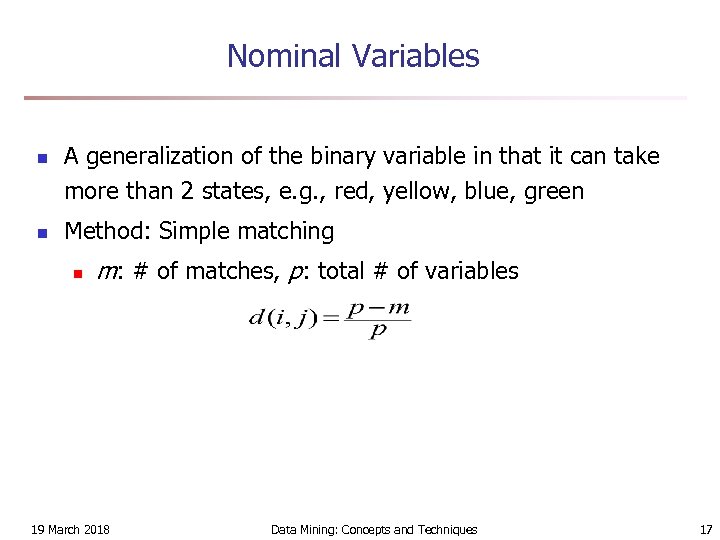 Nominal Variables n n A generalization of the binary variable in that it can take more than 2 states, e. g. , red, yellow, blue, green Method: Simple matching n m: # of matches, p: total # of variables 19 March 2018 Data Mining: Concepts and Techniques 17
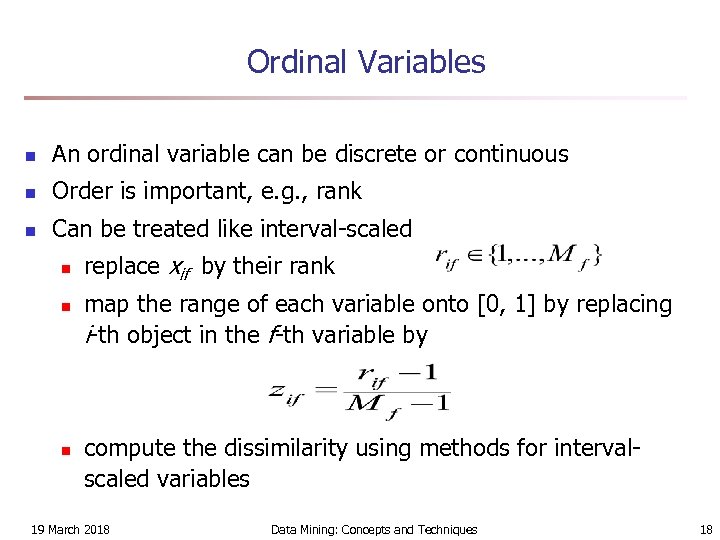 Ordinal Variables n An ordinal variable can be discrete or continuous n Order is important, e. g. , rank n Can be treated like interval-scaled n n n replace xif by their rank map the range of each variable onto [0, 1] by replacing i-th object in the f-th variable by compute the dissimilarity using methods for intervalscaled variables 19 March 2018 Data Mining: Concepts and Techniques 18
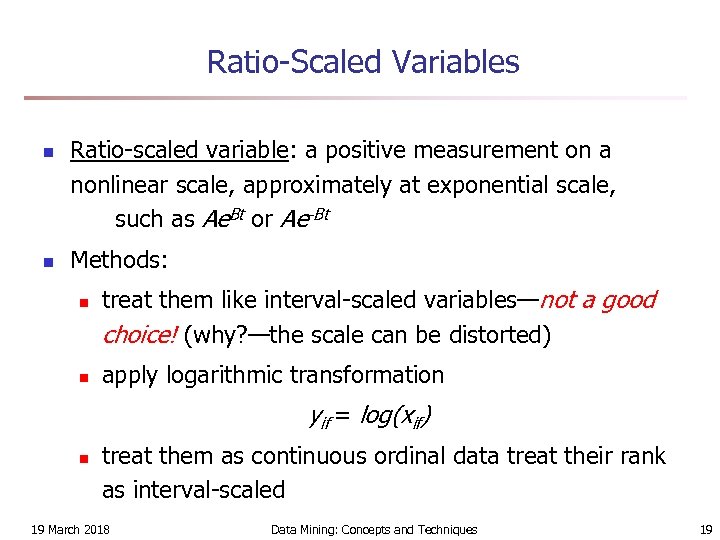 Ratio-Scaled Variables n n Ratio-scaled variable: a positive measurement on a nonlinear scale, approximately at exponential scale, such as Ae. Bt or Ae-Bt Methods: n n treat them like interval-scaled variables—not a good choice! (why? —the scale can be distorted) apply logarithmic transformation yif = log(xif) n treat them as continuous ordinal data treat their rank as interval-scaled 19 March 2018 Data Mining: Concepts and Techniques 19
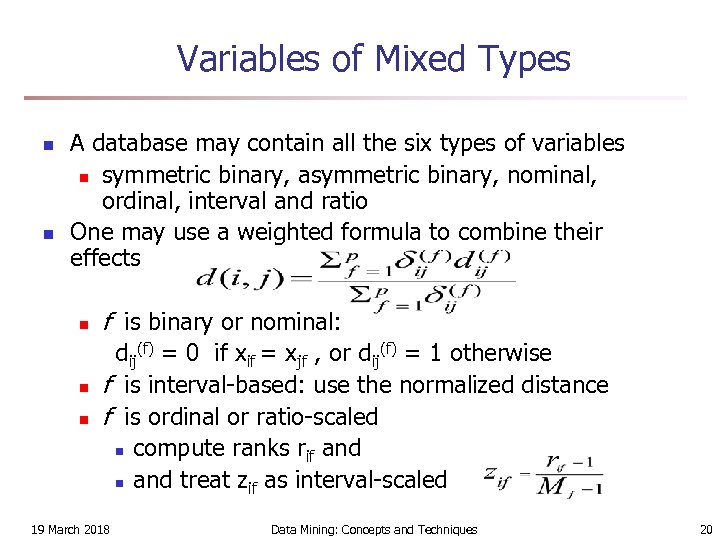 Variables of Mixed Types n n A database may contain all the six types of variables n symmetric binary, asymmetric binary, nominal, ordinal, interval and ratio One may use a weighted formula to combine their effects n n n f is binary or nominal: dij(f) = 0 if xif = xjf , or dij(f) = 1 otherwise f is interval-based: use the normalized distance f is ordinal or ratio-scaled n compute ranks rif and n and treat zif as interval-scaled 19 March 2018 Data Mining: Concepts and Techniques 20
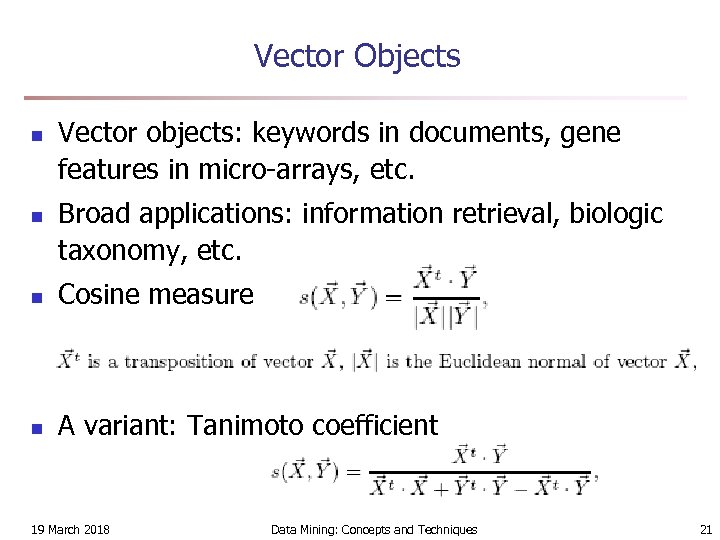 Vector Objects n n Vector objects: keywords in documents, gene features in micro-arrays, etc. Broad applications: information retrieval, biologic taxonomy, etc. n Cosine measure n A variant: Tanimoto coefficient 19 March 2018 Data Mining: Concepts and Techniques 21
 Chapter 7. Cluster Analysis 1. What is Cluster Analysis? 2. Types of Data in Cluster Analysis 3. A Categorization of Major Clustering Methods 4. Partitioning Methods 5. Hierarchical Methods 6. Density-Based Methods 7. Grid-Based Methods 8. Model-Based Methods 9. Clustering High-Dimensional Data 10. Constraint-Based Clustering 11. Outlier Analysis 12. Summary 19 March 2018 Data Mining: Concepts and Techniques 22
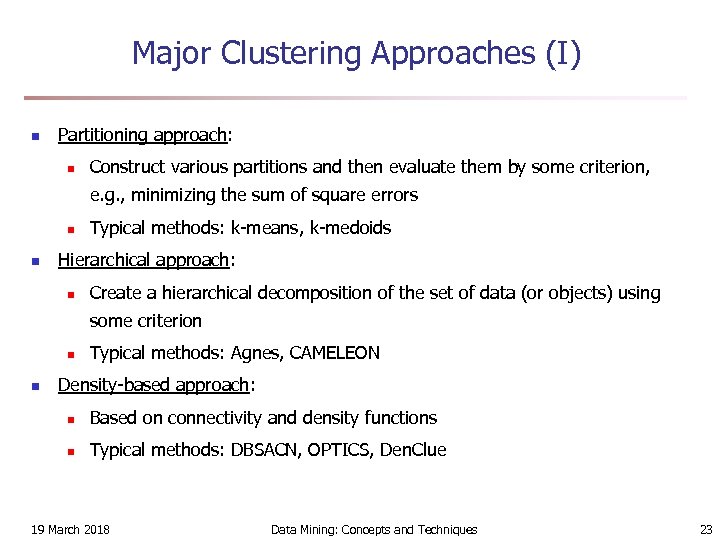 Major Clustering Approaches (I) n Partitioning approach: n Construct various partitions and then evaluate them by some criterion, e. g. , minimizing the sum of square errors n n Typical methods: k-means, k-medoids Hierarchical approach: n Create a hierarchical decomposition of the set of data (or objects) using some criterion n n Typical methods: Agnes, CAMELEON Density-based approach: n Based on connectivity and density functions n Typical methods: DBSACN, OPTICS, Den. Clue 19 March 2018 Data Mining: Concepts and Techniques 23
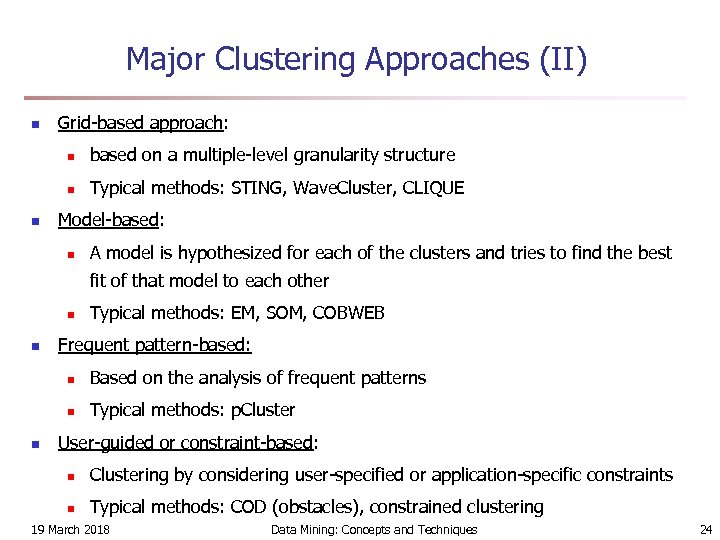 Major Clustering Approaches (II) n Grid-based approach: n n n based on a multiple-level granularity structure Typical methods: STING, Wave. Cluster, CLIQUE Model-based: n A model is hypothesized for each of the clusters and tries to find the best fit of that model to each other n n Typical methods: EM, SOM, COBWEB Frequent pattern-based: n n n Based on the analysis of frequent patterns Typical methods: p. Cluster User-guided or constraint-based: n Clustering by considering user-specified or application-specific constraints n Typical methods: COD (obstacles), constrained clustering 19 March 2018 Data Mining: Concepts and Techniques 24
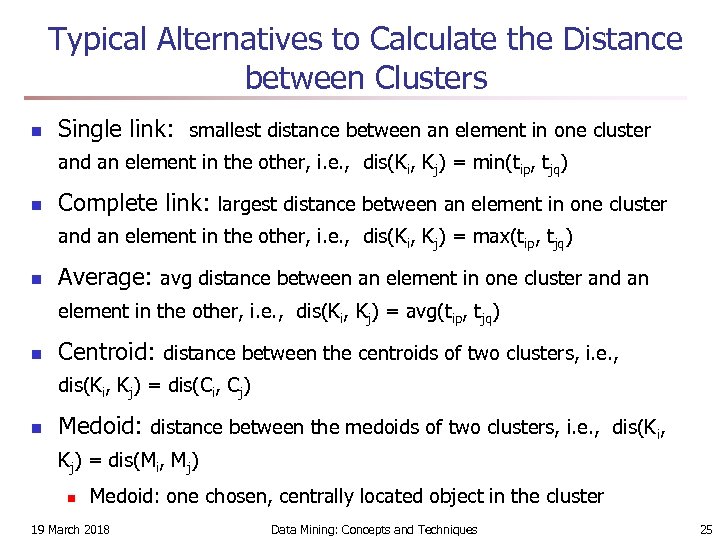 Typical Alternatives to Calculate the Distance between Clusters n Single link: smallest distance between an element in one cluster and an element in the other, i. e. , dis(Ki, Kj) = min(tip, tjq) n Complete link: largest distance between an element in one cluster and an element in the other, i. e. , dis(Ki, Kj) = max(tip, tjq) n Average: avg distance between an element in one cluster and an element in the other, i. e. , dis(Ki, Kj) = avg(tip, tjq) n Centroid: distance between the centroids of two clusters, i. e. , dis(Ki, Kj) = dis(Ci, Cj) n Medoid: distance between the medoids of two clusters, i. e. , dis(Ki, Kj) = dis(Mi, Mj) n Medoid: one chosen, centrally located object in the cluster 19 March 2018 Data Mining: Concepts and Techniques 25
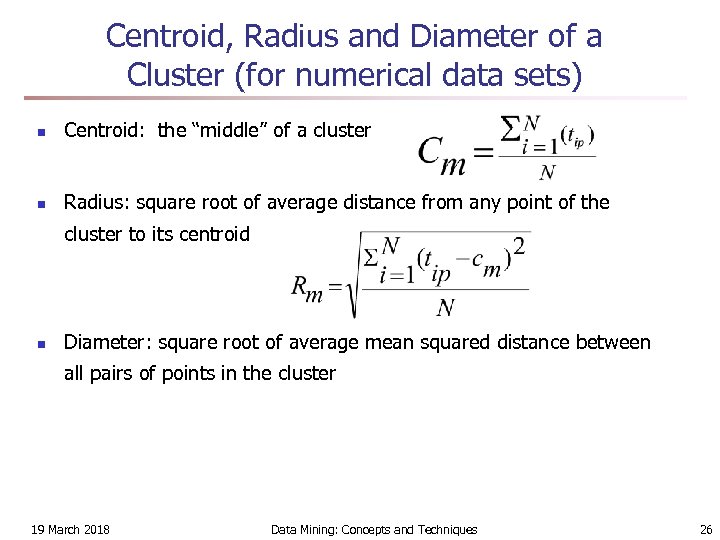 Centroid, Radius and Diameter of a Cluster (for numerical data sets) n Centroid: the “middle” of a cluster n Radius: square root of average distance from any point of the cluster to its centroid n Diameter: square root of average mean squared distance between all pairs of points in the cluster 19 March 2018 Data Mining: Concepts and Techniques 26
 Chapter 7. Cluster Analysis 1. What is Cluster Analysis? 2. Types of Data in Cluster Analysis 3. A Categorization of Major Clustering Methods 4. Partitioning Methods 5. Hierarchical Methods 6. Density-Based Methods 7. Grid-Based Methods 8. Model-Based Methods 9. Clustering High-Dimensional Data 10. Constraint-Based Clustering 11. Outlier Analysis 12. Summary 19 March 2018 Data Mining: Concepts and Techniques 27
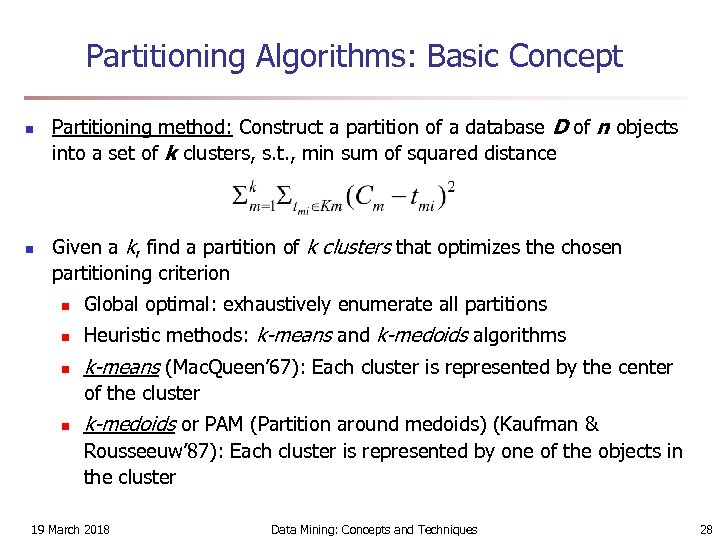 Partitioning Algorithms: Basic Concept n n Partitioning method: Construct a partition of a database D of n objects into a set of k clusters, s. t. , min sum of squared distance Given a k, find a partition of k clusters that optimizes the chosen partitioning criterion n Global optimal: exhaustively enumerate all partitions n Heuristic methods: k-means and k-medoids algorithms n k-means (Mac. Queen’ 67): Each cluster is represented by the center of the cluster n k-medoids or PAM (Partition around medoids) (Kaufman & Rousseeuw’ 87): Each cluster is represented by one of the objects in the cluster 19 March 2018 Data Mining: Concepts and Techniques 28
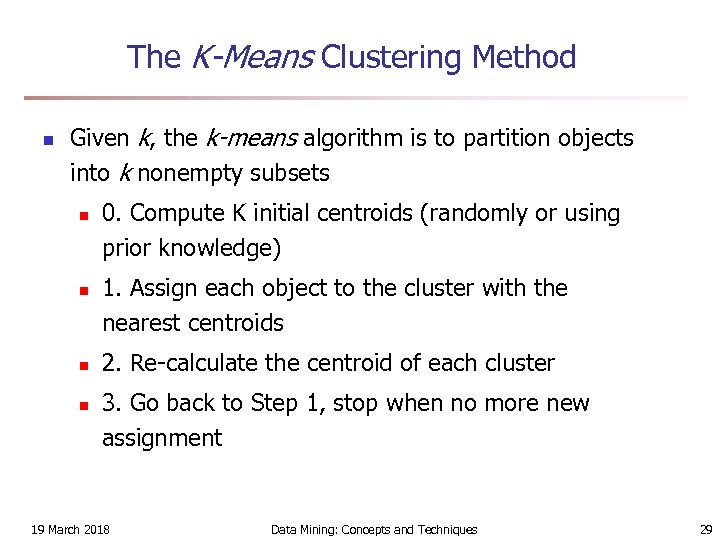 The K-Means Clustering Method n Given k, the k-means algorithm is to partition objects into k nonempty subsets n n 0. Compute K initial centroids (randomly or using prior knowledge) 1. Assign each object to the cluster with the nearest centroids 2. Re-calculate the centroid of each cluster 3. Go back to Step 1, stop when no more new assignment 19 March 2018 Data Mining: Concepts and Techniques 29
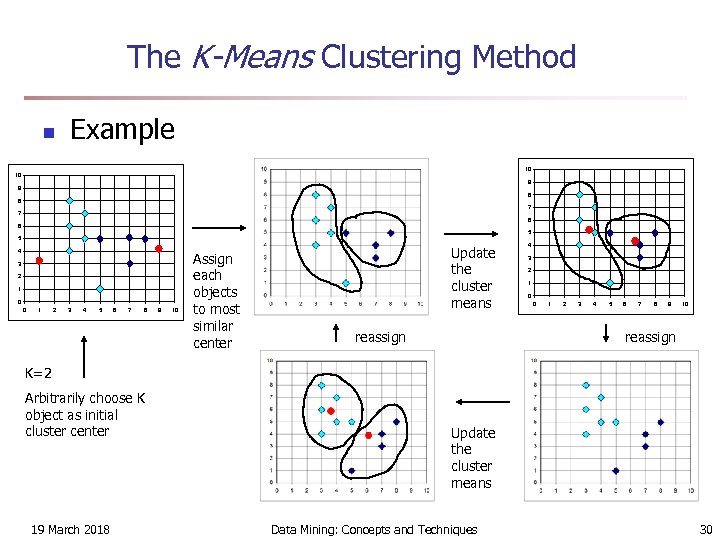 The K-Means Clustering Method n Example 10 10 9 9 8 8 7 7 6 6 5 5 4 3 2 1 0 0 1 2 3 4 5 6 7 8 9 10 Assign each objects to most similar center Update the cluster means reassign 4 3 2 1 0 0 1 2 3 4 5 6 7 8 9 10 reassign K=2 Arbitrarily choose K object as initial cluster center 19 March 2018 Update the cluster means Data Mining: Concepts and Techniques 30
 Comments on the K-Means Method n n n Strength: Relatively efficient: O(tkn), where n is # objects, k is # clusters, and t is # iterations. Normally, k, t << n. Comment: Often terminates at a local optimum. The global optimum may be found using techniques such as: genetic algorithms (how? ) Weakness n Applicable only when mean is defined, then what about categorical data? n Need to specify k, the number of clusters, in advance n Hard to handle noisy data and outliers 19 March 2018 Data Mining: Concepts and Techniques 31
 Variations of the K-Means Method n A few variants of the k-means which differ in n n Dissimilarity calculations n n Selection of the initial k means Strategies to calculate cluster means Handling categorical data: k-modes (Huang’ 98) n Replacing means of clusters with modes n Using new dissimilarity measures to deal with categorical objects n Using a frequency-based method to update modes of clusters 19 March 2018 Data Mining: Concepts and Techniques 32
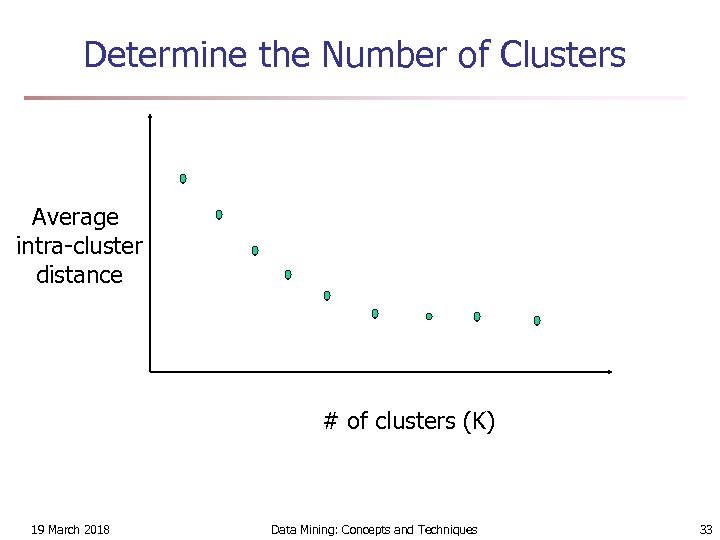 Determine the Number of Clusters Average intra-cluster distance # of clusters (K) 19 March 2018 Data Mining: Concepts and Techniques 33
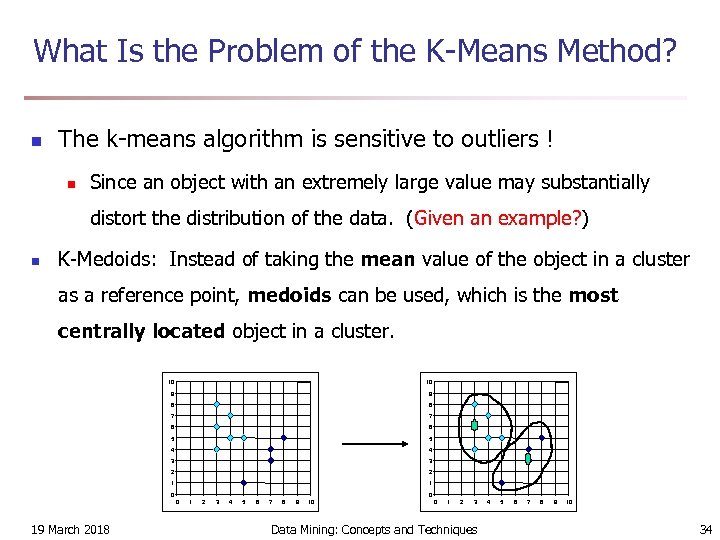 What Is the Problem of the K-Means Method? n The k-means algorithm is sensitive to outliers ! n Since an object with an extremely large value may substantially distort the distribution of the data. (Given an example? ) n K-Medoids: Instead of taking the mean value of the object in a cluster as a reference point, medoids can be used, which is the most centrally located object in a cluster. 10 10 9 9 8 8 7 7 6 6 5 5 4 4 3 3 2 2 1 1 0 0 0 19 March 2018 1 2 3 4 5 6 7 8 9 10 0 1 2 3 Data Mining: Concepts and Techniques 4 5 6 7 8 9 10 34
 The K-Medoids Clustering Method n Find representative objects, called medoids, in clusters n PAM (Partitioning Around Medoids, 1987) n starts from an initial set of medoids and iteratively replaces one of the medoids by one of the non-medoids if it improves the total distance of the resulting clustering n PAM works effectively for small data sets, but does not scale well for large data sets 19 March 2018 Data Mining: Concepts and Techniques 35
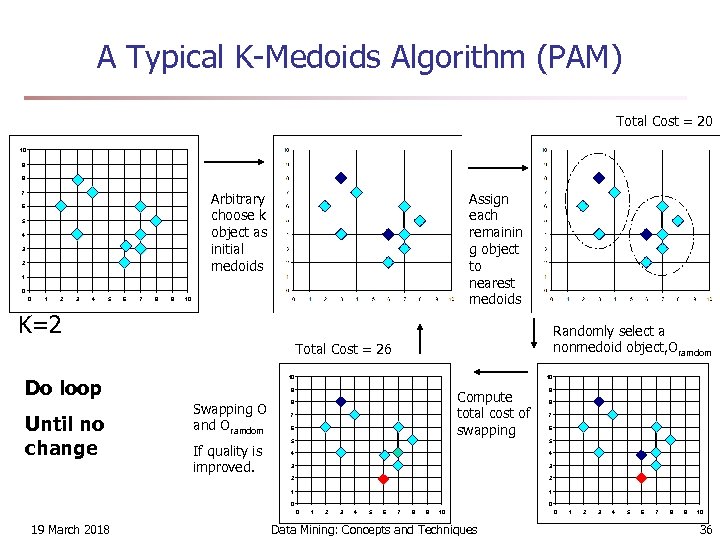 A Typical K-Medoids Algorithm (PAM) Total Cost = 20 10 9 8 Arbitrary choose k object as initial medoids 7 6 5 4 3 2 Assign each remainin g object to nearest medoids 1 0 0 1 2 3 4 5 6 7 8 9 10 K=2 Randomly select a nonmedoid object, Oramdom Total Cost = 26 Do loop Until no change 10 10 9 Swapping O and Oramdom Compute total cost of swapping 8 7 6 9 8 7 6 5 4 4 3 3 2 2 1 If quality is improved. 5 1 0 0 0 19 March 2018 1 2 3 4 5 6 7 8 9 10 Data Mining: Concepts and Techniques 0 1 2 3 4 5 6 7 8 9 10 36
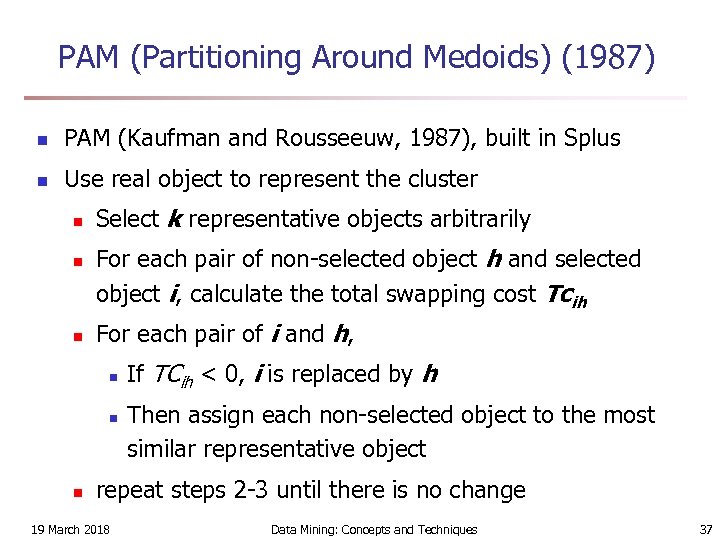 PAM (Partitioning Around Medoids) (1987) n PAM (Kaufman and Rousseeuw, 1987), built in Splus n Use real object to represent the cluster n n n Select k representative objects arbitrarily For each pair of non-selected object h and selected object i, calculate the total swapping cost Tcih For each pair of i and h, n n n If TCih < 0, i is replaced by h Then assign each non-selected object to the most similar representative object repeat steps 2 -3 until there is no change 19 March 2018 Data Mining: Concepts and Techniques 37
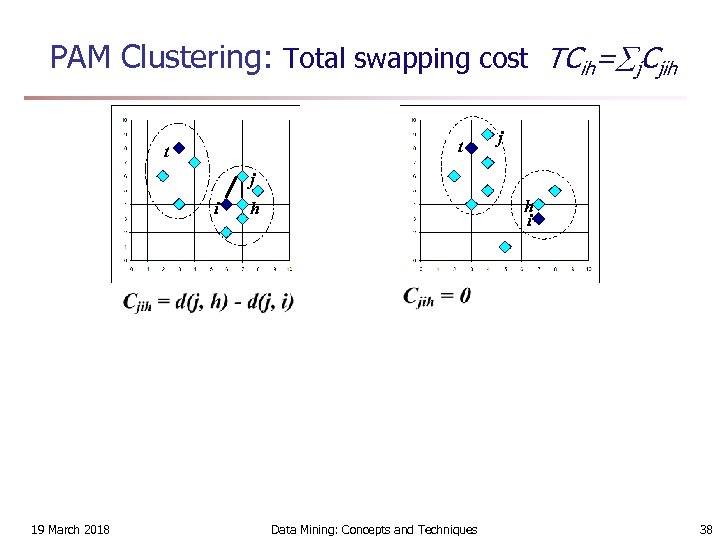 PAM Clustering: Total swapping cost TCih= j. Cjih t t j j i 19 March 2018 h i h Data Mining: Concepts and Techniques 38
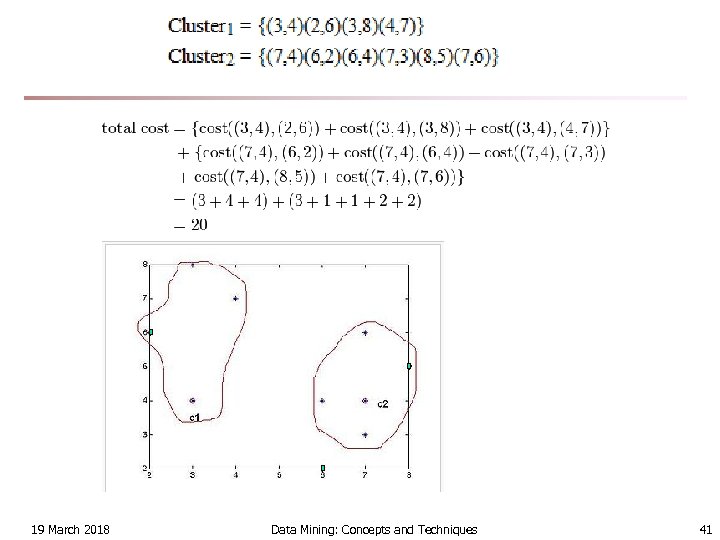
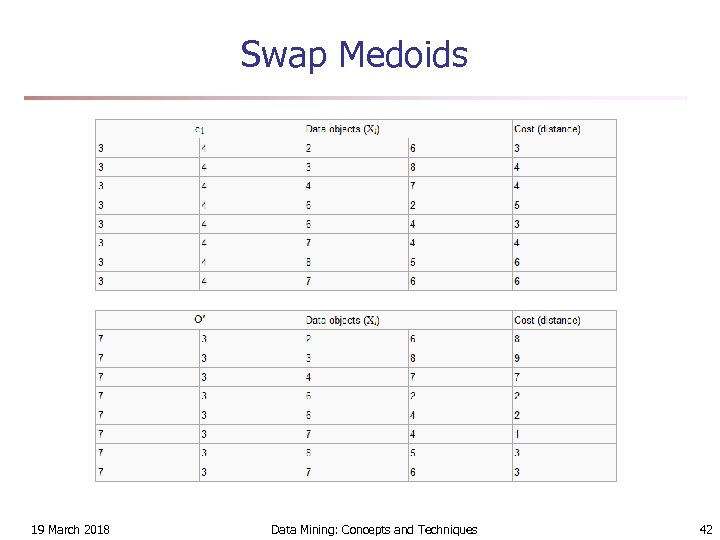
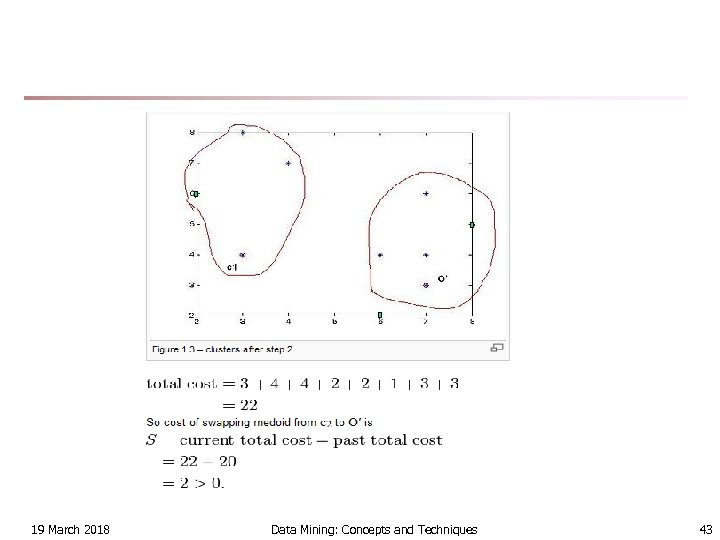
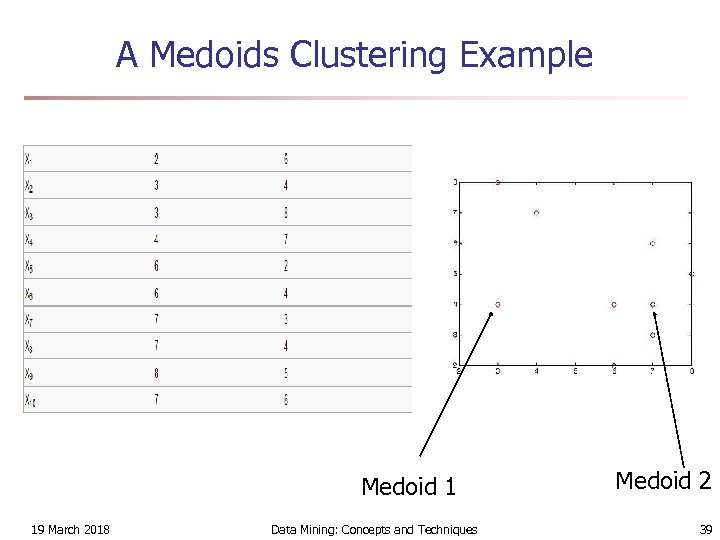 A Medoids Clustering Example Medoid 1 19 March 2018 Data Mining: Concepts and Techniques Medoid 2 39
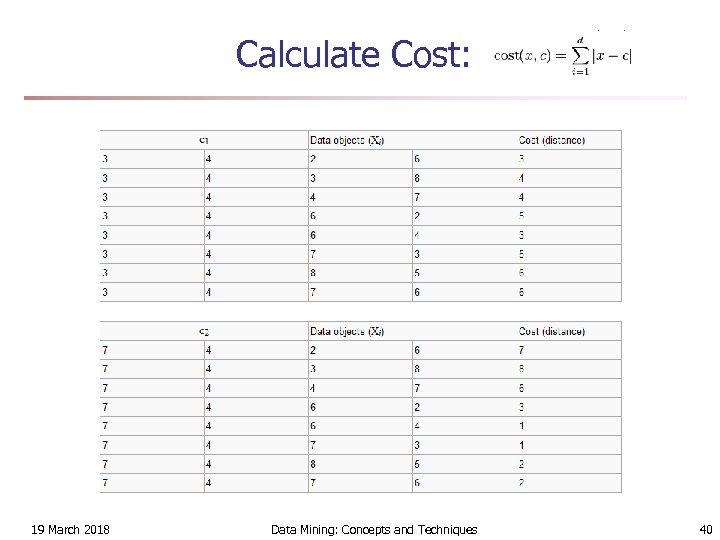 Calculate Cost: 19 March 2018 Data Mining: Concepts and Techniques 40
 19 March 2018 Data Mining: Concepts and Techniques 41
 Swap Medoids 19 March 2018 Data Mining: Concepts and Techniques 42
 19 March 2018 Data Mining: Concepts and Techniques 43
 What Is the Problem with PAM? n n Pam is more robust than k-means in the presence of noise and outliers because a medoid is less influenced by outliers or other extreme values than a mean Pam works efficiently for small data sets but does not scale well for large data sets. n O(k(n-k)2 ) for each iteration where n is # of data, k is # of clusters è Sampling based method, CLARA(Clustering LARge Applications) 19 March 2018 Data Mining: Concepts and Techniques 44
 CLARA (Clustering Large Applications) (1990) n CLARA (Kaufmann and Rousseeuw in 1990) n n Built in statistical analysis packages, such as S+ It draws multiple samples of the data set, applies PAM on each sample, and gives the best clustering as the output n Strength: deals with larger data sets than PAM n Weakness: n n How do clusters of samples expand to the whole data set? Efficiency depends on the sample size A good clustering based on samples will not necessarily represent a good clustering of the whole data set if the sample is biased 19 March 2018 Data Mining: Concepts and Techniques 45
 Chapter 7. Cluster Analysis 1. What is Cluster Analysis? 2. Types of Data in Cluster Analysis 3. A Categorization of Major Clustering Methods 4. Partitioning Methods 5. Hierarchical Methods 6. Density-Based Methods 7. Grid-Based Methods 8. Model-Based Methods 9. Clustering High-Dimensional Data 10. Constraint-Based Clustering 11. Outlier Analysis 12. Summary 19 March 2018 Data Mining: Concepts and Techniques 46
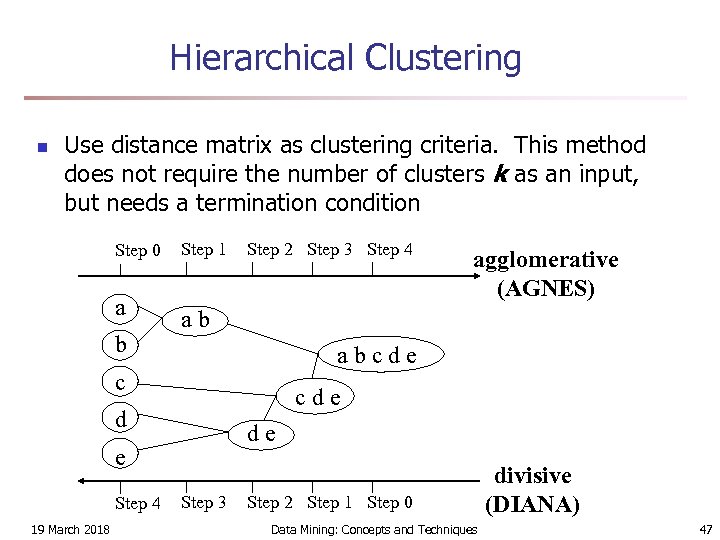 Hierarchical Clustering n Use distance matrix as clustering criteria. This method does not require the number of clusters k as an input, but needs a termination condition Step 0 a b Step 1 Step 2 Step 3 Step 4 ab abcde c cde d de e Step 4 19 March 2018 agglomerative (AGNES) Step 3 Step 2 Step 1 Step 0 Data Mining: Concepts and Techniques divisive (DIANA) 47
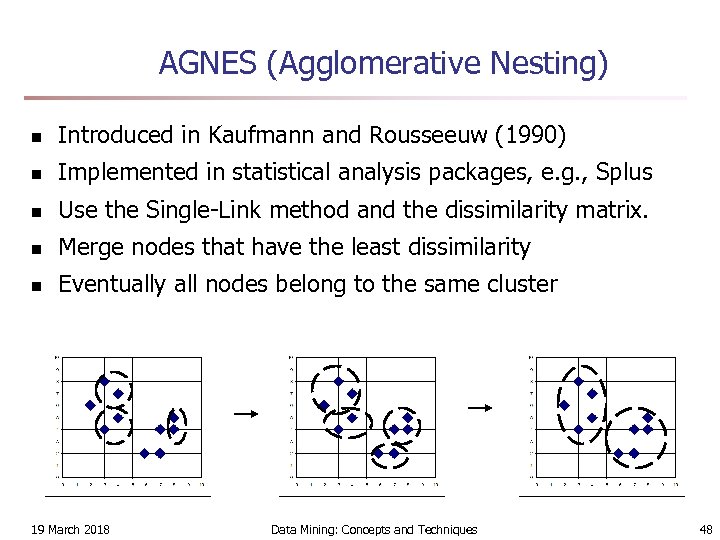 AGNES (Agglomerative Nesting) n Introduced in Kaufmann and Rousseeuw (1990) n Implemented in statistical analysis packages, e. g. , Splus n Use the Single-Link method and the dissimilarity matrix. n Merge nodes that have the least dissimilarity n Eventually all nodes belong to the same cluster 19 March 2018 Data Mining: Concepts and Techniques 48
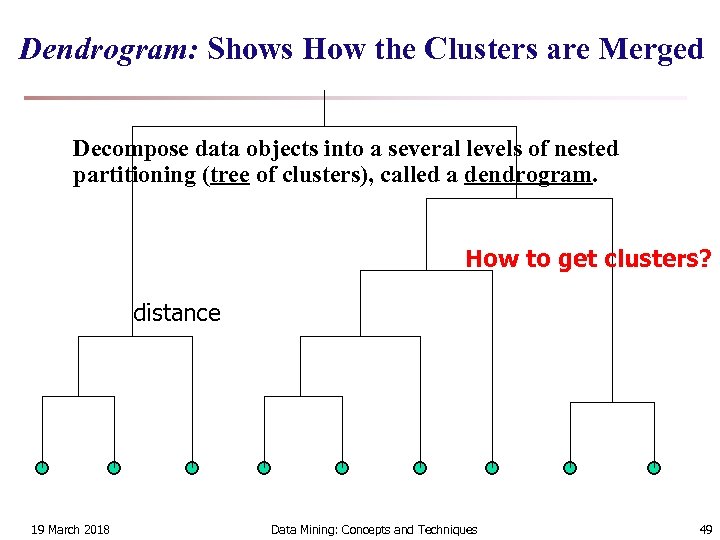 Dendrogram: Shows How the Clusters are Merged Decompose data objects into a several levels of nested partitioning (tree of clusters), called a dendrogram. How to get clusters? distance 19 March 2018 Data Mining: Concepts and Techniques 49
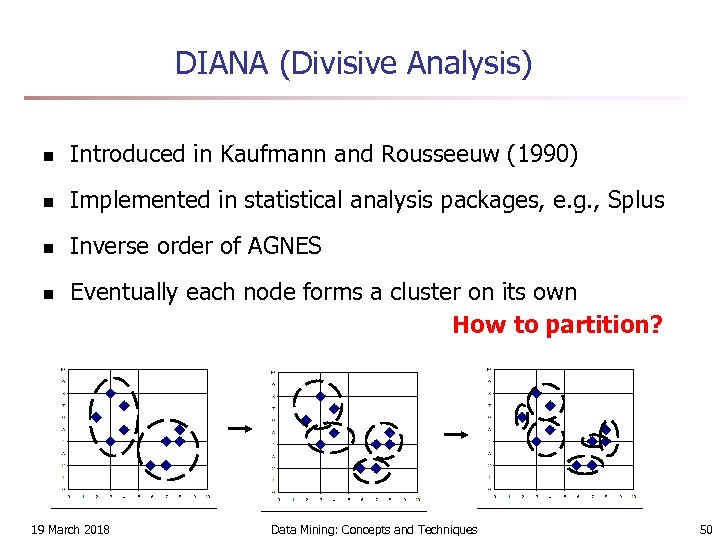 DIANA (Divisive Analysis) n Introduced in Kaufmann and Rousseeuw (1990) n Implemented in statistical analysis packages, e. g. , Splus n Inverse order of AGNES n Eventually each node forms a cluster on its own How to partition? 19 March 2018 Data Mining: Concepts and Techniques 50
 Recent Hierarchical Clustering Methods n Major weakness of agglomerative clustering methods n n n do not scale well: time complexity of at least O(n 2), where n is the number of total objects can never undo what was done previously Integration of hierarchical with distance-based clustering n CHAMELEON (1999): hierarchical clustering using dynamic modeling 19 March 2018 Data Mining: Concepts and Techniques 51
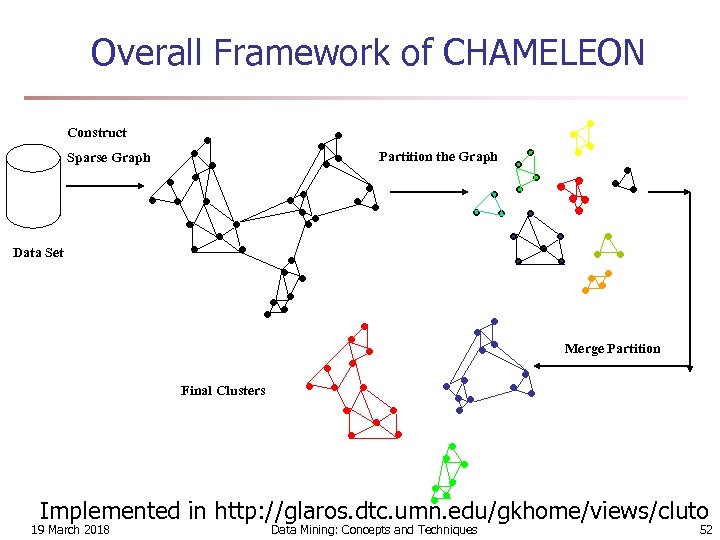 Overall Framework of CHAMELEON Construct Partition the Graph Sparse Graph Data Set Merge Partition Final Clusters Implemented in http: //glaros. dtc. umn. edu/gkhome/views/cluto 19 March 2018 Data Mining: Concepts and Techniques 52
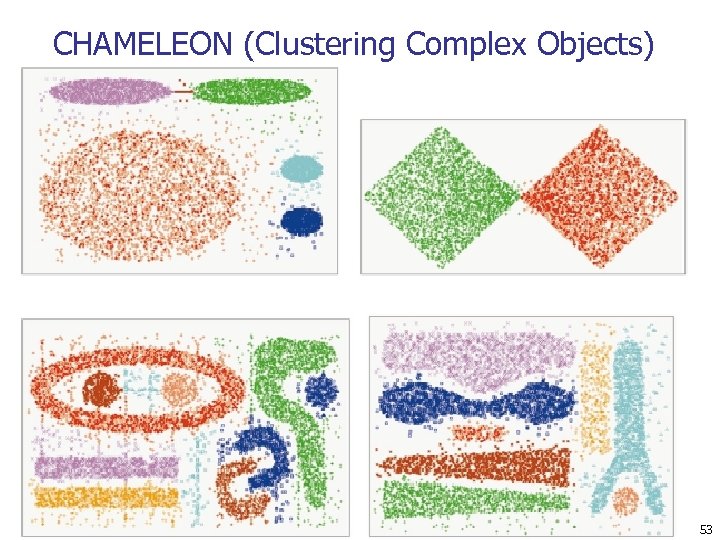 CHAMELEON (Clustering Complex Objects) 19 March 2018 Data Mining: Concepts and Techniques 53
 Chapter 7. Cluster Analysis 1. What is Cluster Analysis? 2. Types of Data in Cluster Analysis 3. A Categorization of Major Clustering Methods 4. Partitioning Methods 5. Hierarchical Methods 6. Density-Based Methods 7. Grid-Based Methods 8. Model-Based Methods 9. Clustering High-Dimensional Data 10. Constraint-Based Clustering 11. Outlier Analysis 12. Summary 19 March 2018 Data Mining: Concepts and Techniques 54
 Density-Based Clustering Methods n n n Clustering based on density (local cluster criterion), such as density-connected points Major features: n Discover clusters of arbitrary shape n Handle noise n One scan n Need density parameters as termination condition Several interesting studies: n DBSCAN: Ester, et al. (KDD’ 96) n OPTICS: Ankerst, et al (SIGMOD’ 99). n DENCLUE: Hinneburg & D. Keim (KDD’ 98) 19 March 2018 Data Mining: Concepts and Techniques 55
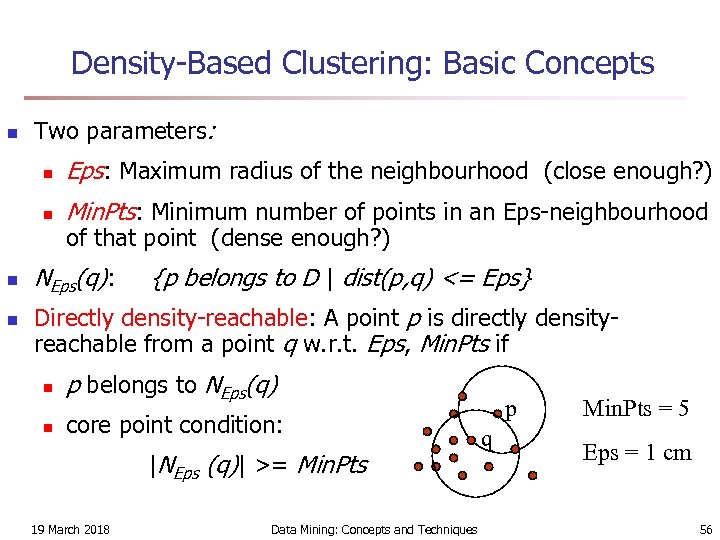 Density-Based Clustering: Basic Concepts n Two parameters: n n Eps: Maximum radius of the neighbourhood (close enough? ) Min. Pts: Minimum number of points in an Eps-neighbourhood of that point (dense enough? ) NEps(q): {p belongs to D | dist(p, q) <= Eps} Directly density-reachable: A point p is directly densityreachable from a point q w. r. t. Eps, Min. Pts if n p belongs to NEps(q) n core point condition: |NEps (q)| >= Min. Pts 19 March 2018 Data Mining: Concepts and Techniques p q Min. Pts = 5 Eps = 1 cm 56
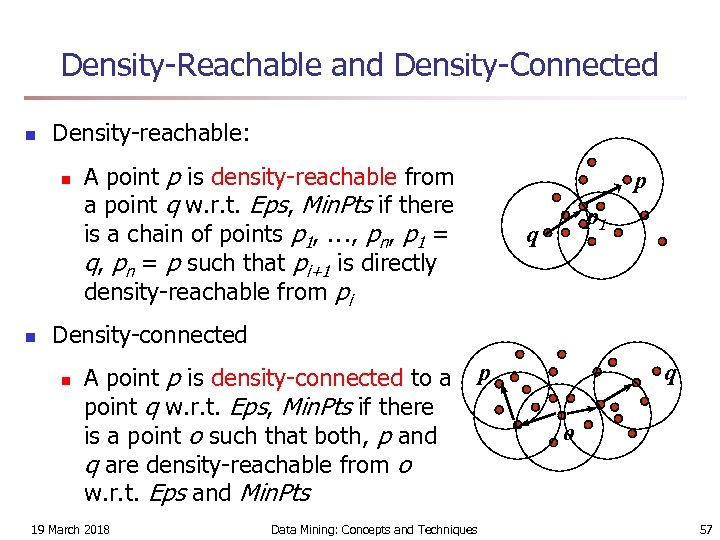 Density-Reachable and Density-Connected n Density-reachable: n n A point p is density-reachable from a point q w. r. t. Eps, Min. Pts if there is a chain of points p 1, …, pn, p 1 = q, pn = p such that pi+1 is directly density-reachable from pi p p 1 q Density-connected n A point p is density-connected to a p point q w. r. t. Eps, Min. Pts if there is a point o such that both, p and q are density-reachable from o w. r. t. Eps and Min. Pts 19 March 2018 Data Mining: Concepts and Techniques q o 57
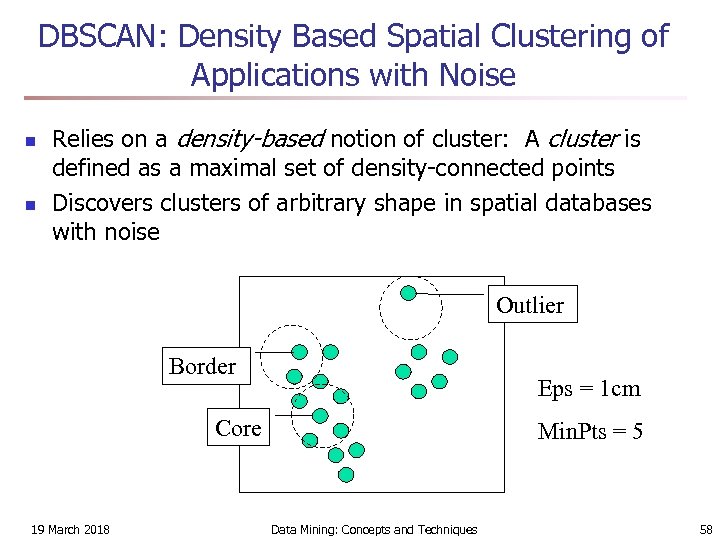 DBSCAN: Density Based Spatial Clustering of Applications with Noise n n Relies on a density-based notion of cluster: A cluster is defined as a maximal set of density-connected points Discovers clusters of arbitrary shape in spatial databases with noise Outlier Border Eps = 1 cm Core 19 March 2018 Min. Pts = 5 Data Mining: Concepts and Techniques 58
 DBSCAN: The Algorithm n n n Arbitrary select a point p Retrieve all points density-reachable from p w. r. t. Eps and Min. Pts. (how? ) If p is a core point, a cluster is formed. If p is a border point, no points are density-reachable from p and DBSCAN visits the next point of the database. Continue the process until all of the points have been processed. 19 March 2018 Data Mining: Concepts and Techniques 59
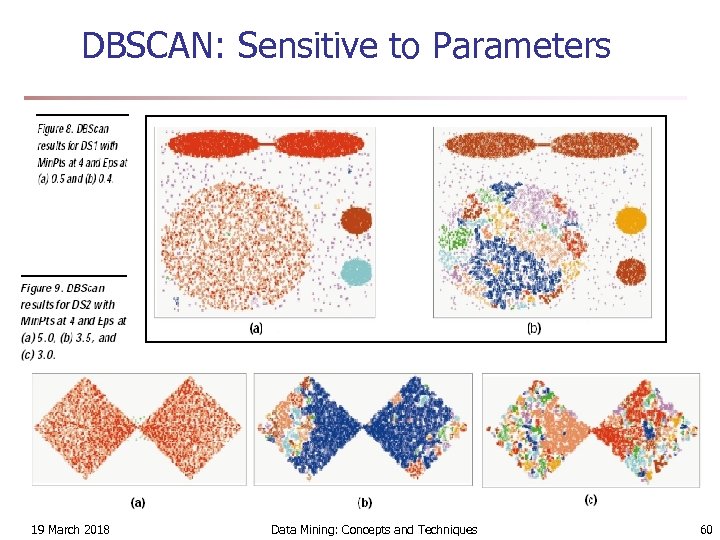 DBSCAN: Sensitive to Parameters 19 March 2018 Data Mining: Concepts and Techniques 60
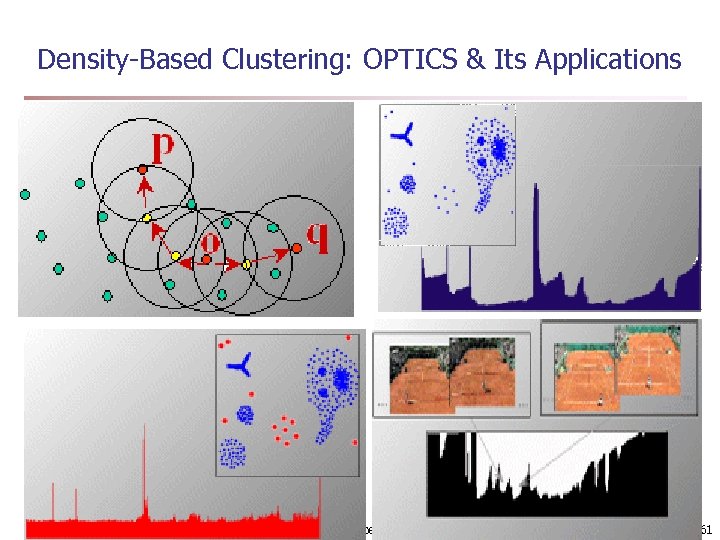 Density-Based Clustering: OPTICS & Its Applications 19 March 2018 Data Mining: Concepts and Techniques 61
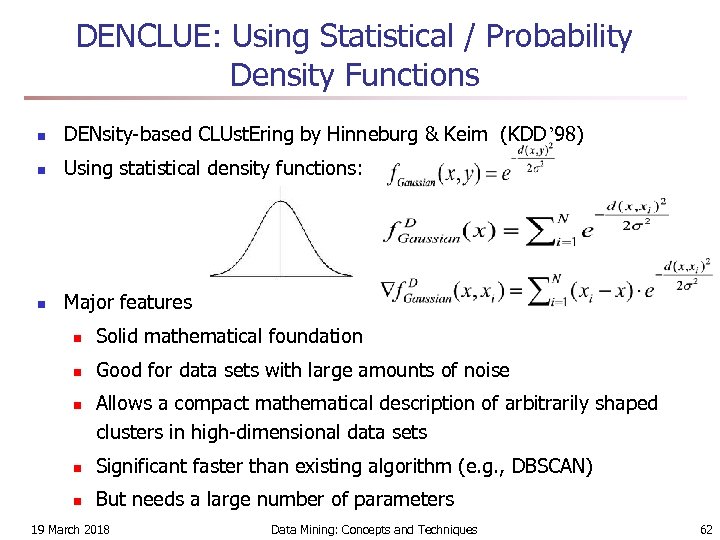 DENCLUE: Using Statistical / Probability Density Functions n DENsity-based CLUst. Ering by Hinneburg & Keim (KDD’ 98) n Using statistical density functions: n Major features n Solid mathematical foundation n Good for data sets with large amounts of noise n Allows a compact mathematical description of arbitrarily shaped clusters in high-dimensional data sets n Significant faster than existing algorithm (e. g. , DBSCAN) n But needs a large number of parameters 19 March 2018 Data Mining: Concepts and Techniques 62
 Denclue: Technical Essence n n Influence function: describes the impact of a data point within its neighborhood Overall density of the data space can be calculated as the sum of the influence function of all data points Clusters can be determined mathematically by identifying density attractors Density attractors are local maximal of the overall density function 19 March 2018 Data Mining: Concepts and Techniques 63
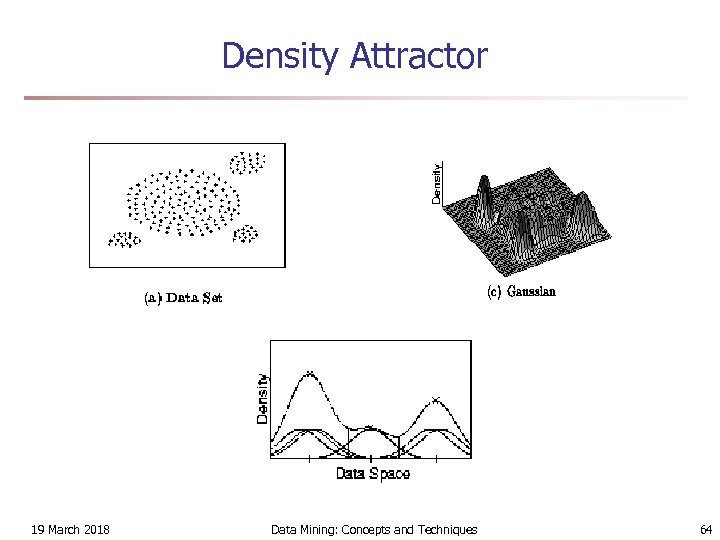 Density Attractor 19 March 2018 Data Mining: Concepts and Techniques 64
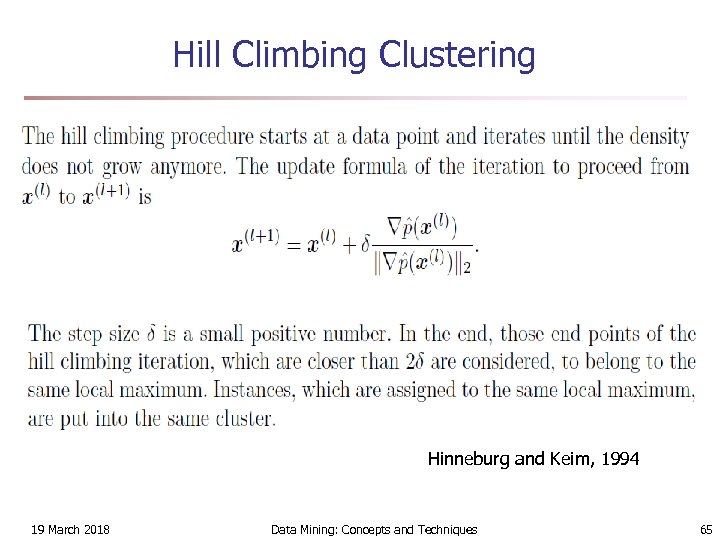 Hill Climbing Clustering Hinneburg and Keim, 1994 19 March 2018 Data Mining: Concepts and Techniques 65
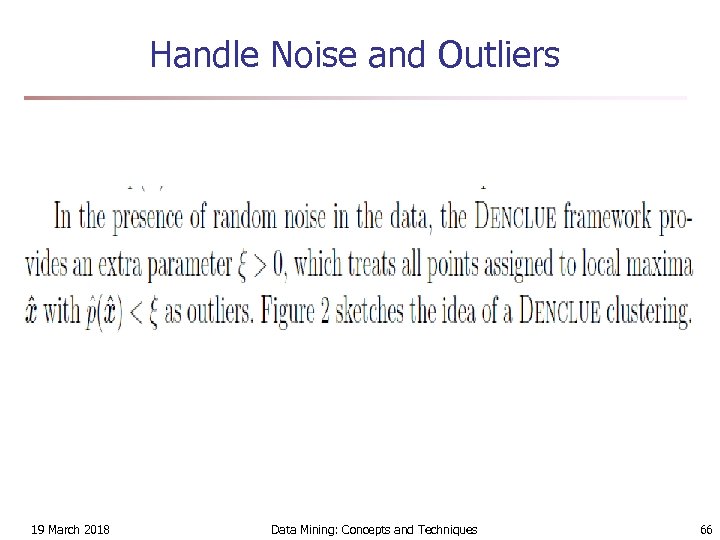 Handle Noise and Outliers 19 March 2018 Data Mining: Concepts and Techniques 66
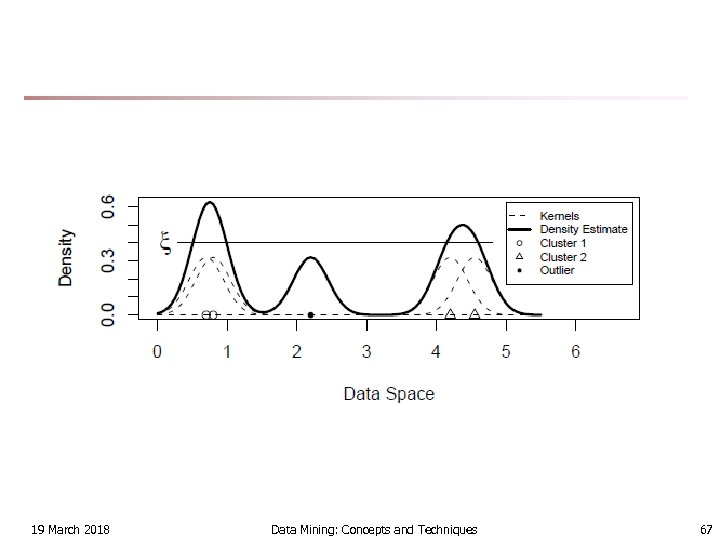 19 March 2018 Data Mining: Concepts and Techniques 67
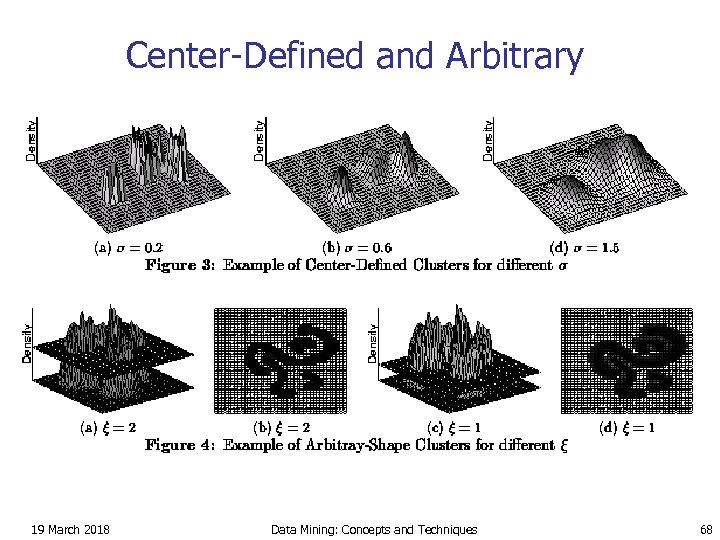 Center-Defined and Arbitrary 19 March 2018 Data Mining: Concepts and Techniques 68
 Clustering Demo n n Weak Clustering DBScan, Hierahical, K-Means Voting data Validation by known classes 19 March 2018 Data Mining: Concepts and Techniques 69
 Chapter 7. Cluster Analysis 1. What is Cluster Analysis? 2. Types of Data in Cluster Analysis 3. A Categorization of Major Clustering Methods 4. Partitioning Methods 5. Hierarchical Methods 6. Density-Based Methods 7. Grid-Based Methods 8. Model-Based Methods 9. Clustering High-Dimensional Data 10. Constraint-Based Clustering 11. Outlier Analysis 12. Summary 19 March 2018 Data Mining: Concepts and Techniques 70
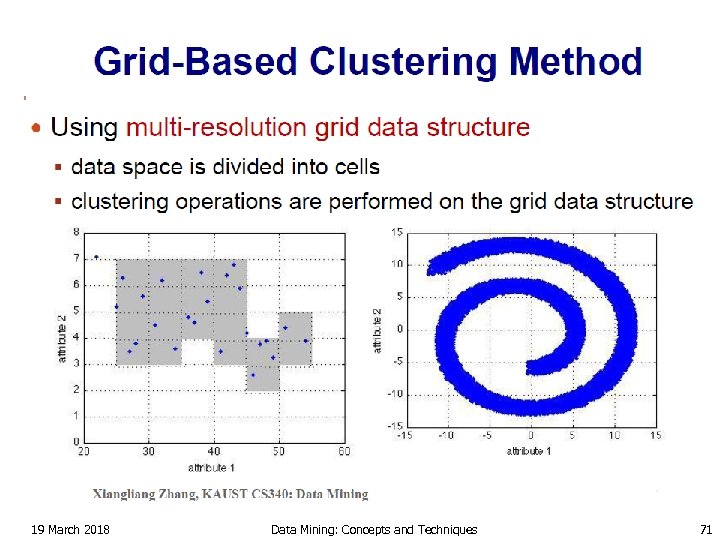 19 March 2018 Data Mining: Concepts and Techniques 71
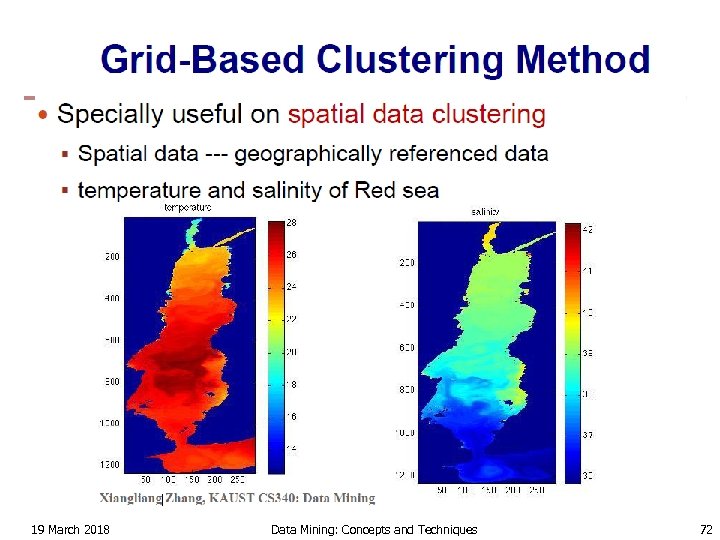 19 March 2018 Data Mining: Concepts and Techniques 72
 Grid-Based Clustering Method n Using multi-resolution grid data structure n Several interesting methods n n STING (a STatistical INformation Grid approach) by Wang, Yang and Muntz (1997) Wave. Cluster by Sheikholeslami, Chatterjee, and Zhang (VLDB’ 98) n 19 March 2018 A multi-resolution clustering approach using wavelet method Data Mining: Concepts and Techniques 73
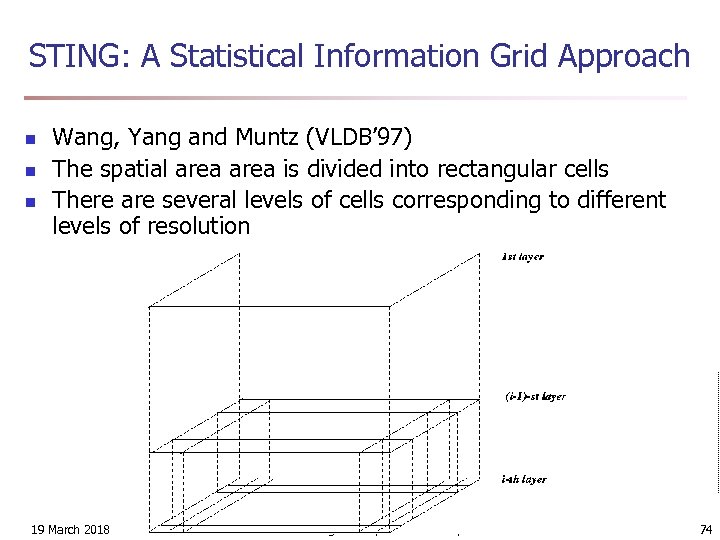 STING: A Statistical Information Grid Approach n n n Wang, Yang and Muntz (VLDB’ 97) The spatial area is divided into rectangular cells There are several levels of cells corresponding to different levels of resolution 19 March 2018 Data Mining: Concepts and Techniques 74
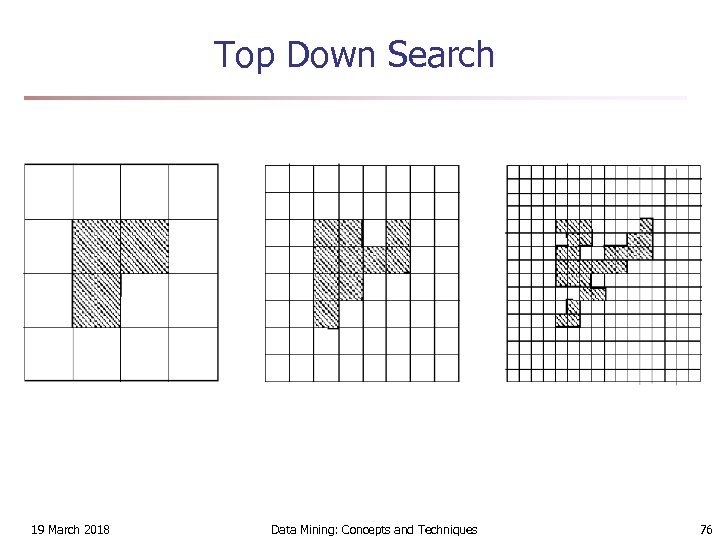
 The STING Clustering Method n n n Each cell at a high level is partitioned into a number of smaller cells in the next lower level Statistical info of each cell is calculated and stored beforehand is used to answer queries Parameters of higher level cells can be easily calculated from parameters of lower level cell n count, mean, std, min, max n type of distribution—normal, uniform, etc. Use a top-down approach to answer spatial data queries Start from a pre-selected layer—typically with a small number of cells For each cell in the current level compute the confidence interval - range of values according to a significance value 19 March 2018 Data Mining: Concepts and Techniques 75
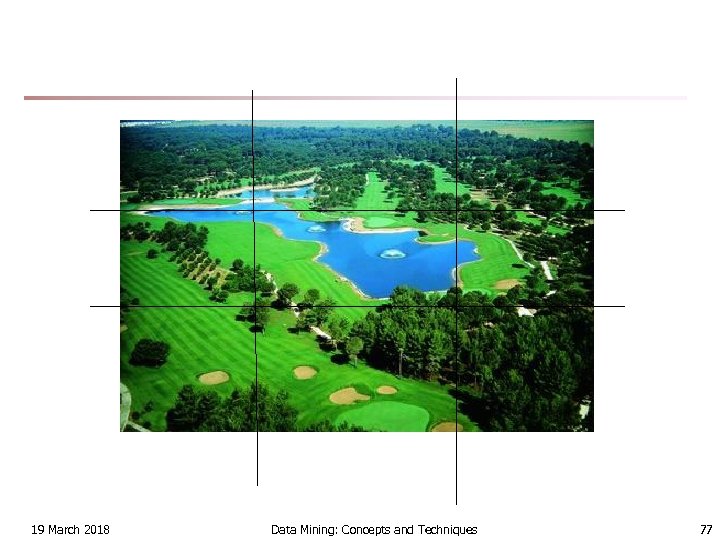
 Top Down Search 19 March 2018 Data Mining: Concepts and Techniques 76
 19 March 2018 Data Mining: Concepts and Techniques 77
 Comments on STING n n Remove the irrelevant cells from further consideration When finish examining the current layer, proceed to the next lower level Repeat this process until the bottom layer is reached Advantages: n Query-independent, easy to parallelize, incremental update n O(K), where K is the number of grid cells at the lowest level n Disadvantages: n All the cluster boundaries are either horizontal or vertical, and no diagonal boundary is detected 19 March 2018 Data Mining: Concepts and Techniques 78
 Wave. Cluster n A multi-resolution clustering approach which applies wavelet transform to the feature space n A wavelet transform is a signal processing technique that composes a signal into different frequency sub-band. n Both grid-based and density-based n Input parameters: n n # of grid cells for each dimension the wavelet, and the # of applications of wavelet transform.
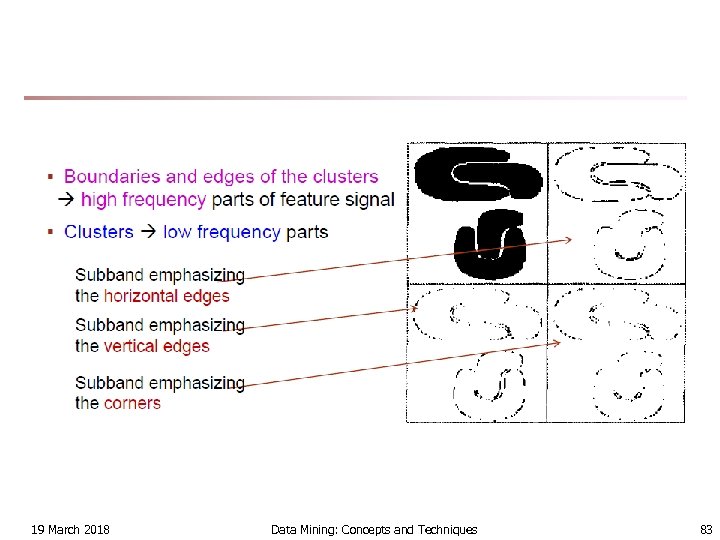
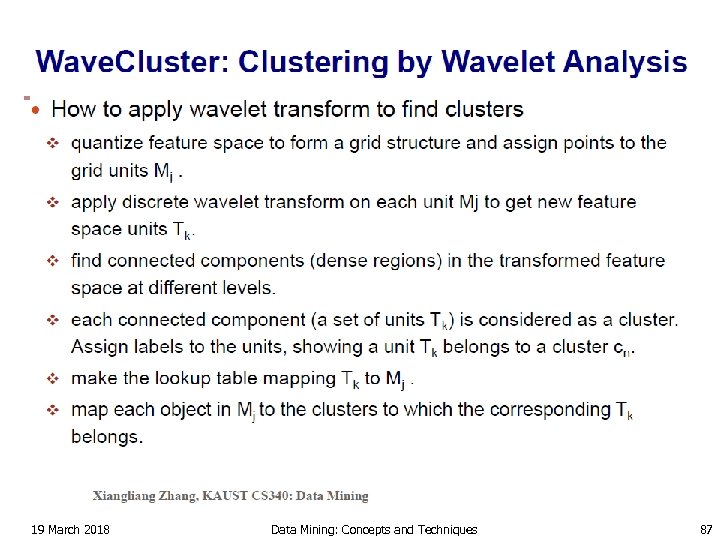
 Wave. Cluster n How to apply wavelet transform to find clusters n Summarize the data by imposing a multidimensional grid structure onto data space n These multidimensional spatial data objects are represented in an n-dimensional feature space (e. g. R, G, B) n Apply wavelet transform on feature space to find the dense regions in the feature space n Apply wavelet transform multiple times which result in clusters at different scales from fine to coarse
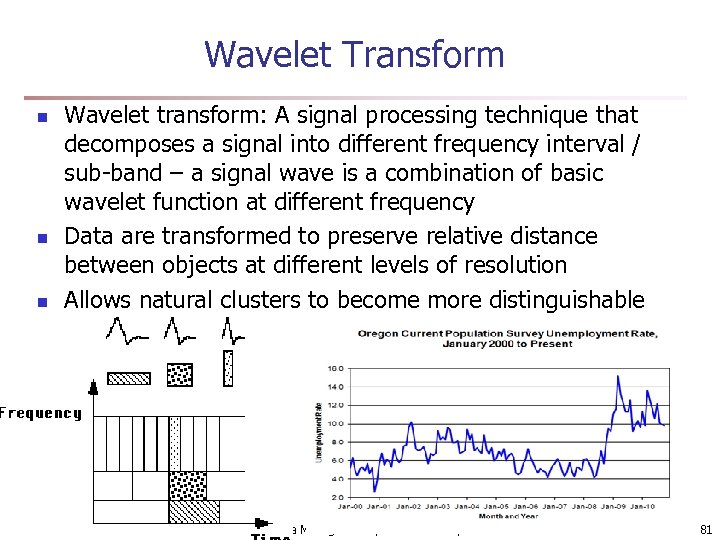 Wavelet Transform n n n Wavelet transform: A signal processing technique that decomposes a signal into different frequency interval / sub-band – a signal wave is a combination of basic wavelet function at different frequency Data are transformed to preserve relative distance between objects at different levels of resolution Allows natural clusters to become more distinguishable 19 March 2018 Data Mining: Concepts and Techniques 81
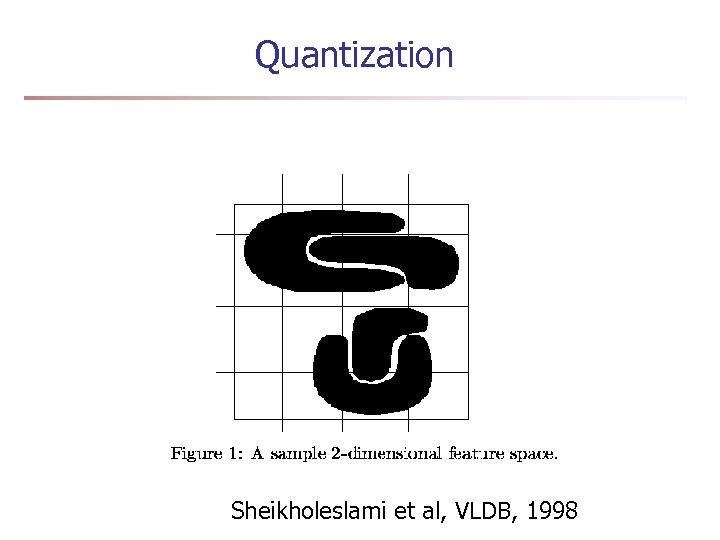 Quantization Sheikholeslami et al, VLDB, 1998
 19 March 2018 Data Mining: Concepts and Techniques 83
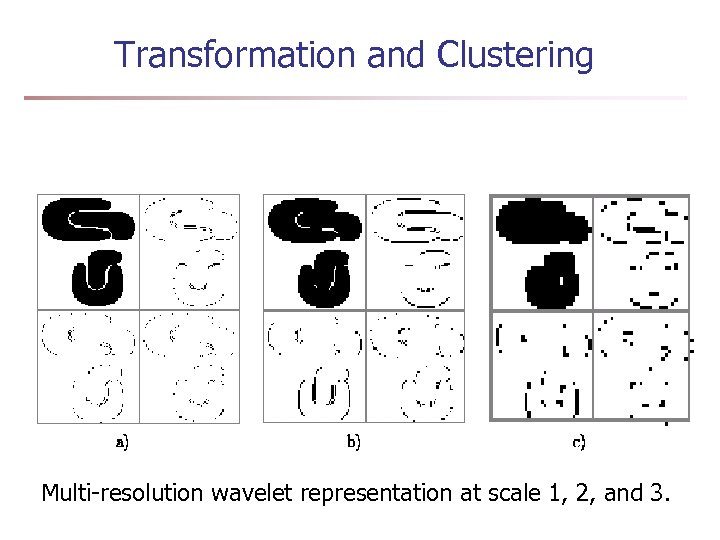 Transformation and Clustering Multi-resolution wavelet representation at scale 1, 2, and 3.
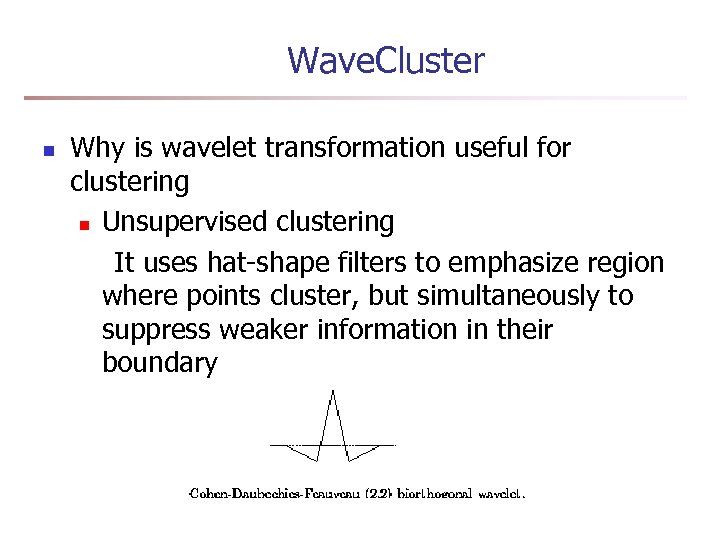 Wave. Cluster n Why is wavelet transformation useful for clustering n Unsupervised clustering It uses hat-shape filters to emphasize region where points cluster, but simultaneously to suppress weaker information in their boundary
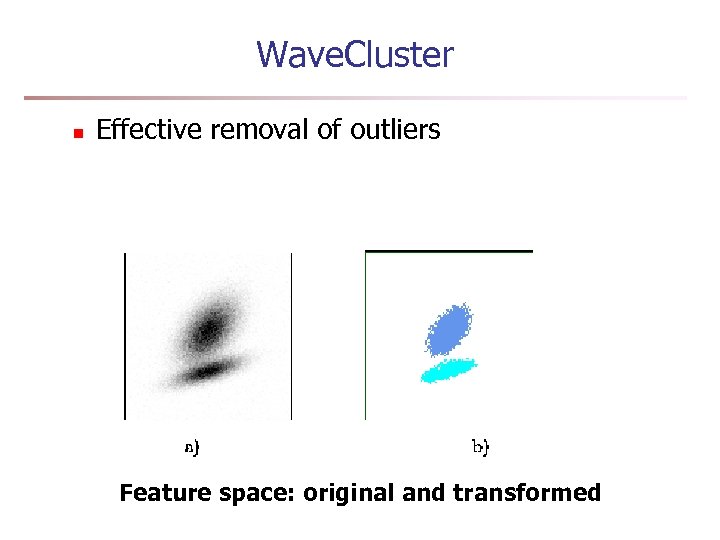 Wave. Cluster n Effective removal of outliers Feature space: original and transformed
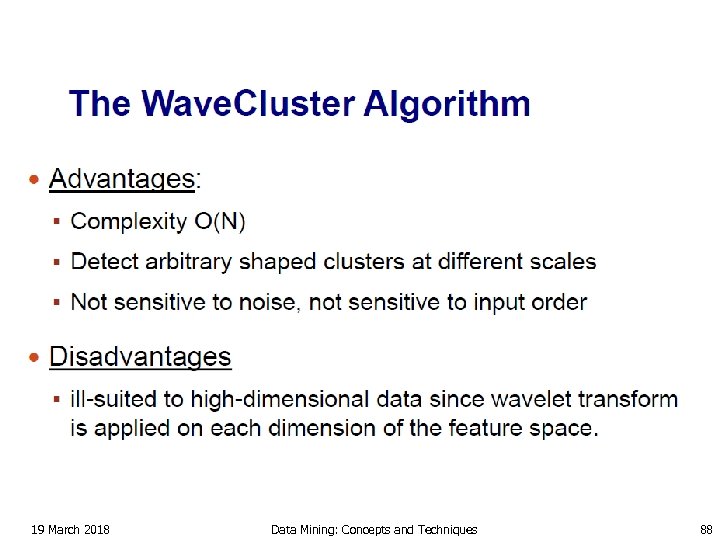
 The Wave. Cluster Algorithm n n Input parameters n # of grid cells for each dimension n the wavelet, and the # of applications of wavelet transform Why is wavelet transformation useful for clustering? n Use hat-shape filters to emphasize region where points cluster, but simultaneously suppress weaker information in their boundary n Effective removal of outliers, multi-resolution, cost effective Major features: n Complexity O(N) n Detect arbitrary shaped clusters at different scales n Not sensitive to noise, not sensitive to input order n Only applicable to low dimensional data Both grid-based and density-based 19 March 2018 Data Mining: Concepts and Techniques 87
 19 March 2018 Data Mining: Concepts and Techniques 88
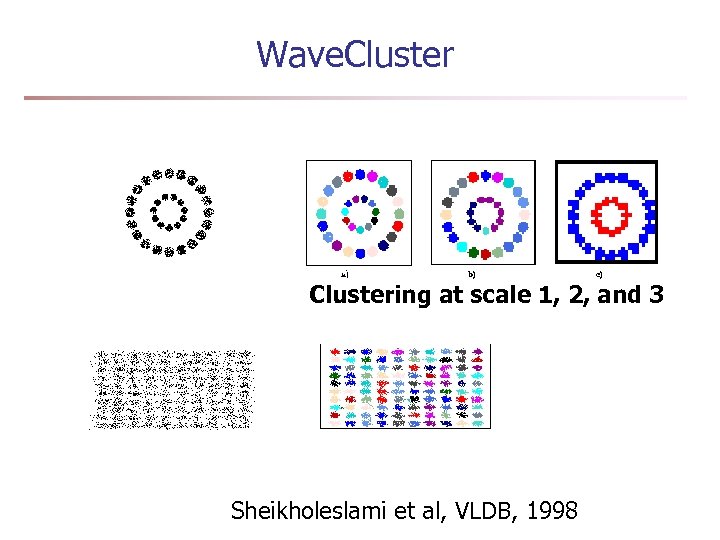 Wave. Clustering at scale 1, 2, and 3 Sheikholeslami et al, VLDB, 1998
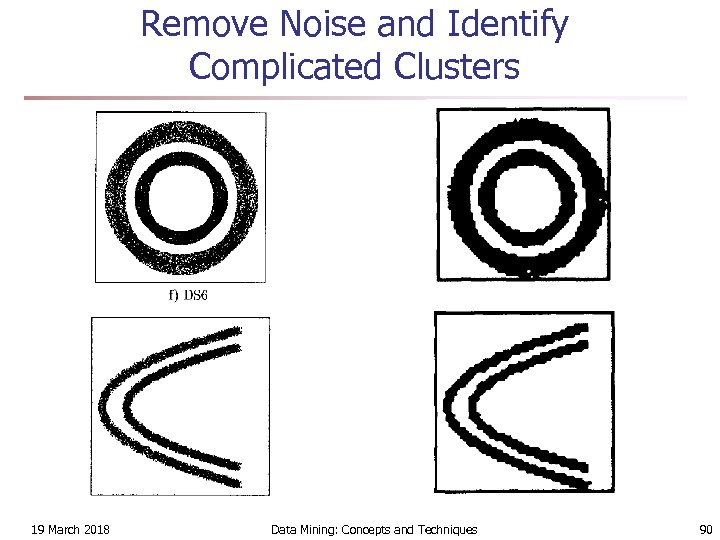 Remove Noise and Identify Complicated Clusters 19 March 2018 Data Mining: Concepts and Techniques 90
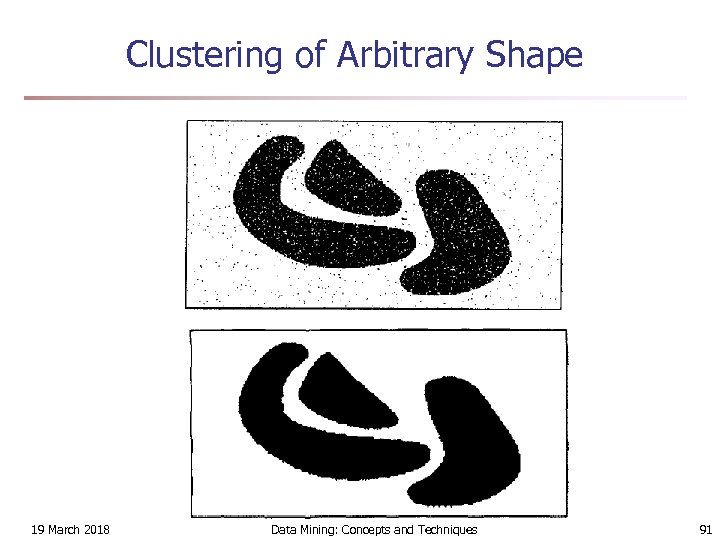 Clustering of Arbitrary Shape 19 March 2018 Data Mining: Concepts and Techniques 91
 Chapter 7. Cluster Analysis 1. What is Cluster Analysis? 2. Types of Data in Cluster Analysis 3. A Categorization of Major Clustering Methods 4. Partitioning Methods 5. Hierarchical Methods 6. Density-Based Methods 7. Grid-Based Methods 8. Model-Based Methods 9. Clustering High-Dimensional Data 10. Constraint-Based Clustering 11. Outlier Analysis 12. Summary 19 March 2018 Data Mining: Concepts and Techniques 92
 Model-Based Clustering n n What is model-based clustering? n Attempt to optimize the fit between the given data and some mathematical model n Based on the assumption: data are generated by a mixture of underlying probability distribution Typical methods n Statistical approach n n EM (Expectation maximization) Neural network approach n 19 March 2018 SOM (Self-Organizing Feature Map) Data Mining: Concepts and Techniques 93
 EM — Expectation Maximization n EM — A popular iterative refinement algorithm n EM clustering is a soft clustering in contrast to k-means hard clustering n n n New means are computed based on weighted average General idea n n n Assign each object to a cluster according to a probability distribution (weight) Starts with an initial estimate of the parameters of each cluster Iteratively rescores the patterns (data points) against the mixture density produced by the parameter vector The rescored patterns are used to update the parameter updates Patterns belonging to the same cluster, if they are placed by their scores in a particular component Algorithm converges fast but may not be in global optima 19 March 2018 Data Mining: Concepts and Techniques 94
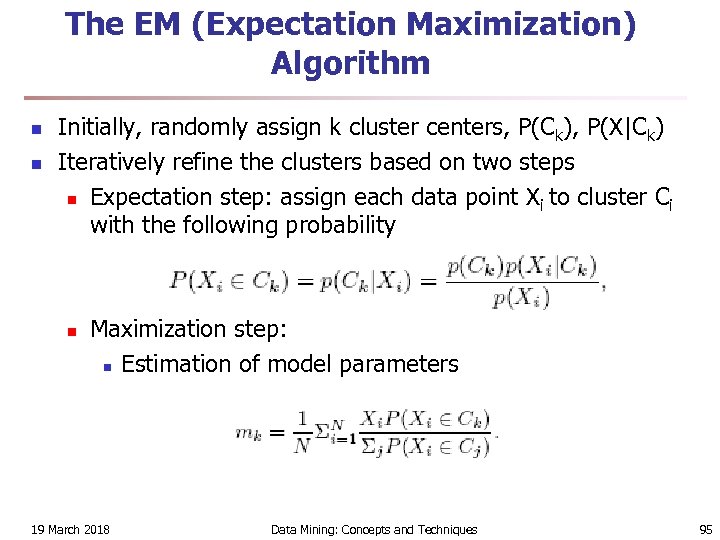 The EM (Expectation Maximization) Algorithm n n Initially, randomly assign k cluster centers, P(Ck), P(X|Ck) Iteratively refine the clusters based on two steps n Expectation step: assign each data point X i to cluster Ci with the following probability n Maximization step: n Estimation of model parameters 19 March 2018 Data Mining: Concepts and Techniques 95
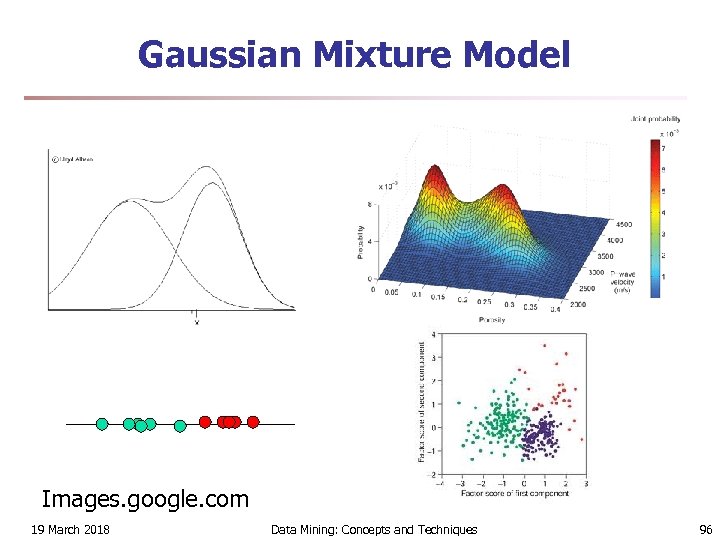 Gaussian Mixture Model Images. google. com 19 March 2018 Data Mining: Concepts and Techniques 96
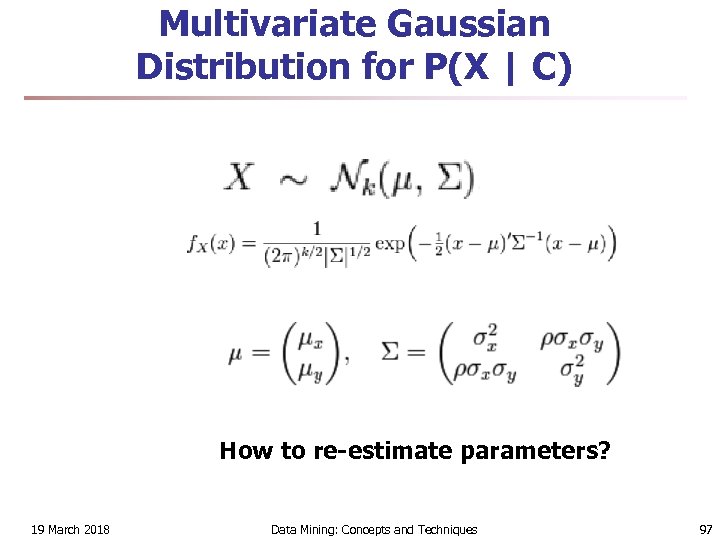 Multivariate Gaussian Distribution for P(X | C) How to re-estimate parameters? 19 March 2018 Data Mining: Concepts and Techniques 97
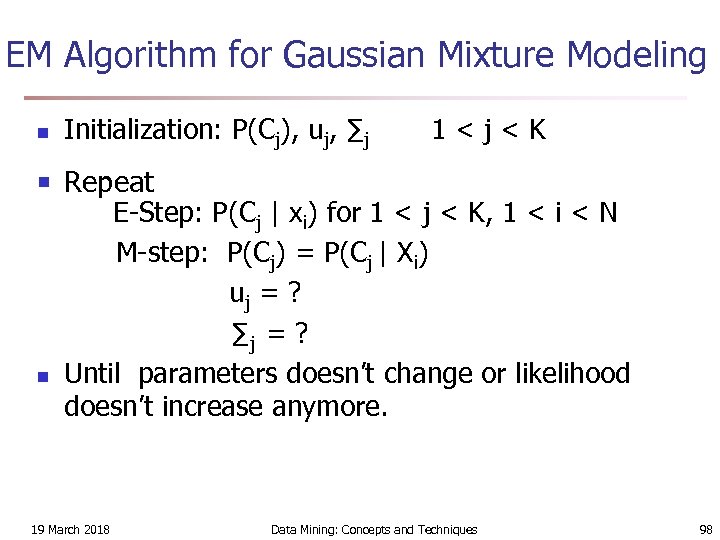 EM Algorithm for Gaussian Mixture Modeling n Initialization: P(Cj), uj, ∑j 1 < j < K Repeat E-Step: P(Cj | xi) for 1 < j < K, 1 < i < N M-step: P(Cj) = P(Cj | Xi) uj = ? ∑j = ? n Until parameters doesn’t change or likelihood doesn’t increase anymore. n 19 March 2018 Data Mining: Concepts and Techniques 98
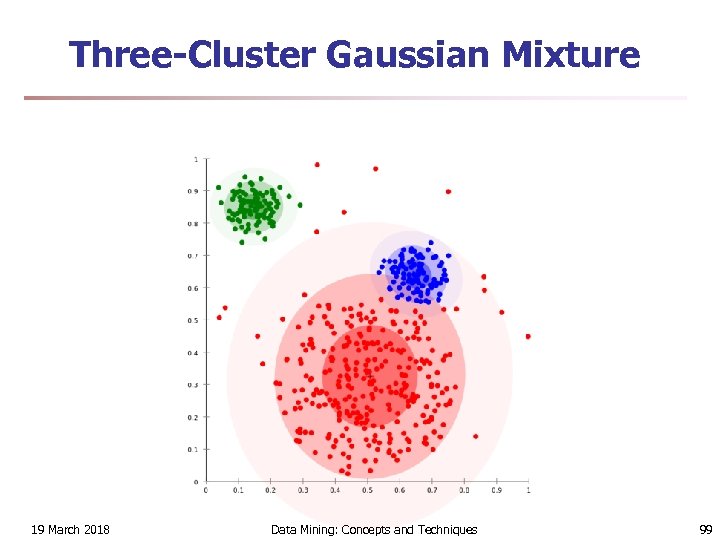 Three-Cluster Gaussian Mixture 19 March 2018 Data Mining: Concepts and Techniques 99
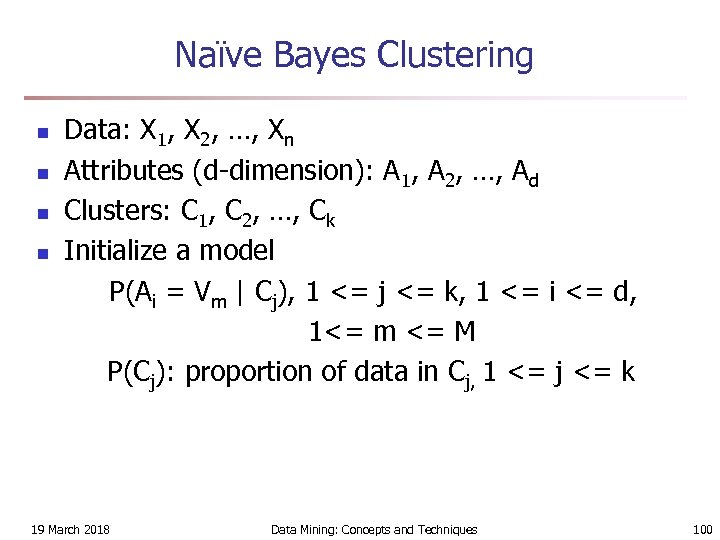 Naïve Bayes Clustering Data: X 1, X 2, …, Xn n Attributes (d-dimension): A 1, A 2, …, Ad n Clusters: C 1, C 2, …, Ck n Initialize a model P(Ai = Vm | Cj), 1 <= j <= k, 1 <= i <= d, 1<= m <= M P(Cj): proportion of data in Cj, 1 <= j <= k n 19 March 2018 Data Mining: Concepts and Techniques 100
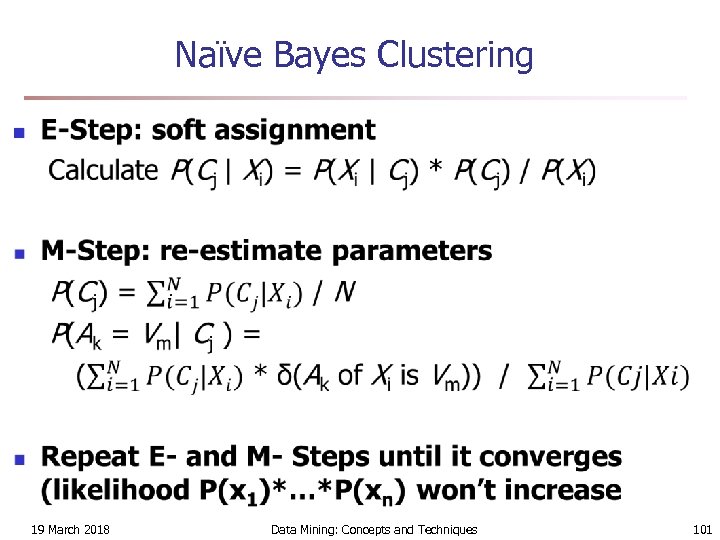 Naïve Bayes Clustering n 19 March 2018 Data Mining: Concepts and Techniques 101
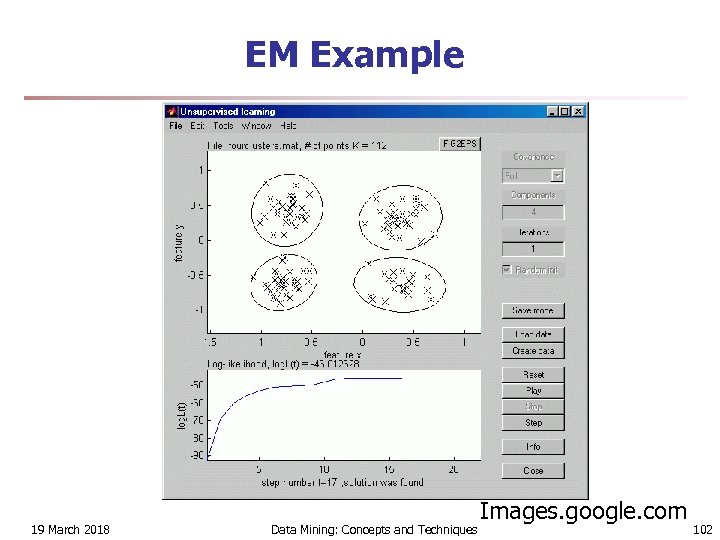 EM Example 19 March 2018 Data Mining: Concepts and Techniques Images. google. com 102
 EM Demo n n Vote data set Binary variables Two classes (C 1 and C 2) Likelihood: P(fi = yes | C 1), P(fi = yes | C 2) 19 March 2018 Data Mining: Concepts and Techniques 103
 Application Demo n n Gaussian Mixture Modeling for Leg Detection in Laser Image Youtube link: http: //www. youtube. com/watch? v=_Ik. Y_s. CW 4 I&feature=related 19 March 2018 Data Mining: Concepts and Techniques 104
 Neural Network Approach n n Neural network approaches n Represent each cluster as an exemplar, acting as a “prototype” of the cluster n New objects are distributed to the cluster whose exemplar is the most similar according to some distance measure Typical methods n SOM (Soft-Organizing feature Map) n Competitive learning n n 19 March 2018 Involves a grid architecture of several units (neurons) Neurons compete in a “winner-takes-all” fashion for the object currently being presented Data Mining: Concepts and Techniques 105
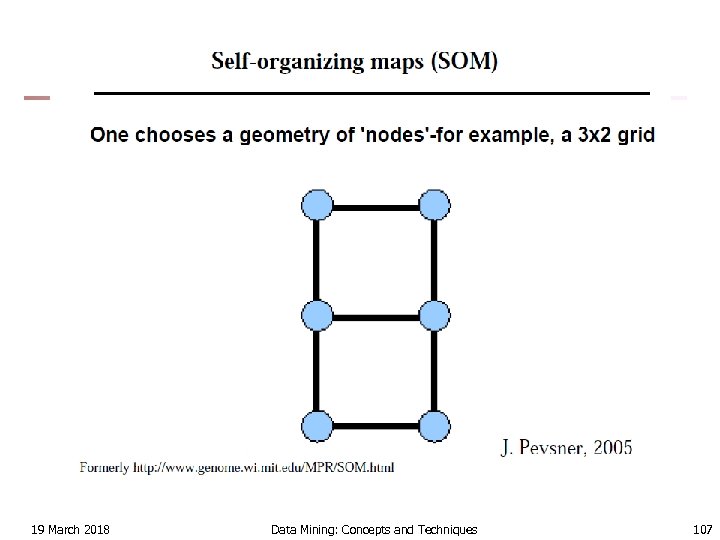
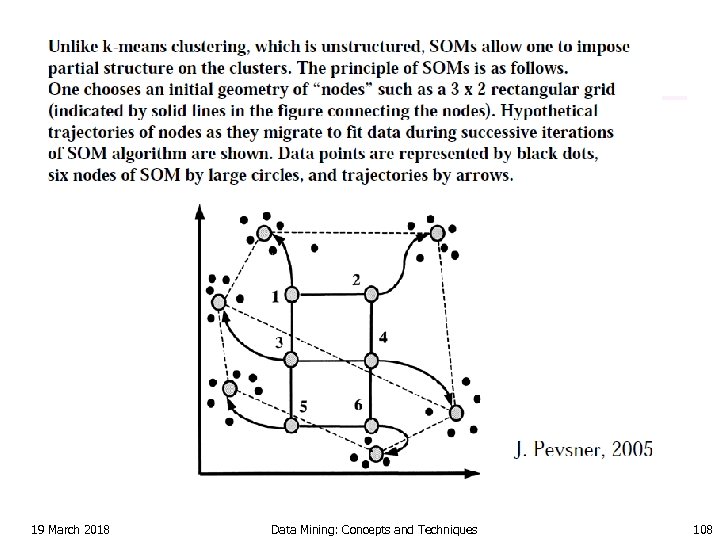
 Self-Organizing Feature Map (SOM) n n SOMs, also called topological ordered maps, or Kohonen Self-Organizing Feature Map (KSOMs) It maps all the points in a high-dimensional source space into a 2 to 3 -d target space, s. t. , the distance and proximity relationship (i. e. , topology) are preserved as much as possible Similar to k-means: cluster centers tend to lie in a low-dimensional manifold in the feature space Clustering is performed by having several units competing for the current object n The unit whose weight vector is closest to the current object wins n The winner and its neighbors learn by weighted addition of object n SOMs are believed to resemble processing that can occur in the brain n Useful for visualizing high-dimensional data in 2 - or 3 -D space 19 March 2018 Data Mining: Concepts and Techniques 106
 19 March 2018 Data Mining: Concepts and Techniques 107
 19 March 2018 Data Mining: Concepts and Techniques 108
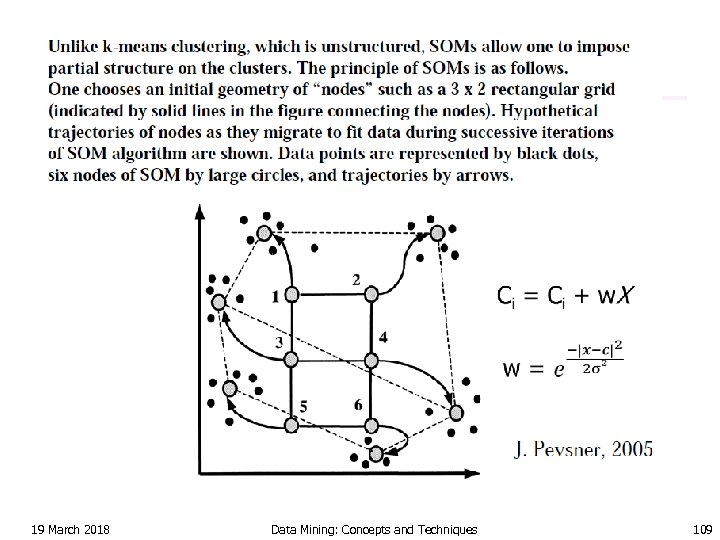 19 March 2018 Data Mining: Concepts and Techniques 109
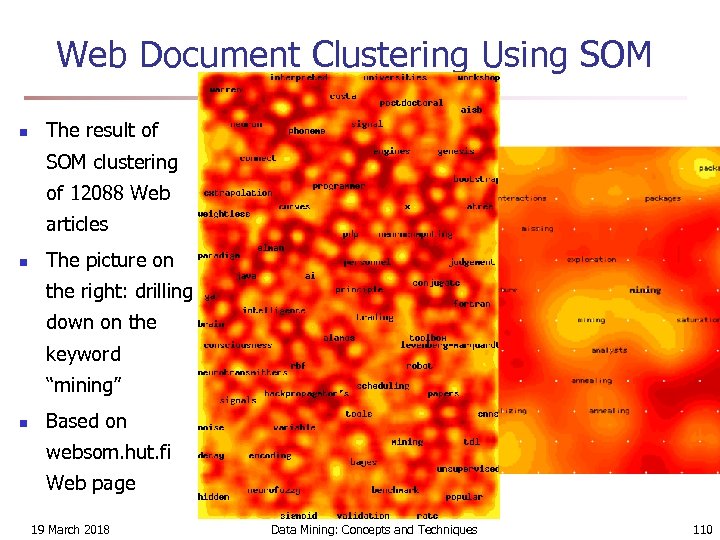 Web Document Clustering Using SOM n The result of SOM clustering of 12088 Web articles n The picture on the right: drilling down on the keyword “mining” n Based on websom. hut. fi Web page 19 March 2018 Data Mining: Concepts and Techniques 110
 Chapter 6. Cluster Analysis 1. What is Cluster Analysis? 2. Types of Data in Cluster Analysis 3. A Categorization of Major Clustering Methods 4. Partitioning Methods 5. Hierarchical Methods 6. Density-Based Methods 7. Grid-Based Methods 8. Model-Based Methods 9. Clustering High-Dimensional Data 10. Constraint-Based Clustering 11. Outlier Analysis 12. Summary 19 March 2018 Data Mining: Concepts and Techniques 111
 Clustering High-Dimensional Data n Clustering high-dimensional data n Many applications: text documents, DNA micro-array data n Major challenges: n n Distance measure becomes meaningless—due to equi-distance n n Many irrelevant dimensions may mask clusters Clusters may exist only in some subspaces Methods n Feature transformation: only effective if most dimensions are relevant n n Feature selection: wrapper or filter approaches n n PCA & SVD useful only when features are highly correlated/redundant useful to find a subspace where the data have nice clusters Subspace-clustering: find clusters in all the possible subspaces n 19 March 2018 CLIQUE and frequent pattern-based clustering Data Mining: Concepts and Techniques 112
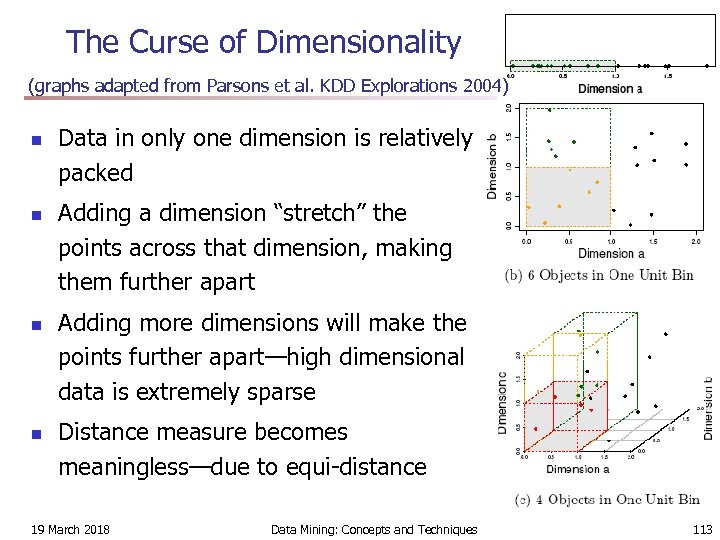 The Curse of Dimensionality (graphs adapted from Parsons et al. KDD Explorations 2004) n n Data in only one dimension is relatively packed Adding a dimension “stretch” the points across that dimension, making them further apart Adding more dimensions will make the points further apart—high dimensional data is extremely sparse Distance measure becomes meaningless—due to equi-distance 19 March 2018 Data Mining: Concepts and Techniques 113
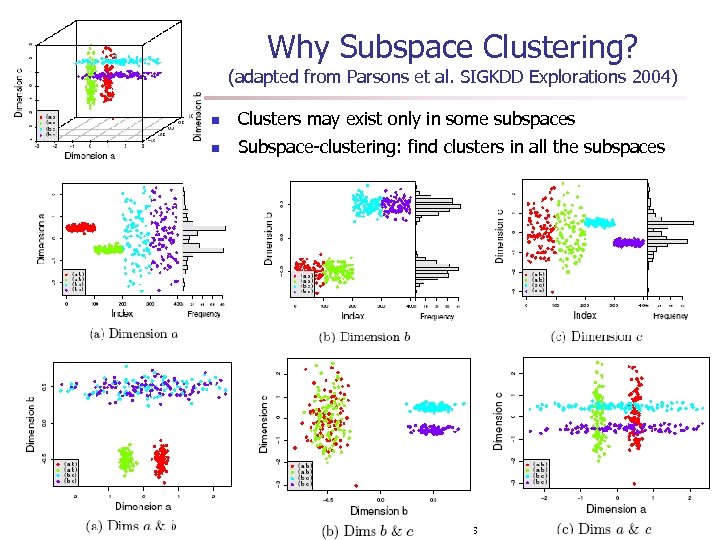 Why Subspace Clustering? (adapted from Parsons et al. SIGKDD Explorations 2004) n n 19 March 2018 Clusters may exist only in some subspaces Subspace-clustering: find clusters in all the subspaces Data Mining: Concepts and Techniques 114
 CLIQUE (Clustering In QUEst) n n n Agrawal, Gehrke, Gunopulos, Raghavan (SIGMOD’ 98) Automatically identifying subspaces of a high dimensional data space that allow better clustering than original space CLIQUE can be considered as both density-based and grid-based n n It partitions each dimension into the same number of equal length interval It partitions an m-dimensional data space into non-overlapping rectangular units A unit is dense if the fraction of total data points contained in the unit exceeds the input model parameter A cluster is a maximal set of connected dense units within a subspace 19 March 2018 Data Mining: Concepts and Techniques 115
 CLIQUE: The Major Steps n n Partition the data space and find the number of points that lie inside each cell of the partition. Identify clusters n n n Determine dense units in all subspaces of interests Determine connected dense units in all subspaces of interests. Generate minimal description for the clusters n Determine maximal regions that cover a cluster of connected dense units for each cluster n Determination of minimal cover for each cluster 19 March 2018 Data Mining: Concepts and Techniques 116
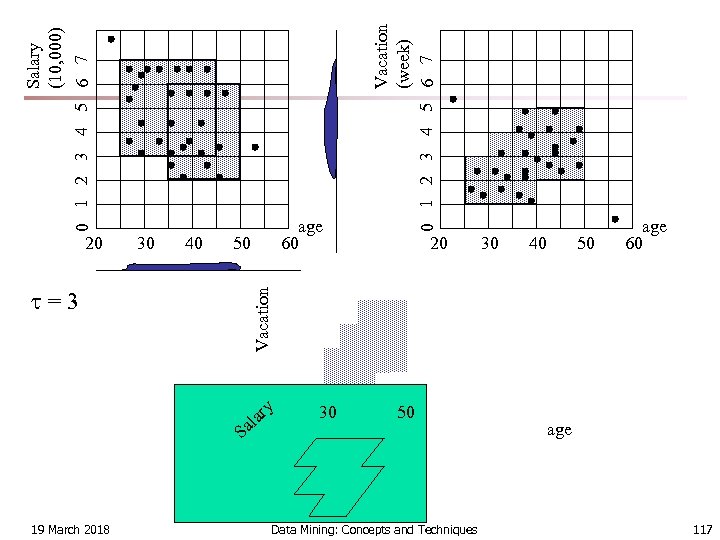 30 40 50 20 a al ry 30 50 S 19 March 2018 30 40 50 age 60 Vacation =3 Vacation (week) 0 1 2 3 4 5 6 7 Salary (10, 000) 0 1 2 3 4 5 6 7 20 age 60 Data Mining: Concepts and Techniques age 117
 Strength and Weakness of CLIQUE n Strength n n automatically finds subspaces of the highest dimensionality such that high density clusters exist in those subspaces n insensitive to the order of records in input and does not presume some canonical data distribution n scales linearly with the size of input and has good scalability as the number of dimensions in the data increases Weakness n The accuracy of the clustering result may be degraded at the expense of simplicity of the method 19 March 2018 Data Mining: Concepts and Techniques 118
 Frequent Pattern-Based Approach n Clustering high-dimensional space (e. g. , clustering text documents, microarray data) n Projected subspace-clustering: which dimensions to be projected on? n n CLIQUE Using frequent patterns as “features” n n n “Frequent” are inherent features Mining freq. patterns may not be so expensive Typical methods n Frequent-term-based document clustering n Clustering by pattern similarity in micro-array data (p. Clustering) 19 March 2018 Data Mining: Concepts and Techniques 119
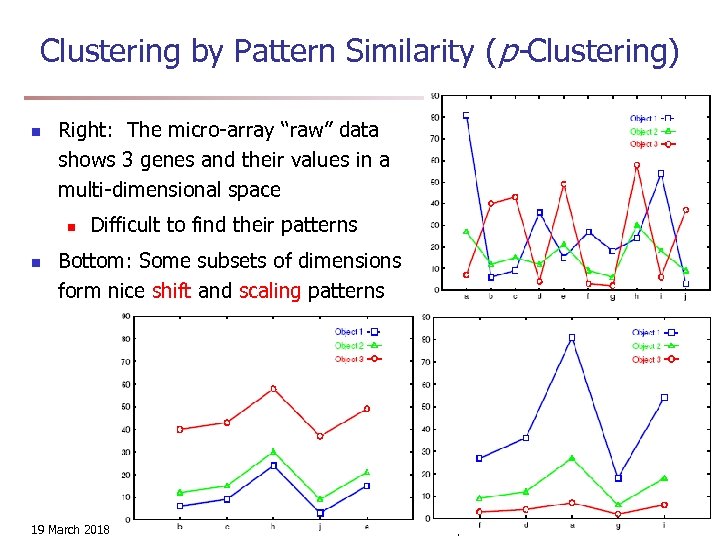 Clustering by Pattern Similarity (p-Clustering) n Right: The micro-array “raw” data shows 3 genes and their values in a multi-dimensional space n n Difficult to find their patterns Bottom: Some subsets of dimensions form nice shift and scaling patterns 19 March 2018 Data Mining: Concepts and Techniques 120
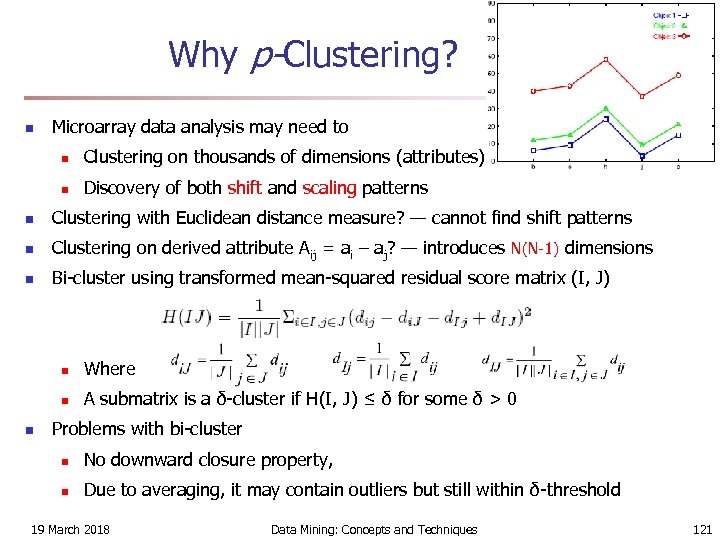 Why p-Clustering? n Microarray data analysis may need to n Clustering on thousands of dimensions (attributes) n Discovery of both shift and scaling patterns n Clustering with Euclidean distance measure? — cannot find shift patterns n Clustering on derived attribute Aij = ai – aj? — introduces N(N-1) dimensions n Bi-cluster using transformed mean-squared residual score matrix (I, J) n n n Where A submatrix is a δ-cluster if H(I, J) ≤ δ for some δ > 0 Problems with bi-cluster n No downward closure property, n Due to averaging, it may contain outliers but still within δ-threshold 19 March 2018 Data Mining: Concepts and Techniques 121
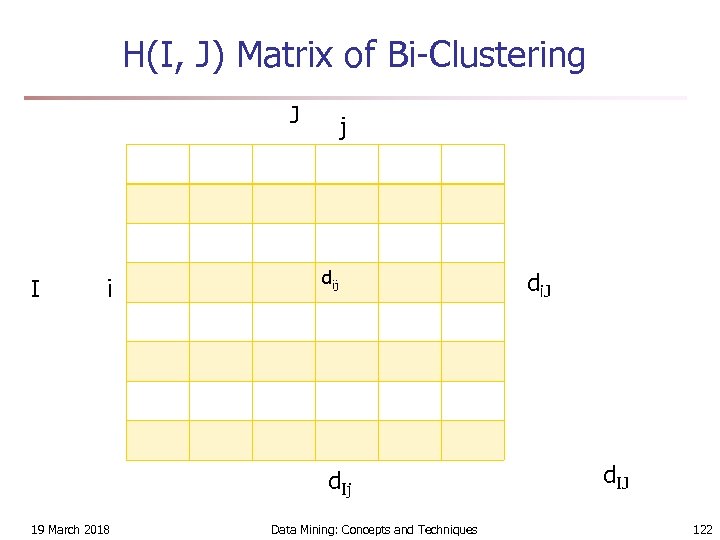 H(I, J) Matrix of Bi-Clustering J I i j dij d. Ij 19 March 2018 Data Mining: Concepts and Techniques di. J d. IJ 122
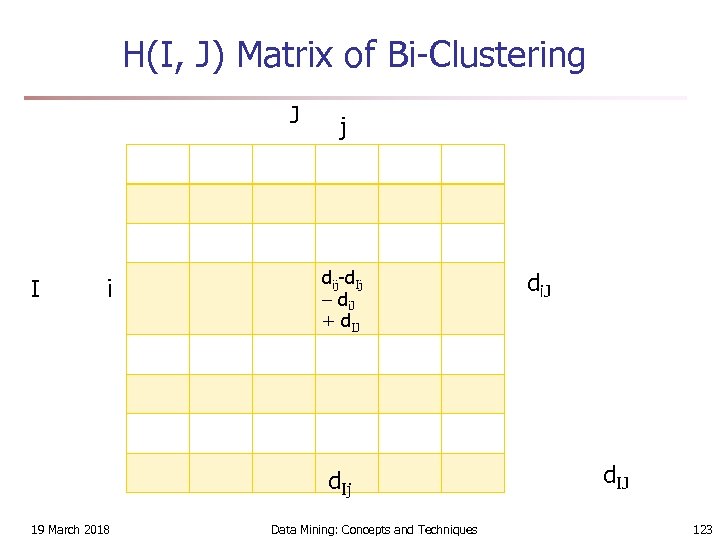 H(I, J) Matrix of Bi-Clustering J I i j dij-d. Ij – di. J + d. IJ d. Ij 19 March 2018 Data Mining: Concepts and Techniques di. J d. IJ 123
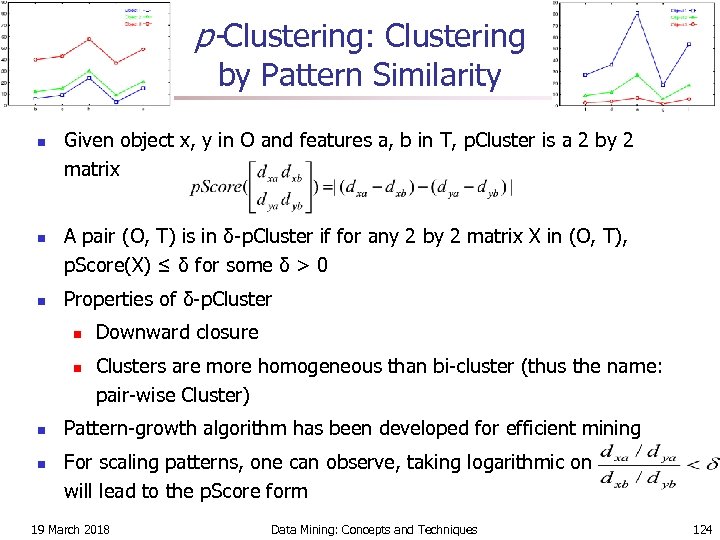 p-Clustering: Clustering by Pattern Similarity n n n Given object x, y in O and features a, b in T, p. Cluster is a 2 by 2 matrix A pair (O, T) is in δ-p. Cluster if for any 2 by 2 matrix X in (O, T), p. Score(X) ≤ δ for some δ > 0 Properties of δ-p. Cluster n n Downward closure Clusters are more homogeneous than bi-cluster (thus the name: pair-wise Cluster) Pattern-growth algorithm has been developed for efficient mining For scaling patterns, one can observe, taking logarithmic on will lead to the p. Score form 19 March 2018 Data Mining: Concepts and Techniques 124
 Chapter 6. Cluster Analysis 1. What is Cluster Analysis? 2. Types of Data in Cluster Analysis 3. A Categorization of Major Clustering Methods 4. Partitioning Methods 5. Hierarchical Methods 6. Density-Based Methods 7. Grid-Based Methods 8. Model-Based Methods 9. Clustering High-Dimensional Data 10. Constraint-Based Clustering 11. Outlier Analysis 12. Summary 19 March 2018 Data Mining: Concepts and Techniques 125
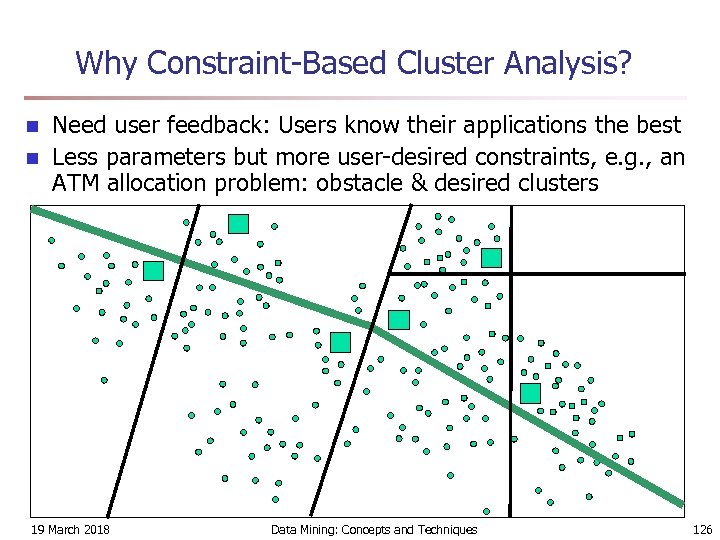 Why Constraint-Based Cluster Analysis? Need user feedback: Users know their applications the best n Less parameters but more user-desired constraints, e. g. , an ATM allocation problem: obstacle & desired clusters n 19 March 2018 Data Mining: Concepts and Techniques 126
 A Classification of Constraints in Cluster Analysis n n Clustering in applications: desirable to have user-guided (i. e. , constrained) cluster analysis Different constraints in cluster analysis: n Constraints on individual objects (do selection first) n n Constraints on distance or similarity functions n n # of clusters, Min. Pts, etc. User-specified constraints n n Weighted functions, obstacles (e. g. , rivers, lakes) Constraints on the selection of clustering parameters n n Cluster on houses worth over $300 K Contain at least 500 valued customers and 5000 ordinary ones Semi-supervised: giving small training sets as “constraints” or hints 19 March 2018 Data Mining: Concepts and Techniques 127
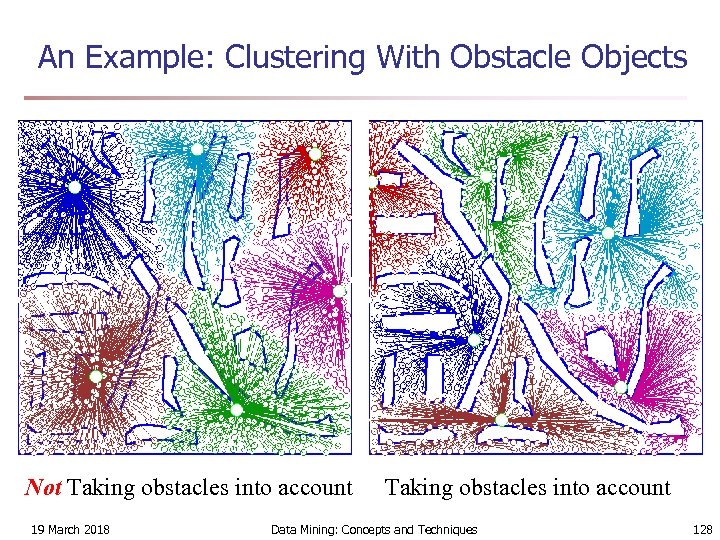 An Example: Clustering With Obstacle Objects Not Taking obstacles into account 19 March 2018 Taking obstacles into account Data Mining: Concepts and Techniques 128
 Chapter 7. Cluster Analysis 1. What is Cluster Analysis? 2. Types of Data in Cluster Analysis 3. A Categorization of Major Clustering Methods 4. Partitioning Methods 5. Hierarchical Methods 6. Density-Based Methods 7. Grid-Based Methods 8. Model-Based Methods 9. Clustering High-Dimensional Data 10. Constraint-Based Clustering 11. Outlier Analysis 12. Summary 19 March 2018 Data Mining: Concepts and Techniques 129
 What Is Outlier Discovery? n n n What are outliers? n The set of objects are considerably dissimilar from the remainder of the data n Example: Sports: Michael Jordon, Wayne Gretzky, . . . Problem: Define and find outliers in large data sets Applications: n Credit card fraud detection n Telecom fraud detection n Customer segmentation n Medical analysis n Bioinformatics 19 March 2018 Data Mining: Concepts and Techniques 130
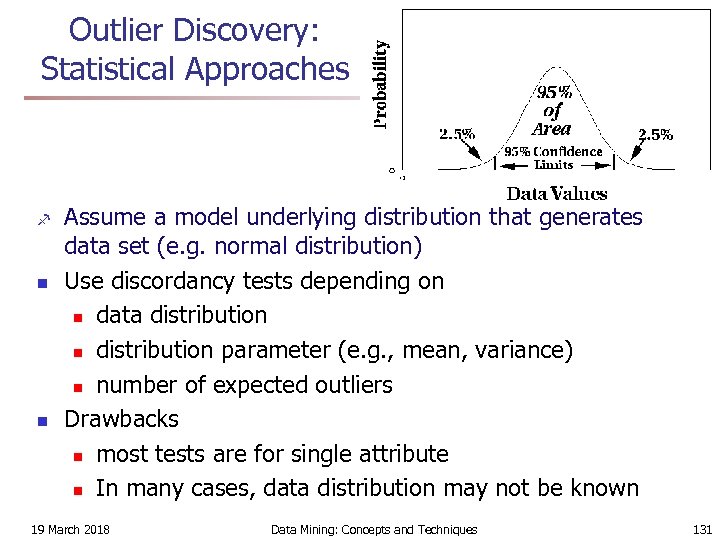 Outlier Discovery: Statistical Approaches f n n Assume a model underlying distribution that generates data set (e. g. normal distribution) Use discordancy tests depending on n data distribution n distribution parameter (e. g. , mean, variance) n number of expected outliers Drawbacks n most tests are for single attribute n In many cases, data distribution may not be known 19 March 2018 Data Mining: Concepts and Techniques 131
 Outlier Discovery: Distance-Based Approach n n Introduced to counter the main limitations imposed by statistical methods n We need multi-dimensional analysis without knowing data distribution Distance-based outlier: A DB(p, d)-outlier is an object O in a dataset T such that at least a fraction p of the objects in T lies at a distance greater than d from O 19 March 2018 Data Mining: Concepts and Techniques 132
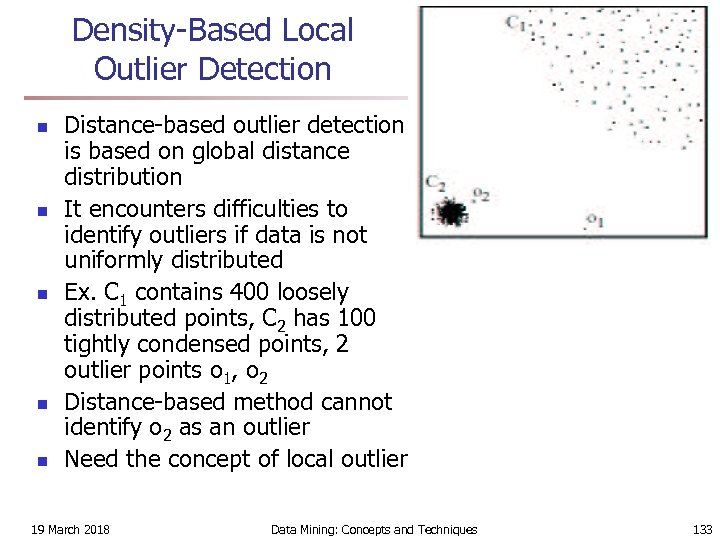 Density-Based Local Outlier Detection n n Distance-based outlier detection is based on global distance distribution It encounters difficulties to identify outliers if data is not uniformly distributed Ex. C 1 contains 400 loosely distributed points, C 2 has 100 tightly condensed points, 2 outlier points o 1, o 2 Distance-based method cannot identify o 2 as an outlier Need the concept of local outlier 19 March 2018 Data Mining: Concepts and Techniques 133
 Outlier Discovery: Deviation-Based Approach n n n Identifies outliers by examining the main characteristics of objects in a group Objects that “deviate” from this description are considered outliers Sequential exception technique n n simulates the way in which humans can distinguish unusual objects from among a series of supposedly like objects Data cube technique n uses data cubes to identify regions of anomalies in large multidimensional data 19 March 2018 Data Mining: Concepts and Techniques 134
 Chapter 7. Cluster Analysis 1. What is Cluster Analysis? 2. Types of Data in Cluster Analysis 3. A Categorization of Major Clustering Methods 4. Partitioning Methods 5. Hierarchical Methods 6. Density-Based Methods 7. Grid-Based Methods 8. Model-Based Methods 9. Clustering High-Dimensional Data 10. Constraint-Based Clustering 11. Outlier Analysis 12. Summary 19 March 2018 Data Mining: Concepts and Techniques 135
 Summary n n n Cluster analysis groups objects based on their similarity and has wide applications Measure of similarity can be computed for various types of data Clustering algorithms can be categorized into partitioning methods, hierarchical methods, density-based methods, grid-based methods, model-based methods, frequent pattern based method Outlier detection and analysis are very useful for fraud detection, etc. and can be performed by statistical, distance-based or deviation-based approaches There are still lots of research issues on cluster analysis 19 March 2018 Data Mining: Concepts and Techniques 136
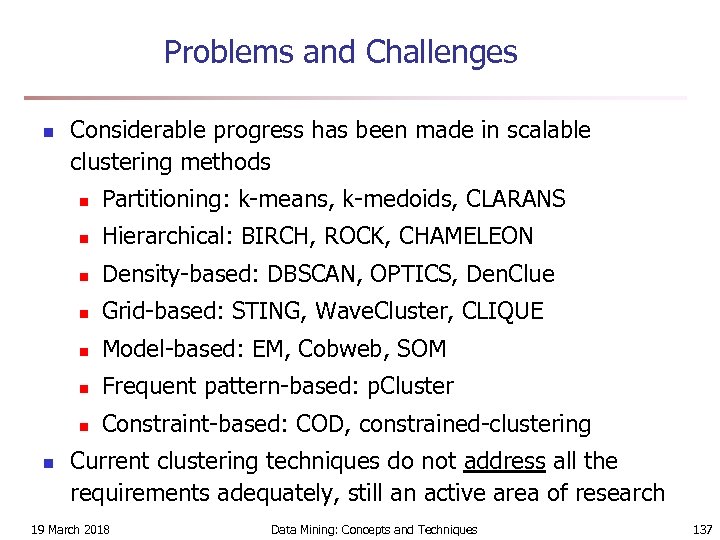 Problems and Challenges n Considerable progress has been made in scalable clustering methods n n Hierarchical: BIRCH, ROCK, CHAMELEON n Density-based: DBSCAN, OPTICS, Den. Clue n Grid-based: STING, Wave. Cluster, CLIQUE n Model-based: EM, Cobweb, SOM n Frequent pattern-based: p. Cluster n n Partitioning: k-means, k-medoids, CLARANS Constraint-based: COD, constrained-clustering Current clustering techniques do not address all the requirements adequately, still an active area of research 19 March 2018 Data Mining: Concepts and Techniques 137
 References (1) n R. Agrawal, J. Gehrke, D. Gunopulos, and P. Raghavan. Automatic subspace clustering of high dimensional data for data mining applications. SIGMOD'98 n M. R. Anderberg. Cluster Analysis for Applications. Academic Press, 1973. n M. Ankerst, M. Breunig, H. -P. Kriegel, and J. Sander. Optics: Ordering points to identify the clustering structure, SIGMOD’ 99. n P. Arabie, L. J. Hubert, and G. De Soete. Clustering and Classification. World Scientific, 1996 n Beil F. , Ester M. , Xu X. : "Frequent Term-Based Text Clustering", KDD'02 n M. M. Breunig, H. -P. Kriegel, R. Ng, J. Sander. LOF: Identifying Density-Based Local Outliers. SIGMOD 2000. n M. Ester, H. -P. Kriegel, J. Sander, and X. Xu. A density-based algorithm for discovering clusters in large spatial databases. KDD'96. n M. Ester, H. -P. Kriegel, and X. Xu. Knowledge discovery in large spatial databases: Focusing techniques for efficient class identification. SSD'95. n D. Fisher. Knowledge acquisition via incremental conceptual clustering. Machine Learning, 2: 139172, 1987. n D. Gibson, J. Kleinberg, and P. Raghavan. Clustering categorical data: An approach based on dynamic systems. VLDB’ 98. 19 March 2018 Data Mining: Concepts and Techniques 138
 References (2) n n n n n V. Ganti, J. Gehrke, R. Ramakrishan. CACTUS Clustering Categorical Data Using Summaries. KDD'99. D. Gibson, J. Kleinberg, and P. Raghavan. Clustering categorical data: An approach based on dynamic systems. In Proc. VLDB’ 98. S. Guha, R. Rastogi, and K. Shim. Cure: An efficient clustering algorithm for large databases. SIGMOD'98. S. Guha, R. Rastogi, and K. Shim. ROCK: A robust clustering algorithm for categorical attributes. In ICDE'99, pp. 512 -521, Sydney, Australia, March 1999. A. Hinneburg, D. l A. Keim: An Efficient Approach to Clustering in Large Multimedia Databases with Noise. KDD’ 98. A. K. Jain and R. C. Dubes. Algorithms for Clustering Data. Printice Hall, 1988. G. Karypis, E. -H. Han, and V. Kumar. CHAMELEON: A Hierarchical Clustering Algorithm Using Dynamic Modeling. COMPUTER, 32(8): 68 -75, 1999. L. Kaufman and P. J. Rousseeuw. Finding Groups in Data: an Introduction to Cluster Analysis. John Wiley & Sons, 1990. E. Knorr and R. Ng. Algorithms for mining distance-based outliers in large datasets. VLDB’ 98. G. J. Mc. Lachlan and K. E. Bkasford. Mixture Models: Inference and Applications to Clustering. John Wiley and Sons, 1988. n P. Michaud. Clustering techniques. Future Generation Computer systems, 13, 1997. n R. Ng and J. Han. Efficient and effective clustering method for spatial data mining. VLDB'94. 19 March 2018 Data Mining: Concepts and Techniques 139
 References (3) n L. Parsons, E. Haque and H. Liu, Subspace Clustering for High Dimensional Data: A Review , SIGKDD Explorations, 6(1), June 2004 n E. Schikuta. Grid clustering: An efficient hierarchical clustering method for very large data sets. Proc. 1996 Int. Conf. on Pattern Recognition, . n G. Sheikholeslami, S. Chatterjee, and A. Zhang. Wave. Cluster: A multi-resolution clustering approach for very large spatial databases. VLDB’ 98. n A. K. H. Tung, J. Han, L. V. S. Lakshmanan, and R. T. Ng. Constraint-Based Clustering in Large Databases, ICDT'01. n A. K. H. Tung, J. Hou, and J. Han. Spatial Clustering in the Presence of Obstacles , ICDE'01 n H. Wang, W. Wang, J. Yang, and P. S. Yu. Clustering by pattern similarity in large data sets, SIGMOD’ 02. n W. Wang, Yang, R. Muntz, STING: A Statistical Information grid Approach to Spatial Data Mining, VLDB’ 97. n T. Zhang, R. Ramakrishnan, and M. Livny. BIRCH : an efficient data clustering method for very large databases. SIGMOD'96. 19 March 2018 Data Mining: Concepts and Techniques 140