


 Скачать презентацию Data Mining Concepts and Techniques Chapter 5
b35167853e98cc8b14ef92af438219c2.ppt
- Количество слайдов: 85
 Data Mining: Concepts and Techniques — Chapter 5 — Jianlin Cheng Department of Computer Science University of Missouri, Columbia Adapted from Slides of the Text Book © 2006 Jiawei Han and Micheline Kamber, All rights reserved 15 March 2018 Data Mining: Concepts and Techniques 1
 Chapter 5: Mining Frequent Patterns, Association and Correlations n n Basic concepts Efficient and scalable frequent itemset mining methods Mining various kinds of association rules From association mining to correlation analysis n Constraint-based association mining n Summary 15 March 2018 Data Mining: Concepts and Techniques 2
 What Is Frequent Pattern Analysis? Frequent pattern: a pattern (a set of items, subsequences, substructures, n etc. ) that occurs frequently in a data set n First proposed by Agrawal, Imielinski, and Swami [AIS 93] in the context of frequent itemsets and association rule mining Motivation: Finding inherent regularities in data n n n What are the subsequent purchases after buying a PC? n What kinds of DNA are sensitive to this new drug? n n What products were often purchased together? — Beer and diapers? ! Can we automatically classify web documents? Applications n Basket data analysis, cross-marketing, catalog design, sale campaign analysis, Web log (click stream) analysis, and DNA sequence analysis. 15 March 2018 Data Mining: Concepts and Techniques 3
 Why Is Freq. Pattern Mining Important? n Discloses an intrinsic and important property of data sets n Forms the foundation for many essential data mining tasks n Association, correlation, and causality analysis n Sequential, structural (e. g. , sub-graph) patterns n Pattern analysis in spatiotemporal, multimedia, timeseries, and stream data n Classification: associative classification n Cluster analysis: frequent pattern-based clustering n Broad applications 15 March 2018 Data Mining: Concepts and Techniques 4
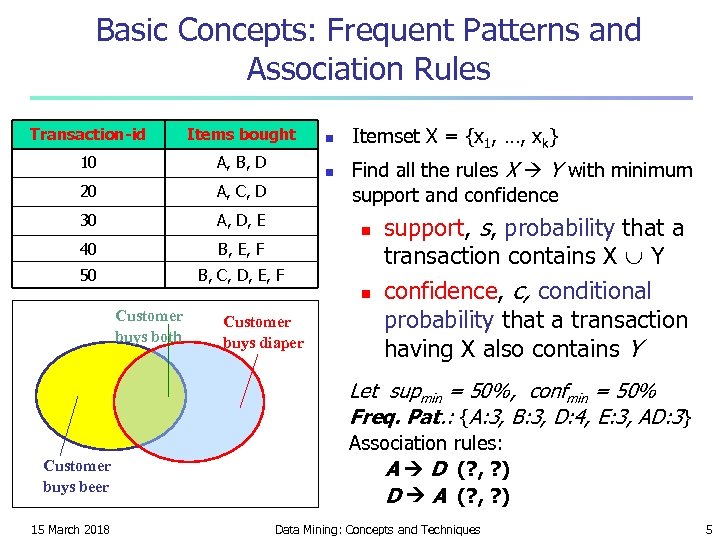 Basic Concepts: Frequent Patterns and Association Rules Transaction-id Items bought 10 A, B, D 20 A, C, D 30 A, D, E 40 B, E, F 50 Itemset X = {x 1, …, xk} B, C, D, E, F n n Find all the rules X Y with minimum support and confidence n n Customer buys both Customer buys diaper support, s, probability that a transaction contains X Y confidence, c, conditional probability that a transaction having X also contains Y Let supmin = 50%, confmin = 50% Freq. Pat. : {A: 3, B: 3, D: 4, E: 3, AD: 3} Customer buys beer 15 March 2018 Association rules: A D (? , ? ) D A (? , ? ) Data Mining: Concepts and Techniques 5
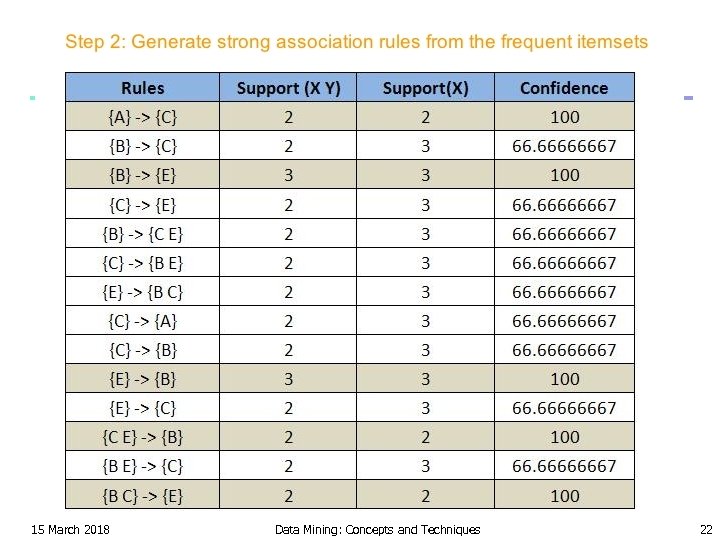
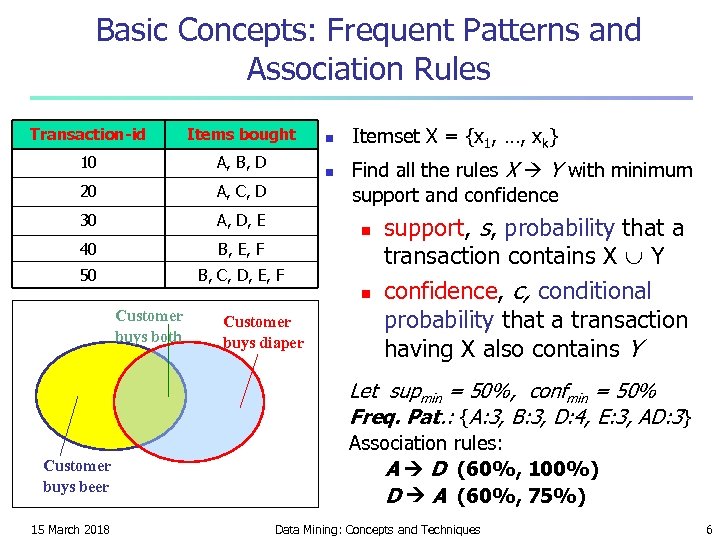 Basic Concepts: Frequent Patterns and Association Rules Transaction-id Items bought 10 A, B, D 20 A, C, D 30 A, D, E 40 B, E, F 50 Itemset X = {x 1, …, xk} B, C, D, E, F n n Find all the rules X Y with minimum support and confidence n n Customer buys both Customer buys diaper support, s, probability that a transaction contains X Y confidence, c, conditional probability that a transaction having X also contains Y Let supmin = 50%, confmin = 50% Freq. Pat. : {A: 3, B: 3, D: 4, E: 3, AD: 3} Customer buys beer 15 March 2018 Association rules: A D (60%, 100%) D A (60%, 75%) Data Mining: Concepts and Techniques 6
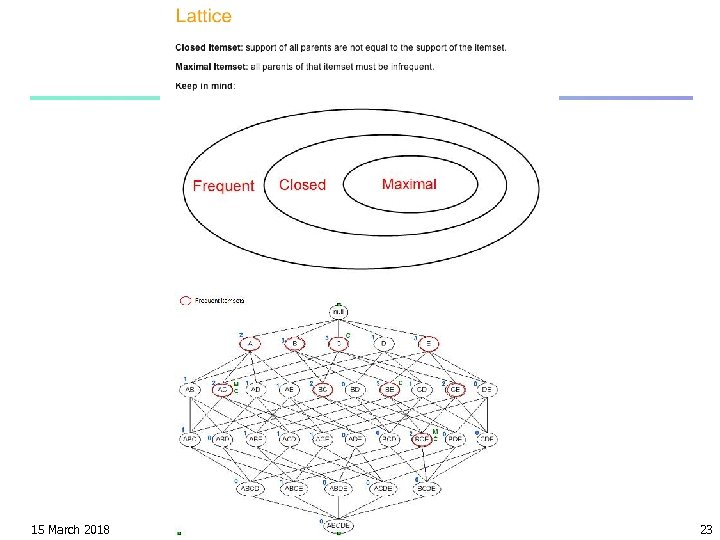
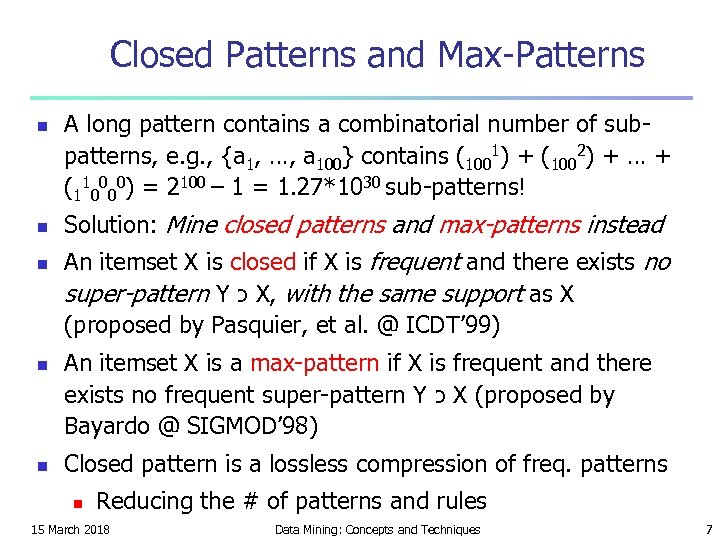 Closed Patterns and Max-Patterns n n n A long pattern contains a combinatorial number of subpatterns, e. g. , {a 1, …, a 100} contains (1001) + (1002) + … + (110000) = 2100 – 1 = 1. 27*1030 sub-patterns! Solution: Mine closed patterns and max-patterns instead An itemset X is closed if X is frequent and there exists no super-pattern Y כ X, with the same support as X (proposed by Pasquier, et al. @ ICDT’ 99) An itemset X is a max-pattern if X is frequent and there exists no frequent super-pattern Y כ X (proposed by Bayardo @ SIGMOD’ 98) Closed pattern is a lossless compression of freq. patterns n Reducing the # of patterns and rules 15 March 2018 Data Mining: Concepts and Techniques 7
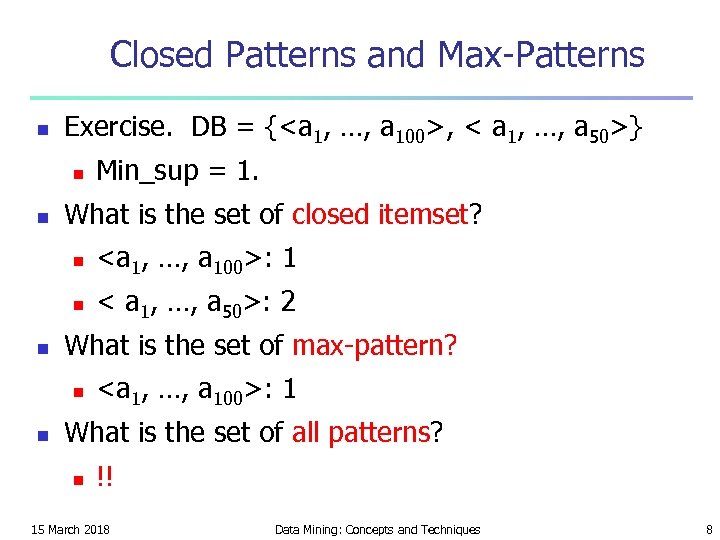 Closed Patterns and Max-Patterns n Exercise. DB = {, < a 1, …, a 50>} n n Min_sup = 1. What is the set of closed itemset? n n n : 1 < a 1, …, a 50>: 2 What is the set of max-pattern? n n : 1 What is the set of all patterns? n !! 15 March 2018 Data Mining: Concepts and Techniques 8
 Chapter 5: Mining Frequent Patterns, Association and Correlations n n Basic concepts Efficient and scalable frequent itemset mining methods Mining various kinds of association rules From association mining to correlation analysis n Constraint-based association mining n Summary 15 March 2018 Data Mining: Concepts and Techniques 9
 Scalable Methods for Mining Frequent Patterns n n The downward closure property of frequent patterns n Any subset of a frequent itemset must be frequent n If {beer, diaper, nuts} is frequent, so is {beer, diaper} n Why? Scalable mining methods: Three major approaches n Apriori (Agrawal & Srikant@VLDB’ 94) n Freq. pattern growth (FPgrowth—Han, Pei & Yin @SIGMOD’ 00) 15 March 2018 Data Mining: Concepts and Techniques 10
 Scalable Methods for Mining Frequent Patterns n n The downward closure property of frequent patterns n Any subset of a frequent itemset must be frequent n If {beer, diaper, nuts} is frequent, so is {beer, diaper} n i. e. , every transaction having {beer, diaper, nuts} also contains {beer, diaper} Scalable mining methods: Three major approaches n Apriori (Agrawal & Srikant@VLDB’ 94) n Freq. pattern growth (FPgrowth—Han, Pei & Yin @SIGMOD’ 00) 15 March 2018 Data Mining: Concepts and Techniques 11
 Apriori: A Candidate Generation-and-Test Approach n n Apriori pruning principle: If there is any itemset which is infrequent, its superset should not be generated/tested! Why? (Agrawal & Srikant @VLDB’ 94, Mannila, et al. @ KDD’ 94). Method: Can we use only smaller itemsets to generate larger ones rather than explore all larger ones? 15 March 2018 Data Mining: Concepts and Techniques 12
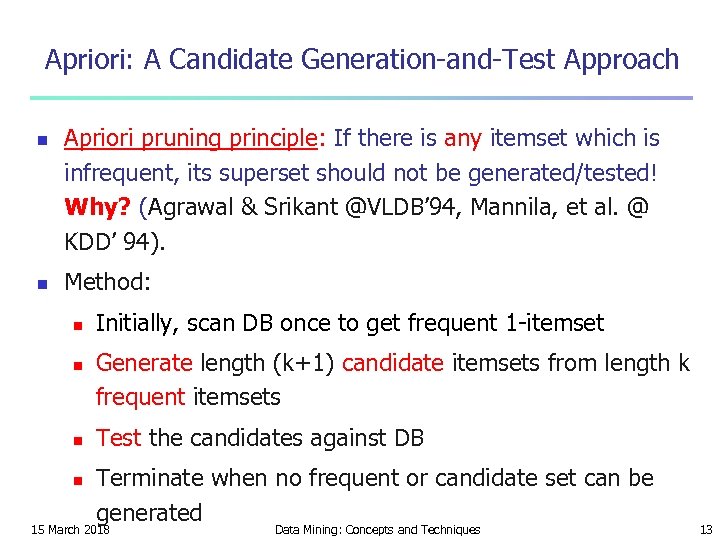 Apriori: A Candidate Generation-and-Test Approach n n Apriori pruning principle: If there is any itemset which is infrequent, its superset should not be generated/tested! Why? (Agrawal & Srikant @VLDB’ 94, Mannila, et al. @ KDD’ 94). Method: n n Initially, scan DB once to get frequent 1 -itemset Generate length (k+1) candidate itemsets from length k frequent itemsets Test the candidates against DB Terminate when no frequent or candidate set can be generated 15 March 2018 Data Mining: Concepts and Techniques 13
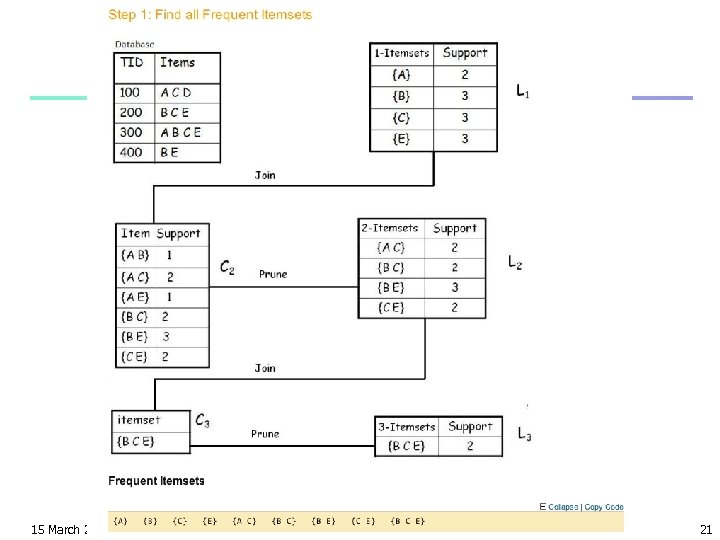
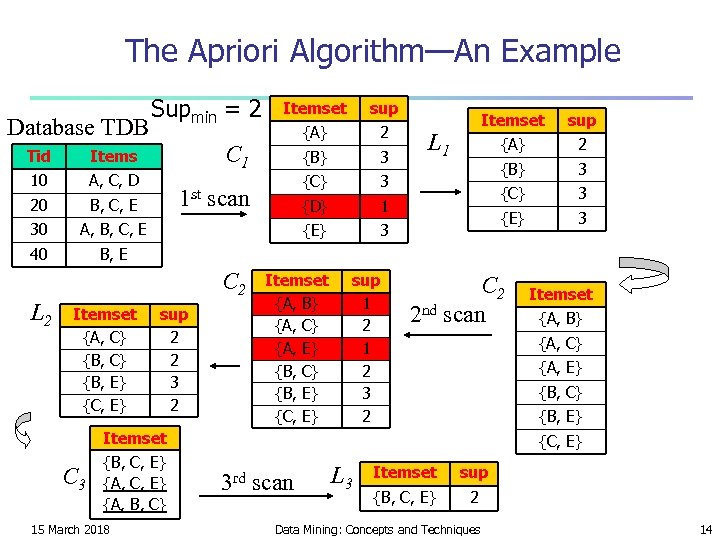 The Apriori Algorithm—An Example Database TDB Tid B, C, E 30 {A} 2 {B} 3 {C} 3 {D} 1 3 A, B, C, E 40 sup {E} A, C, D 20 Itemset C 1 Items 10 Supmin = 2 Itemset {A} 2 {B} 3 {C} 3 {E} L 1 sup 3 B, E 1 st scan C 2 L 2 Itemset {A, C} {B, E} {C, E} sup 2 2 3 2 Itemset {A, B} {A, C} {A, E} {B, C} {B, E} {C, E} sup 1 2 3 2 C 2 2 nd scan {B, C, E} {A, B, C} 15 March 2018 {A, B} {A, C} {A, E} {B, C} {B, E} Itemset C 3 Itemset {C, E} 3 rd scan L 3 Itemset sup {B, C, E} 2 Data Mining: Concepts and Techniques 14
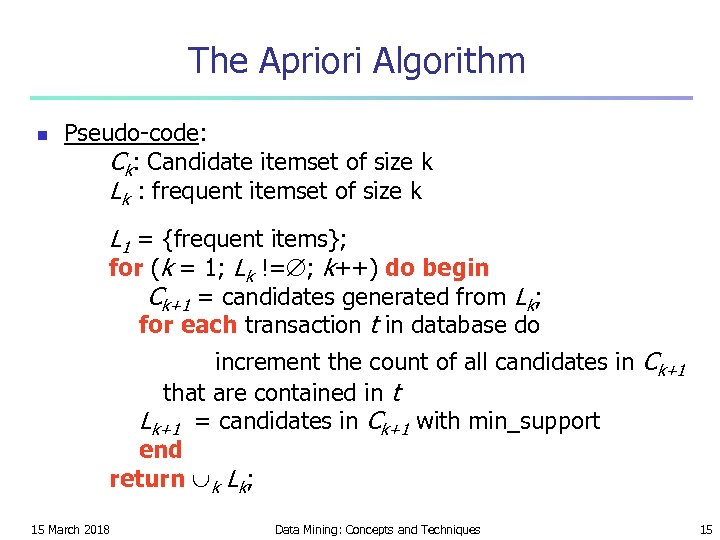 The Apriori Algorithm n Pseudo-code: Ck: Candidate itemset of size k Lk : frequent itemset of size k L 1 = {frequent items}; for (k = 1; Lk != ; k++) do begin Ck+1 = candidates generated from Lk; for each transaction t in database do increment the count of all candidates in Ck+1 that are contained in t Lk+1 = candidates in Ck+1 with min_support end return k Lk; 15 March 2018 Data Mining: Concepts and Techniques 15
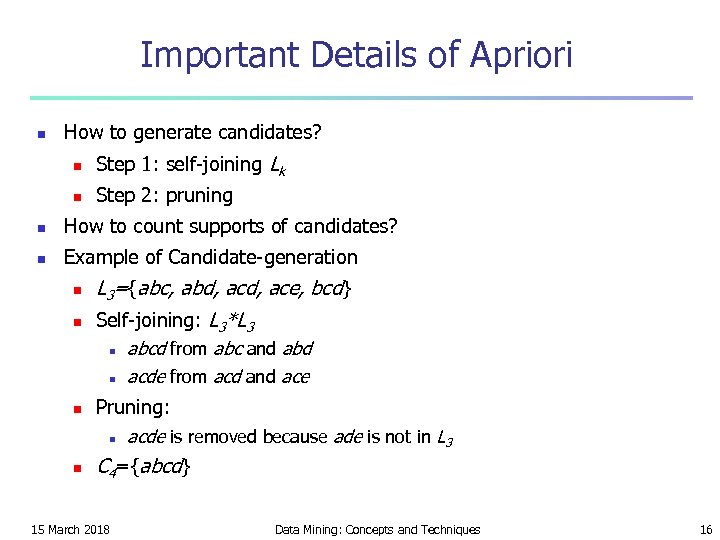 Important Details of Apriori n How to generate candidates? n Step 1: self-joining Lk n Step 2: pruning n How to count supports of candidates? n Example of Candidate-generation n n L 3={abc, abd, ace, bcd} Self-joining: L 3*L 3 n n abcd from abc and abd acde from acd and ace Pruning: n acde is removed because ade is not in L 3 C 4={abcd} 15 March 2018 Data Mining: Concepts and Techniques 16
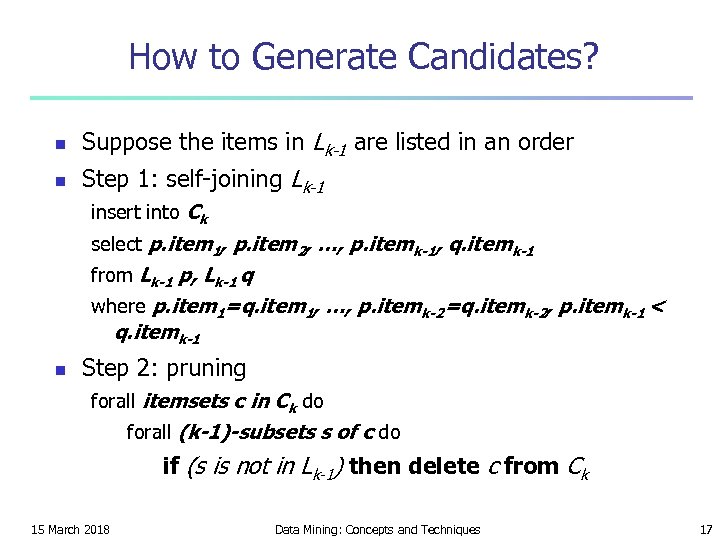 How to Generate Candidates? n Suppose the items in Lk-1 are listed in an order n Step 1: self-joining Lk-1 insert into Ck select p. item 1, p. item 2, …, p. itemk-1, q. itemk-1 from Lk-1 p, Lk-1 q where p. item 1=q. item 1, …, p. itemk-2=q. itemk-2, p. itemk-1 < q. itemk-1 n Step 2: pruning forall itemsets c in Ck do forall (k-1)-subsets s of c do if (s is not in Lk-1) then delete c from Ck 15 March 2018 Data Mining: Concepts and Techniques 17
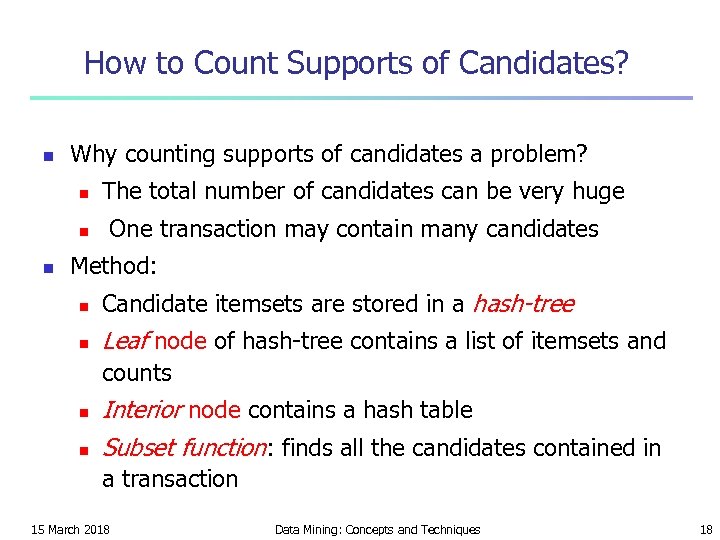 How to Count Supports of Candidates? n Why counting supports of candidates a problem? n n n The total number of candidates can be very huge One transaction may contain many candidates Method: n Candidate itemsets are stored in a hash-tree n Leaf node of hash-tree contains a list of itemsets and counts n n Interior node contains a hash table Subset function: finds all the candidates contained in a transaction 15 March 2018 Data Mining: Concepts and Techniques 18
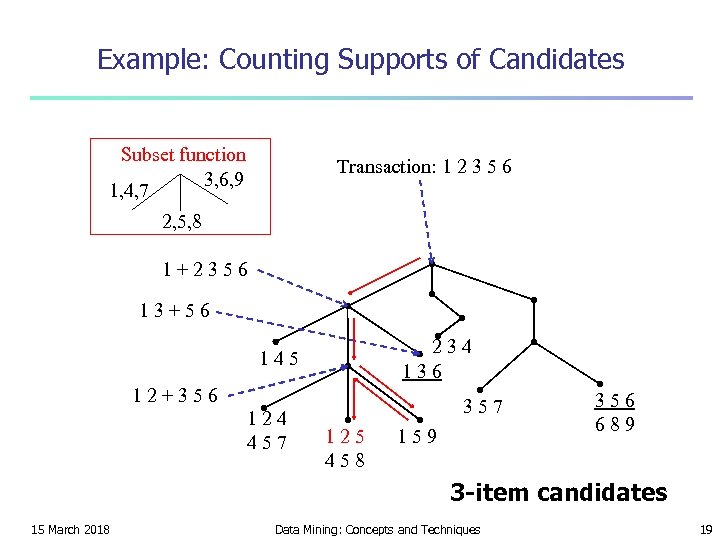 Example: Counting Supports of Candidates Subset function 3, 6, 9 1, 4, 7 Transaction: 1 2 3 5 6 2, 5, 8 1+2356 13+56 234 136 145 12+356 124 457 357 125 458 159 356 689 3 -item candidates 15 March 2018 Data Mining: Concepts and Techniques 19
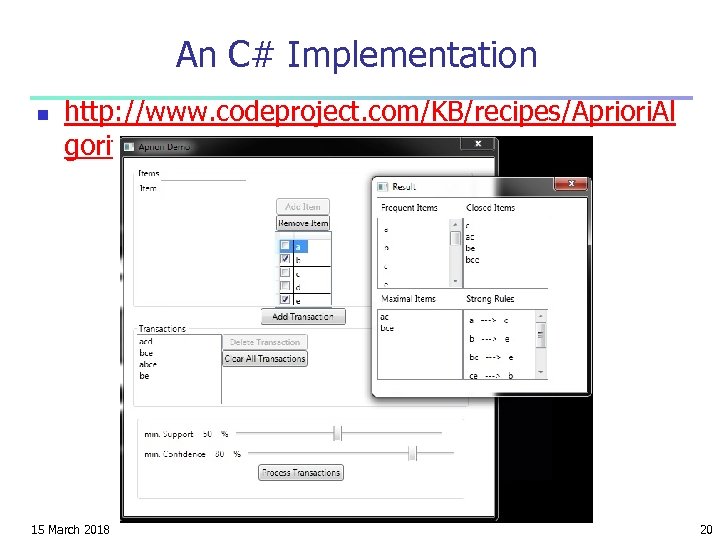 An C# Implementation n http: //www. codeproject. com/KB/recipes/Apriori. Al gorithm. aspx 15 March 2018 Data Mining: Concepts and Techniques 20
 15 March 2018 Data Mining: Concepts and Techniques 21
 15 March 2018 Data Mining: Concepts and Techniques 22
 15 March 2018 Data Mining: Concepts and Techniques 23
 Challenges of Frequent Pattern Mining n Challenges n n Huge number of candidates n n Multiple scans of transaction database Tedious workload of support counting for candidates Improving Apriori: general ideas n Reduce passes of transaction database scans n Shrink number of candidates n Facilitate support counting of candidates 15 March 2018 Data Mining: Concepts and Techniques 24
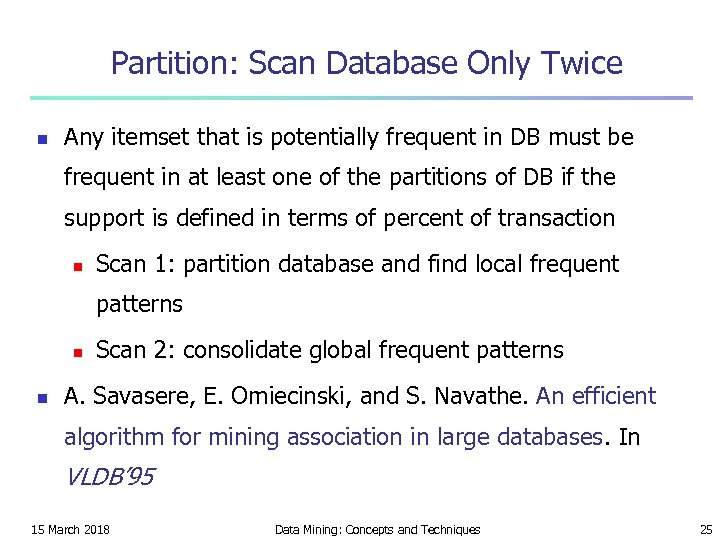 Partition: Scan Database Only Twice n Any itemset that is potentially frequent in DB must be frequent in at least one of the partitions of DB if the support is defined in terms of percent of transaction n Scan 1: partition database and find local frequent patterns n n Scan 2: consolidate global frequent patterns A. Savasere, E. Omiecinski, and S. Navathe. An efficient algorithm for mining association in large databases. In VLDB’ 95 15 March 2018 Data Mining: Concepts and Techniques 25
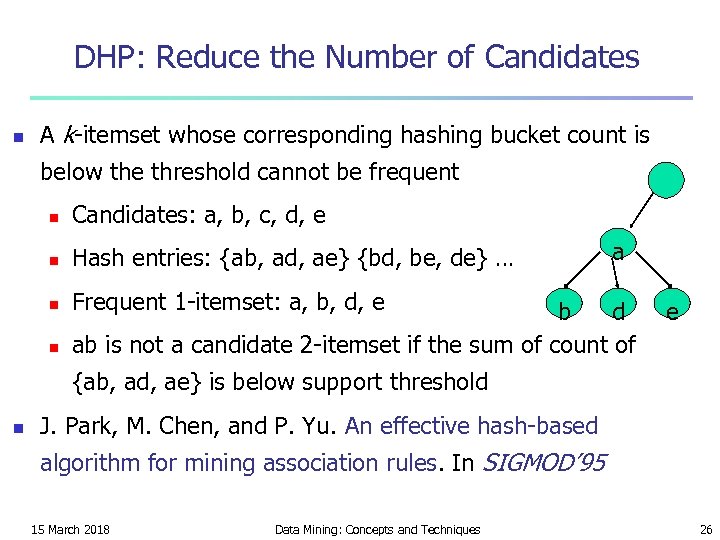 DHP: Reduce the Number of Candidates n A k-itemset whose corresponding hashing bucket count is below the threshold cannot be frequent n Candidates: a, b, c, d, e n Hash entries: {ab, ad, ae} {bd, be, de} … n Frequent 1 -itemset: a, b, d, e n a b d ab is not a candidate 2 -itemset if the sum of count of e {ab, ad, ae} is below support threshold n J. Park, M. Chen, and P. Yu. An effective hash-based algorithm for mining association rules. In SIGMOD’ 95 15 March 2018 Data Mining: Concepts and Techniques 26
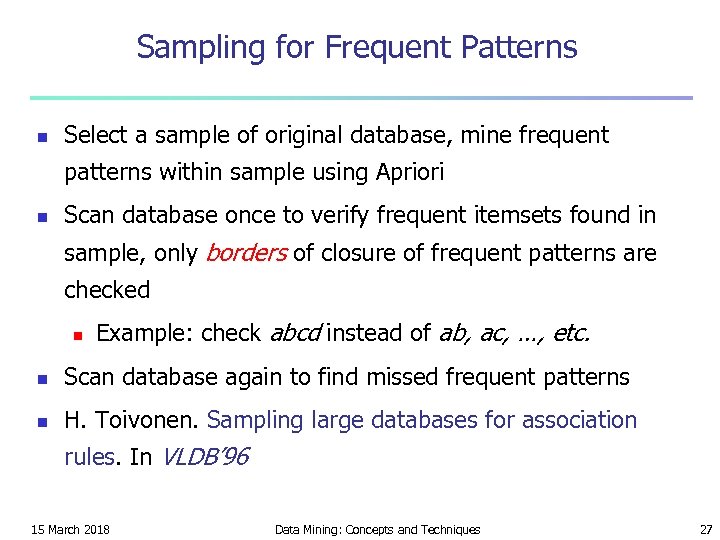 Sampling for Frequent Patterns n Select a sample of original database, mine frequent patterns within sample using Apriori n Scan database once to verify frequent itemsets found in sample, only borders of closure of frequent patterns are checked n Example: check abcd instead of ab, ac, …, etc. n Scan database again to find missed frequent patterns n H. Toivonen. Sampling large databases for association rules. In VLDB’ 96 15 March 2018 Data Mining: Concepts and Techniques 27
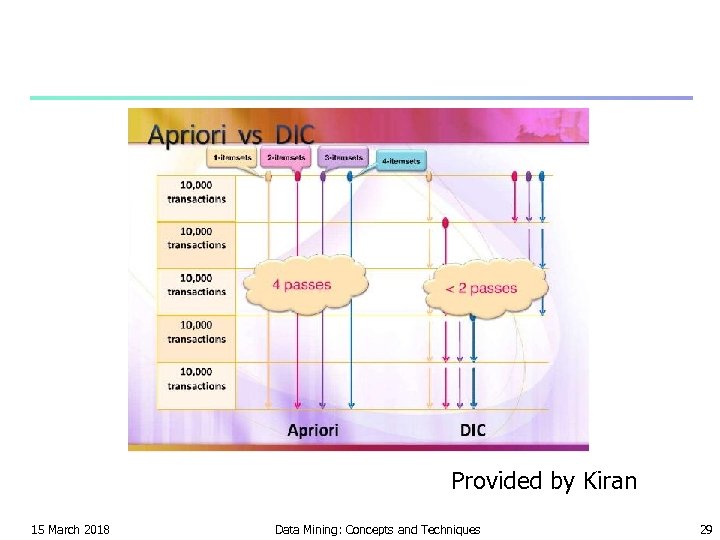
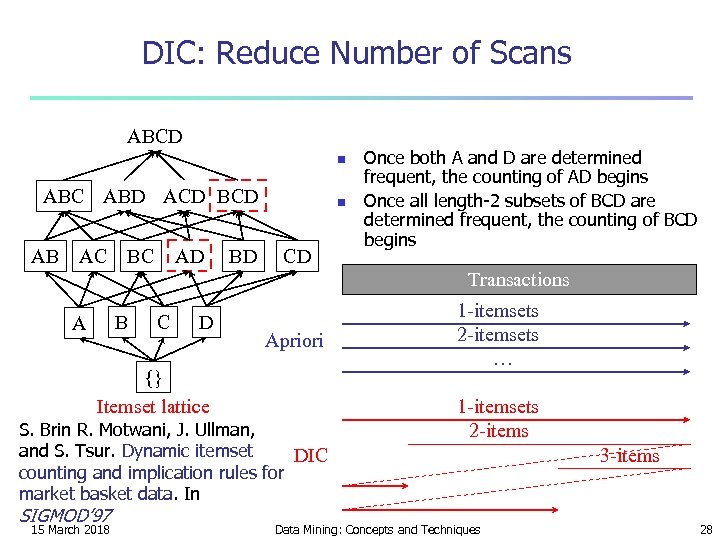 DIC: Reduce Number of Scans ABCD n ABC ABD ACD BCD AB AC BC AD BD n CD Once both A and D are determined frequent, the counting of AD begins Once all length-2 subsets of BCD are determined frequent, the counting of BCD begins Transactions B A C D Apriori {} Itemset lattice S. Brin R. Motwani, J. Ullman, and S. Tsur. Dynamic itemset DIC counting and implication rules for market basket data. In SIGMOD’ 97 15 March 2018 1 -itemsets 2 -itemsets … 1 -itemsets 2 -items Data Mining: Concepts and Techniques 3 -items 28
 Provided by Kiran 15 March 2018 Data Mining: Concepts and Techniques 29
 Bottleneck of Frequent-pattern Mining n n Multiple database scans are costly Mining long patterns needs many passes of scanning and generates lots of candidates n To find frequent itemset i 1 i 2…i 100 n n # of scans: 100 # of Candidates: (1001) + (1002) + … + (110000) = 21001 = 1. 27*1030 ! n Bottleneck: candidate-generation-and-test n Can we avoid candidate generation? 15 March 2018 Data Mining: Concepts and Techniques 30
 Mining Frequent Patterns Without Candidate Generation n Grow long patterns from short ones using local frequent items n “abc” is a frequent pattern n Get all transactions having “abc”: DB|abc n “d” is a local frequent item (in term of count of occurrences) in DB|abc abcd is a frequent pattern 15 March 2018 Data Mining: Concepts and Techniques 31
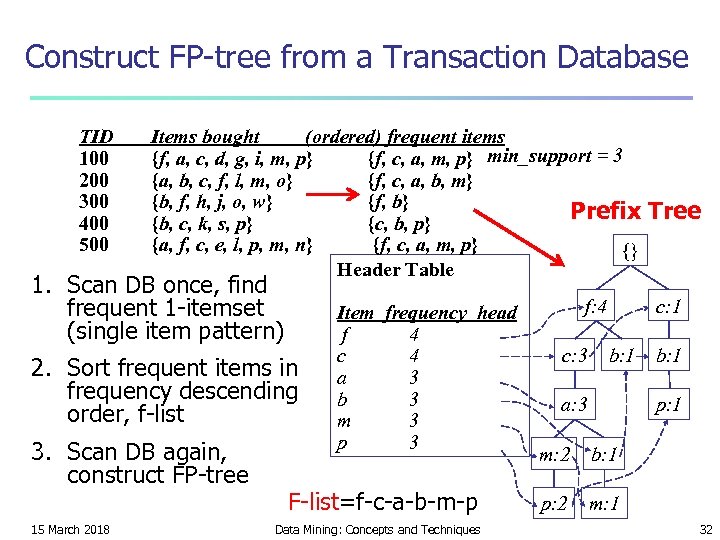 Construct FP-tree from a Transaction Database TID 100 200 300 400 500 Items bought (ordered) frequent items {f, a, c, d, g, i, m, p} {f, c, a, m, p} min_support = 3 {a, b, c, f, l, m, o} {f, c, a, b, m} {b, f, h, j, o, w} {f, b} Prefix {b, c, k, s, p} {c, b, p} {a, f, c, e, l, p, m, n} {f, c, a, m, p} {} Header Table 1. Scan DB once, find frequent 1 -itemset (single item pattern) 2. Sort frequent items in frequency descending order, f-list 3. Scan DB again, construct FP-tree 15 March 2018 Item frequency head f 4 c 4 a 3 b 3 m 3 p 3 F-list=f-c-a-b-m-p Data Mining: Concepts and Techniques f: 4 c: 3 Tree c: 1 b: 1 a: 3 b: 1 p: 1 m: 2 b: 1 p: 2 m: 1 32
 Benefits of the FP-tree Structure n n Completeness n Preserve complete information for frequent pattern mining n Never break a long pattern of any transaction Compactness n Reduce irrelevant info—infrequent items are gone n Items in frequency descending order: the more frequently occurring, the more likely to be shared n Never be larger than the original database (not count node-links and the count field) n For Connect-4 DB, compression ratio could be over 100 15 March 2018 Data Mining: Concepts and Techniques 33
 Partition Patterns and Databases n n Frequent patterns can be partitioned into subsets according to f-list Peeling of Onion n F-list=f-c-a-b-m-p n Patterns containing p n Patterns having m but no p n … n Patterns having c but no a nor b, m, p n Pattern f, no others Completeness and non-redundency? 15 March 2018 Data Mining: Concepts and Techniques 34
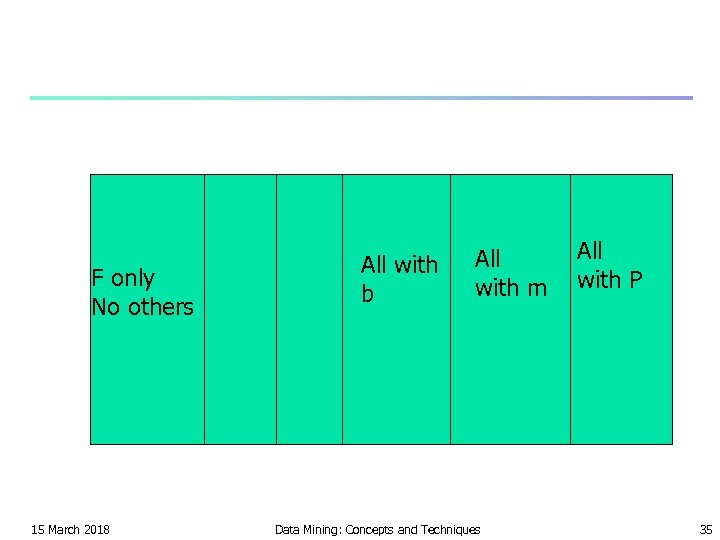 F only No others 15 March 2018 All with b All with m Data Mining: Concepts and Techniques All with P 35
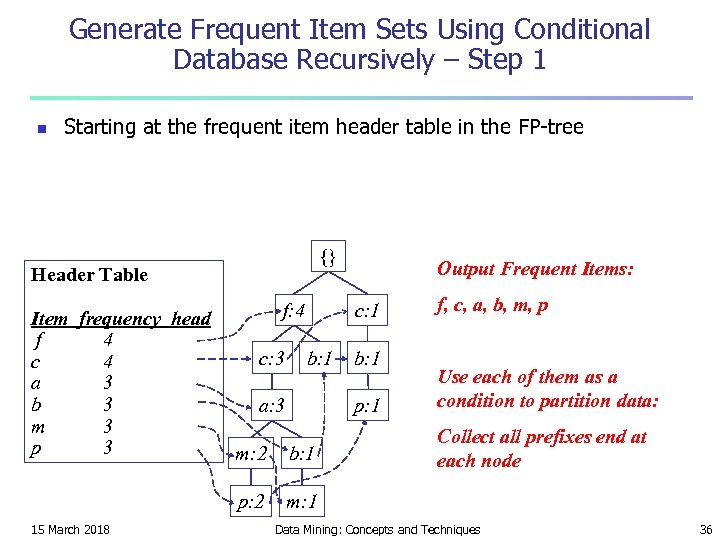 Generate Frequent Item Sets Using Conditional Database Recursively – Step 1 n Starting at the frequent item header table in the FP-tree {} Header Table Item frequency head f 4 c 4 a 3 b 3 m 3 p 3 f: 4 c: 3 c: 1 b: 1 a: 3 b: 1 p: 1 m: 2 b: 1 p: 2 15 March 2018 Output Frequent Items: f, c, a, b, m, p Use each of them as a condition to partition data: Collect all prefixes end at each node m: 1 Data Mining: Concepts and Techniques 36
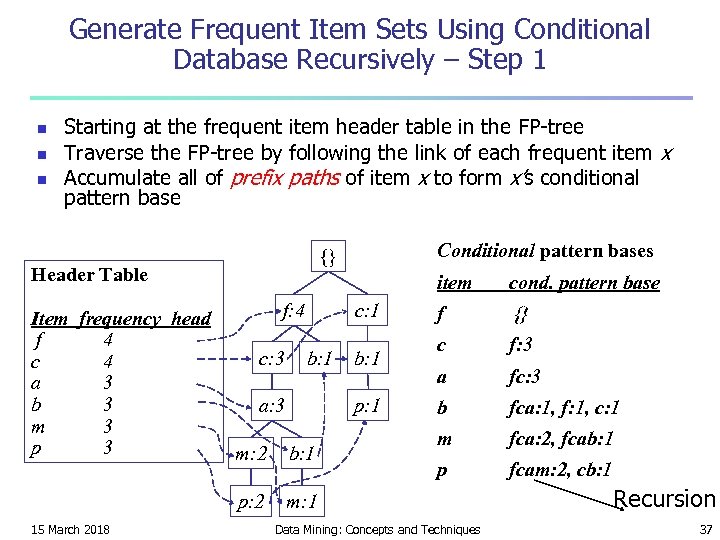 Generate Frequent Item Sets Using Conditional Database Recursively – Step 1 n n n Starting at the frequent item header table in the FP-tree Traverse the FP-tree by following the link of each frequent item x Accumulate all of prefix paths of item x to form x’s conditional pattern base Header Table Item frequency head f 4 c 4 a 3 b 3 m 3 p 3 item f: 4 c: 3 c: 1 b: 1 a: 3 b: 1 p: 1 m: 2 b: 1 p: 2 15 March 2018 Conditional pattern bases {} cond. pattern base f {} c f: 3 a fc: 3 b fca: 1, f: 1, c: 1 m fca: 2, fcab: 1 p fcam: 2, cb: 1 m: 1 Data Mining: Concepts and Techniques Recursion 37
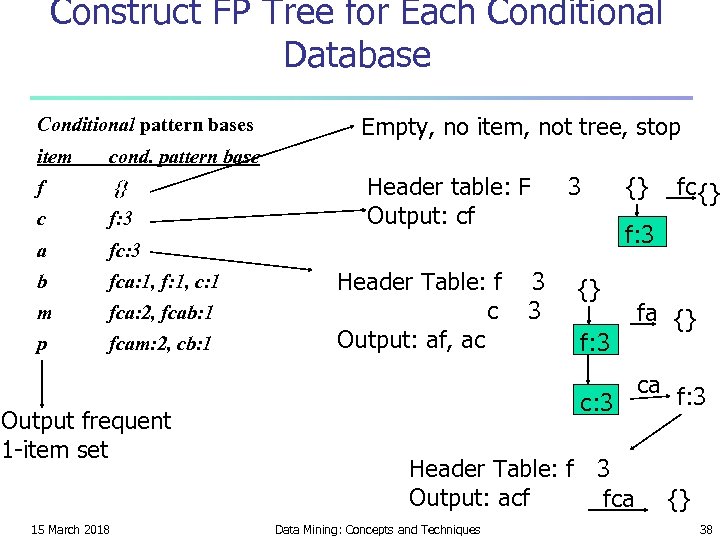 Construct FP Tree for Each Conditional Database Conditional pattern bases item cond. pattern base f {} c f: 3 a fc: 3 b fca: 1, f: 1, c: 1 m fca: 2, fcab: 1 p fcam: 2, cb: 1 Empty, no item, not tree, stop Output frequent 1 -item set 15 March 2018 Header table: F Output: cf Header Table: f c Output: af, ac 3 3 3 {} f: 3 c: 3 Header Table: f 3 Output: acf fca Data Mining: Concepts and Techniques fc {} fa {} ca f: 3 {} 38
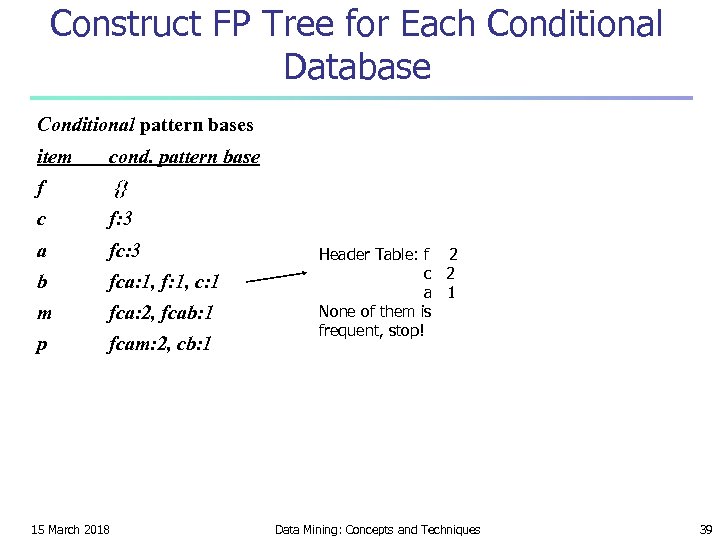 Construct FP Tree for Each Conditional Database Conditional pattern bases item cond. pattern base f {} c f: 3 a fc: 3 b fca: 1, f: 1, c: 1 m fca: 2, fcab: 1 p fcam: 2, cb: 1 15 March 2018 Header Table: f 2 c 2 a 1 None of them is frequent, stop! Data Mining: Concepts and Techniques 39
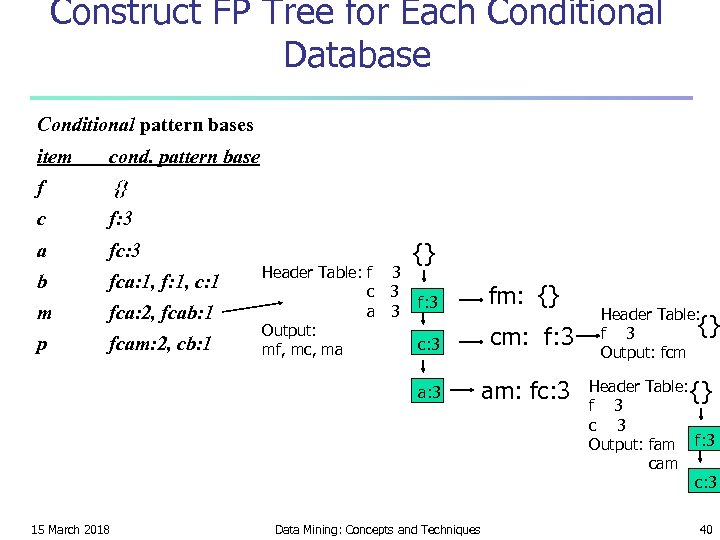 Construct FP Tree for Each Conditional Database Conditional pattern bases item cond. pattern base f {} c f: 3 a fc: 3 b fca: 1, f: 1, c: 1 m fca: 2, fcab: 1 p fcam: 2, cb: 1 Header Table: f 3 c 3 a 3 Output: mf, mc, ma {} fm: {} c: 3 cm: f: 3 a: 3 15 March 2018 f: 3 am: fc: 3 Data Mining: Concepts and Techniques Header Table: {} f 3 Output: fcm Header Table: {} f 3 c 3 Output: fam f: 3 cam c: 3 40
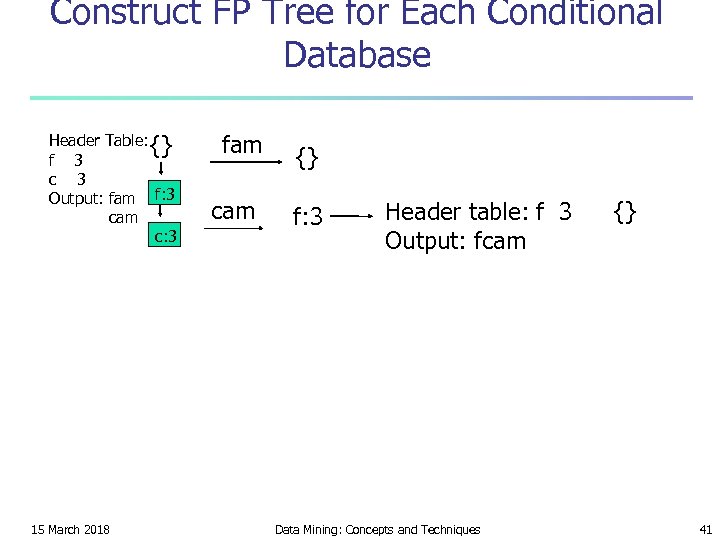 Construct FP Tree for Each Conditional Database Header Table: {} f 3 c 3 Output: fam f: 3 cam c: 3 15 March 2018 fam cam {} f: 3 Header table: f 3 Output: fcam Data Mining: Concepts and Techniques {} 41
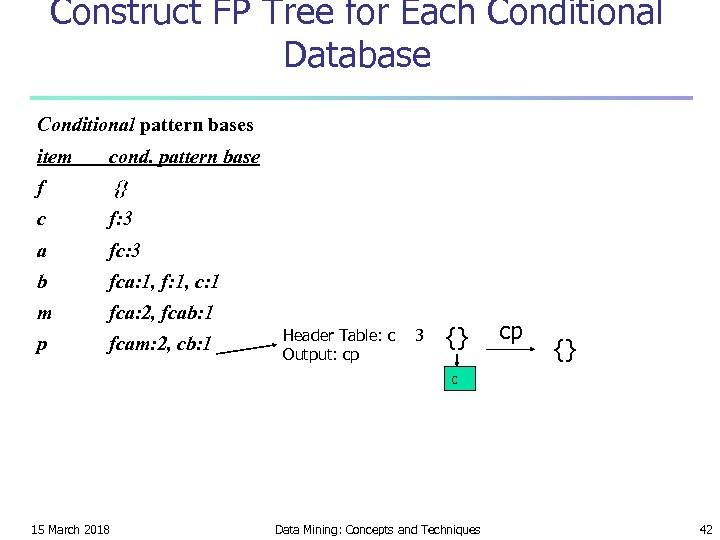 Construct FP Tree for Each Conditional Database Conditional pattern bases item cond. pattern base f {} c f: 3 a fc: 3 b fca: 1, f: 1, c: 1 m fca: 2, fcab: 1 p fcam: 2, cb: 1 Header Table: c Output: cp 3 {} cp {} c 15 March 2018 Data Mining: Concepts and Techniques 42
 Mining Frequent Patterns With FP-trees n n Idea: Frequent pattern growth n Recursively grow frequent patterns by pattern and database partition Method n For each frequent item, construct its conditional pattern -base, and then its conditional FP-tree n Output frequent patterns found at the current step n Repeat the process on each newly created conditional FP-tree n Until the resulting FP-tree is empty 15 March 2018 Data Mining: Concepts and Techniques 43
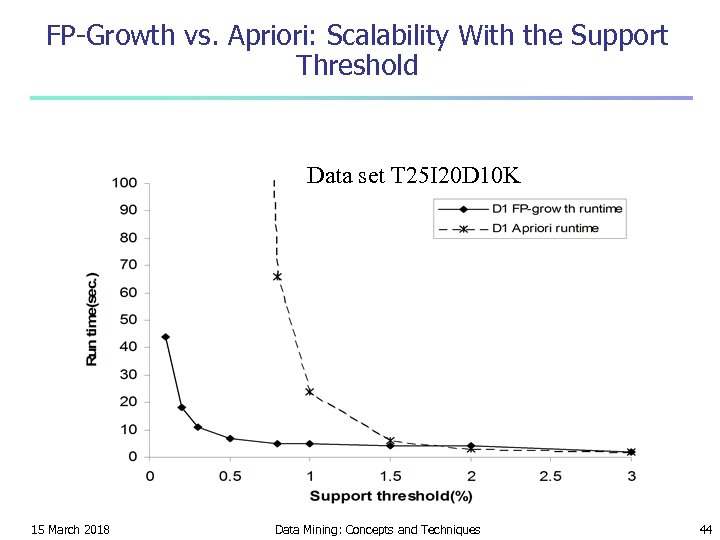 FP-Growth vs. Apriori: Scalability With the Support Threshold Data set T 25 I 20 D 10 K 15 March 2018 Data Mining: Concepts and Techniques 44
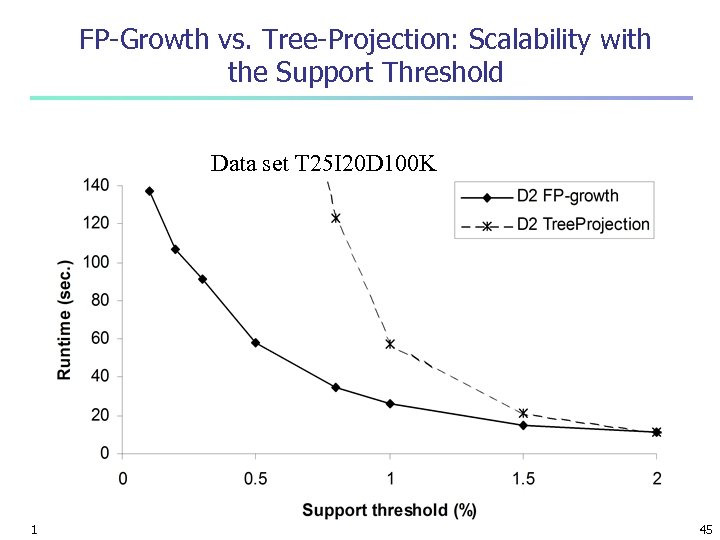 FP-Growth vs. Tree-Projection: Scalability with the Support Threshold Data set T 25 I 20 D 100 K 15 March 2018 Data Mining: Concepts and Techniques 45
 Why Is FP-Growth the Winner? n Divide-and-conquer: n n n decompose both the mining task and DB according to the frequent patterns obtained so far leads to focused search of smaller databases Other factors n no candidate generation, no candidate test n compressed database: FP-tree structure n no repeated scan of entire database n basic ops—counting local freq items and building sub FP-tree, no pattern search and matching 15 March 2018 Data Mining: Concepts and Techniques 46
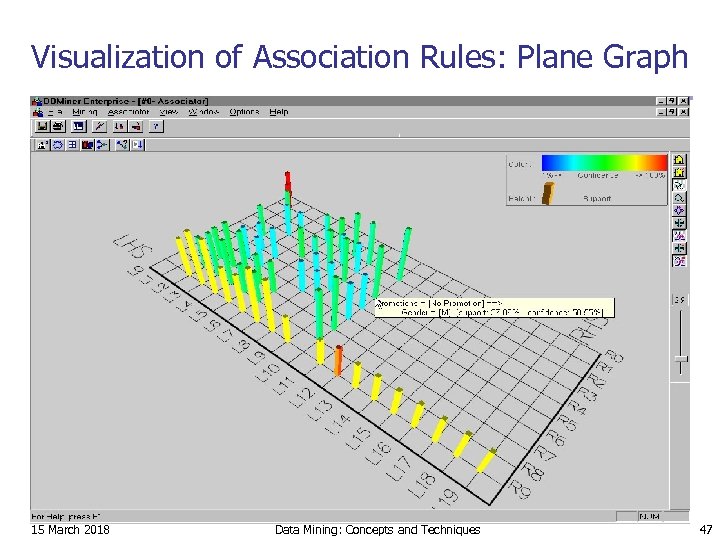 Visualization of Association Rules: Plane Graph 15 March 2018 Data Mining: Concepts and Techniques 47
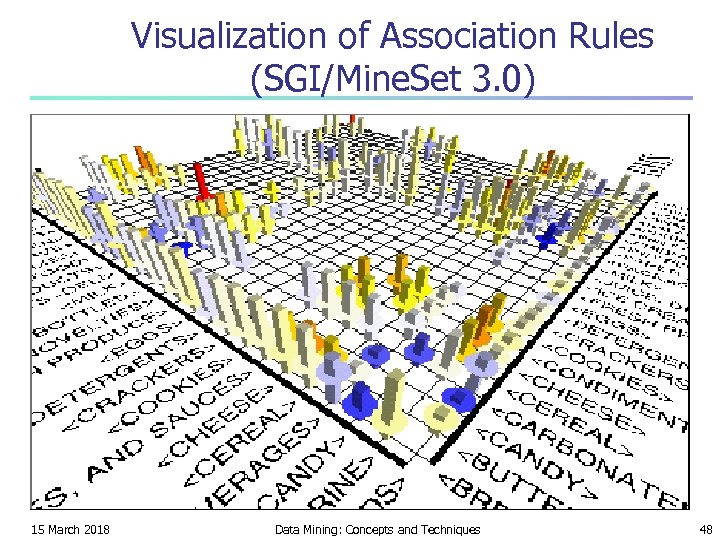 Visualization of Association Rules (SGI/Mine. Set 3. 0) 15 March 2018 Data Mining: Concepts and Techniques 48
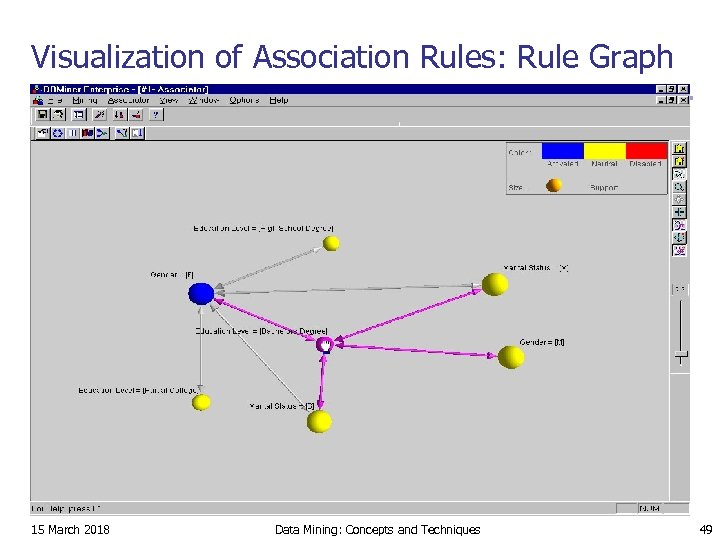 Visualization of Association Rules: Rule Graph 15 March 2018 Data Mining: Concepts and Techniques 49
 Chapter 5: Mining Frequent Patterns, Association and Correlations n n Basic concepts and a road map Efficient and scalable frequent itemset mining methods Mining various kinds of association rules From association mining to correlation analysis n Constraint-based association mining n Summary 15 March 2018 Data Mining: Concepts and Techniques 50
 Mining Various Kinds of Association Rules n Mining multilevel association n Miming multidimensional association n Mining quantitative association n Mining interesting correlation patterns 15 March 2018 Data Mining: Concepts and Techniques 51
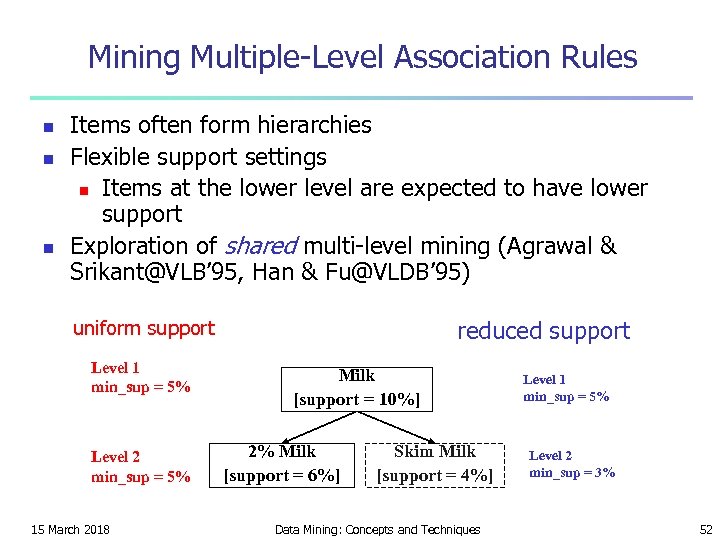 Mining Multiple-Level Association Rules n n n Items often form hierarchies Flexible support settings n Items at the lower level are expected to have lower support Exploration of shared multi-level mining (Agrawal & Srikant@VLB’ 95, Han & Fu@VLDB’ 95) reduced support uniform support Level 1 min_sup = 5% Level 2 min_sup = 5% 15 March 2018 Milk [support = 10%] 2% Milk [support = 6%] Skim Milk [support = 4%] Data Mining: Concepts and Techniques Level 1 min_sup = 5% Level 2 min_sup = 3% 52
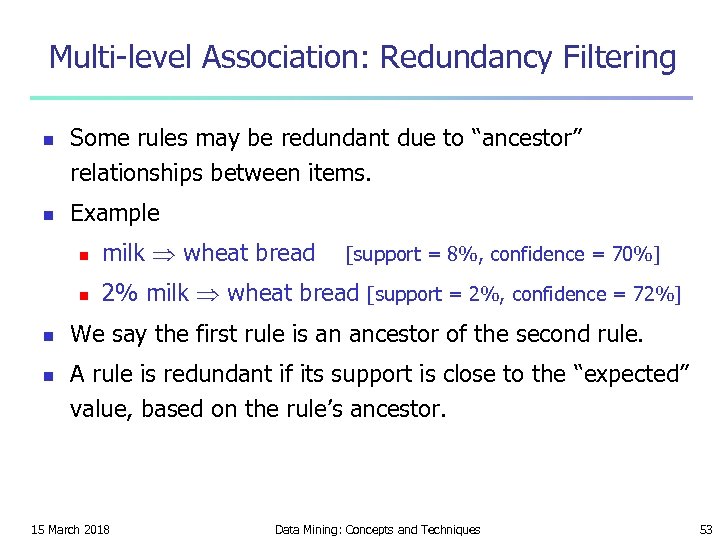 Multi-level Association: Redundancy Filtering n n Some rules may be redundant due to “ancestor” relationships between items. Example n n milk wheat bread 2% milk wheat bread [support = 2%, confidence = 72%] [support = 8%, confidence = 70%] We say the first rule is an ancestor of the second rule. A rule is redundant if its support is close to the “expected” value, based on the rule’s ancestor. 15 March 2018 Data Mining: Concepts and Techniques 53
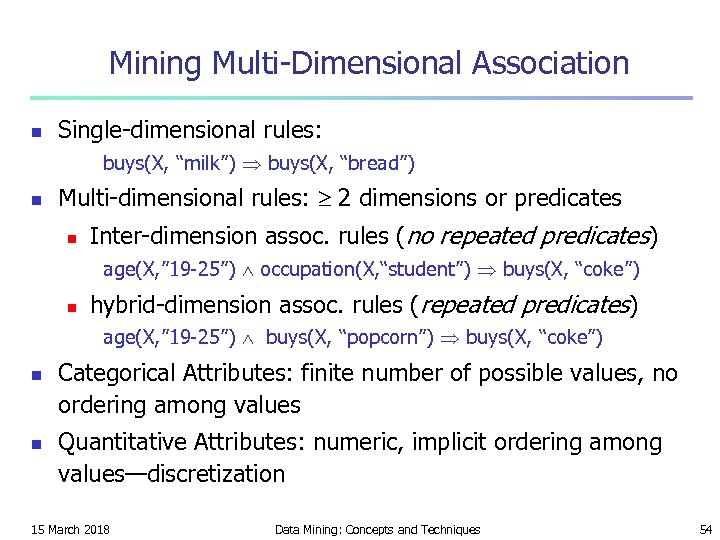 Mining Multi-Dimensional Association n Single-dimensional rules: buys(X, “milk”) buys(X, “bread”) n Multi-dimensional rules: 2 dimensions or predicates n Inter-dimension assoc. rules (no repeated predicates) age(X, ” 19 -25”) occupation(X, “student”) buys(X, “coke”) n hybrid-dimension assoc. rules (repeated predicates) age(X, ” 19 -25”) buys(X, “popcorn”) buys(X, “coke”) n n Categorical Attributes: finite number of possible values, no ordering among values Quantitative Attributes: numeric, implicit ordering among values—discretization 15 March 2018 Data Mining: Concepts and Techniques 54
 Mining Quantitative Associations n 1. 2. Techniques can be categorized by how numerical attributes, such as age or salary are treated Static discretization based on predefined concept hierarchies Dynamic discretization based on data distribution (Agrawal & Srikant@SIGMOD 96) 15 March 2018 Data Mining: Concepts and Techniques 55
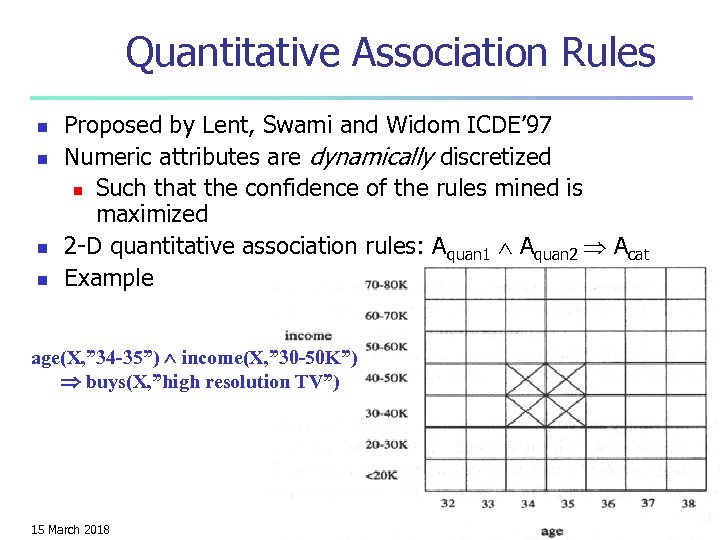 Quantitative Association Rules n n Proposed by Lent, Swami and Widom ICDE’ 97 Numeric attributes are dynamically discretized n Such that the confidence of the rules mined is maximized 2 -D quantitative association rules: Aquan 1 Aquan 2 Acat Example age(X, ” 34 -35”) income(X, ” 30 -50 K”) buys(X, ”high resolution TV”) 15 March 2018 Data Mining: Concepts and Techniques 56
 Chapter 5: Mining Frequent Patterns, Association and Correlations n n Basic concepts and a road map Efficient and scalable frequent itemset mining methods n Mining various kinds of association rules n From association mining to correlation analysis n Constraint-based association mining n Summary 15 March 2018 Data Mining: Concepts and Techniques 57
![Interestingness Measure: Correlations (Lift) n play basketball eat cereal [40%, 66. 7%] is misleading](https://present5.com/presentation/b35167853e98cc8b14ef92af438219c2/image-58.jpg "Interestingness Measure: Correlations (Lift) n play basketball eat cereal [40%, 66. 7%] is misleading") Interestingness Measure: Correlations (Lift) n play basketball eat cereal [40%, 66. 7%] is misleading n n The overall % of students eating cereal is 75% > 66. 7%. play basketball not eat cereal [20%, 33. 3%] is more accurate, although with lower support and confidence n Measure of dependent/correlated events: lift Basketball Sum (row) Cereal 2000 1750 3750 Not cereal 1000 250 1250 Sum(col. ) 15 March 2018 Not basketball 3000 2000 5000 Data Mining: Concepts and Techniques 58
Interestingness Measure: Correlations (Lift) n play basketball eat cereal [40%, 66. 7%] is misleading n n The overall % of students eating cereal is 75% > 66. 7%. play basketball not eat cereal [20%, 33. 3%] is more accurate, although with lower support and confidence n Measure of dependent/correlated events: lift Basketball Sum (row) Cereal 2000 1750 3750 Not cereal 1000 250 1250 Sum(col. ) 15 March 2018 Not basketball 3000 2000 5000 Data Mining: Concepts and Techniques 58
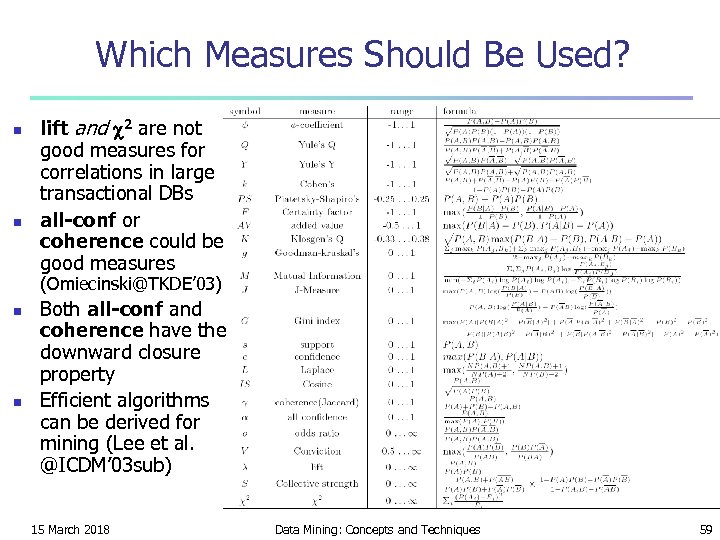 Which Measures Should Be Used? n n lift and 2 are not good measures for correlations in large transactional DBs all-conf or coherence could be good measures (Omiecinski@TKDE’ 03) n n Both all-conf and coherence have the downward closure property Efficient algorithms can be derived for mining (Lee et al. @ICDM’ 03 sub) 15 March 2018 Data Mining: Concepts and Techniques 59
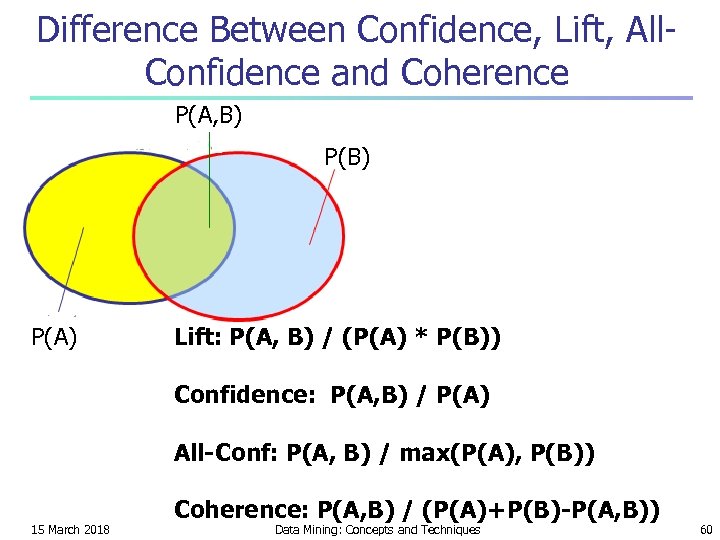 Difference Between Confidence, Lift, All. Confidence and Coherence P(A, B) P(A) Lift: P(A, B) / (P(A) * P(B)) Confidence: P(A, B) / P(A) All-Conf: P(A, B) / max(P(A), P(B)) 15 March 2018 Coherence: P(A, B) / (P(A)+P(B)-P(A, B)) Data Mining: Concepts and Techniques 60
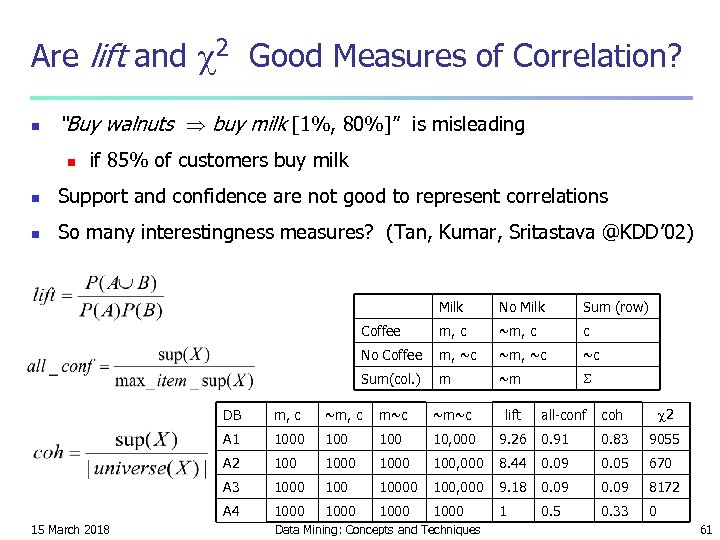 Are lift and 2 Good Measures of Correlation? n “Buy walnuts buy milk [1%, 80%]” is misleading n if 85% of customers buy milk n Support and confidence are not good to represent correlations n So many interestingness measures? (Tan, Kumar, Sritastava @KDD’ 02) Milk No Milk Sum (row) Coffee m, c ~m, c c No Coffee m, ~c ~c Sum(col. ) m ~m all-conf coh 2 9. 26 0. 91 0. 83 9055 100, 000 8. 44 0. 09 0. 05 670 10000 100, 000 9. 18 0. 09 8172 1000 1 0. 5 0. 33 0 DB ~m, c m~c ~m~c lift A 1 1000 100 10, 000 A 2 1000 A 3 1000 100 A 4 15 March 2018 m, c 1000 Data Mining: Concepts and Techniques 61
 Chapter 5: Mining Frequent Patterns, Association and Correlations n n Basic concepts and a road map Efficient and scalable frequent itemset mining methods n Mining various kinds of association rules n From association mining to correlation analysis n Constraint-based association mining n Summary 15 March 2018 Data Mining: Concepts and Techniques 62
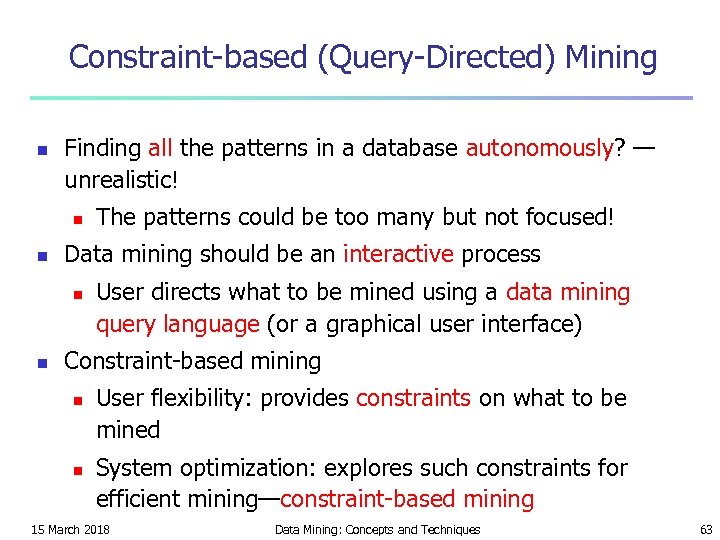 Constraint-based (Query-Directed) Mining n Finding all the patterns in a database autonomously? — unrealistic! n n Data mining should be an interactive process n n The patterns could be too many but not focused! User directs what to be mined using a data mining query language (or a graphical user interface) Constraint-based mining n n User flexibility: provides constraints on what to be mined System optimization: explores such constraints for efficient mining—constraint-based mining 15 March 2018 Data Mining: Concepts and Techniques 63
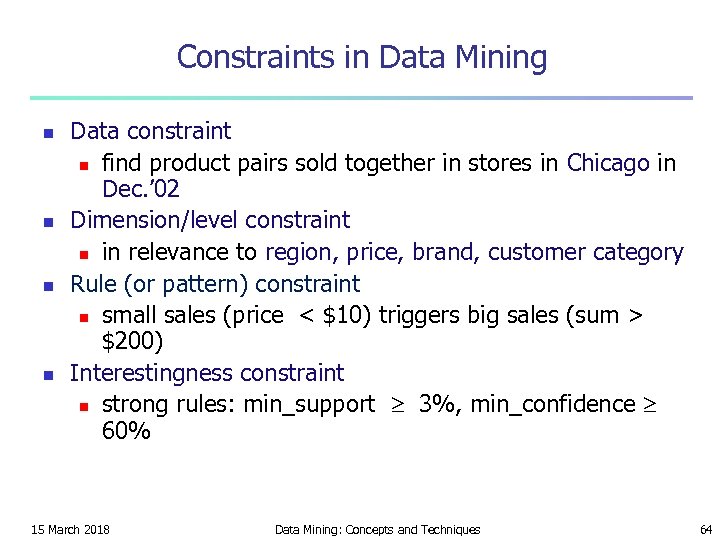 Constraints in Data Mining n n Data constraint n find product pairs sold together in stores in Chicago in Dec. ’ 02 Dimension/level constraint n in relevance to region, price, brand, customer category Rule (or pattern) constraint n small sales (price < $10) triggers big sales (sum > $200) Interestingness constraint n strong rules: min_support 3%, min_confidence 60% 15 March 2018 Data Mining: Concepts and Techniques 64
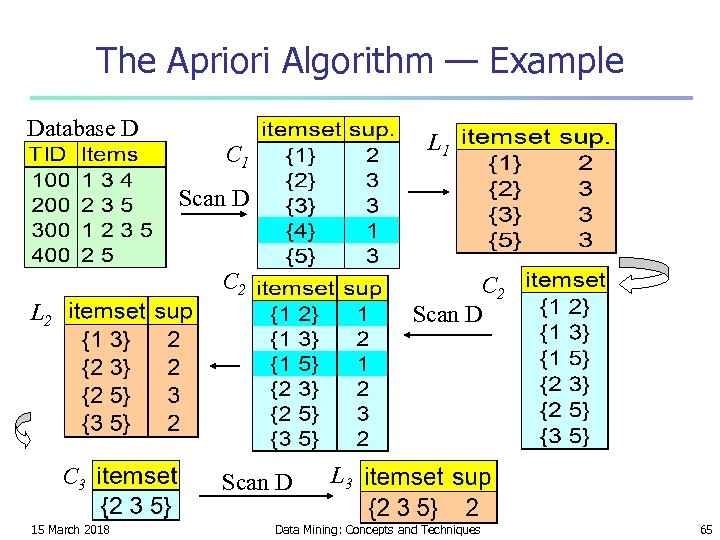 The Apriori Algorithm — Example Database D L 1 C 1 Scan D C 2 Scan D L 2 C 3 15 March 2018 Scan D L 3 Data Mining: Concepts and Techniques 65
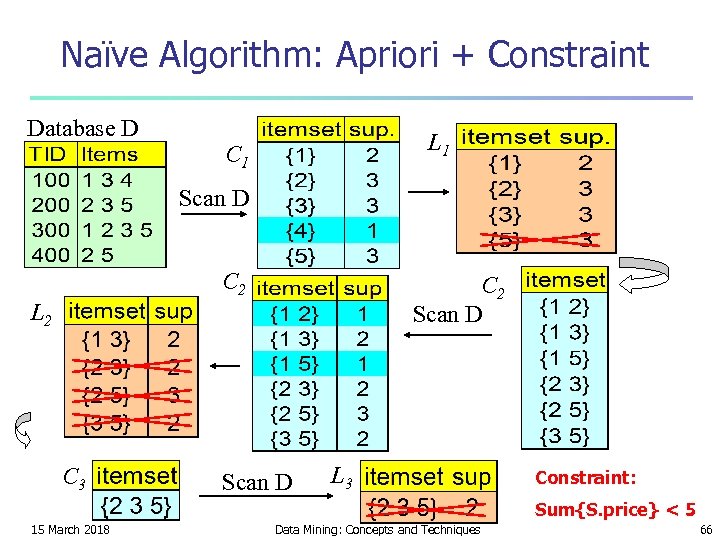 Naïve Algorithm: Apriori + Constraint Database D L 1 C 1 Scan D C 2 Scan D L 2 C 3 Scan D L 3 Constraint: Sum{S. price} < 5 15 March 2018 Data Mining: Concepts and Techniques 66
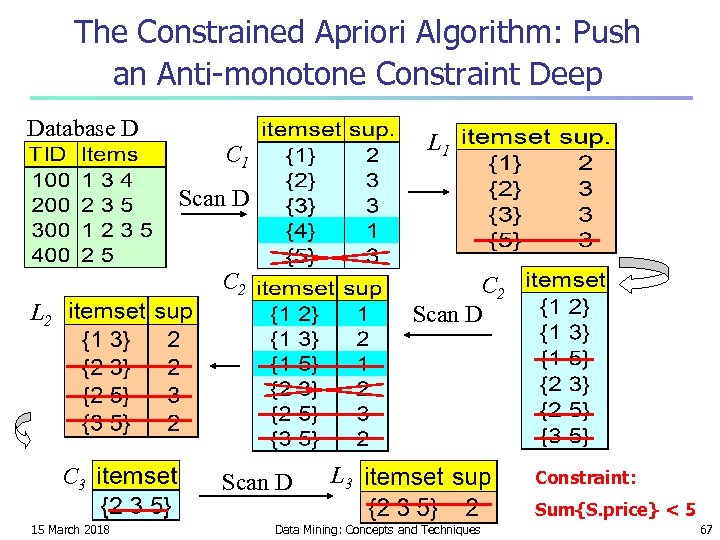 The Constrained Apriori Algorithm: Push an Anti-monotone Constraint Deep Database D L 1 C 1 Scan D C 2 Scan D L 2 C 3 Scan D L 3 Constraint: Sum{S. price} < 5 15 March 2018 Data Mining: Concepts and Techniques 67
 Chapter 5: Mining Frequent Patterns, Association and Correlations n n Basic concepts and a road map Efficient and scalable frequent itemset mining methods n Mining various kinds of association rules n From association mining to correlation analysis n Constraint-based association mining n Summary 15 March 2018 Data Mining: Concepts and Techniques 68
 Frequent-Pattern Mining: Summary n Frequent pattern mining—an important task in data mining n Scalable frequent pattern mining methods n Apriori (Candidate generation & test) n Projection-based (FPgrowth) § Mining a variety of rules and interesting patterns § Constraint-based mining § Mining sequential and structured patterns n Mining truly interesting patterns n Surprising, novel, concise, … 15 March 2018 Data Mining: Concepts and Techniques 69
 Ref: Basic Concepts of Frequent Pattern Mining n n (Association Rules) R. Agrawal, T. Imielinski, and A. Swami. Mining association rules between sets of items in large databases. SIGMOD'93. (Max-pattern) R. J. Bayardo. Efficiently mining long patterns from databases. SIGMOD'98. (Closed-pattern) N. Pasquier, Y. Bastide, R. Taouil, and L. Lakhal. Discovering frequent closed itemsets for association rules. ICDT'99. (Sequential pattern) R. Agrawal and R. Srikant. Mining sequential patterns. ICDE'95 15 March 2018 Data Mining: Concepts and Techniques 70
 Ref: Apriori and Its Improvements n n n n R. Agrawal and R. Srikant. Fast algorithms for mining association rules. VLDB'94. H. Mannila, H. Toivonen, and A. I. Verkamo. Efficient algorithms for discovering association rules. KDD'94. A. Savasere, E. Omiecinski, and S. Navathe. An efficient algorithm for mining association rules in large databases. VLDB'95. J. S. Park, M. S. Chen, and P. S. Yu. An effective hash-based algorithm for mining association rules. SIGMOD'95. H. Toivonen. Sampling large databases for association rules. VLDB'96. S. Brin, R. Motwani, J. D. Ullman, and S. Tsur. Dynamic itemset counting and implication rules for market basket analysis. SIGMOD'97. S. Sarawagi, S. Thomas, and R. Agrawal. Integrating association rule mining with relational database systems: Alternatives and implications. SIGMOD'98. 15 March 2018 Data Mining: Concepts and Techniques 71
 Ref: Depth-First, Projection-Based FP Mining n n n n R. Agarwal, C. Aggarwal, and V. V. V. Prasad. A tree projection algorithm for generation of frequent itemsets. J. Parallel and Distributed Computing: 02. J. Han, J. Pei, and Y. Yin. Mining frequent patterns without candidate generation. SIGMOD’ 00. J. Pei, J. Han, and R. Mao. CLOSET: An Efficient Algorithm for Mining Frequent Closed Itemsets. DMKD'00. J. Liu, Y. Pan, K. Wang, and J. Han. Mining Frequent Item Sets by Opportunistic Projection. KDD'02. J. Han, J. Wang, Y. Lu, and P. Tzvetkov. Mining Top-K Frequent Closed Patterns without Minimum Support. ICDM'02. J. Wang, J. Han, and J. Pei. CLOSET+: Searching for the Best Strategies for Mining Frequent Closed Itemsets. KDD'03. G. Liu, H. Lu, W. Lou, J. X. Yu. On Computing, Storing and Querying Frequent Patterns. KDD'03. 15 March 2018 Data Mining: Concepts and Techniques 72
 Ref: Vertical Format and Row Enumeration Methods n n M. J. Zaki, S. Parthasarathy, M. Ogihara, and W. Li. Parallel algorithm for discovery of association rules. DAMI: 97. Zaki and Hsiao. CHARM: An Efficient Algorithm for Closed Itemset Mining, SDM'02. C. Bucila, J. Gehrke, D. Kifer, and W. White. Dual. Miner: A Dual. Pruning Algorithm for Itemsets with Constraints. KDD’ 02. F. Pan, G. Cong, A. K. H. Tung, J. Yang, and M. Zaki , CARPENTER: Finding Closed Patterns in Long Biological Datasets. KDD'03. 15 March 2018 Data Mining: Concepts and Techniques 73
 Ref: Mining Multi-Level and Quantitative Rules n n n n R. Srikant and R. Agrawal. Mining generalized association rules. VLDB'95. J. Han and Y. Fu. Discovery of multiple-level association rules from large databases. VLDB'95. R. Srikant and R. Agrawal. Mining quantitative association rules in large relational tables. SIGMOD'96. T. Fukuda, Y. Morimoto, S. Morishita, and T. Tokuyama. Data mining using two-dimensional optimized association rules: Scheme, algorithms, and visualization. SIGMOD'96. K. Yoda, T. Fukuda, Y. Morimoto, S. Morishita, and T. Tokuyama. Computing optimized rectilinear regions for association rules. KDD'97. R. J. Miller and Y. Yang. Association rules over interval data. SIGMOD'97. Y. Aumann and Y. Lindell. A Statistical Theory for Quantitative Association Rules KDD'99. 15 March 2018 Data Mining: Concepts and Techniques 74
 Ref: Mining Correlations and Interesting Rules n n n M. Klemettinen, H. Mannila, P. Ronkainen, H. Toivonen, and A. I. Verkamo. Finding interesting rules from large sets of discovered association rules. CIKM'94. S. Brin, R. Motwani, and C. Silverstein. Beyond market basket: Generalizing association rules to correlations. SIGMOD'97. C. Silverstein, S. Brin, R. Motwani, and J. Ullman. Scalable techniques for mining causal structures. VLDB'98. P. -N. Tan, V. Kumar, and J. Srivastava. Selecting the Right Interestingness Measure for Association Patterns. KDD'02. E. Omiecinski. Alternative Interest Measures for Mining Associations. TKDE’ 03. Y. K. Lee, W. Y. Kim, Y. D. Cai, and J. Han. Co. Mine: Efficient Mining of Correlated Patterns. ICDM’ 03. 15 March 2018 Data Mining: Concepts and Techniques 75
 Ref: Mining Other Kinds of Rules n n n R. Meo, G. Psaila, and S. Ceri. A new SQL-like operator for mining association rules. VLDB'96. B. Lent, A. Swami, and J. Widom. Clustering association rules. ICDE'97. A. Savasere, E. Omiecinski, and S. Navathe. Mining for strong negative associations in a large database of customer transactions. ICDE'98. D. Tsur, J. D. Ullman, S. Abitboul, C. Clifton, R. Motwani, and S. Nestorov. Query flocks: A generalization of association-rule mining. SIGMOD'98. F. Korn, A. Labrinidis, Y. Kotidis, and C. Faloutsos. Ratio rules: A new paradigm for fast, quantifiable data mining. VLDB'98. K. Wang, S. Zhou, J. Han. Profit Mining: From Patterns to Actions. EDBT’ 02. 15 March 2018 Data Mining: Concepts and Techniques 76
 Ref: Constraint-Based Pattern Mining n R. Srikant, Q. Vu, and R. Agrawal. Mining association rules with item constraints. KDD'97. n R. Ng, L. V. S. Lakshmanan, J. Han & A. Pang. Exploratory mining and pruning optimizations of constrained association rules. SIGMOD’ 98. n n n M. N. Garofalakis, R. Rastogi, K. Shim: SPIRIT: Sequential Pattern Mining with Regular Expression Constraints. VLDB’ 99. G. Grahne, L. Lakshmanan, and X. Wang. Efficient mining of constrained correlated sets. ICDE'00. J. Pei, J. Han, and L. V. S. Lakshmanan. Mining Frequent Itemsets with Convertible Constraints. ICDE'01. n J. Pei, J. Han, and W. Wang, Mining Sequential Patterns with Constraints in Large Databases, CIKM'02. 15 March 2018 Data Mining: Concepts and Techniques 77
 Ref: Mining Sequential and Structured Patterns n n n n R. Srikant and R. Agrawal. Mining sequential patterns: Generalizations and performance improvements. EDBT’ 96. H. Mannila, H Toivonen, and A. I. Verkamo. Discovery of frequent episodes in event sequences. DAMI: 97. M. Zaki. SPADE: An Efficient Algorithm for Mining Frequent Sequences. Machine Learning: 01. J. Pei, J. Han, H. Pinto, Q. Chen, U. Dayal, and M. -C. Hsu. Prefix. Span: Mining Sequential Patterns Efficiently by Prefix-Projected Pattern Growth. ICDE'01. M. Kuramochi and G. Karypis. Frequent Subgraph Discovery. ICDM'01. X. Yan, J. Han, and R. Afshar. Clo. Span: Mining Closed Sequential Patterns in Large Datasets. SDM'03. X. Yan and J. Han. Close. Graph: Mining Closed Frequent Graph Patterns. KDD'03. 15 March 2018 Data Mining: Concepts and Techniques 78
 Ref: Mining Spatial, Multimedia, and Web Data n n K. Koperski and J. Han, Discovery of Spatial Association Rules in Geographic Information Databases, SSD’ 95. O. R. Zaiane, M. Xin, J. Han, Discovering Web Access Patterns and Trends by Applying OLAP and Data Mining Technology on Web Logs. ADL'98. O. R. Zaiane, J. Han, and H. Zhu, Mining Recurrent Items in Multimedia with Progressive Resolution Refinement. ICDE'00. D. Gunopulos and I. Tsoukatos. Efficient Mining of Spatiotemporal Patterns. SSTD'01. 15 March 2018 Data Mining: Concepts and Techniques 79
 Ref: Mining Frequent Patterns in Time-Series Data n n n B. Ozden, S. Ramaswamy, and A. Silberschatz. Cyclic association rules. ICDE'98. J. Han, G. Dong and Y. Yin, Efficient Mining of Partial Periodic Patterns in Time Series Database, ICDE'99. H. Lu, L. Feng, and J. Han. Beyond Intra-Transaction Association Analysis: Mining Multi-Dimensional Inter-Transaction Association Rules. TOIS: 00. B. -K. Yi, N. Sidiropoulos, T. Johnson, H. V. Jagadish, C. Faloutsos, and A. Biliris. Online Data Mining for Co-Evolving Time Sequences. ICDE'00. W. Wang, J. Yang, R. Muntz. TAR: Temporal Association Rules on Evolving Numerical Attributes. ICDE’ 01. J. Yang, W. Wang, P. S. Yu. Mining Asynchronous Periodic Patterns in Time Series Data. TKDE’ 03. 15 March 2018 Data Mining: Concepts and Techniques 80
 Ref: Iceberg Cube and Cube Computation n n n S. Agarwal, R. Agrawal, P. M. Deshpande, A. Gupta, J. F. Naughton, R. Ramakrishnan, and S. Sarawagi. On the computation of multidimensional aggregates. VLDB'96. Y. Zhao, P. M. Deshpande, and J. F. Naughton. An array-based algorithm for simultaneous multidi-mensional aggregates. SIGMOD'97. J. Gray, et al. Data cube: A relational aggregation operator generalizing group-by, cross-tab and sub-totals. DAMI: 97. M. Fang, N. Shivakumar, H. Garcia-Molina, R. Motwani, and J. D. Ullman. Computing iceberg queries efficiently. VLDB'98. S. Sarawagi, R. Agrawal, and N. Megiddo. Discovery-driven exploration of OLAP data cubes. EDBT'98. K. Beyer and R. Ramakrishnan. Bottom-up computation of sparse and iceberg cubes. SIGMOD'99. 15 March 2018 Data Mining: Concepts and Techniques 81
 Ref: Iceberg Cube and Cube Exploration n n n J. Han, J. Pei, G. Dong, and K. Wang, Computing Iceberg Data Cubes with Complex Measures. SIGMOD’ 01. W. Wang, H. Lu, J. Feng, and J. X. Yu. Condensed Cube: An Effective Approach to Reducing Data Cube Size. ICDE'02. G. Dong, J. Han, J. Lam, J. Pei, and K. Wang. Mining Multi. Dimensional Constrained Gradients in Data Cubes. VLDB'01. T. Imielinski, L. Khachiyan, and A. Abdulghani. Cubegrades: Generalizing association rules. DAMI: 02. L. V. S. Lakshmanan, J. Pei, and J. Han. Quotient Cube: How to Summarize the Semantics of a Data Cube. VLDB'02. D. Xin, J. Han, X. Li, B. W. Wah. Star-Cubing: Computing Iceberg Cubes by Top-Down and Bottom-Up Integration. VLDB'03. 15 March 2018 Data Mining: Concepts and Techniques 82
 Ref: FP for Classification and Clustering n n n n G. Dong and J. Li. Efficient mining of emerging patterns: Discovering trends and differences. KDD'99. B. Liu, W. Hsu, Y. Ma. Integrating Classification and Association Rule Mining. KDD’ 98. W. Li, J. Han, and J. Pei. CMAR: Accurate and Efficient Classification Based on Multiple Class-Association Rules. ICDM'01. H. Wang, W. Wang, J. Yang, and P. S. Yu. Clustering by pattern similarity in large data sets. SIGMOD’ 02. J. Yang and W. Wang. CLUSEQ: efficient and effective sequence clustering. ICDE’ 03. B. Fung, K. Wang, and M. Ester. Large Hierarchical Document Clustering Using Frequent Itemset. SDM’ 03. X. Yin and J. Han. CPAR: Classification based on Predictive Association Rules. SDM'03. 15 March 2018 Data Mining: Concepts and Techniques 83
 Ref: Stream and Privacy-Preserving FP Mining n n n A. Evfimievski, R. Srikant, R. Agrawal, J. Gehrke. Privacy Preserving Mining of Association Rules. KDD’ 02. J. Vaidya and C. Clifton. Privacy Preserving Association Rule Mining in Vertically Partitioned Data. KDD’ 02. G. Manku and R. Motwani. Approximate Frequency Counts over Data Streams. VLDB’ 02. Y. Chen, G. Dong, J. Han, B. W. Wah, and J. Wang. Multi. Dimensional Regression Analysis of Time-Series Data Streams. VLDB'02. C. Giannella, J. Han, J. Pei, X. Yan and P. S. Yu. Mining Frequent Patterns in Data Streams at Multiple Time Granularities, Next Generation Data Mining: 03. A. Evfimievski, J. Gehrke, and R. Srikant. Limiting Privacy Breaches in Privacy Preserving Data Mining. PODS’ 03. 15 March 2018 Data Mining: Concepts and Techniques 84
 Ref: Other Freq. Pattern Mining Applications n Y. Huhtala, J. Kärkkäinen, P. Porkka, H. Toivonen. Efficient Discovery of Functional and Approximate Dependencies Using Partitions. ICDE’ 98. n H. V. Jagadish, J. Madar, and R. Ng. Semantic Compression and Pattern Extraction with Fascicles. VLDB'99. n T. Dasu, T. Johnson, S. Muthukrishnan, and V. Shkapenyuk. Mining Database Structure; or How to Build a Data Quality Browser. SIGMOD'02. 15 March 2018 Data Mining: Concepts and Techniques 85