


 Скачать презентацию Data Mining Concepts and Techniques 2 nd ed
56e4a5bd37eec4596b86d3f50ad3cb97.ppt
- Количество слайдов: 43
 Data Mining: Concepts and Techniques (2 nd ed. ) — Chapter 6 — Classification and Prediction 1
 Basic Concepts n Classification and prediction are two forms of data analysis that are used to design models describing important data trends. n Classification predicts categorical labels (class lable), whereas prediction models continuous valued functions. n Applications: target marketing, performance prediction, medical diagnosis, manufacturing, fraud detection, webpage categorization… 2
 Lecture Outline n Issues Regarding Classification & Prediction n Decision Tree Induction n Bayes Classification Methods n Rule-Based Classification n Summary 3
 Supervised vs. Unsupervised Learning n Supervised learning (classification) n Supervision: The training data (observations, measurements, etc. ) are accompanied by labels indicating the class of the observations n n New data is classified based on the training set Unsupervised learning (clustering) n The class labels of training data is unknown n Given a set of measurements, observations, etc. with the aim of establishing the existence of classes or clusters in the data 4
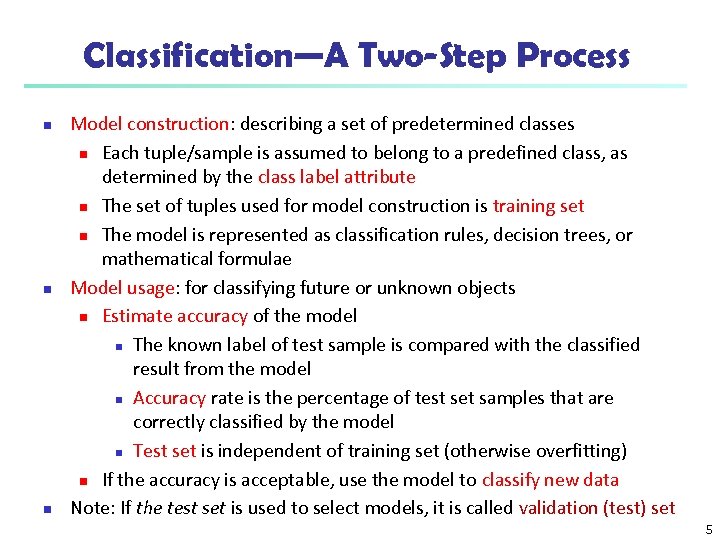 Classification—A Two-Step Process n n n Model construction: describing a set of predetermined classes n Each tuple/sample is assumed to belong to a predefined class, as determined by the class label attribute n The set of tuples used for model construction is training set n The model is represented as classification rules, decision trees, or mathematical formulae Model usage: for classifying future or unknown objects n Estimate accuracy of the model n The known label of test sample is compared with the classified result from the model n Accuracy rate is the percentage of test set samples that are correctly classified by the model n Test set is independent of training set (otherwise overfitting) n If the accuracy is acceptable, use the model to classify new data Note: If the test set is used to select models, it is called validation (test) set 5
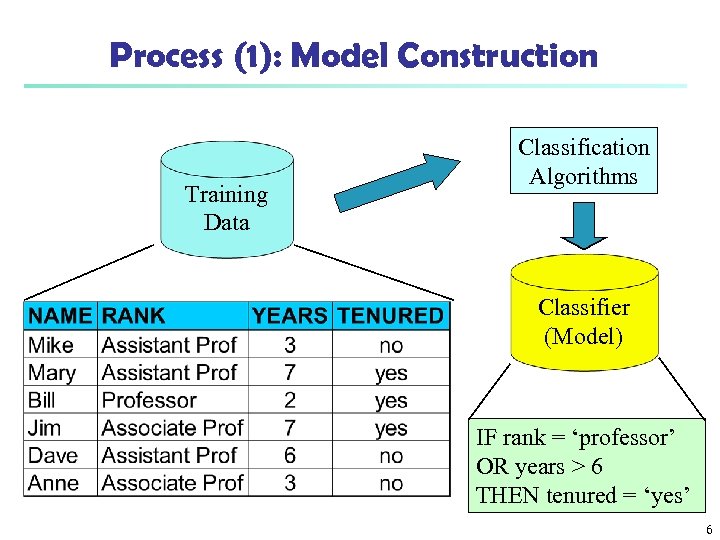 Process (1): Model Construction Training Data Classification Algorithms Classifier (Model) IF rank = ‘professor’ OR years > 6 THEN tenured = ‘yes’ 6
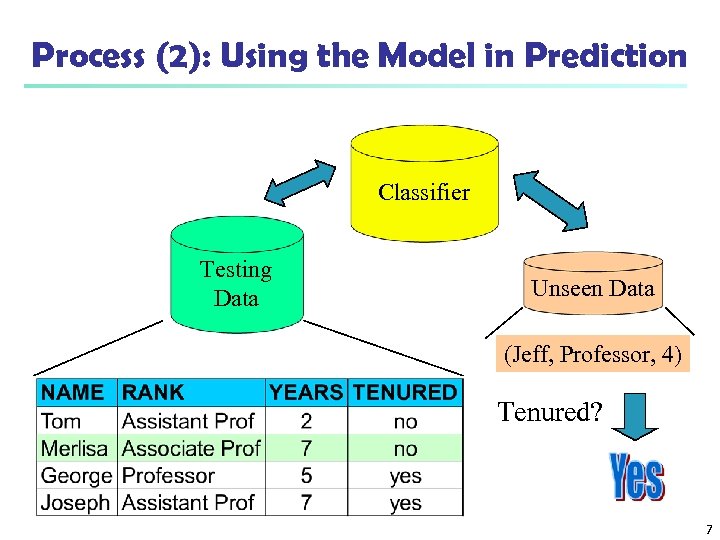 Process (2): Using the Model in Prediction Classifier Testing Data Unseen Data (Jeff, Professor, 4) Tenured? 7
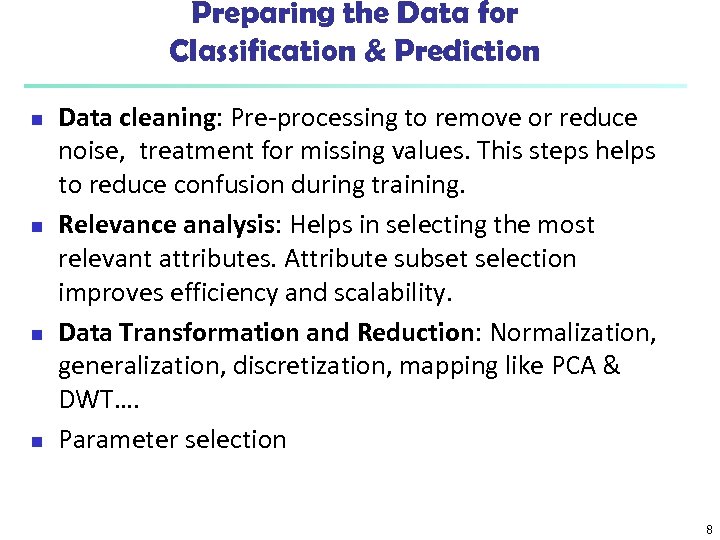 Preparing the Data for Classification & Prediction n n Data cleaning: Pre-processing to remove or reduce noise, treatment for missing values. This steps helps to reduce confusion during training. Relevance analysis: Helps in selecting the most relevant attributes. Attribute subset selection improves efficiency and scalability. Data Transformation and Reduction: Normalization, generalization, discretization, mapping like PCA & DWT…. Parameter selection 8
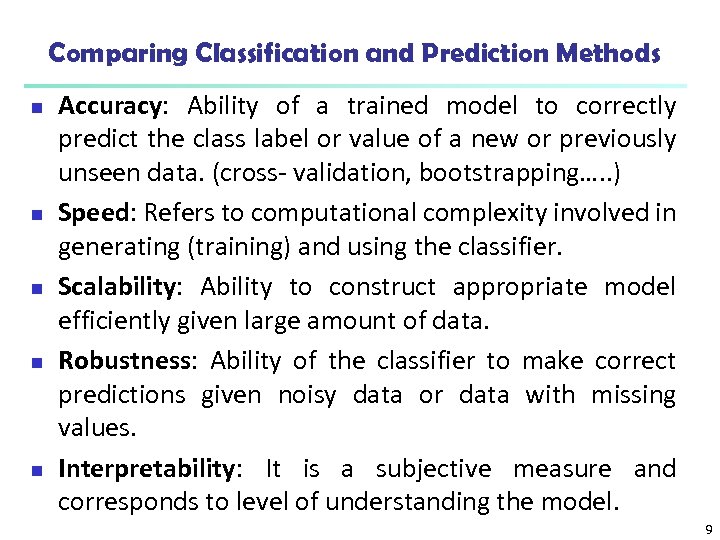 Comparing Classification and Prediction Methods n n n Accuracy: Ability of a trained model to correctly predict the class label or value of a new or previously unseen data. (cross- validation, bootstrapping…. . ) Speed: Refers to computational complexity involved in generating (training) and using the classifier. Scalability: Ability to construct appropriate model efficiently given large amount of data. Robustness: Ability of the classifier to make correct predictions given noisy data or data with missing values. Interpretability: It is a subjective measure and corresponds to level of understanding the model. 9
 Chapter 6. Classification: Basic Concepts n Decision Tree Induction n Bayes Classification Methods n Rule-Based Classification n Summary 10
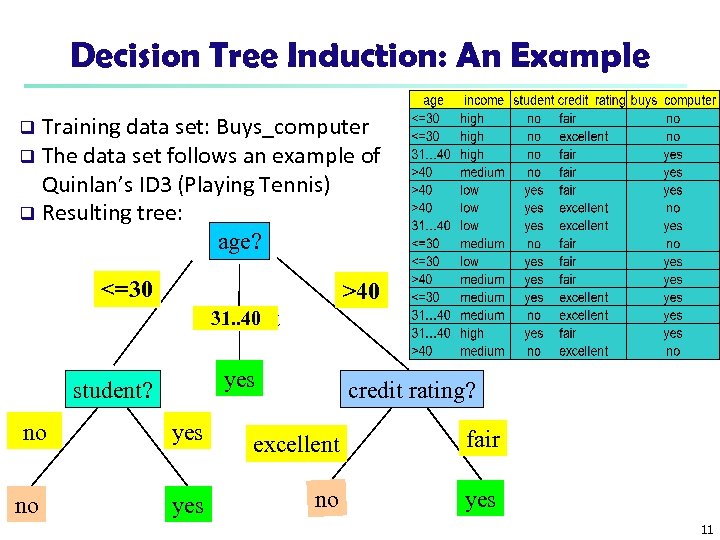 Decision Tree Induction: An Example Training data set: Buys_computer q The data set follows an example of Quinlan’s ID 3 (Playing Tennis) q Resulting tree: age? q <=30 >40 31. . 40 overcast yes student? no no yes credit rating? excellent fair no yes 11
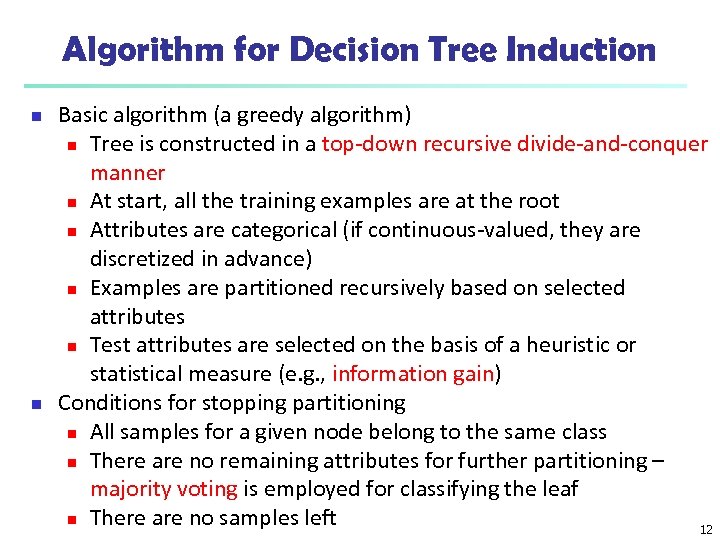 Algorithm for Decision Tree Induction n n Basic algorithm (a greedy algorithm) n Tree is constructed in a top-down recursive divide-and-conquer manner n At start, all the training examples are at the root n Attributes are categorical (if continuous-valued, they are discretized in advance) n Examples are partitioned recursively based on selected attributes n Test attributes are selected on the basis of a heuristic or statistical measure (e. g. , information gain) Conditions for stopping partitioning n All samples for a given node belong to the same class n There are no remaining attributes for further partitioning – majority voting is employed for classifying the leaf n There are no samples left 12
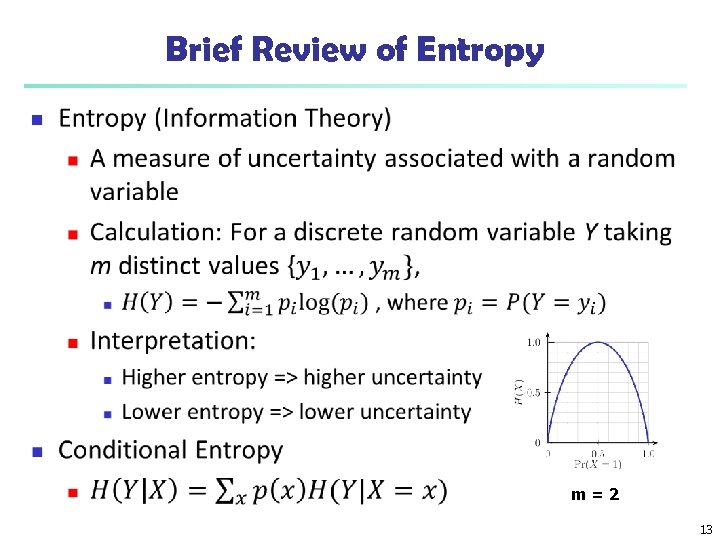 Brief Review of Entropy n m=2 13
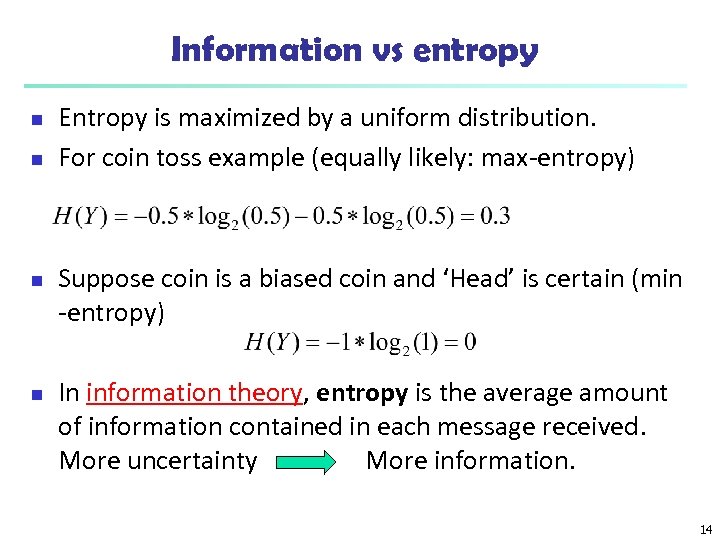 Information vs entropy n n Entropy is maximized by a uniform distribution. For coin toss example (equally likely: max-entropy) Suppose coin is a biased coin and ‘Head’ is certain (min -entropy) In information theory, entropy is the average amount of information contained in each message received. More uncertainty More information. 14
 ID 3 Algorithm “Iterative Dichotomizer 3” n Invented by Ross Quinlan in 1979. Generates Decision Trees using Shannon Entropy. Succeeded by Quinlan’s C 4. 5 and C 5. 0). Steps: n n n Establish Classification Attribute Ci in the database ‘D’. Compute Classification Attribute Entropy. For all other attributes in D, calculate Information Gain using the classification attribute Ci. Select Attribute with the highest gain to be the next Node in the tree (starting from the Root node). Remove Node Attribute, creating reduced table DS. Repeat steps 3 -5 until all attributes have been used, or the same classification value remains for all rows in the reduced table.
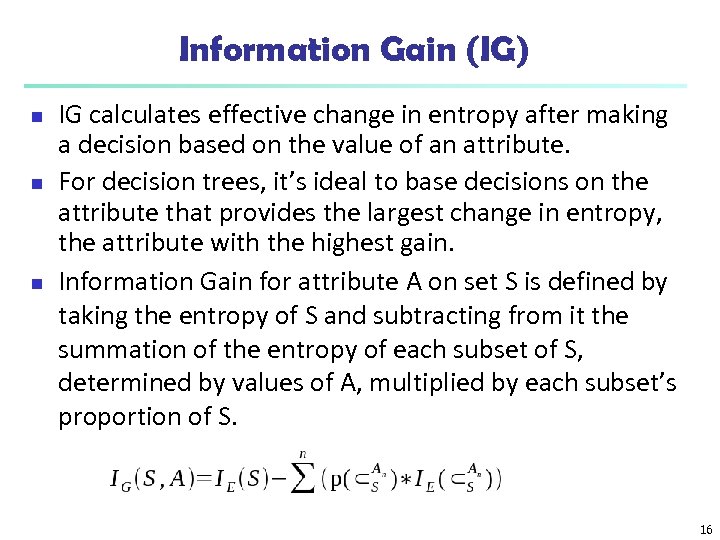 Information Gain (IG) n n n IG calculates effective change in entropy after making a decision based on the value of an attribute. For decision trees, it’s ideal to base decisions on the attribute that provides the largest change in entropy, the attribute with the highest gain. Information Gain for attribute A on set S is defined by taking the entropy of S and subtracting from it the summation of the entropy of each subset of S, determined by values of A, multiplied by each subset’s proportion of S. 16
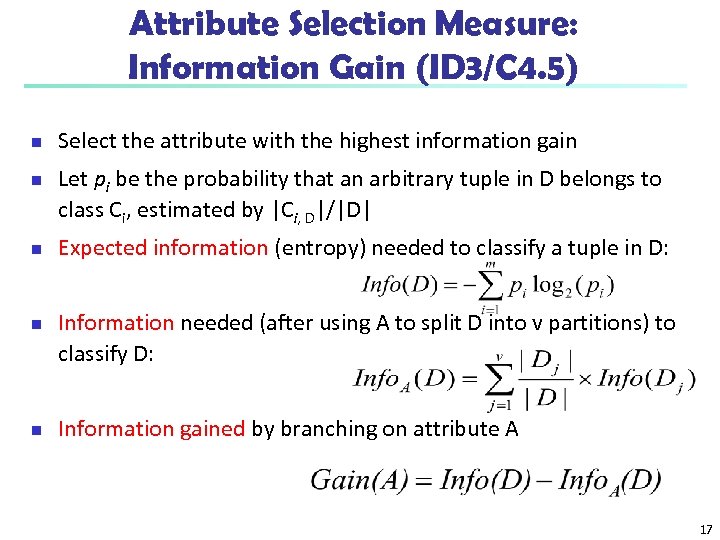 Attribute Selection Measure: Information Gain (ID 3/C 4. 5) n n n Select the attribute with the highest information gain Let pi be the probability that an arbitrary tuple in D belongs to class Ci, estimated by |Ci, D|/|D| Expected information (entropy) needed to classify a tuple in D: Information needed (after using A to split D into v partitions) to classify D: Information gained by branching on attribute A 17
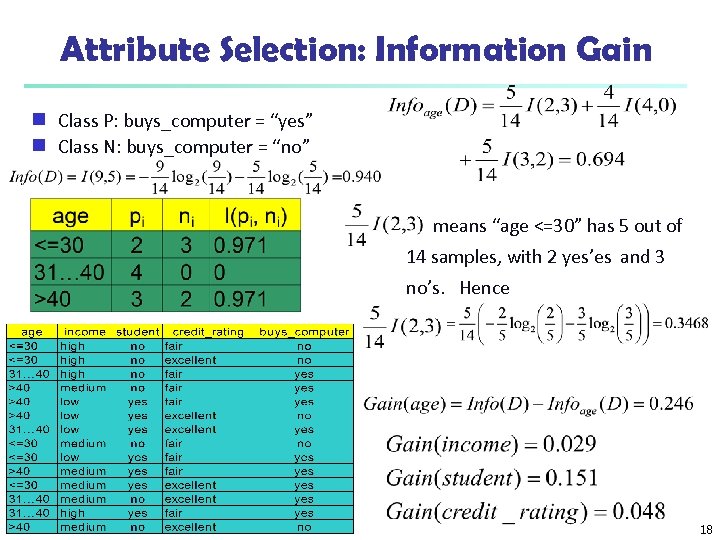 Attribute Selection: Information Gain Class P: buys_computer = “yes” g Class N: buys_computer = “no” g means “age <=30” has 5 out of 14 samples, with 2 yes’es and 3 no’s. Hence 18
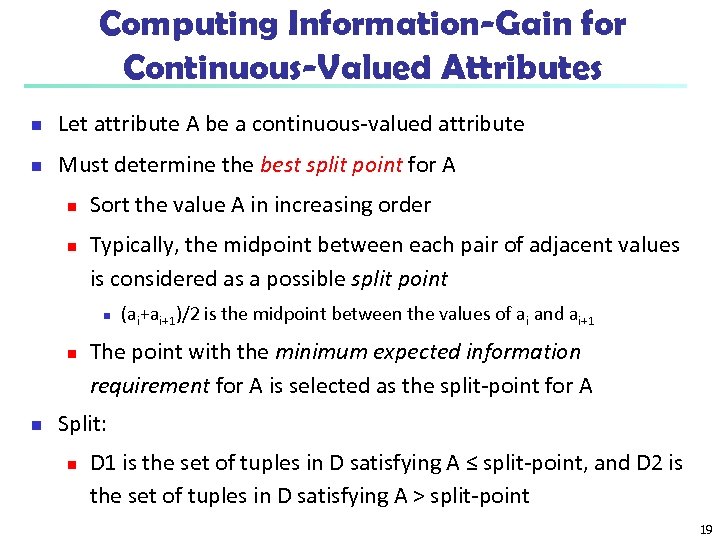 Computing Information-Gain for Continuous-Valued Attributes n Let attribute A be a continuous-valued attribute n Must determine the best split point for A n n Sort the value A in increasing order Typically, the midpoint between each pair of adjacent values is considered as a possible split point n n n (ai+ai+1)/2 is the midpoint between the values of ai and ai+1 The point with the minimum expected information requirement for A is selected as the split-point for A Split: n D 1 is the set of tuples in D satisfying A ≤ split-point, and D 2 is the set of tuples in D satisfying A > split-point 19
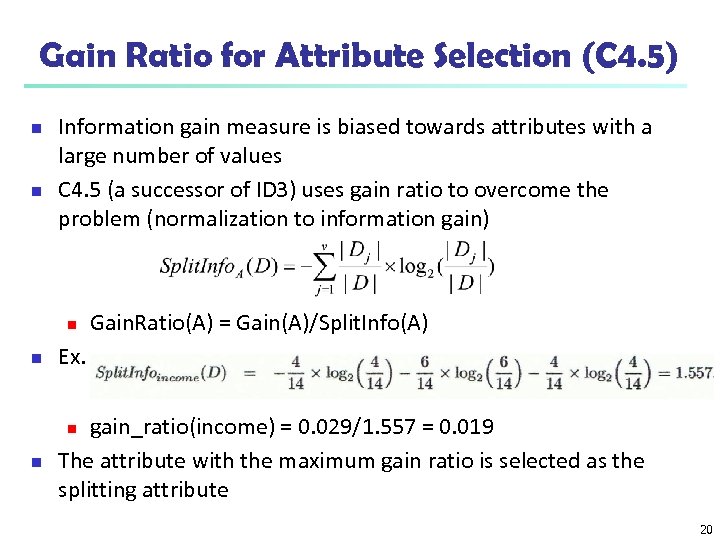 Gain Ratio for Attribute Selection (C 4. 5) n n Information gain measure is biased towards attributes with a large number of values C 4. 5 (a successor of ID 3) uses gain ratio to overcome the problem (normalization to information gain) n Gain. Ratio(A) = Gain(A)/Split. Info(A) n Ex. n gain_ratio(income) = 0. 029/1. 557 = 0. 019 The attribute with the maximum gain ratio is selected as the splitting attribute n 20
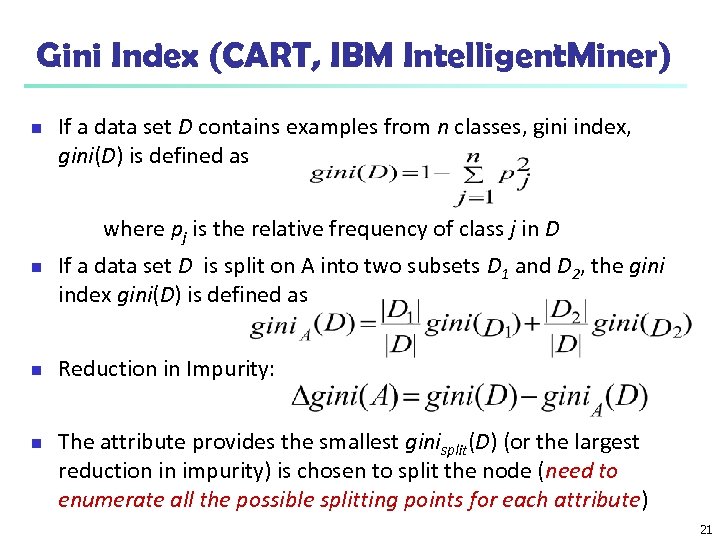 Gini Index (CART, IBM Intelligent. Miner) n n n n If a data set D contains examples from n classes, gini index, gini(D) is defined as where pj is the relative frequency of class j in D If a data set D is split on A into two subsets D 1 and D 2, the gini index gini(D) is defined as Reduction in Impurity: The attribute provides the smallest ginisplit(D) (or the largest reduction in impurity) is chosen to split the node (need to enumerate all the possible splitting points for each attribute) 21
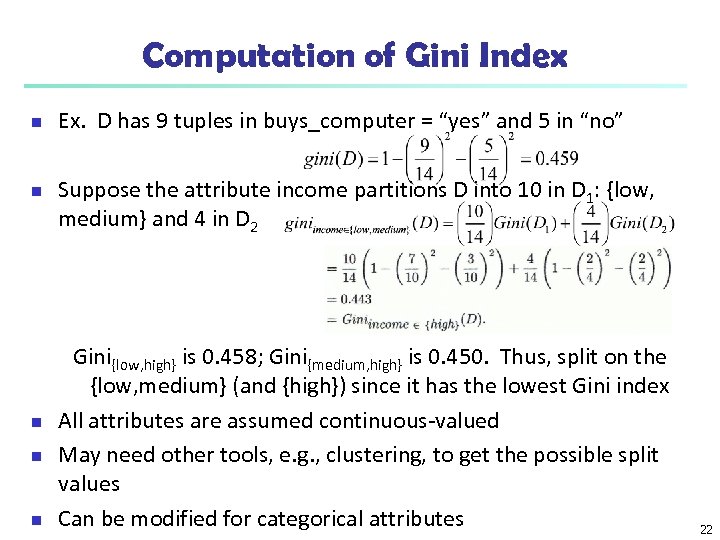 Computation of Gini Index n n n Ex. D has 9 tuples in buys_computer = “yes” and 5 in “no” Suppose the attribute income partitions D into 10 in D 1: {low, medium} and 4 in D 2 Gini{low, high} is 0. 458; Gini{medium, high} is 0. 450. Thus, split on the {low, medium} (and {high}) since it has the lowest Gini index All attributes are assumed continuous-valued May need other tools, e. g. , clustering, to get the possible split values Can be modified for categorical attributes 22
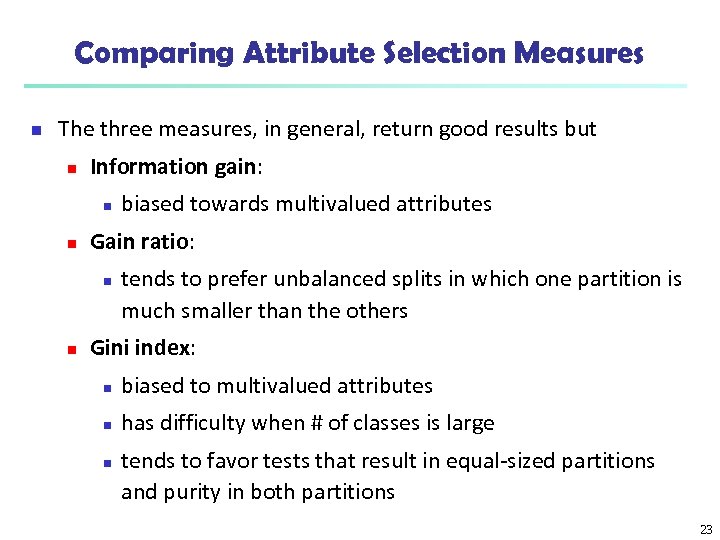 Comparing Attribute Selection Measures n The three measures, in general, return good results but n Information gain: n n Gain ratio: n n biased towards multivalued attributes tends to prefer unbalanced splits in which one partition is much smaller than the others Gini index: n biased to multivalued attributes n has difficulty when # of classes is large n tends to favor tests that result in equal-sized partitions and purity in both partitions 23
 Other Attribute Selection Measures n CHAID: a popular decision tree algorithm, measure based on χ2 test for independence n C-SEP: performs better than info. gain and gini index in certain cases n G-statistic: has a close approximation to χ2 distribution n MDL (Minimal Description Length) principle (i. e. , the simplest solution is preferred): n The best tree as the one that requires the fewest # of bits to both (1) encode the tree, and (2) encode the exceptions to the tree n Multivariate splits (partition based on multiple variable combinations) n n CART: finds multivariate splits based on a linear comb. of attrs. Which attribute selection measure is the best? n Most give good results, none is significantly superior than others 24
 Overfitting and Tree Pruning n n Overfitting: An induced tree may overfit the training data n Too many branches, some may reflect anomalies due to noise or outliers n Poor accuracy for unseen samples Two approaches to avoid overfitting n Prepruning: Halt tree construction early do not split a node if this would result in the goodness measure falling below a threshold n Difficult to choose an appropriate threshold n Postpruning: Remove branches from a “fully grown” tree— get a sequence of progressively pruned trees n Use a set of data different from the training data to decide which is the “best pruned tree” 25
 Enhancements to Basic Decision Tree Induction n Allow for continuous-valued attributes n n Dynamically define new discrete-valued attributes that partition the continuous attribute value into a discrete set of intervals Handle missing attribute values n n n Assign the most common value of the attribute Assign probability to each of the possible values Attribute construction n n Create new attributes based on existing ones that are sparsely represented This reduces fragmentation, repetition, and replication 26
 Classification in Large Databases n n Classification—a classical problem extensively studied by statisticians and machine learning researchers Scalability: Classifying data sets with millions of examples and hundreds of attributes with reasonable speed Why is decision tree induction popular? n relatively faster learning speed (than other classification methods) n convertible to simple and easy to understand classification rules n can use SQL queries for accessing databases n comparable classification accuracy with other methods Rain. Forest (VLDB’ 98 — Gehrke, Ramakrishnan & Ganti) n Builds an AVC-list (attribute, value, class label) 27
 Chapter 6. Classification: Basic Concepts n Decision Tree Induction n Bayes Classification Methods n Rule-Based Classification n Summary 28
 Bayesian Classification: Why? n n n A statistical classifier: performs probabilistic prediction, i. e. , predicts class membership probabilities Foundation: Based on Bayes’ Theorem. Performance: A simple Bayesian classifier, naïve Bayesian classifier, has comparable performance with decision tree and selected neural network classifiers Incremental: Each training example can incrementally increase/decrease the probability that a hypothesis is correct — prior knowledge can be combined with observed data Standard: Even when Bayesian methods are computationally intractable, they can provide a standard of optimal decision making against which other methods can be measured 29
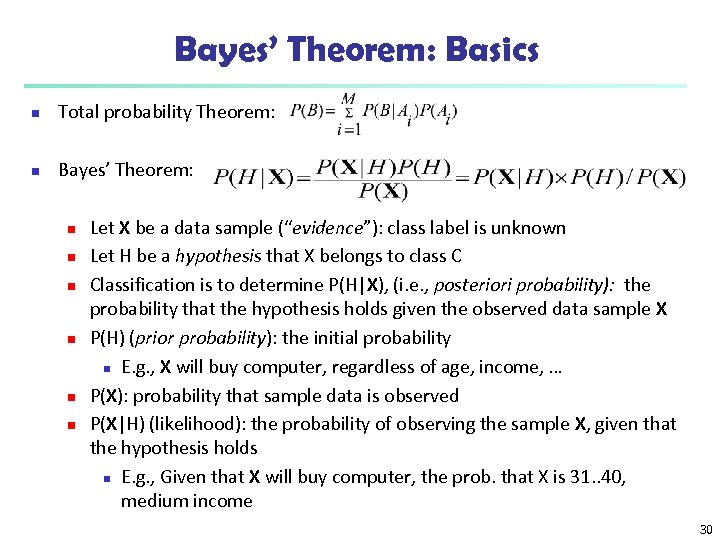 Bayes’ Theorem: Basics n Total probability Theorem: n Bayes’ Theorem: n n n Let X be a data sample (“evidence”): class label is unknown Let H be a hypothesis that X belongs to class C Classification is to determine P(H|X), (i. e. , posteriori probability): the probability that the hypothesis holds given the observed data sample X P(H) (prior probability): the initial probability n E. g. , X will buy computer, regardless of age, income, … P(X): probability that sample data is observed P(X|H) (likelihood): the probability of observing the sample X, given that the hypothesis holds n E. g. , Given that X will buy computer, the prob. that X is 31. . 40, medium income 30
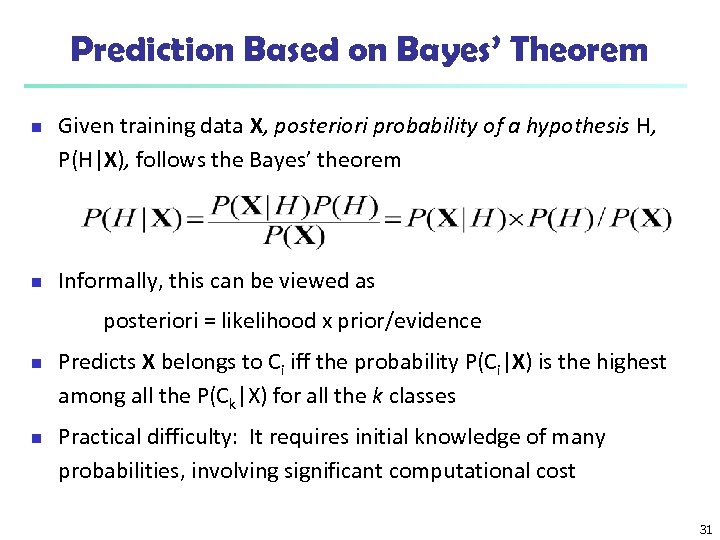 Prediction Based on Bayes’ Theorem n n Given training data X, posteriori probability of a hypothesis H, P(H|X), follows the Bayes’ theorem Informally, this can be viewed as posteriori = likelihood x prior/evidence n n Predicts X belongs to Ci iff the probability P(Ci|X) is the highest among all the P(Ck|X) for all the k classes Practical difficulty: It requires initial knowledge of many probabilities, involving significant computational cost 31
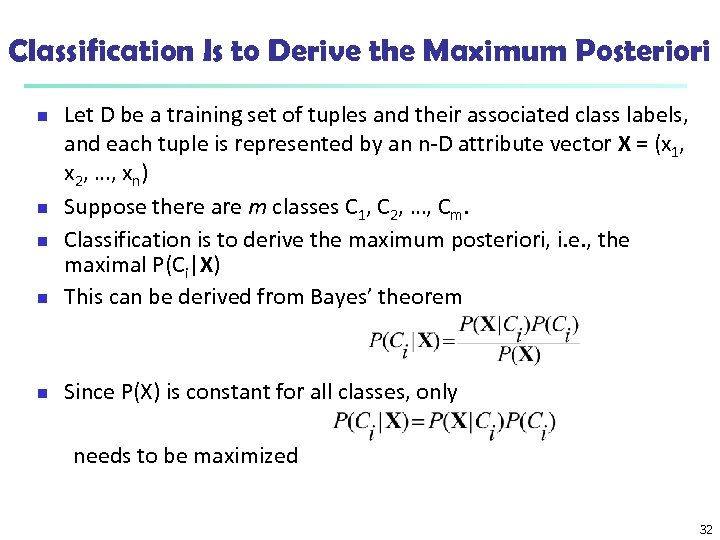 Classification Is to Derive the Maximum Posteriori n Let D be a training set of tuples and their associated class labels, and each tuple is represented by an n-D attribute vector X = (x 1, x 2, …, xn) Suppose there are m classes C 1, C 2, …, Cm. Classification is to derive the maximum posteriori, i. e. , the maximal P(Ci|X) This can be derived from Bayes’ theorem n Since P(X) is constant for all classes, only n needs to be maximized 32
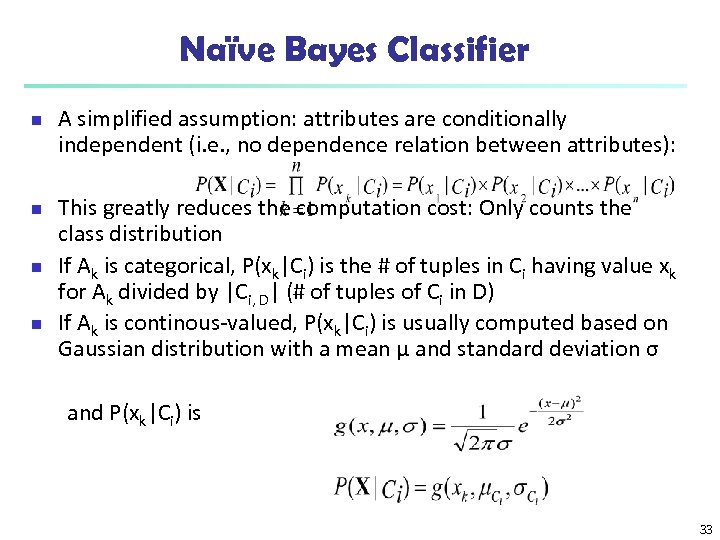 Naïve Bayes Classifier n n A simplified assumption: attributes are conditionally independent (i. e. , no dependence relation between attributes): This greatly reduces the computation cost: Only counts the class distribution If Ak is categorical, P(xk|Ci) is the # of tuples in Ci having value xk for Ak divided by |Ci, D| (# of tuples of Ci in D) If Ak is continous-valued, P(xk|Ci) is usually computed based on Gaussian distribution with a mean μ and standard deviation σ and P(xk|Ci) is 33
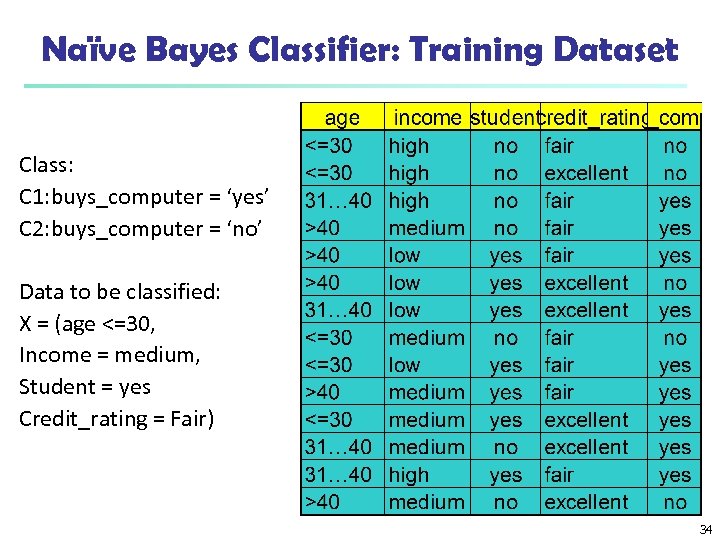 Naïve Bayes Classifier: Training Dataset Class: C 1: buys_computer = ‘yes’ C 2: buys_computer = ‘no’ Data to be classified: X = (age <=30, Income = medium, Student = yes Credit_rating = Fair) 34
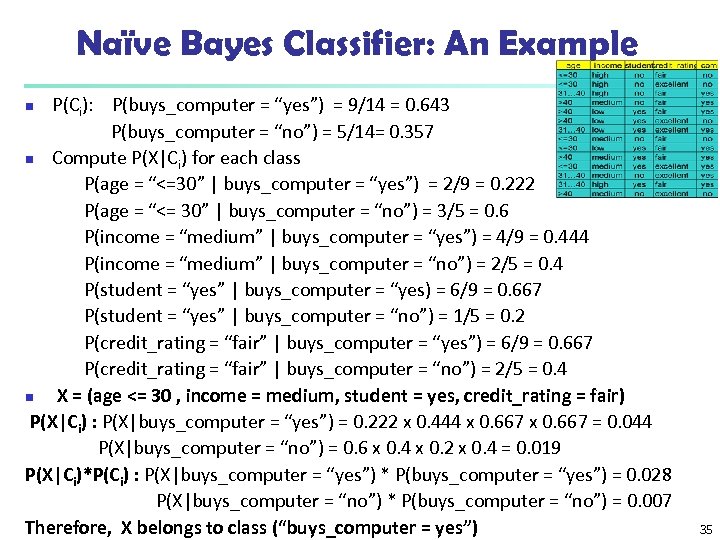 Naïve Bayes Classifier: An Example P(Ci): P(buys_computer = “yes”) = 9/14 = 0. 643 P(buys_computer = “no”) = 5/14= 0. 357 n Compute P(X|Ci) for each class P(age = “<=30” | buys_computer = “yes”) = 2/9 = 0. 222 P(age = “<= 30” | buys_computer = “no”) = 3/5 = 0. 6 P(income = “medium” | buys_computer = “yes”) = 4/9 = 0. 444 P(income = “medium” | buys_computer = “no”) = 2/5 = 0. 4 P(student = “yes” | buys_computer = “yes) = 6/9 = 0. 667 P(student = “yes” | buys_computer = “no”) = 1/5 = 0. 2 P(credit_rating = “fair” | buys_computer = “yes”) = 6/9 = 0. 667 P(credit_rating = “fair” | buys_computer = “no”) = 2/5 = 0. 4 n X = (age <= 30 , income = medium, student = yes, credit_rating = fair) P(X|Ci) : P(X|buys_computer = “yes”) = 0. 222 x 0. 444 x 0. 667 = 0. 044 P(X|buys_computer = “no”) = 0. 6 x 0. 4 x 0. 2 x 0. 4 = 0. 019 P(X|Ci)*P(Ci) : P(X|buys_computer = “yes”) * P(buys_computer = “yes”) = 0. 028 P(X|buys_computer = “no”) * P(buys_computer = “no”) = 0. 007 Therefore, X belongs to class (“buys_computer = yes”) n 35
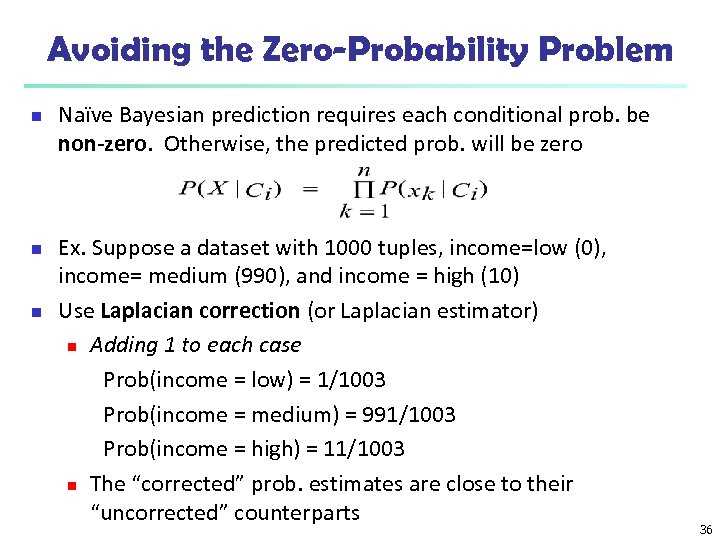 Avoiding the Zero-Probability Problem n n n Naïve Bayesian prediction requires each conditional prob. be non-zero. Otherwise, the predicted prob. will be zero Ex. Suppose a dataset with 1000 tuples, income=low (0), income= medium (990), and income = high (10) Use Laplacian correction (or Laplacian estimator) n Adding 1 to each case Prob(income = low) = 1/1003 Prob(income = medium) = 991/1003 Prob(income = high) = 11/1003 n The “corrected” prob. estimates are close to their “uncorrected” counterparts 36
 Naïve Bayes Classifier: Comments n n n Advantages n Easy to implement n Good results obtained in most of the cases Disadvantages n Assumption: class conditional independence, therefore loss of accuracy n Practically, dependencies exist among variables n E. g. , hospitals: patients: Profile: age, family history, etc. Symptoms: fever, cough etc. , Disease: lung cancer, diabetes, etc. n Dependencies among these cannot be modeled by Naïve Bayes Classifier How to deal with these dependencies? Bayesian Belief Networks (Chapter 9) 37
 Chapter 6. Classification: Basic Concepts n Decision Tree Induction n Bayes Classification Methods n Rule-Based Classification n Summary 38
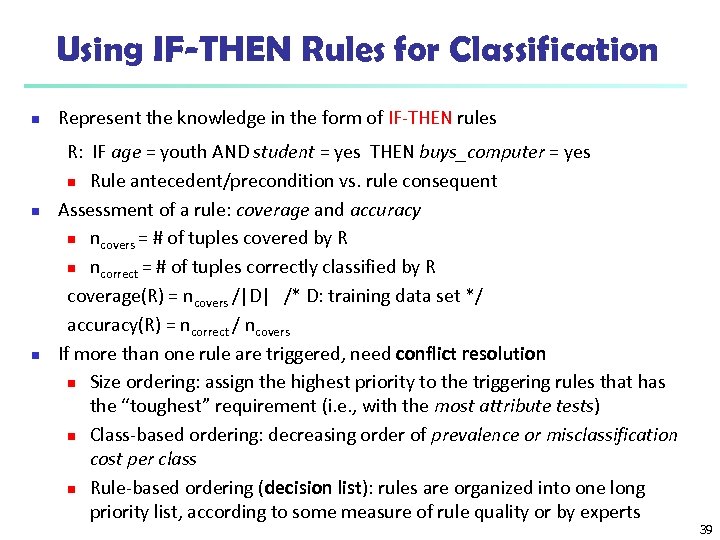 Using IF-THEN Rules for Classification n Represent the knowledge in the form of IF-THEN rules R: IF age = youth AND student = yes THEN buys_computer = yes n Rule antecedent/precondition vs. rule consequent Assessment of a rule: coverage and accuracy n ncovers = # of tuples covered by R n ncorrect = # of tuples correctly classified by R coverage(R) = ncovers /|D| /* D: training data set */ accuracy(R) = ncorrect / ncovers If more than one rule are triggered, need conflict resolution n Size ordering: assign the highest priority to the triggering rules that has the “toughest” requirement (i. e. , with the most attribute tests) n Class-based ordering: decreasing order of prevalence or misclassification cost per class n Rule-based ordering (decision list): rules are organized into one long priority list, according to some measure of rule quality or by experts 39
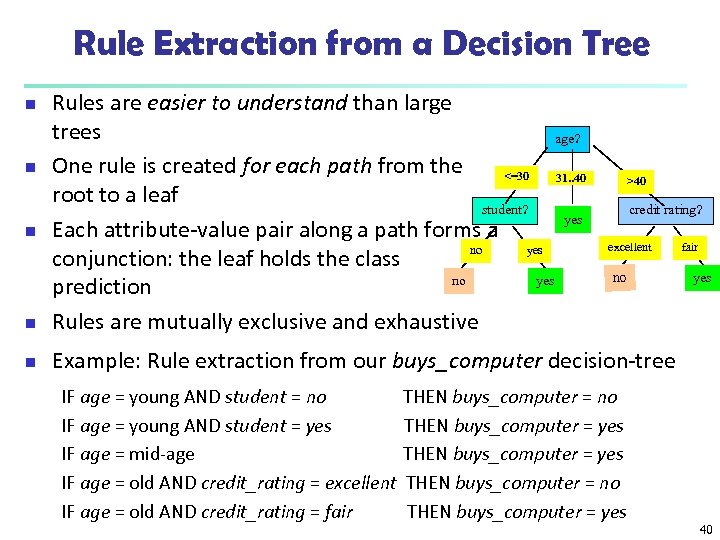 Rule Extraction from a Decision Tree n Rules are easier to understand than large trees age? One rule is created for each path from the <=30 31. . 40 root to a leaf student? yes Each attribute-value pair along a path forms a no yes conjunction: the leaf holds the class no yes prediction Rules are mutually exclusive and exhaustive n Example: Rule extraction from our buys_computer decision-tree n n n >40 credit rating? excellent no IF age = young AND student = no THEN buys_computer = no IF age = young AND student = yes THEN buys_computer = yes IF age = mid-age THEN buys_computer = yes IF age = old AND credit_rating = excellent THEN buys_computer = no IF age = old AND credit_rating = fair THEN buys_computer = yes fair yes 40
 Rule Induction: Sequential Covering Method n n n Sequential covering algorithm: Extracts rules directly from training data Typical sequential covering algorithms: FOIL, AQ, CN 2, RIPPER Rules are learned sequentially, each for a given class Ci will cover many tuples of Ci but none (or few) of the tuples of other classes Steps: n Rules are learned one at a time n Each time a rule is learned, the tuples covered by the rules are removed n Repeat the process on the remaining tuples until termination condition, e. g. , when no more training examples or when the quality of a rule returned is below a user-specified threshold Comp. w. decision-tree induction: learning a set of rules simultaneously 41
 Summary n Classification is a form of data analysis that extracts models describing important data classes. n Supervised & unsupervised n Comparing classifiers n Evaluation metrics include: accuracy, sensitivity, n Effective and scalable methods have been developed for decision tree induction, Naive Bayesian classification, rule-based classification, and many other classification methods. 42
 Sample Questions n n n Obtain decision tree for the given database Use decision tree to find rules. Why is tree pruning useful? Outline the major ideas of naïve Bayesian classification. Related questions from the past examination papers. 43