


 Скачать презентацию Data Mining Concepts and Techniques 18 March 2018
6e88c9abc9f11f9372cc5cfaaf77a1ce.ppt
- Количество слайдов: 55
 Data Mining: Concepts and Techniques 18 March 2018 Data Mining: Concepts and Techniques 1
 Chapter 7. Cluster Analysis 1. What is Cluster Analysis? 2. Types of Data in Cluster Analysis 3. A Categorization of Major Clustering Methods 4. Partitioning Methods 5. Hierarchical Methods 6. Density-Based Methods 7. Grid-Based Methods 8. Model-Based Methods 9. Clustering High-Dimensional Data 10. Constraint-Based Clustering 11. Outlier Analysis 12. Summary 18 March 2018 Data Mining: Concepts and Techniques 2
 What is Cluster Analysis? n Cluster: a collection of data objects n n n Similar to one another within the same cluster Dissimilar to the objects in other clusters Cluster analysis n Finding similarities between data according to the characteristics found in the data and grouping similar data objects into clusters n Unsupervised learning: no predefined classes n Typical applications n As a stand-alone tool to get insight into data distribution n As a preprocessing step for other algorithms 18 March 2018 Data Mining: Concepts and Techniques 3
 Clustering: Rich Applications and Multidisciplinary Efforts n Pattern Recognition n Spatial Data Analysis n n Create thematic maps in GIS by clustering feature spaces Detect spatial clusters or for other spatial mining tasks n Image Processing n Economic Science (especially market research) n WWW n n Document classification Cluster Weblog data to discover groups of similar access patterns 18 March 2018 Data Mining: Concepts and Techniques 4
 Examples of Clustering Applications n Marketing: Help marketers discover distinct groups in their customer bases, and then use this knowledge to develop targeted marketing programs n Land use: Identification of areas of similar land use in an earth observation database n Insurance: Identifying groups of motor insurance policy holders with a high average claim cost n City-planning: Identifying groups of houses according to their house type, value, and geographical location n Earth-quake studies: Observed earth quake epicenters should be clustered along continent faults 18 March 2018 Data Mining: Concepts and Techniques 5
 Quality: What Is Good Clustering? n A good clustering method will produce high quality clusters with n n n high intra-class similarity low inter-class similarity The quality of a clustering result depends on both the similarity measure used by the method and its implementation n The quality of a clustering method is also measured by its ability to discover some or all of the hidden patterns 18 March 2018 Data Mining: Concepts and Techniques 6
 Measure the Quality of Clustering n n n Dissimilarity/Similarity metric: Similarity is expressed in terms of a distance function, typically metric: d(i, j) There is a separate “quality” function that measures the “goodness” of a cluster. The definitions of distance functions are usually very different for interval-scaled, boolean, categorical, ordinal ratio, and vector variables. Weights should be associated with different variables based on applications and data semantics. It is hard to define “similar enough” or “good enough” n the answer is typically highly subjective. 18 March 2018 Data Mining: Concepts and Techniques 7
 Requirements of Clustering in Data Mining n Scalability n Ability to deal with different types of attributes n Ability to handle dynamic data n Discovery of clusters with arbitrary shape n Minimal requirements for domain knowledge to determine input parameters n Able to deal with noise and outliers n Insensitive to order of input records n High dimensionality n Incorporation of user-specified constraints n Interpretability and usability 18 March 2018 Data Mining: Concepts and Techniques 8
 Chapter 7. Cluster Analysis 1. What is Cluster Analysis? 2. Types of Data in Cluster Analysis 3. A Categorization of Major Clustering Methods 4. Partitioning Methods 5. Hierarchical Methods 6. Density-Based Methods 7. Grid-Based Methods 8. Model-Based Methods 9. Clustering High-Dimensional Data 10. Constraint-Based Clustering 11. Outlier Analysis 12. Summary 18 March 2018 Data Mining: Concepts and Techniques 9
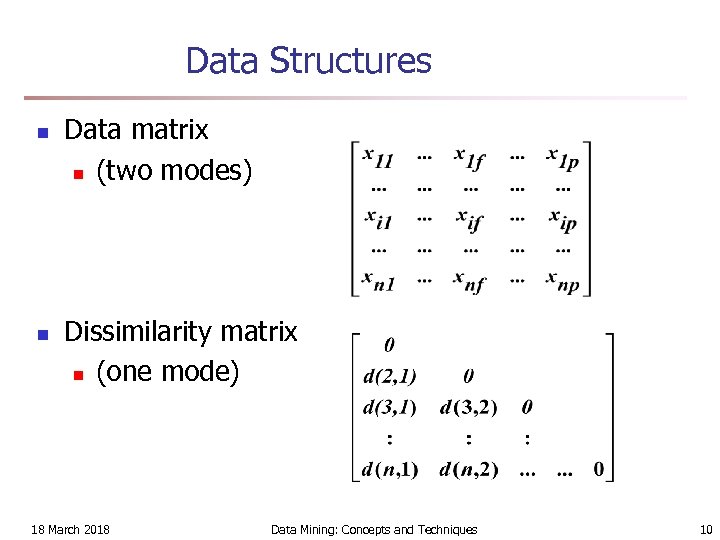 Data Structures n n Data matrix n (two modes) Dissimilarity matrix n (one mode) 18 March 2018 Data Mining: Concepts and Techniques 10
 Type of data in clustering analysis n Interval-scaled variables n Binary variables n Nominal, ordinal, and ratio variables n Variables of mixed types 18 March 2018 Data Mining: Concepts and Techniques 11
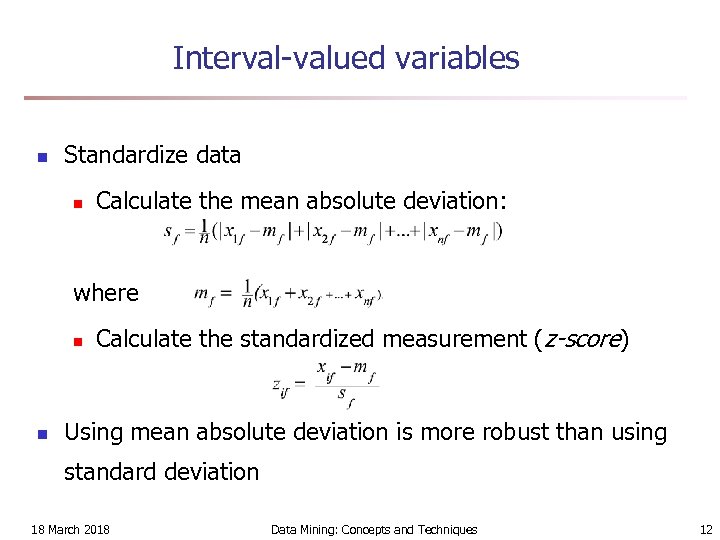 Interval-valued variables n Standardize data n Calculate the mean absolute deviation: where n n Calculate the standardized measurement (z-score) Using mean absolute deviation is more robust than using standard deviation 18 March 2018 Data Mining: Concepts and Techniques 12
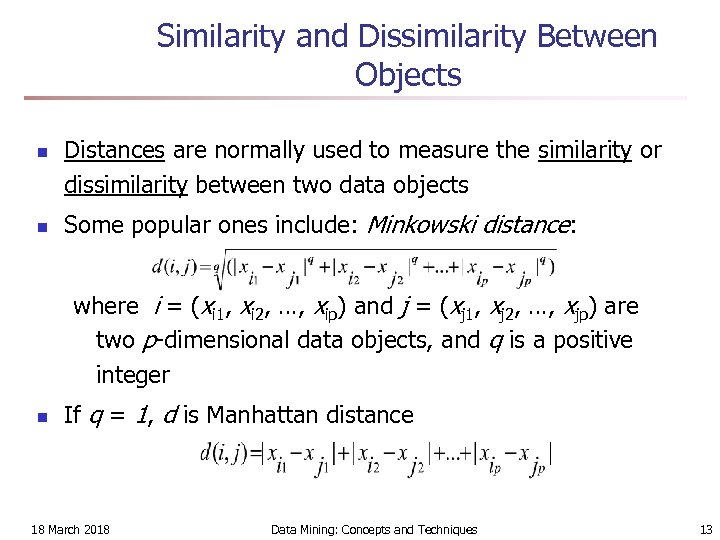 Similarity and Dissimilarity Between Objects n n Distances are normally used to measure the similarity or dissimilarity between two data objects Some popular ones include: Minkowski distance: where i = (xi 1, xi 2, …, xip) and j = (xj 1, xj 2, …, xjp) are two p-dimensional data objects, and q is a positive integer n If q = 1, d is Manhattan distance 18 March 2018 Data Mining: Concepts and Techniques 13
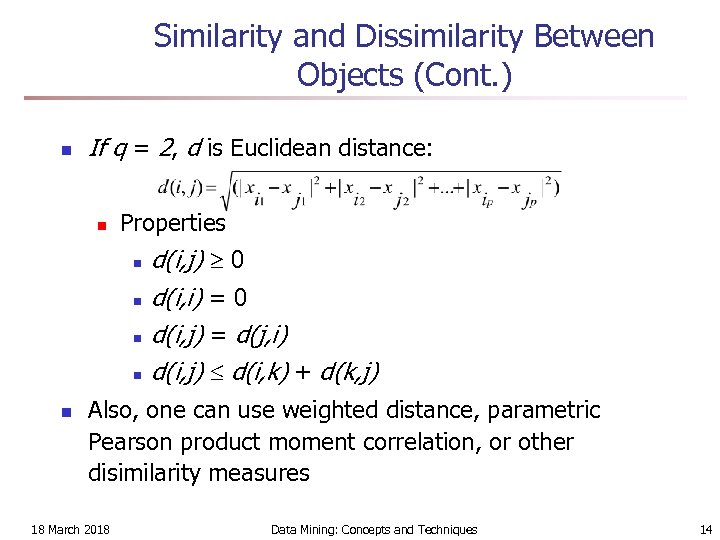 Similarity and Dissimilarity Between Objects (Cont. ) n If q = 2, d is Euclidean distance: n Properties n n n d(i, j) 0 d(i, i) = 0 d(i, j) = d(j, i) d(i, j) d(i, k) + d(k, j) Also, one can use weighted distance, parametric Pearson product moment correlation, or other disimilarity measures 18 March 2018 Data Mining: Concepts and Techniques 14
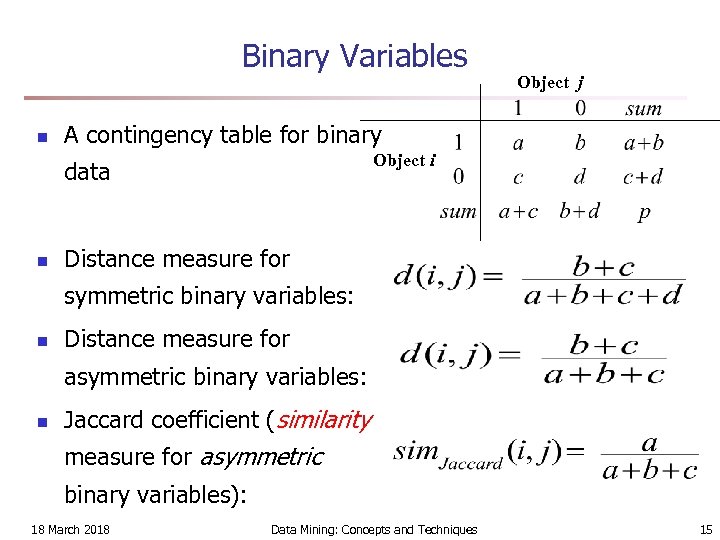 Binary Variables n A contingency table for binary Object i data n Object j Distance measure for symmetric binary variables: n Distance measure for asymmetric binary variables: n Jaccard coefficient (similarity measure for asymmetric binary variables): 18 March 2018 Data Mining: Concepts and Techniques 15
 Dissimilarity between Binary Variables n Example n n n gender is a symmetric attribute the remaining attributes are asymmetric binary let the values Y and P be set to 1, and the value N be set to 0 18 March 2018 Data Mining: Concepts and Techniques 16
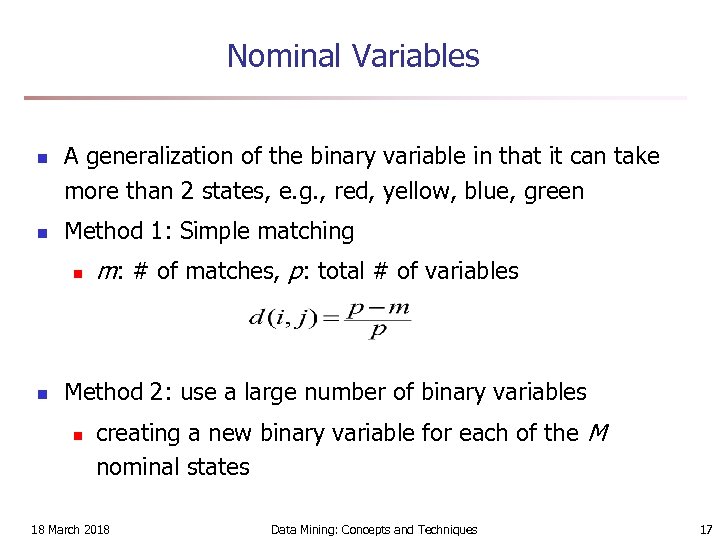 Nominal Variables n n A generalization of the binary variable in that it can take more than 2 states, e. g. , red, yellow, blue, green Method 1: Simple matching n n m: # of matches, p: total # of variables Method 2: use a large number of binary variables n creating a new binary variable for each of the M nominal states 18 March 2018 Data Mining: Concepts and Techniques 17
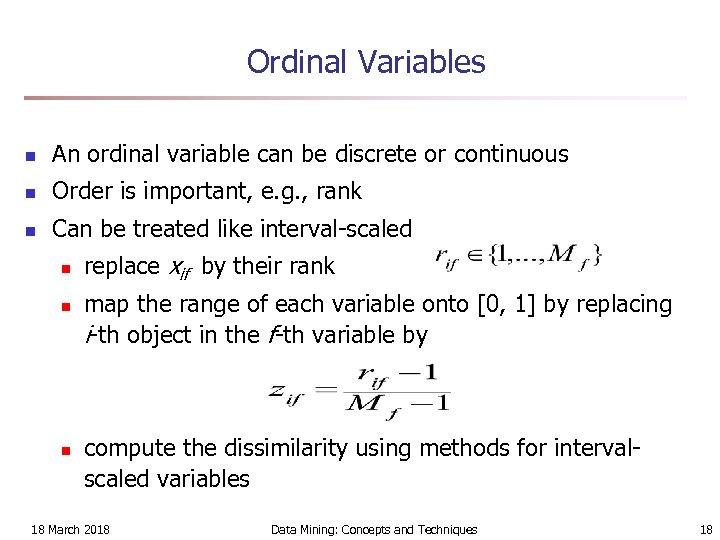 Ordinal Variables n An ordinal variable can be discrete or continuous n Order is important, e. g. , rank n Can be treated like interval-scaled n n n replace xif by their rank map the range of each variable onto [0, 1] by replacing i-th object in the f-th variable by compute the dissimilarity using methods for intervalscaled variables 18 March 2018 Data Mining: Concepts and Techniques 18
 Ratio-Scaled Variables n n Ratio-scaled variable: a positive measurement on a nonlinear scale, approximately at exponential scale, such as Ae. Bt or Ae-Bt Methods: n n treat them like interval-scaled variables—not a good choice! (why? —the scale can be distorted) apply logarithmic transformation yif = log(xif) n treat them as continuous ordinal data treat their rank as interval-scaled 18 March 2018 Data Mining: Concepts and Techniques 19
 Variables of Mixed Types n n A database may contain all the six types of variables n symmetric binary, asymmetric binary, nominal, ordinal, interval and ratio One may use a weighted formula to combine their effects n n n f is binary or nominal: dij(f) = 0 if xif = xjf , or dij(f) = 1 otherwise f is interval-based: use the normalized distance f is ordinal or ratio-scaled n compute ranks rif and n and treat zif as interval-scaled 18 March 2018 Data Mining: Concepts and Techniques 20
 Vector Objects n n Vector objects: keywords in documents, gene features in micro-arrays, etc. Broad applications: information retrieval, biologic taxonomy, etc. n Cosine measure n A variant: Tanimoto coefficient 18 March 2018 Data Mining: Concepts and Techniques 21
 Chapter 7. Cluster Analysis 1. What is Cluster Analysis? 2. Types of Data in Cluster Analysis 3. A Categorization of Major Clustering Methods 4. Partitioning Methods 5. Hierarchical Methods 6. Density-Based Methods 7. Grid-Based Methods 8. Model-Based Methods 9. Clustering High-Dimensional Data 10. Constraint-Based Clustering 11. Outlier Analysis 12. Summary 18 March 2018 Data Mining: Concepts and Techniques 22
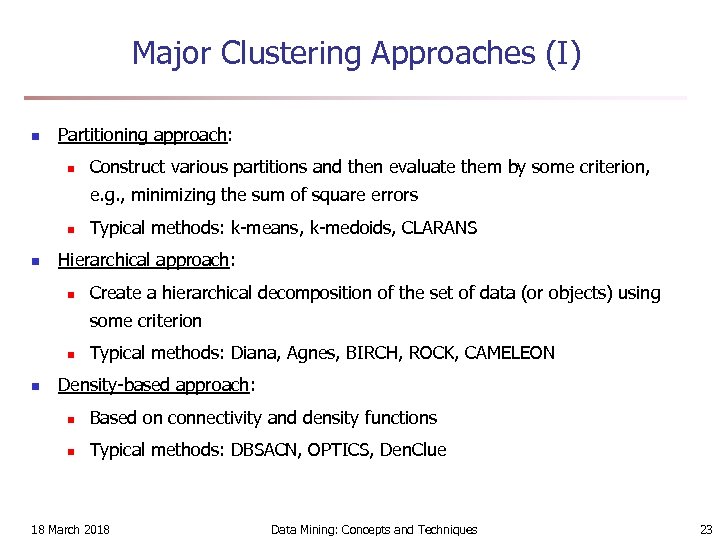 Major Clustering Approaches (I) n Partitioning approach: n Construct various partitions and then evaluate them by some criterion, e. g. , minimizing the sum of square errors n n Typical methods: k-means, k-medoids, CLARANS Hierarchical approach: n Create a hierarchical decomposition of the set of data (or objects) using some criterion n n Typical methods: Diana, Agnes, BIRCH, ROCK, CAMELEON Density-based approach: n Based on connectivity and density functions n Typical methods: DBSACN, OPTICS, Den. Clue 18 March 2018 Data Mining: Concepts and Techniques 23
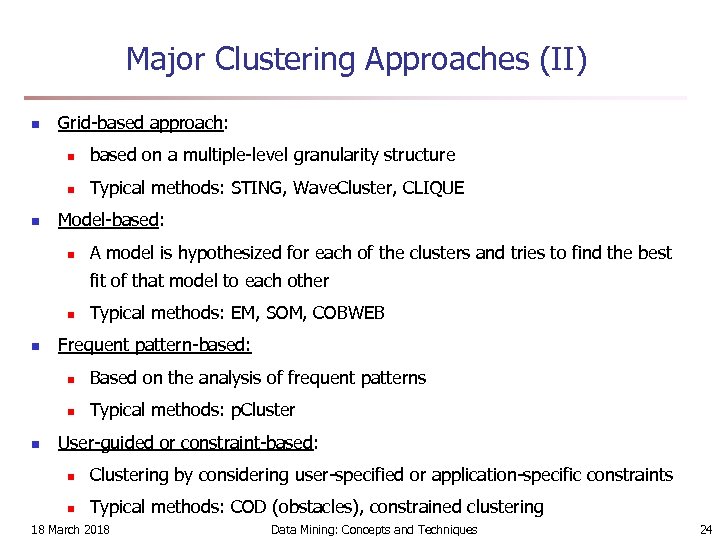 Major Clustering Approaches (II) n Grid-based approach: n n n based on a multiple-level granularity structure Typical methods: STING, Wave. Cluster, CLIQUE Model-based: n A model is hypothesized for each of the clusters and tries to find the best fit of that model to each other n n Typical methods: EM, SOM, COBWEB Frequent pattern-based: n n n Based on the analysis of frequent patterns Typical methods: p. Cluster User-guided or constraint-based: n Clustering by considering user-specified or application-specific constraints n Typical methods: COD (obstacles), constrained clustering 18 March 2018 Data Mining: Concepts and Techniques 24
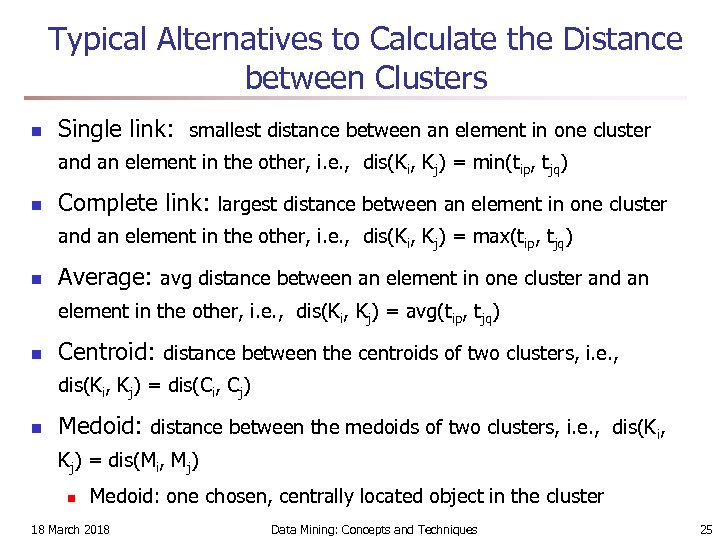 Typical Alternatives to Calculate the Distance between Clusters n Single link: smallest distance between an element in one cluster and an element in the other, i. e. , dis(Ki, Kj) = min(tip, tjq) n Complete link: largest distance between an element in one cluster and an element in the other, i. e. , dis(Ki, Kj) = max(tip, tjq) n Average: avg distance between an element in one cluster and an element in the other, i. e. , dis(Ki, Kj) = avg(tip, tjq) n Centroid: distance between the centroids of two clusters, i. e. , dis(Ki, Kj) = dis(Ci, Cj) n Medoid: distance between the medoids of two clusters, i. e. , dis(Ki, Kj) = dis(Mi, Mj) n Medoid: one chosen, centrally located object in the cluster 18 March 2018 Data Mining: Concepts and Techniques 25
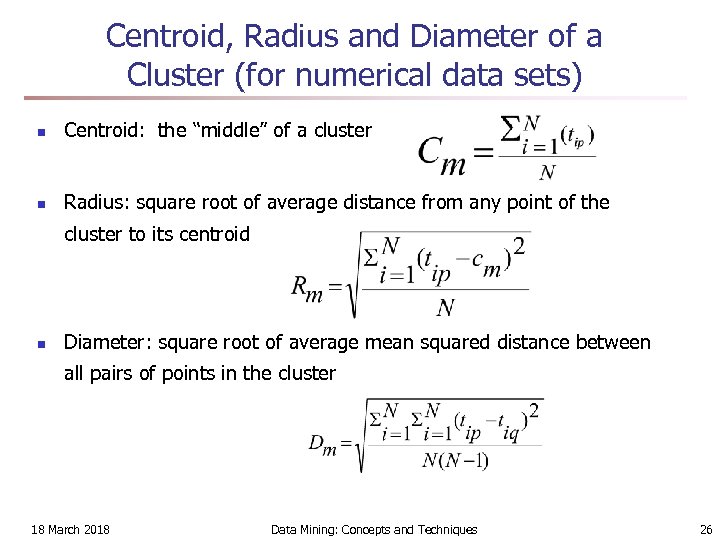 Centroid, Radius and Diameter of a Cluster (for numerical data sets) n Centroid: the “middle” of a cluster n Radius: square root of average distance from any point of the cluster to its centroid n Diameter: square root of average mean squared distance between all pairs of points in the cluster 18 March 2018 Data Mining: Concepts and Techniques 26
 Chapter 7. Cluster Analysis 1. What is Cluster Analysis? 2. Types of Data in Cluster Analysis 3. A Categorization of Major Clustering Methods 4. Partitioning Methods 5. Hierarchical Methods 6. Density-Based Methods 7. Grid-Based Methods 8. Model-Based Methods 9. Clustering High-Dimensional Data 10. Constraint-Based Clustering 11. Outlier Analysis 12. Summary 18 March 2018 Data Mining: Concepts and Techniques 27
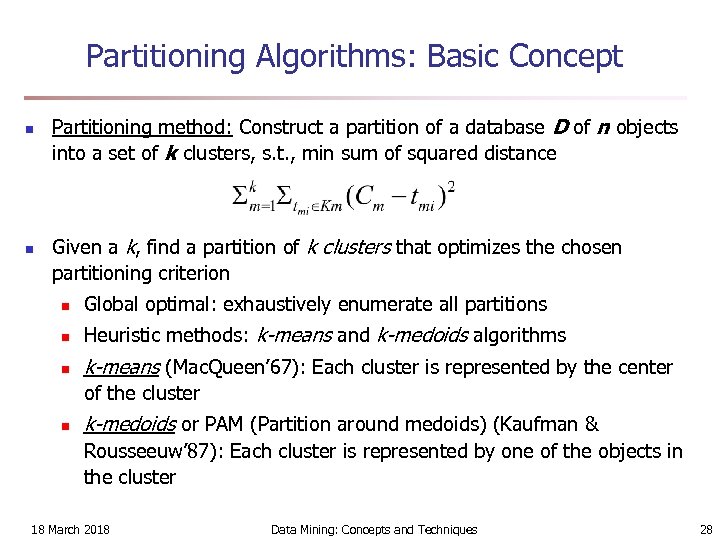 Partitioning Algorithms: Basic Concept n n Partitioning method: Construct a partition of a database D of n objects into a set of k clusters, s. t. , min sum of squared distance Given a k, find a partition of k clusters that optimizes the chosen partitioning criterion n Global optimal: exhaustively enumerate all partitions n Heuristic methods: k-means and k-medoids algorithms n k-means (Mac. Queen’ 67): Each cluster is represented by the center of the cluster n k-medoids or PAM (Partition around medoids) (Kaufman & Rousseeuw’ 87): Each cluster is represented by one of the objects in the cluster 18 March 2018 Data Mining: Concepts and Techniques 28
 The K-Means Clustering Method n Given k, the k-means algorithm is implemented in four steps: n n Partition objects into k nonempty subsets Compute seed points as the centroids of the clusters of the current partition (the centroid is the center, i. e. , mean point, of the cluster) Assign each object to the cluster with the nearest seed point Go back to Step 2, stop when no more new assignment 18 March 2018 Data Mining: Concepts and Techniques 29
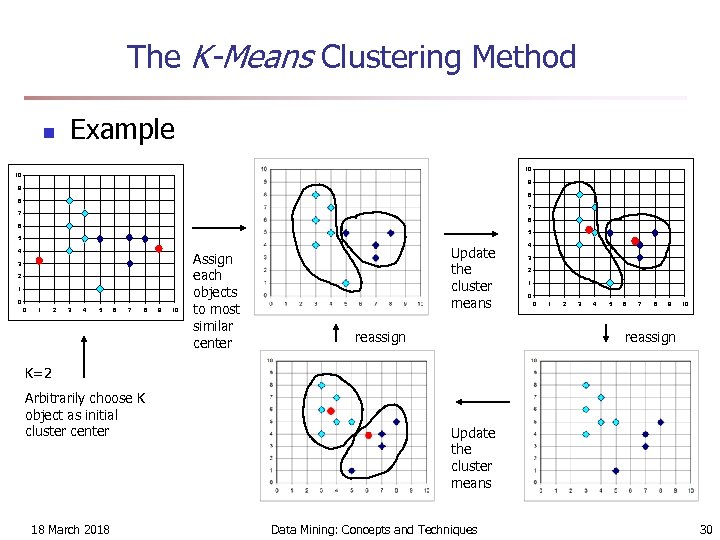 The K-Means Clustering Method n Example 10 10 9 9 8 8 7 7 6 6 5 5 4 3 2 1 0 0 1 2 3 4 5 6 7 8 9 10 Assign each objects to most similar center Update the cluster means reassign 4 3 2 1 0 0 1 2 3 4 5 6 7 8 9 10 reassign K=2 Arbitrarily choose K object as initial cluster center 18 March 2018 Update the cluster means Data Mining: Concepts and Techniques 30
 Comments on the K-Means Method n Strength: Relatively efficient: O(tkn), where n is # objects, k is # clusters, and t is # iterations. Normally, k, t << n. n n Comparing: PAM: O(k(n-k)2 ), CLARA: O(ks 2 + k(n-k)) Comment: Often terminates at a local optimum. The global optimum may be found using techniques such as: deterministic annealing and genetic algorithms n Weakness n Applicable only when mean is defined, then what about categorical data? n Need to specify k, the number of clusters, in advance n Unable to handle noisy data and outliers n Not suitable to discover clusters with non-convex shapes 18 March 2018 Data Mining: Concepts and Techniques 31
 Variations of the K-Means Method n A few variants of the k-means which differ in n n Dissimilarity calculations n n Selection of the initial k means Strategies to calculate cluster means Handling categorical data: k-modes (Huang’ 98) n Replacing means of clusters with modes n Using new dissimilarity measures to deal with categorical objects n Using a frequency-based method to update modes of clusters n A mixture of categorical and numerical data: k-prototype method 18 March 2018 Data Mining: Concepts and Techniques 32
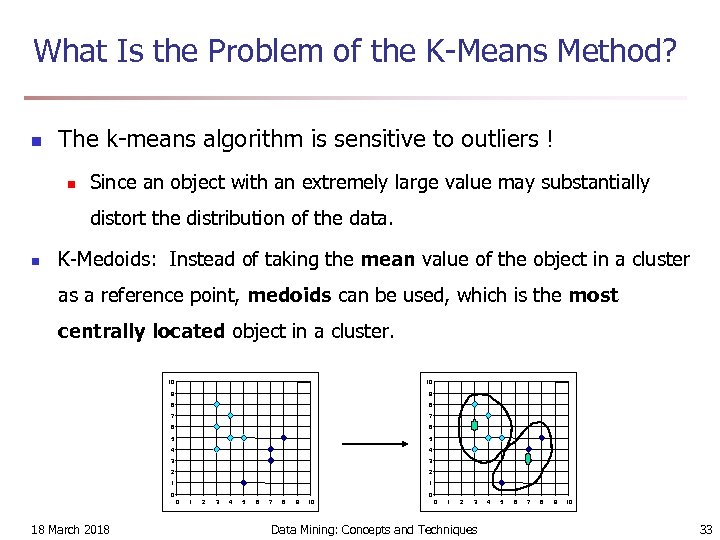 What Is the Problem of the K-Means Method? n The k-means algorithm is sensitive to outliers ! n Since an object with an extremely large value may substantially distort the distribution of the data. n K-Medoids: Instead of taking the mean value of the object in a cluster as a reference point, medoids can be used, which is the most centrally located object in a cluster. 10 10 9 9 8 8 7 7 6 6 5 5 4 4 3 3 2 2 1 1 0 0 0 18 March 2018 1 2 3 4 5 6 7 8 9 10 0 1 2 3 Data Mining: Concepts and Techniques 4 5 6 7 8 9 10 33
 The K-Medoids Clustering Method n Find representative objects, called medoids, in clusters n PAM (Partitioning Around Medoids, 1987) n starts from an initial set of medoids and iteratively replaces one of the medoids by one of the non-medoids if it improves the total distance of the resulting clustering n PAM works effectively for small data sets, but does not scale well for large data sets n CLARA (Kaufmann & Rousseeuw, 1990) n CLARANS (Ng & Han, 1994): Randomized sampling n Focusing + spatial data structure (Ester et al. , 1995) 18 March 2018 Data Mining: Concepts and Techniques 34
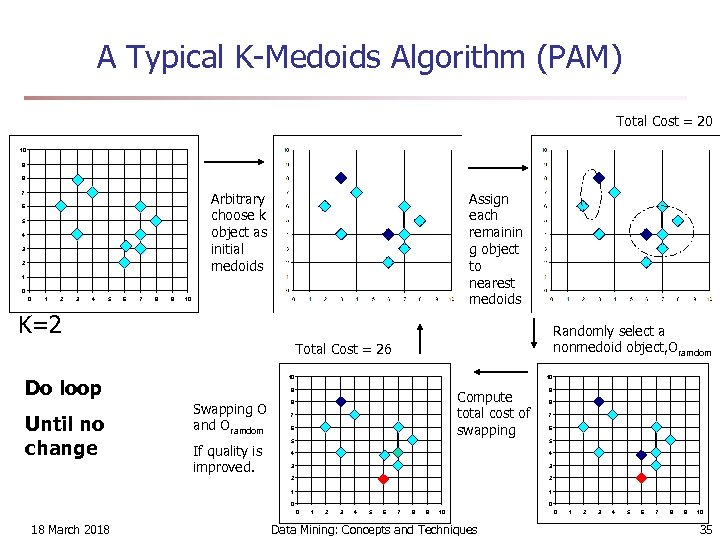 A Typical K-Medoids Algorithm (PAM) Total Cost = 20 10 9 8 Arbitrary choose k object as initial medoids 7 6 5 4 3 2 Assign each remainin g object to nearest medoids 1 0 0 1 2 3 4 5 6 7 8 9 10 K=2 Randomly select a nonmedoid object, Oramdom Total Cost = 26 Do loop Until no change 10 10 9 Swapping O and Oramdom Compute total cost of swapping 8 7 6 9 8 7 6 5 4 4 3 3 2 2 1 If quality is improved. 5 1 0 0 0 18 March 2018 1 2 3 4 5 6 7 8 9 10 Data Mining: Concepts and Techniques 0 1 2 3 4 5 6 7 8 9 10 35
 PAM (Partitioning Around Medoids) (1987) n PAM (Kaufman and Rousseeuw, 1987), built in Splus n Use real object to represent the cluster n n n Select k representative objects arbitrarily For each pair of non-selected object h and selected object i, calculate the total swapping cost TCih For each pair of i and h, n n n If TCih < 0, i is replaced by h Then assign each non-selected object to the most similar representative object repeat steps 2 -3 until there is no change 18 March 2018 Data Mining: Concepts and Techniques 36
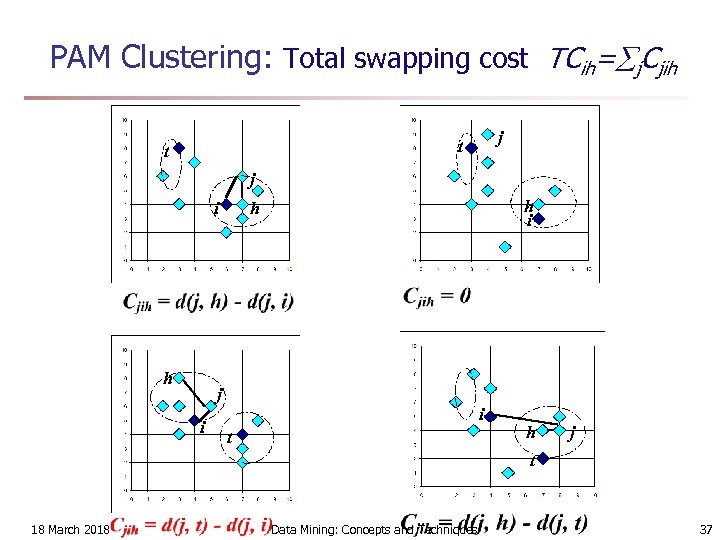 PAM Clustering: Total swapping cost TCih= j. Cjih j t t j i h h i h j i i t h j t 18 March 2018 Data Mining: Concepts and Techniques 37
 What Is the Problem with PAM? n n Pam is more robust than k-means in the presence of noise and outliers because a medoid is less influenced by outliers or other extreme values than a mean Pam works efficiently for small data sets but does not scale well for large data sets. n O(k(n-k)2 ) for each iteration where n is # of data, k is # of clusters è Sampling based method, CLARA(Clustering LARge Applications) 18 March 2018 Data Mining: Concepts and Techniques 38
 CLARA (Clustering Large Applications) (1990) n CLARA (Kaufmann and Rousseeuw in 1990) n n Built in statistical analysis packages, such as S+ It draws multiple samples of the data set, applies PAM on each sample, and gives the best clustering as the output n Strength: deals with larger data sets than PAM n Weakness: n n Efficiency depends on the sample size A good clustering based on samples will not necessarily represent a good clustering of the whole data set if the sample is biased 18 March 2018 Data Mining: Concepts and Techniques 39
 Chapter 7. Cluster Analysis 1. What is Cluster Analysis? 2. Types of Data in Cluster Analysis 3. A Categorization of Major Clustering Methods 4. Partitioning Methods 5. Hierarchical Methods 6. Density-Based Methods 7. Grid-Based Methods 8. Model-Based Methods 9. Clustering High-Dimensional Data 10. Constraint-Based Clustering 11. Outlier Analysis 12. Summary 18 March 2018 Data Mining: Concepts and Techniques 40
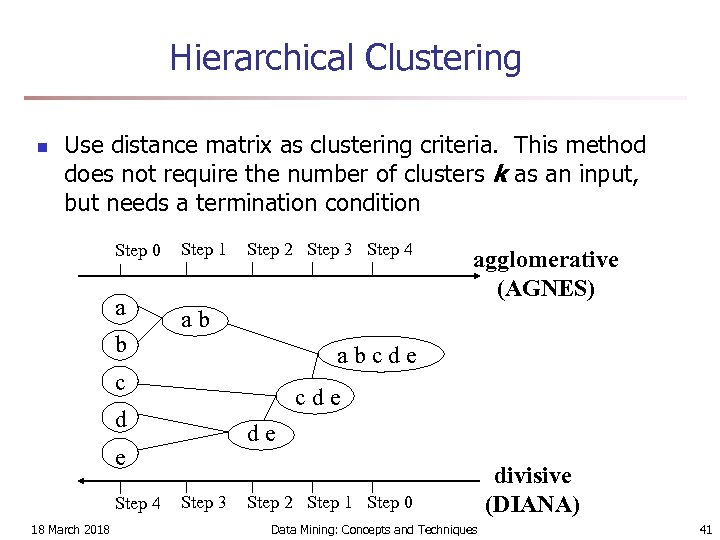 Hierarchical Clustering n Use distance matrix as clustering criteria. This method does not require the number of clusters k as an input, but needs a termination condition Step 0 a b Step 1 Step 2 Step 3 Step 4 ab abcde c cde d de e Step 4 18 March 2018 agglomerative (AGNES) Step 3 Step 2 Step 1 Step 0 Data Mining: Concepts and Techniques divisive (DIANA) 41
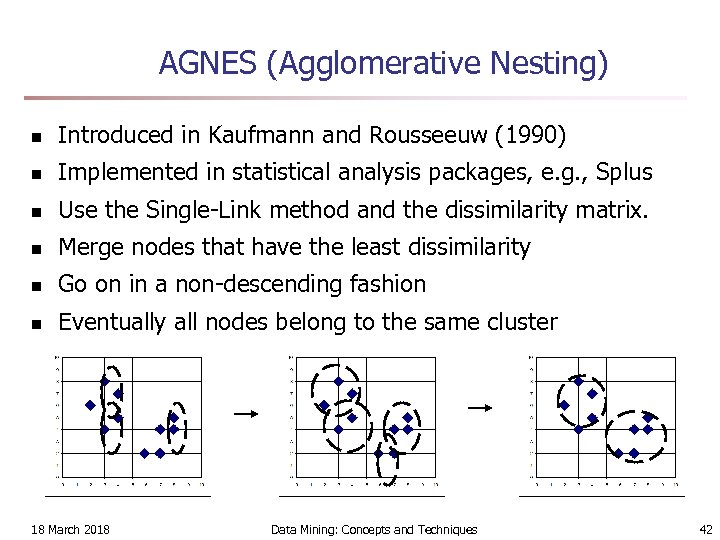 AGNES (Agglomerative Nesting) n Introduced in Kaufmann and Rousseeuw (1990) n Implemented in statistical analysis packages, e. g. , Splus n Use the Single-Link method and the dissimilarity matrix. n Merge nodes that have the least dissimilarity n Go on in a non-descending fashion n Eventually all nodes belong to the same cluster 18 March 2018 Data Mining: Concepts and Techniques 42
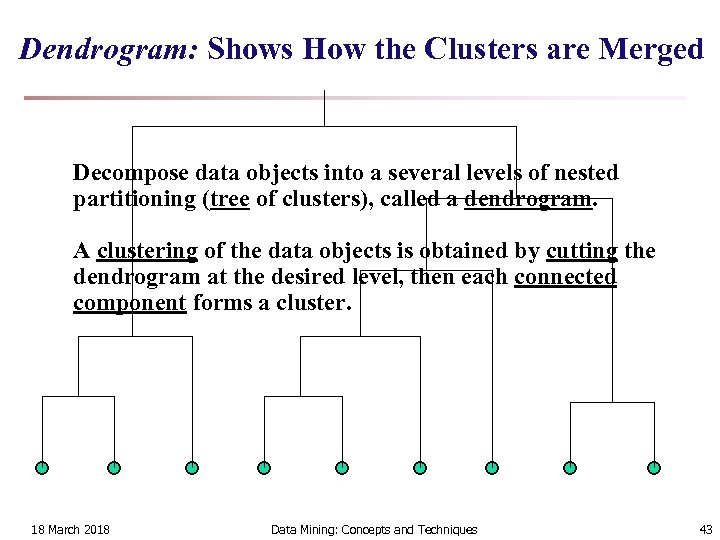 Dendrogram: Shows How the Clusters are Merged Decompose data objects into a several levels of nested partitioning (tree of clusters), called a dendrogram. A clustering of the data objects is obtained by cutting the dendrogram at the desired level, then each connected component forms a cluster. 18 March 2018 Data Mining: Concepts and Techniques 43
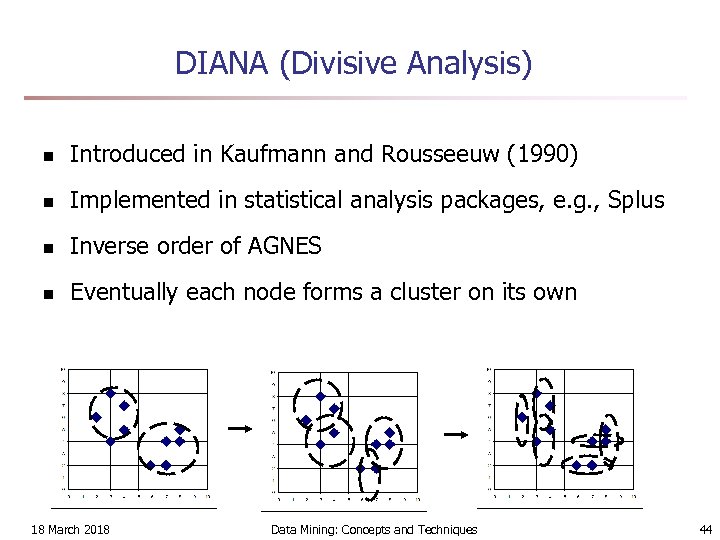 DIANA (Divisive Analysis) n Introduced in Kaufmann and Rousseeuw (1990) n Implemented in statistical analysis packages, e. g. , Splus n Inverse order of AGNES n Eventually each node forms a cluster on its own 18 March 2018 Data Mining: Concepts and Techniques 44
 Recent Hierarchical Clustering Methods n Major weakness of agglomerative clustering methods n n n do not scale well: time complexity of at least O(n 2), where n is the number of total objects can never undo what was done previously Integration of hierarchical with distance-based clustering n n n BIRCH (1996): uses CF-tree and incrementally adjusts the quality of sub-clusters ROCK (1999): clustering categorical data by neighbor and link analysis CHAMELEON (1999): hierarchical clustering using dynamic modeling 18 March 2018 Data Mining: Concepts and Techniques 45
 BIRCH (1996) n n Birch: Balanced Iterative Reducing and Clustering using Hierarchies (Zhang, Ramakrishnan & Livny, SIGMOD’ 96) Incrementally construct a CF (Clustering Feature) tree, a hierarchical data structure for multiphase clustering n n Phase 1: scan DB to build an initial in-memory CF tree (a multi-level compression of the data that tries to preserve the inherent clustering structure of the data) Phase 2: use an arbitrary clustering algorithm to cluster the leaf nodes of the CF-tree n Scales linearly: finds a good clustering with a single scan n Weakness: handles only numeric data, and sensitive to the and improves the quality with a few additional scans order of the data record. 18 March 2018 Data Mining: Concepts and Techniques 46
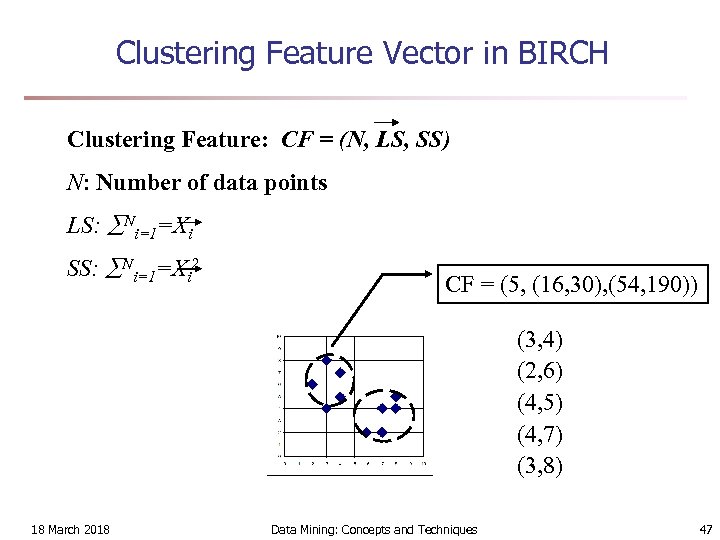 Clustering Feature Vector in BIRCH Clustering Feature: CF = (N, LS, SS) N: Number of data points LS: Ni=1=Xi SS: Ni=1=Xi 2 CF = (5, (16, 30), (54, 190)) (3, 4) (2, 6) (4, 5) (4, 7) (3, 8) 18 March 2018 Data Mining: Concepts and Techniques 47
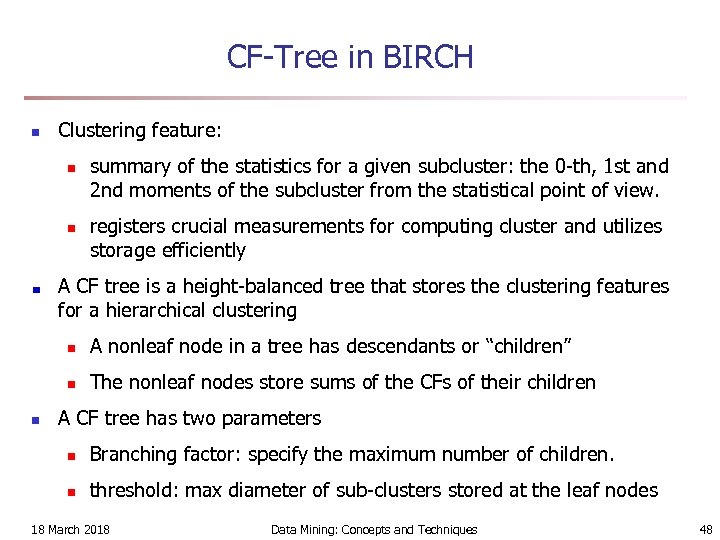 CF-Tree in BIRCH n Clustering feature: n n summary of the statistics for a given subcluster: the 0 -th, 1 st and 2 nd moments of the subcluster from the statistical point of view. registers crucial measurements for computing cluster and utilizes storage efficiently A CF tree is a height-balanced tree that stores the clustering features for a hierarchical clustering n n n A nonleaf node in a tree has descendants or “children” The nonleaf nodes store sums of the CFs of their children A CF tree has two parameters n Branching factor: specify the maximum number of children. n threshold: max diameter of sub-clusters stored at the leaf nodes 18 March 2018 Data Mining: Concepts and Techniques 48
 Chapter 7. Cluster Analysis 1. What is Cluster Analysis? 2. Types of Data in Cluster Analysis 3. A Categorization of Major Clustering Methods 4. Partitioning Methods 5. Hierarchical Methods 6. Density-Based Methods 7. Grid-Based Methods 8. Model-Based Methods 9. Clustering High-Dimensional Data 10. Constraint-Based Clustering 11. Outlier Analysis 12. Summary 18 March 2018 Data Mining: Concepts and Techniques 49
 Density-Based Clustering Methods n n n Clustering based on density (local cluster criterion), such as density-connected points Major features: n Discover clusters of arbitrary shape n Handle noise n One scan n Need density parameters as termination condition Several interesting studies: n DBSCAN: Ester, et al. (KDD’ 96) n OPTICS: Ankerst, et al (SIGMOD’ 99). n DENCLUE: Hinneburg & D. Keim (KDD’ 98) n CLIQUE: Agrawal, et al. (SIGMOD’ 98) (more grid-based) 18 March 2018 Data Mining: Concepts and Techniques 50
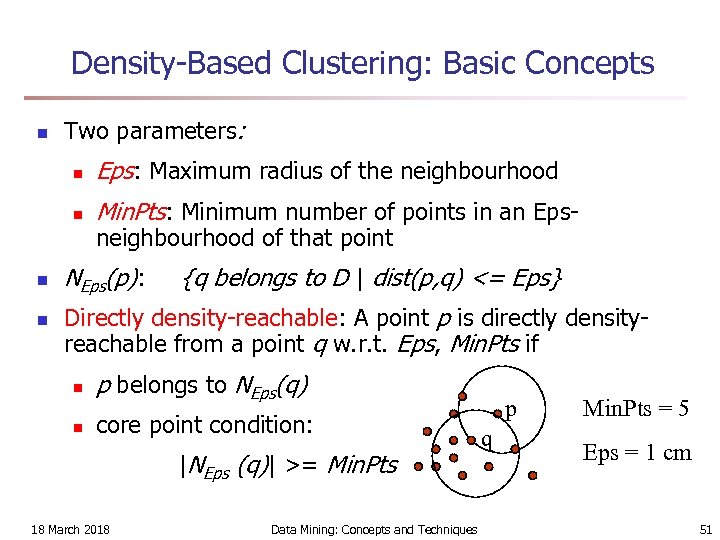 Density-Based Clustering: Basic Concepts n Two parameters: n n Eps: Maximum radius of the neighbourhood Min. Pts: Minimum number of points in an Epsneighbourhood of that point NEps(p): {q belongs to D | dist(p, q) <= Eps} Directly density-reachable: A point p is directly densityreachable from a point q w. r. t. Eps, Min. Pts if n p belongs to NEps(q) n core point condition: |NEps (q)| >= Min. Pts 18 March 2018 Data Mining: Concepts and Techniques p q Min. Pts = 5 Eps = 1 cm 51
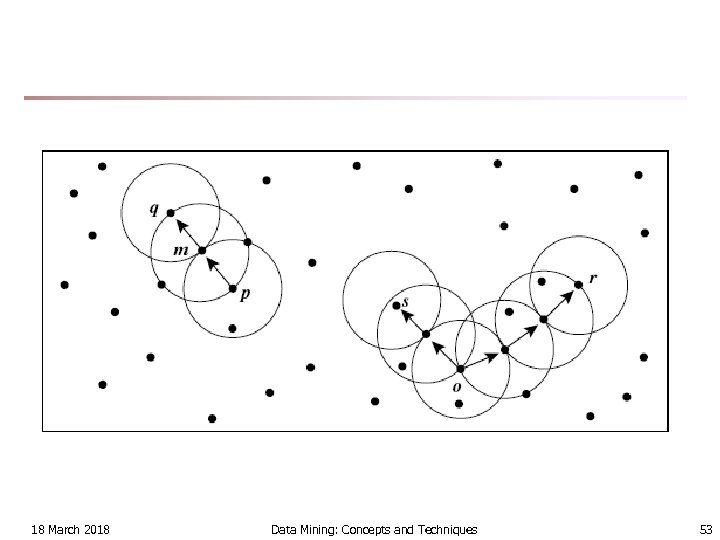
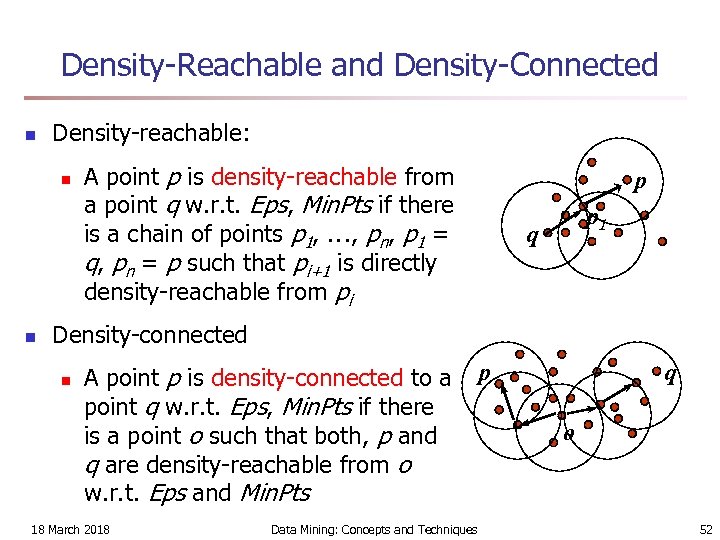 Density-Reachable and Density-Connected n Density-reachable: n n A point p is density-reachable from a point q w. r. t. Eps, Min. Pts if there is a chain of points p 1, …, pn, p 1 = q, pn = p such that pi+1 is directly density-reachable from pi p p 1 q Density-connected n A point p is density-connected to a point q w. r. t. Eps, Min. Pts if there is a point o such that both, p and q are density-reachable from o w. r. t. Eps and Min. Pts 18 March 2018 Data Mining: Concepts and Techniques p q o 52
 18 March 2018 Data Mining: Concepts and Techniques 53
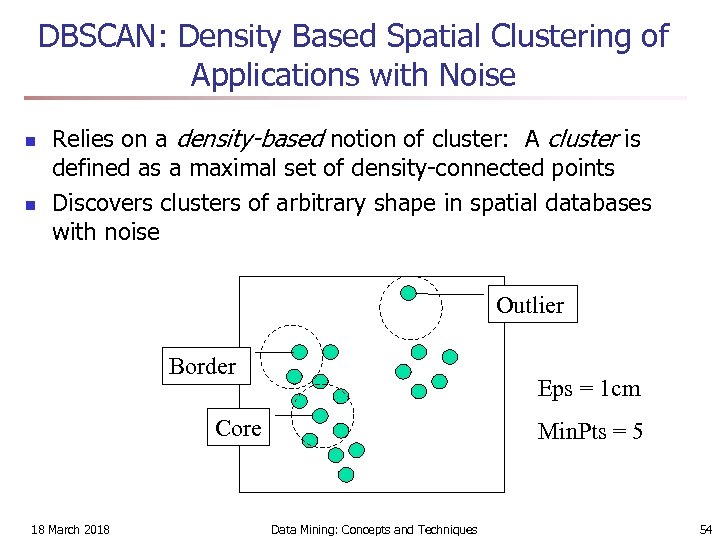 DBSCAN: Density Based Spatial Clustering of Applications with Noise n n Relies on a density-based notion of cluster: A cluster is defined as a maximal set of density-connected points Discovers clusters of arbitrary shape in spatial databases with noise Outlier Border Eps = 1 cm Core 18 March 2018 Min. Pts = 5 Data Mining: Concepts and Techniques 54
 DBSCAN: The Algorithm n n n Arbitrary select a point p Retrieve all points density-reachable from p w. r. t. Eps and Min. Pts. If p is a core point, a cluster is formed. If p is a border point, no points are density-reachable from p and DBSCAN visits the next point of the database. Continue the process until all of the points have been processed. 18 March 2018 Data Mining: Concepts and Techniques 55