 Скачать презентацию Data Mining Business Planning of Engineering Research Projects Presentation 2
9aa69f67a25fbad567e2181ac9648ba7.ppt
- Количество слайдов: 30



Data Mining&Business Planning of Engineering/Research Projects Presentation 2 Dr. Gábor Pauler, Associate Professor Faculty of Sciences, University of Pécs Tel: 30/9015 -488 E-mail: pauler@t-online. hu
Content of the Presentation Role of Marketing in Business Planning: What is NOT Marketing? Then, what is Marketing? Why it is important for you? Tipical marketing failures of small enterprises: How to avoid? Stages of development of Marketing Orientation Marketing Mix (4 P): What we should sell? P 1 Product: Principle 1: Product Differentiation Principle 2: Product Diversification Principle 3: Core Competence Team game 1: Toothpick Where and when to sell? P 2 Place/Distribution channel: Levels INCOTERMS Width For Whom to sell/Why he/she should buy? P 3 Promotion: Principle 1: Discovering target market with Market Research Survey variables Market Segmentation Principle 2: Send messages to generate sales Content Design Unique Selling Position Rational/ Emotional/ Moral arguments Team game 2: Parking company Format design: Promotion Mix PS: Personal Selling AD: Advertisements SP: Sales Promotion PR: Public Relations References
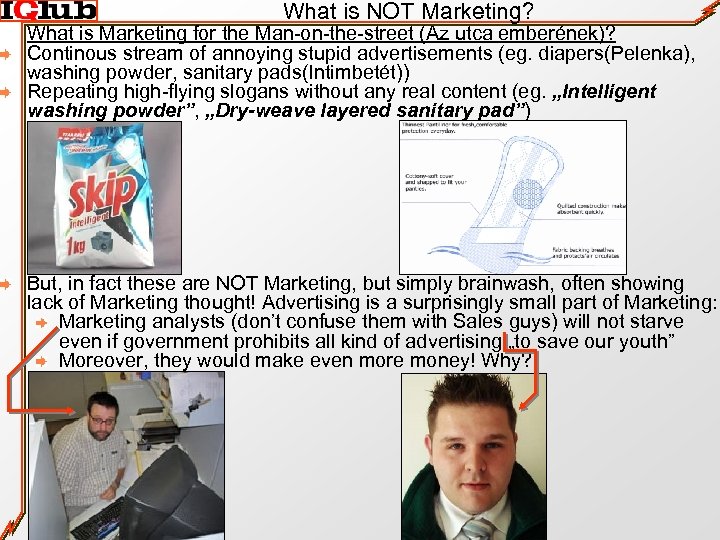
What is NOT Marketing? What is Marketing for the Man-on-the-street (Az utca emberének)? Continous stream of annoying stupid advertisements (eg. diapers(Pelenka), washing powder, sanitary pads(Intimbetét)) Repeating high-flying slogans without any real content (eg. „Intelligent washing powder”, „Dry-weave layered sanitary pad”) But, in fact these are NOT Marketing, but simply brainwash, often showing lack of Marketing thought! Advertising is a surprisingly small part of Marketing: Marketing analysts (don’t confuse them with Sales guys) will not starve even if government prohibits all kind of advertising „to save our youth” Moreover, they would make even more money! Why?
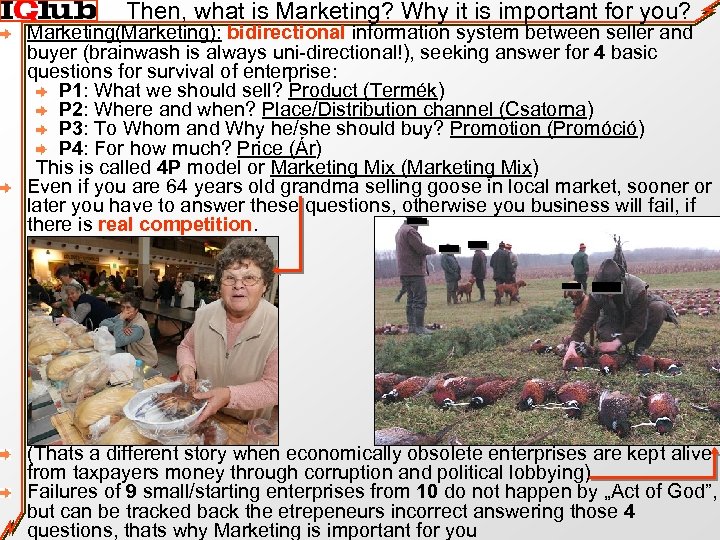
Then, what is Marketing? Why it is important for you? Marketing(Marketing): bidirectional information system between seller and buyer (brainwash is always uni-directional!), seeking answer for 4 basic questions for survival of enterprise: P 1: What we should sell? Product (Termék) P 2: Where and when? Place/Distribution channel (Csatorna) P 3: To Whom and Why he/she should buy? Promotion (Promóció) P 4: For how much? Price (Ár) This is called 4 P model or Marketing Mix (Marketing Mix) Even if you are 64 years old grandma selling goose in local market, sooner or later you have to answer these questions, otherwise you business will fail, if there is real competition. (Thats a different story when economically obsolete enterprises are kept alive from taxpayers money through corruption and political lobbying) Failures of 9 small/starting enterprises from 10 do not happen by „Act of God”, but can be tracked back the etrepeneurs incorrect answering those 4 questions, thats why Marketing is important for you
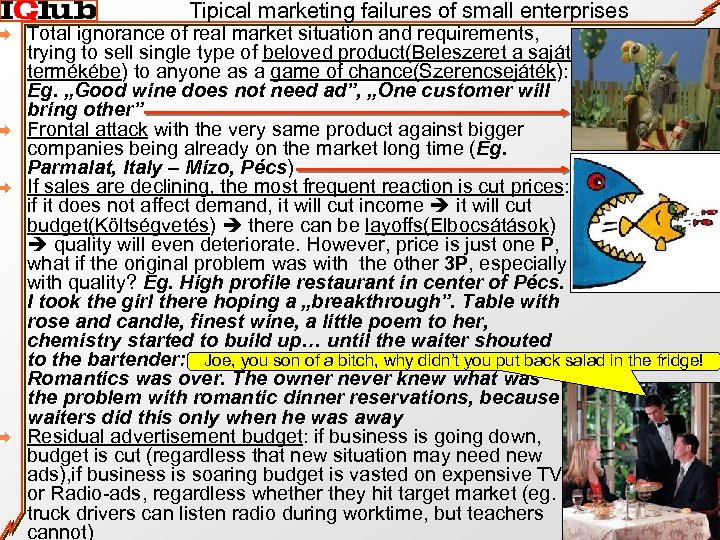
Tipical marketing failures of small enterprises Total ignorance of real market situation and requirements, trying to sell single type of beloved product(Beleszeret a saját termékébe) to anyone as a game of chance(Szerencsejáték): Eg. „Good wine does not need ad”, „One customer will bring other” Frontal attack with the very same product against bigger companies being already on the market long time (Eg. Parmalat, Italy – Mizo, Pécs) If sales are declining, the most frequent reaction is cut prices: if it does not affect demand, it will cut income it will cut budget(Költségvetés) there can be layoffs(Elbocsátások) quality will even deteriorate. However, price is just one P, what if the original problem was with the other 3 P, especially with quality? Eg. High profile restaurant in center of Pécs. I took the girl there hoping a „breakthrough”. Table with rose and candle, finest wine, a little poem to her, chemistry started to build up… until the waiter shouted to the bartender: Joe, you son of a bitch, why didn’t you put back salad in the fridge! Romantics was over. The owner never knew what was the problem with romantic dinner reservations, because waiters did this only when he was away Residual advertisement budget: if business is going down, budget is cut (regardless that new situation may need new ads), if business is soaring budget is vasted on expensive TV or Radio-ads, regardless whether they hit target market (eg. truck drivers can listen radio during worktime, but teachers cannot)
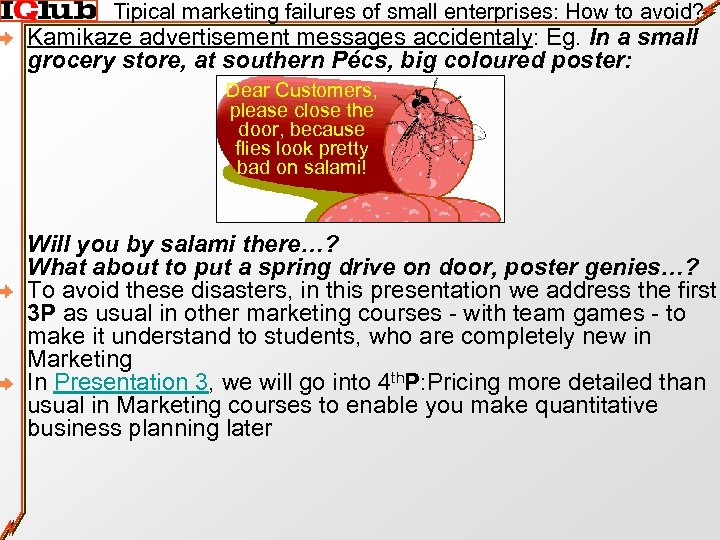
Tipical marketing failures of small enterprises: How to avoid? Kamikaze advertisement messages accidentaly: Eg. In a small grocery store, at southern Pécs, big coloured poster: Dear Customers, please close the door, because flies look pretty bad on salami! Will you by salami there…? What about to put a spring drive on door, poster genies…? To avoid these disasters, in this presentation we address the first 3 P as usual in other marketing courses - with team games - to make it understand to students, who are completely new in Marketing In Presentation 3, we will go into 4 th. P: Pricing more detailed than usual in Marketing courses to enable you make quantitative business planning later
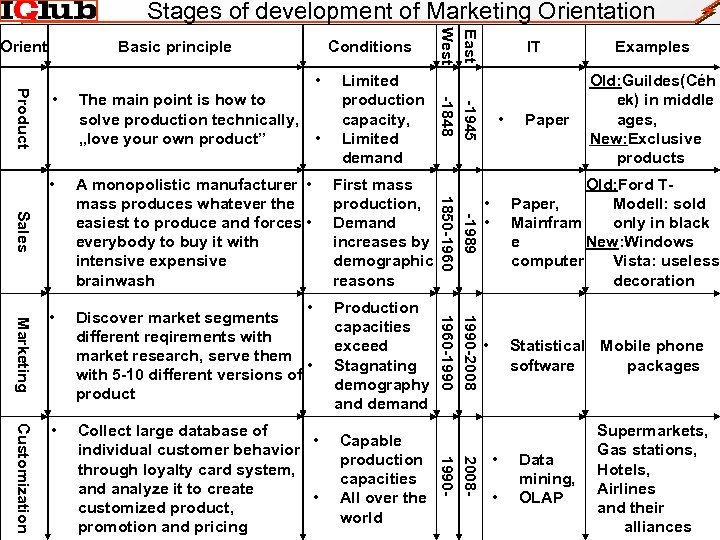
Stages of development of Marketing Orientation Basic principle Conditions • Marketing • Discover market segments different reqirements with market research, serve them • with 5 -10 different versions of product Production capacities exceed Stagnating demography and demand Collect large database of • individual customer behavior through loyalty card system, and analyze it to create • customized product, promotion and pricing Capable production capacities All over the world 2008 - 1990 - Customization • First mass production, Demand increases by demographic reasons 1990 -2008 1960 -1990 Sales • A monopolistic manufacturer • mass produces whatever the easiest to produce and forces • everybody to buy it with intensive expensive brainwash -1989 1850 -1960 • The main point is how to solve production technically, „love your own product” • Limited production capacity, Limited demand IT -1945 -1848 Product • East West Orient • Paper Examples Old: Guildes(Céh ek) in middle ages, New: Exclusive products Old: Ford TModell: sold Paper, Mainfram only in black e New: Windows computer Vista: useless decoration • • • Statistical Mobile phone software packages • • Data mining, OLAP Supermarkets, Gas stations, Hotels, Airlines and their alliances
Content of the Presentation Role of Marketing in Business Planning: What is NOT Marketing? Then, what is Marketing? Why it is important for you? Tipical marketing failures of small enterprises: How to avoid? Stages of development of Marketing Orientation Marketing Mix (4 P): What we should sell? P 1 Product: Principle 1: Product Differentiation Principle 2: Product Diversification Principle 3: Core Competence Team game 1: Toothpick Where and when to sell? P 2 Place/Distribution channel: Levels INCOTERMS Width For Whom to sell/Why he/she should buy? P 3 Promotion: Principle 1: Discovering target market with Market Research Survey variables Market Segmentation Principle 2: Send messages to generate sales Content Design Unique Selling Position Rational/ Emotional/ Moral arguments Team game 2: Parking company Format design: Promotion Mix PS: Personal Selling AD: Advertisements SP: Sales Promotion PR: Public Relations References
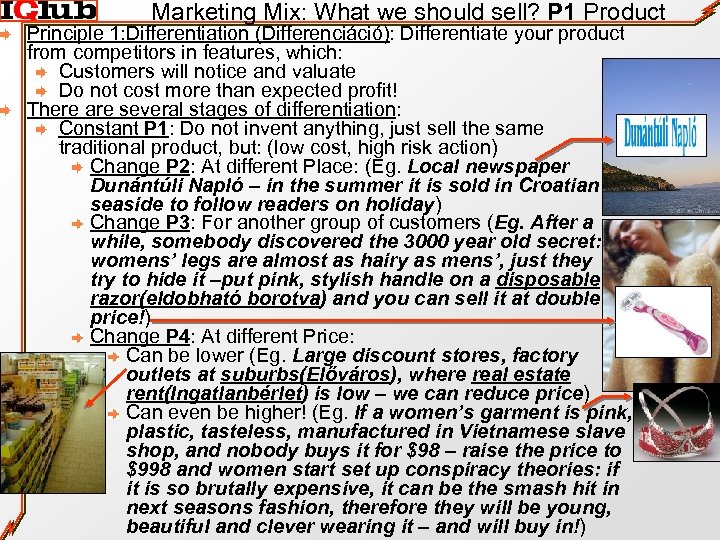
Marketing Mix: What we should sell? P 1 Product Principle 1: Differentiation (Differenciáció): Differentiate your product from competitors in features, which: Customers will notice and valuate Do not cost more than expected profit! There are several stages of differentiation: Constant P 1: Do not invent anything, just sell the same traditional product, but: (low cost, high risk action) Change P 2: At different Place: (Eg. Local newspaper Dunántúli Napló – in the summer it is sold in Croatian seaside to follow readers on holiday) Change P 3: For another group of customers (Eg. After a while, somebody discovered the 3000 year old secret: womens’ legs are almost as hairy as mens’, just they try to hide it –put pink, stylish handle on a disposable razor(eldobható borotva) and you can sell it at double price!) Change P 4: At different Price: Can be lower (Eg. Large discount stores, factory outlets at suburbs(Előváros), where real estate rent(Ingatlanbérlet) is low – we can reduce price) Can even be higher! (Eg. If a women’s garment is pink, plastic, tasteless, manufactured in Vietnamese slave shop, and nobody buys it for $98 – raise the price to $998 and women start set up conspiracy theories: if it is so brutally expensive, it can be the smash hit in next seasons fashion, therefore they will be young, beautiful and clever wearing it – and will buy in!)
P 1 Product: Differentiation Strategies 1 Re-pack and decorate the product with the same content (medium cost, high risk) Eg. Washing powders – every next one is more intelligent than the least one but basically they are the same since 100 years Eg. Windows – it spectacularly grows in outlook and resource consumption, but some times performs basic function even worse Functional improvement of an existing product (big cost, high risk) Eg. Dust bag vacum cleaner Water screen filter vacum cleaner Cost of high tech innovation is tremendous, but it is risky wheteher customers will value it: what if someone has no allergy? Invent new creative product on unsatisfied demand: (medium cost, but can generate high profit Thats why it is for you!) Eg. Instead of cab(Taxi) – call rentable party driver for your own car: cheaper than cab and you can drink Eg. Internet matcmaking(Társkeresés) – lot of contacts fast but still privacy can be preserved for a while Create new demand with an innovative ide and satisfy it: (medium cost, but can generate high profit Thats why it is for you!) Eg. Plain telephone ringtone for 100 years customized ringtones helping to express youngsters „their revolt against adults society” Do not just sell a product or service, but a lifestyle, social prestige, sense of belonging to the elite (high cost, but tremendous profit) Eg. Luxury items: Ferrari, Rolls-Royce, Rolex, Hunting – the are not a usable product, but a compulsory symbol in elite to express membership Eg. Beauty industry: They do not sell a liquid distilled from monkeys urine: they sell women the promise of „blonde prince coming for you on white horse”
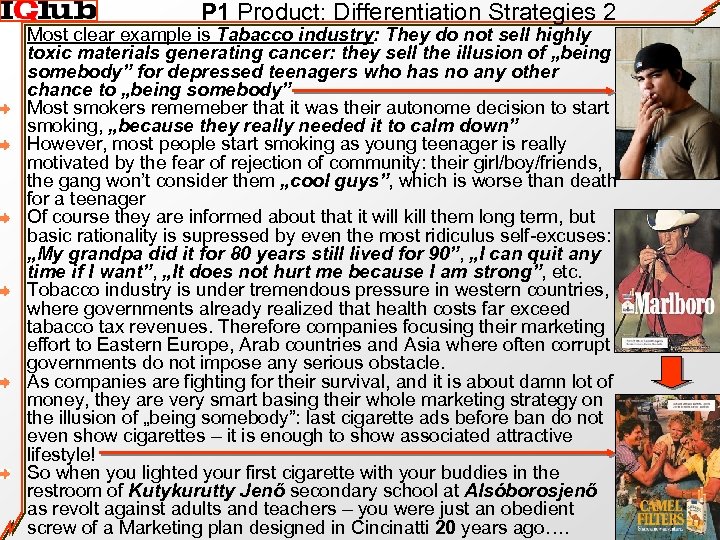
P 1 Product: Differentiation Strategies 2 Most clear example is Tabacco industry: They do not sell highly toxic materials generating cancer: they sell the illusion of „being somebody” for depressed teenagers who has no any other chance to „being somebody” Most smokers rememeber that it was their autonome decision to start smoking, „because they really needed it to calm down” However, most people start smoking as young teenager is really motivated by the fear of rejection of community: their girl/boy/friends, the gang won’t consider them „cool guys”, which is worse than death for a teenager Of course they are informed about that it will kill them long term, but basic rationality is supressed by even the most ridiculus self-excuses: „My grandpa did it for 80 years still lived for 90”, „I can quit any time if I want”, „It does not hurt me because I am strong”, etc. Tobacco industry is under tremendous pressure in western countries, where governments already realized that health costs far exceed tabacco tax revenues. Therefore companies focusing their marketing effort to Eastern Europe, Arab countries and Asia where often corrupt governments do not impose any serious obstacle. As companies are fighting for their survival, and it is about damn lot of money, they are very smart basing their whole marketing strategy on the illusion of „being somebody”: last cigarette ads before ban do not even show cigarettes – it is enough to show associated attractive lifestyle! So when you lighted your first cigarette with your buddies in the restroom of Kutykurutty Jenő secondary school at Alsóborosjenő as revolt against adults and teachers – you were just an obedient screw of a Marketing plan designed in Cincinatti 20 years ago….
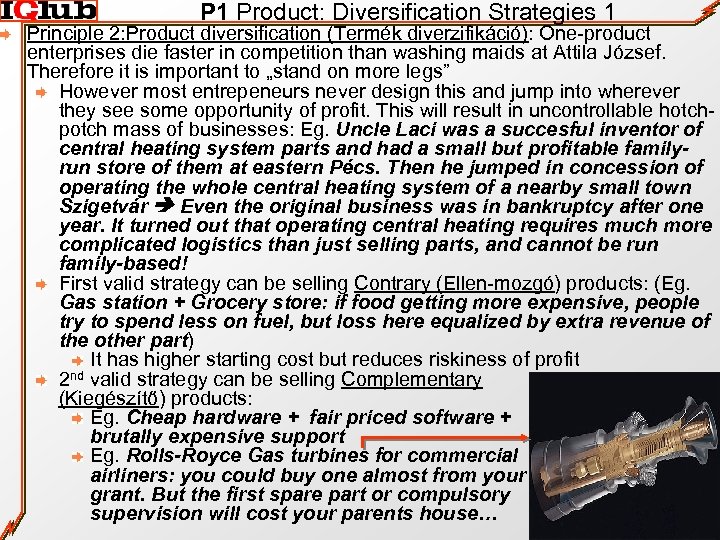
P 1 Product: Diversification Strategies 1 Principle 2: Product diversification (Termék diverzifikáció): One-product enterprises die faster in competition than washing maids at Attila József. Therefore it is important to „stand on more legs” However most entrepeneurs never design this and jump into wherever they see some opportunity of profit. This will result in uncontrollable hotchpotch mass of businesses: Eg. Uncle Laci was a succesful inventor of central heating system parts and had a small but profitable familyrun store of them at eastern Pécs. Then he jumped in concession of operating the whole central heating system of a nearby small town Szigetvár Even the original business was in bankruptcy after one year. It turned out that operating central heating requires much more complicated logistics than just selling parts, and cannot be run family-based! First valid strategy can be selling Contrary (Ellen-mozgó) products: (Eg. Gas station + Grocery store: if food getting more expensive, people try to spend less on fuel, but loss here equalized by extra revenue of the other part) It has higher starting cost but reduces riskiness of profit nd valid strategy can be selling Complementary 2 (Kiegészítő) products: Eg. Cheap hardware + fair priced software + brutally expensive support Eg. Rolls-Royce Gas turbines for commercial airliners: you could buy one almost from your grant. But the first spare part or compulsory supervision will cost your parents house…
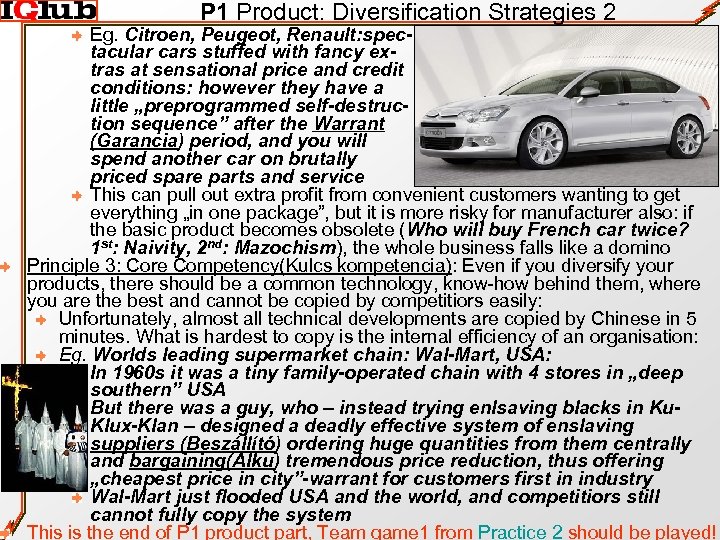
P 1 Product: Diversification Strategies 2 Eg. Citroen, Peugeot, Renault: spectacular cars stuffed with fancy extras at sensational price and credit conditions: however they have a little „preprogrammed self-destruction sequence” after the Warrant (Garancia) period, and you will spend another car on brutally priced spare parts and service This can pull out extra profit from convenient customers wanting to get everything „in one package”, but it is more risky for manufacturer also: if the basic product becomes obsolete (Who will buy French car twice? 1 st: Naivity, 2 nd: Mazochism), the whole business falls like a domino Principle 3: Core Competency(Kulcs kompetencia): Even if you diversify your products, there should be a common technology, know-how behind them, where you are the best and cannot be copied by competitiors easily: Unfortunately, almost all technical developments are copied by Chinese in 5 minutes. What is hardest to copy is the internal efficiency of an organisation: Eg. Worlds leading supermarket chain: Wal-Mart, USA: In 1960 s it was a tiny family-operated chain with 4 stores in „deep southern” USA But there was a guy, who – instead trying enlsaving blacks in Ku. Klux-Klan – designed a deadly effective system of enslaving suppliers (Beszállító) ordering huge quantities from them centrally and bargaining(Alku) tremendous price reduction, thus offering „cheapest price in city”-warrant for customers first in industry Wal-Mart just flooded USA and the world, and competitiors still cannot fully copy the system This is the end of P 1 product part, Team game 1 from Practice 2 should be played!
Content of the Presentation Role of Marketing in Business Planning: What is NOT Marketing? Then, what is Marketing? Why it is important for you? Tipical marketing failures of small enterprises: How to avoid? Stages of development of Marketing Orientation Marketing Mix (4 P): What we should sell? P 1 Product: Principle 1: Product Differentiation Principle 2: Product Diversification Principle 3: Core Competence Team game 1: Toothpick Where and when to sell? P 2 Place/Distribution channel: Levels INCOTERMS Width For Whom to sell/Why he/she should buy? P 3 Promotion: Principle 1: Discovering target market with Market Research Survey variables Market Segmentation Principle 2: Send messages to generate sales Content Design Unique Selling Position Rational/ Emotional/ Moral arguments Team game 2: Parking company Format design: Promotion Mix PS: Personal Selling AD: Advertisements SP: Sales Promotion PR: Public Relations References
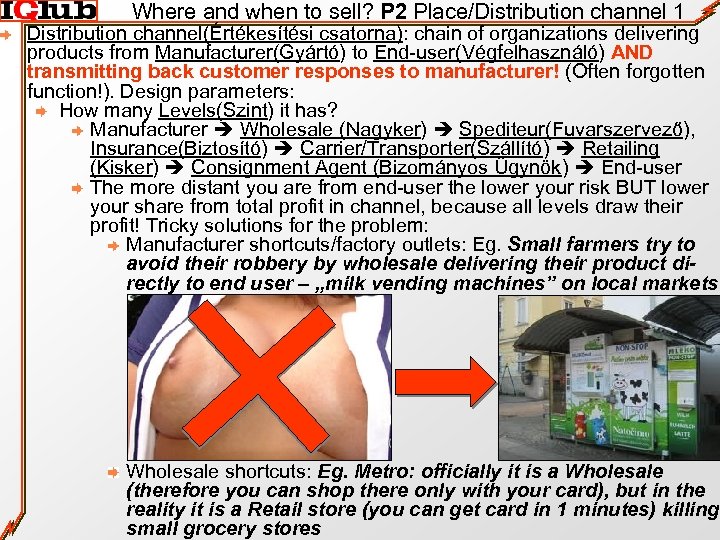
Where and when to sell? P 2 Place/Distribution channel 1 Distribution channel(Értékesítési csatorna): chain of organizations delivering products from Manufacturer(Gyártó) to End-user(Végfelhasználó) AND transmitting back customer responses to manufacturer! (Often forgotten function!). Design parameters: How many Levels(Szint) it has? Manufacturer Wholesale (Nagyker) Spediteur(Fuvarszervező), Insurance(Biztosító) Carrier/Transporter(Szállító) Retailing (Kisker) Consignment Agent (Bizományos Ügynök) End-user The more distant you are from end-user the lower your risk BUT lower your share from total profit in channel, because all levels draw their profit! Tricky solutions for the problem: Manufacturer shortcuts/factory outlets: Eg. Small farmers try to avoid their robbery by wholesale delivering their product directly to end user – „milk vending machines” on local markets Wholesale shortcuts: Eg. Metro: officially it is a Wholesale (therefore you can shop there only with your card), but in the reality it is a Retail store (you can get card in 1 minutes) killing small grocery stores
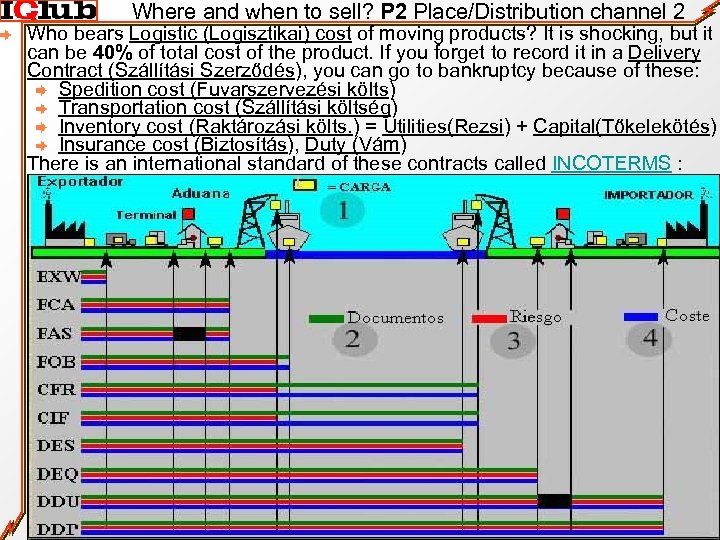
Where and when to sell? P 2 Place/Distribution channel 2 Who bears Logistic (Logisztikai) cost of moving products? It is shocking, but it can be 40% of total cost of the product. If you forget to record it in a Delivery Contract (Szállítási Szerződés), you can go to bankruptcy because of these: Spedition cost (Fuvarszervezési költs) Transportation cost (Szállítási költség) Inventory cost (Raktározási költs. ) = Utilities(Rezsi) + Capital(Tőkelekötés) Insurance cost (Biztosítás), Duty (Vám) There is an international standard of these contracts called INCOTERMS :
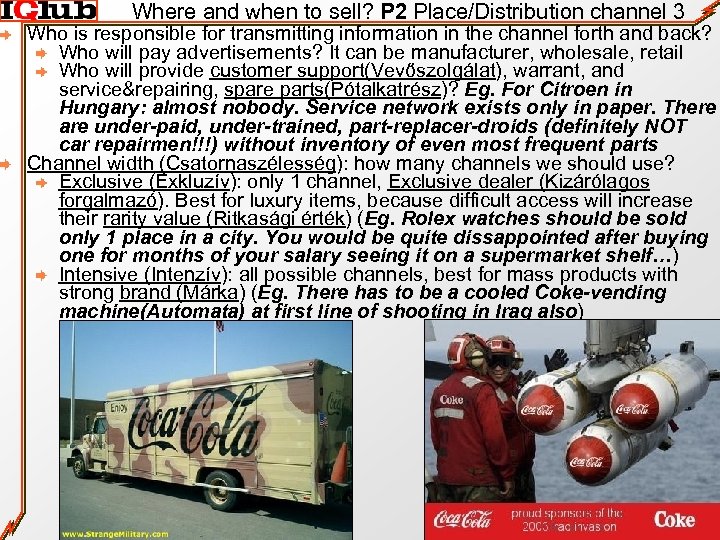
Where and when to sell? P 2 Place/Distribution channel 3 Who is responsible for transmitting information in the channel forth and back? Who will pay advertisements? It can be manufacturer, wholesale, retail Who will provide customer support(Vevőszolgálat), warrant, and service&repairing, spare parts(Pótalkatrész)? Eg. For Citroen in Hungary: almost nobody. Service network exists only in paper. There are under-paid, under-trained, part-replacer-droids (definitely NOT car repairmen!!!) without inventory of even most frequent parts Channel width (Csatornaszélesség): how many channels we should use? Exclusive (Exkluzív): only 1 channel, Exclusive dealer (Kizárólagos forgalmazó). Best for luxury items, because difficult access will increase their rarity value (Ritkasági érték) (Eg. Rolex watches should be sold only 1 place in a city. You would be quite dissappointed after buying one for months of your salary seeing it on a supermarket shelf…) Intensive (Intenzív): all possible channels, best for mass products with strong brand (Márka) (Eg. There has to be a cooled Coke-vending machine(Automata) at first line of shooting in Iraq also)
Content of the Presentation Role of Marketing in Business Planning: What is NOT Marketing? Then, what is Marketing? Why it is important for you? Tipical marketing failures of small enterprises: How to avoid? Stages of development of Marketing Orientation Marketing Mix (4 P): What we should sell? P 1 Product: Principle 1: Product Differentiation Principle 2: Product Diversification Principle 3: Core Competence Team game 1: Toothpick Where and when to sell? P 2 Place/Distribution channel: Levels INCOTERMS Width For Whom to sell/Why he/she should buy? P 3 Promotion: Principle 1: Discovering target market with Market Research Survey variables Market Segmentation Principle 2: Send messages to generate sales Content Design Unique Selling Position Rational/ Emotional/ Moral arguments Team game 2: Parking company Format design: Promotion Mix PS: Personal Selling AD: Advertisements SP: Sales Promotion PR: Public Relations References
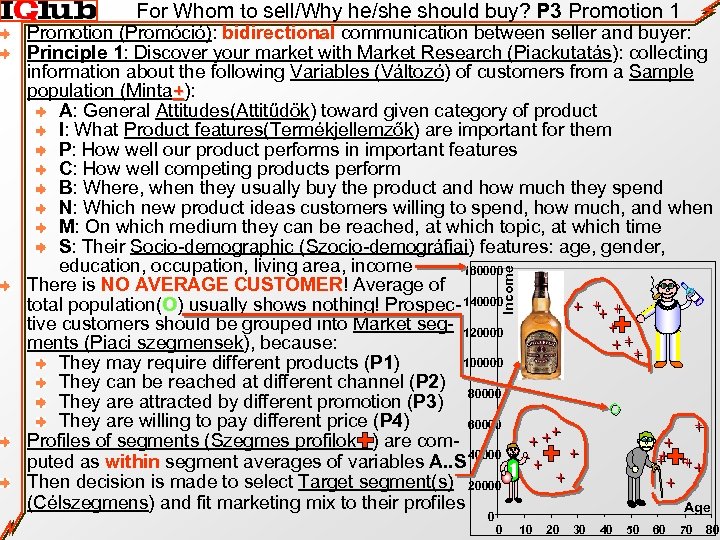
For Whom to sell/Why he/she should buy? P 3 Promotion 1 Income Promotion (Promóció): bidirectional communication between seller and buyer: Principle 1: Discover your market with Market Research (Piackutatás): collecting information about the following Variables (Változó) of customers from a Sample population (Minta+): A: General Attitudes(Attitűdök) toward given category of product I: What Product features(Termékjellemzők) are important for them P: How well our product performs in important features C: How well competing products perform B: Where, when they usually buy the product and how much they spend N: Which new product ideas customers willing to spend, how much, and when M: On which medium they can be reached, at which topic, at which time S: Their Socio-demographic (Szocio-demográfiai) features: age, gender, education, occupation, living area, income 160000 There is NO AVERAGE CUSTOMER! Average of total population(O) usually shows nothing! Prospec- 140000 tive customers should be grouped into Market seg- 120000 ments (Piaci szegmensek), because: 100000 They may require different products (P 1) They can be reached at different channel (P 2) 80000 They are attracted by different promotion (P 3) They are willing to pay different price (P 4) 60000 Profiles of segments (Szegmes profilok ) are computed as within segment averages of variables A. . S 40000 1 Then decision is made to select Target segment(s) 20000 (Célszegmens) and fit marketing mix to their profiles Age 0 0 10 20 30 40 50 60 70 80
For Whom to sell/Why he/she should buy? P 3 Promotion 2 Grouping should be based on variables I: (product feature preferences), or S: (socio-demographics), not on P: (satisfaction with us)! It is one very serious mistake frequently made by small entrepeneurs that „they like costumers only who like them”. Business is not an emotional love affair with your customers: an actually bad customer can be a very profitable customer if we present the right supply (Kínálat). Whoever ignores segmenting the market, and just tries to sell the same product for anybody, will find free market and real competition unpredictable and dangerous, and goes down very quickly! Principle 2: Send messages (Üzenet) to customers, which motivate them to buy from you: Content design (Tartalmi tervezés) of messages: It should contain Unique Selling Position, USP (Egyedi eladási pozíció): Why we are better than competition? Rational argument (Racionális érvelés) based on product features (Eg. Procter&Gamble diaper ads. Its dry. Its true. But hell boring!) Emotional argument (Érzelmi érvelés): Positive, usually presented by a popular celebrity, sweet kids, sweet little dogs/kittens (Eg. Unilever: Libero diaper ads) Nostalgic (Eg. the new Mini, the new Fiat 500) Negative, frightening customers (Eg. in P&G: Head&Shoulders anti-dandruff shampoo) Moral argument (Morális érvelés): (Eg. Business Software Alliance) Play Team game 2 from Practice 2 here!
Content of the Presentation Role of Marketing in Business Planning: What is NOT Marketing? Then, what is Marketing? Why it is important for you? Tipical marketing failures of small enterprises: How to avoid? Stages of development of Marketing Orientation Marketing Mix (4 P): What we should sell? P 1 Product: Principle 1: Product Differentiation Principle 2: Product Diversification Principle 3: Core Competence Team game 1: Toothpick Where and when to sell? P 2 Place/Distribution channel: Levels INCOTERMS Width For Whom to sell/Why he/she should buy? P 3 Promotion: Principle 1: Discovering target market with Market Research Survey variables Market Segmentation Principle 2: Send messages to generate sales Content Design Unique Selling Position Rational/ Emotional/ Moral arguments Team game 2: Parking company Format design: Promotion Mix PS: Personal Selling AD: Advertisements SP: Sales Promotion PR: Public Relations References
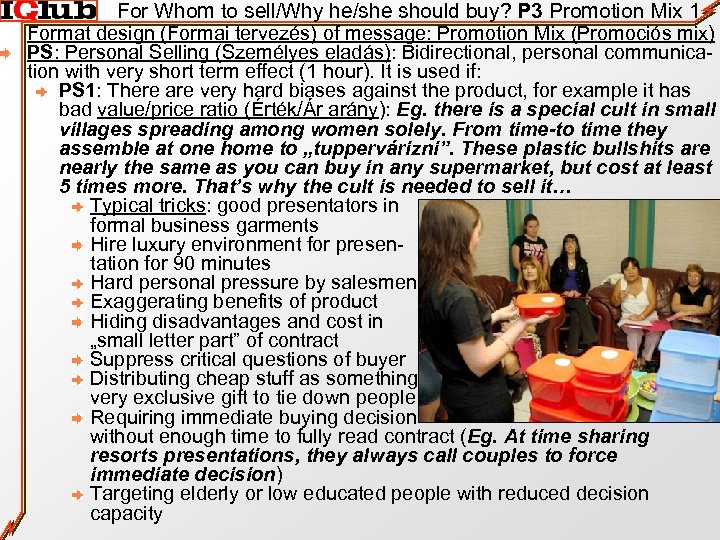
For Whom to sell/Why he/she should buy? P 3 Promotion Mix 1 Format design (Formai tervezés) of message: Promotion Mix (Promociós mix) PS: Personal Selling (Személyes eladás): Bidirectional, personal communication with very short term effect (1 hour). It is used if: PS 1: There are very hard biases against the product, for example it has bad value/price ratio (Érték/Ár arány): Eg. there is a special cult in small villages spreading among women solely. From time-to time they assemble at one home to „tuppervárizni”. These plastic bullshits are nearly the same as you can buy in any supermarket, but cost at least 5 times more. That’s why the cult is needed to sell it… Typical tricks: good presentators in formal business garments Hire luxury environment for presentation for 90 minutes Hard personal pressure by salesmen Exaggerating benefits of product Hiding disadvantages and cost in „small letter part” of contract Suppress critical questions of buyer Distributing cheap stuff as something very exclusive gift to tie down people Requiring immediate buying decision without enough time to fully read contract (Eg. At time sharing resorts presentations, they always call couples to force immediate decision) Targeting elderly or low educated people with reduced decision capacity
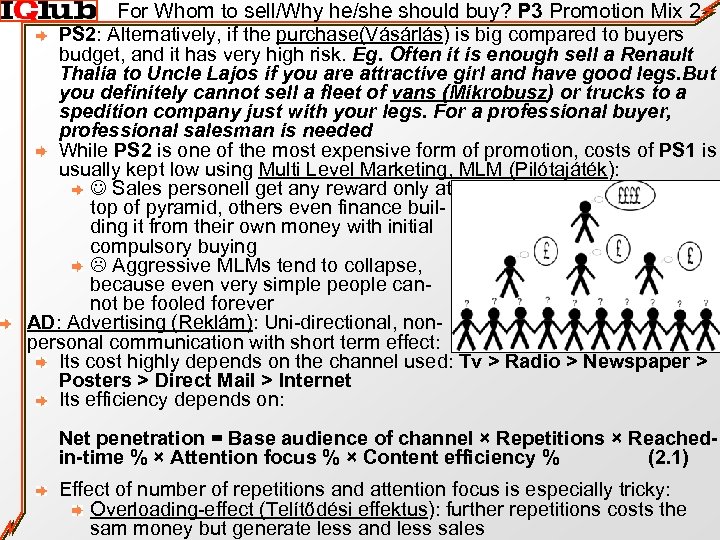
For Whom to sell/Why he/she should buy? P 3 Promotion Mix 2 PS 2: Alternatively, if the purchase(Vásárlás) is big compared to buyers budget, and it has very high risk. Eg. Often it is enough sell a Renault Thalia to Uncle Lajos if you are attractive girl and have good legs. But you definitely cannot sell a fleet of vans (Mikrobusz) or trucks to a spedition company just with your legs. For a professional buyer, professional salesman is needed While PS 2 is one of the most expensive form of promotion, costs of PS 1 is usually kept low using Multi Level Marketing, MLM (Pilótajáték): Sales personell get any reward only at top of pyramid, others even finance building it from their own money with initial compulsory buying Aggressive MLMs tend to collapse, because even very simple people cannot be fooled forever AD: Advertising (Reklám): Uni-directional, nonpersonal communication with short term effect: Its cost highly depends on the channel used: Tv > Radio > Newspaper > Posters > Direct Mail > Internet Its efficiency depends on: Net penetration = Base audience of channel × Repetitions × Reachedin-time % × Attention focus % × Content efficiency % (2. 1) Effect of number of repetitions and attention focus is especially tricky: Overloading-effect (Telítődési effektus): further repetitions costs the sam money but generate less and less sales
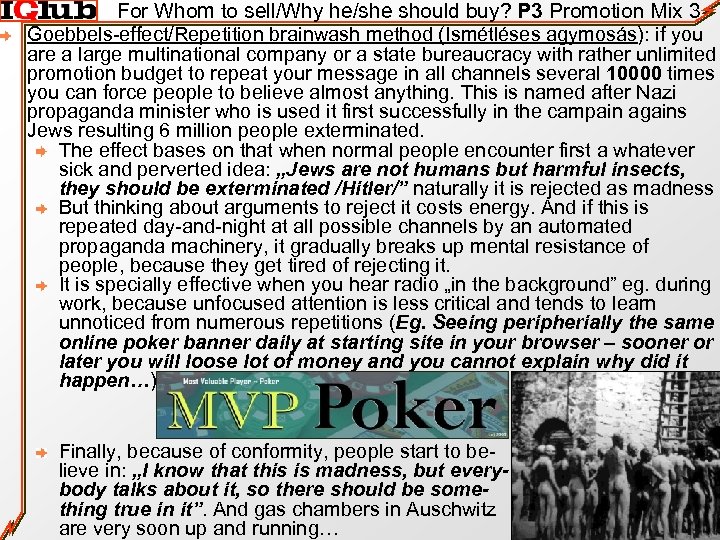
For Whom to sell/Why he/she should buy? P 3 Promotion Mix 3 Goebbels-effect/Repetition brainwash method (Ismétléses agymosás): if you are a large multinational company or a state bureaucracy with rather unlimited promotion budget to repeat your message in all channels several 10000 times you can force people to believe almost anything. This is named after Nazi propaganda minister who is used it first successfully in the campain agains Jews resulting 6 million people exterminated. The effect bases on that when normal people encounter first a whatever sick and perverted idea: „Jews are not humans but harmful insects, they should be exterminated /Hitler/” naturally it is rejected as madness But thinking about arguments to reject it costs energy. And if this is repeated day-and-night at all possible channels by an automated propaganda machinery, it gradually breaks up mental resistance of people, because they get tired of rejecting it. It is specially effective when you hear radio „in the background” eg. during work, because unfocused attention is less critical and tends to learn unnoticed from numerous repetitions (Eg. Seeing peripherially the same online poker banner daily at starting site in your browser – sooner or later you will loose lot of money and you cannot explain why did it happen…) Finally, because of conformity, people start to believe in: „I know that this is madness, but everybody talks about it, so there should be something true in it”. And gas chambers in Auschwitz are very soon up and running…
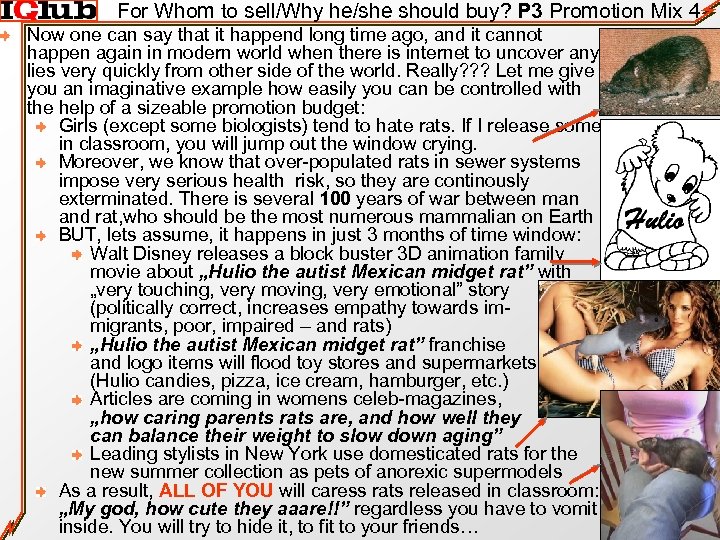
For Whom to sell/Why he/she should buy? P 3 Promotion Mix 4 Now one can say that it happend long time ago, and it cannot happen again in modern world when there is internet to uncover any lies very quickly from other side of the world. Really? ? ? Let me give you an imaginative example how easily you can be controlled with the help of a sizeable promotion budget: Girls (except some biologists) tend to hate rats. If I release some in classroom, you will jump out the window crying. Moreover, we know that over-populated rats in sewer systems impose very serious health risk, so they are continously exterminated. There is several 100 years of war between man and rat, who should be the most numerous mammalian on Earth BUT, lets assume, it happens in just 3 months of time window: Walt Disney releases a block buster 3 D animation family movie about „Hulio the autist Mexican midget rat” with „very touching, very moving, very emotional” story (politically correct, increases empathy towards immigrants, poor, impaired – and rats) „Hulio the autist Mexican midget rat” franchise and logo items will flood toy stores and supermarkets (Hulio candies, pizza, ice cream, hamburger, etc. ) Articles are coming in womens celeb-magazines, „how caring parents rats are, and how well they can balance their weight to slow down aging” Leading stylists in New York use domesticated rats for the new summer collection as pets of anorexic supermodels As a result, ALL OF YOU will caress rats released in classroom: „My god, how cute they aaare!!” regardless you have to vomit inside. You will try to hide it, to fit to your friends…
Content of the Presentation Role of Marketing in Business Planning: What is NOT Marketing? Then, what is Marketing? Why it is important for you? Tipical marketing failures of small enterprises: How to avoid? Stages of development of Marketing Orientation Marketing Mix (4 P): What we should sell? P 1 Product: Principle 1: Product Differentiation Principle 2: Product Diversification Principle 3: Core Competence Team game 1: Toothpick Where and when to sell? P 2 Place/Distribution channel: Levels INCOTERMS Width For Whom to sell/Why he/she should buy? P 3 Promotion: Principle 1: Discovering target market with Market Research Survey variables Market Segmentation Principle 2: Send messages to generate sales Content Design Unique Selling Position Rational/ Emotional/ Moral arguments Team game 2: Parking company Format design: Promotion Mix PS: Personal Selling AD: Advertisements SP: Sales Promotion PR: Public Relations References
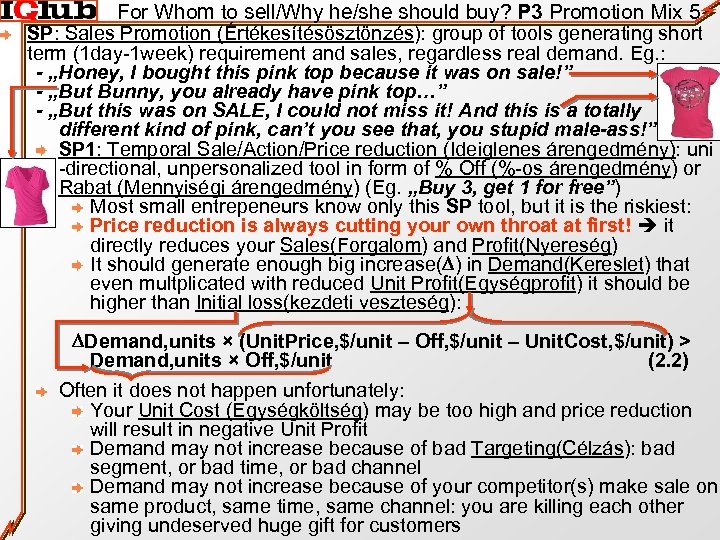
For Whom to sell/Why he/she should buy? P 3 Promotion Mix 5 SP: Sales Promotion (Értékesítésösztönzés): group of tools generating short term (1 day-1 week) requirement and sales, regardless real demand. Eg. : - „Honey, I bought this pink top because it was on sale!” - „But Bunny, you already have pink top…” - „But this was on SALE, I could not miss it! And this is a totally different kind of pink, can’t you see that, you stupid male-ass!” SP 1: Temporal Sale/Action/Price reduction (Ideiglenes árengedmény): uni -directional, unpersonalized tool in form of % Off (%-os árengedmény) or Rabat (Mennyiségi árengedmény) (Eg. „Buy 3, get 1 for free”) Most small entrepeneurs know only this SP tool, but it is the riskiest: Price reduction is always cutting your own throat at first! it directly reduces your Sales(Forgalom) and Profit(Nyereség) It should generate enough big increase(D) in Demand(Kereslet) that even multplicated with reduced Unit Profit(Egységprofit) it should be higher than Initial loss(kezdeti veszteség): DDemand, units × (Unit. Price, $/unit – Off, $/unit – Unit. Cost, $/unit) > Demand, units × Off, $/unit (2. 2) Often it does not happen unfortunately: Your Unit Cost (Egységköltség) may be too high and price reduction will result in negative Unit Profit Demand may not increase because of bad Targeting(Célzás): bad segment, or bad time, or bad channel Demand may not increase because of your competitor(s) make sale on same product, same time, same channel: you are killing each other giving undeserved huge gift for customers
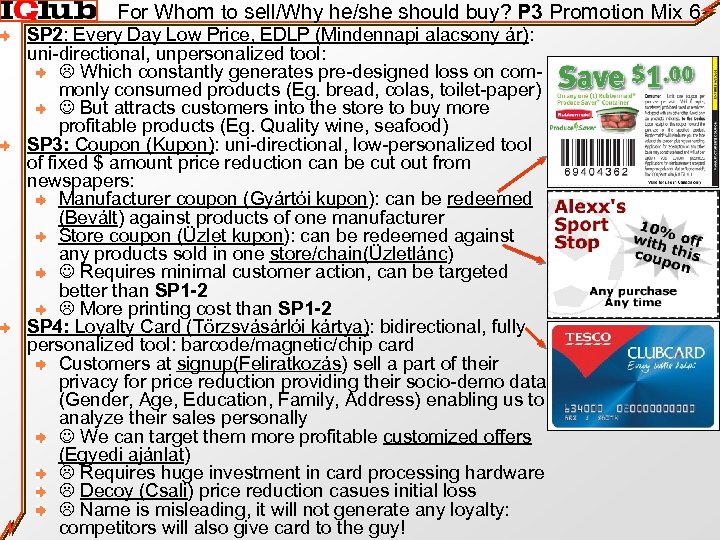
For Whom to sell/Why he/she should buy? P 3 Promotion Mix 6 SP 2: Every Day Low Price, EDLP (Mindennapi alacsony ár): uni-directional, unpersonalized tool: Which constantly generates pre-designed loss on commonly consumed products (Eg. bread, colas, toilet-paper) But attracts customers into the store to buy more profitable products (Eg. Quality wine, seafood) SP 3: Coupon (Kupon): uni-directional, low-personalized tool of fixed $ amount price reduction can be cut out from newspapers: Manufacturer coupon (Gyártói kupon): can be redeemed (Bevált) against products of one manufacturer Store coupon (Üzlet kupon): can be redeemed against any products sold in one store/chain(Üzletlánc) Requires minimal customer action, can be targeted better than SP 1 -2 More printing cost than SP 1 -2 SP 4: Loyalty Card (Törzsvásárlói kártya): bidirectional, fully personalized tool: barcode/magnetic/chip card Customers at signup(Feliratkozás) sell a part of their privacy for price reduction providing their socio-demo data (Gender, Age, Education, Family, Address) enabling us to analyze their sales personally We can target them more profitable customized offers (Egyedi ajánlat) Requires huge investment in card processing hardware Decoy (Csali) price reduction casues initial loss Name is misleading, it will not generate any loyalty: competitors will also give card to the guy!
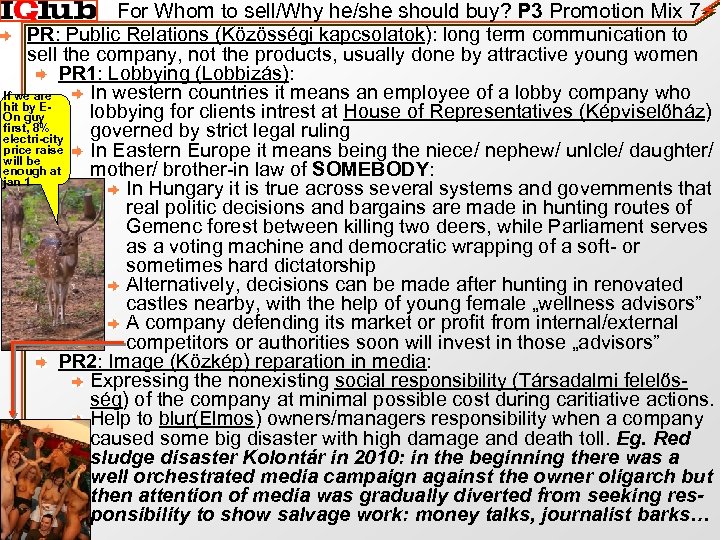
For Whom to sell/Why he/she should buy? P 3 Promotion Mix 7 PR: Public Relations (Közösségi kapcsolatok): long term communication to sell the company, not the products, usually done by attractive young women PR 1: Lobbying (Lobbizás): In western countries it means an employee of a lobby company who If we are hit by Elobbying for clients intrest at House of Representatives (Képviselőház) On guy first, 8% governed by strict legal ruling electri-city price raise In Eastern Europe it means being the niece/ nephew/ unlcle/ daughter/ will be enough at mother/ brother-in law of SOMEBODY: jan 1 In Hungary it is true across several systems and governments that real politic decisions and bargains are made in hunting routes of Gemenc forest between killing two deers, while Parliament serves as a voting machine and democratic wrapping of a soft- or sometimes hard dictatorship Alternatively, decisions can be made after hunting in renovated castles nearby, with the help of young female „wellness advisors” A company defending its market or profit from internal/external competitors or authorities soon will invest in those „advisors” PR 2: Image (Közkép) reparation in media: Expressing the nonexisting social responsibility (Társadalmi felelősség) of the company at minimal possible cost during caritiative actions. Help to blur(Elmos) owners/managers responsibility when a company caused some big disaster with high damage and death toll. Eg. Red sludge disaster Kolontár in 2010: in the beginning there was a well orchestrated media campaign against the owner oligarch but then attention of media was gradually diverted from seeking responsibility to show salvage work: money talks, journalist barks…
References Marketing mix: http: //www. quickmba. com/marketing/mix/ http: //www. freeworldacademy. com/newbizzadviser/fw 15. htm http: //www. netmba. com/marketing/mix/ Entrepeneur failures: http: //www. gaebler. com/The-Root-Cause-of-Failure-in. Entrepreneurship. htm http: //campusentrepreneurship. wordpress. com/2010/03/12/entrepreneurshi p-and-failure-50 -brilliant-failures/ Marketing orientation: http: //tutor 2 u. net/business/gcse/marketing_orientation. htm http: //www. nowsell. com/marketing-guide/marketing-orientation. html Product differentiation strategies: http: //www. ehow. com/way_5380009_product-differentiation-strategy. html http: //www. 1000 ventures. com/business_guide/differentiation_strategy. html Product diversification strategies: http: //www. ehow. com/way_5272073_product-diversification-strategy. html http: //www. enotes. com/management-encyclopedia/diversification-strategy INCOTERMS: http: //www. export 911. com/e 911/export/com. Term. htm http: //www. i-b-t. net/incoterms. html Useful links: http: //www. learnmarketing. net/ http: //marketing. lap. hu/
Скачать презентацию Data Mining Business Planning of Engineering Research Projects Presentation 2
9aa69f67a25fbad567e2181ac9648ba7.ppt