 Скачать презентацию Data Mining as a BI Tool Data Extraction
a626deab7d638097ba6c4a7a7a546b5b.ppt
- Количество слайдов: 15



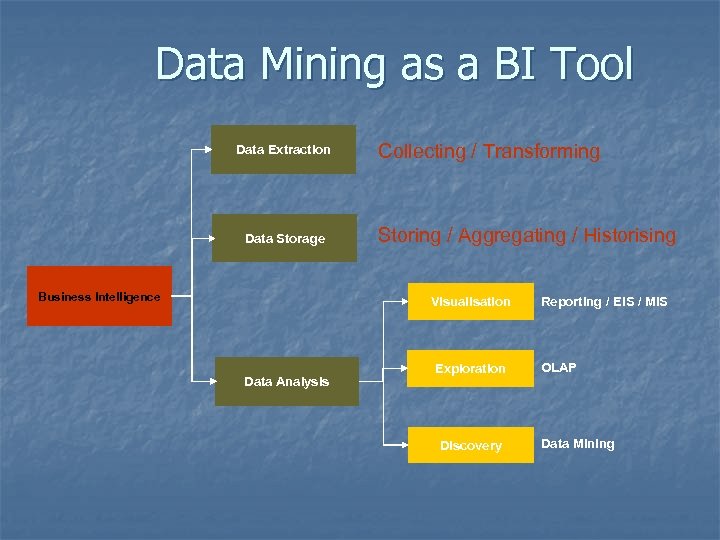
Data Mining as a BI Tool Data Extraction Data Storage Business Intelligence Collecting / Transforming Storing / Aggregating / Historising Visualisation Data Analysis Exploration Discovery Reporting / EIS / MIS OLAP Data Mining
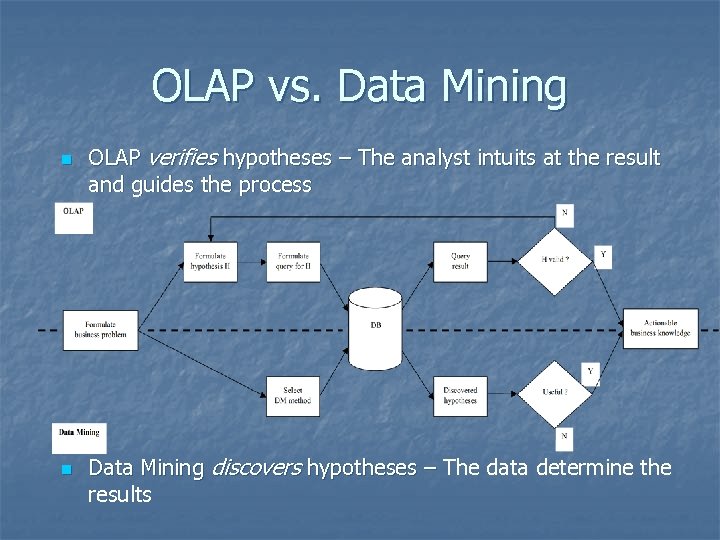
OLAP vs. Data Mining n n OLAP verifies hypotheses – The analyst intuits at the result and guides the process Data Mining discovers hypotheses – The data determine the hypotheses – results
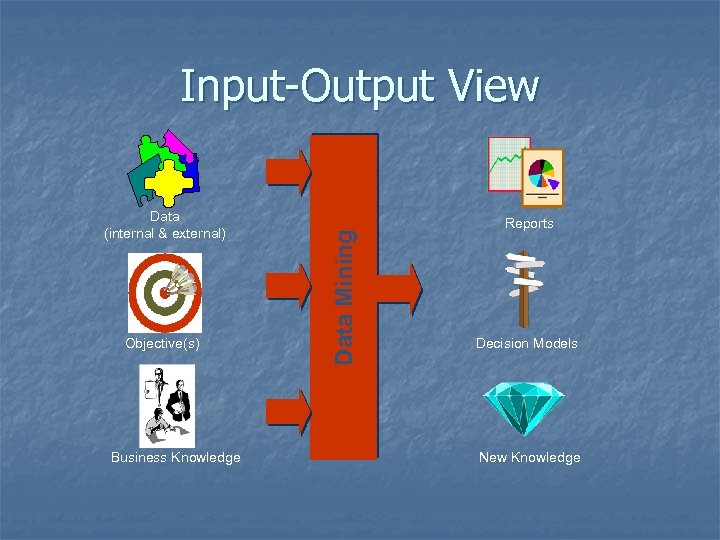
Data (internal & external) Objective(s) Business Knowledge Data Mining Input-Output View Reports Decision Models New Knowledge
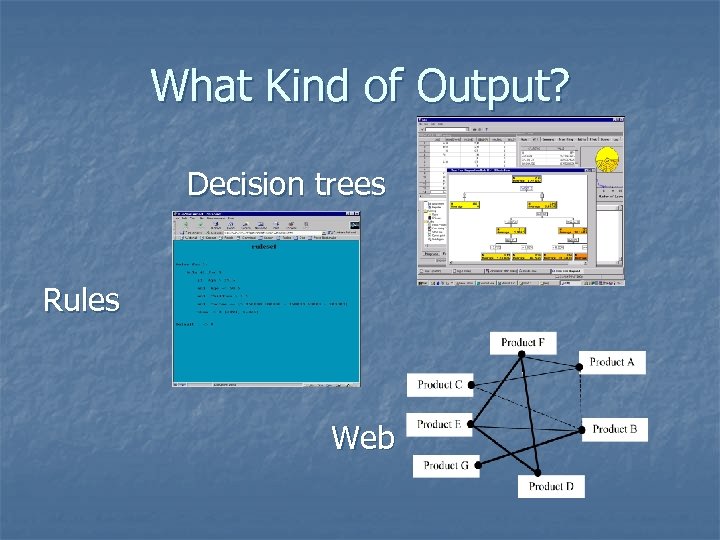
What Kind of Output? Decision trees Rules Web
Data Mining n Operationalization of Machine Learning, with two specific emphases Emphasis on process n Emphasis on action n
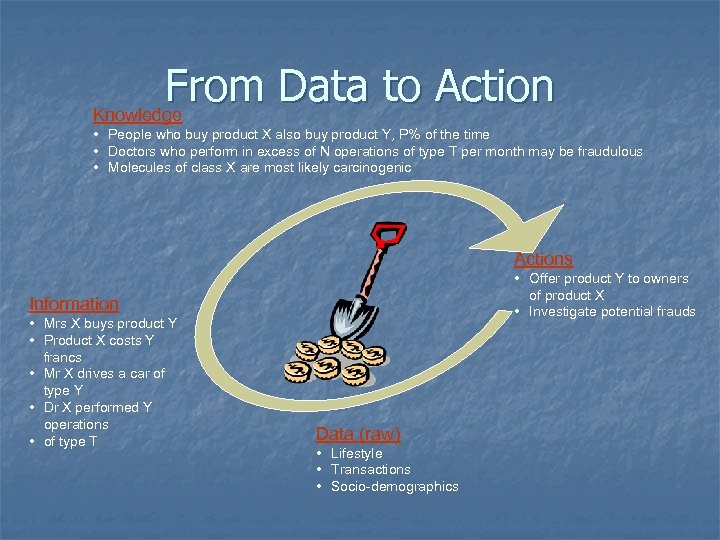
From Data to Action Knowledge • People who buy product X also buy product Y, P% of the time • Doctors who perform in excess of N operations of type T per month may be fraudulous • Molecules of class X are most likely carcinogenic Actions • Offer product Y to owners of product X • Investigate potential frauds Information • Mrs X buys product Y • Product X costs Y francs • Mr X drives a car of type Y • Dr X performed Y operations • of type T Data (raw) • Lifestyle • Transactions • Socio-demographics
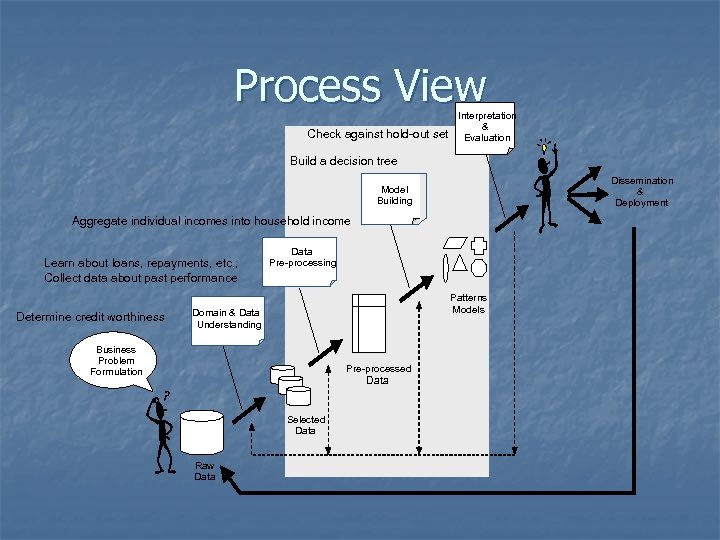
Process View Check against hold-out set Interpretation & Evaluation Build a decision tree Dissemination & Deployment Model Building Aggregate individual incomes into household income Learn about loans, repayments, etc. ; Collect data about past performance Determine credit worthiness Data Pre-processing Patterns Models Domain & Data Understanding Business Problem Formulation Pre-processed Data Selected Data Raw Data
Key Success Factors n n Have a clearly articulated business problem that needs to be solved and for which Data Mining is the adequate technology Ensure that the problem being pursued is supported by the right type of data of sufficient quality and in sufficient quantity Recognise that Data Mining is a process with many components and dependencies Plan to learn from the Data Mining process whatever the outcome
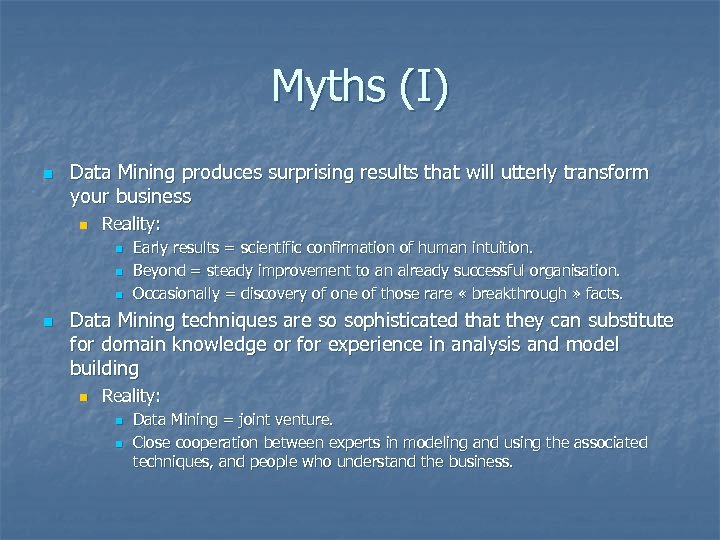
Myths (I) n Data Mining produces surprising results that will utterly transform your business n Reality: n n Early results = scientific confirmation of human intuition. Beyond = steady improvement to an already successful organisation. Occasionally = discovery of one of those rare « breakthrough » facts. Data Mining techniques are so sophisticated that they can substitute for domain knowledge or for experience in analysis and model building n Reality: n n Data Mining = joint venture. Close cooperation between experts in modeling and using the associated techniques, and people who understand the business.
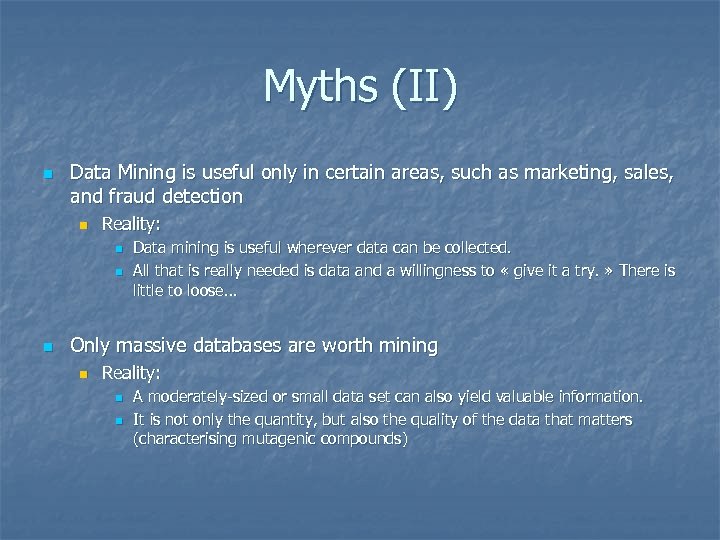
Myths (II) n Data Mining is useful only in certain areas, such as marketing, sales, and fraud detection n Reality: n n n Data mining is useful wherever data can be collected. All that is really needed is data and a willingness to « give it a try. » There is little to loose… Only massive databases are worth mining n Reality: n n A moderately-sized or small data set can also yield valuable information. It is not only the quantity, but also the quality of the data that matters (characterising mutagenic compounds)
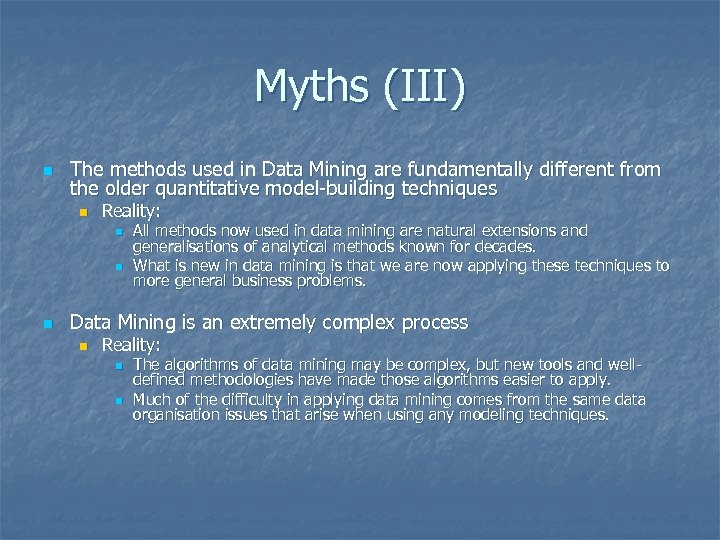
Myths (III) n The methods used in Data Mining are fundamentally different from the older quantitative model-building techniques n Reality: n n n All methods now used in data mining are natural extensions and generalisations of analytical methods known for decades. What is new in data mining is that we are now applying these techniques to more general business problems. Data Mining is an extremely complex process n Reality: n n The algorithms of data mining may be complex, but new tools and welldefined methodologies have made those algorithms easier to apply. Much of the difficulty in applying data mining comes from the same data organisation issues that arise when using any modeling techniques.

OLAP vs. DM Illustration
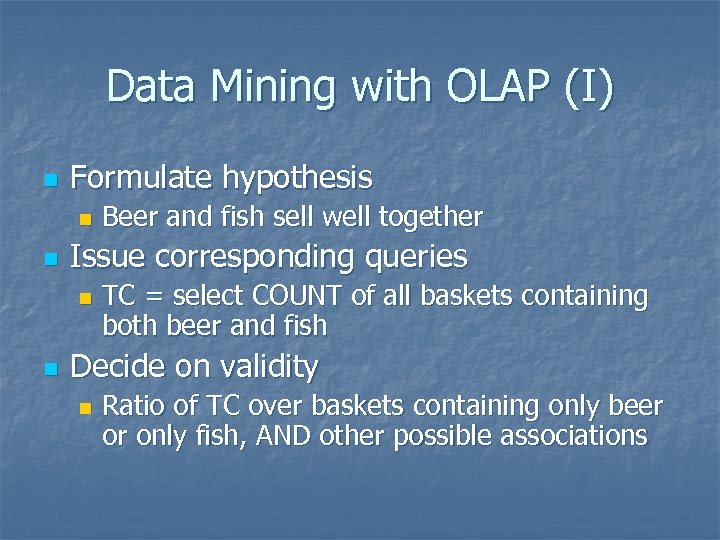
Data Mining with OLAP (I) n Formulate hypothesis n n Issue corresponding queries n n Beer and fish sell well together TC = select COUNT of all baskets containing both beer and fish Decide on validity n Ratio of TC over baskets containing only beer or only fish, AND other possible associations
Data Mining with OLAP (II) n Assume 11 possible products in any one basket and restrict to associations of at most 4 products 55 possible associations of 2 products n 165 possible associations of 3 products n 330 possible associations of 4 products n n Must issue 550 queries and compare the results!!!
Data Mining Instead of OLAP n Only two alternatives with OLAP: Brute force: prohibitive! n Intuition: speculative! n n Data Mining strikes a balance: Try most associations n Use heuristics to guide the search n n DM increases chances of useful discovery!
Скачать презентацию Data Mining as a BI Tool Data Extraction
a626deab7d638097ba6c4a7a7a546b5b.ppt