


 Скачать презентацию Data Mining 198 541 Definition Data mining
b7a4931ac04e81c3404ad7850ff51ccc.ppt
- Количество слайдов: 35
 Data Mining 198: 541
 Definition Data mining is the exploration and analysis of large quantities of data in order to discover valid, novel, potentially useful, and ultimately understandable patterns in data. Example pattern (Census Bureau Data): If (relationship = husband), then (gender = male). 99. 6%
 Definition (Cont. ) Data mining is the exploration and analysis of large quantities of data in order to discover valid, novel, potentially useful, and ultimately understandable patterns in data. Valid: The patterns hold in general. Novel: We did not know the pattern beforehand. Useful: We can devise actions from the patterns. Understandable: We can interpret and comprehend the patterns.
 Why Use Data Mining Today? Human analysis skills are inadequate: • Volume and dimensionality of the data • High data growth rate Availability of: • • • Data Storage Computational power Off-the-shelf software Expertise
 An Abundance of Data • • • Supermarket scanners, POS data Preferred customer cards Credit card transactions Direct mail response Call center records ATM machines Demographic data Sensor networks Cameras Web server logs Customer web site trails
 Why Use Data Mining Today? Competitive pressure! “The secret of success is to know something that nobody else knows. ” Aristotle Onassis • Competition on service, not only on price (Banks, phone companies, hotel chains, rental car companies) • Personalization, CRM • The real-time enterprise • “Systemic listening” • Security, homeland defense
 The Knowledge Discovery Process Steps: l Identify business problem l Data mining l Action l Evaluation and measurement l Deployment and integration into businesses processes
 Data Mining Step in Detail 2. 1 Data preprocessing • Data selection: Identify target datasets and relevant fields • Data cleaning • • Remove noise and outliers Data transformation Create common units Generate new fields 2. 2 Data mining model construction 2. 3 Model evaluation
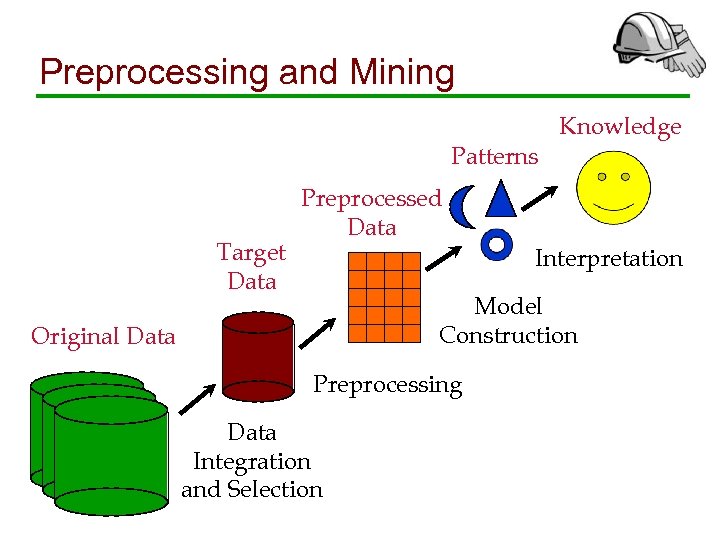 Preprocessing and Mining Knowledge Patterns Target Data Preprocessed Data Interpretation Model Construction Original Data Preprocessing Data Integration and Selection
 Example Application: Sky Survey • Input data: 3 TB of image data with 2 billion sky objects, took more than six years to complete • Goal: Generate a catalog with all objects and their type • Method: Use decision trees as data mining model • Results: • 94% accuracy in predicting sky object classes • Increased number of faint objects classified by 300% • Helped team of astronomers to discover 16 new high red-shift quasars in one order of magnitude less observation time
 Gold Nuggets? • Investment firm mailing list: Discovered that old people do not respond to IRA mailings • Bank clustered their customers. One cluster: Older customers, no mortgage, less likely to have a credit card • “Bank of 1911” • Customer churn example
 What is a Data Mining Model? A data mining model is a description of a specific aspect of a dataset. It produces output values for an assigned set of input values. Examples: • Linear regression model • Classification model • Clustering
 Data Mining Models (Contd. ) A data mining model can be described at two levels: • Functional level: • Describes model in terms of its intended usage. Examples: Classification, clustering • Representational level: • Specific representation of a model. Example: Log-linear model, classification tree, nearest neighbor method. • Black-box models versus transparent models
 Data Mining: Types of Data • Relational data and transactional data • Spatial and temporal data, spatio-temporal observations • Time-series data • Text • Images, video • Mixtures of data • Sequence data • Features from processing other data sources
 Types of Variables • Numerical: Domain is ordered and can be represented on the real line (e. g. , age, income) • Nominal or categorical: Domain is a finite set without any natural ordering (e. g. , occupation, marital status, race) • Ordinal: Domain is ordered, but absolute differences between values is unknown (e. g. , preference scale, severity of an injury)
 Data Mining Techniques • Supervised learning • Classification and regression • Unsupervised learning • Clustering • Dependency modeling • Associations, summarization, causality • Outlier and deviation detection • Trend analysis and change detection
 Market Basket Analysis • Consider shopping cart filled with several items • Market basket analysis tries to answer the following questions: • Who makes purchases? • What do customers buy together? • In what order do customers purchase items?
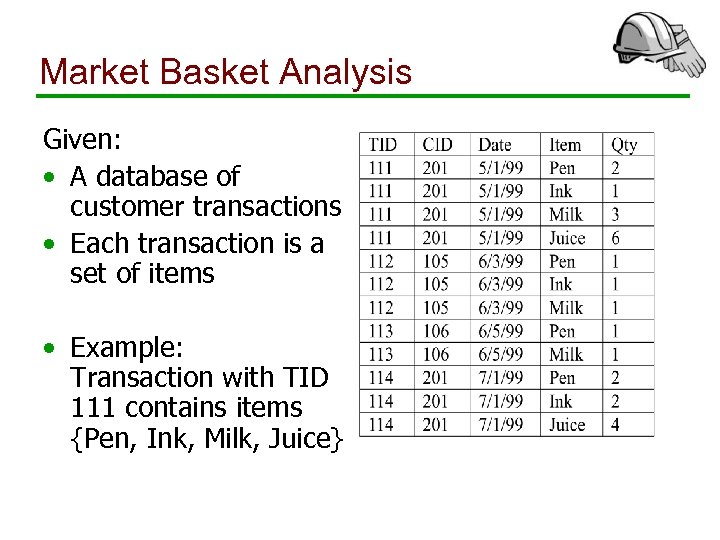 Market Basket Analysis Given: • A database of customer transactions • Each transaction is a set of items • Example: Transaction with TID 111 contains items {Pen, Ink, Milk, Juice}
 Market Basket Analysis (Contd. ) • Coocurrences • 80% of all customers purchase items X, Y and Z together. • Association rules • 60% of all customers who purchase X and Y also buy Z. • Sequential patterns • 60% of customers who first buy X also purchase Y within three weeks.
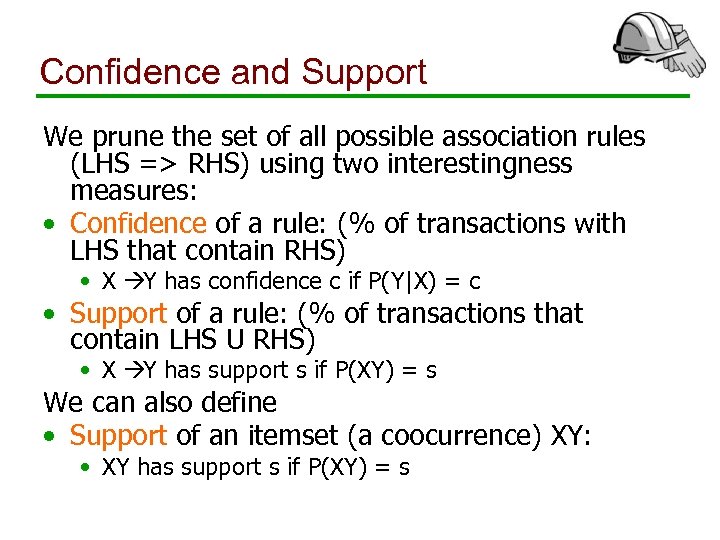 Confidence and Support We prune the set of all possible association rules (LHS => RHS) using two interestingness measures: • Confidence of a rule: (% of transactions with LHS that contain RHS) • X àY has confidence c if P(Y|X) = c • Support of a rule: (% of transactions that contain LHS U RHS) • X àY has support s if P(XY) = s We can also define • Support of an itemset (a coocurrence) XY: • XY has support s if P(XY) = s
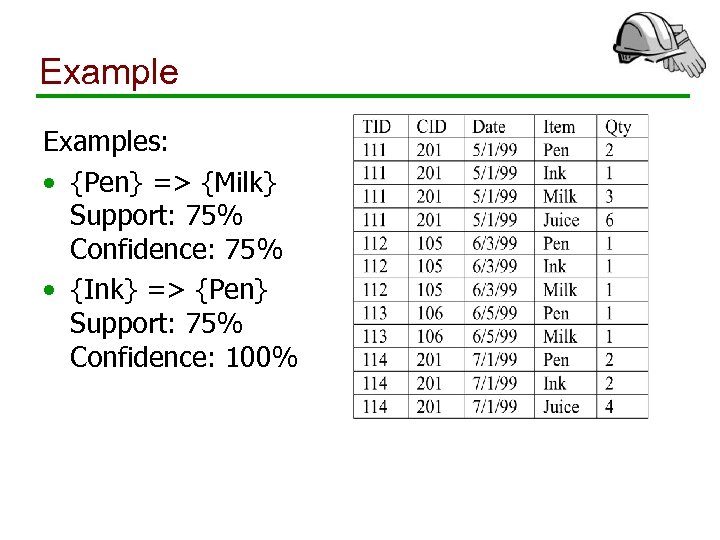 Examples: • {Pen} => {Milk} Support: 75% Confidence: 75% • {Ink} => {Pen} Support: 75% Confidence: 100%
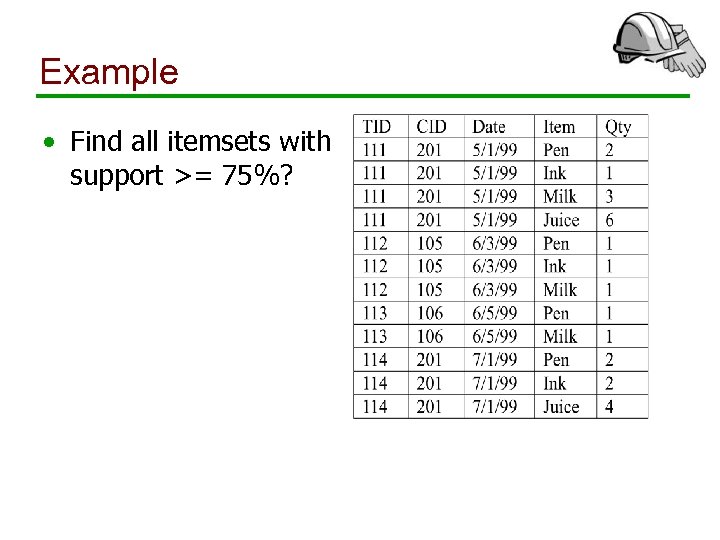 Example • Find all itemsets with support >= 75%?
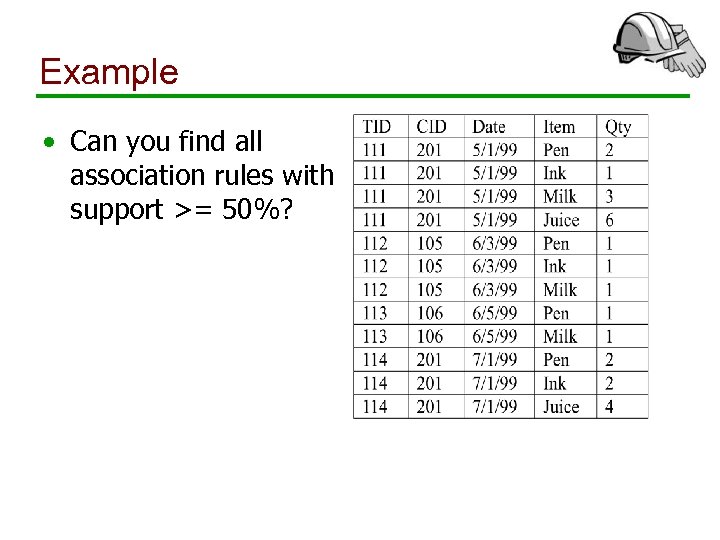 Example • Can you find all association rules with support >= 50%?
 Market Basket Analysis: Applications • Sample Applications • • • Direct marketing Fraud detection for medical insurance Floor/shelf planning Web site layout Cross-selling
 Association Rule Algorithms • Find all large itemsets • For each large itemset, find all association rules with sufficient confidence A priori Algorithm (Agrawal et al. ) Any subset of a frequent itemset has to be frequent
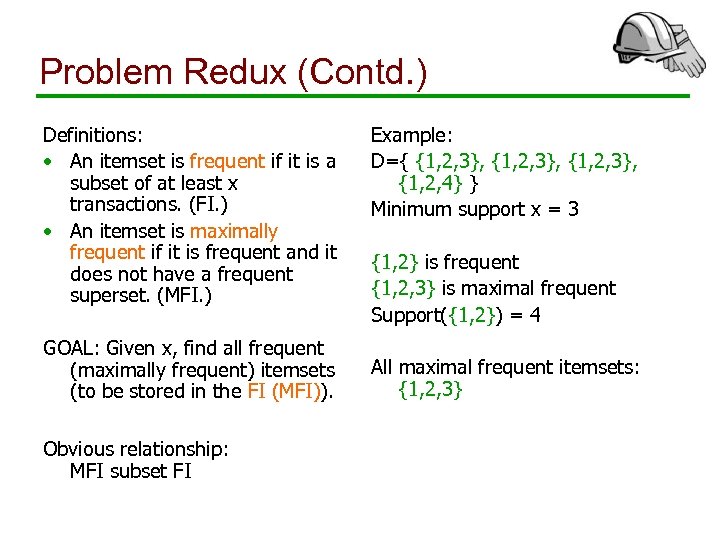 Problem Redux (Contd. ) Definitions: • An itemset is frequent if it is a subset of at least x transactions. (FI. ) • An itemset is maximally frequent if it is frequent and it does not have a frequent superset. (MFI. ) GOAL: Given x, find all frequent (maximally frequent) itemsets (to be stored in the FI (MFI)). Obvious relationship: MFI subset FI Example: D={ {1, 2, 3}, {1, 2, 4} } Minimum support x = 3 {1, 2} is frequent {1, 2, 3} is maximal frequent Support({1, 2}) = 4 All maximal frequent itemsets: {1, 2, 3}
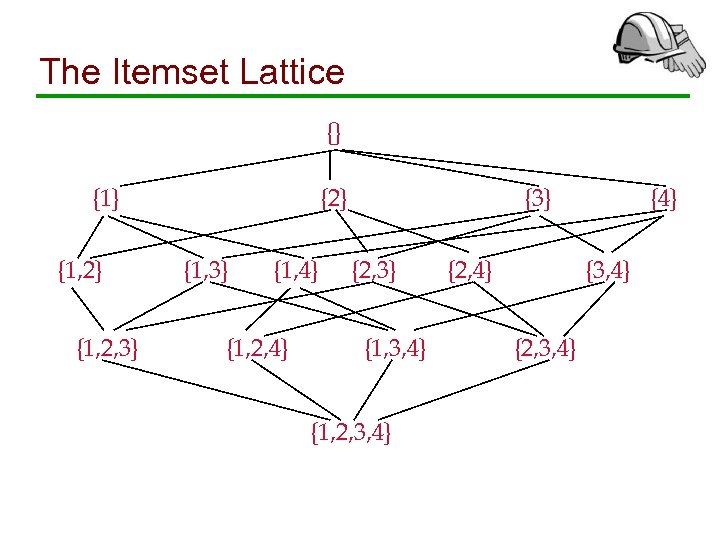 The Itemset Lattice {} {1, 2} {1, 2, 3} {2} {1, 3} {1, 4} {1, 2, 4} {3} {2, 3} {1, 3, 4} {1, 2, 3, 4} {2, 4} {3, 4} {2, 3, 4}
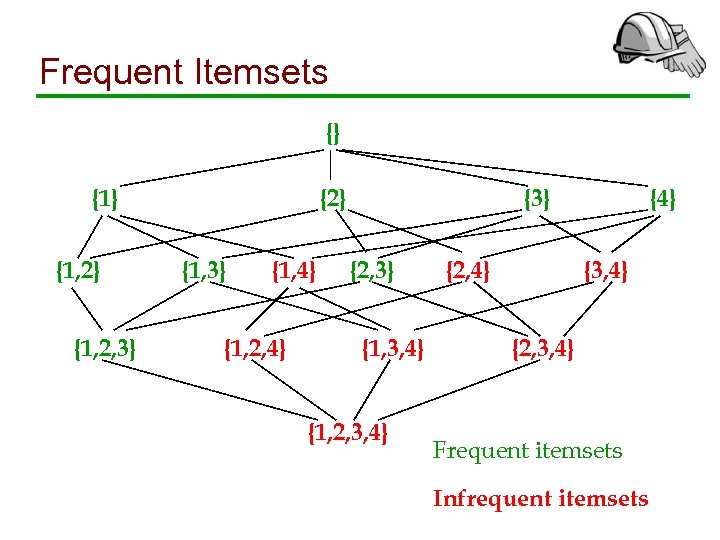 Frequent Itemsets {} {1, 2} {1, 2, 3} {2} {1, 3} {1, 4} {1, 2, 4} {3} {2, 3} {1, 3, 4} {1, 2, 3, 4} {2, 4} {3, 4} {2, 3, 4} Frequent itemsets Infrequent itemsets
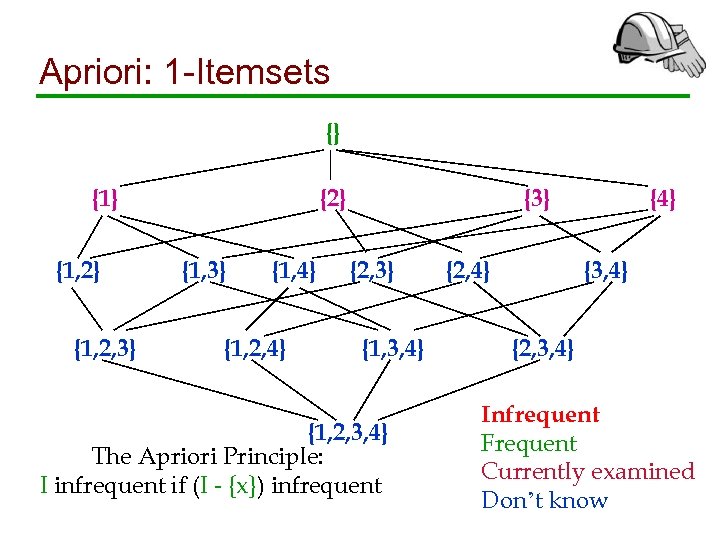 Apriori: 1 -Itemsets {} {1, 2} {1, 2, 3} {2} {1, 3} {1, 4} {1, 2, 4} {3} {2, 3} {1, 3, 4} {1, 2, 3, 4} The Apriori Principle: I infrequent if (I - {x}) infrequent {2, 4} {3, 4} {2, 3, 4} Infrequent Frequent Currently examined Don’t know
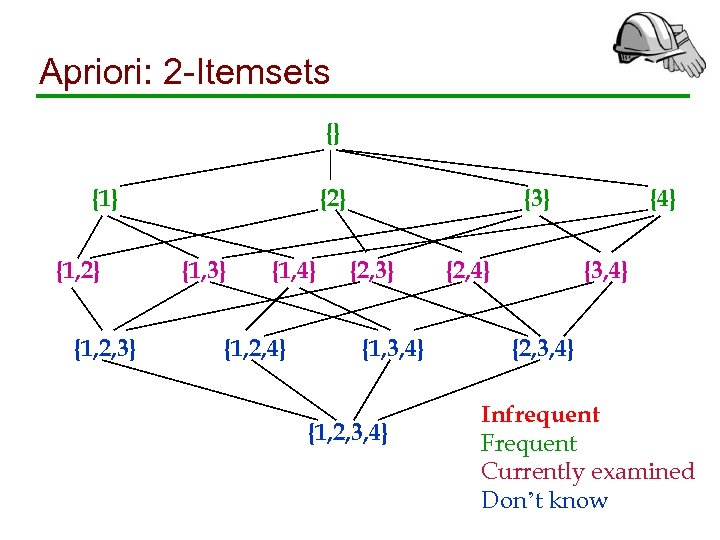 Apriori: 2 -Itemsets {} {1, 2} {1, 2, 3} {2} {1, 3} {1, 4} {1, 2, 4} {3} {2, 3} {1, 3, 4} {1, 2, 3, 4} {2, 4} {3, 4} {2, 3, 4} Infrequent Frequent Currently examined Don’t know
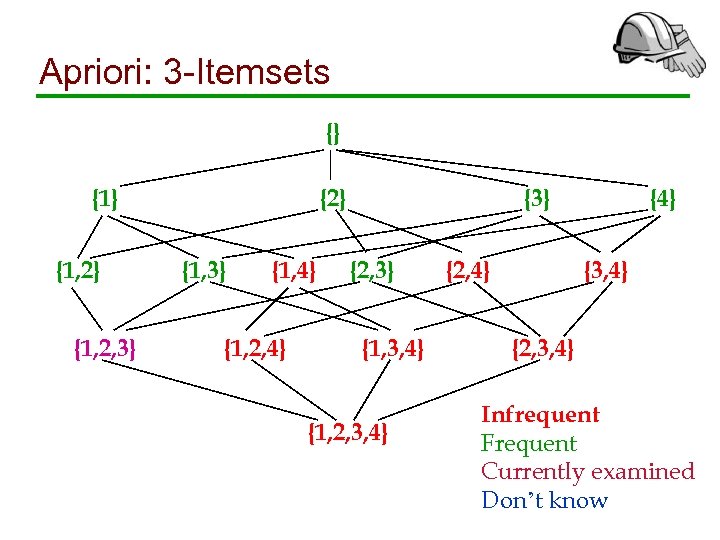 Apriori: 3 -Itemsets {} {1, 2} {1, 2, 3} {2} {1, 3} {1, 4} {1, 2, 4} {3} {2, 3} {1, 3, 4} {1, 2, 3, 4} {2, 4} {3, 4} {2, 3, 4} Infrequent Frequent Currently examined Don’t know
 Extensions • Imposing constraints • • Only find rules involving the dairy department Only find rules involving expensive products Only find “expensive” rules Only find rules with “whiskey” on the right hand side Only find rules with “milk” on the left hand side Hierarchies on the items Calendars (every Sunday, every 1 st of the month)
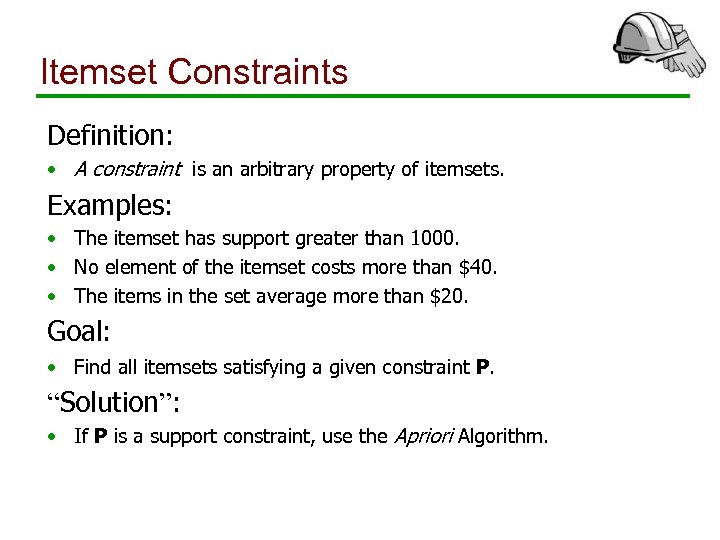 Itemset Constraints Definition: • A constraint is an arbitrary property of itemsets. Examples: • The itemset has support greater than 1000. • No element of the itemset costs more than $40. • The items in the set average more than $20. Goal: • Find all itemsets satisfying a given constraint P. “Solution”: • If P is a support constraint, use the Apriori Algorithm.
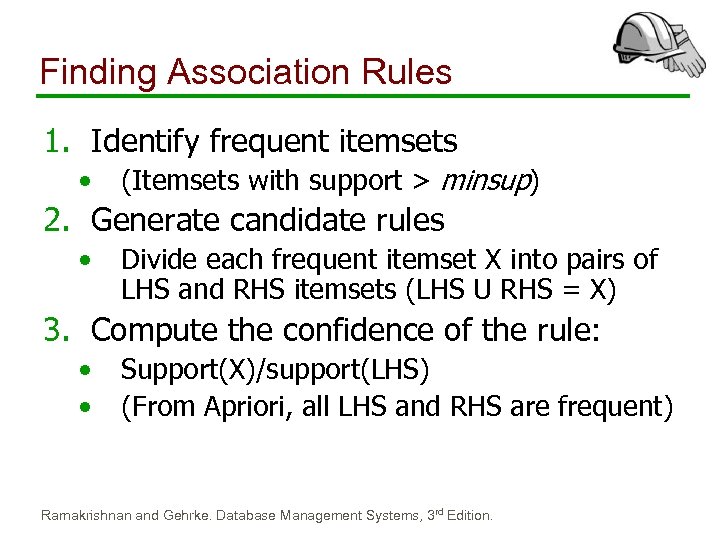 Finding Association Rules 1. Identify frequent itemsets • (Itemsets with support > minsup) 2. Generate candidate rules • Divide each frequent itemset X into pairs of LHS and RHS itemsets (LHS U RHS = X) 3. Compute the confidence of the rule: • • Support(X)/support(LHS) (From Apriori, all LHS and RHS are frequent) Ramakrishnan and Gehrke. Database Management Systems, 3 rd Edition.
 Applications • • Spatial association rules Web mining Market basket analysis User/customer profiling