


 Скачать презентацию Data Dissemination for Spot Applications in Ad -Hoc
308857956df815b3d1e4b84a9da6327b.ppt
- Количество слайдов: 46
 Data Dissemination for Spot Applications in Ad -Hoc Networks Alaeddine EL-FAWAL Thesis director : Jean-Yves Le Boudec Private Defense, 3 April 2009, EPFL
 Overview on the Ph. D Work Supported by 2 projects: ü Haggle: European project in Situated and Autonomic Communications ü NCCR MICS: National Center of Competence in Research – Mobile Information and Communication Systems 2 parts in my Ph. D work: ü Data dissemination for spot applications over WIFI technology (Haggle) ü Cross-layer optimization for UWB systems (MICS) Dealing with different facets of uncoordinated ad-hoc wireless networks and deals with challenges at all networking layers
 OUTLINE Introduction SLEF: Our Data Dissemination Middleware Performance Validation Prototyping and Testbed Conclusions Achievements 3
 Open-Ended Environment Caused by: Dramatic expansion of WIFI interfaces: laptops, PDAs, mobile phones, video games and even with peripherals and vehicles. Characteristics: Ø Involves from few to thousands of nodes. Ø Challenging circumstances: § Highly dynamic § Unpredictable § Uncoordinated § Short contact time § Quickly changing from dense to sparse, non-congested to congested 4
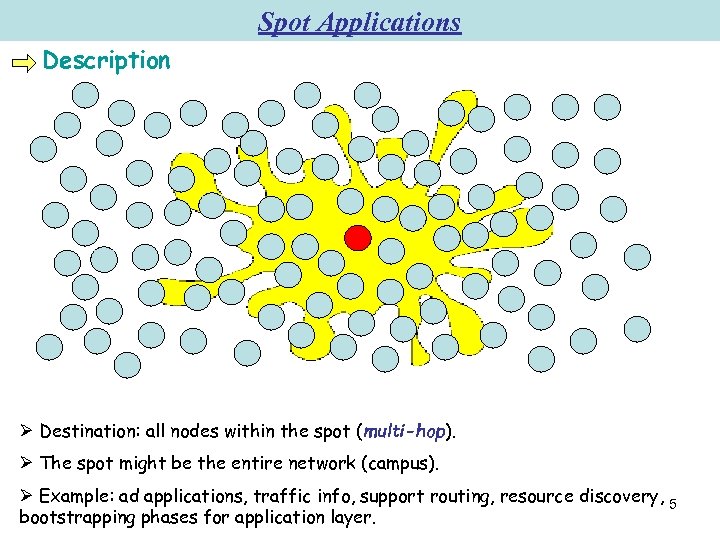 Spot Applications Description Ø Destination: all nodes within the spot (multi-hop). Ø The spot might be the entire network (campus). Ø Example: ad applications, traffic info, support routing, resource discovery, 5 bootstrapping phases for application layer.
 Spot Applications Requirements: Ø Efficient and reliable data dissemination service Ø Trade-off: spread-application rate ü Spread: number of nodes within the application spot (number of nodes that receive a packet). ü The spot size is variable according to the network conditions. Ø Delivery ratio can not be used… instead, we talk about spread. 7
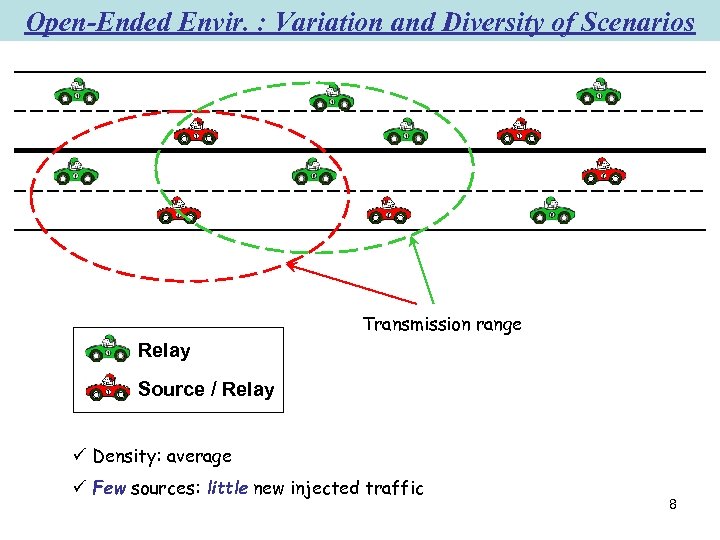 Open-Ended Envir. : Variation and Diversity of Scenarios Transmission range Relay Source / Relay ü Density: average ü Few sources: little new injected traffic 8
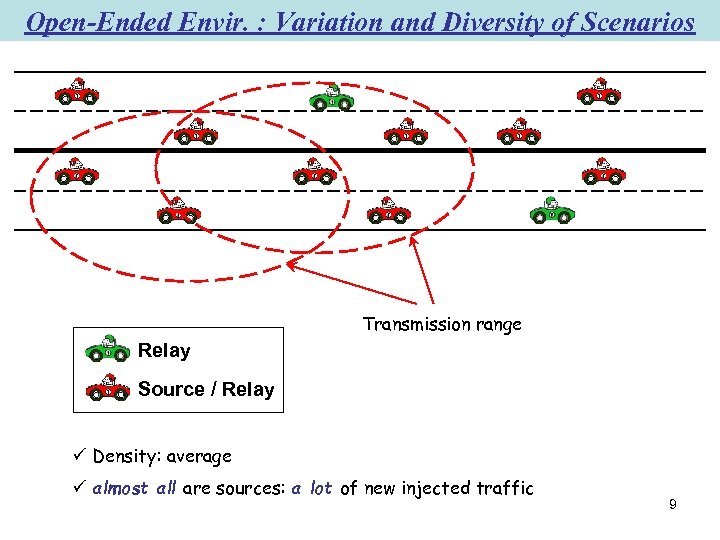 Open-Ended Envir. : Variation and Diversity of Scenarios Transmission range Relay Source / Relay ü Density: average ü almost all are sources: a lot of new injected traffic 9
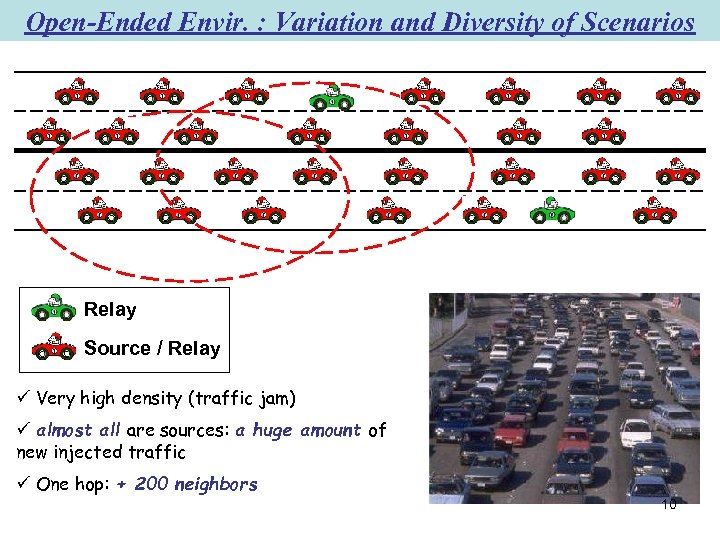 Open-Ended Envir. : Variation and Diversity of Scenarios Relay Source / Relay ü Very high density (traffic jam) ü almost all are sources: a huge amount of new injected traffic ü One hop: + 200 neighbors 10
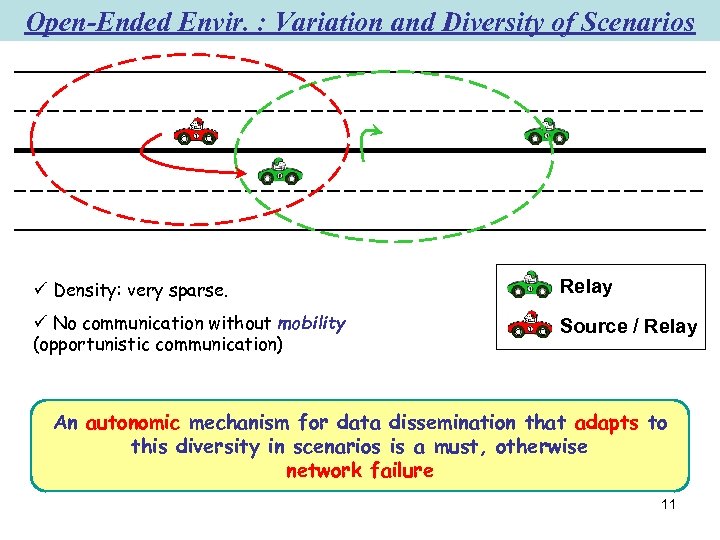 Open-Ended Envir. : Variation and Diversity of Scenarios ü Density: very sparse. Relay ü No communication without mobility (opportunistic communication) Source / Relay An autonomic mechanism for data dissemination that adapts to this diversity in scenarios is a must, otherwise network failure 11
 OUTLINE Introduction SLEF: Our Data Dissemination Middleware Performance Validation Prototyping and Testbed Conclusions Achievements 12
 SLEF: Self Limiting Epidemic Forwarding Data dissemination through limited epidemic forwarding : ü A source transmits packets in broadcast mode. ü Nodes forward each packet they receive Forwarding Factor times. ü Packets are forwarded within a limited hop count. We propose the SLEF middleware. ü Delivers an efficient and reliable data dissemination service to the spot applications ü Deals with the tradeoff: spread-application rate ü The network conditions define the TTL limit (spread control). ü Functional between the application and the transmission sockets (UDP or raw sockets). 13
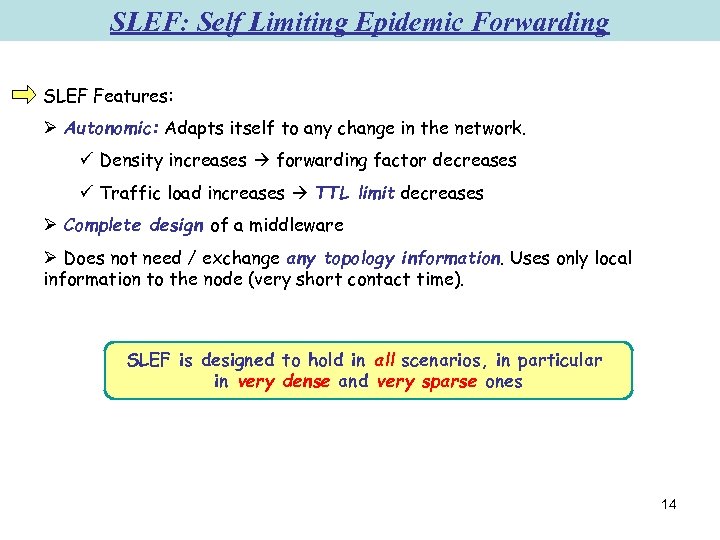 SLEF: Self Limiting Epidemic Forwarding SLEF Features: Ø Autonomic: Adapts itself to any change in the network. ü Density increases forwarding factor decreases ü Traffic load increases TTL limit decreases Ø Complete design of a middleware Ø Does not need / exchange any topology information. Uses only local information to the node (very short contact time). SLEF is designed to hold in all scenarios, in particular in very dense and very sparse ones 14
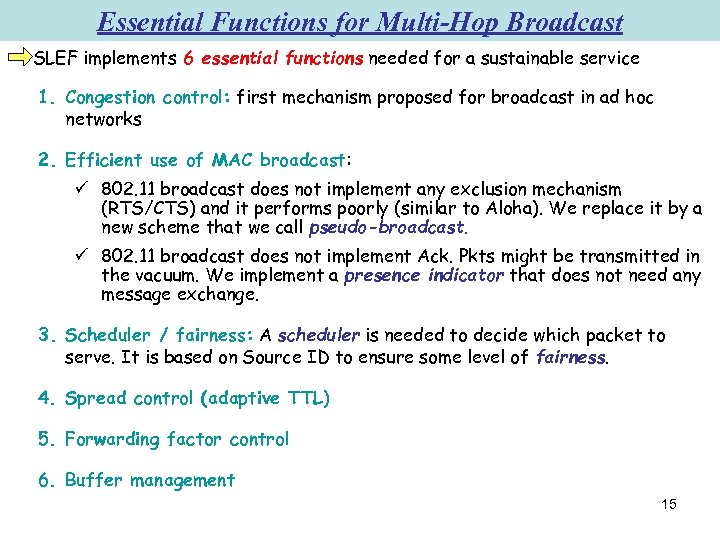 Essential Functions for Multi-Hop Broadcast SLEF implements 6 essential functions needed for a sustainable service 1. Congestion control: first mechanism proposed for broadcast in ad hoc networks 2. Efficient use of MAC broadcast: ü 802. 11 broadcast does not implement any exclusion mechanism (RTS/CTS) and it performs poorly (similar to Aloha). We replace it by a new scheme that we call pseudo-broadcast. ü 802. 11 broadcast does not implement Ack. Pkts might be transmitted in the vacuum. We implement a presence indicator that does not need any message exchange. 3. Scheduler / fairness: A scheduler is needed to decide which packet to serve. It is based on Source ID to ensure some level of fairness. 4. Spread control (adaptive TTL) 5. Forwarding factor control 6. Buffer management 15
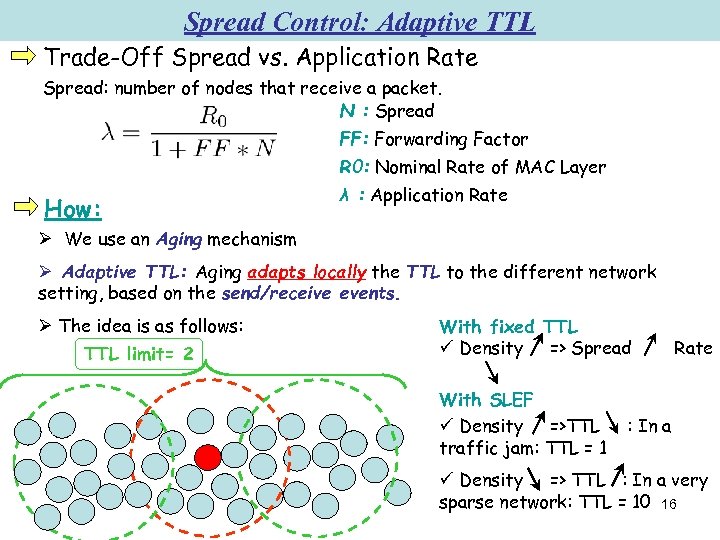 Spread Control: Adaptive TTL Trade-Off Spread vs. Application Rate Spread: number of nodes that receive a packet. N : Spread FF: Forwarding Factor R 0: Nominal Rate of MAC Layer How: λ : Application Rate Ø We use an Aging mechanism Ø Adaptive TTL: Aging adapts locally the TTL to the different network setting, based on the send/receive events. Ø The idea is as follows: TTL limit= 2 With fixed TTL ü Density => Spread With SLEF ü Density =>TTL traffic jam: TTL = 1 Rate : In a ü Density => TTL : In a very sparse network: TTL = 10 16
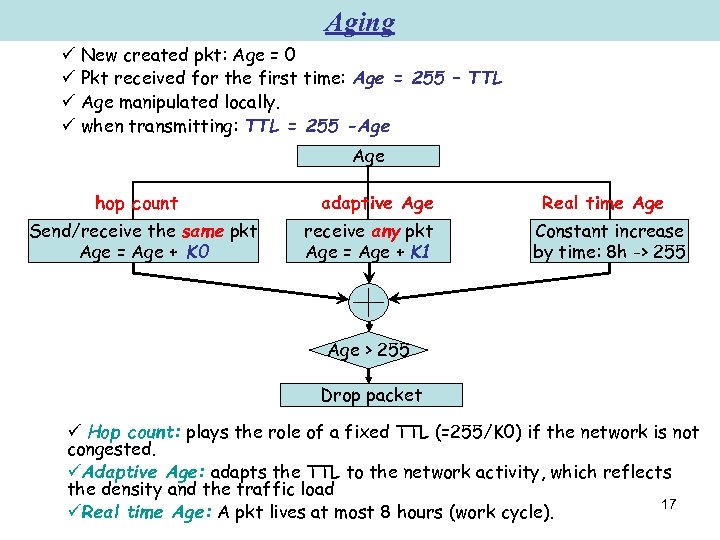 Aging ü New created pkt: Age = 0 ü Pkt received for the first time: Age = 255 – TTL ü Age manipulated locally. ü when transmitting: TTL = 255 -Age hop count Send/receive the same pkt Age = Age + K 0 adaptive Age receive any pkt Age = Age + K 1 Real time Age Constant increase by time: 8 h -> 255 Age > 255 Drop packet ü Hop count: plays the role of a fixed TTL (=255/K 0) if the network is not congested. üAdaptive Age: adapts the TTL to the network activity, which reflects the density and the traffic load 17 üReal time Age: A pkt lives at most 8 hours (work cycle).
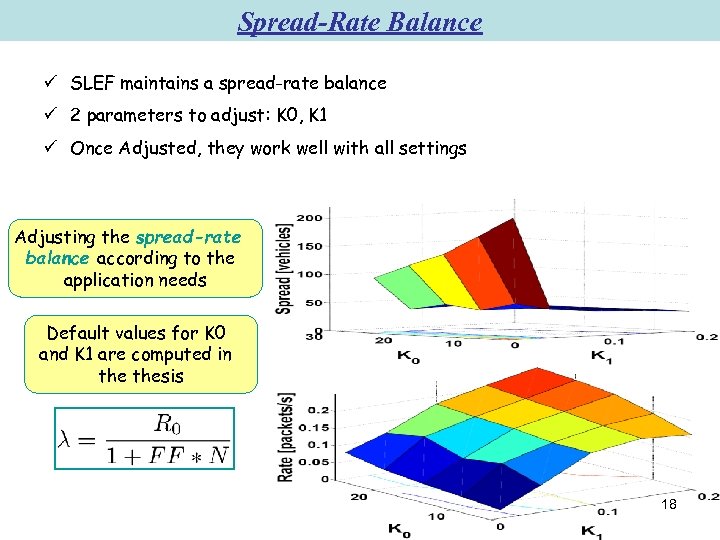 Spread-Rate Balance ü SLEF maintains a spread-rate balance ü 2 parameters to adjust: K 0, K 1 ü Once Adjusted, they work well with all settings Adjusting the spread-rate balance according to the application needs Default values for K 0 and K 1 are computed in thesis 18
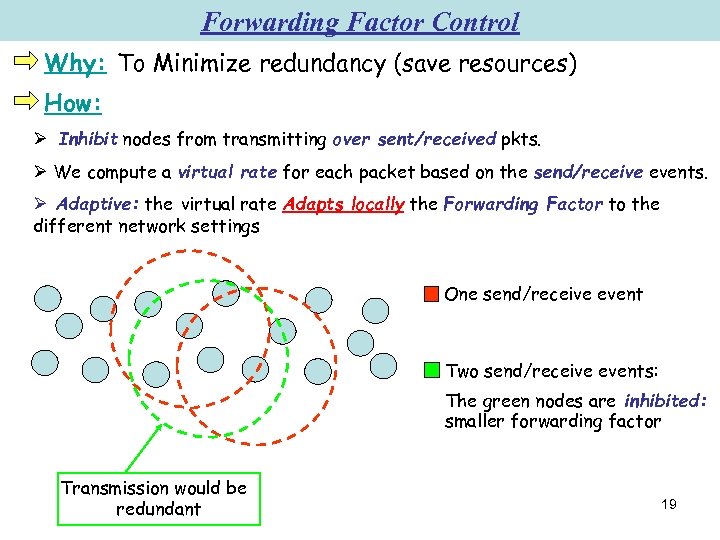 Forwarding Factor Control Why: To Minimize redundancy (save resources) How: Ø Inhibit nodes from transmitting over sent/received pkts. Ø We compute a virtual rate for each packet based on the send/receive events. Ø Adaptive: the virtual rate Adapts locally the Forwarding Factor to the different network settings One send/receive event Two send/receive events: The green nodes are inhibited: smaller forwarding factor Transmission would be redundant 19
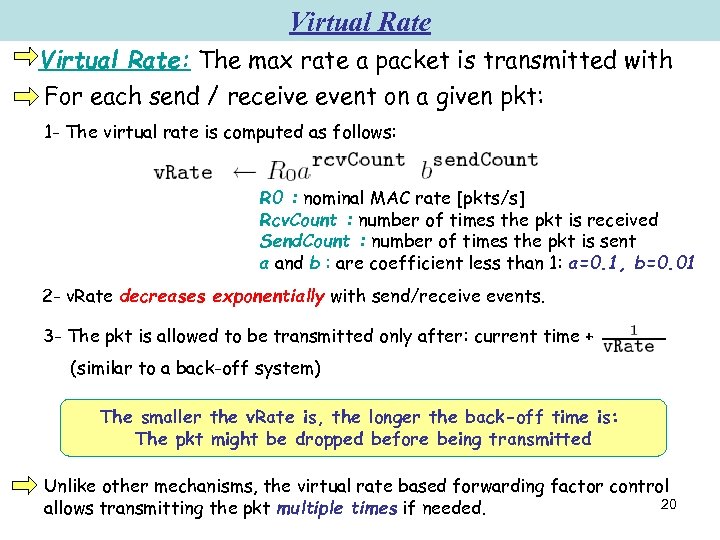 Virtual Rate: The max rate a packet is transmitted with For each send / receive event on a given pkt: 1 - The virtual rate is computed as follows: R 0 : nominal MAC rate [pkts/s] Rcv. Count : number of times the pkt is received Send. Count : number of times the pkt is sent a and b : are coefficient less than 1: a=0. 1, b=0. 01 2 - v. Rate decreases exponentially with send/receive events. 3 - The pkt is allowed to be transmitted only after: current time + (similar to a back-off system) The smaller the v. Rate is, the longer the back-off time is: The pkt might be dropped before being transmitted Unlike other mechanisms, the virtual rate based forwarding factor control 20 allows transmitting the pkt multiple times if needed.
 Buffer Management Ø Cleans the buffer in order to keep space for new incoming packets. Ø Based on Aging. Ø Drops packets with the highest age Highest age Lived the highest number of send/receive events 21
 OUTLINE Introduction SLEF: Our Data Dissemination Middleware Performance Validation Prototyping and Testbed Conclusions Achievements 22
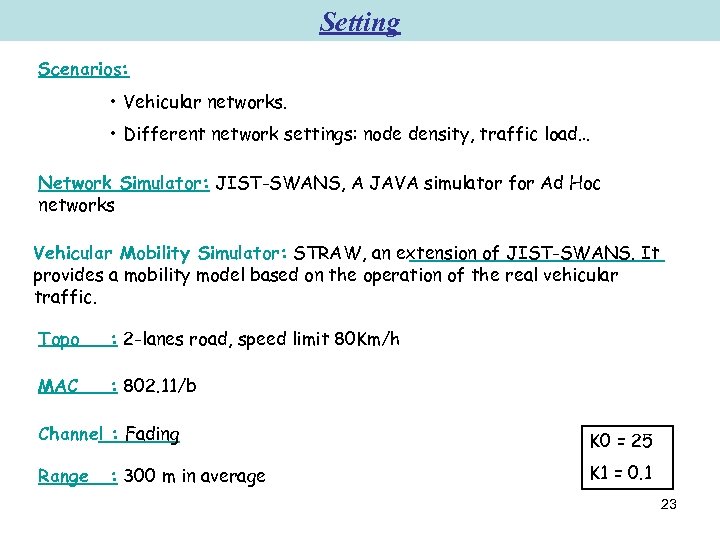 Setting Scenarios: • Vehicular networks. • Different network settings: node density, traffic load… Network Simulator: JIST-SWANS, A JAVA simulator for Ad Hoc networks Vehicular Mobility Simulator: STRAW, an extension of JIST-SWANS. It provides a mobility model based on the operation of the real vehicular traffic. Topo : 2 -lanes road, speed limit 80 Km/h MAC : 802. 11/b Channel : Fading K 0 = 25 Range K 1 = 0. 1 : 300 m in average 23
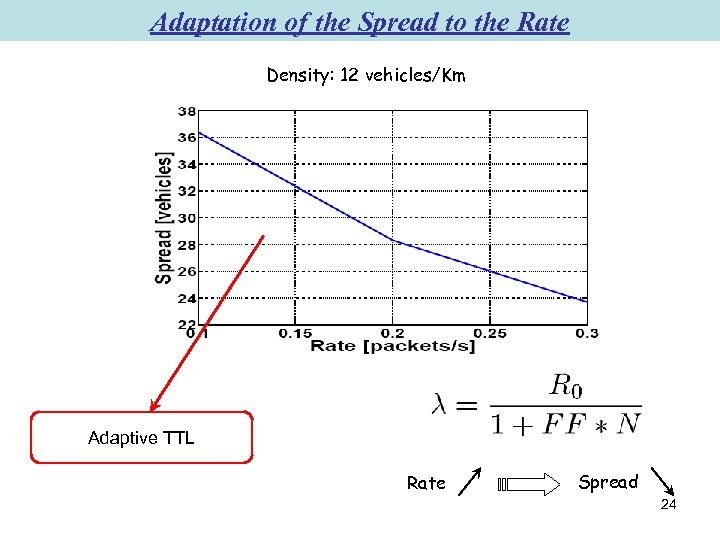 Adaptation of the Spread to the Rate Density: 12 vehicles/Km Adaptive TTL Rate Spread 24
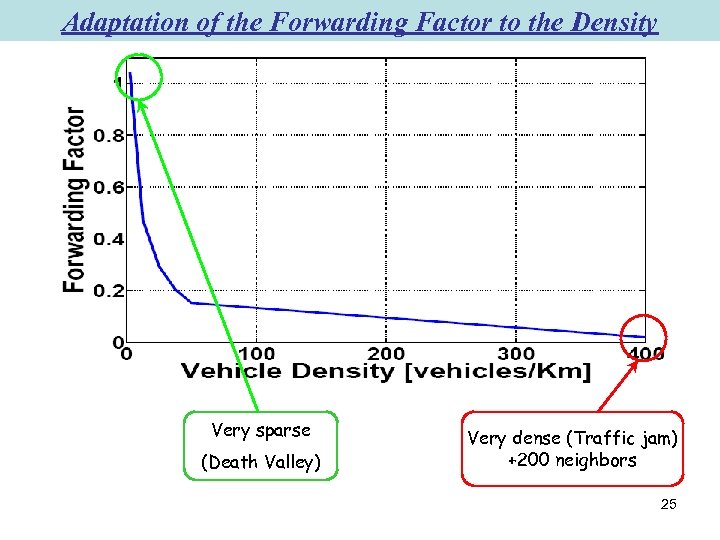 Adaptation of the Forwarding Factor to the Density Very sparse (Death Valley) Very dense (Traffic jam) +200 neighbors 25
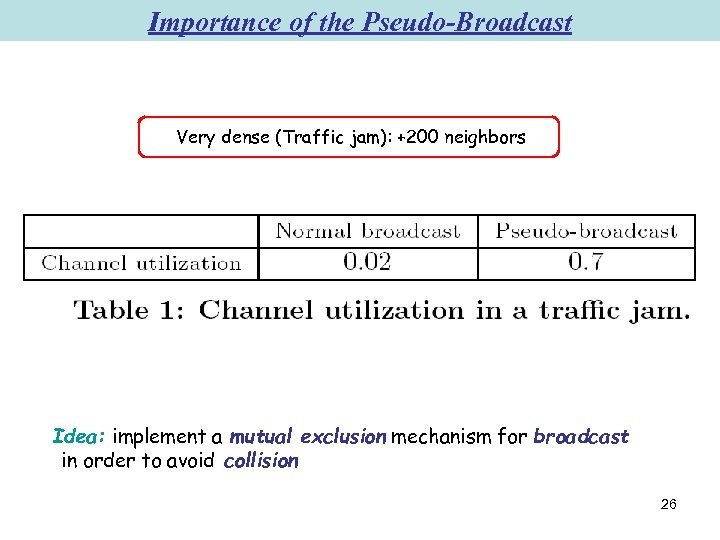 Importance of the Pseudo-Broadcast Very dense (Traffic jam): +200 neighbors Idea: implement a mutual exclusion mechanism for broadcast in order to avoid collision 26
 OUTLINE Introduction SLEF: Our Data Dissemination Middleware Performance Validation Prototyping and Testbed Conclusions Achievements 27
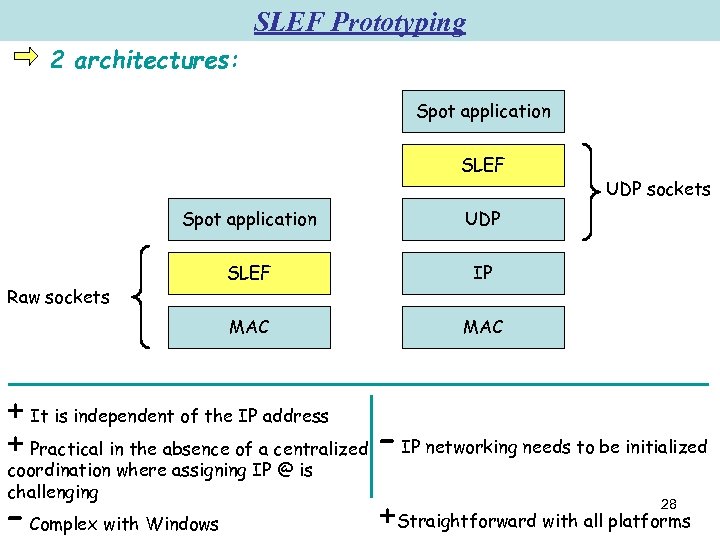 SLEF Prototyping 2 architectures: Spot application SLEF Spot application UDP SLEF IP MAC UDP sockets MAC Raw sockets + It is independent of the IP address + Practical in the absence of a centralized – IP networking needs to be initialized coordination where assigning IP @ is challenging – Complex with Windows +Straightforward with all platforms 28
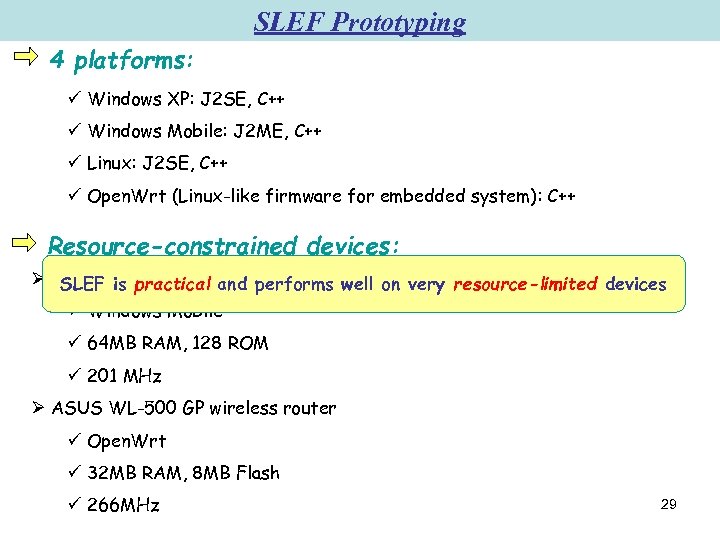 SLEF Prototyping 4 platforms: ü Windows XP: J 2 SE, C++ ü Windows Mobile: J 2 ME, C++ ü Linux: J 2 SE, C++ ü Open. Wrt (Linux-like firmware for embedded system): C++ Resource-constrained devices: Ø Smartphone HTC S 620: performs well on very resource-limited devices SLEF is practical and ü Windows Mobile ü 64 MB RAM, 128 ROM ü 201 MHz Ø ASUS WL-500 GP wireless router ü Open. Wrt ü 32 MB RAM, 8 MB Flash ü 266 MHz 29
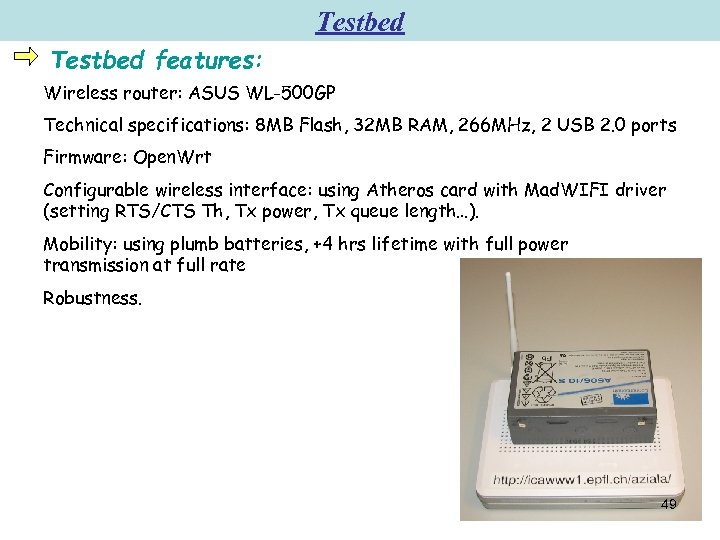
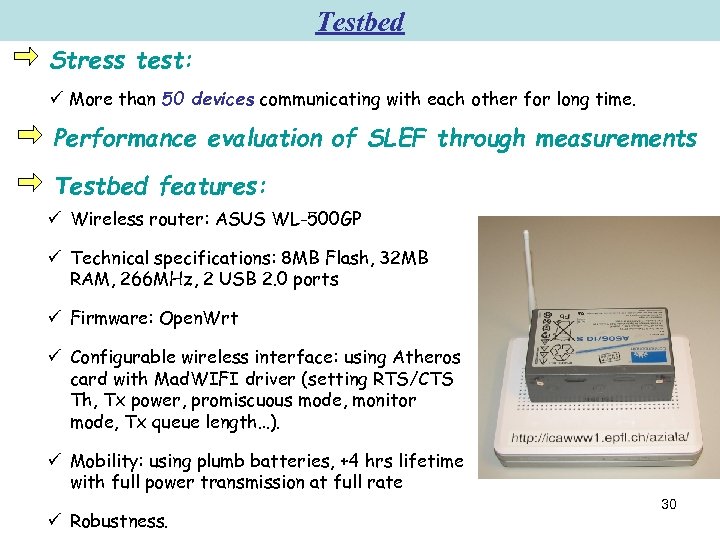 Testbed Stress test: ü More than 50 devices communicating with each other for long time. Performance evaluation of SLEF through measurements Testbed features: ü Wireless router: ASUS WL-500 GP ü Technical specifications: 8 MB Flash, 32 MB RAM, 266 MHz, 2 USB 2. 0 ports ü Firmware: Open. Wrt ü Configurable wireless interface: using Atheros card with Mad. WIFI driver (setting RTS/CTS Th, Tx power, promiscuous mode, monitor mode, Tx queue length…). ü Mobility: using plumb batteries, +4 hrs lifetime with full power transmission at full rate ü Robustness. 30
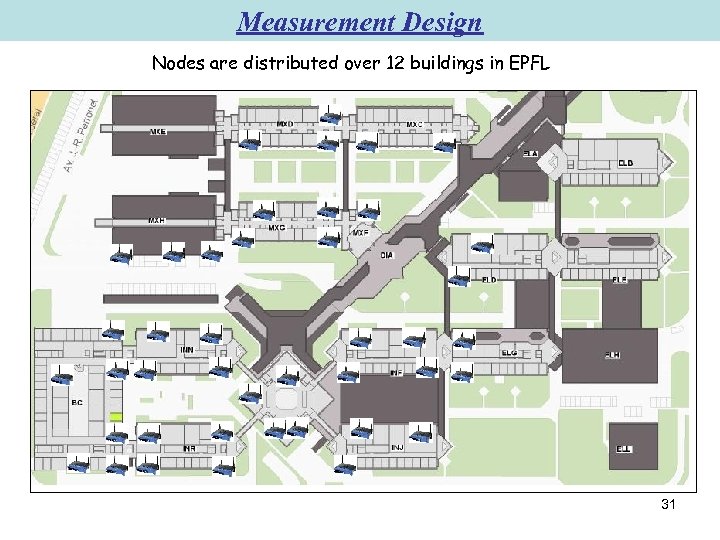 Measurement Design Nodes are distributed over 12 buildings in EPFL 31
 Measurement Design Ø Application: injects packets at fixed rate. Ø Application rate: can be reduced by the congestion control mechanism. Ø Comparison: SLEF vs. fixed-TTL Ø Fixed-TTL: ü Implements all functions of SLEF, otherwise it is not functional. ü Spread control is replaced by TTL (decremented by one for each hop) ü TTL limit is fixed ü Buffer management is based on the TTL and not on the age: packets with the smallest TTL are dropped first when the buffer is full ü Fixed-TTL limits the spread through 2 parameters: TTL limit and the buffer size. Ø Buffer size of fixed-TTL: ü Small buffer size: We ran SLEF and we use the average buffer occupation obtained (620 packets). ü Large buffer size: 10 000 packets. 32
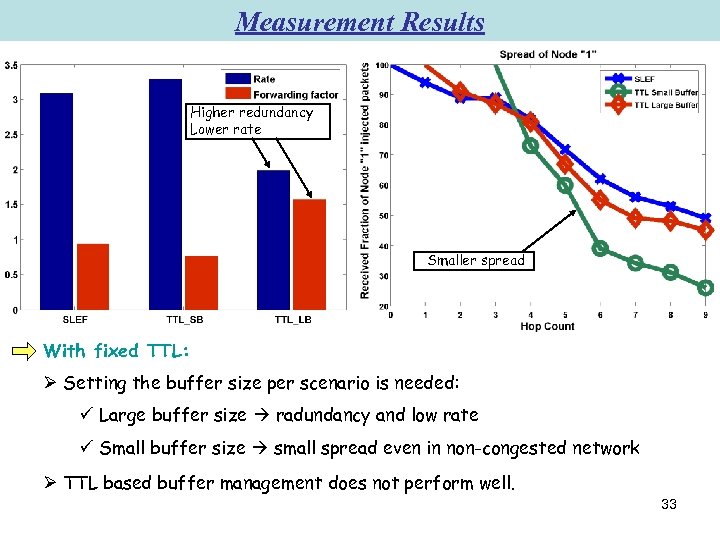 Measurement Results Higher redundancy Lower rate Smaller spread With fixed TTL: Ø Setting the buffer size per scenario is needed: ü Large buffer size radundancy and low rate ü Small buffer size small spread even in non-congested network Ø TTL based buffer management does not perform well. 33
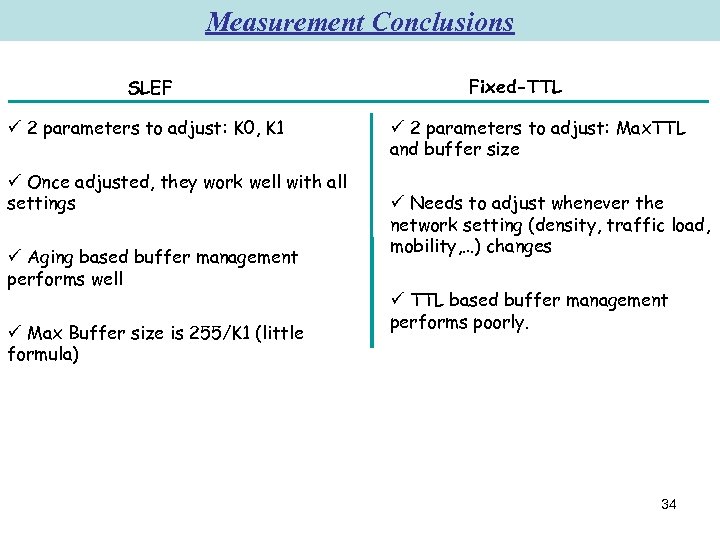 Measurement Conclusions SLEF ü 2 parameters to adjust: K 0, K 1 ü Once adjusted, they work well with all settings ü Aging based buffer management performs well ü Max Buffer size is 255/K 1 (little formula) Fixed-TTL ü 2 parameters to adjust: Max. TTL and buffer size ü Needs to adjust whenever the network setting (density, traffic load, mobility, …) changes ü TTL based buffer management performs poorly. 34
 OUTLINE Introduction SLEF: Our Data Dissemination Middleware Performance Validation Prototyping and Testbed Conclusions Achievements 35
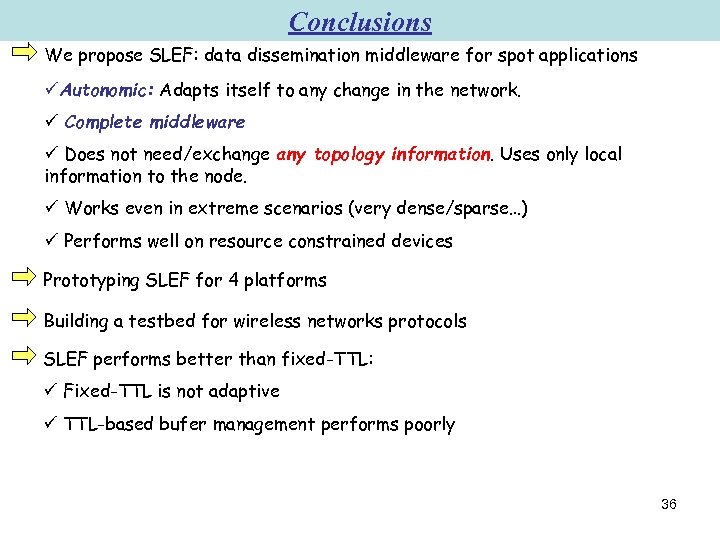 Conclusions We propose SLEF: data dissemination middleware for spot applications üAutonomic: Adapts itself to any change in the network. ü Complete middleware ü Does not need/exchange any topology information. Uses only local information to the node. ü Works even in extreme scenarios (very dense/sparse…) ü Performs well on resource constrained devices Prototyping SLEF for 4 platforms Building a testbed for wireless networks protocols SLEF performs better than fixed-TTL: ü Fixed-TTL is not adaptive ü TTL-based bufer management performs poorly 36
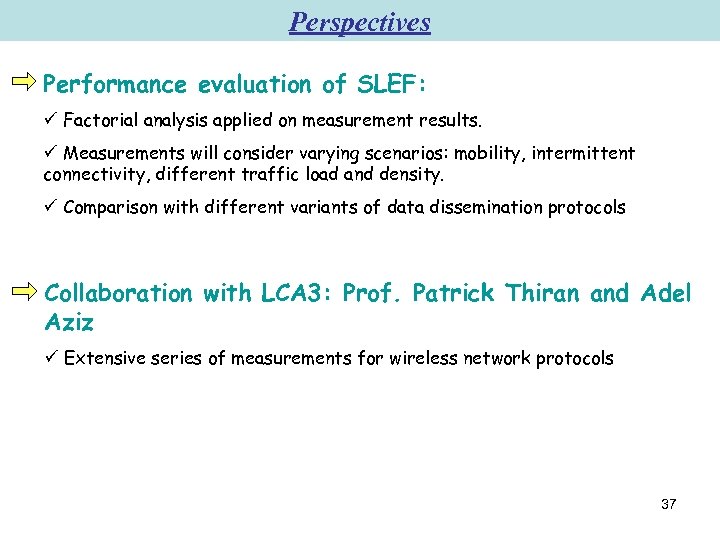 Perspectives Performance evaluation of SLEF: ü Factorial analysis applied on measurement results. ü Measurements will consider varying scenarios: mobility, intermittent connectivity, different traffic load and density. ü Comparison with different variants of data dissemination protocols Collaboration with LCA 3: Prof. Patrick Thiran and Adel Aziz ü Extensive series of measurements for wireless network protocols 37
 OUTLINE Introduction SLEF: Our Data Dissemination Middleware Performance Validation Prototyping and Testbed Conclusions Achievements 38
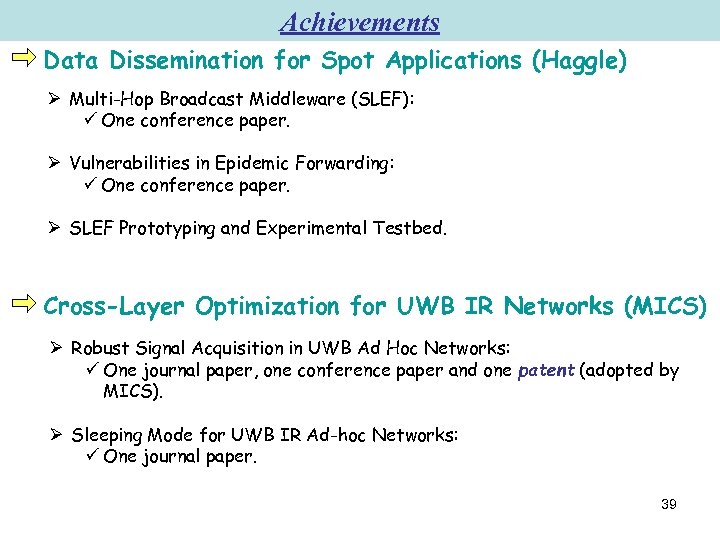 Achievements Data Dissemination for Spot Applications (Haggle) Ø Multi-Hop Broadcast Middleware (SLEF): ü One conference paper. Ø Vulnerabilities in Epidemic Forwarding: ü One conference paper. Ø SLEF Prototyping and Experimental Testbed. Cross-Layer Optimization for UWB IR Networks (MICS) Ø Robust Signal Acquisition in UWB Ad Hoc Networks: ü One journal paper, one conference paper and one patent (adopted by MICS). Ø Sleeping Mode for UWB IR Ad-hoc Networks: ü One journal paper. 39
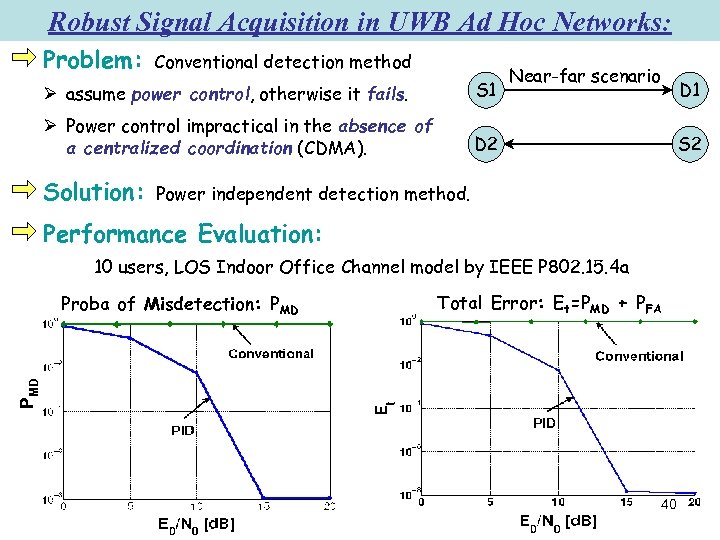 Robust Signal Acquisition in UWB Ad Hoc Networks: Problem: Conventional detection method Ø assume power control, otherwise it fails. S 1 Ø Power control impractical in the absence of a centralized coordination (CDMA). Near-far scenario D 2 Solution: D 1 S 2 Power independent detection method. Performance Evaluation: 10 users, LOS Indoor Office Channel model by IEEE P 802. 15. 4 a Total Error: Et=PMD + PFA PMD Proba of Misdetection: PMD 40
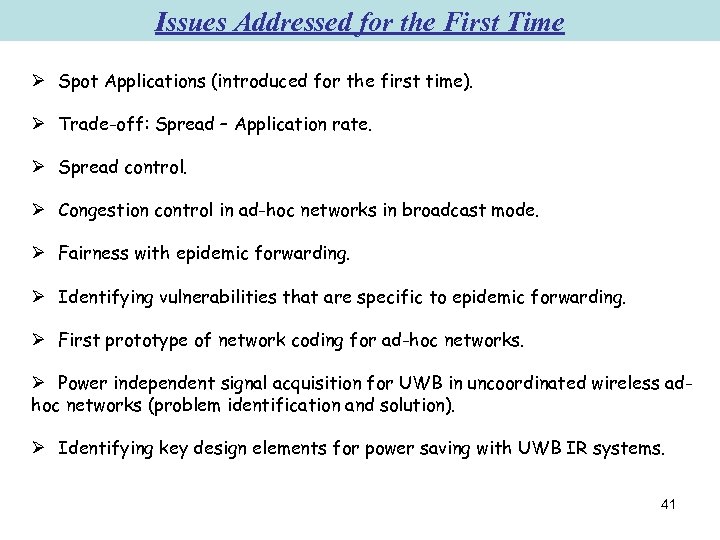 Issues Addressed for the First Time Ø Spot Applications (introduced for the first time). Ø Trade-off: Spread – Application rate. Ø Spread control. Ø Congestion control in ad-hoc networks in broadcast mode. Ø Fairness with epidemic forwarding. Ø Identifying vulnerabilities that are specific to epidemic forwarding. Ø First prototype of network coding for ad-hoc networks. Ø Power independent signal acquisition for UWB in uncoordinated wireless adhoc networks (problem identification and solution). Ø Identifying key design elements for power saving with UWB IR systems. 41
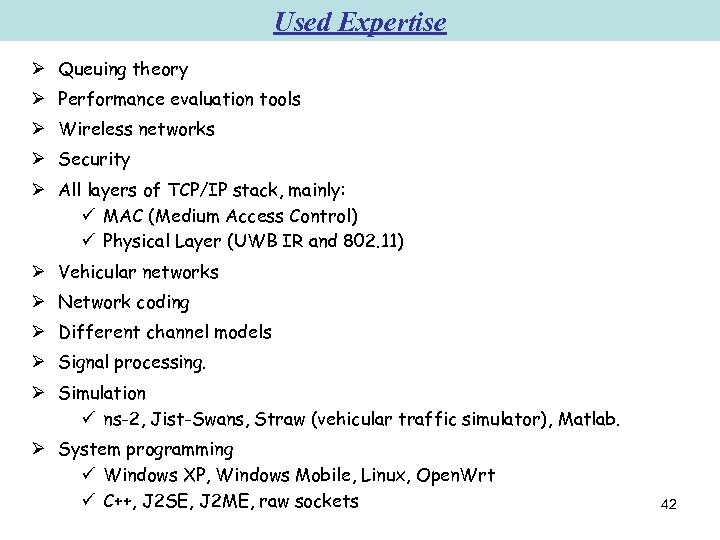 Used Expertise Ø Queuing theory Ø Performance evaluation tools Ø Wireless networks Ø Security Ø All layers of TCP/IP stack, mainly: ü MAC (Medium Access Control) ü Physical Layer (UWB IR and 802. 11) Ø Vehicular networks Ø Network coding Ø Different channel models Ø Signal processing. Ø Simulation ü ns-2, Jist-Swans, Straw (vehicular traffic simulator), Matlab. Ø System programming ü Windows XP, Windows Mobile, Linux, Open. Wrt ü C++, J 2 SE, J 2 ME, raw sockets 42
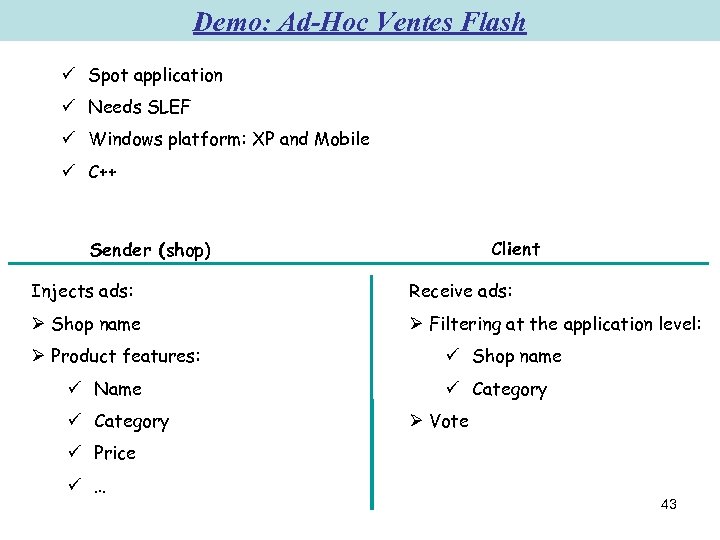 Demo: Ad-Hoc Ventes Flash ü Spot application ü Needs SLEF ü Windows platform: XP and Mobile ü C++ Client Sender (shop) Injects ads: Receive ads: Ø Shop name Ø Filtering at the application level: Ø Product features: ü Name ü Category ü Shop name ü Category Ø Vote ü Price ü … 43
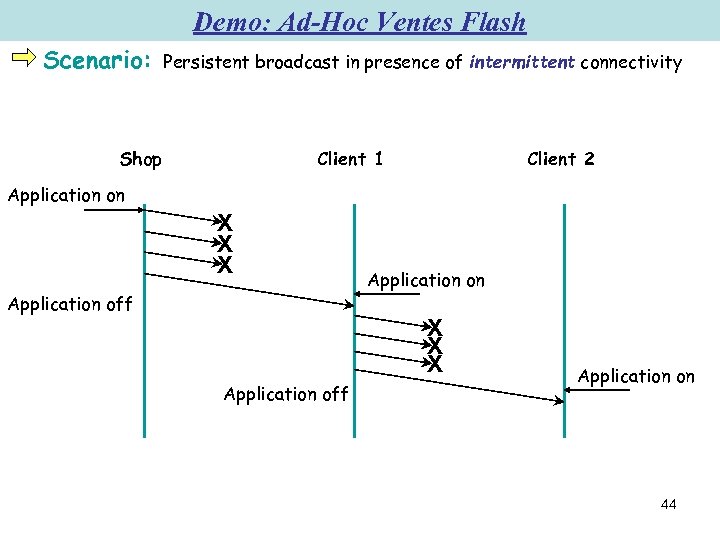 Demo: Ad-Hoc Ventes Flash Scenario: Persistent broadcast in presence of intermittent connectivity Shop Client 1 Client 2 Application on X X X Application off Application on 44
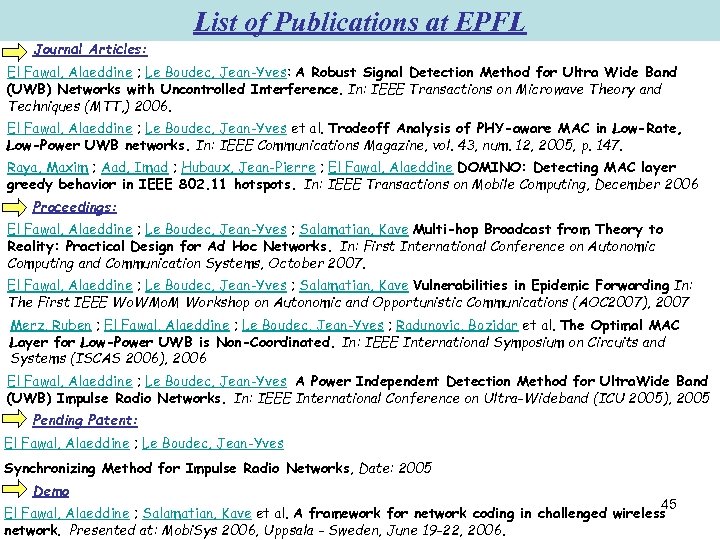 List of Publications at EPFL Journal Articles: El Fawal, Alaeddine ; Le Boudec, Jean-Yves: A Robust Signal Detection Method for Ultra Wide Band (UWB) Networks with Uncontrolled Interference. In: IEEE Transactions on Microwave Theory and Techniques (MTT, ) 2006. El Fawal, Alaeddine ; Le Boudec, Jean-Yves et al. Tradeoff Analysis of PHY-aware MAC in Low-Rate, Low-Power UWB networks. In: IEEE Communications Magazine, vol. 43, num. 12, 2005, p. 147. Raya, Maxim ; Aad, Imad ; Hubaux, Jean-Pierre ; El Fawal, Alaeddine DOMINO: Detecting MAC layer greedy behavior in IEEE 802. 11 hotspots. In: IEEE Transactions on Mobile Computing, December 2006 Proceedings: El Fawal, Alaeddine ; Le Boudec, Jean-Yves ; Salamatian, Kave Multi-hop Broadcast from Theory to Reality: Practical Design for Ad Hoc Networks. In: First International Conference on Autonomic Computing and Communication Systems, October 2007. El Fawal, Alaeddine ; Le Boudec, Jean-Yves ; Salamatian, Kave Vulnerabilities in Epidemic Forwarding In: The First IEEE Wo. WMo. M Workshop on Autonomic and Opportunistic Communications (AOC 2007), 2007 Merz, Ruben ; El Fawal, Alaeddine ; Le Boudec, Jean-Yves ; Radunovic, Bozidar et al. The Optimal MAC Layer for Low-Power UWB is Non-Coordinated. In: IEEE International Symposium on Circuits and Systems (ISCAS 2006), 2006 El Fawal, Alaeddine ; Le Boudec, Jean-Yves A Power Independent Detection Method for Ultra. Wide Band (UWB) Impulse Radio Networks. In: IEEE International Conference on Ultra-Wideband (ICU 2005), 2005 Pending Patent: El Fawal, Alaeddine ; Le Boudec, Jean-Yves Synchronizing Method for Impulse Radio Networks, Date: 2005 Demo 45 El Fawal, Alaeddine ; Salamatian, Kave et al. A framework for network coding in challenged wireless network. Presented at: Mobi. Sys 2006, Uppsala - Sweden, June 19 -22, 2006.
 46
46
 Testbed features: Wireless router: ASUS WL-500 GP Technical specifications: 8 MB Flash, 32 MB RAM, 266 MHz, 2 USB 2. 0 ports Firmware: Open. Wrt Configurable wireless interface: using Atheros card with Mad. WIFI driver (setting RTS/CTS Th, Tx power, Tx queue length…). Mobility: using plumb batteries, +4 hrs lifetime with full power transmission at full rate Robustness. 49