


 Скачать презентацию Data Compilation and Managment African Centre for Statistics
fb500c7cfda0a1910f5d69fe4ec16c2a.ppt
- Количество слайдов: 22
 Data Compilation and Managment African Centre for Statistics Economic Commission for Africa
 Contents Existing data collection mechanisms Coordination Data quality Data collection burden on countries Increase use of technology Data collection from Internet sources Data exchange standards Metadata Recommended data flow
 Existing data collection mechanisms Common questionnaire Excel based questionnaire Focal points in NSOs Data collection missions Gaps in data presented in yearbooks Done in ad-hoc basis Resource intensive Country websites Informal Networks
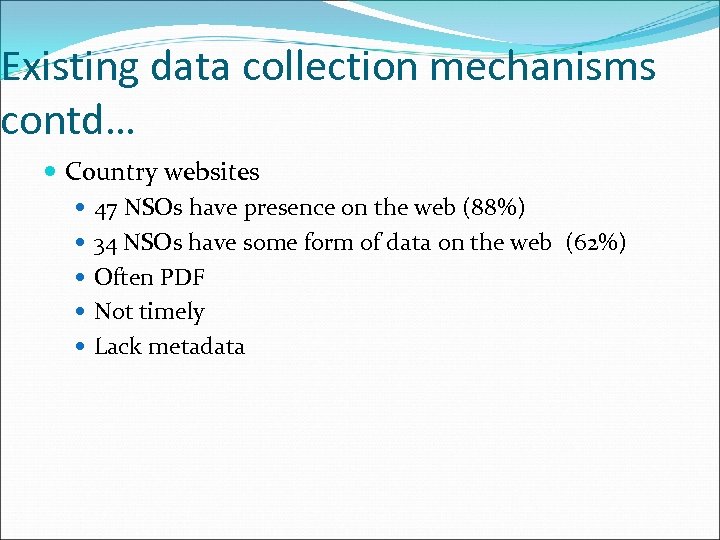 Existing data collection mechanisms contd… Country websites 47 NSOs have presence on the web (88%) 34 NSOs have some form of data on the web (62%) Often PDF Not timely Lack metadata
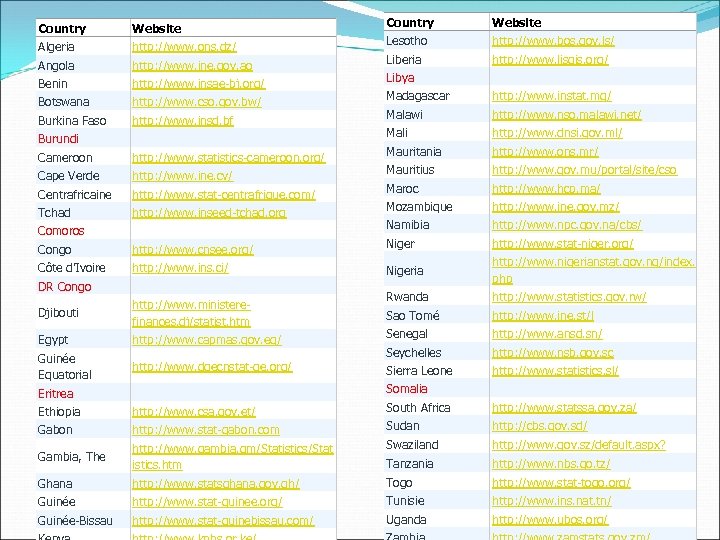 Country Website Lesotho http: //www. bos. gov. ls/ Liberia http: //www. lisgis. org/ Libya Madagascar http: //www. instat. mg/ Malawi http: //www. nso. malawi. net/ Mali http: //www. dnsi. gov. ml/ Mauritania http: //www. ons. mr/ Mauritius http: //www. gov. mu/portal/site/cso Maroc http: //www. hcp. ma/ Mozambique http: //www. ine. gov. mz/ Namibia http: //www. npc. gov. na/cbs/ http: //www. cnsee. org/ Niger http: //www. stat-niger. org/ Côte d’Ivoire http: //www. ins. ci/ Nigeria DR Congo http: //www. nigerianstat. gov. ng/index. php Rwanda http: //www. statistics. gov. rw/ Djibouti http: //www. ministerefinances. dj/statist. htm Sao Tomé http: //www. ine. st/l Egypt http: //www. capmas. gov. eg/ Senegal http: //www. ansd. sn/ Guinée Equatorial http: //www. dgecnstat-ge. org/ Seychelles http: //www. nsb. gov. sc Sierra Leone http: //www. statistics. sl/ Eritrea Somalia Ethiopia http: //www. csa. gov. et/ South Africa http: //www. statssa. gov. za/ Gabon http: //www. stat-gabon. com Sudan http: //cbs. gov. sd/ Gambia, The http: //www. gambia. gm/Statistics/Stat istics. htm Swaziland http: //www. gov. sz/default. aspx? Tanzania http: //www. nbs. go. tz/ Ghana http: //www. statsghana. gov. gh/ Togo http: //www. stat-togo. org/ Guinée http: //www. stat-guinee. org/ Tunisie http: //www. ins. nat. tn/ Guinée-Bissau http: //www. stat-guinebissau. com/ Uganda http: //www. ubos. org/ Country Website Algeria http: //www. ons. dz/ Angola http: //www. ine. gov. ao Benin http: //www. insae-bj. org/ Botswana http: //www. cso. gov. bw/ Burkina Faso http: //www. insd. bf Burundi Cameroon http: //www. statistics-cameroon. org/ Cape Verde http: //www. ine. cv/ Centrafricaine http: //www. stat-centrafrique. com/ Tchad http: //www. inseed-tchad. org Comoros Congo
 Existing data collection mechanisms (contd…) Informal Networks Breaks bureaucracy Fast for quick demand Not officially endorsed Ad-hoc
 Data sources Member states National statistical offices Central banks Ministries and national authorities United Nations specialized agencies International Organizations IMF World Bank NGOs
 Data needs Economic Trade Social Statistics Finance and Monetary Infrastructure MDGs …. .
 Coordination RRSF ASCC The joint African Statistical Yearbook A joint Statistical Database Africa. Info
 RRSF The Reference Regional Strategic Framework for Statistical Capacity Building in Africa (RRSF) External Stakeholders: Sub-regional organizations, international agencies and organizations and bilateral donors Stakeholders use nationally produced Statistics. Over the years, provided technical and financial assistance to African countries to build statistical capacity and collect various types of statistical data. Have important stake in Africa’s national statistical systems.
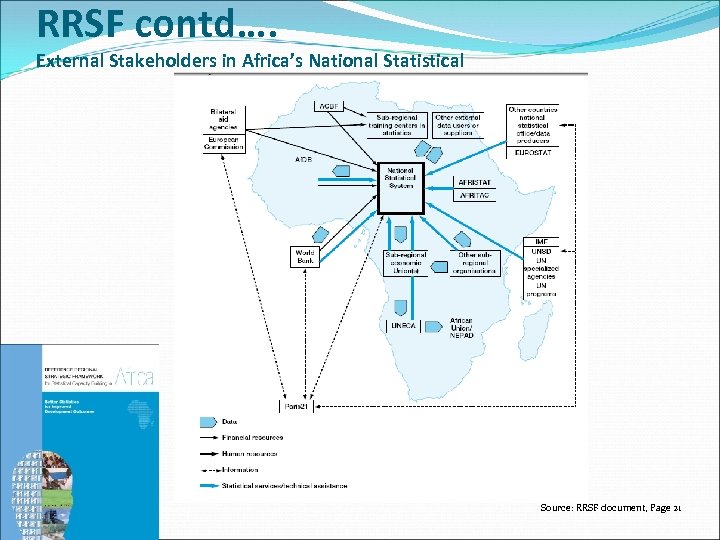 RRSF contd…. External Stakeholders in Africa’s National Statistical Source: RRSF document, Page 21
 RRSF contd…. Recommendations of RRSF related to data: 14. Create an inter-ministerial committee of users and sectoral producers, chaired by a high-level person, that would meet regularly, and technical working groups or task forces for key sectoral areas to determine the core set of national statistics to produce 16. Identify the minimum data sets that meet the priority needs for each economic/policy sector, keeping in mind the costs of and capacities available to produce data on a sustainable basis 17. Use a balanced mix of administrative records, censuses, and sample surveys to meet the priority data needs of key data users in a timely, cost-effective and efficient manner so as to produce data of adequate quality 19. Evaluate each new data request to determine the extent to which it can be met by available administrative records without resorting to a new or expanded sample survey 20. Negotiate with the custodians of administrative information to determine how the data can be shared within the legal framework
 ASCC The African Statistical Coordination Committee Following the successful design of RRSF, major regional institutions Af. DB, AUC, ACBF, UNECA agreed that their respective statistical activities to be coordinated Formed ASCC in 2007. The ASCC meets annually The ASCC reports to management of respective institutions and to the Statistical Commission Africa (Stat. Com-Africa) Terms of reference include: Reviewing statistical programmes in Africa; Organizing joint statistical programmes; Organizing expert groups and meetings; and Publishing a joint African Statistical Yearbook.
 The African Statistical Yearbook History of ASYB was an annual publication by respective organizations ASYB publications started in 1972 ECA has been publishing the ASYB on its own until 2008 African Statistical Coordination Committee Joint statistical yearbook and Joint statistical database
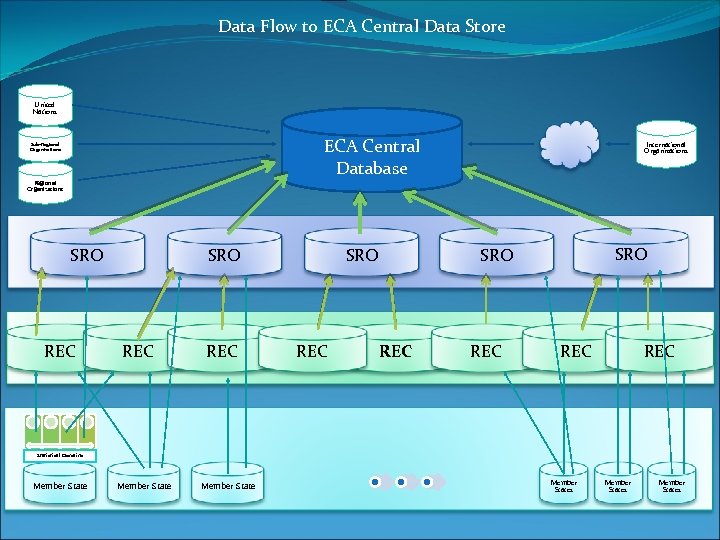 Data Flow to ECA Central Data Store United Nations ECA Central Database Sub-Regional Organizations International Organizations Regional Organizations SRO REC REC SRO SRO REC REC Statistical Domains Member States Member States
 Data collection burden on countries Without collaboration and co-ordination, countries would be continually burdened by similar data requests and the indicators Data release calendars Creation of Data-hub at NSOs Push and pull models in data provision Push Model: NSO notifies clients that data is available Pull model: Clients make data request to NSO
 Increase use of technology Automatic ways of data capturing Development of country and sub-regional database Use of web which is an inexpensive means data exchange SDMX
 Data collection from Internet sources Lack of standard Not regularly updated Often PDF
 Data exchange standards SDMX Statistical Data and Metadata Exchange 7 institutions sponsoring ISO Recommendation Since 2001 Macro/Aggregate data DDI Data Document Initiative Microdata IHSN
 Data quality Putting in place a range of quality assurance instruments in different stages of data compilation. RRSF 47. Undertake methodological research and development to enhance data quality Data validation mechanisms
 Metadata Often forgotten As important as the data assisting to understand the concepts Assisting in analysis, interpretation assisting search and navigation Difficult to use data without it RRSF 6. Develop documentation on statistical standards and methodologies applied in data collection
 Conclusions Overlapping of RECs and SROs All required domains are not covered by RECs Metadata Use of IT tools Lack of human resources related to statistics for coordination of statistical compilation No databases at NSO and SROs