


 Скачать презентацию Data Communication and Networks Lecture 10 Network Congestion
06e9d8a55fdbc77292dd1bac22aaa016.ppt
- Количество слайдов: 23
 Data Communication and Networks Lecture 10 Network Congestion: Causes, Effects, Controls November 17, 2005 Transport Layer 1
 What Is Congestion? r Congestion occurs when the number of packets r r r being transmitted through the network approaches the packet handling capacity of the network Congestion control aims to keep number of packets below level at which performance falls off dramatically Data network is a network of queues Generally 80% utilization is critical Finite queues mean data may be lost A top-10 problem! Transport Layer 2
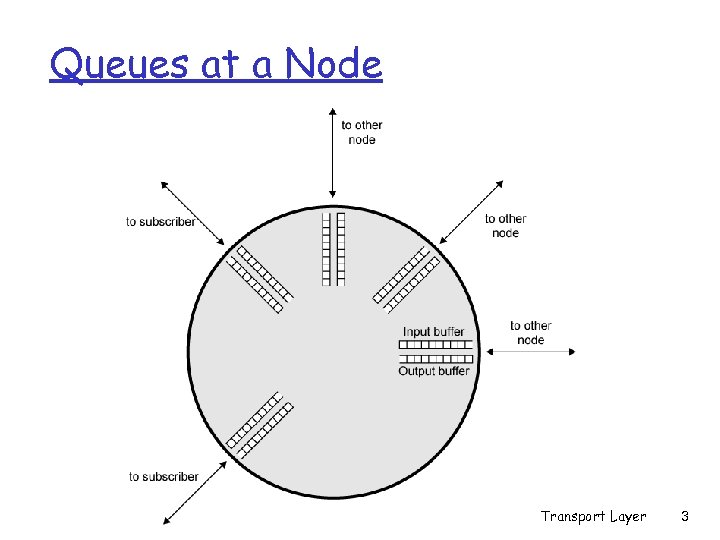 Queues at a Node Transport Layer 3
 Effects of Congestion r Packets arriving are stored at input buffers r Routing decision made r Packet moves to output buffer r Packets queued for output transmitted as fast as possible m Statistical time division multiplexing r If packets arrive to fast to be routed, or to be output, buffers will fill r Can discard packets r Can use flow control m Can propagate congestion through network Transport Layer 4
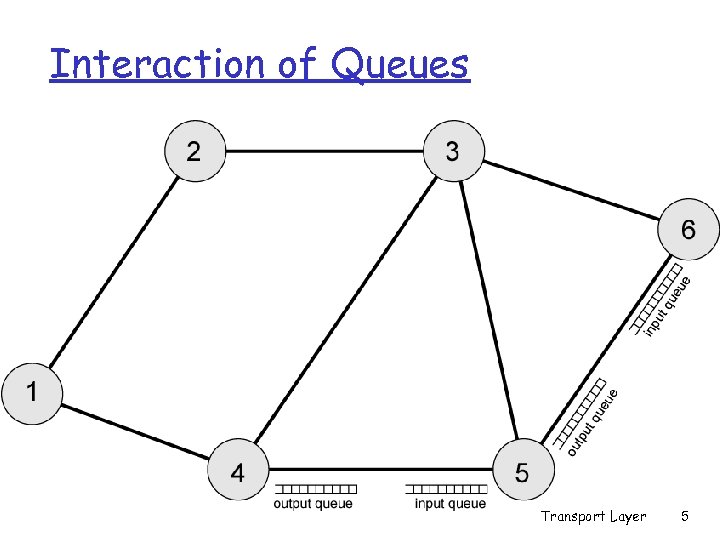 Interaction of Queues Transport Layer 5
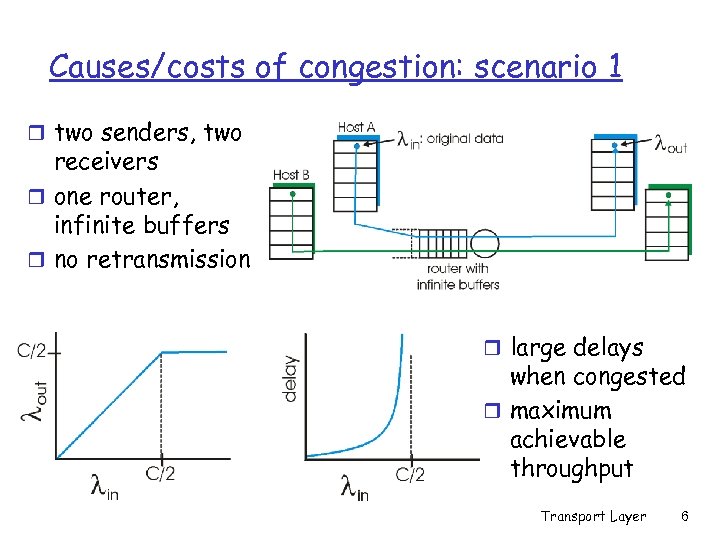 Causes/costs of congestion: scenario 1 r two senders, two receivers r one router, infinite buffers r no retransmission r large delays when congested r maximum achievable throughput Transport Layer 6
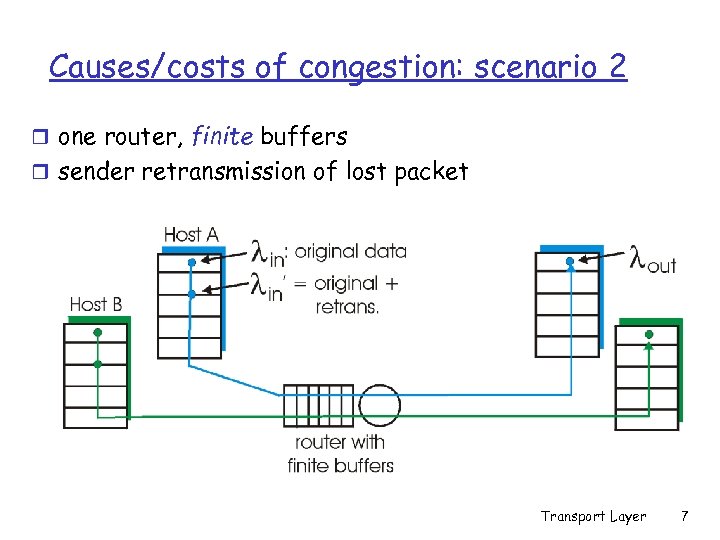 Causes/costs of congestion: scenario 2 r one router, finite buffers r sender retransmission of lost packet Transport Layer 7
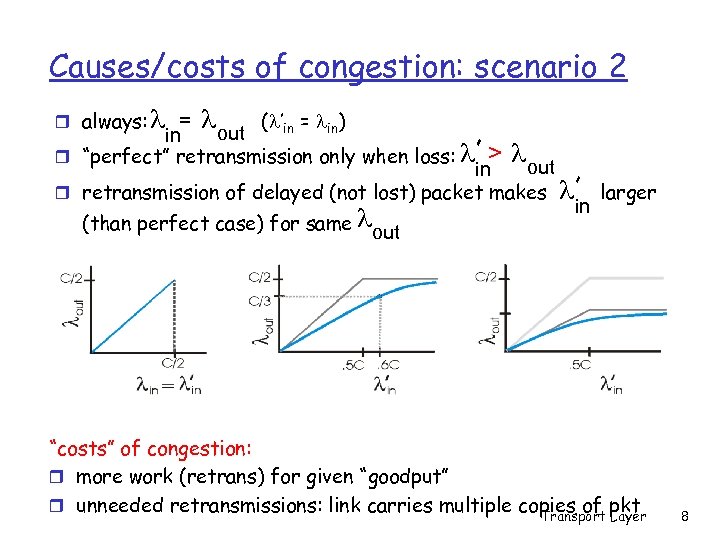 Causes/costs of congestion: scenario 2 = ( ’in = in) out in r “perfect” retransmission only when loss: r always: > out in r retransmission of delayed (not lost) packet makes (than perfect case) for same out in larger “costs” of congestion: r more work (retrans) for given “goodput” r unneeded retransmissions: link carries multiple copies of pkt Transport Layer 8
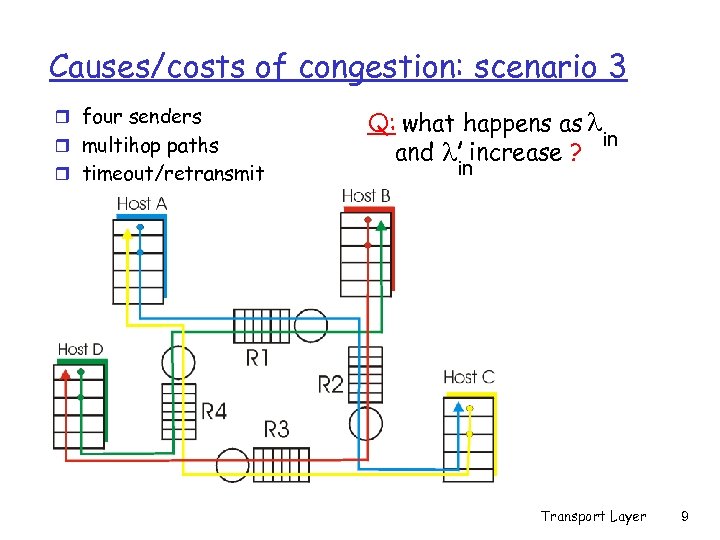 Causes/costs of congestion: scenario 3 r four senders r multihop paths r timeout/retransmit Q: what happens as in and increase ? in Transport Layer 9
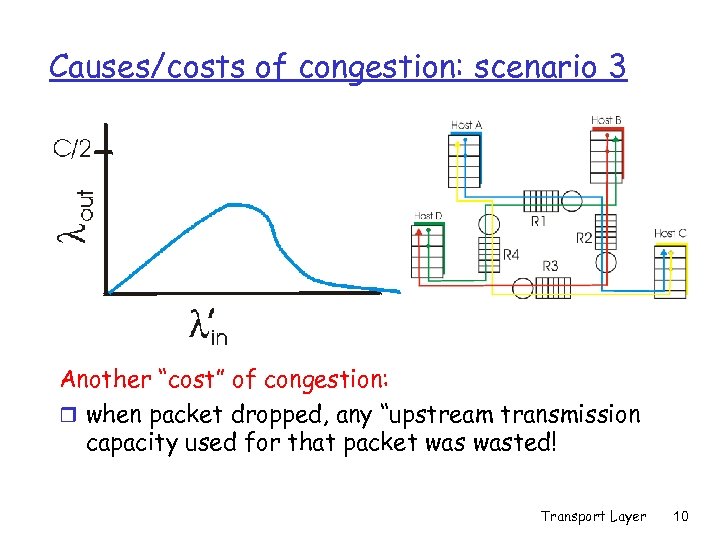 Causes/costs of congestion: scenario 3 Another “cost” of congestion: r when packet dropped, any “upstream transmission capacity used for that packet wasted! Transport Layer 10
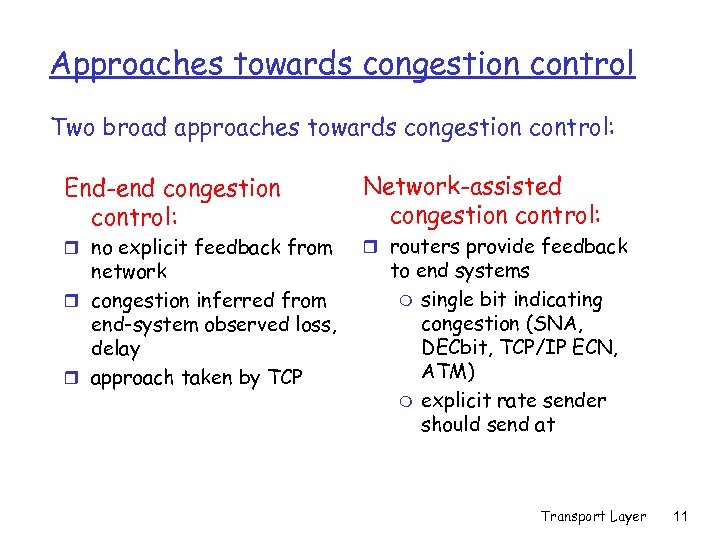 Approaches towards congestion control Two broad approaches towards congestion control: End-end congestion control: r no explicit feedback from network r congestion inferred from end-system observed loss, delay r approach taken by TCP Network-assisted congestion control: r routers provide feedback to end systems m single bit indicating congestion (SNA, DECbit, TCP/IP ECN, ATM) m explicit rate sender should send at Transport Layer 11
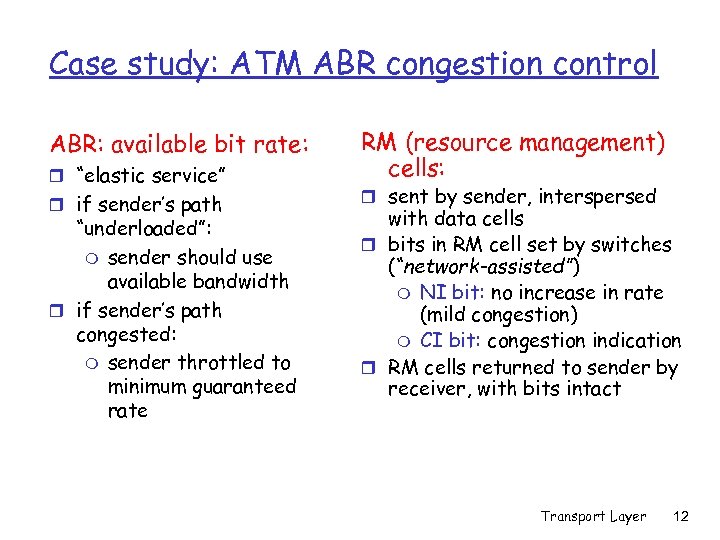 Case study: ATM ABR congestion control ABR: available bit rate: r “elastic service” r if sender’s path “underloaded”: m sender should use available bandwidth r if sender’s path congested: m sender throttled to minimum guaranteed rate RM (resource management) cells: r sent by sender, interspersed with data cells r bits in RM cell set by switches (“network-assisted”) m NI bit: no increase in rate (mild congestion) m CI bit: congestion indication r RM cells returned to sender by receiver, with bits intact Transport Layer 12
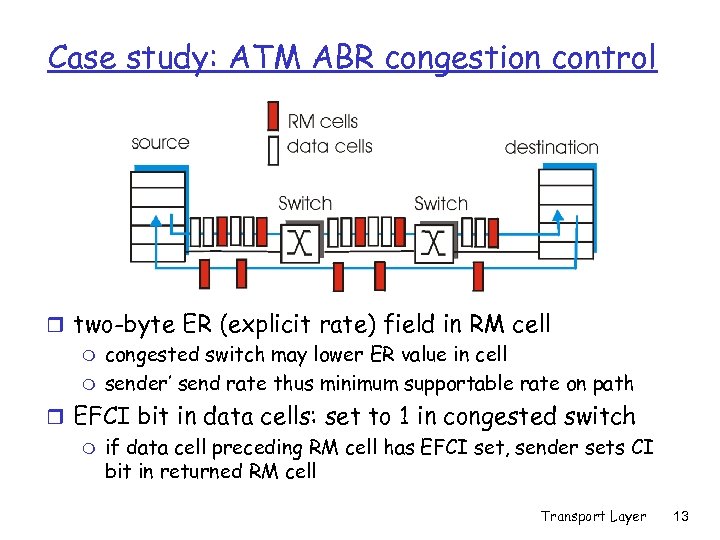 Case study: ATM ABR congestion control r two-byte ER (explicit rate) field in RM cell m congested switch may lower ER value in cell m sender’ send rate thus minimum supportable rate on path r EFCI bit in data cells: set to 1 in congested switch m if data cell preceding RM cell has EFCI set, sender sets CI bit in returned RM cell Transport Layer 13
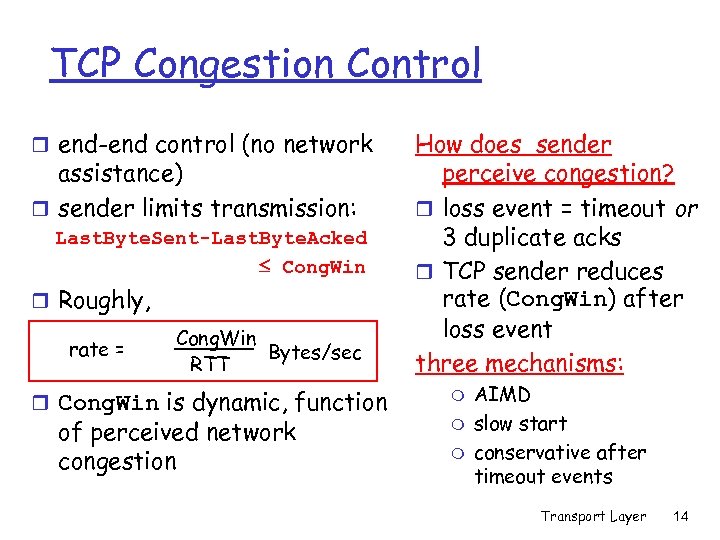 TCP Congestion Control r end-end control (no network assistance) r sender limits transmission: Last. Byte. Sent-Last. Byte. Acked Cong. Win r Roughly, rate = Cong. Win Bytes/sec RTT r Cong. Win is dynamic, function of perceived network congestion How does sender perceive congestion? r loss event = timeout or 3 duplicate acks r TCP sender reduces rate (Cong. Win) after loss event three mechanisms: m m m AIMD slow start conservative after timeout events Transport Layer 14
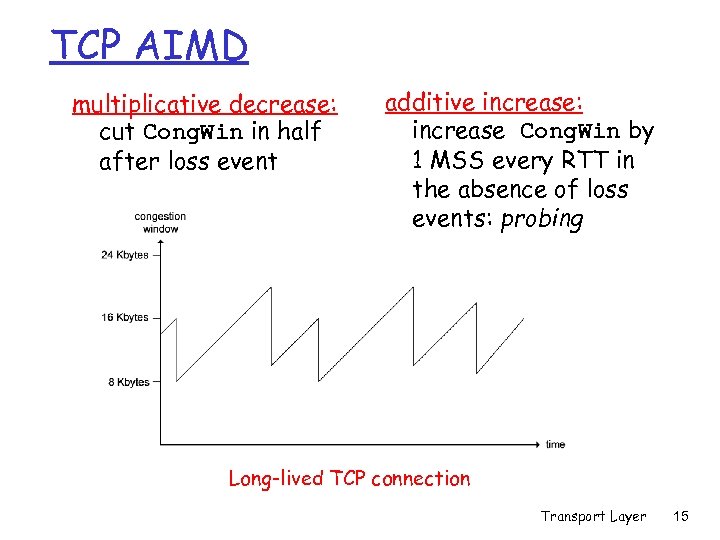 TCP AIMD multiplicative decrease: cut Cong. Win in half after loss event additive increase: increase Cong. Win by 1 MSS every RTT in the absence of loss events: probing Long-lived TCP connection Transport Layer 15
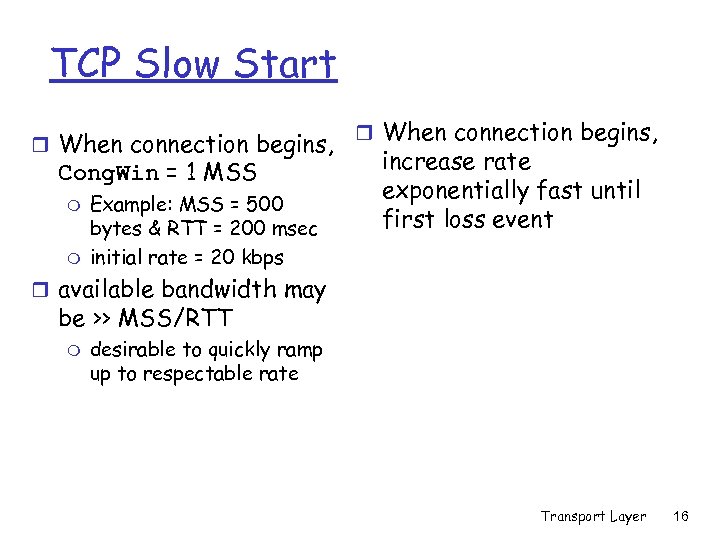 TCP Slow Start r When connection begins, Cong. Win = 1 MSS m m Example: MSS = 500 bytes & RTT = 200 msec initial rate = 20 kbps r When connection begins, increase rate exponentially fast until first loss event r available bandwidth may be >> MSS/RTT m desirable to quickly ramp up to respectable rate Transport Layer 16
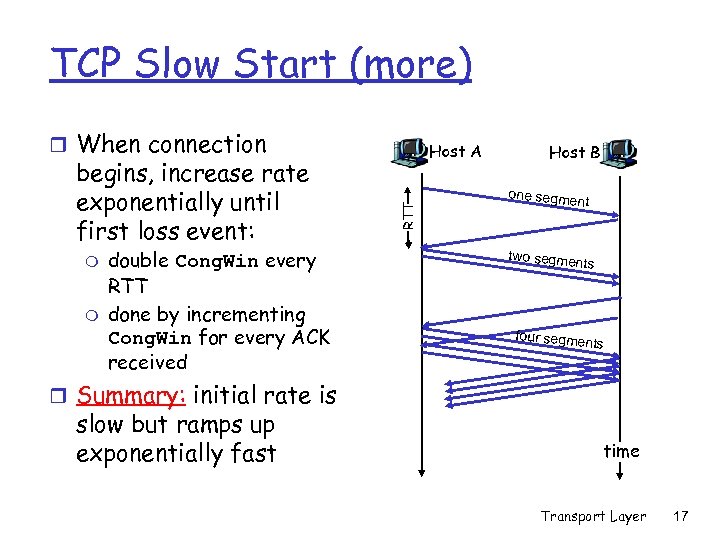 TCP Slow Start (more) r When connection m m double Cong. Win every RTT done by incrementing Cong. Win for every ACK received RTT begins, increase rate exponentially until first loss event: Host A Host B one segme nt two segme nts four segme nts r Summary: initial rate is slow but ramps up exponentially fast time Transport Layer 17
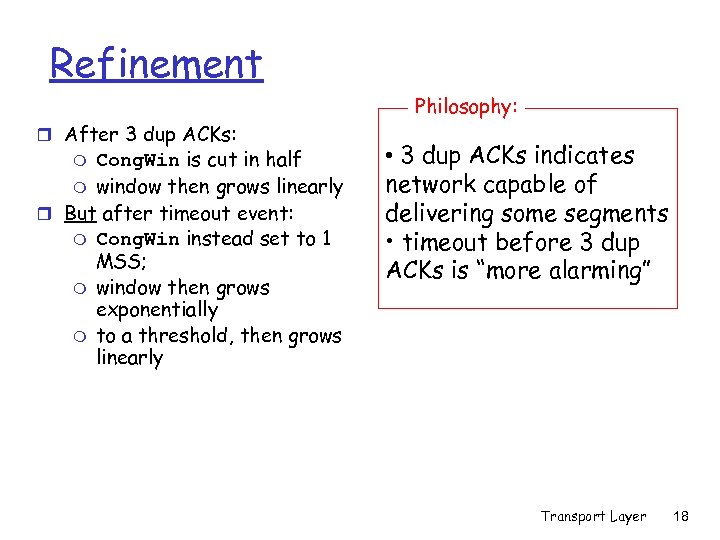 Refinement Philosophy: r After 3 dup ACKs: Cong. Win is cut in half m window then grows linearly r But after timeout event: m Cong. Win instead set to 1 MSS; m window then grows exponentially m to a threshold, then grows linearly m • 3 dup ACKs indicates network capable of delivering some segments • timeout before 3 dup ACKs is “more alarming” Transport Layer 18
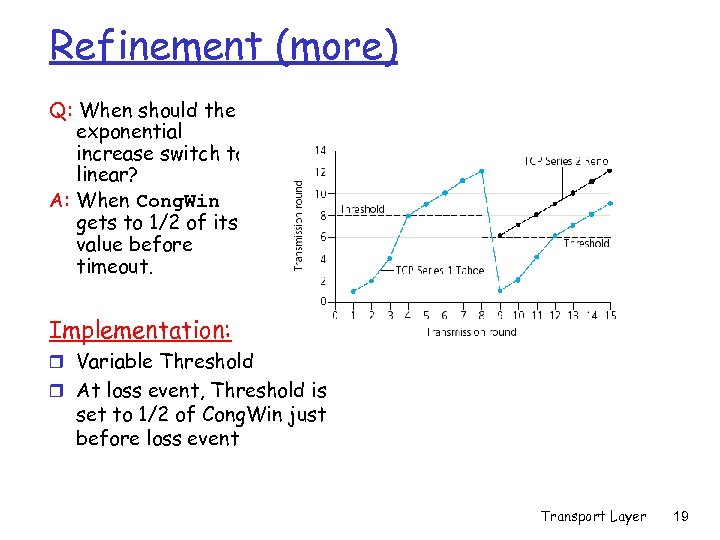 Refinement (more) Q: When should the exponential increase switch to linear? A: When Cong. Win gets to 1/2 of its value before timeout. Implementation: r Variable Threshold r At loss event, Threshold is set to 1/2 of Cong. Win just before loss event Transport Layer 19
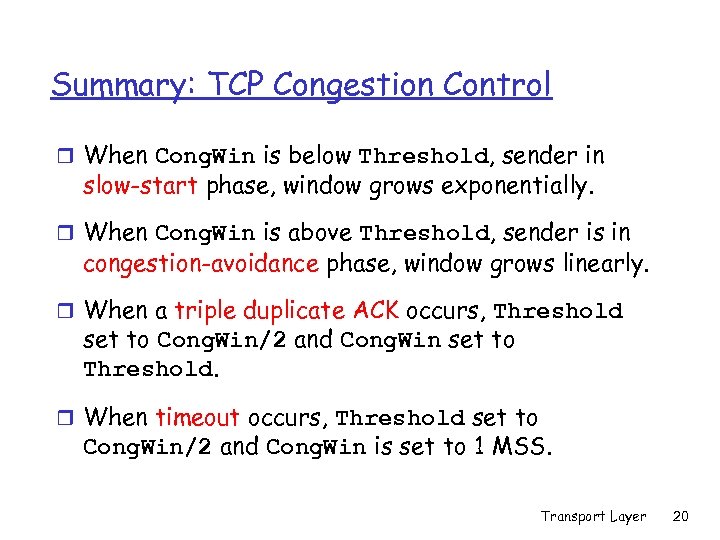 Summary: TCP Congestion Control r When Cong. Win is below Threshold, sender in slow-start phase, window grows exponentially. r When Cong. Win is above Threshold, sender is in congestion-avoidance phase, window grows linearly. r When a triple duplicate ACK occurs, Threshold set to Cong. Win/2 and Cong. Win set to Threshold. r When timeout occurs, Threshold set to Cong. Win/2 and Cong. Win is set to 1 MSS. Transport Layer 20
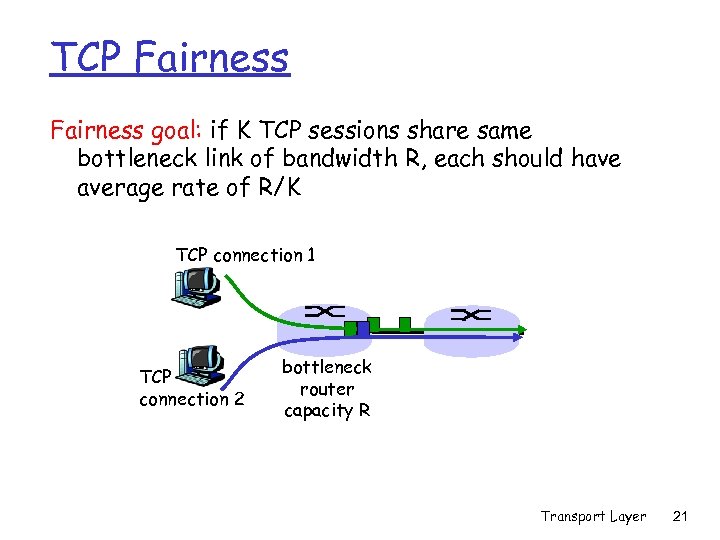 TCP Fairness goal: if K TCP sessions share same bottleneck link of bandwidth R, each should have average rate of R/K TCP connection 1 TCP connection 2 bottleneck router capacity R Transport Layer 21
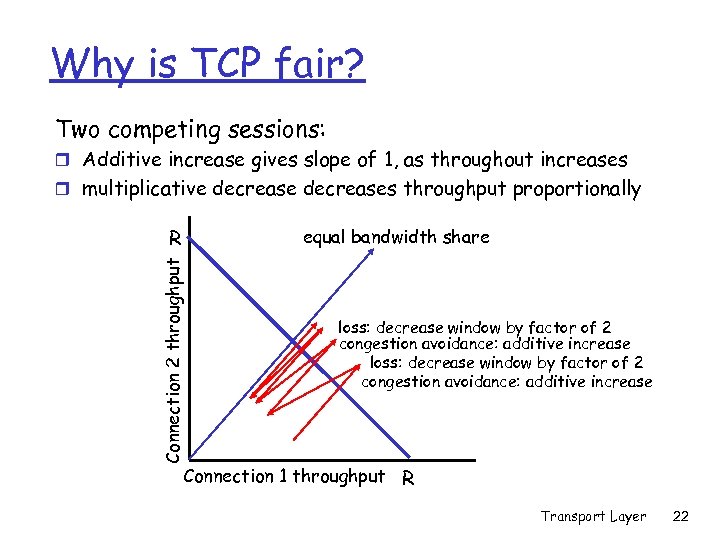 Why is TCP fair? Two competing sessions: r Additive increase gives slope of 1, as throughout increases r multiplicative decreases throughput proportionally equal bandwidth share Connection 2 throughput R loss: decrease window by factor of 2 congestion avoidance: additive increase Connection 1 throughput R Transport Layer 22
 Fairness (more) Fairness and UDP r Multimedia apps often do not use TCP m do not want rate throttled by congestion control r Instead use UDP: m pump audio/video at constant rate, tolerate packet loss r Research area: TCP friendly Fairness and parallel TCP connections r nothing prevents app from opening parallel cnctions between 2 hosts. r Web browsers do this r Example: link of rate R supporting 9 cnctions; m m new app asks for 1 TCP, gets rate R/10 new app asks for 11 TCPs, gets R/2 ! Transport Layer 23