


 Скачать презентацию Data and Computer Communications Chapter 14 Cellular
0385fd25aba5414d894f000d0a331894.ppt
- Количество слайдов: 70
 Data and Computer Communications Chapter 14 – Cellular Wireless Networks Eighth Edition by William Stallings Lecture slides by Lawrie Brown
 Cellular Wireless Networks key technology for mobiles, wireless nets etc Ø developed to increase mobile phone capacity Ø based on multiple low power transmitters Ø area divided into cells Ø l l l in a tiling pattern to provide full coverage each with own antenna each with own range of frequencies served by base station adjacent cells use different frequencies to avoid crosstalk
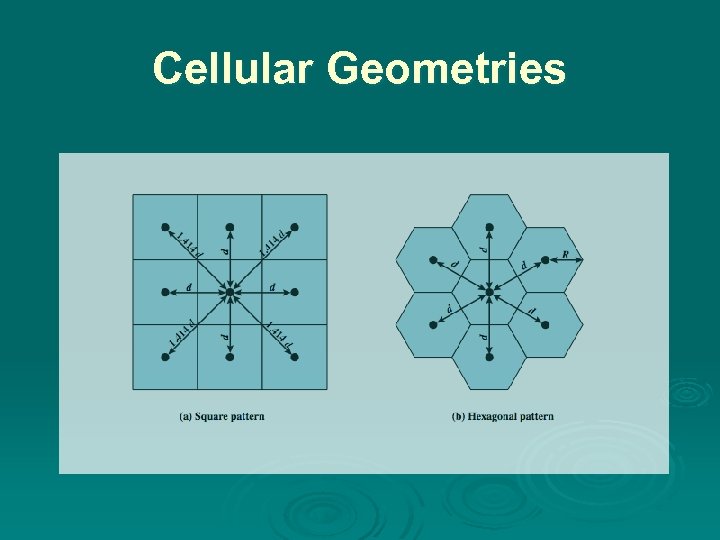 Cellular Geometries
 Frequency Reuse must manage reuse of frequencies Ø power of base transceiver controlled Ø l l l allow communications within cell on given frequency limit escaping power to adjacent cells allow re-use of frequencies in nearby cells typically 10 – 50 frequencies per cell example for Advanced Mobile Phone Service (AMPS) • • N cells all using same number of frequencies K total number of frequencies used in systems each cell has K/N frequencies K=395, N=7 giving 57 frequencies per cell on average
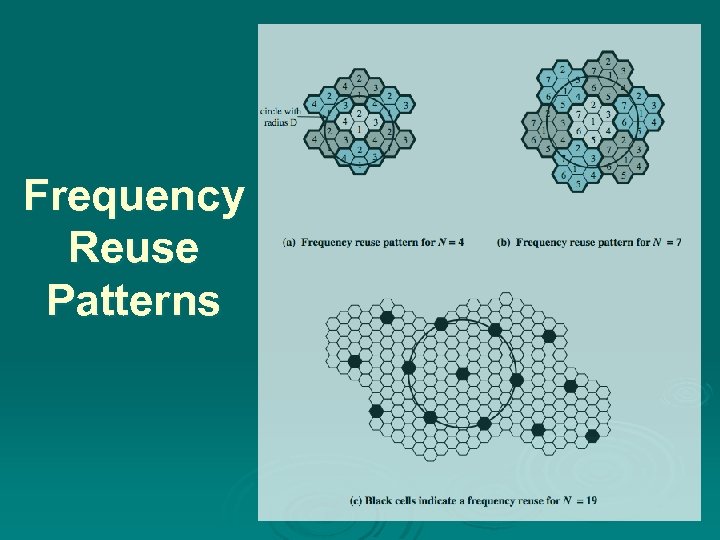 Frequency Reuse Patterns
 Increasing Capacity Ø add new channels l not all channels used to start with Ø frequency borrowing l l taken from adjacent cells by congested cells or assign frequencies dynamically Ø cell splitting l l non-uniform topography and traffic distribution use smaller cells in high use areas
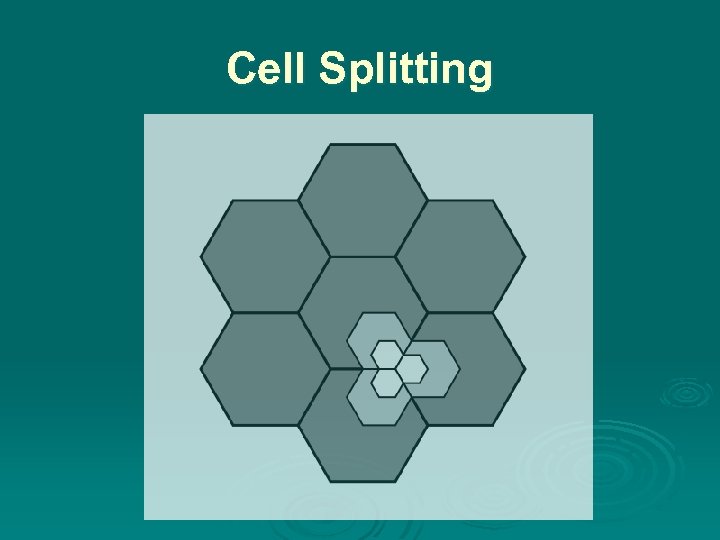 Cell Splitting
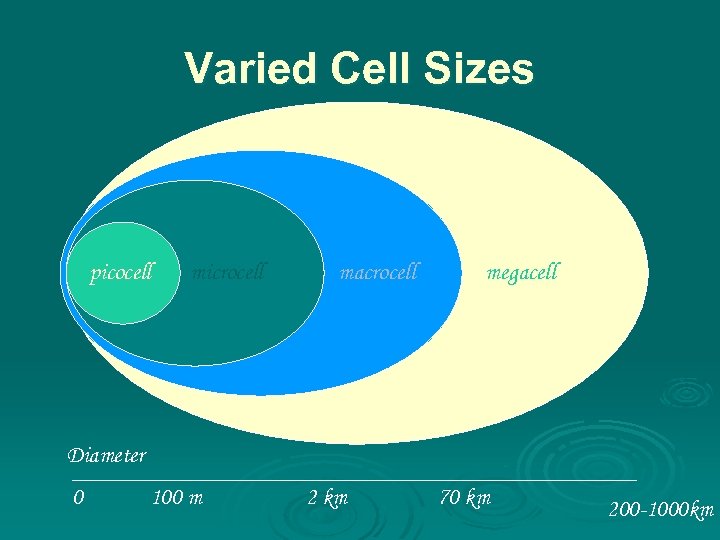 Varied Cell Sizes picocell microcell macrocell megacell Diameter 0 100 m 2 km 70 km 200 -1000 km
 Increasing Capacity Ø cell sectoring l l l Ø cell divided into wedge shaped sectors (3– 6 per cell) each with own channel set directional antennas microcells l l l move antennas from tops of hills and large buildings to tops of small buildings and sides of large buildings use reduced power to cover a much smaller area good for city streets, roads, inside large buildings
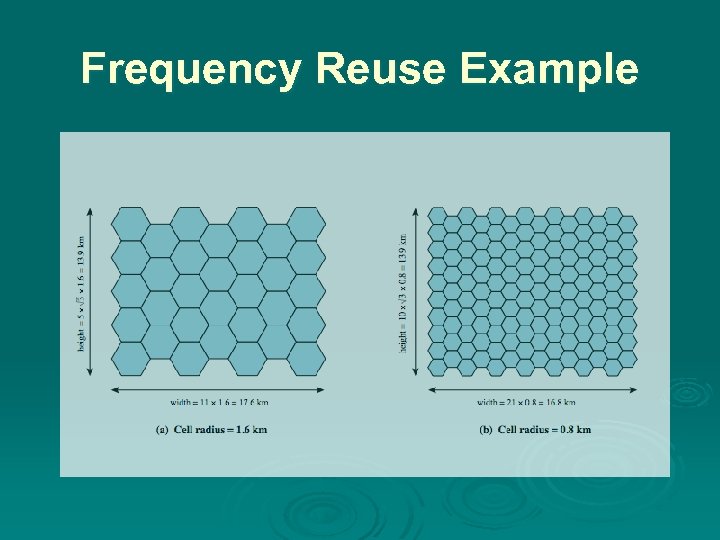 Frequency Reuse Example
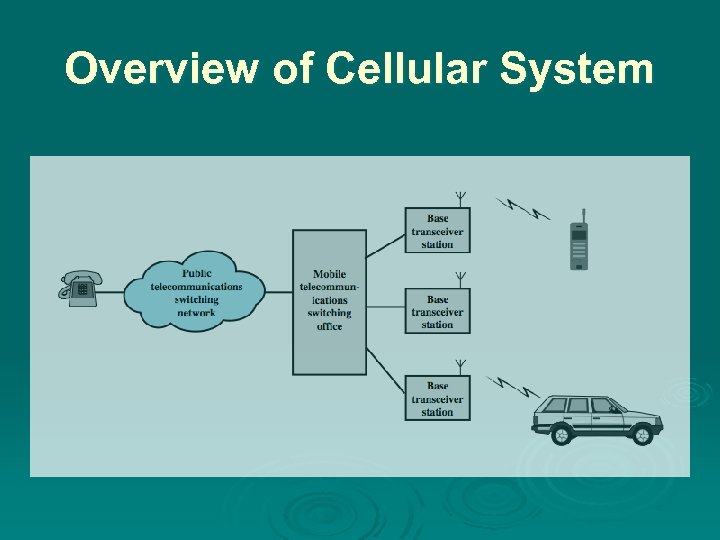 Overview of Cellular System
 Cellular System Channels Ø system is fully automated Ø see two types of channels between mobile and base station (BS) Ø control channels l l set up and maintain calls establish relationship between mobile unit and nearest BS Ø traffic channels l carry voice and data
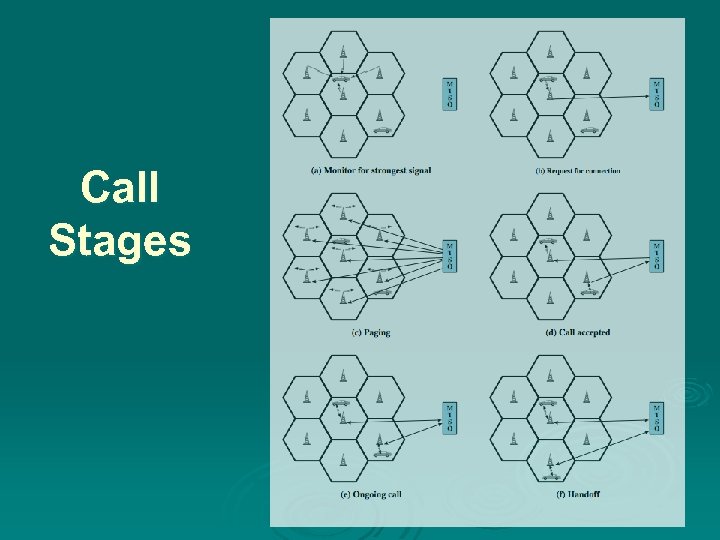 Call Stages
 Other Functions Ø call blocking l Ø call termination l Ø when user hangs up call drop l Ø if all traffic channels busy when BS cannot maintain required signal strength calls to/from fixed and remote mobile subscriber l l MTSO connects mobile user and fixed line via PSTN MTSO connects to remote MTSO via PSTN or dedicated lines
 Mobile Radio Propagation Effects Ø signal strength l l l Ø strength of signal between BS and mobile unit strong enough to maintain signal quality at the receiver not too strong to create cochannel interference must handle variations in noise fading l l l time variation of received signal caused by changes in transmission path(s) even if signal strength in effective range, signal propagation effects may disrupt the signal
 Design Factors propagation effects Ø max transmit power level at BS and mobile units Ø typical height of mobile unit antenna Ø available height of the BS antenna Ø these factors determine size of individual cell Ø use model based on empirical data Ø eg. model by Okumura et al & refined by Hata Ø l l l detailed analysis of tokyo area produced path loss info for an urban environment Hata's model is an empirical formulation
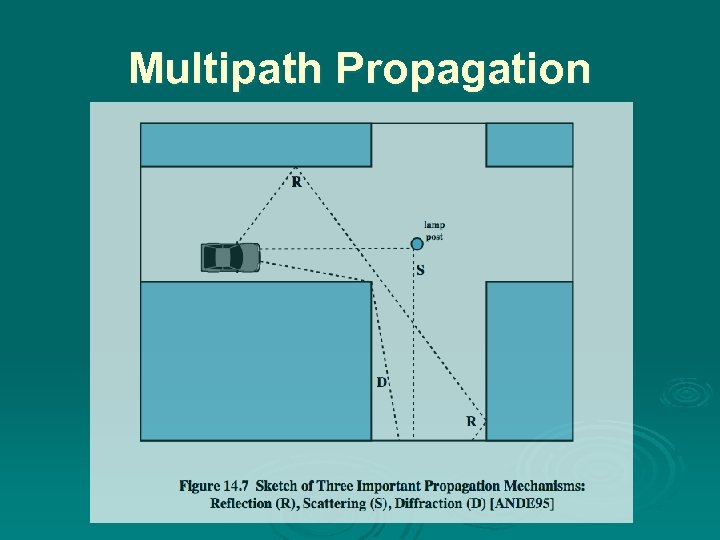 Multipath Propagation
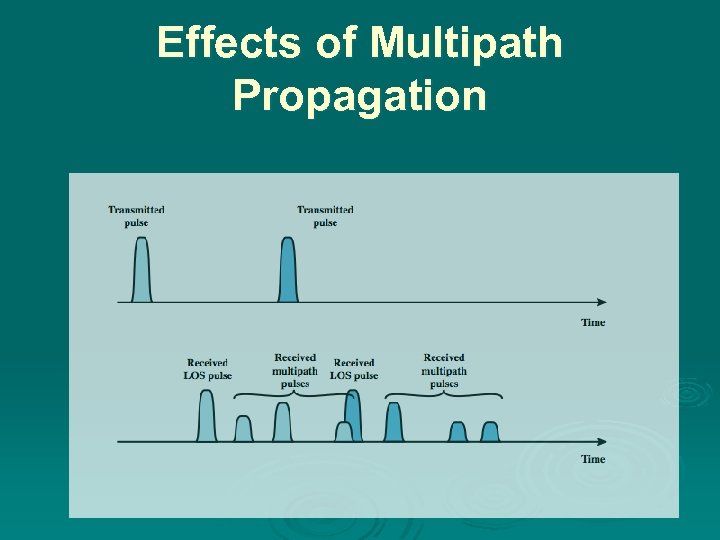 Effects of Multipath Propagation
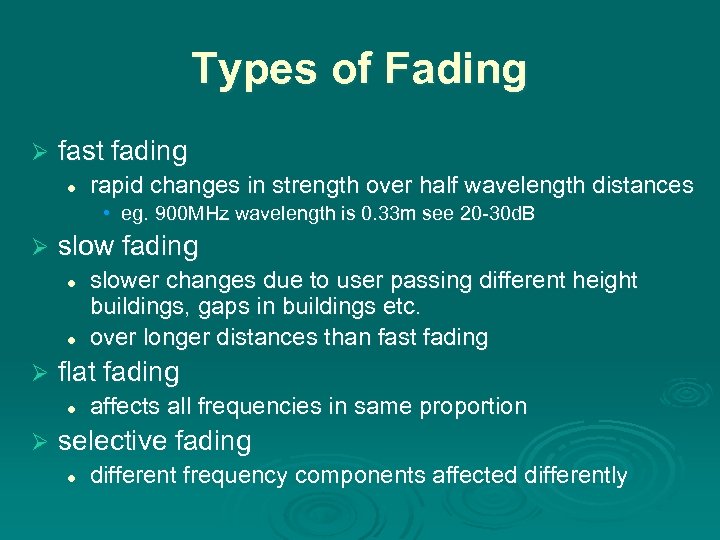 Types of Fading Ø fast fading l rapid changes in strength over half wavelength distances • eg. 900 MHz wavelength is 0. 33 m see 20 -30 d. B Ø slow fading l l Ø flat fading l Ø slower changes due to user passing different height buildings, gaps in buildings etc. over longer distances than fast fading affects all frequencies in same proportion selective fading l different frequency components affected differently
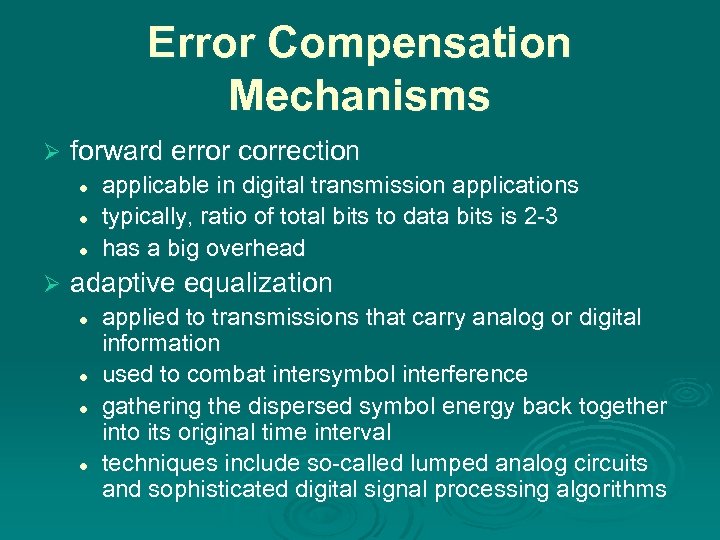 Error Compensation Mechanisms Ø forward error correction l l l Ø applicable in digital transmission applications typically, ratio of total bits to data bits is 2 -3 has a big overhead adaptive equalization l l applied to transmissions that carry analog or digital information used to combat intersymbol interference gathering the dispersed symbol energy back together into its original time interval techniques include so-called lumped analog circuits and sophisticated digital signal processing algorithms
 Error Compensation Mechanisms Ø diversity l l l l based on fact that individual channels experience independent fading events use multiple logical channels between transmitter and receiver send part of signal over each channel doesn’t eliminate errors reduce error rate equalization, forward error correction then cope with reduced error rate space diversity involves physical transmission paths more commonly refers to frequency or time diversity
 First Generation Analog Ø original cellular telephone networks Ø analog traffic channels Ø early 1980 s in North America Ø Advanced Mobile Phone Service (AMPS) Ø also common in South America, Australia, and China Ø replaced by later generation systems
 AMPS Spectral Allocation In North America Ø two 25 -MHz bands are allocated to AMPS l l Ø Ø Ø Ø from BS to mobile unit (869– 894 MHz) from mobile to base station (824– 849 MHz) bands is split in two to encourage competition operator is allocated only 12. 5 MHz in each direction channels spaced 30 k. Hz apart (416 channels / operator) control channels are 10 kbps data channels voice channels carry analog using frequency modulation control info also sent on voice channels in bursts as data number of channels inadequate for most major markets for AMPS, frequency reuse is exploited
 Operation Ø AMPS-capable phone has numeric assignment module (NAM) in read-only memory l l l NAM contains number of phone serial number of phone when phone turned on, transmits serial number and phone number to MTSO has database of mobile units reported stolen MTSO uses phone number for billing if phone is used in remote city, service is still billed to user's local service provider
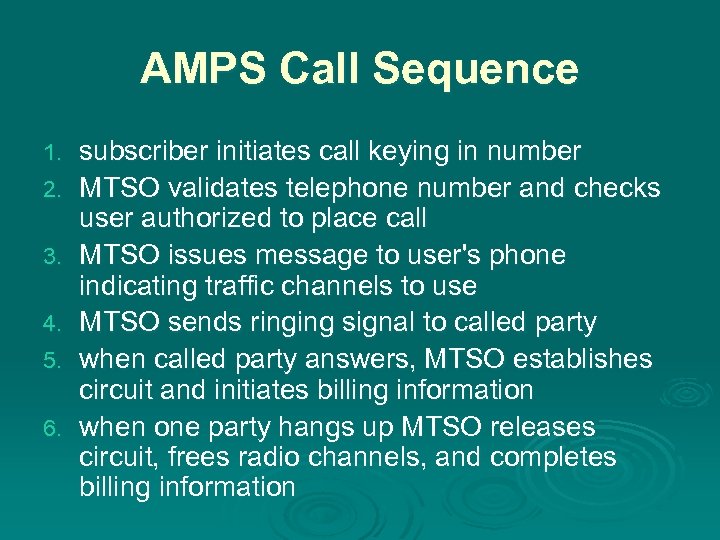 AMPS Call Sequence 1. 2. 3. 4. 5. 6. subscriber initiates call keying in number MTSO validates telephone number and checks user authorized to place call MTSO issues message to user's phone indicating traffic channels to use MTSO sends ringing signal to called party when called party answers, MTSO establishes circuit and initiates billing information when one party hangs up MTSO releases circuit, frees radio channels, and completes billing information
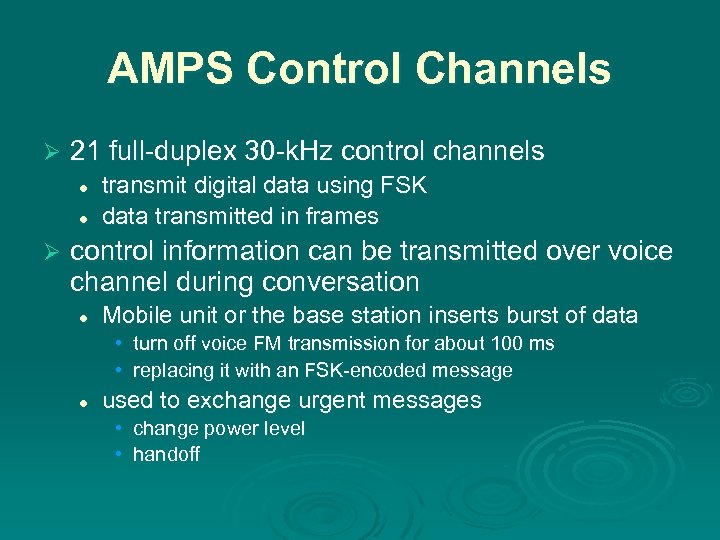 AMPS Control Channels Ø 21 full-duplex 30 -k. Hz control channels l l Ø transmit digital data using FSK data transmitted in frames control information can be transmitted over voice channel during conversation l Mobile unit or the base station inserts burst of data • turn off voice FM transmission for about 100 ms • replacing it with an FSK-encoded message l used to exchange urgent messages • change power level • handoff
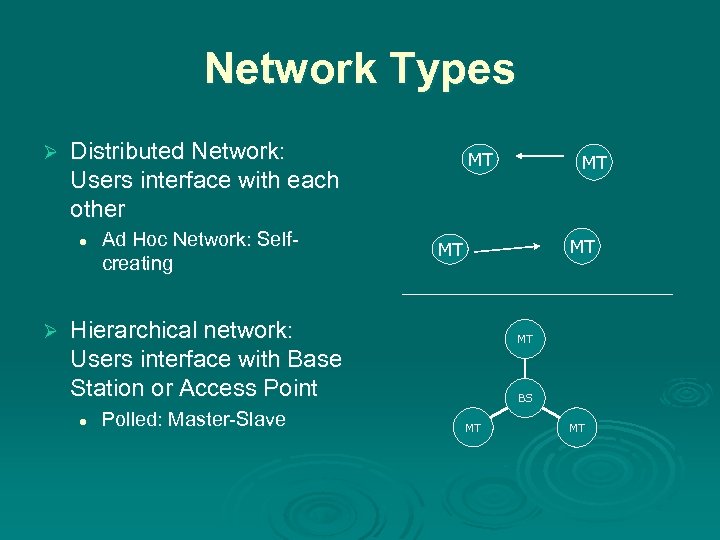 Network Types Ø Distributed Network: Users interface with each other l Ø Ad Hoc Network: Selfcreating MT MT MT Hierarchical network: Users interface with Base Station or Access Point l Polled: Master-Slave MT MT BS MT MT
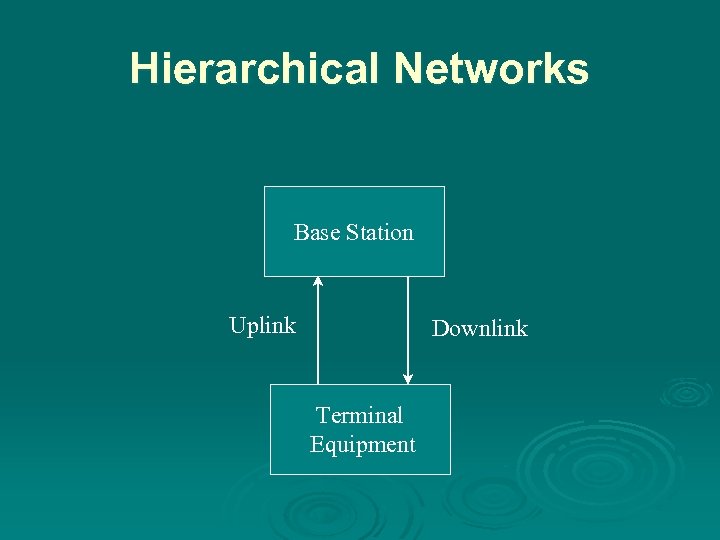 Hierarchical Networks Base Station Uplink Downlink Terminal Equipment
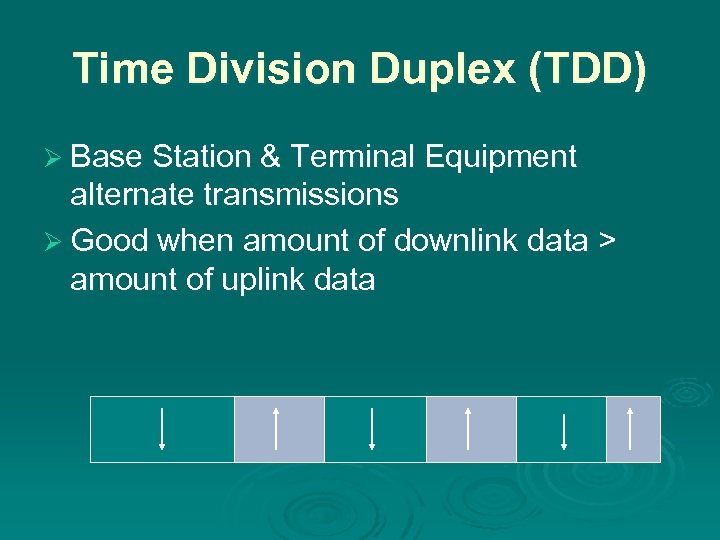 Time Division Duplex (TDD) Ø Base Station & Terminal Equipment alternate transmissions Ø Good when amount of downlink data > amount of uplink data
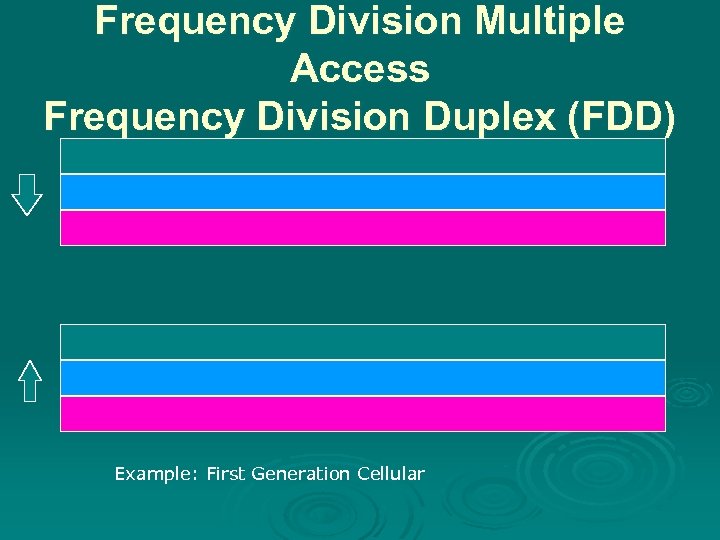 Frequency Division Multiple Access Frequency Division Duplex (FDD) Example: First Generation Cellular
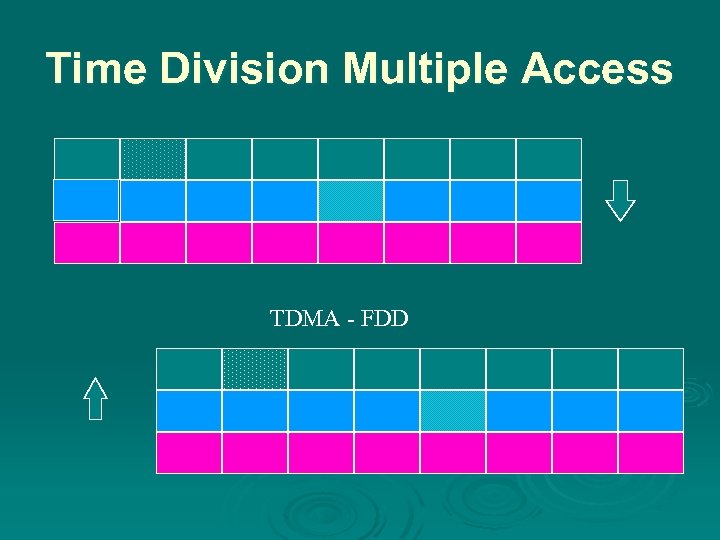 Time Division Multiple Access TDMA - FDD
 Time Division Multiple Access Ø Channels allocated by Frequency & Timeslot Ø A Multiframe defines who & what transmits during a timeslot (E. g. : ) l l Broadcast / Paging / Synchronization Channel Random Access Channel Signaling Channels Traffic Channel
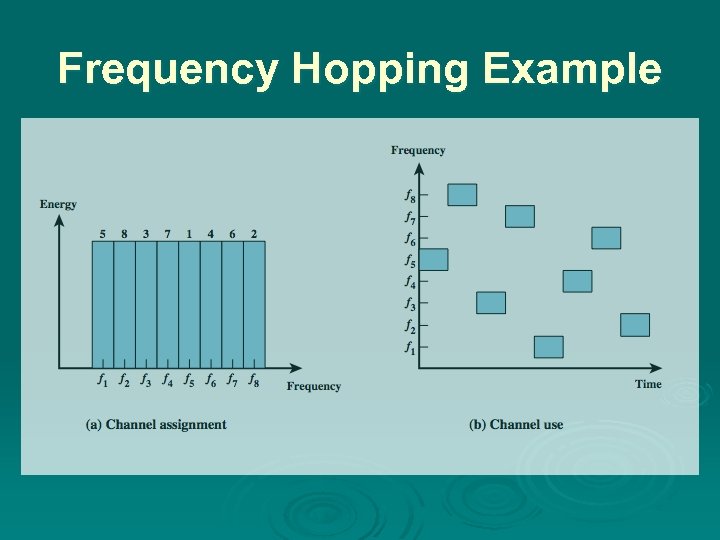
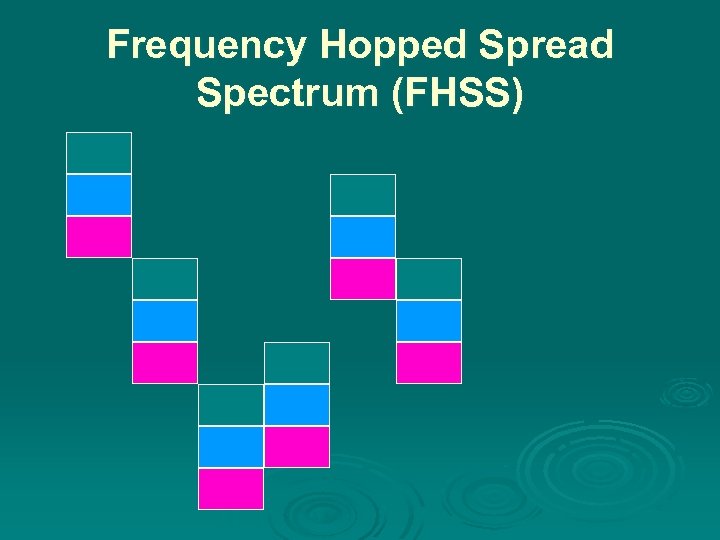 Frequency Hopped Spread Spectrum (FHSS)
 EDGE Technology
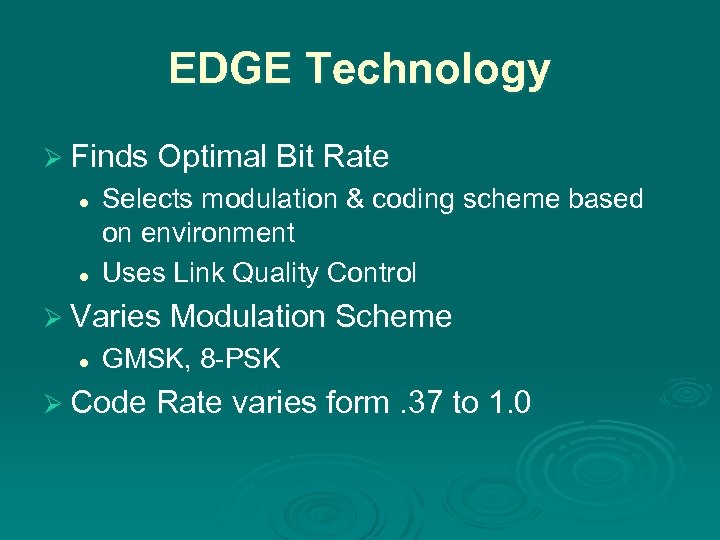 EDGE Technology Ø Finds Optimal Bit Rate l l Selects modulation & coding scheme based on environment Uses Link Quality Control Ø Varies Modulation Scheme l GMSK, 8 -PSK Ø Code Rate varies form. 37 to 1. 0
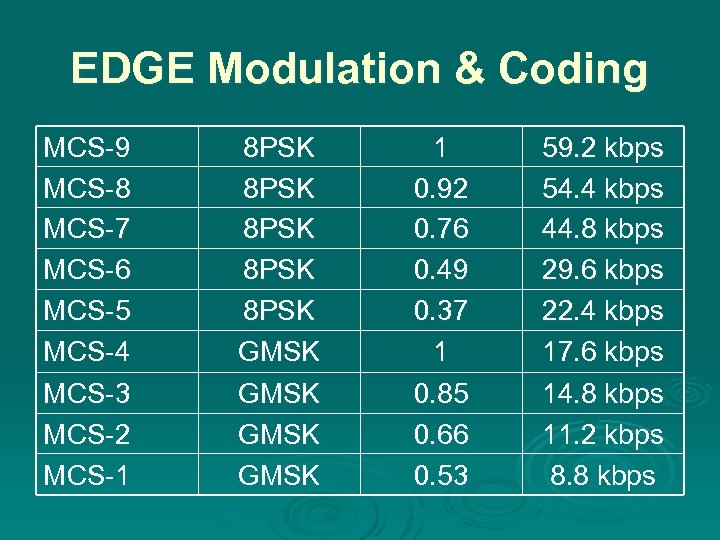 EDGE Modulation & Coding MCS-9 MCS-8 MCS-7 MCS-6 MCS-5 MCS-4 MCS-3 MCS-2 MCS-1 8 PSK 8 PSK GMSK 1 0. 92 0. 76 0. 49 0. 37 1 0. 85 0. 66 0. 53 59. 2 kbps 54. 4 kbps 44. 8 kbps 29. 6 kbps 22. 4 kbps 17. 6 kbps 14. 8 kbps 11. 2 kbps 8. 8 kbps
 Direct Sequence Spread Spectrum (DSSS) 1 0 1 0 1 1 1 0 1 0 0 0
 Code Division Multiple Access (CDMA) Ø Each bit is transmitted multiple times at different frequencies, called. . . l l Direct Sequence Spread Spectrum Fast Frequency Hopping Ø Message x spreading signal l l Pseudo-noise code sequence @ chip rate Codewords are orthogonal to each other Ø Interference Limited
 CDMA Enhancements CDMA 2000: Ø Chip rates of N=1, 3, 6, 9, 12 Ø Reduced spreading Ø Turbo codes: 10 -6 vs 10 -3 Ø QPSK on Forward (v) Link l BPSK on Reverse (^)
 Frequency Hopping Example
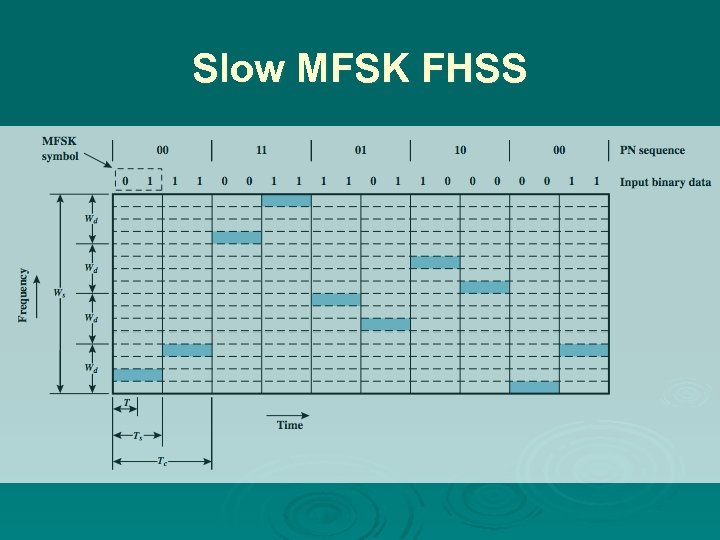 Slow MFSK FHSS
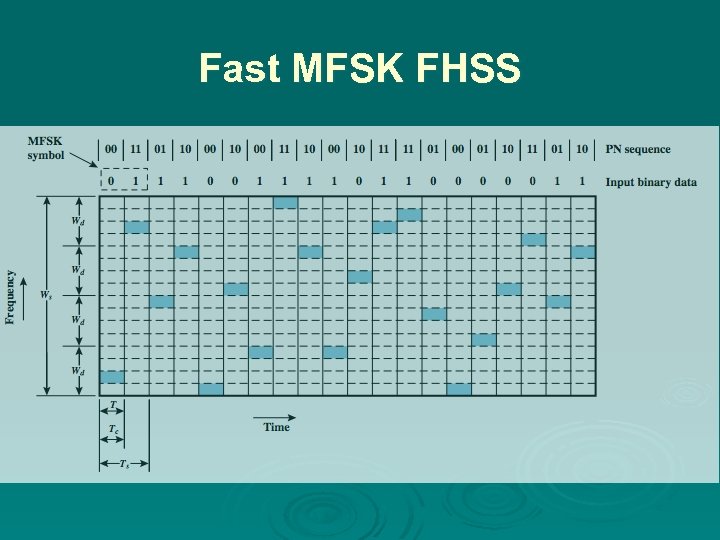 Fast MFSK FHSS
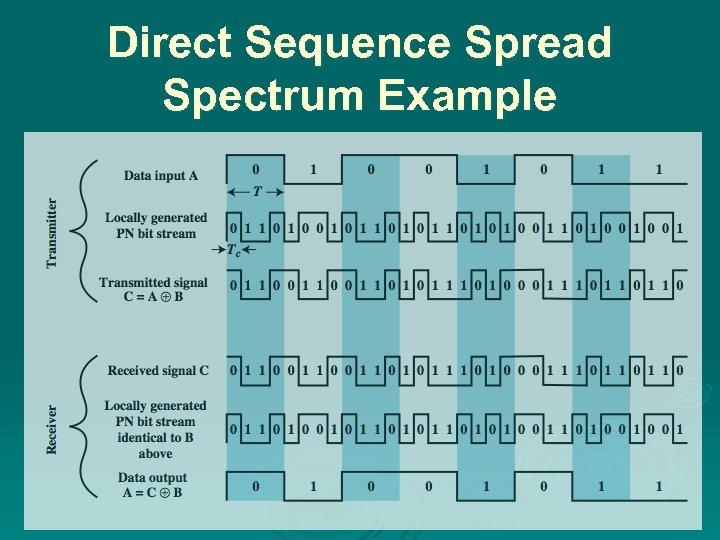 Direct Sequence Spread Spectrum Example
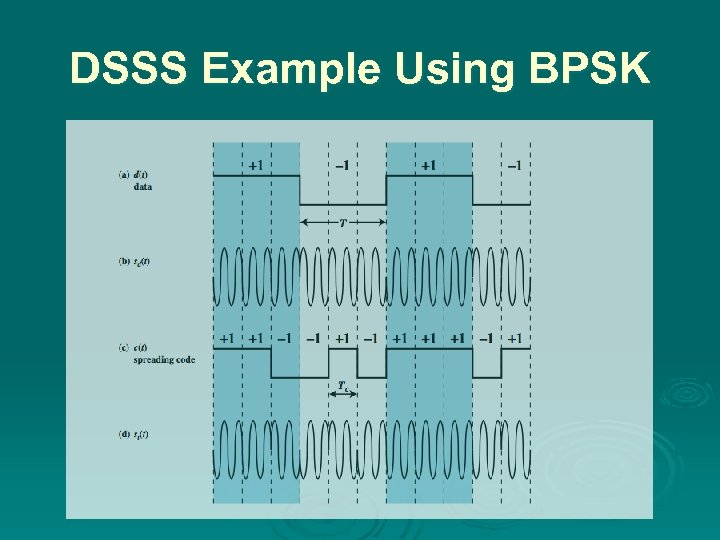 DSSS Example Using BPSK
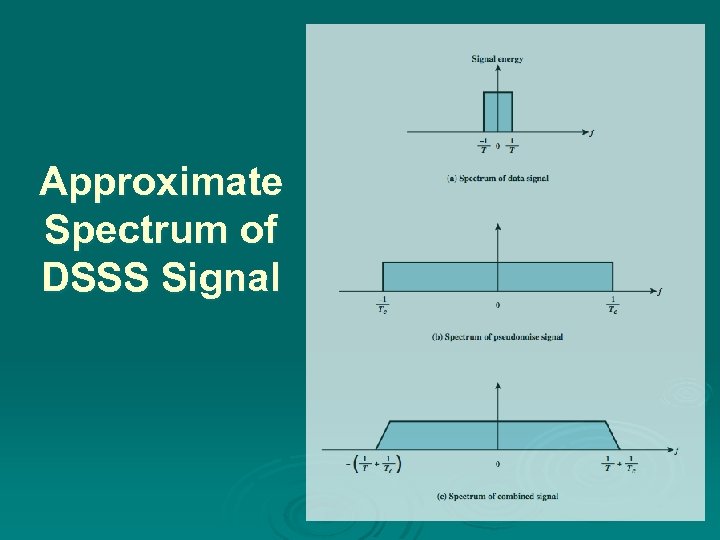 Approximate Spectrum of DSSS Signal
 Code Division Multiple Access (CDMA) Ø a multiplexing technique used with spread spectrum Ø given a data signal rate D Ø break each bit into k chips according to a fixed chipping code specific to each user Ø resulting new channel has chip data rate k. D chips per second Ø can have multiple channels superimposed
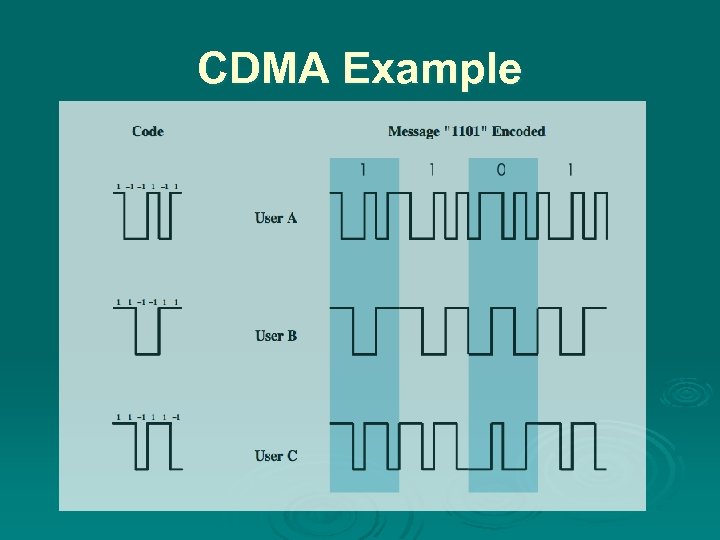 CDMA Example
 Second Generation CDMA provide higher quality signals, higher data rates, support digital services, with overall greater capacity Ø key differences include Ø l l digital traffic channels encryption error detection and correction channel access • time division multiple access (TDMA) • code division multiple access (CDMA)
 Code Division Multiple Access (CDMA) Ø have a number of 2 nd gen systems l for example IS-95 using CDMA Ø each cell allocated frequency bandwidth Ø is split in two l l half for reverse, half forward uses direct-sequence spread spectrum (DSSS)
 Code Division Multiple Access (CDMA) Advantages Ø frequency diversity l Ø multipath resistance l Ø chipping codes have low cross & auto correlation privacy l Ø noise bursts & fading have less effect inherent in use of spread-spectrum graceful degradation l l more users means more noise leads to slow signal degradation until unacceptable
 Code Division Multiple Access (CDMA) Disadvantages Ø self-jamming l some cross correlation between users Ø near-far problem l signals closer to receiver are received with less attenuation than signals farther away
 IS-95 Ø second generation CDMA scheme Ø primarily deployed in North America Ø transmission structures different on forward and reverse links
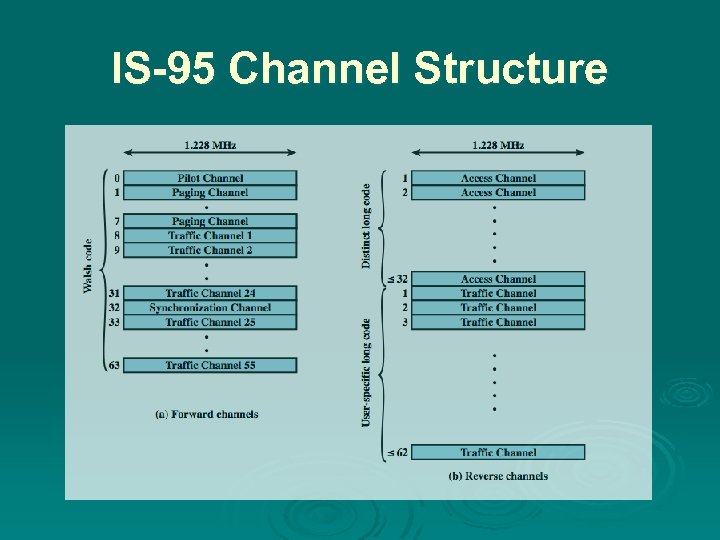 IS-95 Channel Structure
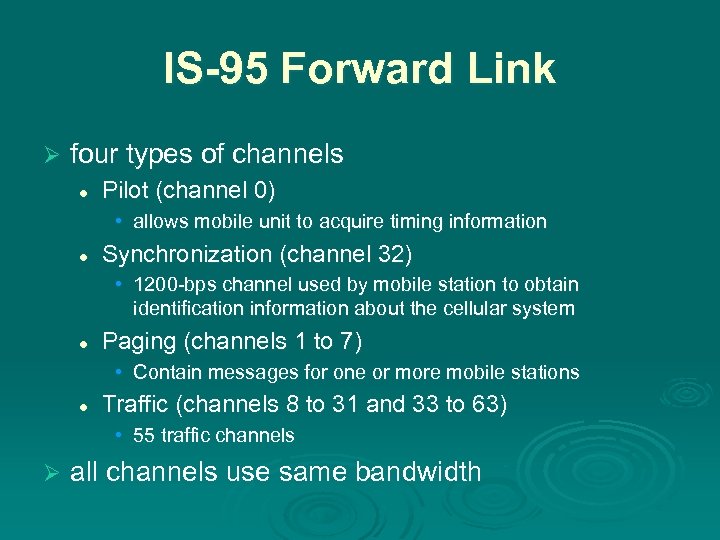 IS-95 Forward Link Ø four types of channels l Pilot (channel 0) • allows mobile unit to acquire timing information l Synchronization (channel 32) • 1200 -bps channel used by mobile station to obtain identification information about the cellular system l Paging (channels 1 to 7) • Contain messages for one or more mobile stations l Traffic (channels 8 to 31 and 33 to 63) • 55 traffic channels Ø all channels use same bandwidth
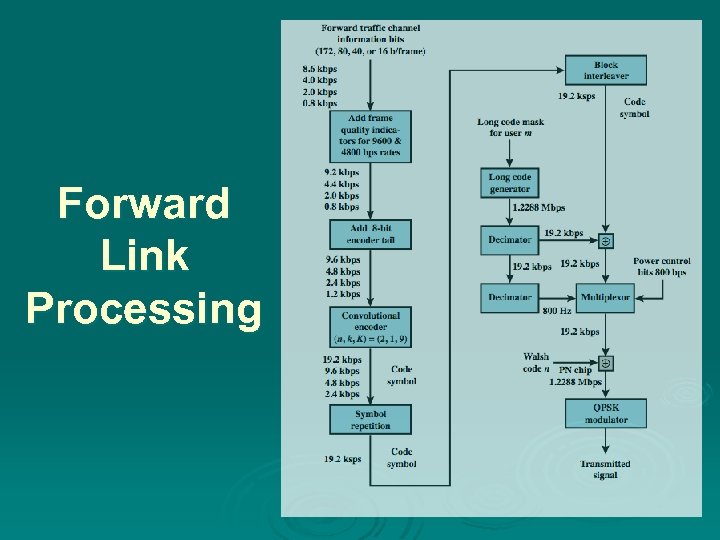 Forward Link Processing
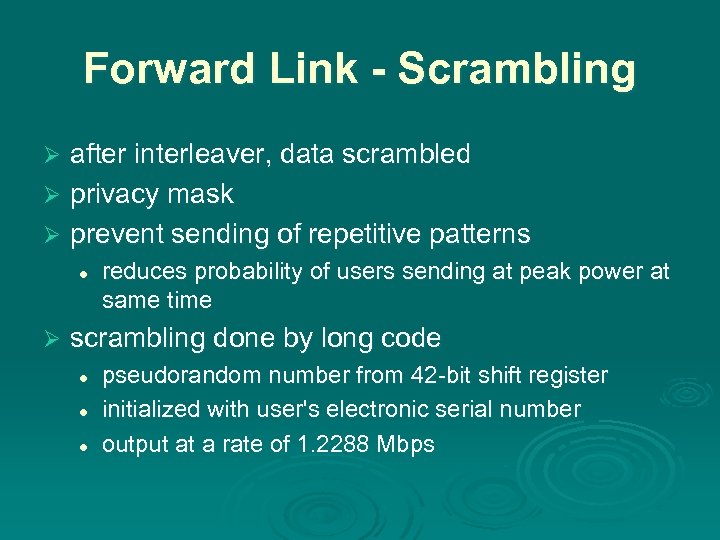 Forward Link - Scrambling after interleaver, data scrambled Ø privacy mask Ø prevent sending of repetitive patterns Ø l Ø reduces probability of users sending at peak power at same time scrambling done by long code l l l pseudorandom number from 42 -bit shift register initialized with user's electronic serial number output at a rate of 1. 2288 Mbps
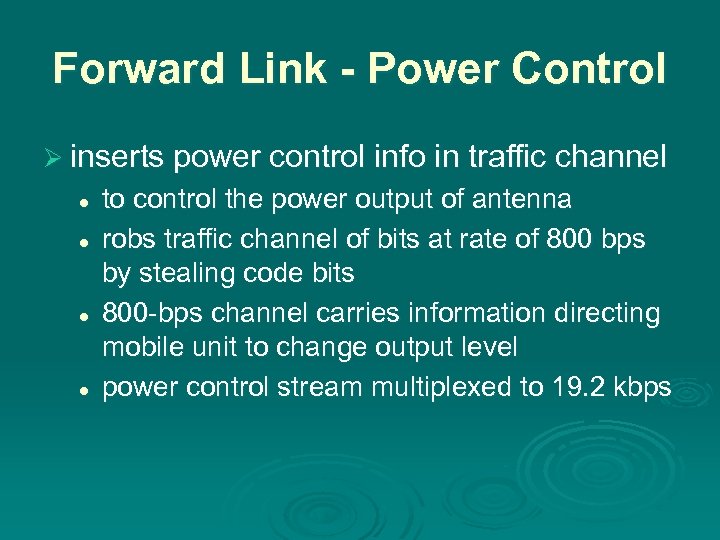 Forward Link - Power Control Ø inserts power control info in traffic channel l l to control the power output of antenna robs traffic channel of bits at rate of 800 bps by stealing code bits 800 -bps channel carries information directing mobile unit to change output level power control stream multiplexed to 19. 2 kbps
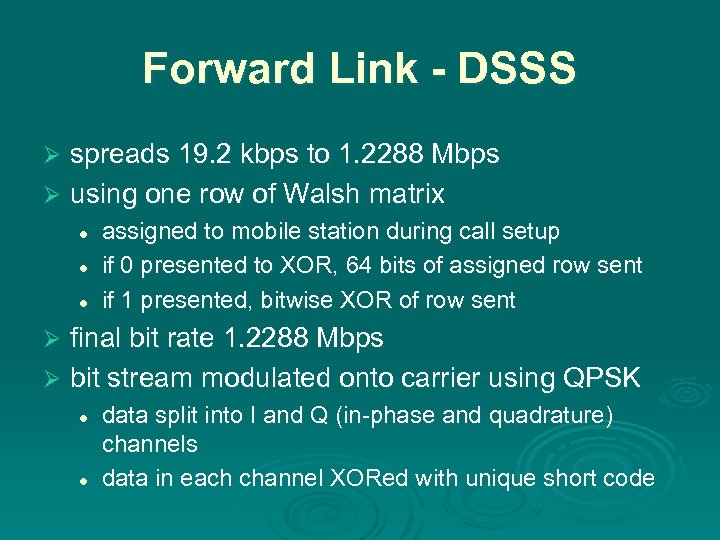 Forward Link - DSSS spreads 19. 2 kbps to 1. 2288 Mbps Ø using one row of Walsh matrix Ø l l l assigned to mobile station during call setup if 0 presented to XOR, 64 bits of assigned row sent if 1 presented, bitwise XOR of row sent final bit rate 1. 2288 Mbps Ø bit stream modulated onto carrier using QPSK Ø l l data split into I and Q (in-phase and quadrature) channels data in each channel XORed with unique short code
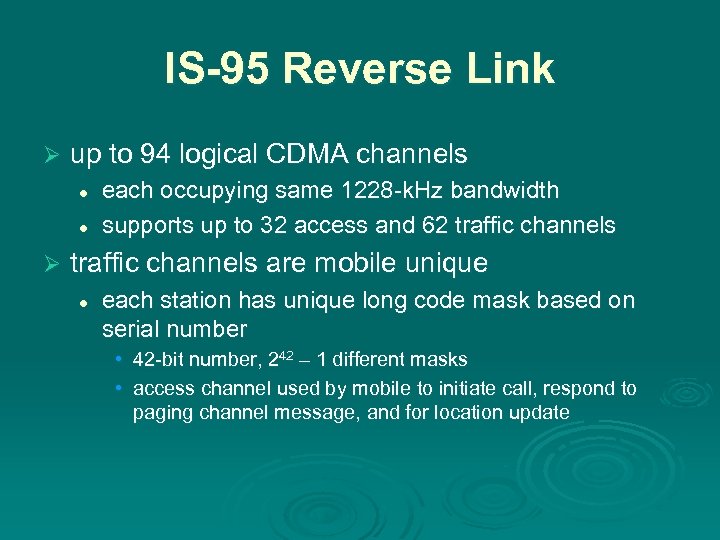 IS-95 Reverse Link Ø up to 94 logical CDMA channels l l Ø each occupying same 1228 -k. Hz bandwidth supports up to 32 access and 62 traffic channels are mobile unique l each station has unique long code mask based on serial number • 42 -bit number, 242 – 1 different masks • access channel used by mobile to initiate call, respond to paging channel message, and for location update
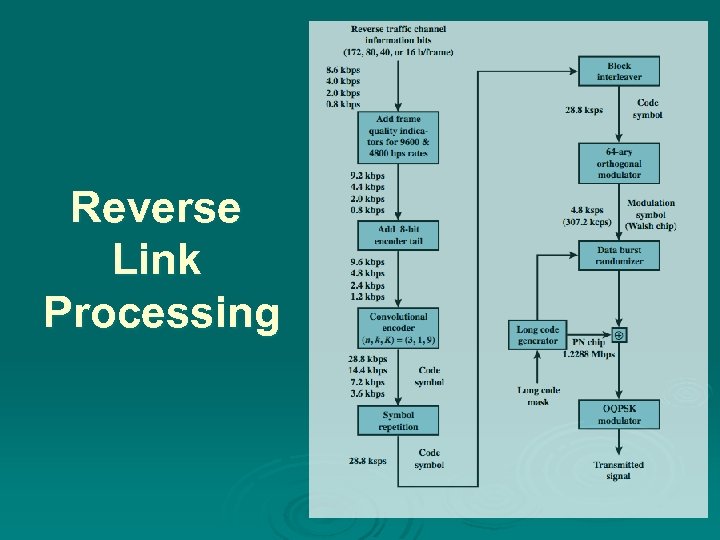 Reverse Link Processing
 Reverse Link - DSSS long code unique to mobile XORed with output of randomizer Ø 1. 2288 -Mbps final data stream Ø modulated using orthogonal QPSK modulation Ø differs from forward channel in use of delay element in modulator to produce orthogonality Ø l l forward channel, spreading codes orthogonal reverse channel orthogonality of spreading codes not guaranteed
 Third Generation Systems high-speed wireless communications to support multimedia, data, and video in addition to voice Ø 3 G capabilities: Ø • • • voice quality comparable to PSTN 144 kbps available to users over large areas 384 kbps available to pedestrians over small areas support for 2. 048 Mbps for office use symmetrical and asymmetrical data rates packet-switched and circuit-switched services adaptive interface to Internet more efficient use of available spectrum support for variety of mobile equipment allow introduction of new services and technologies
 Driving Forces Ø Ø Ø trend toward universal personal telecommunications universal communications access GSM cellular telephony with subscriber identity module, is step towards goals personal communications services (PCSs) and personal communication networks (PCNs) also form objectives for third-generation wireless technology is digital using time division multiple access or code-division multiple access PCS handsets low power, small and light
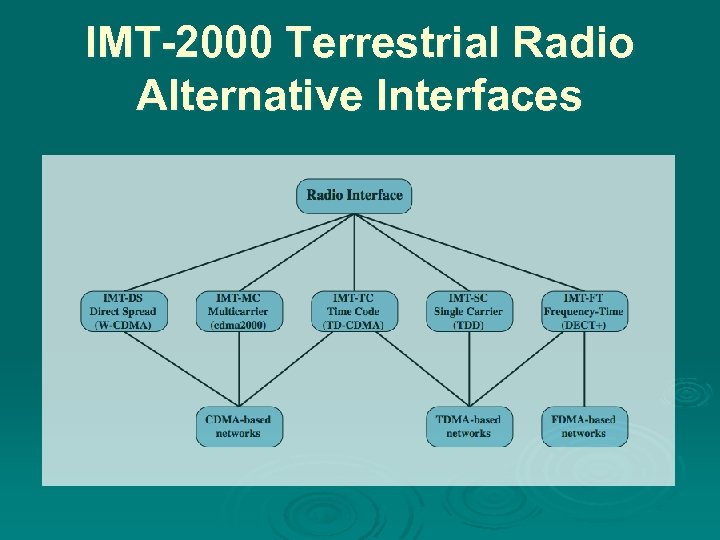 IMT-2000 Terrestrial Radio Alternative Interfaces
 Spatial Diversity Multiple Access SDMA or Smart Antennas l l Forms a focused beam Allows channels to be reused within a cell Ø Multibeam Type l Multiple fixed beams with a narrow focus Ø Adaptive Array l l Uses Spatial & Angle Diversity Separates signal from its path
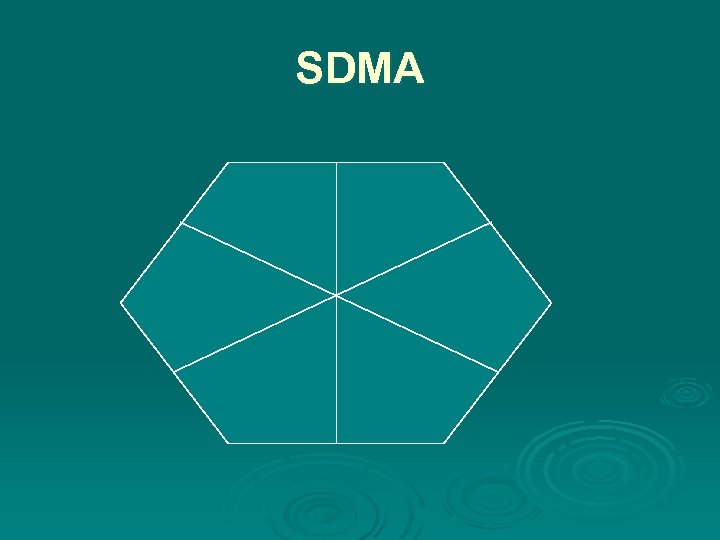 SDMA
SDMA
 CDMA Design Considerations – Bandwidth and Chip Rate Ø dominant technology for 3 G systems is CDMA l Ø bandwidth (limit channel to 5 MHz) l l Ø 3 CDMA schemes, share some design issues 5 MHz reasonable upper limit on what can be allocated for 3 G 5 MHz is enough for data rates of 144 and 384 k. Hz chip rate l l given bandwidth, chip rate depends on desired data rate, need for error control, and bandwidth limitations chip rate of 3 Mbps or more reasonable
 CDMA Design Considerations – Multirate Ø Ø Ø Ø provision of multiple fixed-data-rate channels to user different data rates provided on different logical channels logical channel traffic can be switched independently through wireless fixed networks to different destinations flexibly support multiple simultaneous applications efficiently use available capacity by only providing the capacity required for each service use TDMA within single CDMA channel or use multiple CDMA codes
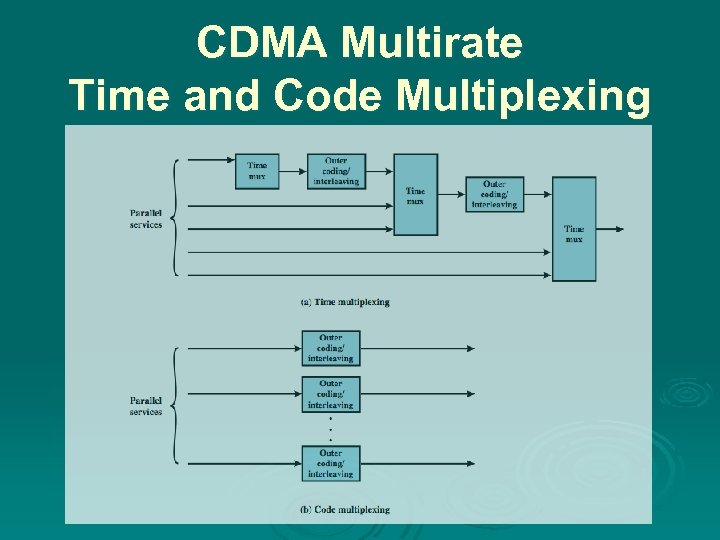 CDMA Multirate Time and Code Multiplexing
 Summary Ø principles of wireless cellular networks Ø operation of wireless cellular networks Ø first-generation analog Ø second-generation CDMA Ø third-generation systems