


 Скачать презентацию Data and Applications Security Developments and Directions Dr
633d438076c07d9a5696ae751f1861ab.ppt
- Количество слайдов: 25
 Data and Applications Security Developments and Directions Dr. Bhavani Thuraisingham The University of Texas at Dallas Trustworthy Semantic Webs March 25, 2011
 Outline l Semantic web l XML security l RDF security l Ontologies and Security l Rules and Security l Reference: - Building trustworthy semantic web, Thuraisingham, CRC Press, 2007
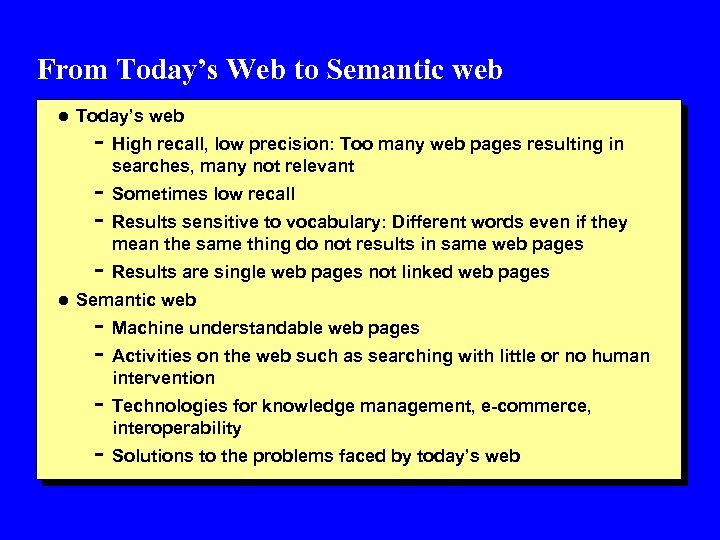 From Today’s Web to Semantic web l Today’s web - High recall, low precision: Too many web pages resulting in searches, many not relevant - Sometimes low recall - Results sensitive to vocabulary: Different words even if they mean the same thing do not results in same web pages - Results are single web pages not linked web pages l Semantic web - Machine understandable web pages - Activities on the web such as searching with little or no human intervention - Technologies for knowledge management, e-commerce, interoperability - Solutions to the problems faced by today’s web
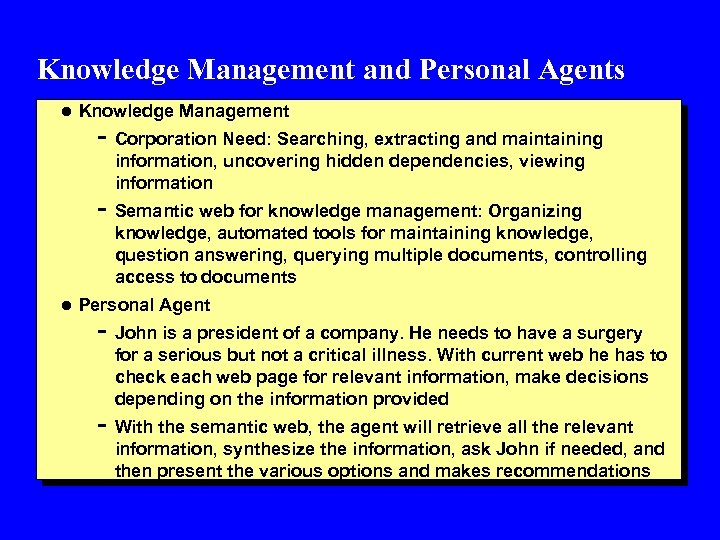 Knowledge Management and Personal Agents l Knowledge Management - Corporation Need: Searching, extracting and maintaining information, uncovering hidden dependencies, viewing information - Semantic web for knowledge management: Organizing knowledge, automated tools for maintaining knowledge, question answering, querying multiple documents, controlling access to documents l Personal Agent - John is a president of a company. He needs to have a surgery for a serious but not a critical illness. With current web he has to check each web page for relevant information, make decisions depending on the information provided - With the semantic web, the agent will retrieve all the relevant information, synthesize the information, ask John if needed, and then present the various options and makes recommendations
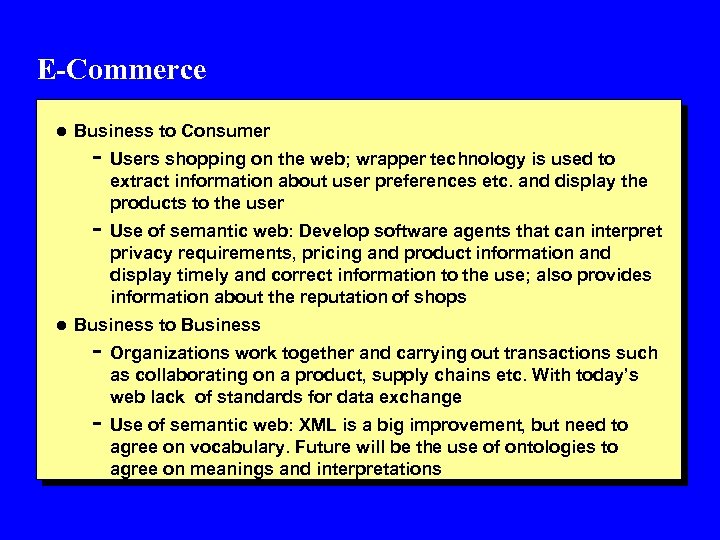 E-Commerce l Business to Consumer - Users shopping on the web; wrapper technology is used to extract information about user preferences etc. and display the products to the user - Use of semantic web: Develop software agents that can interpret privacy requirements, pricing and product information and display timely and correct information to the use; also provides information about the reputation of shops l Business to Business - Organizations work together and carrying out transactions such as collaborating on a product, supply chains etc. With today’s web lack of standards for data exchange - Use of semantic web: XML is a big improvement, but need to agree on vocabulary. Future will be the use of ontologies to agree on meanings and interpretations
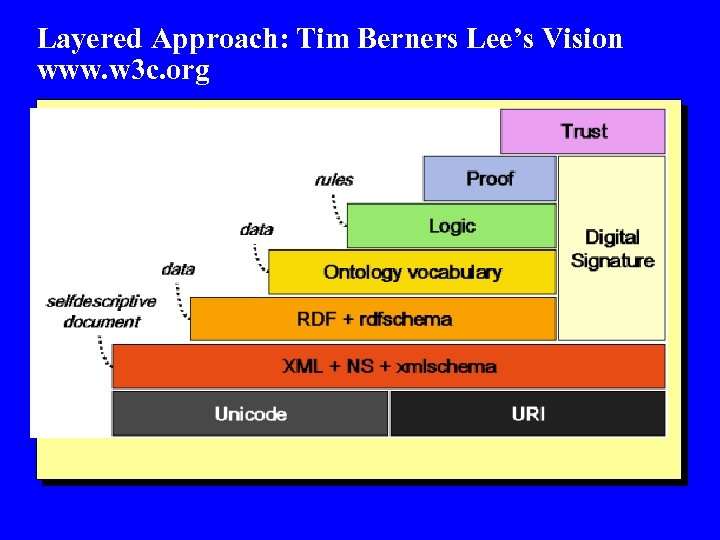 Layered Approach: Tim Berners Lee’s Vision www. w 3 c. org
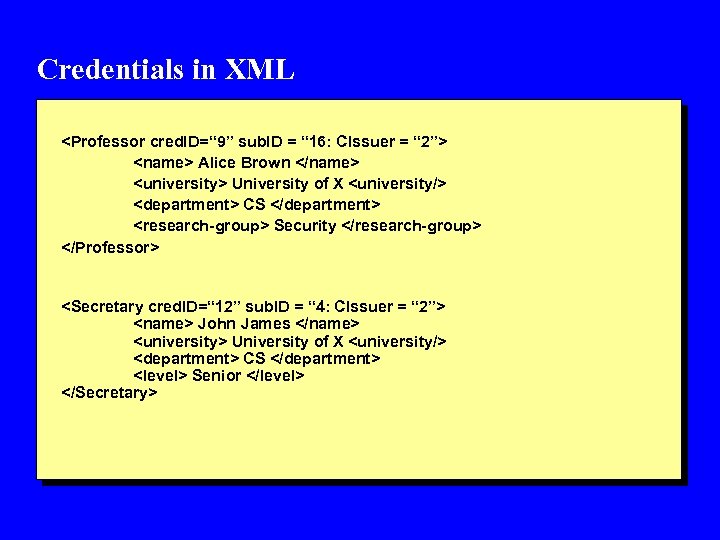 Credentials in XML
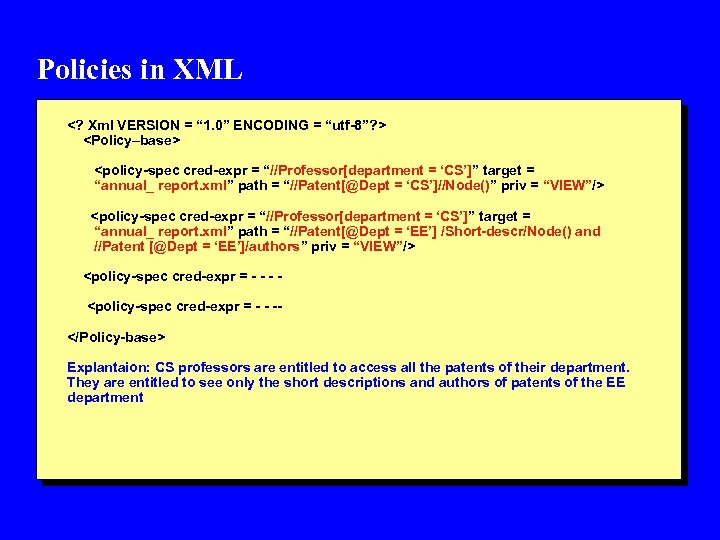 Policies in XML
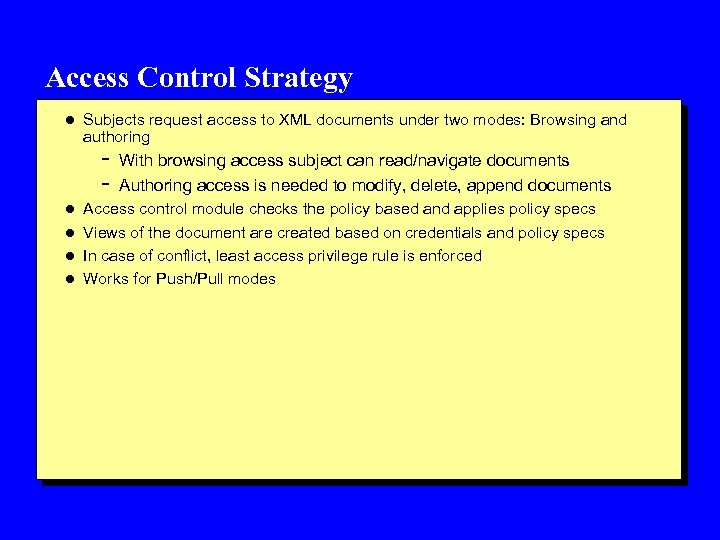 Access Control Strategy l Subjects request access to XML documents under two modes: Browsing and authoring - With browsing access subject can read/navigate documents Authoring access is needed to modify, delete, append documents l Access control module checks the policy based and applies policy specs l Views of the document are created based on credentials and policy specs l In case of conflict, least access privilege rule is enforced l Works for Push/Pull modes
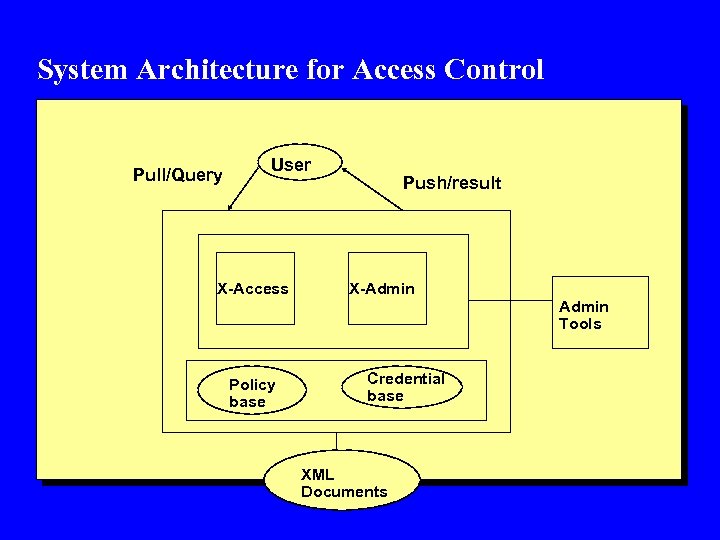 System Architecture for Access Control Pull/Query User X-Access Push/result X-Admin Tools Policy base Credential base XML Documents
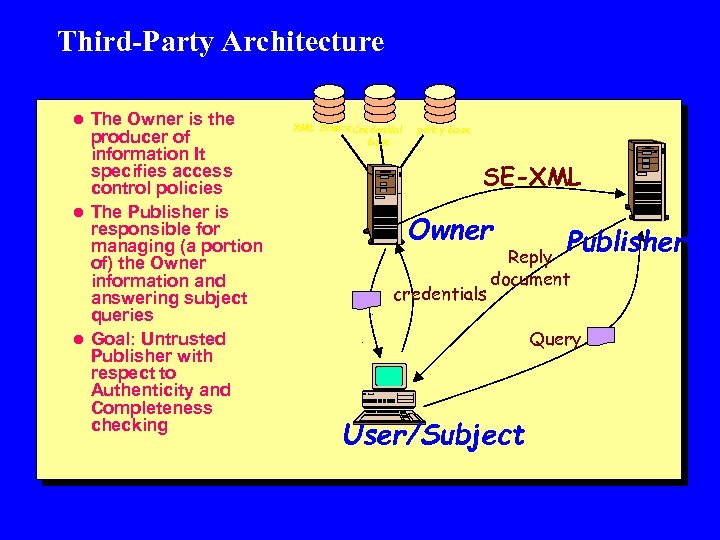 Third-Party Architecture l The Owner is the producer of information It specifies access control policies l The Publisher is responsible for managing (a portion of) the Owner information and answering subject queries l Goal: Untrusted Publisher with respect to Authenticity and Completeness checking XML Source Credential base policy base SE-XML Owner credentials Publisher Reply document Query User/Subject
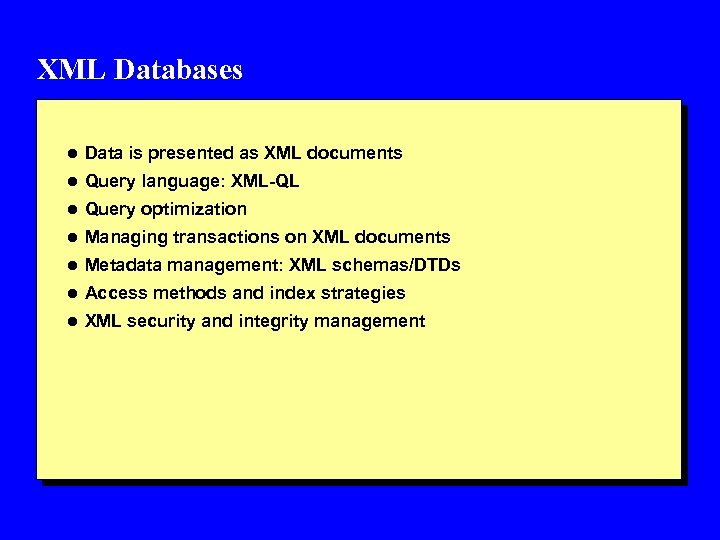 XML Databases l Data is presented as XML documents l Query language: XML-QL l Query optimization l Managing transactions on XML documents l Metadata management: XML schemas/DTDs l Access methods and index strategies l XML security and integrity management
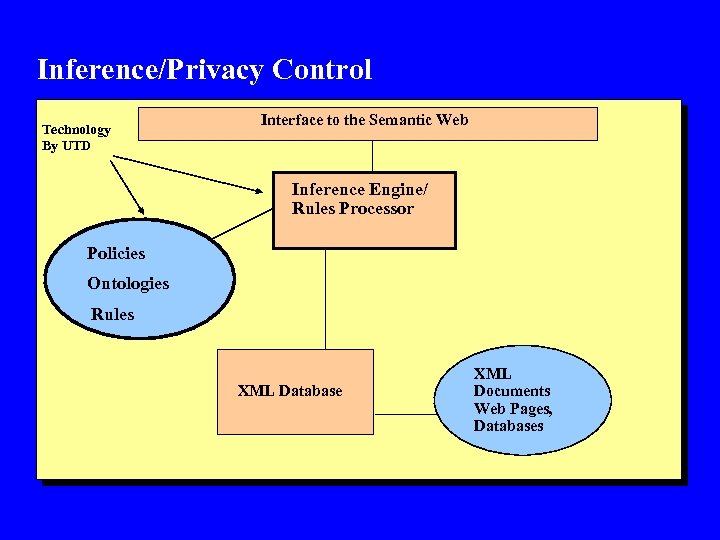 Inference/Privacy Control Technology By UTD Interface to the Semantic Web Inference Engine/ Rules Processor Policies Ontologies Rules XML Database XML Documents Web Pages, Databases
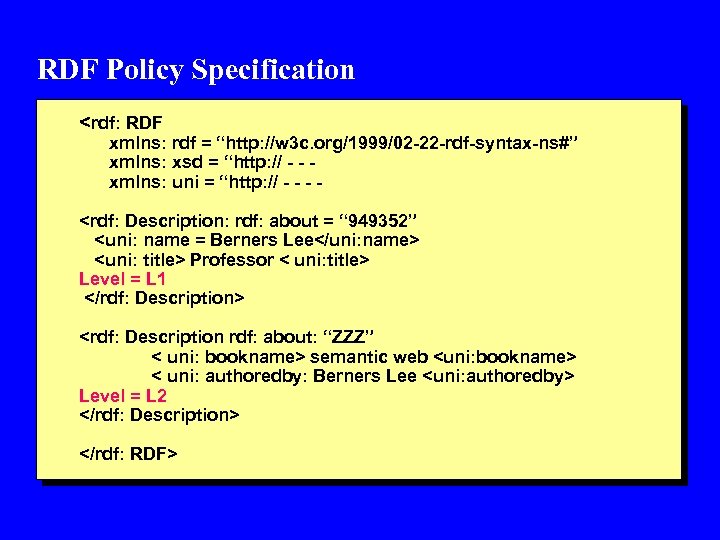 RDF Policy Specification
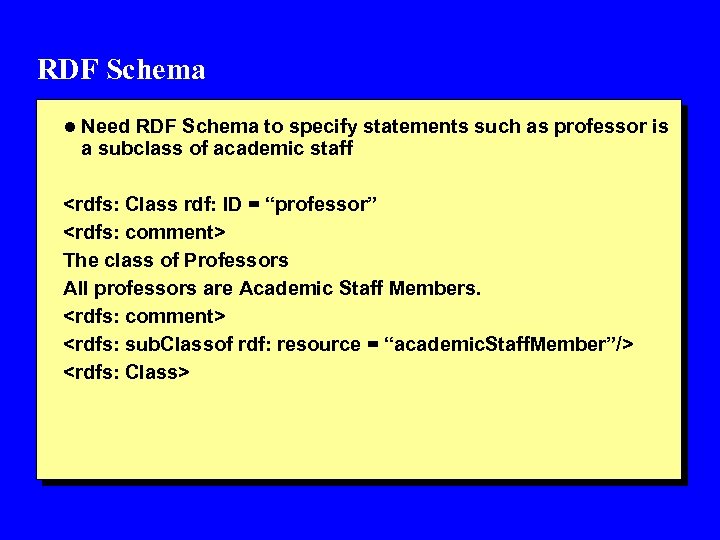 RDF Schema l Need RDF Schema to specify statements such as professor is a subclass of academic staff
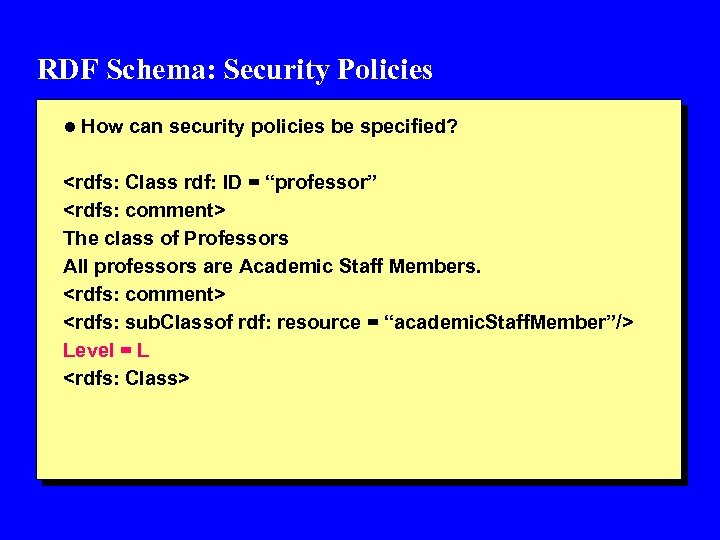 RDF Schema: Security Policies l How can security policies be specified?
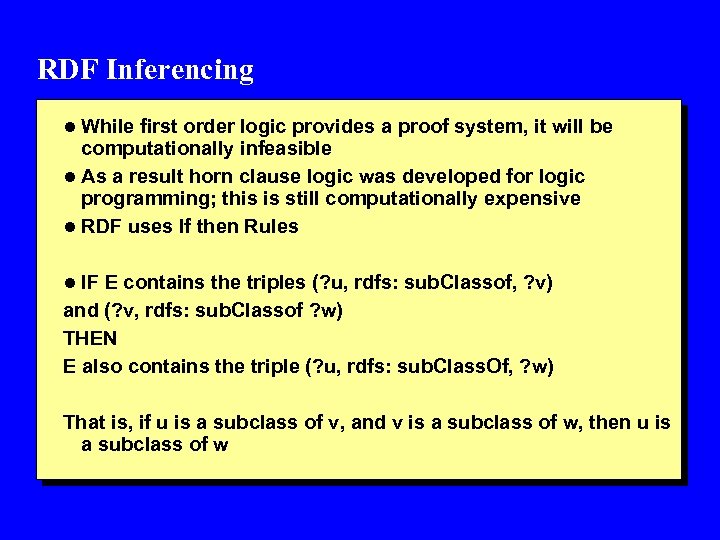 RDF Inferencing l While first order logic provides a proof system, it will be computationally infeasible l As a result horn clause logic was developed for logic programming; this is still computationally expensive l RDF uses If then Rules l IF E contains the triples (? u, rdfs: sub. Classof, ? v) and (? v, rdfs: sub. Classof ? w) THEN E also contains the triple (? u, rdfs: sub. Class. Of, ? w) That is, if u is a subclass of v, and v is a subclass of w, then u is a subclass of w
 RDF Query l One can query RDF using XML, but this will be very difficult as RDF is much richer than XML l Is there an analogy between say XQuery and a query language for RDF? l RQL – an SQL-like language has been developed for RDF l Select from “RDF document” where some “condition”
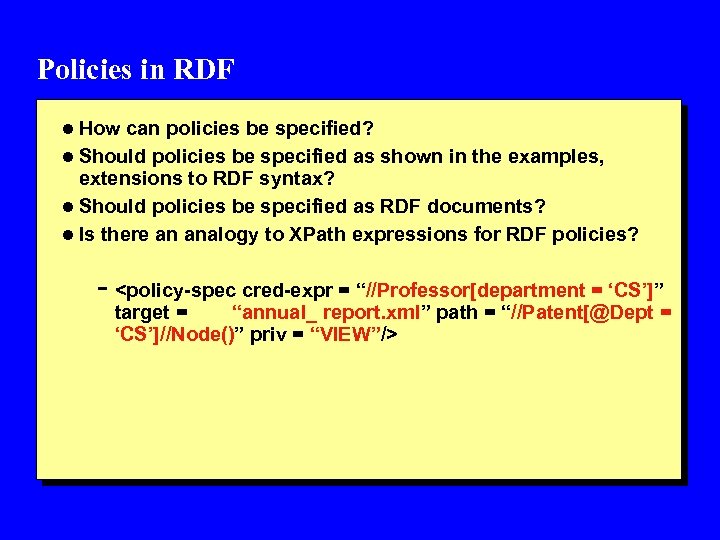 Policies in RDF l How can policies be specified? l Should policies be specified as shown in the examples, extensions to RDF syntax? l Should policies be specified as RDF documents? l Is there an analogy to XPath expressions for RDF policies? -
 Security and Ontology l Ontologies used to specify security policies - Example: OWL to specify security policies - Choice between XML, RDF, OWL, Rules ML, etc. l Security for Ontologies - Access control on Ontologies l Give access to certain parts of the Ontology
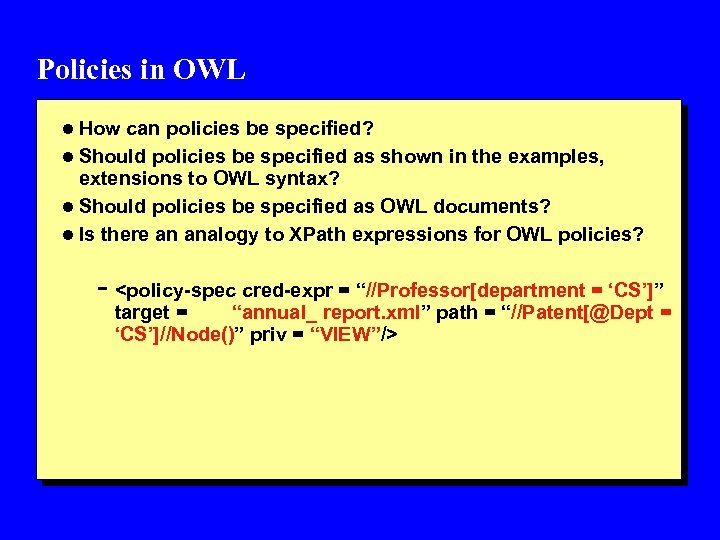 Policies in OWL l How can policies be specified? l Should policies be specified as shown in the examples, extensions to OWL syntax? l Should policies be specified as OWL documents? l Is there an analogy to XPath expressions for OWL policies? -
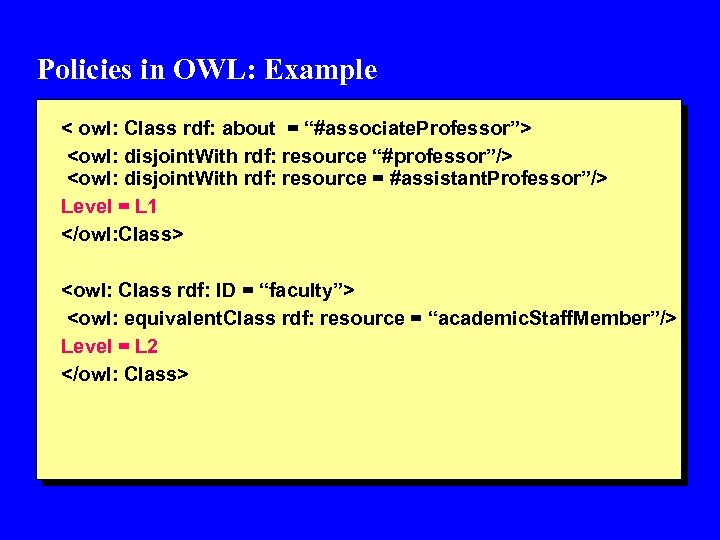 Policies in OWL: Example < owl: Class rdf: about = “#associate. Professor”>
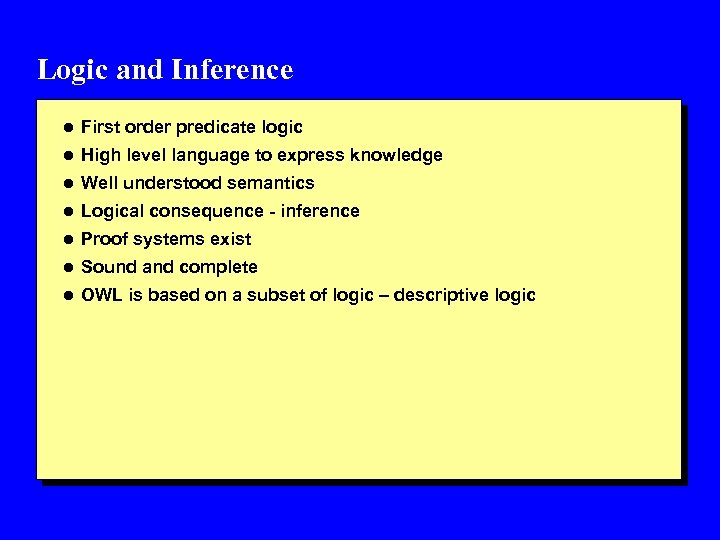 Logic and Inference l First order predicate logic l High level language to express knowledge l Well understood semantics l Logical consequence - inference l Proof systems exist l Sound and complete l OWL is based on a subset of logic – descriptive logic
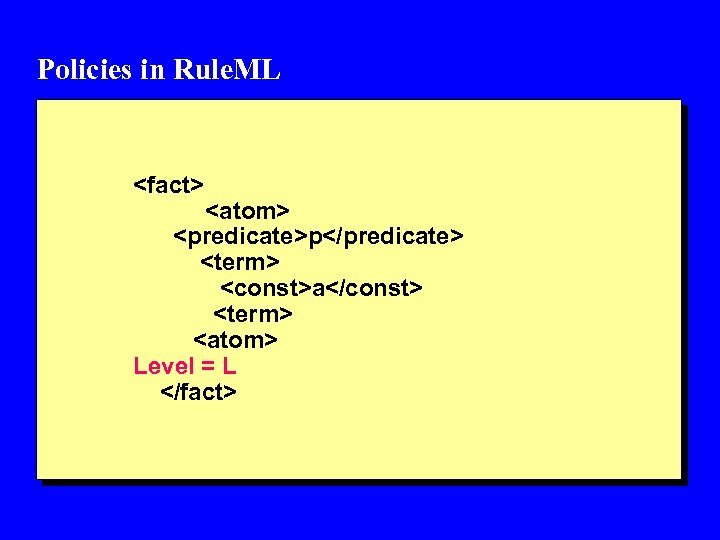 Policies in Rule. ML
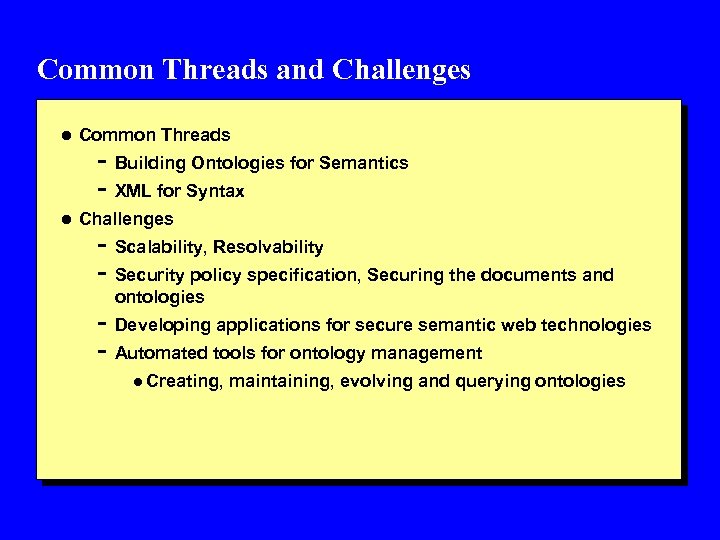 Common Threads and Challenges l Common Threads - Building Ontologies for Semantics - XML for Syntax l Challenges - Scalability, Resolvability - Security policy specification, Securing the documents and ontologies - Developing applications for secure semantic web technologies - Automated tools for ontology management l Creating, maintaining, evolving and querying ontologies