


 Скачать презентацию Дашкевич И В учитель английского языка Первая гимназия
secondary education.ppt
- Количество слайдов: 11
 Дашкевич И. В. учитель английского языка Первая гимназия Г. Петропавловск РК
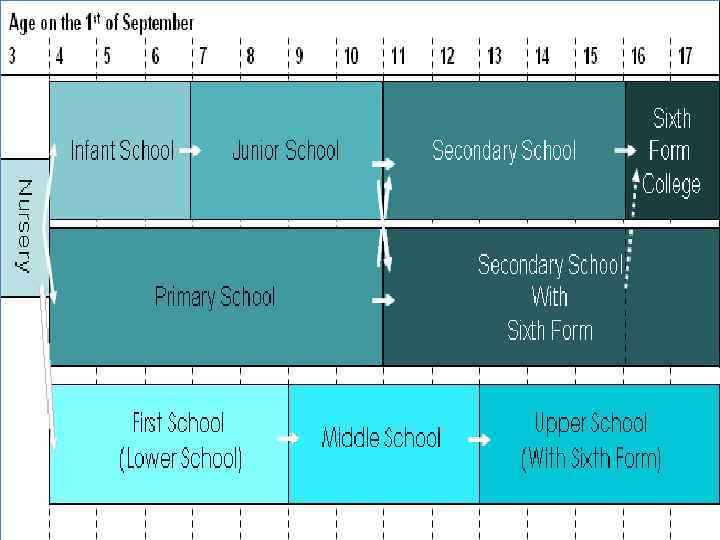
 Compulsary from 5 till 16 State schools Private schools - are free -schools provide their pupils with books equipment for their studies (Independent schools) -parents pay money for these schools and about 7 percent of all children about 93 percent of all children 3 stages of education: PRIMARY (5 -11) SECONDARY (11 -16) FURTHER (16 -18)
 State and Public schools The great majority of children (about 9 million) attend Britain’s 30, 500 state schools. No tuition fees are payable in any of them. A further 600, 000 go to 2, 500 private schools, often referred to as the “independent sector” where the parents have to pay for their children Fettes College Eton school
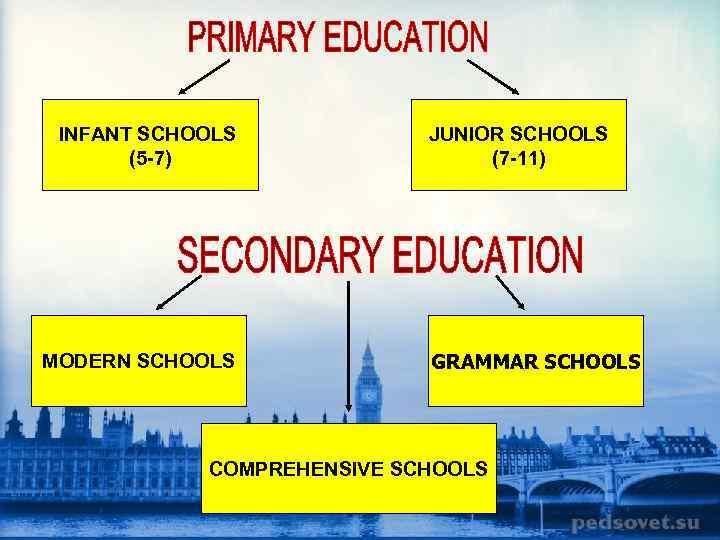 INFANT SCHOOLS (5 -7) MODERN SCHOOLS JUNIOR SCHOOLS (7 -11) GRAMMAR SCHOOLS COMPREHENSIVE SCHOOLS
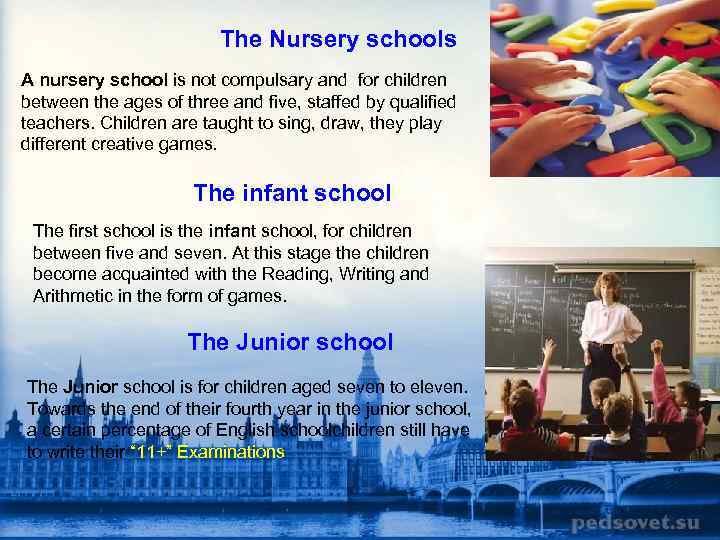 The Nursery schools A nursery school is not compulsary and for children between the ages of three and five, staffed by qualified teachers. Children are taught to sing, draw, they play different creative games. The infant school The first school is the infant school, for children between five and seven. At this stage the children become acquainted with the Reading, Writing and Arithmetic in the form of games. The Junior school is for children aged seven to eleven. Towards the end of their fourth year in the junior school, a certain percentage of English schoolchildren still have to write their “ 11+” Examinations
 The grammar school provided a traditional literary and scientific education up to the age of eighteen, it gives pupils the more academic education, and prepares them for entry to universities. The secondary modern school provides a general education, including much instruction of a practical sort, up to the age of fifteen only, when the children leave school to go to work. The Technical school providing technical education up to the age of eighteen, was established by the Educational Act of 1944, but as yet there are very few schools of this type. Comprehensive schools admit children of all abilities and provide a wide range of secondary education for all or most of the children in a district. The comprehensive system aims to develop the gifts of all children to the full, to reveal those who often remain unsuspected under the old system, and to raise the standards of all children.
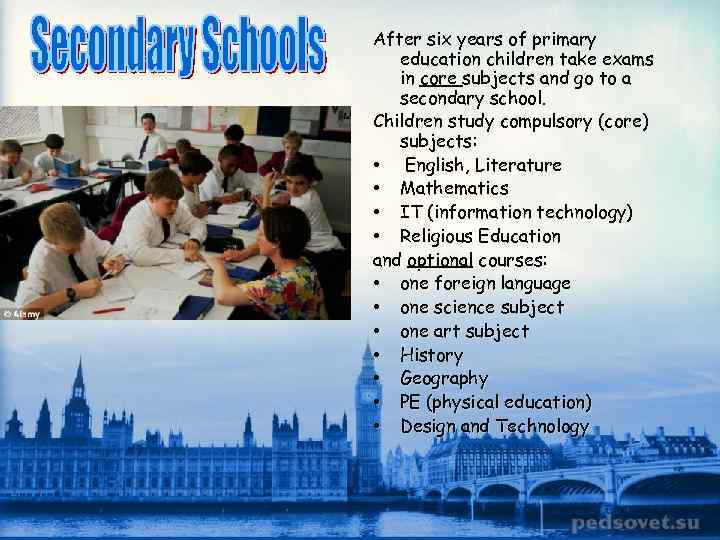 After six years of primary education children take exams in core subjects and go to a secondary school. Children study compulsory (core) subjects: • English, Literature • Mathematics • IT (information technology) • Religious Education and optional courses: • one foreign language • one science subject • one art subject • History • Geography • PE (physical education) • Design and Technology
 • can leave school if they wish: • go to a college of further education to study for more practical (vocational) diplomas relating to the world of work, such as hairdressing, typing or mechanics • work • About two thirds of the pupils • continue their studies in the sixth form (2 years) • About one-third
 16 -18 years old • choose 4 -5 subjects, which are necessary to pass the advanced level exams • have further examinations which are necessary for getting into university or college • are prepared for a national exam called "A" level (advanced level) (after the first year) • "A 2" level (after the second year) • IB (International Baccalaureate)
 A lot of people think that school uniforms in England are for the children from rich families at the country’s best schools. But it isn’t always true. In fact, uniforms first came to schools for poor because they were cheaper. Today a lot of British schools have uniforms. Usually they differ only in colours but include a blazer, a pullover, a shirt (a blouse), trousers (a skirt), tights or socks, shoes and boots, a scarf and gloves of a certain colour, a cap or a hat. School badge is on a cap and on a blazer’s pocket. One of the most important elements of the uniform is a school tie.