 Скачать презентацию DARPA Embedded Software A Critical Technology Challenge Dr
bbe0d764f27d11bdad93ec75ba6f3d6f.ppt
- Количество слайдов: 19



DARPA Embedded Software: A Critical Technology Challenge Dr. Janos Sztipanovits, DARPA/ITO
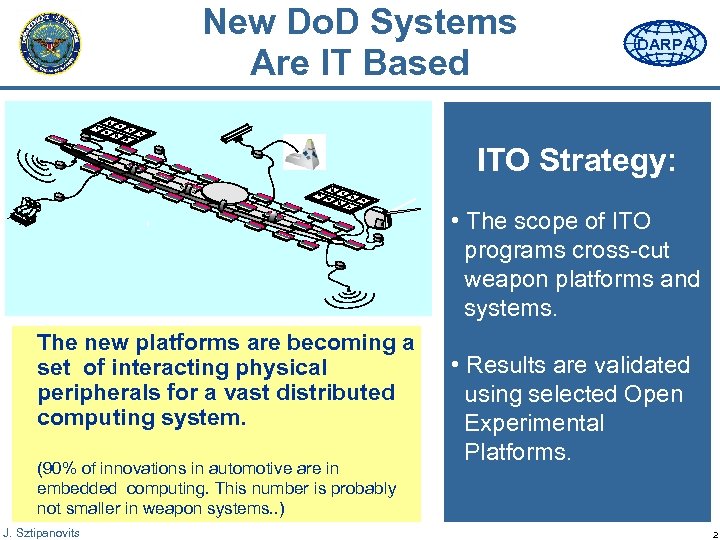
New Do. D Systems Are IT Based DARPA ITO Strategy: • The scope of ITO programs cross-cut weapon platforms and systems. The new platforms are becoming a set of interacting physical peripherals for a vast distributed computing system. (90% of innovations in automotive are in embedded computing. This number is probably not smaller in weapon systems. . ) J. Sztipanovits • Results are validated using selected Open Experimental Platforms. 2
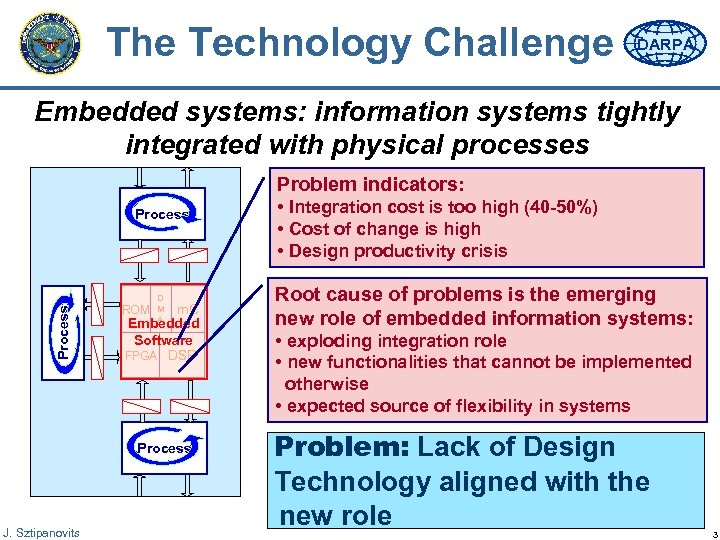
The Technology Challenge DARPA Embedded systems: information systems tightly integrated with physical processes Problem indicators: Process D M A m. C Embedded Software FPGA DSP ROM Process J. Sztipanovits • Integration cost is too high (40 -50%) • Cost of change is high • Design productivity crisis Root cause of problems is the emerging new role of embedded information systems: • exploding integration role • new functionalities that cannot be implemented otherwise • expected source of flexibility in systems Problem: Lack of Design Technology aligned with the new role 3
Problem for Whom? DARPA u Do. D (from avionics to micro-robots) – Essential source of superiority – Largest, most complex systems u Automotive (drive-by-wire) – Key competitive element in the future – Increasing interest but low risk taking u Consumer Electronics (from mobile phones to TVs) – Problem is generally simpler – US industry is strongly challenged u Plant Automation Systems – Limited market, conservative approach J. Sztipanovits 4
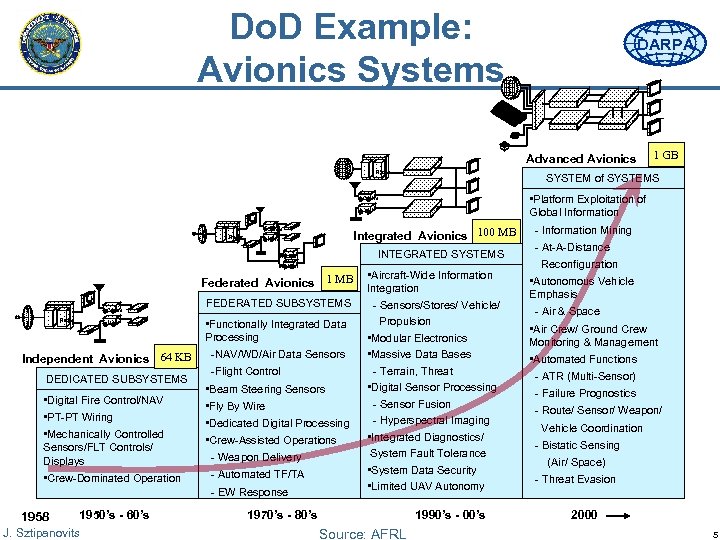
Do. D Example: Avionics Systems DARPA Advanced Avionics Radar SYSTEM of SYSTEMS Comm EW Integrated Avionics 100 MB Comm Radar NAV INTEGRATED SYSTEMS Mission Federated Avionics 1 MB Comm Radar NAV Independent Avionics 64 KB DEDICATED SUBSYSTEMS • Digital Fire Control/NAV • PT-PT Wiring • Mechanically Controlled Sensors/FLT Controls/ Displays • Crew-Dominated Operation 1950’s - 60’s J. Sztipanovits 1958 FEDERATED SUBSYSTEMS • Functionally Integrated Data Processing -NAV/WD/Air Data Sensors -Flight Control • Beam Steering Sensors • Fly By Wire • Dedicated Digital Processing • Crew-Assisted Operations - Weapon Delivery - Automated TF/TA - EW Response • Aircraft-Wide Information Integration - Sensors/Stores/ Vehicle/ Propulsion • Modular Electronics • Massive Data Bases - Terrain, Threat • Digital Sensor Processing - Sensor Fusion - Hyperspectral Imaging • Integrated Diagnostics/ System Fault Tolerance • System Data Security • Limited UAV Autonomy 1970’s - 80’s 1990’s - 00’s Source: AFRL 1 GB • Platform Exploitation of Global Information - Information Mining - At-A-Distance Reconfiguration • Autonomous Vehicle Emphasis - Air & Space • Air Crew/ Ground Crew Monitoring & Management • Automated Functions - ATR (Multi-Sensor) - Failure Prognostics - Route/ Sensor/ Weapon/ Vehicle Coordination - Bistatic Sensing (Air/ Space) - Threat Evasion 2000 5
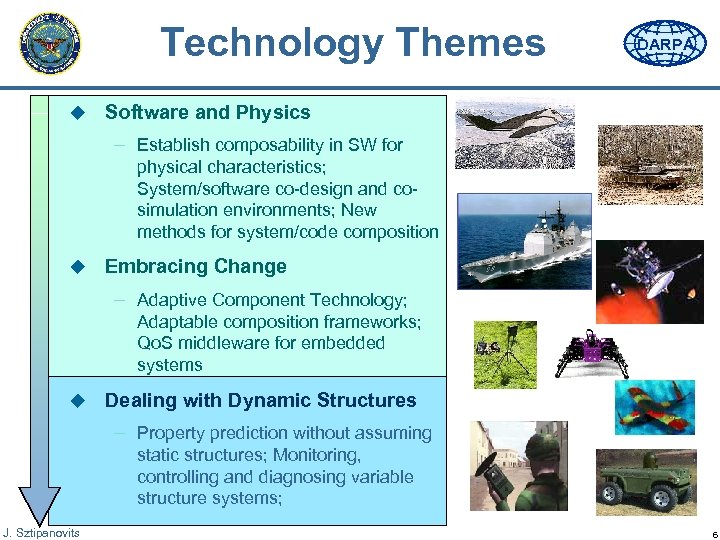
Technology Themes u DARPA Software and Physics – Establish composability in SW for physical characteristics; System/software co-design and cosimulation environments; New methods for system/code composition u Embracing Change – Adaptive Component Technology; Adaptable composition frameworks; Qo. S middleware for embedded systems u Dealing with Dynamic Structures – Property prediction without assuming static structures; Monitoring, controlling and diagnosing variable structure systems; J. Sztipanovits 6
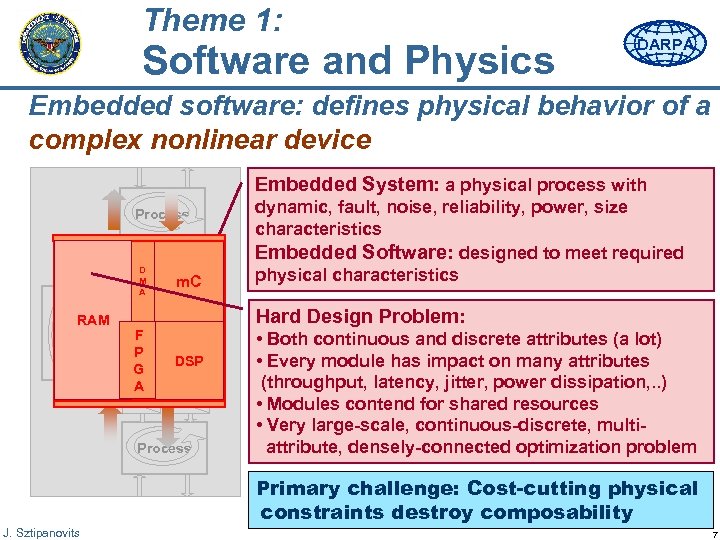
Theme 1: Software and Physics DARPA Embedded software: defines physical behavior of a complex nonlinear device Embedded System: a physical process with Process D M A m. C dynamic, fault, noise, reliability, power, size characteristics Embedded Software: designed to meet required physical characteristics D ROM M m. C Embedded A RAM Embedded Software F Software P FPGA DSP G A Process Hard Design Problem: • Both continuous and discrete attributes (a lot) • Every module has impact on many attributes (throughput, latency, jitter, power dissipation, . . ) • Modules contend for shared resources • Very large-scale, continuous-discrete, multiattribute, densely-connected optimization problem Primary challenge: Cost-cutting physical constraints destroy composability J. Sztipanovits 7
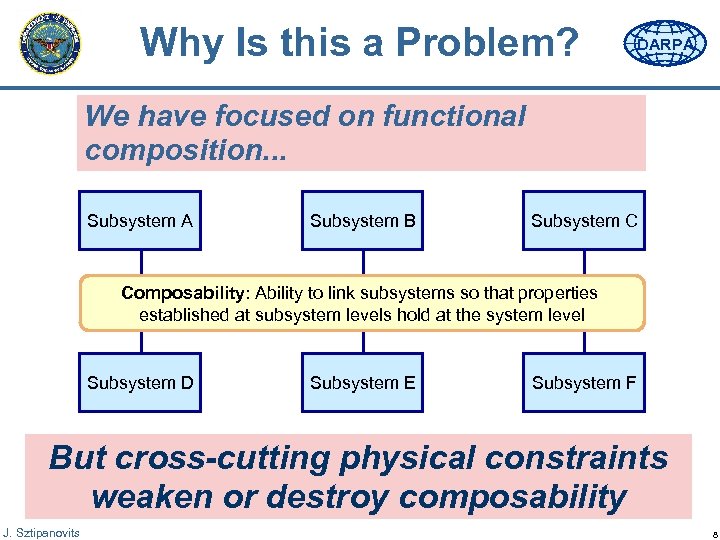
Why Is this a Problem? DARPA We have focused on functional composition. . . Subsystem A Subsystem B Subsystem C Composability: Ability to link subsystems so that properties established at subsystem levels hold at the system level Subsystem D Subsystem E Subsystem F But cross-cutting physical constraints weaken or destroy composability J. Sztipanovits 8
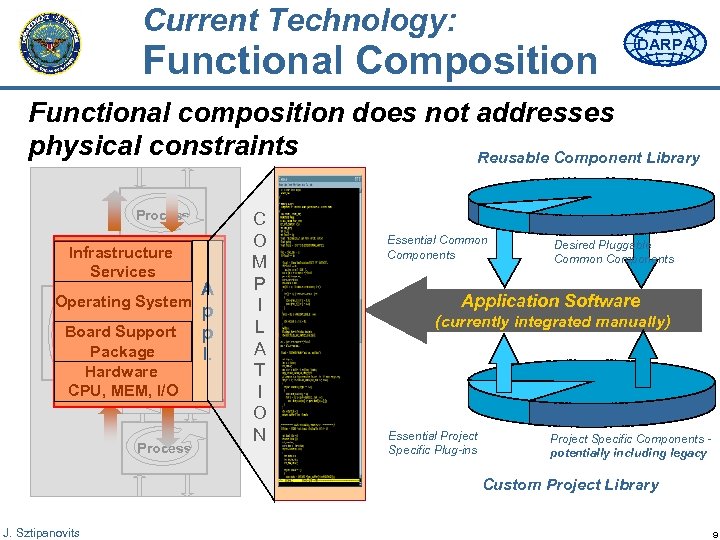
Current Technology: Functional Composition DARPA Functional composition does not addresses physical constraints Reusable Component Library Process Infrastructure Services A p A Embedded Board Support Software p Package DSP l. FPGA Process D Operating System ROM M m. C Hardware CPU, MEM, I/O Process C O M P I L A T I O N Essential Common Components Desired Pluggable Common Components Application Software (currently integrated manually) Essential Project Specific Plug-ins Project Specific Components potentially including legacy Custom Project Library J. Sztipanovits 9
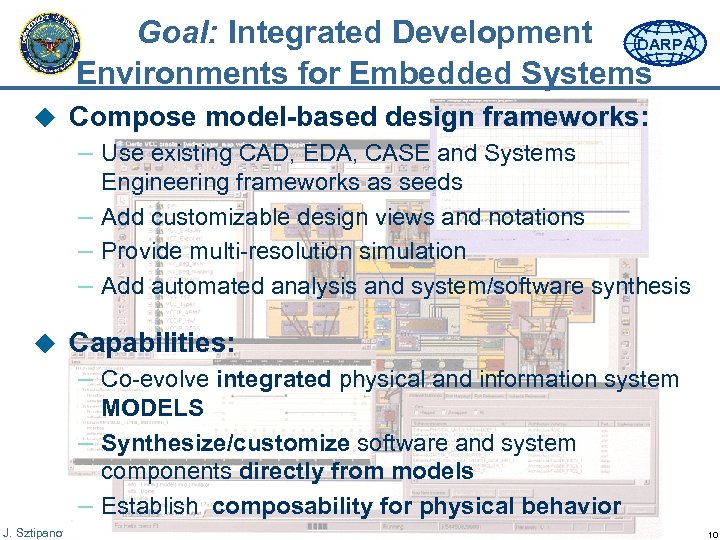
Goal: Integrated Development DARPA Environments for Embedded Systems u Compose model-based design frameworks: – Use existing CAD, EDA, CASE and Systems Engineering frameworks as seeds – Add customizable design views and notations – Provide multi-resolution simulation – Add automated analysis and system/software synthesis u Capabilities: – Co-evolve integrated physical and information system MODELS – Synthesize/customize software and system components directly from models – Establish composability for physical behavior J. Sztipanovits 10
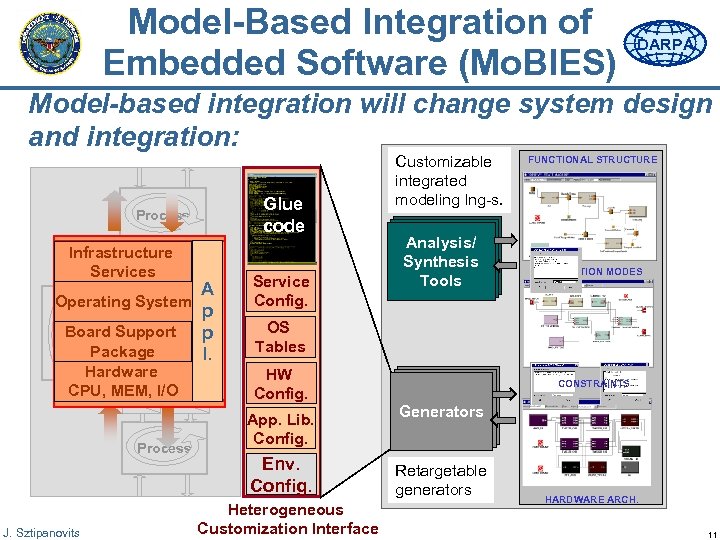
Model-Based Integration of Embedded Software (Mo. BIES) DARPA Model-based integration will change system design and integration: Glue code Process Infrastructure Services A p A Embedded Board Support Software p Package DSP l. FPGA Process D Operating System ROM M m. C Hardware CPU, MEM, I/O Process J. Sztipanovits Service Config. Customizable integrated modeling lng-s. Analysis/ Analysis Synthesis Tools FUNCTIONAL STRUCTURE OPERATION MODES OS Tables HW Config. App. Lib. Config. Env. Config. Heterogeneous Customization Interface CONSTRAINTS Generators Retargetable generators HARDWARE ARCH. 11
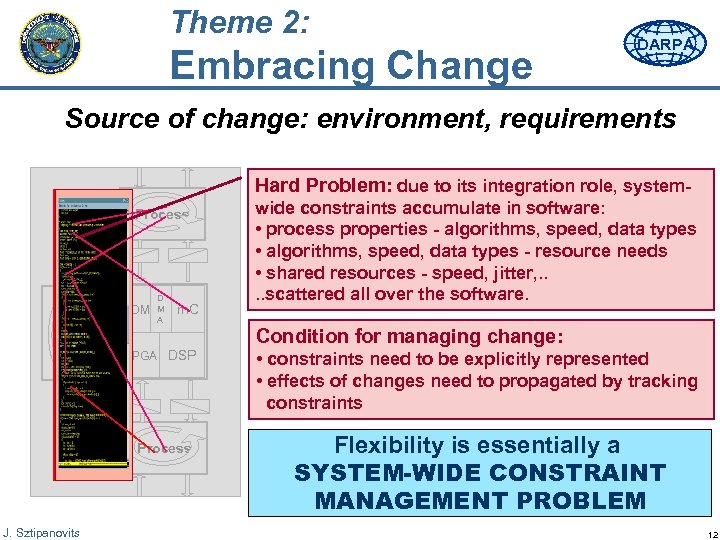
Theme 2: Embracing Change DARPA Source of change: environment, requirements Hard Problem: due to its integration role, system. Process D M A Process m. C Embedded Software FPGA DSP ROM Process J. Sztipanovits wide constraints accumulate in software: • process properties - algorithms, speed, data types • algorithms, speed, data types - resource needs • shared resources - speed, jitter, . . scattered all over the software. Condition for managing change: • constraints need to be explicitly represented • effects of changes need to propagated by tracking constraints Flexibility is essentially a SYSTEM-WIDE CONSTRAINT MANAGEMENT PROBLEM 12
Goal: Adaptive Component Technology for Embedded SW DARPA u Builds on object component technology (CORBA, COM) but provides: – Internal mechanisms to respond to changes. – Physically and computationally “self-aware” components. u Capabilities: – Insulates software from hardware with small performance penalty – Increases tolerance to unexpected changes – Optimizes performance – Increases tolerance to faults J. Sztipanovits 13
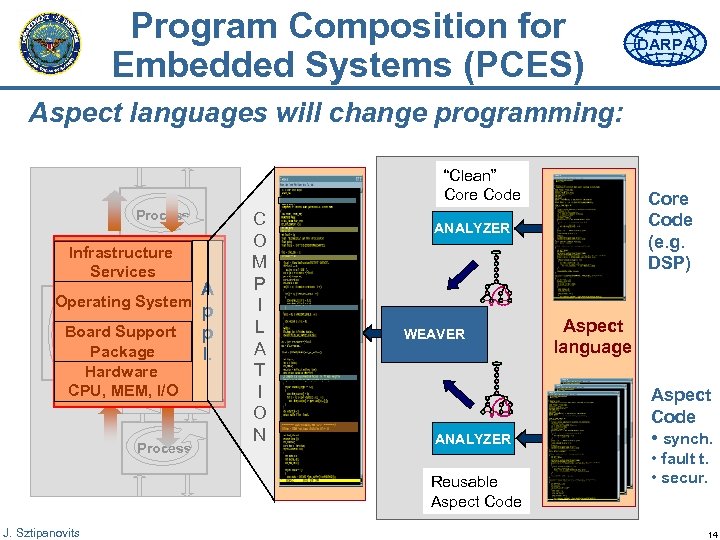
Program Composition for Embedded Systems (PCES) DARPA Aspect languages will change programming: “Clean” Core Code Process Infrastructure Services A p A Embedded Board Support Software p Package DSP l. FPGA Process D Operating System ROM M m. C Hardware CPU, MEM, I/O Process C O M P I L A T I O N ANALYZER WEAVER ANALYZER Reusable Aspect Code J. Sztipanovits Core Code (e. g. DSP) Aspect language Aspect Code • synch. • fault t. • secur. 14
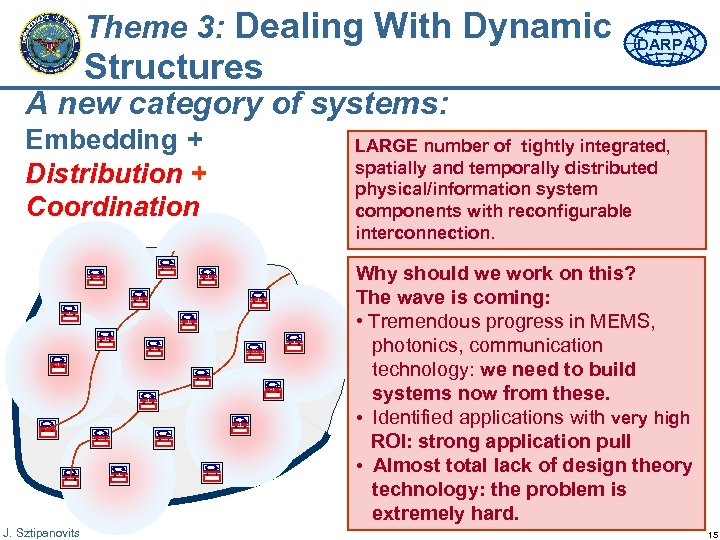
Theme 3: Dealing With Dynamic Structures DARPA A new category of systems: Embedding + Distribution + Coordination LARGE number of tightly integrated, spatially and temporally distributed physical/information system components with reconfigurable interconnection. Why should we work on this? The wave is coming: • Tremendous progress in MEMS, photonics, communication technology: we need to build systems now from these. • Identified applications with very high ROI: strong application pull • Almost total lack of design theory technology: the problem is extremely hard. J. Sztipanovits 15
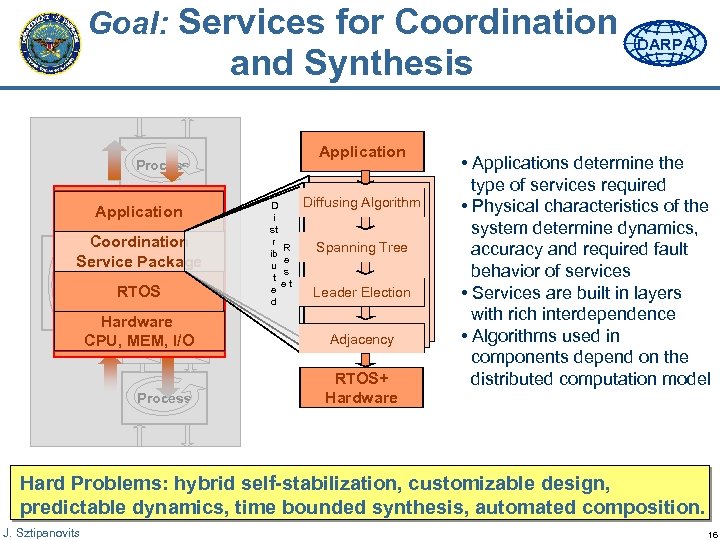
Goal: Services for Coordination and Synthesis Application Process Application Coordination D ROM M m. C Service Package A Embedded Software RTOS FPGA DSP Hardware CPU, MEM, I/O Process D i st r R ib e u s t et e d Diffusing Algorithm Spanning Tree Leader Election Adjacency RTOS+ Application Hardware DARPA • Applications determine the type of services required • Physical characteristics of the system determine dynamics, accuracy and required fault behavior of services • Services are built in layers with rich interdependence • Algorithms used in components depend on the distributed computation model Hard Problems: hybrid self-stabilization, customizable design, predictable dynamics, time bounded synthesis, automated composition. J. Sztipanovits 16
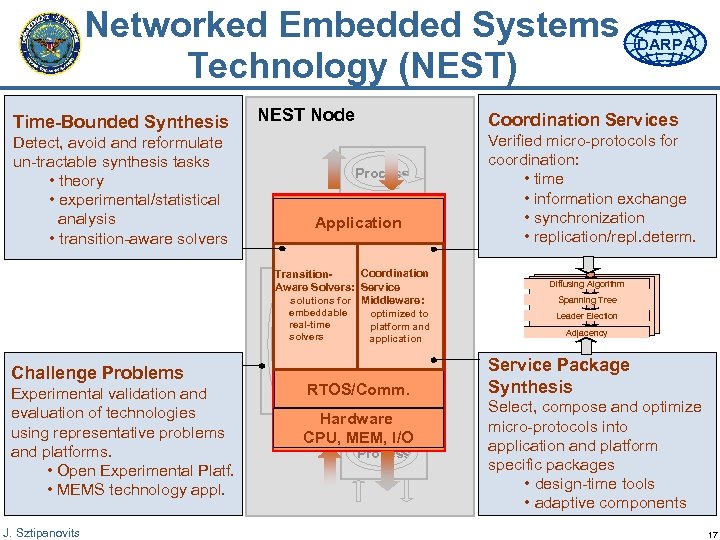
Networked Embedded Systems Technology (NEST) Time-Bounded Synthesis NEST Node Detect, avoid and reformulate un-tractable synthesis tasks • theory • experimental/statistical analysis • transition-aware solvers Coordination Services Process Application Coordination Transition. Aware Solvers: Service D solutions for Middleware: ROM M m. C optimized to Experimental validation and evaluation of technologies using representative problems and platforms. • Open Experimental Platf. • MEMS technology appl. J. Sztipanovits Process embeddable A real-time platform and Embedded solvers application Challenge Problems DARPA Software FPGA DSP RTOS/Comm. Hardware CPU, MEM, I/O Process Verified micro-protocols for coordination: • time • information exchange • synchronization • replication/repl. determ. Diffusing Algorithm Spanning Tree Leader Election Adjacency Service Package Synthesis Select, compose and optimize micro-protocols into application and platform specific packages • design-time tools • adaptive components 17
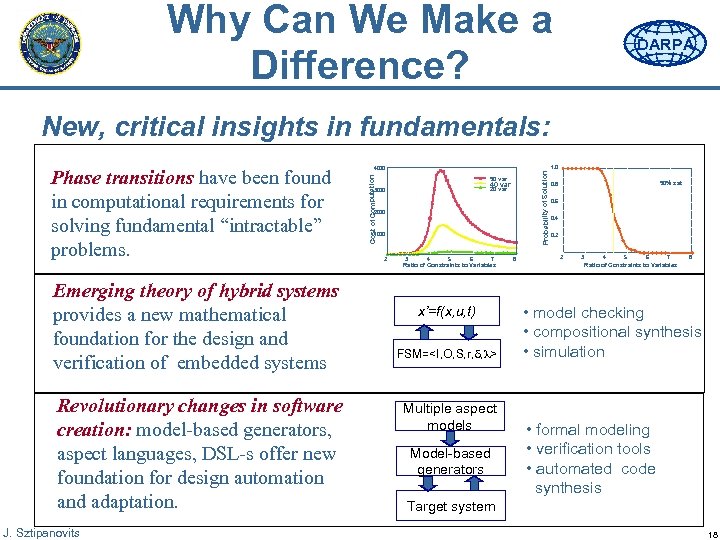
Why Can We Make a Difference? DARPA New, critical insights in fundamentals: Emerging theory of hybrid systems provides a new mathematical foundation for the design and verification of embedded systems Revolutionary changes in software creation: model-based generators, aspect languages, DSL-s offer new foundation for design automation and adaptation. J. Sztipanovits Probability of Solution Cost of Computation Phase transitions have been found in computational requirements for solving fundamental “intractable” problems. 1. 0 4000 50 var 40 var 20 var 3000 2000 1000 0 2 3 4 5 6 7 Ratio of Constraints to Variables x’=f(x, u, t) FSM=<I, O, S, r, , > Multiple aspect models Model-based generators 8 50% sat 0. 8 0. 6 0. 4 0. 2 0. 0 2 3 4 5 6 7 8 Ratio of Constraints to Variables • model checking • compositional synthesis • simulation • formal modeling • verification tools • automated code synthesis Target system 18
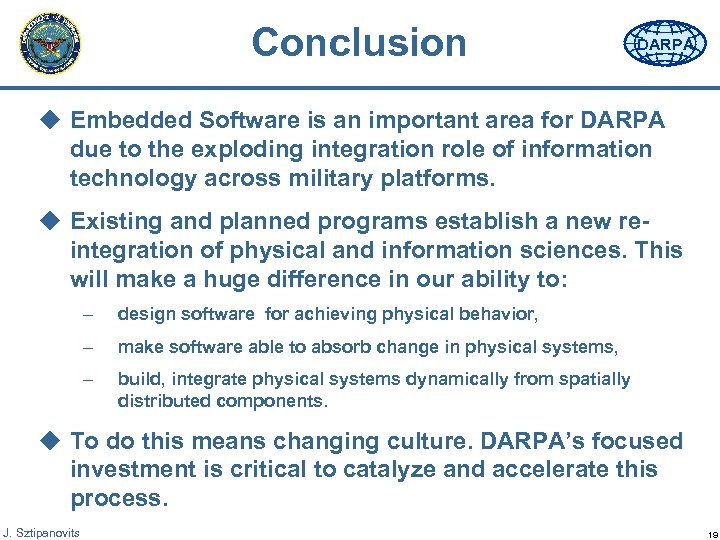
Conclusion DARPA u Embedded Software is an important area for DARPA due to the exploding integration role of information technology across military platforms. u Existing and planned programs establish a new reintegration of physical and information sciences. This will make a huge difference in our ability to: – design software for achieving physical behavior, – make software able to absorb change in physical systems, – build, integrate physical systems dynamically from spatially distributed components. u To do this means changing culture. DARPA’s focused investment is critical to catalyze and accelerate this process. J. Sztipanovits 19
Скачать презентацию DARPA Embedded Software A Critical Technology Challenge Dr
bbe0d764f27d11bdad93ec75ba6f3d6f.ppt