Скачать презентацию Dante Alighieri Durante degli Alighieri 1265 1321 was
Dante.pptx
- Количество слайдов: 7
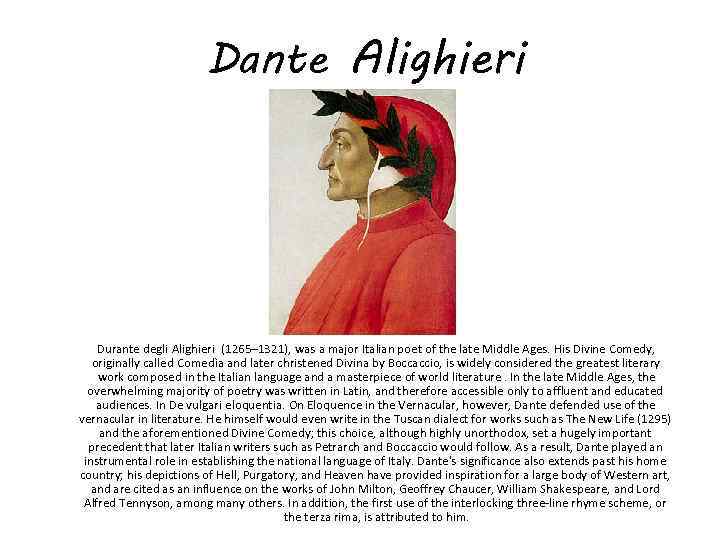 Dante Alighieri Durante degli Alighieri (1265– 1321), was a major Italian poet of the late Middle Ages. His Divine Comedy, originally called Comedìa and later christened Divina by Boccaccio, is widely considered the greatest literary work composed in the Italian language and a masterpiece of world literature. In the late Middle Ages, the overwhelming majority of poetry was written in Latin, and therefore accessible only to affluent and educated audiences. In De vulgari eloquentia. On Eloquence in the Vernacular, however, Dante defended use of the vernacular in literature. He himself would even write in the Tuscan dialect for works such as The New Life (1295) and the aforementioned Divine Comedy; this choice, although highly unorthodox, set a hugely important precedent that later Italian writers such as Petrarch and Boccaccio would follow. As a result, Dante played an instrumental role in establishing the national language of Italy. Dante's significance also extends past his home country; his depictions of Hell, Purgatory, and Heaven have provided inspiration for a large body of Western art, and are cited as an influence on the works of John Milton, Geoffrey Chaucer, William Shakespeare, and Lord Alfred Tennyson, among many others. In addition, the first use of the interlocking three-line rhyme scheme, or the terza rima, is attributed to him.
 LIFE. Dante was born in Florence, Italy. The exact date of his birth is unknown, although it is generally believed to be around 1265. This can be deduced from autobiographic allusions in the Divine Comedy. Its first section, the Inferno, begins, "Nel mezzo del cammin di nostra vita" ("Midway upon the journey of our life"), implying that Dante was around 35 years old, since the average lifespan according to the Bible is 70 years; and since his imaginary travel to the nether world took place in 1300, he was most probably born around 1265. Some verses of the Paradiso section of the Divine Comedy also provide a possible clue that he was born under the sign of Gemini: "As I revolved with the eternal twins, I saw revealed, from hills to river outlets, the threshing-floor that makes us so ferocious" (XXII 151– 154). In 1265, the sun was in Gemini between approximately May 11 and June 11.
 Dante claimed that his family descended from the ancient Romans (Inferno, XV, 76), but the earliest relative he could mention by name was Cacciaguida degli Elisei (Paradiso, XV, 135), born no earlier than about 1100. Dante's father, Alaghiero or Alighiero di Bellincione, was a White Guelph who suffered no reprisals after the Ghibellines won the Battle of Montaperti in the middle of the 13 th century. This suggests that Alighiero or his family may have enjoyed some protective prestige and status, although some suggest that the politically inactive Alighiero was of such low standing that he was not considered worth exiling.
 Dante's family had loyalties to the Guelphs, a political alliance that supported the Papacy and which was involved in complex opposition to the Ghibellines, who were backed by the Holy Roman Emperor. The poet's mother was Bella, likely a member of the Abati family. She died when Dante was not yet ten years old, and Alighiero soon married again, to Lapa di Chiarissimo Cialuffi. It is uncertain whether he really married her, since widowers were socially limited in such matters, but this woman definitely bore him two children, Dante's half-brother Francesco and half-sister Tana (Gaetana).
 Education and poetry. Not much is known about Dante's education; he presumably studied at home or in a chapter school attached to a church or monastery in Florence. It is known that he studied Tuscan poetry and that he admired the compositions of the Bolognese poet Guido Guinizelli — whom in Purgatorio XXVI he characterized as his "father"—at a time when the Sicilian school (Scuola poetica Siciliana), a cultural group from Sicily, was becoming known in Tuscany. His interests brought him to discover the Provençal poetry of the troubadours, such as Arnaut Daniel, and the Latin writers of classical antiquity, including Cicero, Ovid and especially Virgil.
 At 18, Dante met Guido Cavalcanti, Lapo Gianni, Cino da Pistoia and soon after Brunetto Latini; together they became the leaders of the dolce stil novo. Brunetto later received special mention in the Divine Comedy (Inferno, XV, 28) for what he had taught Dante: Nor speaking less on that account I go With Ser Brunetto, and I ask who are his most known and most eminent companions. Some fifty poetical commentaries by Dante are known (the so-called Rime, rhymes), others being included in the later Vita Nuova and Convivio. Other studies are reported, or deduced from Vita Nuova or the Comedy, regarding painting and music.