


 Скачать презентацию Danny Gokey Day Today May 8 2009 My
dc43be6d8976a0ce52f7eb88c9d60c8f.ppt
- Количество слайдов: 44
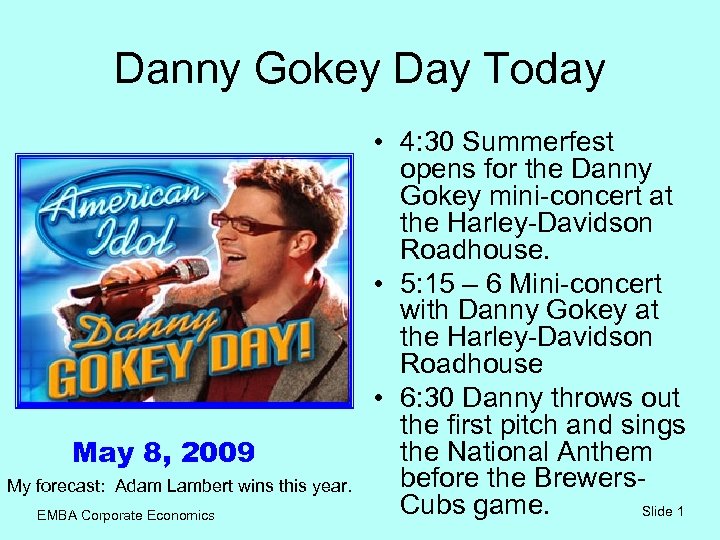 Danny Gokey Day Today May 8, 2009 My forecast: Adam Lambert wins this year. EMBA Corporate Economics • 4: 30 Summerfest opens for the Danny Gokey mini-concert at the Harley-Davidson Roadhouse. • 5: 15 – 6 Mini-concert with Danny Gokey at the Harley-Davidson Roadhouse • 6: 30 Danny throws out the first pitch and sings the National Anthem before the Brewers. Cubs game. Slide 1
 Price Discovery, Auction Markets, & Event Studies in Economics and Finance • Chapter 12 in Baye • In markets, we find out the price that clears the market ØWhat sellers are able to give up their item in exchange for money ØWhat buyers are willing to pay • Stock markets, real estate markets, and product market in essence find or discover the price for goods and services. EMBA Corporate Economics Slide 2
 Prices Convey Information • Land Use Questions • Even wise land-use commissioners, who try – Should we raise to assign the best use, cattle, hops, or are unlikely to have all extract energy from information land • In market economies • Social planners are unlikely to have the price of the land measures of the “social moves in line with opportunity costs” of their what it can be used decisions. to produce EMBA Corporate Economics Slide 3
 The Social Planner’s Problem • How do you get chickens to lay more eggs? v. There are two ways: warmth & food • Suppose a Social Planner can assign natural gas to steel manufacturing or egg production. ØLikely as not, she assigns half to one and half to the other ØMarkets change and the needs for steel change but the assignment is set. ØPrices would do this automatically EMBA Corporate Economics Slide 4
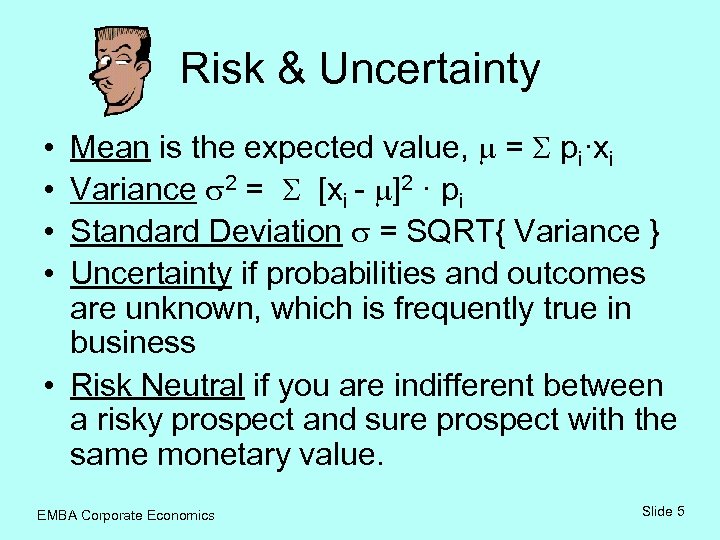 Risk & Uncertainty • • Mean is the expected value, m = S pi·xi Variance s 2 = S [xi - m]2 · pi Standard Deviation s = SQRT{ Variance } Uncertainty if probabilities and outcomes are unknown, which is frequently true in business • Risk Neutral if you are indifferent between a risky prospect and sure prospect with the same monetary value. EMBA Corporate Economics Slide 5
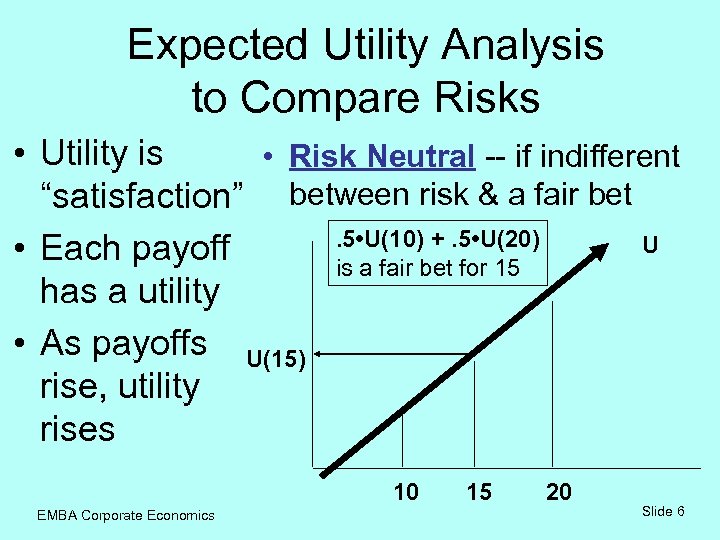 Expected Utility Analysis to Compare Risks • Utility is • Risk Neutral -- if indifferent “satisfaction” between risk & a fair bet. 5 • U(10) +. 5 • U(20) U • Each payoff is a fair bet for 15 has a utility • As payoffs U(15) rise, utility rises 10 EMBA Corporate Economics 15 20 Slide 6
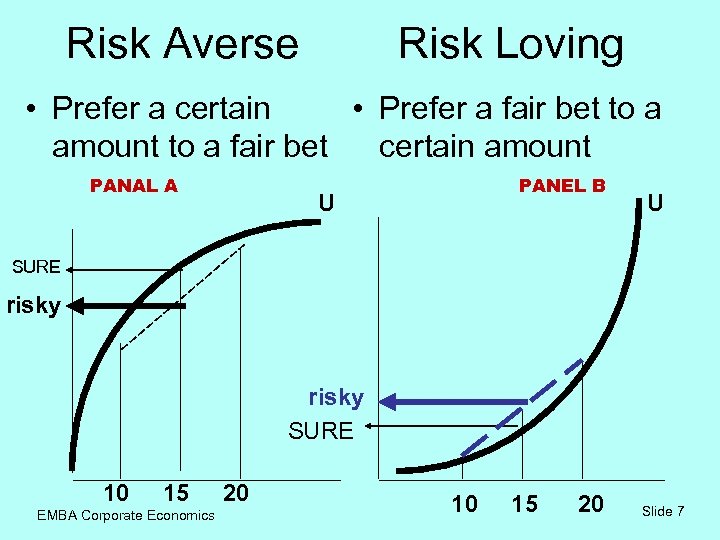 Risk Averse Risk Loving • Prefer a certain • Prefer a fair bet to a amount to a fair bet certain amount PANAL A PANEL B U U SURE risky SURE 10 15 EMBA Corporate Economics 20 10 15 20 Slide 7
 Risk Aversion in Action • Motel chains, such as Holiday Inn – If travelers are risk averse, a known entity is less risk • Restaurant chains, such as Mc. Donald’s – If coming through town, a known meal, a known quality versus the unknown local grille • Insurance purchases – Auto Insurance: risky value of a car (accident or no accident), purchase of insurance moves toward the SURE choice, such as panel A. – Life Insurance also • Yet, we love to gamble. – Milton Friedman’s wiggly utility function EMBA Corporate Economics Slide 8
 The St. Petersburg Paradox • The St. Petersburg Paradox is a gamble of tossing a fair coin, where the payoff doubles for every consecutive head that appears. $2 for the first heads, $4 for the second, etc. • The expected monetary value of this gamble is: $2·(. 5) + $4·(. 25) + $8·(. 125) + $16·(. 0625) +. . . = 1 + 1 +. . . = . INFINITE!!! • But no one would be willing to wager all he or she owns to get into this bet. • It must be that people make decisions by criteria other than maximizing expected monetary payoff. EMBA Corporate Economics Slide 9
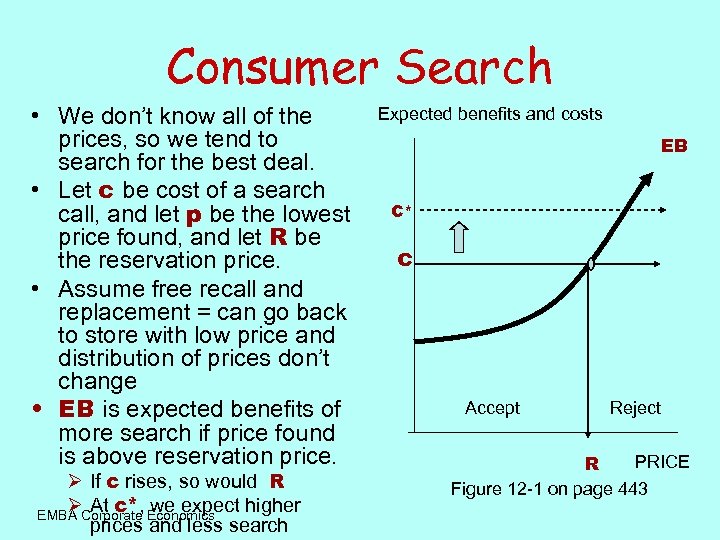 Consumer Search • We don’t know all of the prices, so we tend to search for the best deal. • Let c be cost of a search call, and let p be the lowest price found, and let R be the reservation price. • Assume free recall and replacement = can go back to store with low price and distribution of prices don’t change • EB is expected benefits of more search if price found is above reservation price. Ø If c rises, so would R Ø At c*, we expect higher EMBA Corporate Economics prices and less search Expected benefits and costs EB C* c Accept Reject R PRICE Figure 12 -1 on page 443
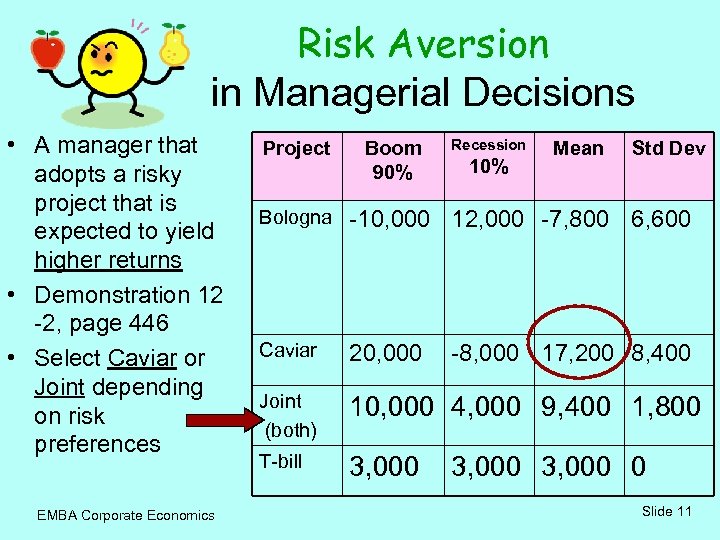 Risk Aversion in Managerial Decisions • A manager that adopts a risky project that is expected to yield higher returns • Demonstration 12 -2, page 446 • Select Caviar or Joint depending on risk preferences EMBA Corporate Economics Project Boom 90% Recession 10% Mean Std Dev Bologna -10, 000 12, 000 -7, 800 6, 600 Caviar 20, 000 Joint (both) 10, 000 4, 000 9, 400 1, 800 T-bill 3, 000 -8, 000 17, 200 8, 400 3, 000 0 Slide 11
 Asymmetric Information page 450 An assumption of pure competition was complete knowledge of all market information. But knowledge can be unevenly distributed among firms and consumers. The concept of a "lemon" in the car market and adverse selection problem are only two of the interesting market phenomena when information is unevenly distributed (asymmetric) among the market participants EMBA Corporate Economics Slide 12
 The Used Car Market • Who knows the most about it? • Asymmetric Information -- unequal or dissimilar knowledge among market participants. • Car prices can drop by four to five thousand dollars when driven away from the dealer Ø Who wants to buy this used car? Ø But if someone is selling his or her car, isn't it likely that the car is no good: a lemon? EMBA Corporate Economics Slide 13
 Asymmetric Information in a Lemon's Market • Search goods are products or services whose quality is best detected through a market search. • Experience goods are products and services whose quality is undetected when purchased. q So Experience Goods are more likely to suffer from the Lemon’s Problem q What of the sale price at auction of wooden furniture versus electonic goods? Which has the greater discount? • To protect consumers, warranties and firm reputations are used to assure quality. EMBA Corporate Economics Slide 14
 Adverse Selection • • A selection process results in a pool of individuals with undesirable characteristics. Cafeteria employee benefit plans and Adverse Selection: v Pick from A, B, C with A family dental, B extra life insurance, and C extended accident insurance for injury. 1. Bucky picks A (with 5 kids all with bad teeth) 2. Margy picks B (both her parents died in their early 50’s of heart attacks) 3. Slim picks C (he knows that has always been accident prone) EMBA Corporate Economics Slide 15
 Moral Hazard • 1. 2. 3. 4. 5. Moral Hazard occurs because of hidden actions by one or more parties after contracting that benefits that individual Stockholders have the directors borrow from bondholders and then asks the directors to take on riskier projects (bondholder use covenants to protect themselves) Low fire insurance and high theft insurance rates (hard to know if a real theft occurred) Helmet laws in Michigan lead to more accidents (as drivers become more reckless with their astronaut helmets) Get $5, 000 in life insurance and start eating less healthy foods Too-big-to-fail Banks took on risky sub-prime debt EMBA Corporate Economics
 Signaling, Sorting, and Screening of Managerial Talent n Applicants to positions know more about themselves than they reveal, which is the problem of asymmetric information. n For example, is the applicant highly risk averse or a risk taker? n How can we sort between risk-takers and risk averse candidates? EMBA Corporate Economics Slide 17
 One Sorting Method • A Linear Incentive Contract provides a combination of salary and (plus or minus!) a profit sharing rate. • An offer that dominates all other offers will not help distinguish among applicants. This is a pooling equilibrium. • Offers that distinguishes between behaviors is a separating equilibrium. • For example, a risk averse person would tend to select an offer which primarily paid a base salary • Whereas the individual would tend to select an EMBA Corporate Economics offer with more profit sharing.
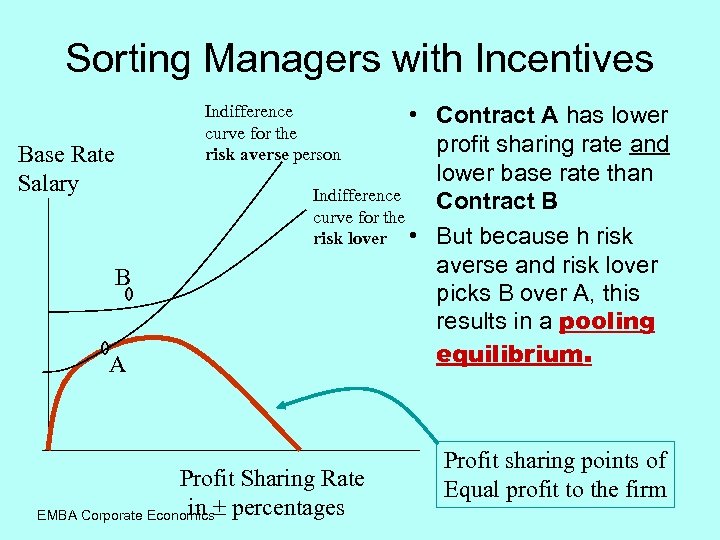 Sorting Managers with Incentives • Contract A has lower profit sharing rate and lower base rate than Indifference Contract B curve for the risk lover • But because h risk averse and risk lover picks B over A, this results in a pooling equilibrium. Indifference curve for the risk averse person Base Rate Salary B A Profit Sharing Rate in EMBA Corporate Economics percentages Profit sharing points of Equal profit to the firm
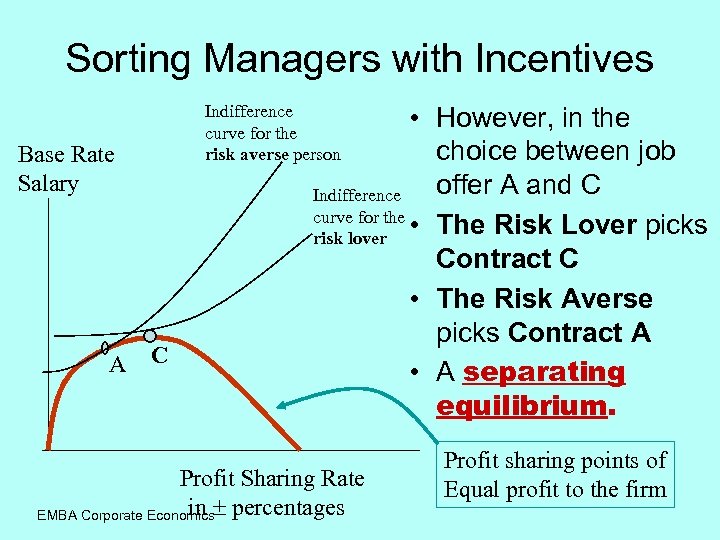 Sorting Managers with Incentives Indifference curve for the risk averse person Base Rate Salary A C • However, in the choice between job offer A and C Indifference curve for the • The Risk Lover picks risk lover Contract C • The Risk Averse picks Contract A • A separating equilibrium. Profit Sharing Rate in EMBA Corporate Economics percentages Profit sharing points of Equal profit to the firm
 Sex, Booze, and Drugs MBN Chapter 5 • If something is illegal, those with comparative • History of abject failure in advantage in illegal preventing prostitution, prohibition, and abstinence activities will tend to gravitate to this market from drugs by laws and imprisonment • If both marijuana and • Buyers & sellers in mutual cocaine are illegal, then greater effort by exchange suppliers of illegal drugs • Government can go after to sell the more demanders or suppliers expensive, and more compact cocaine. EMBA Corporate Economics Slide 21
 Auctions • In English auctions, the prices rise bids arrive. as more – Used by ‘auctioneers’ to ask for higher and higher bids • In Dutch auctions, a high price is announced, and if no one agrees, the auctioneer lowers the price until the first bid arrives. èFor-sale-by-owner sellers of homes keep lowering price until they find a buyer. • In Best Price, Sealed Bid Auction, (books says First-Price), all bids opened at one time with no knowledge of other bidders – Little information revealed until bidding ends. EMBA Corporate Economics Slide 22
 • Second-Price, Sealed Bid Auctions the winning bid goes the highest bid, but at the second highest price • Reservation price the minimum acceptable bid. (A reserve) – e. Bay uses reservation prices to prevent the sale of an item at a mere $1 or lower. EMBA Corporate Economics Slide 23
 Types of Bidding in Auctions • Simultaneous bidding open outcry at estate auctions. Information about other bidders valuation is revealed – price discovery occurs – used by Priceline with Dutch descending prices • Sequential bidding such as private placement for newly issued securities. – used by e. Bay with English ascending prices • Bidding rules can require minimum increases in prices – e. Bay requires each bid to be at least $1 higher than the prior bid. EMBA Corporate Economics Slide 24
 • Bid prices can be discrete or continuous by agreed increments, as in 1/8 or 1/16 for stocks in the past. – August 2000 began decimalization of stock prices on the NYSE and AMEX. They trade to the penny, rather than in fractional prices, and are now essentially continuous. • Bids can be sealed or posted sealed bids make them anonymous and secret to other bidders; whereas posted means all see the bid. • Bids can be one-time-only or multiple rounds. EMBA Corporate Economics Slide 25
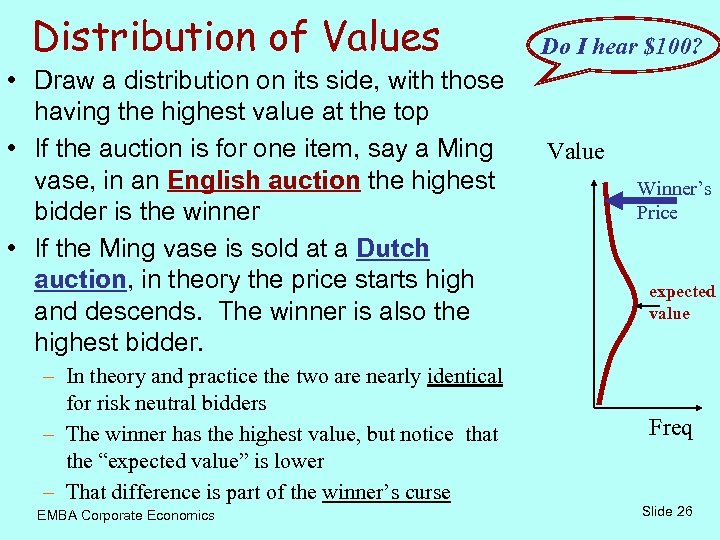 Distribution of Values • Draw a distribution on its side, with those having the highest value at the top • If the auction is for one item, say a Ming vase, in an English auction the highest bidder is the winner • If the Ming vase is sold at a Dutch auction, in theory the price starts high and descends. The winner is also the highest bidder. – In theory and practice the two are nearly identical for risk neutral bidders – The winner has the highest value, but notice that the “expected value” is lower – That difference is part of the winner’s curse EMBA Corporate Economics Do I hear $100? Value Winner’s Price expected value Freq Slide 26
 Winner’s Curse • If the true value of an item is not known, but bidders have a distribution of values that they are willing to pay, the winning bid is very likely to be higher than the true value. • The regret for the bidder is that he or she paid too much: the winner’s curse. • If everyone is aware of the winner’s curse, then all would bid less than what they think is its true value. • This problem has led some auctions to award the highest bidder with the second-best price in a sealed bid auction. Even when you win, the price will be lower than what you bid, so you bid more. Slide 27 EMBA Corporate Economics
 Information Structures in Independent Value Auctions • Independent-value auctions are where bidders have different valuations for the item • A Vickery auction is the secondhighest sealed bid auctions. • Second-highest sealed bids are used to reduce underbidding. – (e. g. , vintage postage stamps) • Knowing that you pay less than bid • The highest value bidders may wish to wait-and-see in English open outcry auctions. • • In sealed-bid auctions, this • strategy does not work. • Even with sealed bidding, the fear of the winners curse may lead to underbidding. EMBA Corporate Economics helps to move bid closer to one’s private value. As the number of bidders rises, underbidding tends to decline. Vickery shows the optimal underbidding is 1/Nth the true value, with N the number of bidders.
 Information Structures in Correlated Value Auctions • Correlated value auctions are ones where the bidders have similar valuation of the item when information is complete (as Milwaukeeans buying a Danny Gorkey CD) • Silent auction, where each writes a price higher than the last works well for these types of items • For simultaneous sealed-bid auctions, the bidder offers prices below their expected value. – No information is conveyed to competitors. • For simultaneous, open-bidding auctions, information is revealed by the bids of others. – One variation is multiple rounds. – Bidding for broadcast spectrum bidding, the FCC used 112 rounds over a four-month bidding period. EMBA Corporate Economics Slide 29
 Strategy with Open Bidding Design • Each bidder tries to elicit sufficient information to identify the value of the item bid upon • After the sealed bids are open, the winner many have bid strategically low to avoid the winner’s curse. • Buy having a second (and third) round, the winning price from the first round is known. • Bidding in the next round “updates” information to include the winning price (part of Bayesian information updating). In Bayesian information processes, the prior information is updated with new information. EMBA Corporate Economics Slide 30
 e. Bay and Internet auctions • www. ebay. com - operates the leading online • • trading community in which buyers and sellers are brought together in an auction format to trade personal items such as antiques, coins, collectibles, computers, memorabilia, stamps and toys. What type of auction is it? (English or Dutch? ) What is a “Buy-it-now” form of auction? Why is there a reservation price? What is “N, ” the number of bidders, in a worldwide auction? EMBA Corporate Economics Slide 31
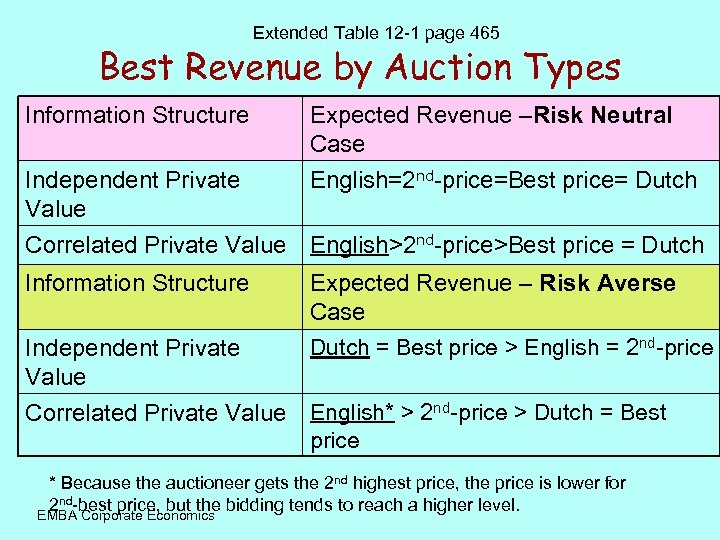 Extended Table 12 -1 page 465 Best Revenue by Auction Types Information Structure Independent Private Value Expected Revenue –Risk Neutral Case English=2 nd-price=Best price= Dutch Correlated Private Value English>2 nd-price>Best price = Dutch Information Structure Expected Revenue – Risk Averse Case Dutch = Best price > English = 2 nd-price Independent Private Value Correlated Private Value English* > 2 nd-price > Dutch = Best price * Because the auctioneer gets the 2 nd highest price, the price is lower for 2 nd-best price, but the bidding tends to reach a higher level. EMBA Corporate Economics
 Dutch Auction IPOs • Google went public in 2004 using a so-called Dutch auction IPO, or modified Dutch auction. • Stock prices in an IPO are likely to be viewed a private-value auctions. • The highest price to the firm from risk-averse investors would come a Dutch auction, although purists would call it a modified Vickery auction. – The price is not the second highest price, but the price that clears the market – Since winning bidders are taken in descending order, it is somewhat like a Dutch auction. EMBA Corporate Economics Slide 33
 IPO Auction (A Modified Vickery Auction) • All bidders submit the number of shares that they would like to buy and the maximum price that they are willing to pay for each of those shares. • When all bids are in, they are opened and sorted into descending order by price • A running total of shares requested is calculated. • The market clearing price is the price at which the running total of shares requested equals the number of shares offered. • All bidders who bid at or more than the market clearing price receive the shares that they requested • They all pay the market clearing price (which will always be less than or equal to their maximum bid price). EMBA Corporate Economics Slide 34
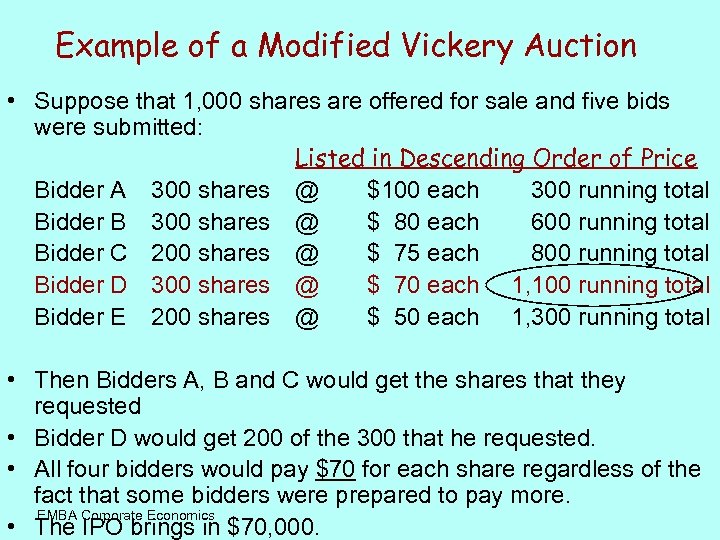 Example of a Modified Vickery Auction • Suppose that 1, 000 shares are offered for sale and five bids were submitted: Listed in Descending Order of Price Bidder A 300 shares @ $100 each 300 running total Bidder B 300 shares @ $ 80 each 600 running total Bidder C 200 shares @ $ 75 each 800 running total Bidder D 300 shares @ $ 70 each 1, 100 running total Bidder E 200 shares @ $ 50 each 1, 300 running total • Then Bidders A, B and C would get the shares that they requested • Bidder D would get 200 of the 300 that he requested. • All four bidders would pay $70 for each share regardless of the fact that some bidders were prepared to pay more. EMBA Corporate Economics • The IPO brings in $70, 000.
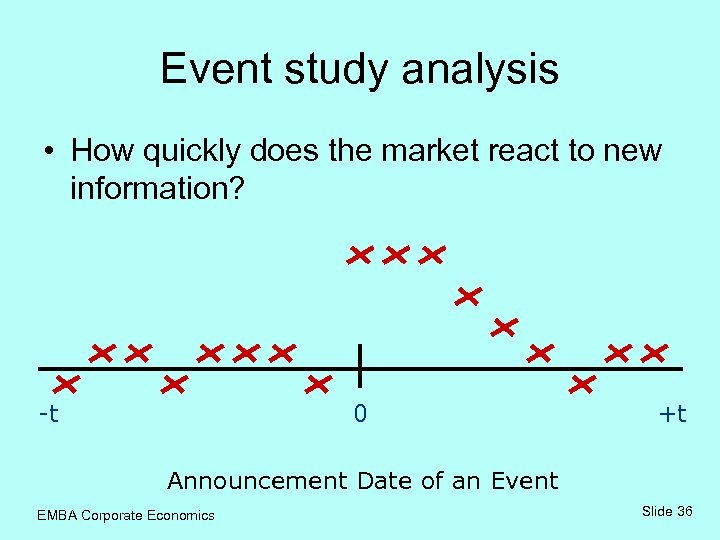 Event study analysis • How quickly does the market react to new information? -t 0 +t Announcement Date of an Event EMBA Corporate Economics Slide 36
 Event study analysis • Measure the speed and magnitude of market reaction to a certain event – High-frequency (usually, daily) data – Ease of use, flexibility – Robustness to the joint hypothesis problem • Experimental design – Pure impact of a given event – Try not to permit “other events” from contaminating study • Collect a sample of similar events and line them all up on the event date Slide 37 EMBA Corporate Economics
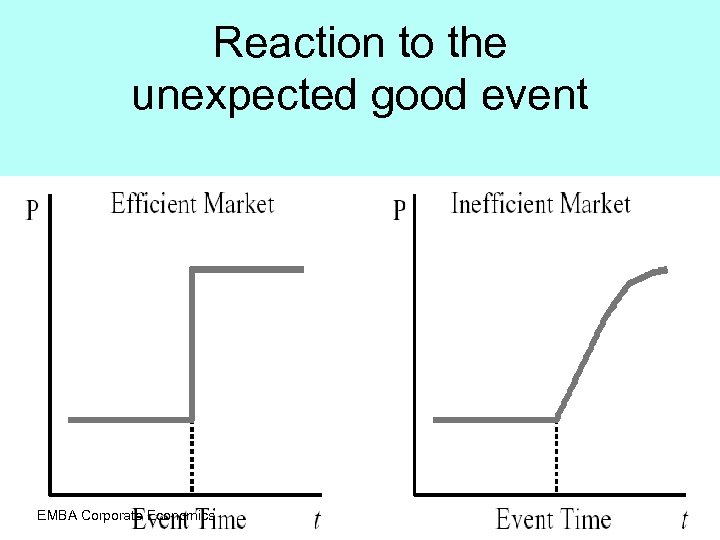 Reaction to the unexpected good event EMBA Corporate Economics Slide 38
 Methodology: find event to be studied and its announcement date • Type of the event ØShare repurchase or dividend change or announcement of a M&A • Date of the event τ=0 ØAnnouncement, not the actual payment ØThe event window: several days around the event date • Selection of the sample – Must be representative, no selection biases EMBA Corporate Economics Slide 39
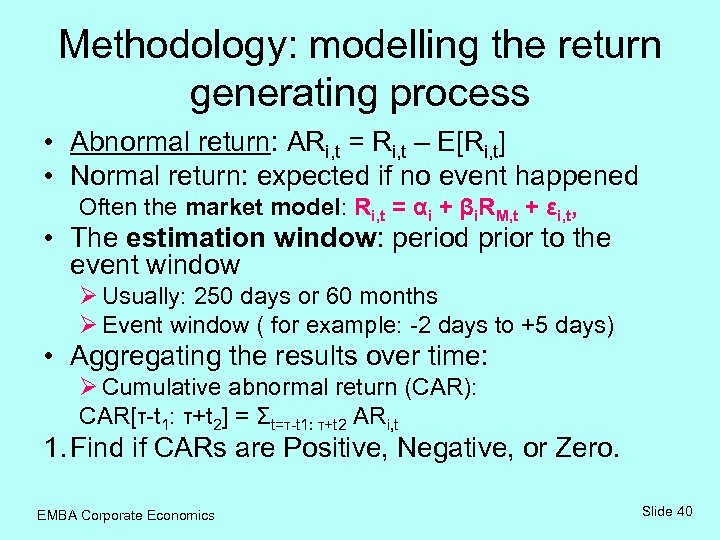 Methodology: modelling the return generating process • Abnormal return: ARi, t = Ri, t – E[Ri, t] • Normal return: expected if no event happened Often the market model: Ri, t = αi + βi. RM, t + εi, t, • The estimation window: period prior to the event window Ø Usually: 250 days or 60 months Ø Event window ( for example: -2 days to +5 days) • Aggregating the results over time: Ø Cumulative abnormal return (CAR): CAR[τ-t 1: τ+t 2] = Σt=τ-t 1: τ+t 2 ARi, t 1. Find if CARs are Positive, Negative, or Zero. EMBA Corporate Economics Slide 40
 Strengths of the event study analysis • Direct and powerful test of Efficiency – Shows whether new info is fully and instantaneously incorporated in stock prices • Testing corporate finance theories – Average AR measures market reaction to different types of the events • Fama Fisher Jensen & Roll tests of stock splits – In theory, nothing happens in a stock split – Found that those with splits and higher dividends gained, those with no dividend increases stayed flat. Fama, Eugene F. , Lawrence Fisher, Michael Jensen and Richard Roll (1969). The adjustment of stock prices to new information, International Economic Review, 10 (1), 1 -21. EMBA Corporate Economics
 Werner De. Bondt & Richard Thaler Journal of Finance (1985) "Does the stock market overreact? " • Test the overreaction hypothesis: – Investors pay too much attention to current earnings and punish companies with low P/E ratio – Later earnings and prices return to fundamental levels – Find that long-term losers (stocks that perform poorly over the prior five-year period) perform better than winners over the subsequent five-year period. • Examine long-run performance of winner and loser portfolios formed on the basis of past returns – Different formation and testing periods EMBA Corporate Economics Slide 42
 Data and methodology • Monthly returns of NYSE common stocks in 1926 -1982 (CRSP) – Stocks with at least 85 months of data (to exclude small and young firms) • Market index: – Equal-weighted average return on all CRSP stocks • Market-adjusted approach for AR: ARi = Ri – RM – Similar results for CAPM and market model approaches EMBA Corporate Economics Slide 43
 Test procedure • Consider 16 non-overlapping 3 year periods: – 1/1930 -12/1932, …, 1/1978 -12/1980 • In the beginning of each period, t=0: – Rank all stocks on cumulative excess returns during the formation period (past 36 months) • Top 35 / top 50 / top deciles stocks = winner portfolio – Similarly, for loser portfolio • Compute ARs and CARs for the next 36 months: t=1: 36 • Tested hypotheses: ARL=0, ARW=0, ACARL=ACARW • Finding: – Losers outperform winners by 24. 6% during 36 month testing period – Mostly driven by • Losers that outperform the market by 19. 6% • January returns • Years 2 and 3 EMBA Corporate Economics Slide 44