 Скачать презентацию Daniel Brazen CTP Session 3 02 Reinventing Billing
27db8f061cdd3b2c8be54f7176a4c143.ppt
- Количество слайдов: 50



Daniel Brazen, CTP Session 3. 02 Reinventing Billing and Receivables Processes Using Today’s Technology Monday, March 8, 2004 2: 15 pm to 3: 15 pm 1
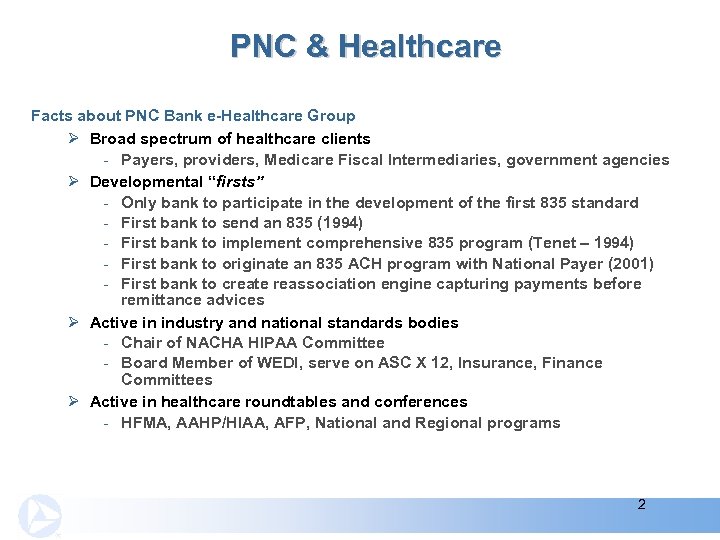
PNC & Healthcare Facts about PNC Bank e-Healthcare Group Ø Broad spectrum of healthcare clients - Payers, providers, Medicare Fiscal Intermediaries, government agencies Ø Developmental “firsts” - Only bank to participate in the development of the first 835 standard - First bank to send an 835 (1994) - First bank to implement comprehensive 835 program (Tenet – 1994) - First bank to originate an 835 ACH program with National Payer (2001) - First bank to create reassociation engine capturing payments before remittance advices Ø Active in industry and national standards bodies - Chair of NACHA HIPAA Committee - Board Member of WEDI, serve on ASC X 12, Insurance, Finance Committees Ø Active in healthcare roundtables and conferences - HFMA, AAHP/HIAA, AFP, National and Regional programs 2
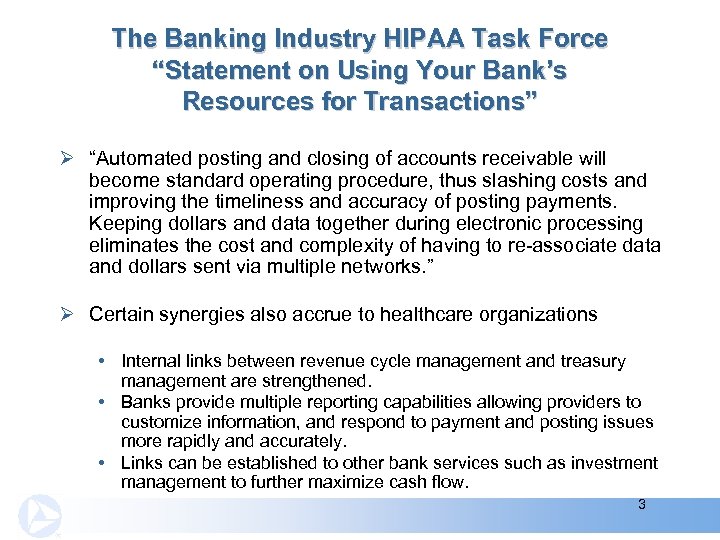
The Banking Industry HIPAA Task Force “Statement on Using Your Bank’s Resources for Transactions” Ø “Automated posting and closing of accounts receivable will become standard operating procedure, thus slashing costs and improving the timeliness and accuracy of posting payments. Keeping dollars and data together during electronic processing eliminates the cost and complexity of having to re-associate data and dollars sent via multiple networks. ” Ø Certain synergies also accrue to healthcare organizations • Internal links between revenue cycle management and treasury management are strengthened. • Banks provide multiple reporting capabilities allowing providers to customize information, and respond to payment and posting issues more rapidly and accurately. • Links can be established to other bank services such as investment management to further maximize cash flow. 3
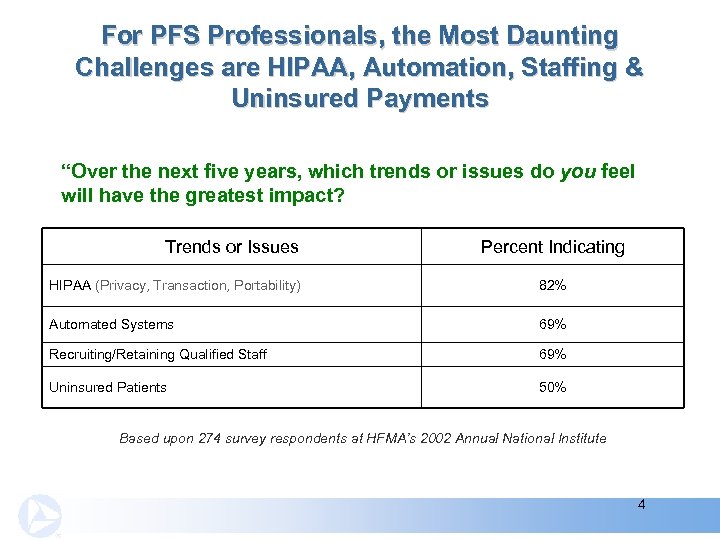
For PFS Professionals, the Most Daunting Challenges are HIPAA, Automation, Staffing & Uninsured Payments “Over the next five years, which trends or issues do you feel will have the greatest impact? Trends or Issues Percent Indicating HIPAA (Privacy, Transaction, Portability) 82% Automated Systems 69% Recruiting/Retaining Qualified Staff 69% Uninsured Patients 50% Based upon 274 survey respondents at HFMA’s 2002 Annual National Institute 4
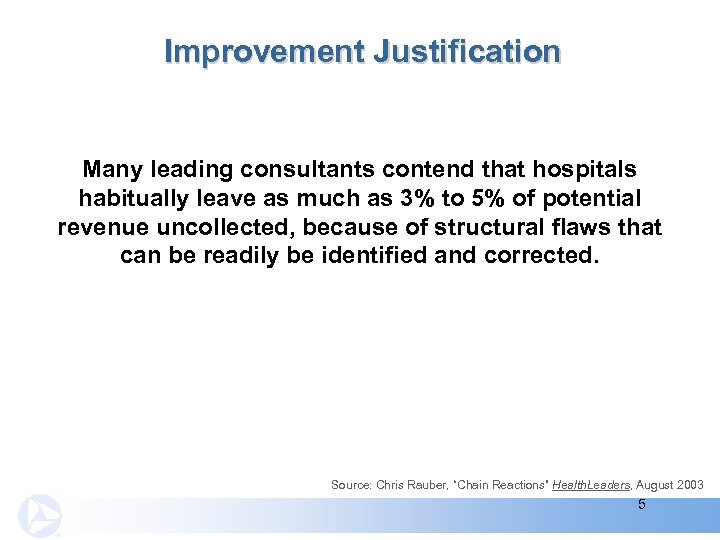
Improvement Justification Many leading consultants contend that hospitals habitually leave as much as 3% to 5% of potential revenue uncollected, because of structural flaws that can be readily be identified and corrected. Source: Chris Rauber, “Chain Reactions” Health. Leaders, August 2003 5
Today’s Agenda Addresses These Two Questions Ø Why should I change my billing/receivable process and technology? Ø What does a fully technology-enabled process look like? 6
Today’s Agenda Addresses These Two Questions Ø Why should I change my billing/receivable process and technology? Ø What does a fully technology-enabled process look like? 7
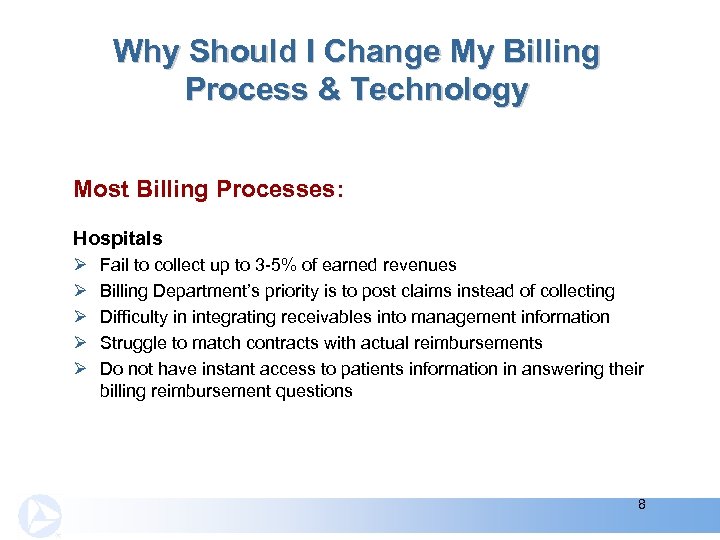
Why Should I Change My Billing Process & Technology Most Billing Processes: Hospitals Ø Ø Ø Fail to collect up to 3 -5% of earned revenues Billing Department’s priority is to post claims instead of collecting Difficulty in integrating receivables into management information Struggle to match contracts with actual reimbursements Do not have instant access to patients information in answering their billing reimbursement questions 8
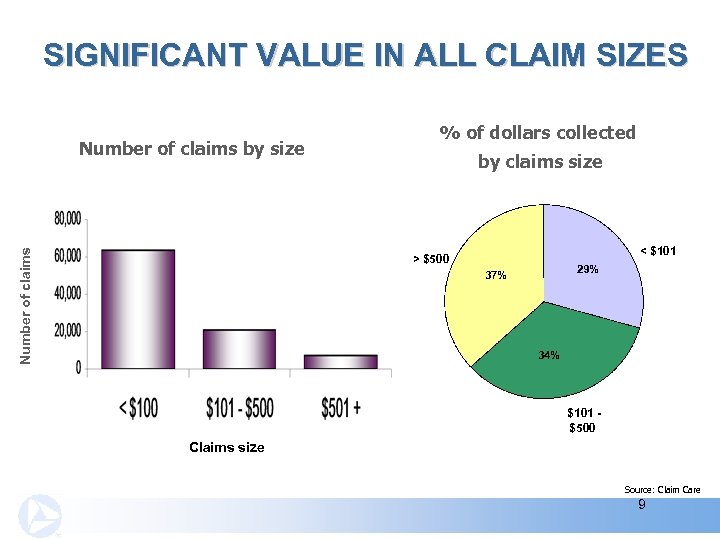
SIGNIFICANT VALUE IN ALL CLAIM SIZES Number of claims by size % of dollars collected by claims size < $101 > $500 29% 37% 34% $101 $500 Claims size Source: Claim Care 9
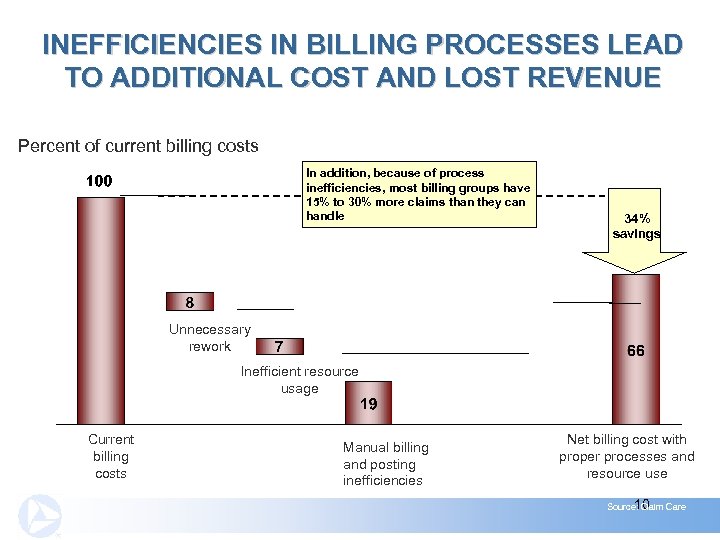
INEFFICIENCIES IN BILLING PROCESSES LEAD TO ADDITIONAL COST AND LOST REVENUE Percent of current billing costs In addition, because of process inefficiencies, most billing groups have 15% to 30% more claims than they can handle 34% savings Unnecessary rework Inefficient resource usage Current billing costs Manual billing and posting inefficiencies Net billing cost with proper processes and resource use 10 Source: Claim Care
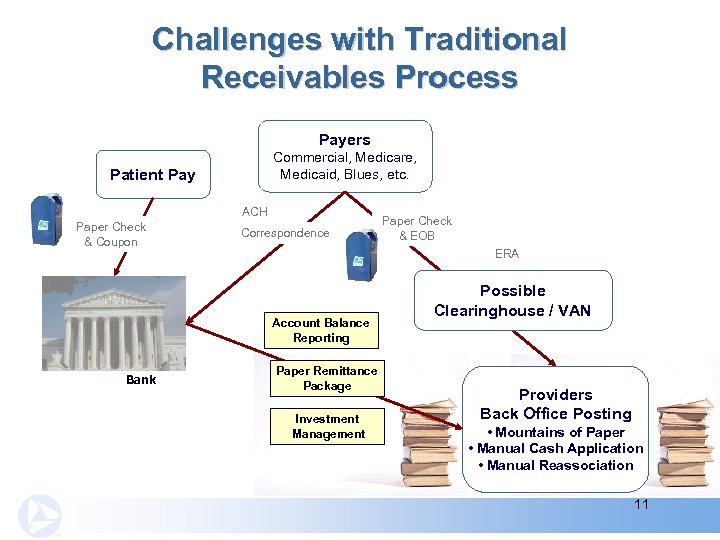
Challenges with Traditional Receivables Process Payers Commercial, Medicare, Medicaid, Blues, etc. Patient Pay ACH Paper Check & Coupon Correspondence ERA Account Balance Reporting Bank Paper Check & EOB Paper Remittance Package Investment Management Possible Clearinghouse / VAN Providers Back Office Posting • Mountains of Paper • Manual Cash Application • Manual Reassociation 11
Typical Challenges You May Be Facing Ø Patient Pay – lack of automation through coupon scanline, or credit card process Ø No Data Capture in Lockbox Process – results in manual posting of all paper receivables Ø Issues with Direct ERA Data Feeds – printing and posting manually; must re-associate with the dollars in your bank account before posting; cost of maintaining multiple direct transmissions and/or clearinghouse; lack of HIPAA validation for incoming files Ø Investment Management – allocate cost and revenue to the units that are borrowers and lenders of cash 12
Today’s Agenda Addresses These Two Questions Ø Why should I change my billing/receivable process and technology? Ø What does a fully technology-enabled process look like? 13
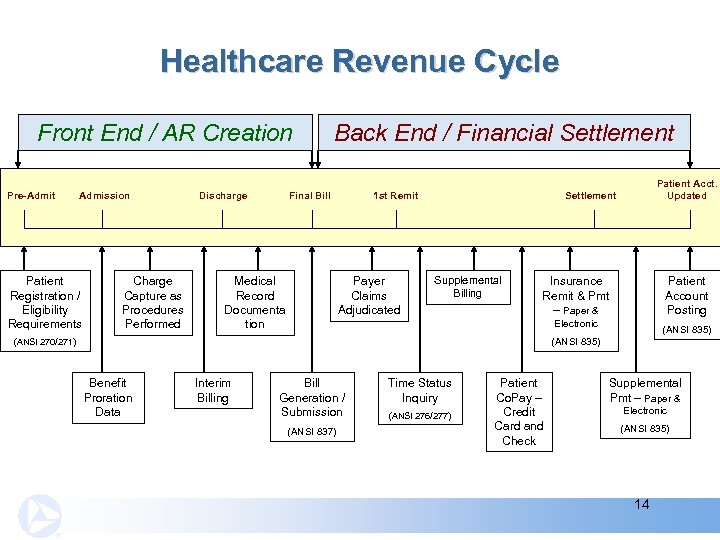
Healthcare Revenue Cycle Front End / AR Creation Pre-Admit Admission Patient Registration / Eligibility Requirements Charge Capture as Procedures Performed Discharge Back End / Financial Settlement Final Bill Medical Record Documenta tion 1 st Remit Payer Claims Adjudicated Patient Acct. Updated Settlement Supplemental Billing Insurance Remit & Pmt – Paper & Patient Account Posting Electronic (ANSI 835) (ANSI 270/271) Benefit Proration Data Interim Billing Bill Generation / Submission (ANSI 837) Time Status Inquiry (ANSI 276/277) Patient Co. Pay – Credit Card and Check Supplemental Pmt – Paper & Electronic (ANSI 835) 14
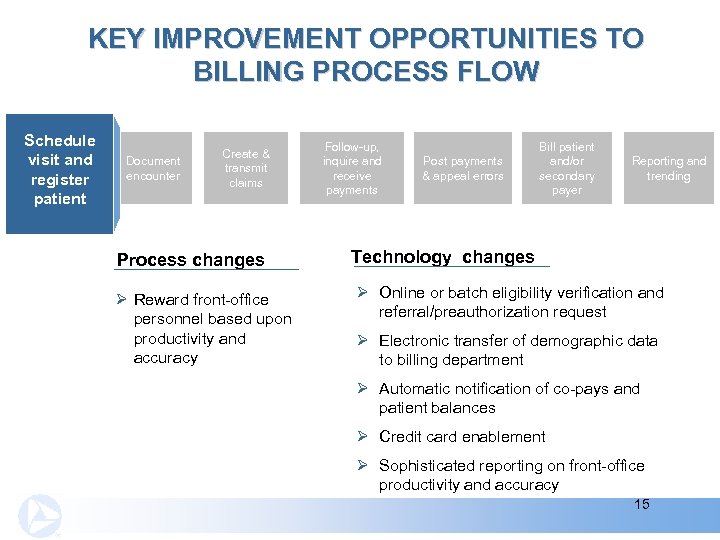
KEY IMPROVEMENT OPPORTUNITIES TO BILLING PROCESS FLOW Schedule visit and & register patient Document encounter Create & transmit claims Process changes Ø Reward front-office personnel based upon productivity and accuracy Follow-up, inquire and receive payments Post payments & appeal errors Bill patient and/or secondary payer Reporting and trending Technology changes Ø Online or batch eligibility verification and referral/preauthorization request Ø Electronic transfer of demographic data to billing department Ø Automatic notification of co-pays and patient balances Ø Credit card enablement Ø Sophisticated reporting on front-office productivity and accuracy 15
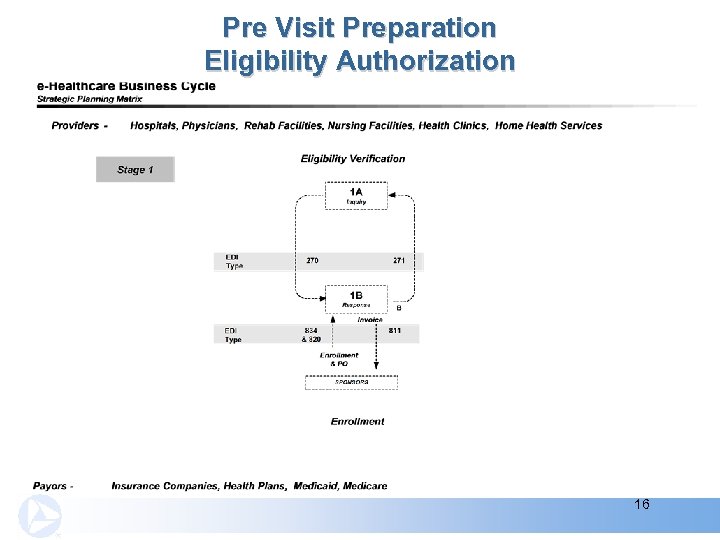
Pre Visit Preparation Eligibility Authorization 16
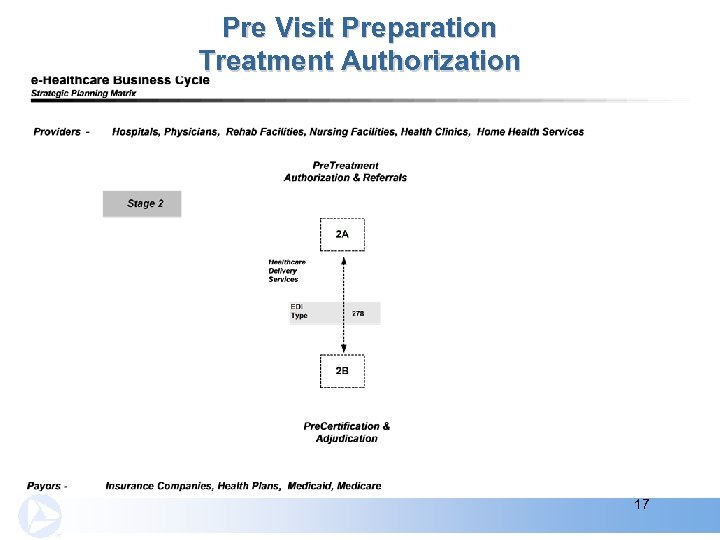
Pre Visit Preparation Treatment Authorization 17
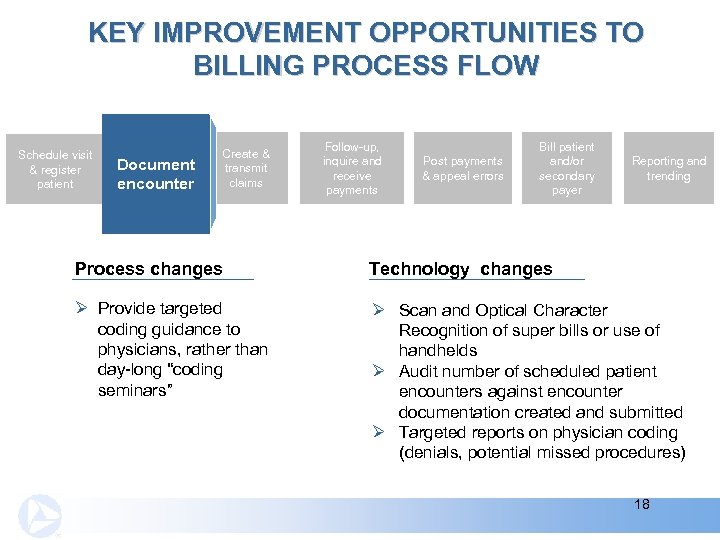
KEY IMPROVEMENT OPPORTUNITIES TO BILLING PROCESS FLOW Schedule visit & register patient Document encounter Create & transmit claims Follow-up, inquire and receive payments Post payments & appeal errors Bill patient and/or secondary payer Reporting and trending Process changes Technology changes Ø Provide targeted coding guidance to physicians, rather than day-long “coding seminars” Ø Scan and Optical Character Recognition of super bills or use of handhelds Ø Audit number of scheduled patient encounters against encounter documentation created and submitted Ø Targeted reports on physician coding (denials, potential missed procedures) 18
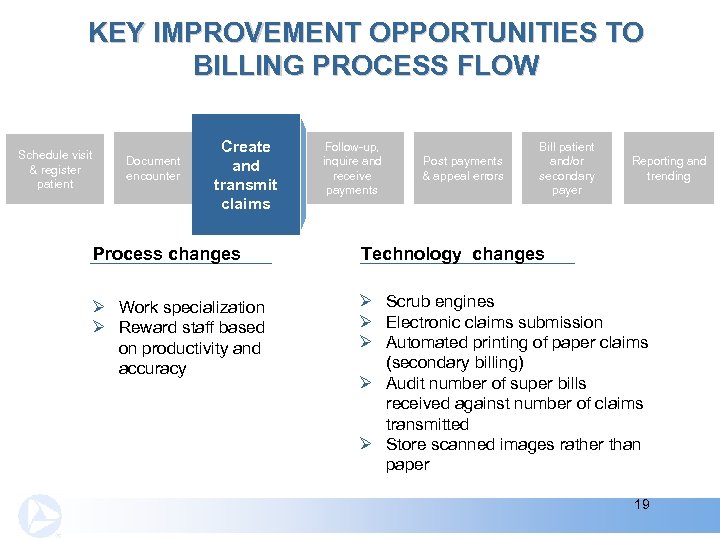
KEY IMPROVEMENT OPPORTUNITIES TO BILLING PROCESS FLOW Schedule visit & register patient Document encounter Create & and transmit claims Follow-up, inquire and receive payments Post payments & appeal errors Bill patient and/or secondary payer Reporting and trending Process changes Technology changes Ø Work specialization Ø Reward staff based on productivity and accuracy Ø Scrub engines Ø Electronic claims submission Ø Automated printing of paper claims (secondary billing) Ø Audit number of super bills received against number of claims transmitted Ø Store scanned images rather than paper 19
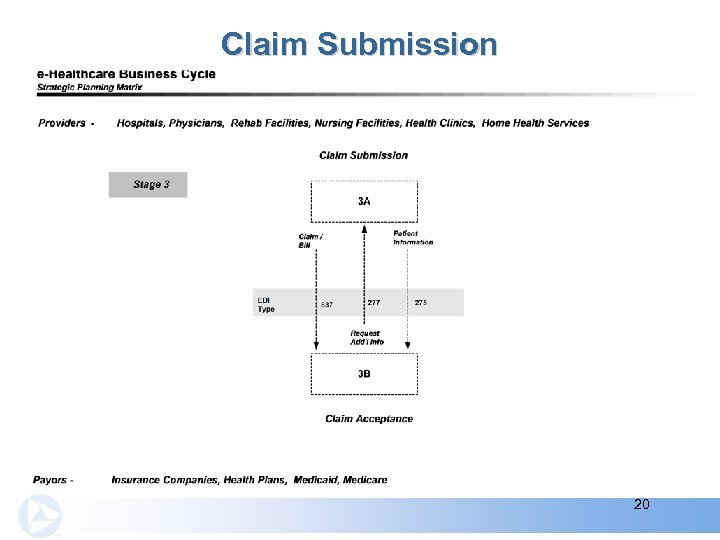
Claim Submission 20
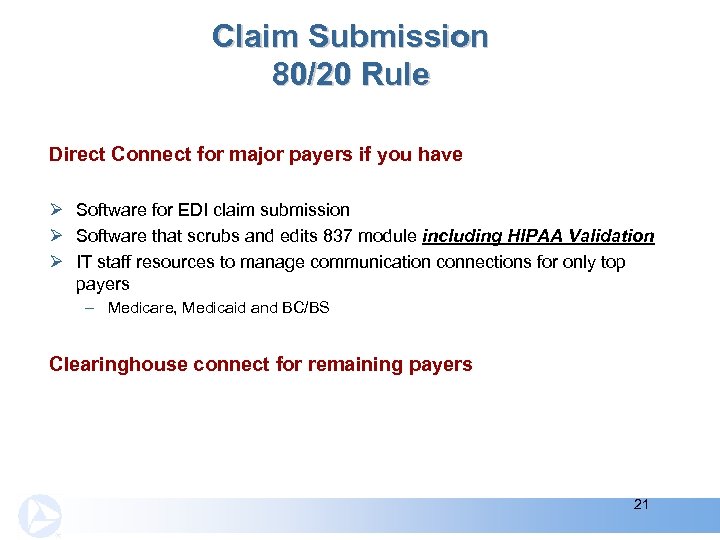
Claim Submission 80/20 Rule Direct Connect for major payers if you have Ø Software for EDI claim submission Ø Software that scrubs and edits 837 module including HIPAA Validation Ø IT staff resources to manage communication connections for only top payers – Medicare, Medicaid and BC/BS Clearinghouse connect for remaining payers 21
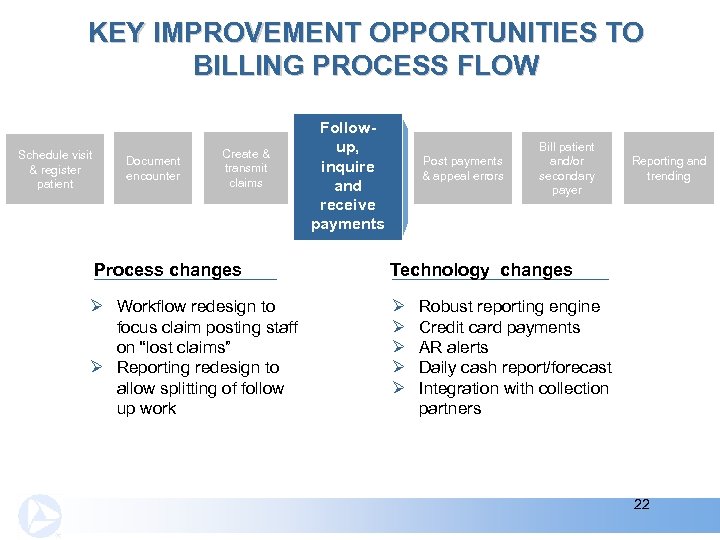
KEY IMPROVEMENT OPPORTUNITIES TO BILLING PROCESS FLOW Schedule visit & register patient Document encounter Create & transmit claims Follow-up, inquire and inquire receive and payments receive payments Post payments & appeal errors Bill patient and/or secondary payer Process changes Technology changes Ø Workflow redesign to focus claim posting staff on “lost claims” Ø Reporting redesign to allow splitting of follow up work Ø Ø Ø Reporting and trending Robust reporting engine Credit card payments AR alerts Daily cash report/forecast Integration with collection partners 22
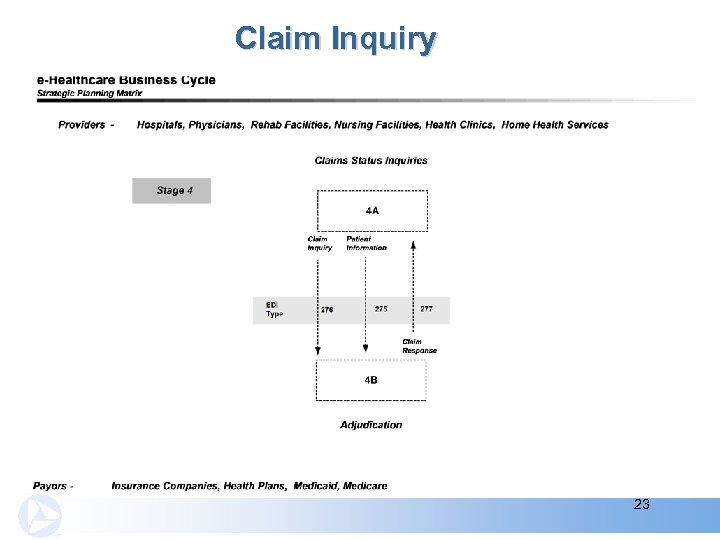
Claim Inquiry 23
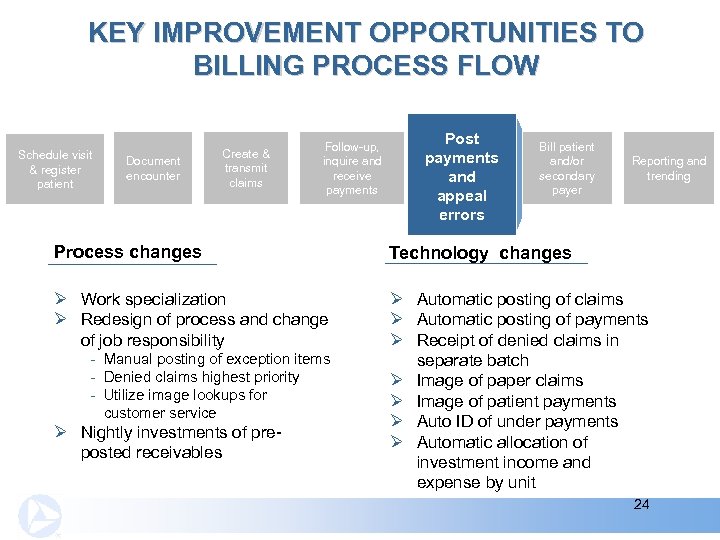
KEY IMPROVEMENT OPPORTUNITIES TO BILLING PROCESS FLOW Schedule visit & register patient Document encounter Create & transmit claims Follow-up, inquire and receive payments Post payments & appeal errors and appeal errors Bill patient and/or secondary payer Reporting and trending Process changes Technology changes Ø Work specialization Ø Redesign of process and change of job responsibility Ø Automatic posting of claims Ø Automatic posting of payments Ø Receipt of denied claims in separate batch Ø Image of paper claims Ø Image of patient payments Ø Auto ID of under payments Ø Automatic allocation of investment income and expense by unit - Manual posting of exception items - Denied claims highest priority - Utilize image lookups for customer service Ø Nightly investments of preposted receivables 24
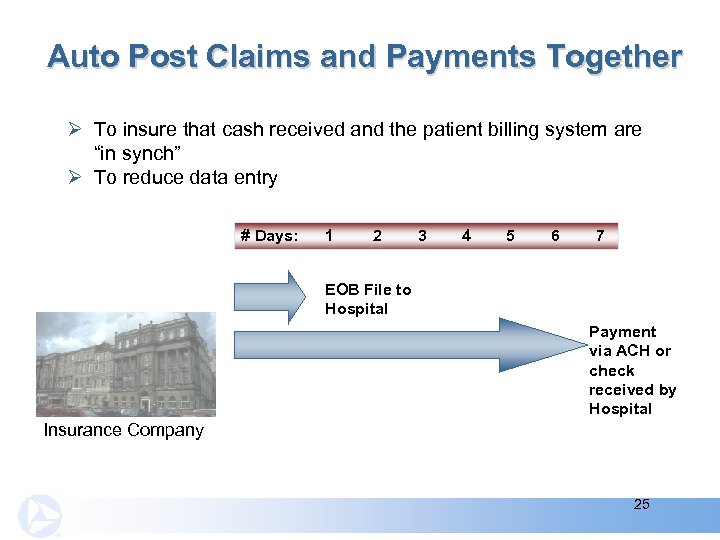
Auto Post Claims and Payments Together Ø To insure that cash received and the patient billing system are “in synch” Ø To reduce data entry # Days: 1 2 3 4 5 6 7 EOB File to Hospital Payment via ACH or check received by Hospital Insurance Company 25
Auto Posting Cash Application Most patient accounting systems are structured to automatically post data delivered in an 835 format Ø Cash application issues to consider: - Electronic information vs. paper EOB (data capture data to assist in posting) - Upload credit card payments from eligibility and patient payments directly into AR - Use of image lockbox vs. paper lockbox Ø Lockbox batches - Identify payers, zero dollar remittances, separate facilities, groupings of images - Reconcile batch number with current day reporting and claims posted Ø Patient ID - To place EOBs and payments into patient folder, automate posting and additional invoices 26
Image Paper EOBs And Self Payments Disadvantages of paper based manual filing systems Ø Documents account for up to 40% of your labor costs Ø Your administrators and staff spend up to 60% of their time handling documents Ø Xerox has found that up to 40% of forms and documents stored by hospitals are obsolete Advantages of imaged-based filing system Ø Knowledge sharing efficiency and higher quality care – improved customer service Ø Faster payment application – reduced data entry errors Ø Store in a digital library – reduced storage cost Ø Access via a Web browser – reduced labor cost - Share images of Self Payments and EOBs Pricewaterhouse. Coopers – “The Regulatory Burden Facing America's Hospitals, ” 2002. 27
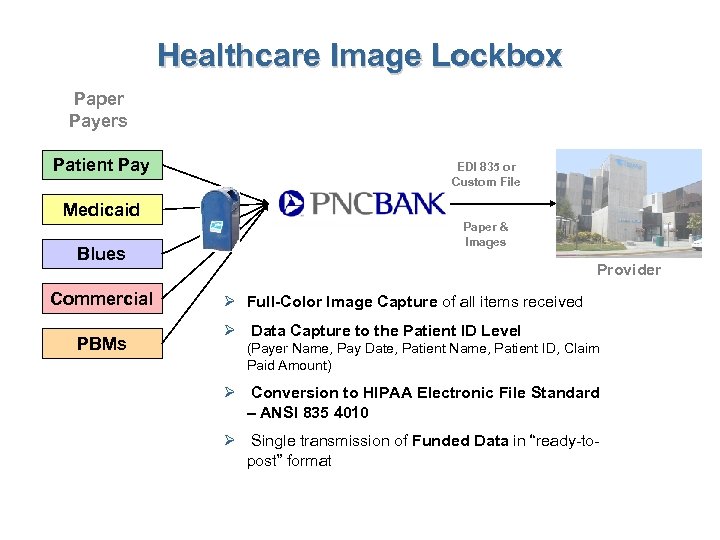
Healthcare Image Lockbox Paper Payers Patient Pay EDI 835 or Custom File Medicaid Blues Commercial PBMs Paper & Images Provider Ø Full-Color Image Capture of all items received Ø Data Capture to the Patient ID Level (Payer Name, Pay Date, Patient Name, Patient ID, Claim Paid Amount) Ø Conversion to HIPAA Electronic File Standard – ANSI 835 4010 Ø Single transmission of Funded Data in “ready-topost” format
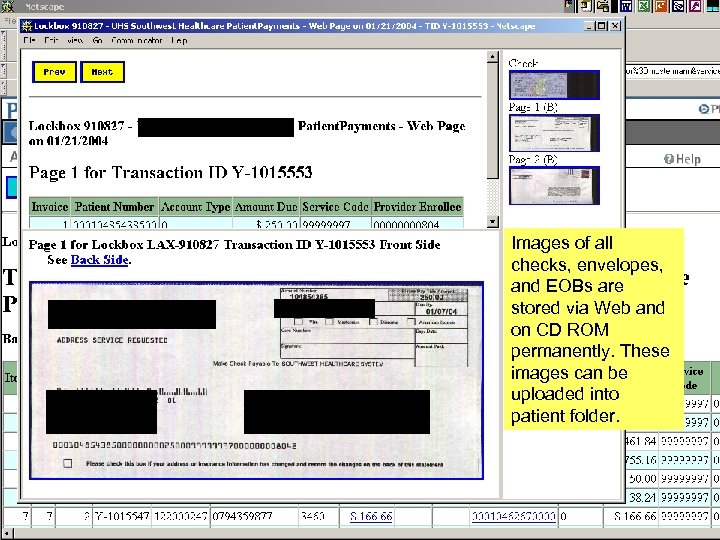
University Health System and Affiliates Pasadena CA Joseph Andrew Smith 100 Center Street Minot, CA 32101 Joseph Andrew Smith University Health System and Affiliates PO Box 910827 Pasadena CA 10027 Images of all checks, envelopes, and EOBs are stored via Web and on CD ROM permanently. These images can be uploaded into patient folder. 29
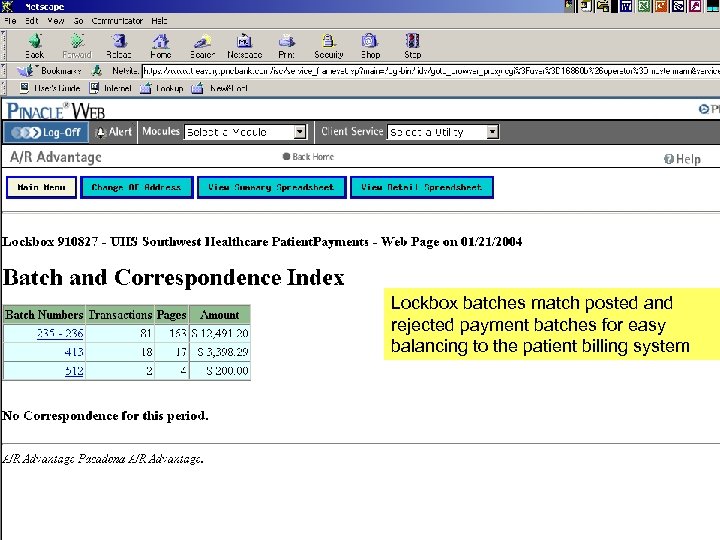
Lockbox batches match posted and rejected payment batches for easy balancing to the patient billing system 30
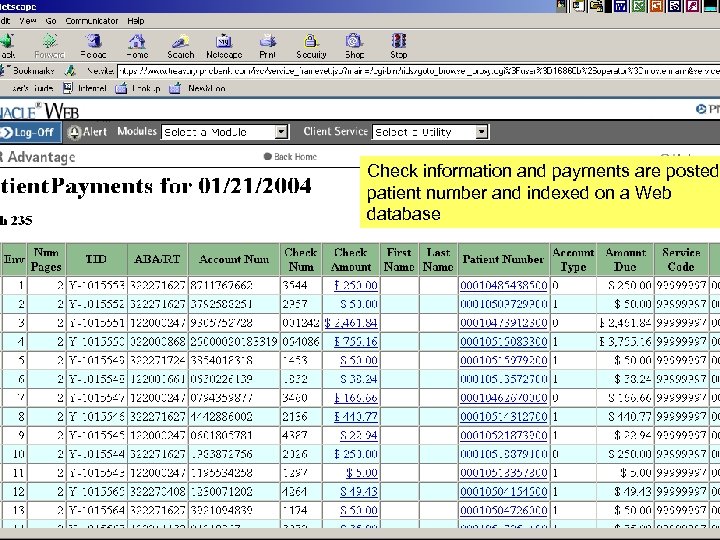
Check information and payments are posted patient number and indexed on a Web database 31
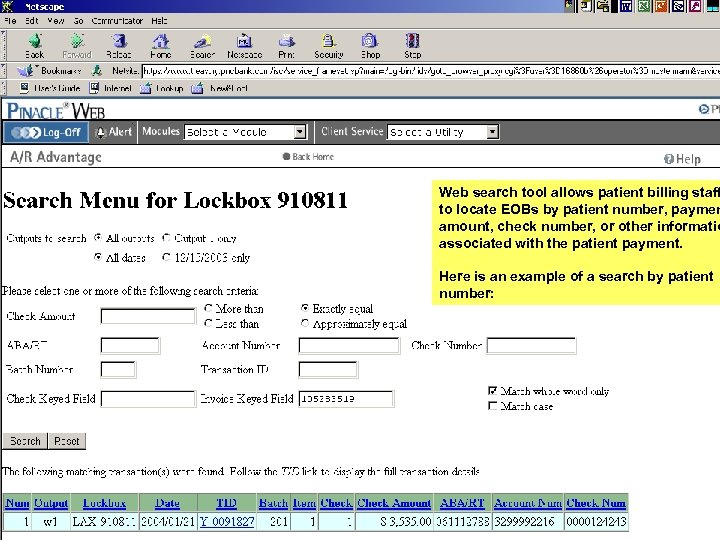
Web search tool allows patient billing staff to locate EOBs by patient number, paymen amount, check number, or other informatio associated with the patient payment. Here is an example of a search by patient number: 32
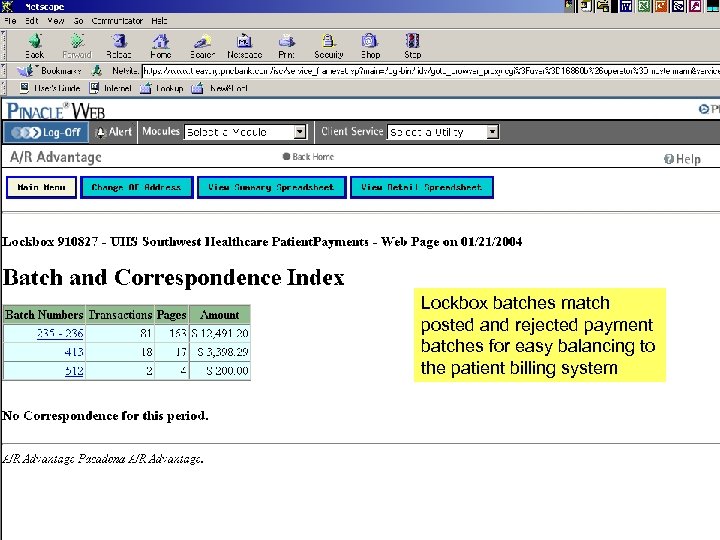
Lockbox batches match posted and rejected payment batches for easy balancing to the patient billing system 33
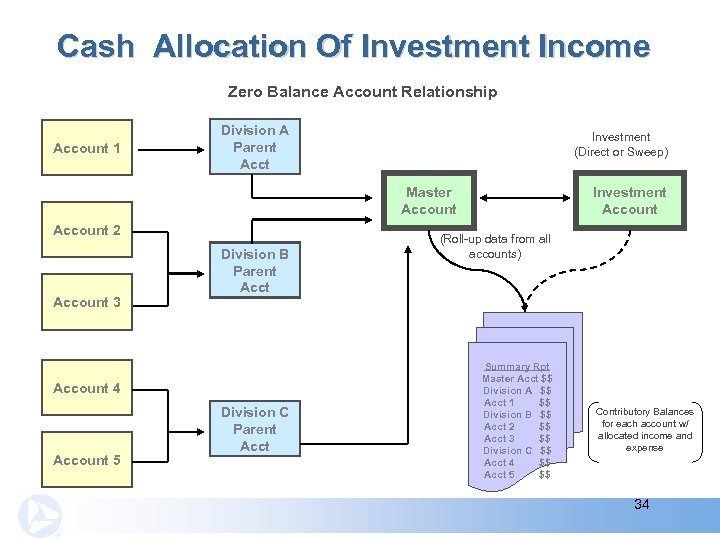
Cash Allocation Of Investment Income Zero Balance Account Relationship Account 1 Division A Parent Acct Investment (Direct or Sweep) Master Account 2 Account 3 Division B Parent Account 4 Account 5 Division C Parent Acct Investment Account (Roll-up data from all accounts) Summary Rpt Master Acct $$ Division A $$ Acct 1 $$ Division B $$ Acct 2 $$ Acct 3 $$ Division C $$ Acct 4 $$ Acct 5 $$ Contributory Balances for each account w/ allocated income and expense 34
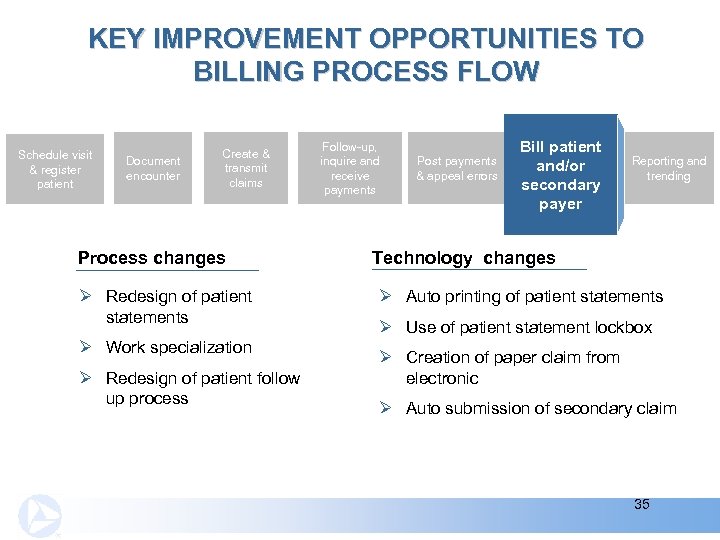
KEY IMPROVEMENT OPPORTUNITIES TO BILLING PROCESS FLOW Schedule visit & register patient Document encounter Create & transmit claims Process changes Ø Redesign of patient statements Ø Work specialization Ø Redesign of patient follow up process Follow-up, inquire and receive payments Post payments & appeal errors Bill patient and/or secondary payer Reporting and trending Technology changes Ø Auto printing of patient statements Ø Use of patient statement lockbox Ø Creation of paper claim from electronic Ø Auto submission of secondary claim 35
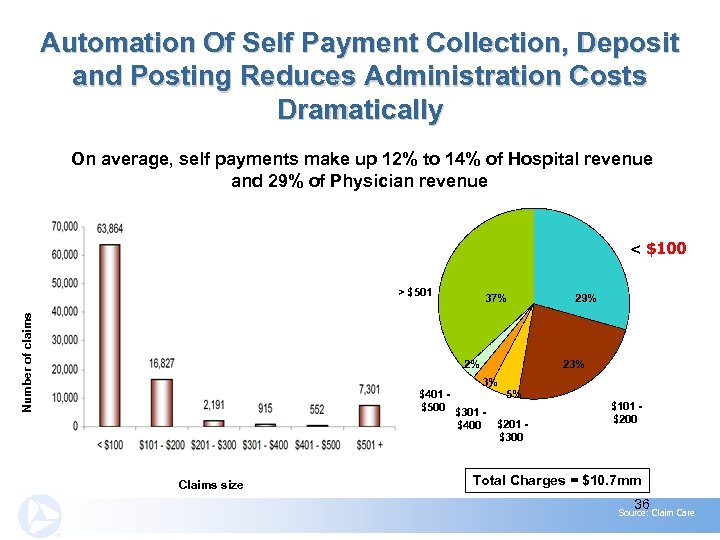
Automation Of Self Payment Collection, Deposit and Posting Reduces Administration Costs Dramatically On average, self payments make up 12% to 14% of Hospital revenue and 29% of Physician revenue < $100 Number of claims > $501 37% 2% 3% $401 5% $500 $301 $400 $201 $300 Claims size 29% 23% $101 $200 Total Charges = $10. 7 mm 36 Source: Claim Care
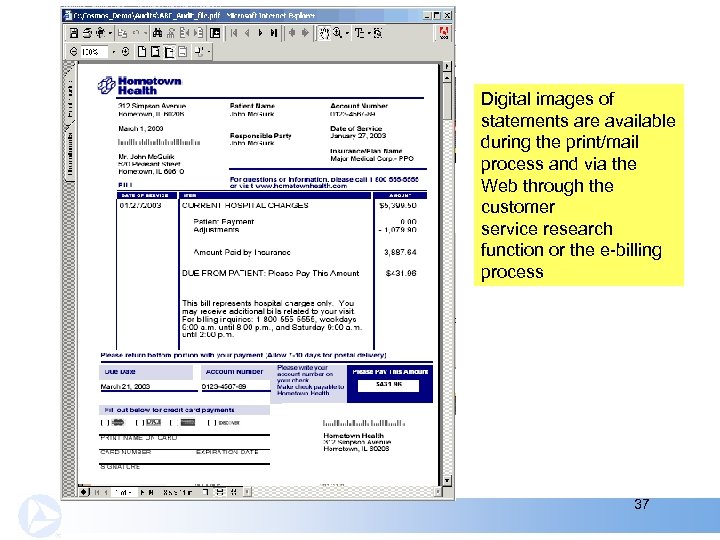
Digital images of statements are available during the print/mail process and via the Web through the customer service research function or the e-billing process 37
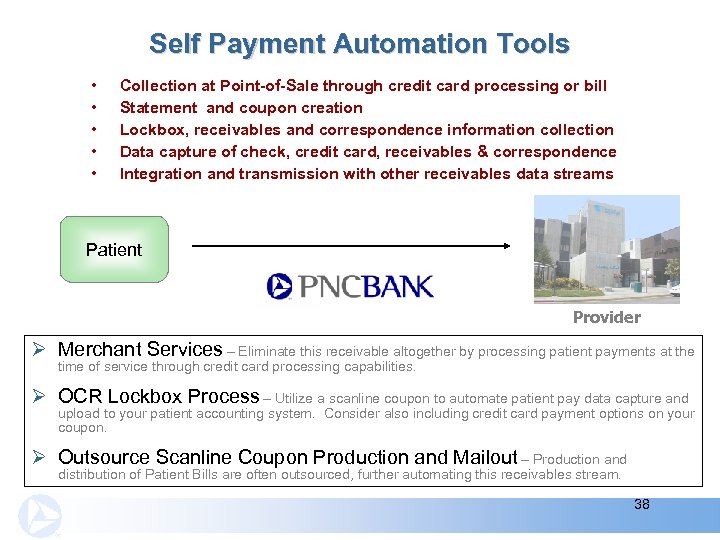
Self Payment Automation Tools • • • Collection at Point-of-Sale through credit card processing or bill Statement and coupon creation Lockbox, receivables and correspondence information collection Data capture of check, credit card, receivables & correspondence Integration and transmission with other receivables data streams Patient Provider Ø Merchant Services – Eliminate this receivable altogether by processing patient payments at the time of service through credit card processing capabilities. Ø OCR Lockbox Process – Utilize a scanline coupon to automate patient pay data capture and upload to your patient accounting system. Consider also including credit card payment options on your coupon. Ø Outsource Scanline Coupon Production and Mailout – Production and distribution of Patient Bills are often outsourced, further automating this receivables stream. 38
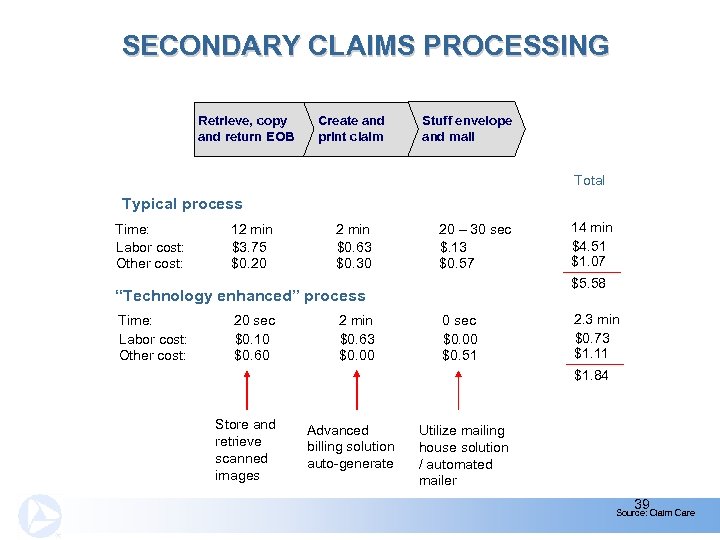
SECONDARY CLAIMS PROCESSING Retrieve, copy and return EOB Create and print claim Stuff envelope and mail Total Typical process Time: Labor cost: Other cost: 12 min $3. 75 $0. 20 2 min $0. 63 $0. 30 20 – 30 sec $. 13 $0. 57 $5. 58 “Technology enhanced” process Time: Labor cost: Other cost: 20 sec $0. 10 $0. 60 2 min $0. 63 $0. 00 14 min $4. 51 $1. 07 0 sec $0. 00 $0. 51 2. 3 min $0. 73 $1. 11 $1. 84 Store and retrieve scanned images Advanced billing solution auto-generate Utilize mailing house solution / automated mailer 39 Source: Claim Care
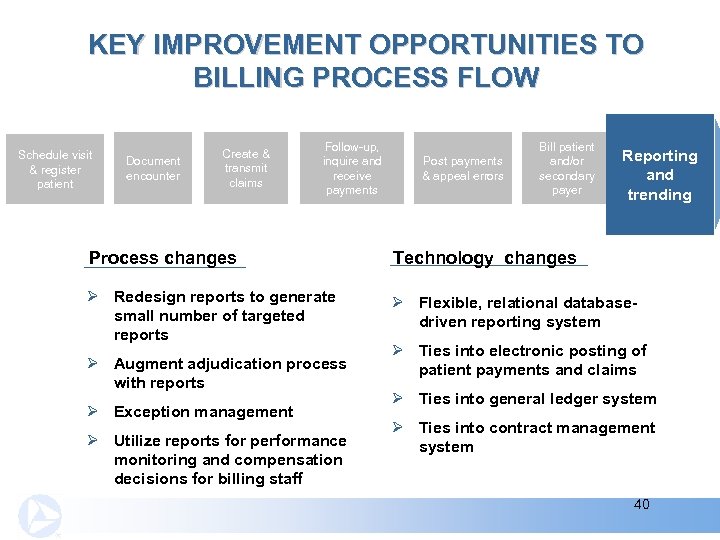
KEY IMPROVEMENT OPPORTUNITIES TO BILLING PROCESS FLOW Schedule visit & register patient Document encounter Create & transmit claims Follow-up, inquire and receive payments Post payments & appeal errors Bill patient and/or secondary payer Reporting and trending Process changes Technology changes Ø Redesign reports to generate small number of targeted reports Ø Flexible, relational databasedriven reporting system Ø Augment adjudication process with reports Ø Exception management Ø Utilize reports for performance monitoring and compensation decisions for billing staff Ø Ties into electronic posting of patient payments and claims Ø Ties into general ledger system Ø Ties into contract management system 40
So, What will all this do for me? 41
IMPLEMENTING BILLING TECHNOLOGY AND PROCESS IMPROVEMENTS CAN HAVE A DRAMATIC EFFECT Simplifying processes, using software to complement structural redesign and retraining workers, can help hospitals recoup as much as 4% of annual net revenue, Stockamp asserts. Source: Chris Rauber, “Chain Reactions” Health. Leaders, August 2003 42
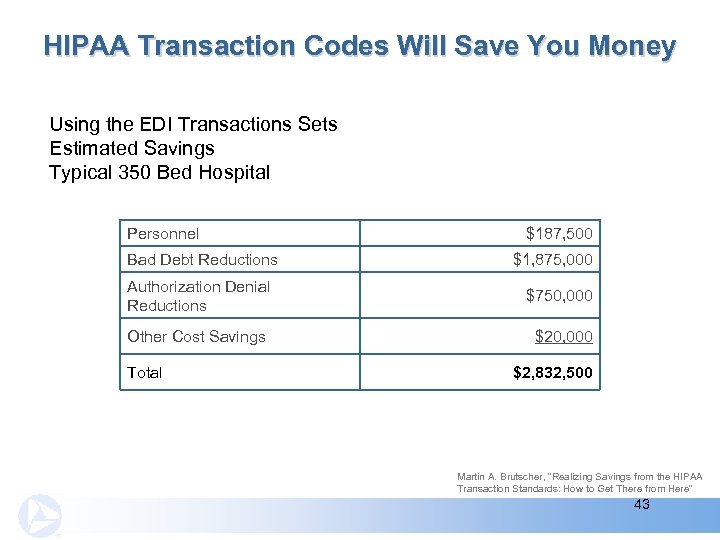
HIPAA Transaction Codes Will Save You Money Using the EDI Transactions Sets Estimated Savings Typical 350 Bed Hospital Personnel Bad Debt Reductions $187, 500 $1, 875, 000 Authorization Denial Reductions $750, 000 Other Cost Savings $20, 000 Total $2, 832, 500 Martin A. Brutscher, “Realizing Savings from the HIPAA Transaction Standards: How to Get There from Here” 43
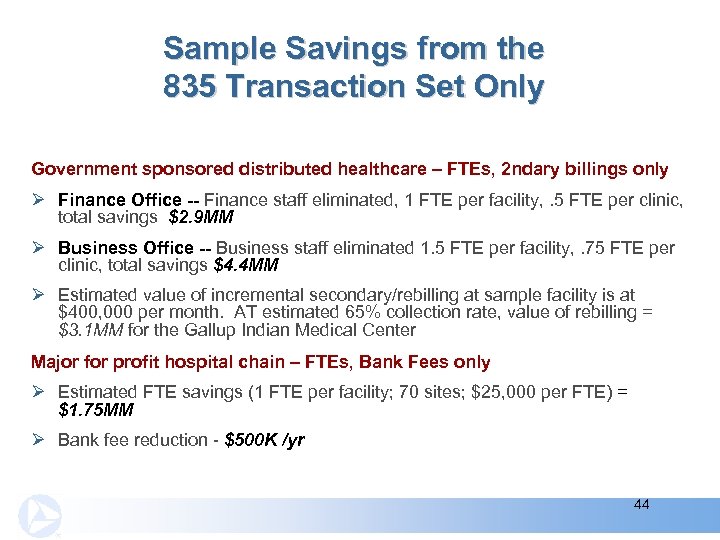
Sample Savings from the 835 Transaction Set Only Government sponsored distributed healthcare – FTEs, 2 ndary billings only Ø Finance Office -- Finance staff eliminated, 1 FTE per facility, . 5 FTE per clinic, total savings $2. 9 MM Ø Business Office -- Business staff eliminated 1. 5 FTE per facility, . 75 FTE per clinic, total savings $4. 4 MM Ø Estimated value of incremental secondary/rebilling at sample facility is at $400, 000 per month. AT estimated 65% collection rate, value of rebilling = $3. 1 MM for the Gallup Indian Medical Center Major for profit hospital chain – FTEs, Bank Fees only Ø Estimated FTE savings (1 FTE per facility; 70 sites; $25, 000 per FTE) = $1. 75 MM Ø Bank fee reduction - $500 K /yr 44
Today’s Agenda Addressed Two Questions Ø Why should I change my billing/receivable process and technology? Ø What does a fully technology-enabled process look like? 45
Key Points Ø Automation of patient A/R remittance processing can result in significant bottom line impact for providers Ø Consider the total collection system when making changes - Select holistic, synergistic approach Ø Process design is as important as technology utilization and selection 46
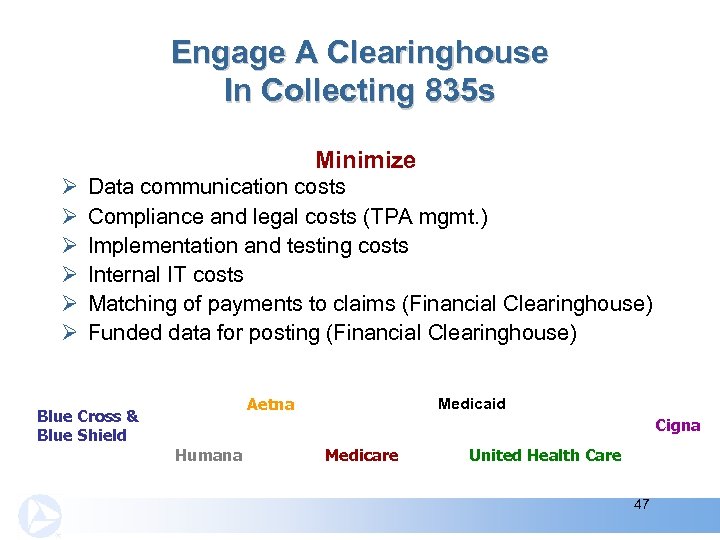
Engage A Clearinghouse In Collecting 835 s Minimize Ø Ø Ø Data communication costs Compliance and legal costs (TPA mgmt. ) Implementation and testing costs Internal IT costs Matching of payments to claims (Financial Clearinghouse) Funded data for posting (Financial Clearinghouse) Aetna Blue Cross & Blue Shield Medicaid Cigna Humana Medicare United Health Care 47
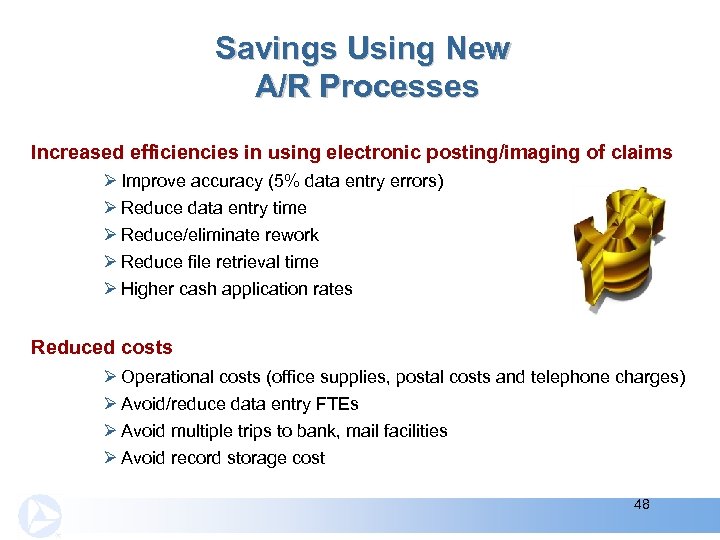
Savings Using New A/R Processes Increased efficiencies in using electronic posting/imaging of claims Ø Improve accuracy (5% data entry errors) Ø Reduce data entry time Ø Reduce/eliminate rework Ø Reduce file retrieval time Ø Higher cash application rates Reduced costs Ø Operational costs (office supplies, postal costs and telephone charges) Ø Avoid/reduce data entry FTEs Ø Avoid multiple trips to bank, mail facilities Ø Avoid record storage cost 48
Savings Using New A/R Processes Improve cash flow Ø Shorten the accounts receivable cycle Ø Reduce days in A/R Enhance credit due to improved balance sheet Ø Lisa Zuckerman, a Director for Standard & Poor’s who analyzes hospitals’ financial results states, “Across the board improved revenue cycle management is the biggest reason for improved results among those hospitals doing better today than they were a few years ago. ” Reduce Costs & Increase Net Income & Bond Ratings Source: Chris Rauber, “Chain Reactions” Health. Leaders, August 2003 49

Speaker Daniel J. Brazen -- AVP & Senior Product Manager – PNC Treasury Management Healthcare Group Mr. Brazen is responsible for coordinating all new product development, advertising, regional sales activities, healthcare industry conference sponsorships and targeted marketing programs for PNC Bank’s e-Healthcare Solutions. Mr. Brazen has over fifteen years experience in marketing and product development with Fed. Ex, Bell Atlantic, and Dun and Bradstreet companies. Mr. Brazen holds an MBA from the Indiana University of Pennsylvania and received his BA from Indiana University of Pennsylvania. Mr. Brazen is the Past President of the Pittsburgh Chapter of the American Marketing Association, member of the Healthcare Financial Management Association and Certified Treasury Manager (CTM). Mr. Brazen has presented healthcare solutions at various local and national healthcare seminars. (412) 768 -7127; daniel. brazen@pncbank. com 50
Скачать презентацию Daniel Brazen CTP Session 3 02 Reinventing Billing
27db8f061cdd3b2c8be54f7176a4c143.ppt