


 Скачать презентацию Dairy Price Risk Management Session 3 Milk
4b6e09d0e3b528c6999d65866ed58856.ppt
- Количество слайдов: 34
 Dairy Price Risk Management: Session 3 – Milk Pricing Fundamentals Cooperative Extension – Ag and Natural Resources 1 Farm and Risk Management Team Last Update: May 1, 2009
 Introduction l l This session: How is the price you’re looking for established? l 2 Session 2: What price do you need to meet business and personal goals? Next session: How can I forecast what my milk price might be?
 How is Your Milk Price Determined? l l l 3 Federal Milk Marketing Orders and Multiple Component Pricing How Component Values are established Deriving the Class III price Mailbox price versus the Class III price Basis
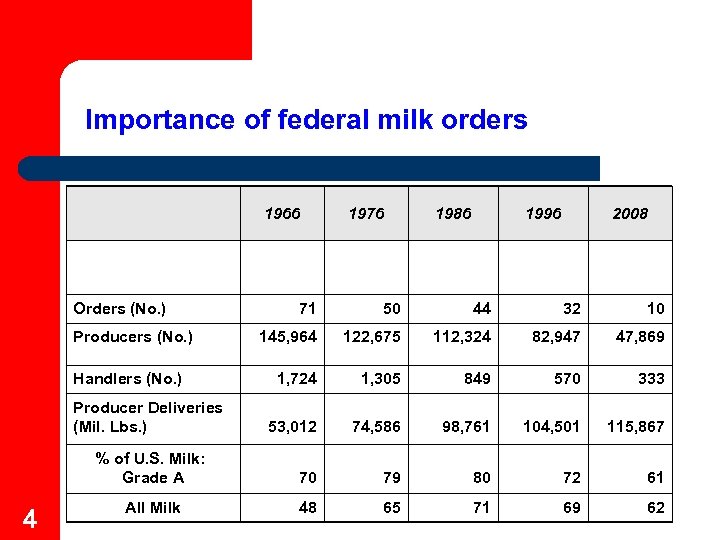 Importance of federal milk orders 1966 Orders (No. ) 1976 1986 1996 2008 71 50 44 32 10 145, 964 122, 675 112, 324 82, 947 47, 869 1, 724 1, 305 849 570 333 53, 012 74, 586 98, 761 104, 501 115, 867 % of U. S. Milk: Grade A 70 79 80 72 61 All Milk 48 65 71 69 62 Producers (No. ) Handlers (No. ) Producer Deliveries (Mil. Lbs. ) 4
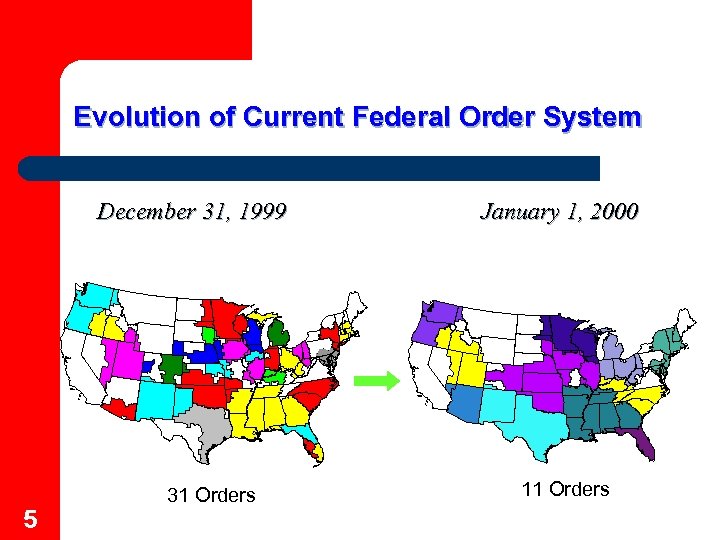 Evolution of Current Federal Order System December 31, 1999 5 31 Orders January 1, 2000 11 Orders
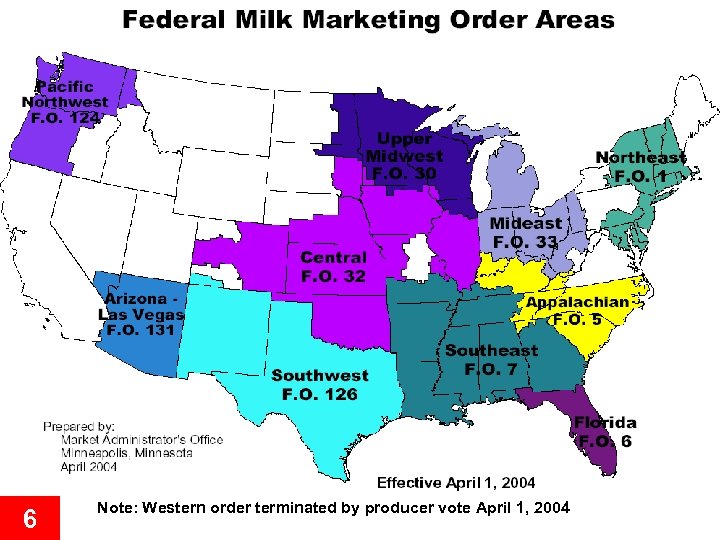 6 Note: Western order terminated by producer vote April 1, 2004
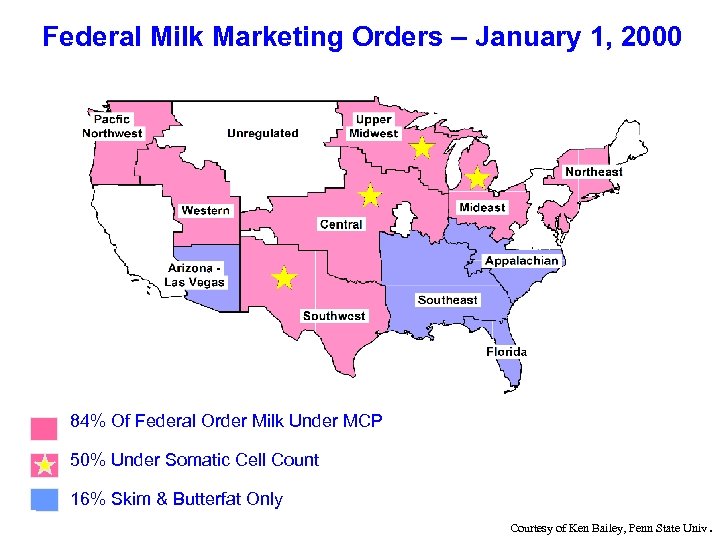 Federal Milk Marketing Orders – January 1, 2000 84% Of Federal Order Milk Under MCP 50% Under Somatic Cell Count 7 16% Skim & Butterfat Only Courtesy of Ken Bailey, Penn State Univ .
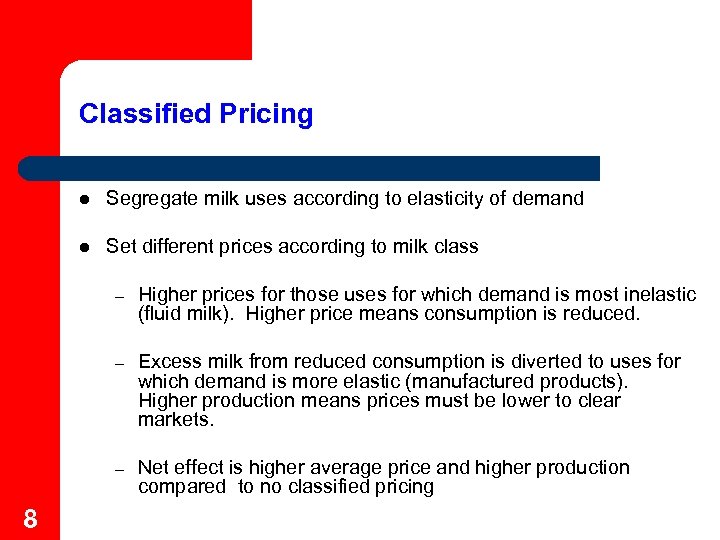 Classified Pricing l Segregate milk uses according to elasticity of demand l Set different prices according to milk class – – Excess milk from reduced consumption is diverted to uses for which demand is more elastic (manufactured products). Higher production means prices must be lower to clear markets. – 8 Higher prices for those uses for which demand is most inelastic (fluid milk). Higher price means consumption is reduced. Net effect is higher average price and higher production compared to no classified pricing
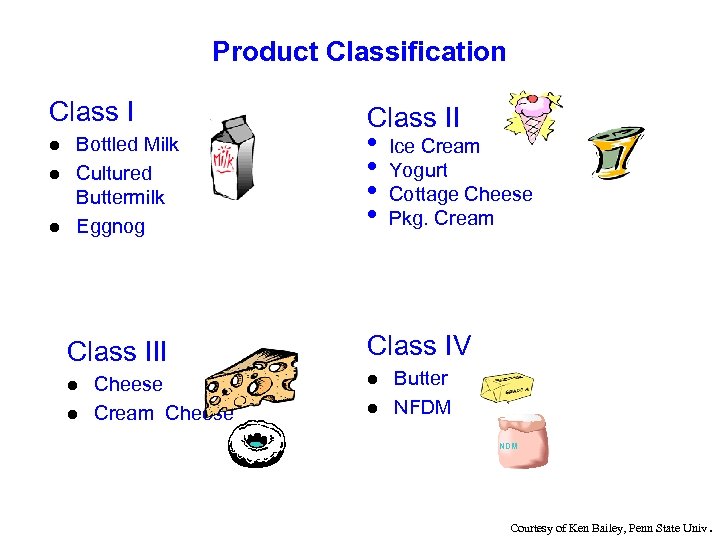 Product Classification Class I l l l Bottled Milk Cultured Buttermilk Eggnog Class III l l Cheese Cream Cheese Class II • • Ice Cream Yogurt Cottage Cheese Pkg. Cream Class IV l l Butter NFDM NDM 9 Courtesy of Ken Bailey, Penn State Univ .
 Multiple Component Pricing l l Dairy farmers receive payment for their herd’s volume of components (pounds of butterfat, pounds of protein, and pounds of other solids) priced at the minimum federal order component values. Component prices are the same across all orders. l 10 Minimum prices for three milk components – butterfat, protein, and other (nonfat, non-protein) solids – are calculated based on market prices for dairy products. Farmers also receive a per hundredweight payment that represents the marginal value (+ or -) of milk used for purposes other than cheese (Class III). In some markets, they also receive a premium or penalty per hundredweight for milk quality.
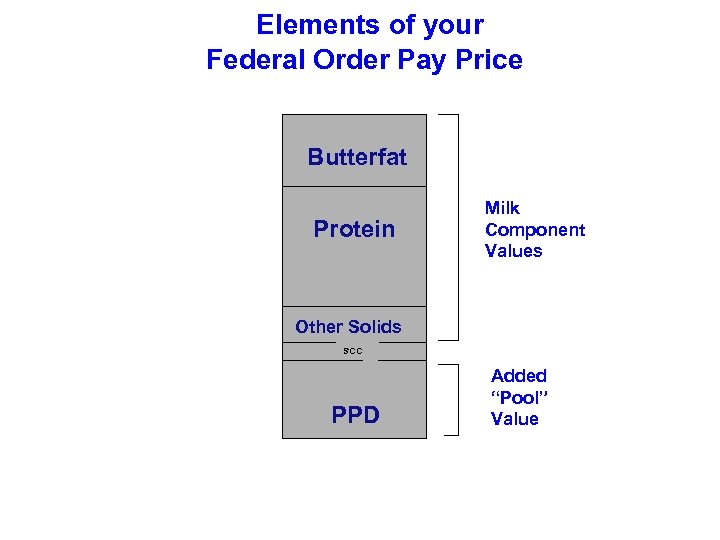 Elements of your Federal Order Pay Price Butterfat Protein Milk Component Values Other Solids SCC PPD 11 Added “Pool” Value
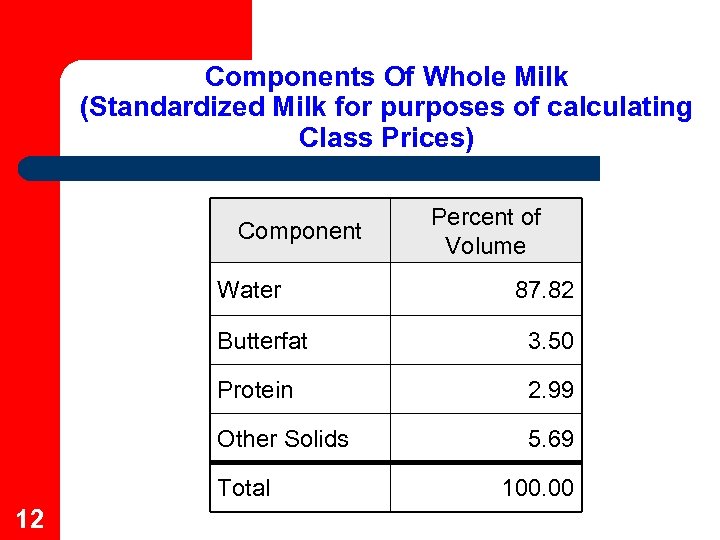 Components Of Whole Milk (Standardized Milk for purposes of calculating Class Prices) Component Water Percent of Volume 87. 82 Butterfat 3. 50 Protein 2. 99 Other Solids 5. 69 Total 12 100. 00
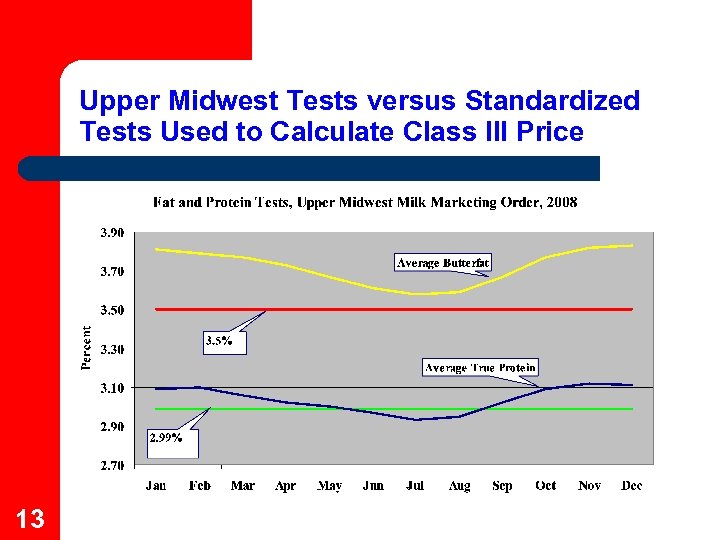 Upper Midwest Tests versus Standardized Tests Used to Calculate Class III Price 13
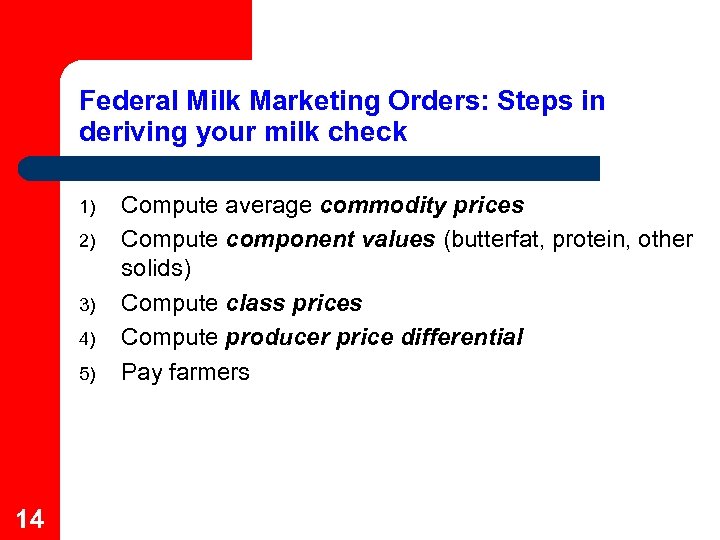 Federal Milk Marketing Orders: Steps in deriving your milk check 1) 2) 3) 4) 5) 14 Compute average commodity prices Compute component values (butterfat, protein, other solids) Compute class prices Compute producer price differential Pay farmers
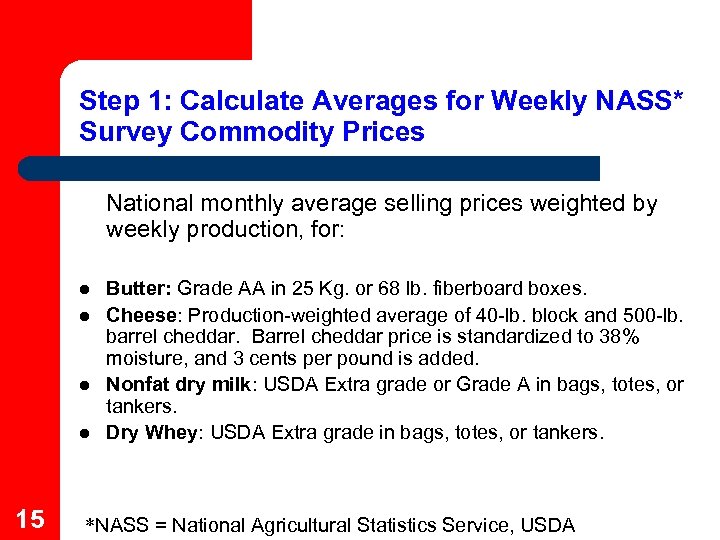 Step 1: Calculate Averages for Weekly NASS* Survey Commodity Prices National monthly average selling prices weighted by weekly production, for: l l 15 Butter: Grade AA in 25 Kg. or 68 lb. fiberboard boxes. Cheese: Production-weighted average of 40 -lb. block and 500 -lb. barrel cheddar. Barrel cheddar price is standardized to 38% moisture, and 3 cents per pound is added. Nonfat dry milk: USDA Extra grade or Grade A in bags, totes, or tankers. Dry Whey: USDA Extra grade in bags, totes, or tankers. *NASS = National Agricultural Statistics Service, USDA
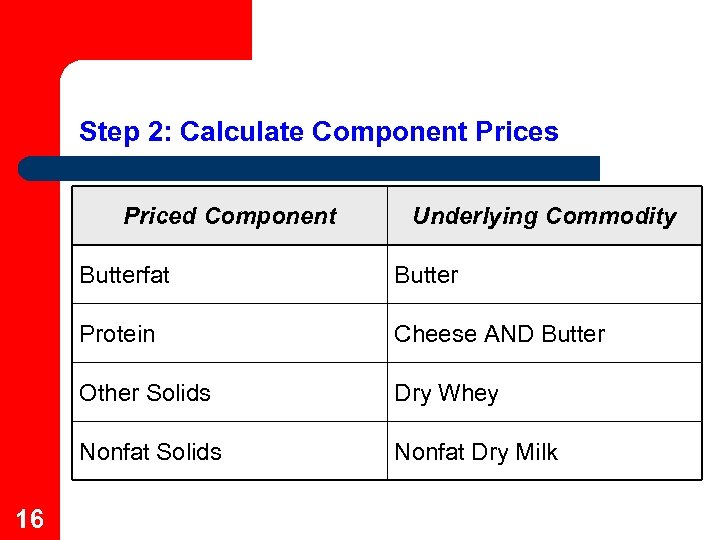 Step 2: Calculate Component Prices Priced Component Underlying Commodity Butterfat Protein Cheese AND Butter Other Solids Dry Whey Nonfat Solids 16 Butter Nonfat Dry Milk
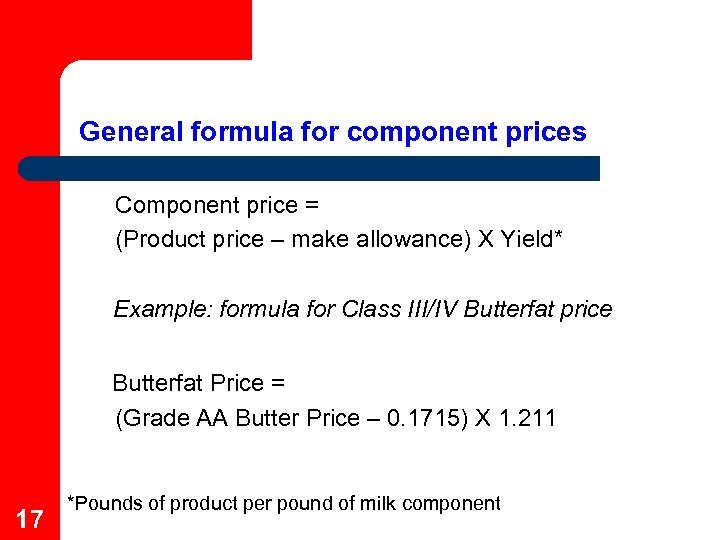 General formula for component prices Component price = (Product price – make allowance) X Yield* Example: formula for Class III/IV Butterfat price Butterfat Price = (Grade AA Butter Price – 0. 1715) X 1. 211 17 *Pounds of product per pound of milk component
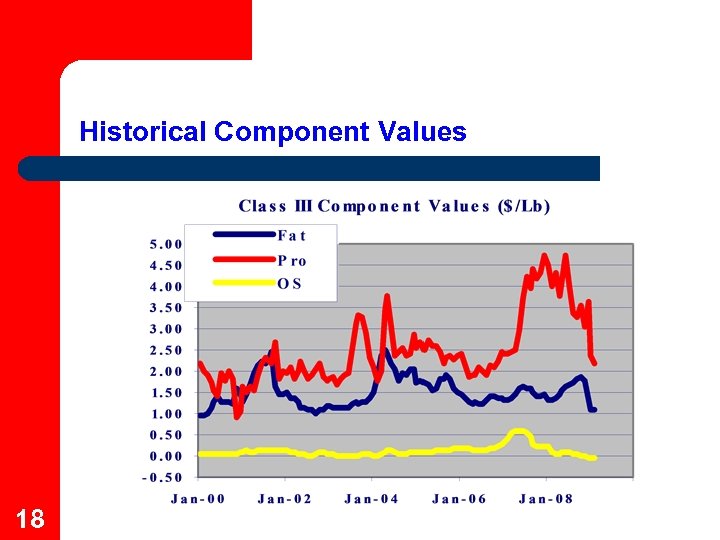 Historical Component Values 18
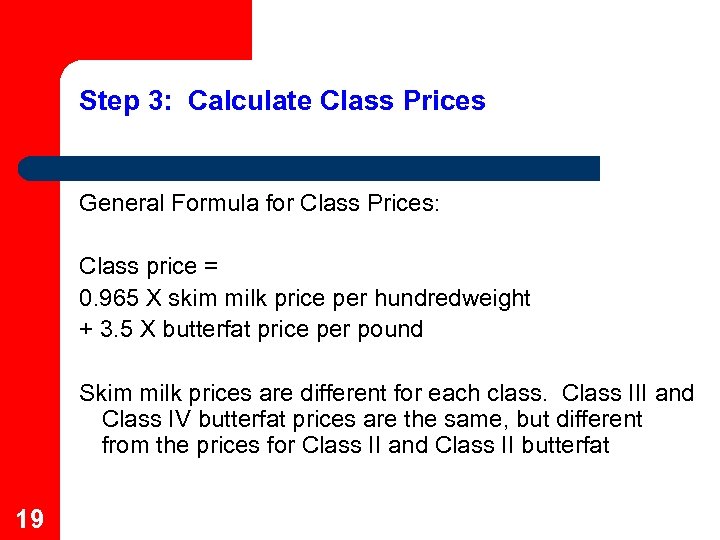 Step 3: Calculate Class Prices General Formula for Class Prices: Class price = 0. 965 X skim milk price per hundredweight + 3. 5 X butterfat price per pound Skim milk prices are different for each class. Class III and Class IV butterfat prices are the same, but different from the prices for Class II and Class II butterfat 19
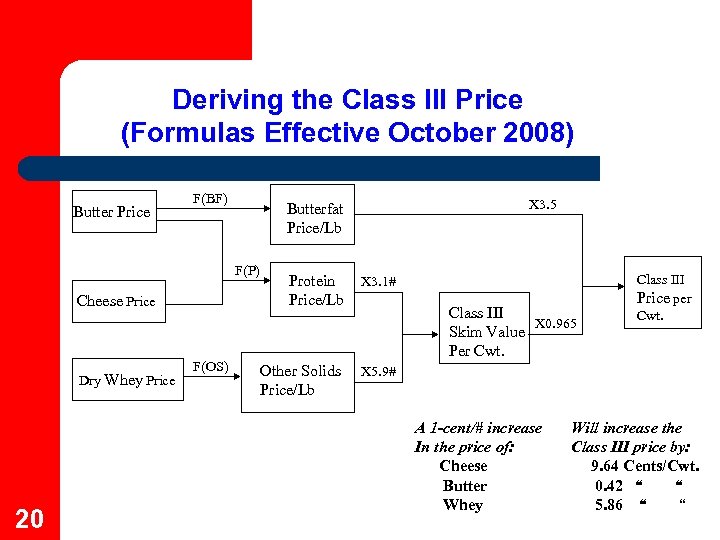 Deriving the Class III Price (Formulas Effective October 2008) Butter Price F(BF) F(P) Cheese Price Dry Whey Price 20 F(OS) X 3. 5 Butterfat Price/Lb Protein Price/Lb X 3. 1# Other Solids Price/Lb X 5. 9# Class III X 0. 965 Skim Value Per Cwt. A 1 -cent/# increase In the price of: Cheese Butter Whey Class III Price per Cwt. Will increase the Class III price by: 9. 64 Cents/Cwt. 0. 42 “ “ 5. 86 “ “
 Class IV Pricing § § 21 The Class IV Skim Milk price is based on the monthly price for nonfat milk solids (nonfat dry milk). The Class IV butterfat price and the Class III butterfat price are the same.
 Class II Pricing § § 22 Class II skim milk is advanced priced (announced before the month to which it applies) based on the price of nonfat milk solids. It is the advanced Class IV skim milk price plus $0. 70 per hundredweight The Class II butterfat price is the monthly Class III/IV butterfat price plus $0. 007 per pound (Class II butterfat is NOT advanced priced)
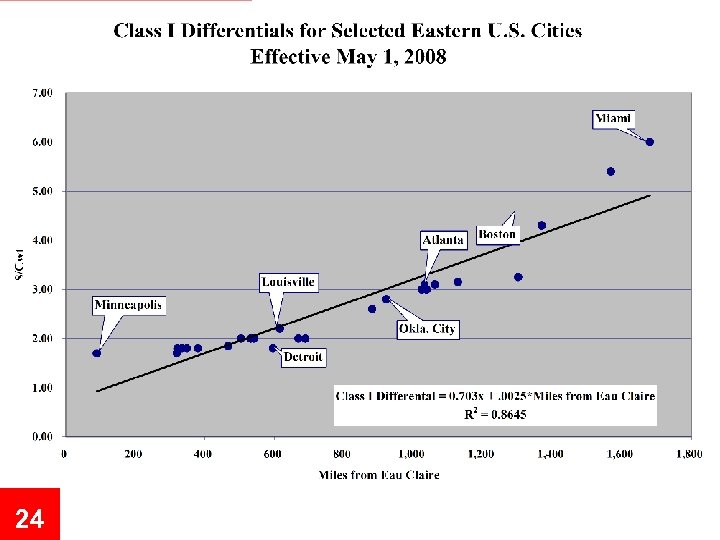
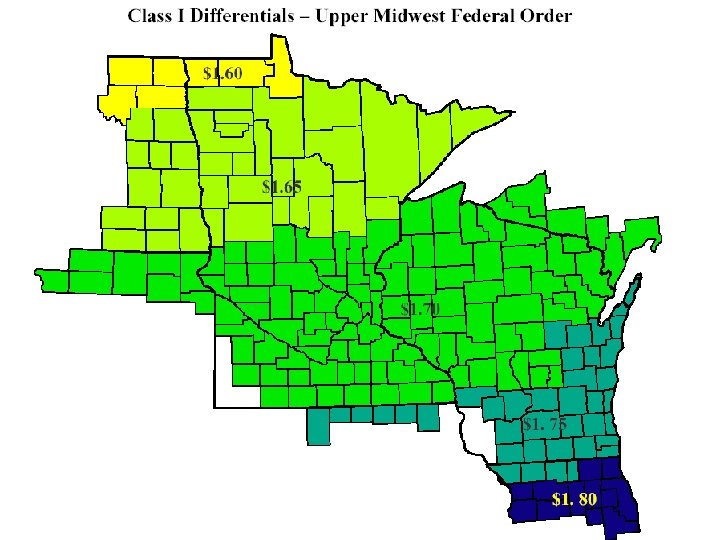
 Class I Pricing § Both the skim milk and butterfat portions of Class I are advanced-priced Ø The base Class I Skim milk price is the higher of the advanced Class III or IV skim milk price. For any market, the Class I Skim Milk price is the base price plus a Class I Differential that varies by market. Ø The Class I butterfat price is the advanced Class III/IV butterfat price plus a differential equal to the Class I Differential that applies to skim milk divided by 100. 23
 24
24
 25
25
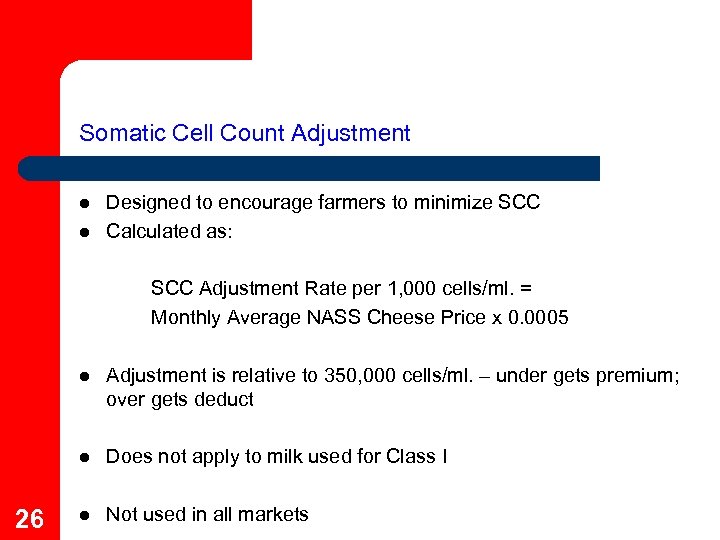 Somatic Cell Count Adjustment l l Designed to encourage farmers to minimize SCC Calculated as: SCC Adjustment Rate per 1, 000 cells/ml. = Monthly Average NASS Cheese Price x 0. 0005 l l 26 Adjustment is relative to 350, 000 cells/ml. – under gets premium; over gets deduct Does not apply to milk used for Class I l Not used in all markets
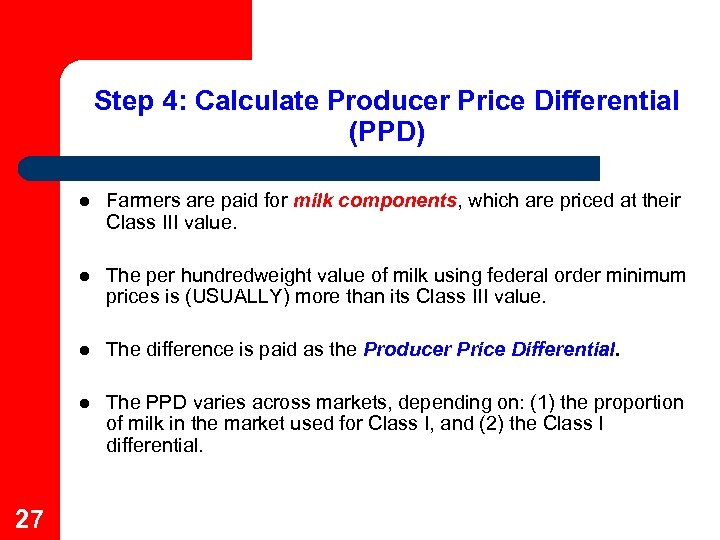 Step 4: Calculate Producer Price Differential (PPD) l l The per hundredweight value of milk using federal order minimum prices is (USUALLY) more than its Class III value. l The difference is paid as the Producer Price Differential. l 27 Farmers are paid for milk components, which are priced at their Class III value. The PPD varies across markets, depending on: (1) the proportion of milk in the market used for Class I, and (2) the Class I differential.
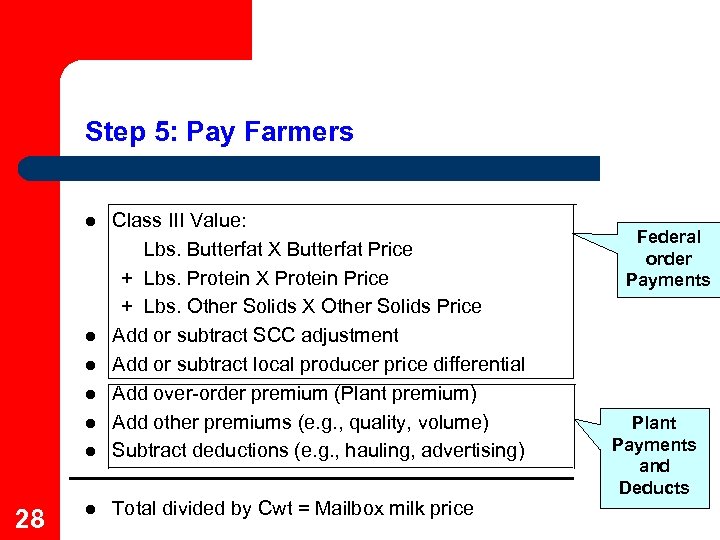 Step 5: Pay Farmers l Class III Value: Lbs. Butterfat X Butterfat Price + Lbs. Protein X Protein Price + Lbs. Other Solids X Other Solids Price Add or subtract SCC adjustment Add or subtract local producer price differential Add over-order premium (Plant premium) Add other premiums (e. g. , quality, volume) Subtract deductions (e. g. , hauling, advertising) l Total divided by Cwt = Mailbox milk price l l l 28 Federal order Payments Plant Payments and Deducts
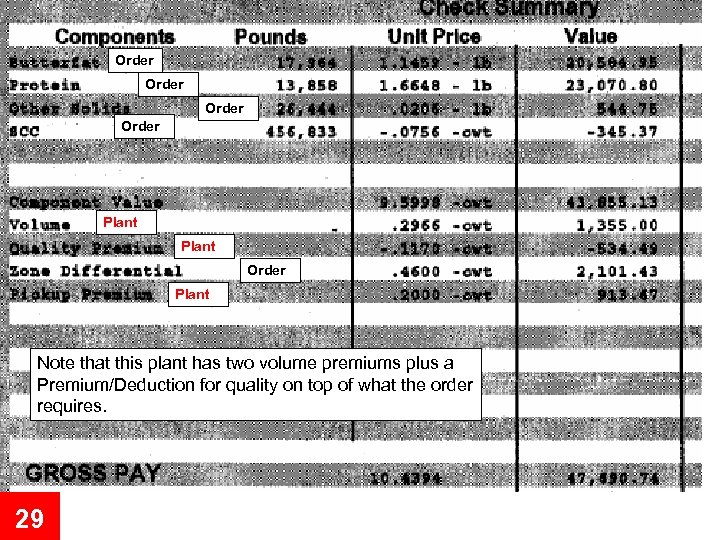 Order Plant Order Plant Note that this plant has two volume premiums plus a Premium/Deduction for quality on top of what the order requires. 29
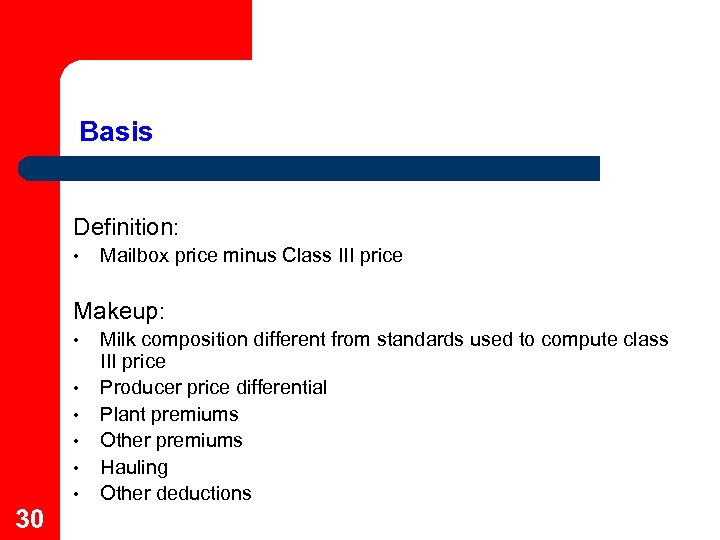 Basis Definition: • Mailbox price minus Class III price Makeup: • • • 30 Milk composition different from standards used to compute class III price Producer price differential Plant premiums Other premiums Hauling Other deductions
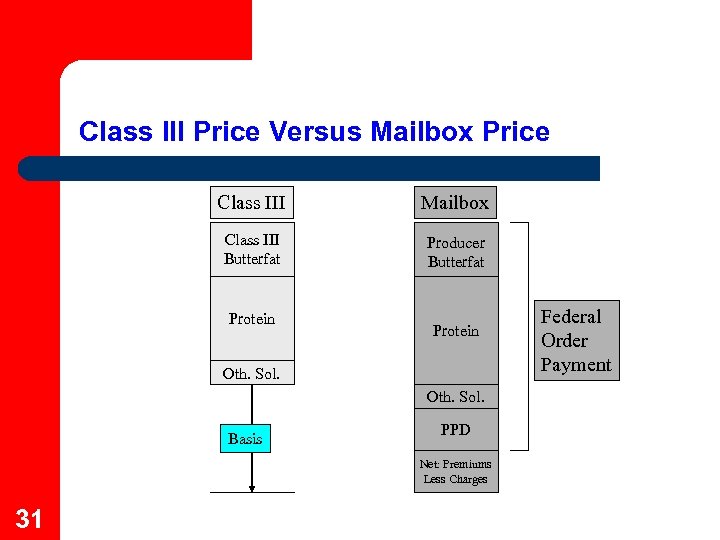 Class III Price Versus Mailbox Price Class III Mailbox Class III Butterfat Producer Butterfat Protein Oth. Sol. Basis PPD Net: Premiums Less Charges 31 Federal Order Payment
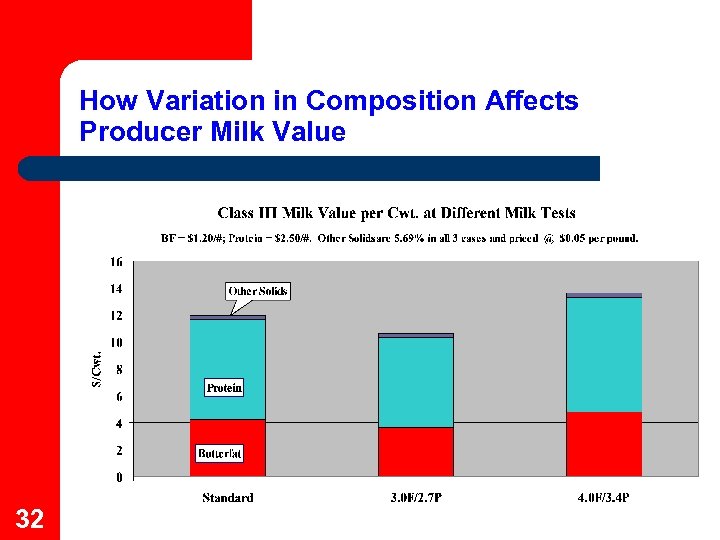 How Variation in Composition Affects Producer Milk Value 32
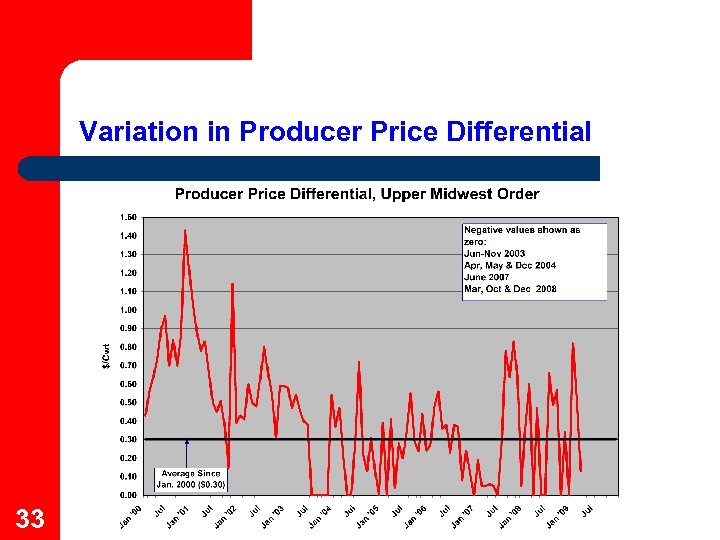 Variation in Producer Price Differential 33
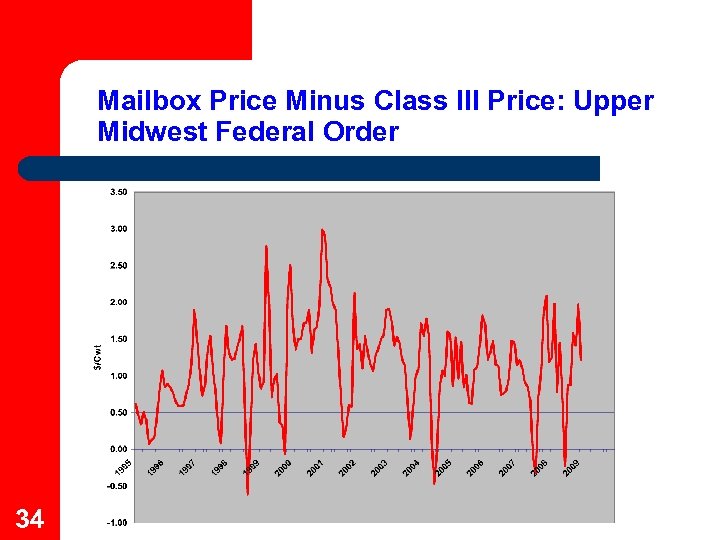 Mailbox Price Minus Class III Price: Upper Midwest Federal Order 34