


 Скачать презентацию Dairy Marketing Dr Roger Ginder Econ 338 Fall
e83151c6eeb73c7b29afd91aeb350708.ppt
- Количество слайдов: 34
 Dairy Marketing Dr. Roger Ginder Econ 338 Fall 2009 Lecture #21
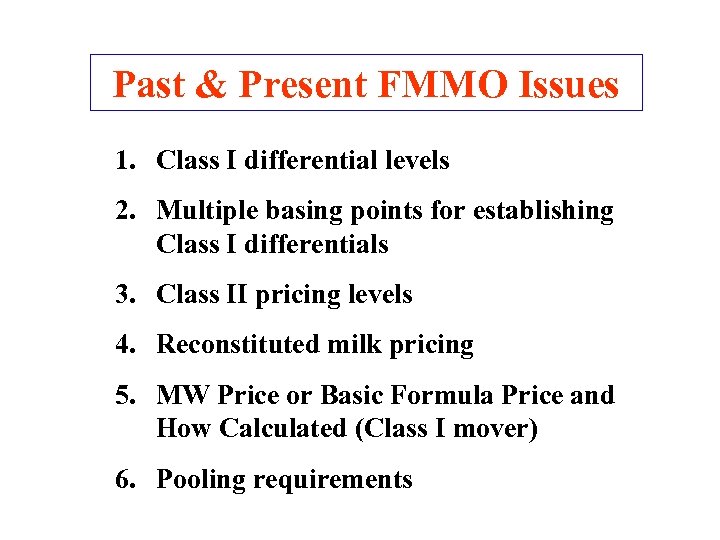 Past & Present FMMO Issues 1. Class I differential levels 2. Multiple basing points for establishing Class I differentials 3. Class II pricing levels 4. Reconstituted milk pricing 5. MW Price or Basic Formula Price and How Calculated (Class I mover) 6. Pooling requirements
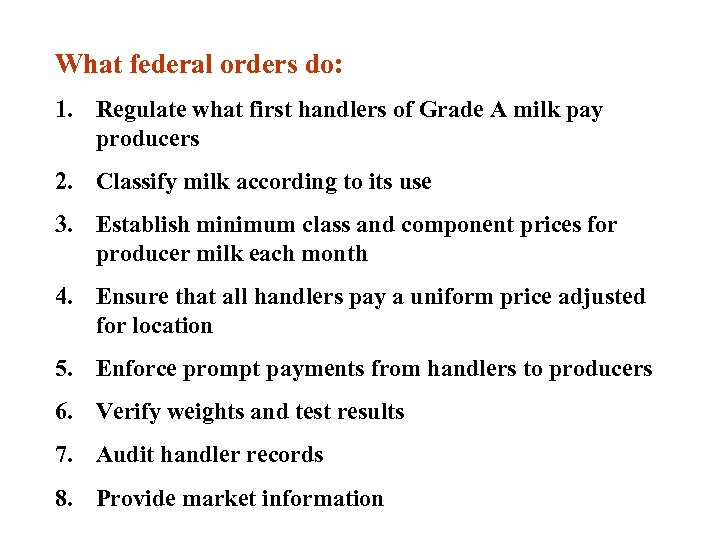 What federal orders do: 1. Regulate what first handlers of Grade A milk pay producers 2. Classify milk according to its use 3. Establish minimum class and component prices for producer milk each month 4. Ensure that all handlers pay a uniform price adjusted for location 5. Enforce prompt payments from handlers to producers 6. Verify weights and test results 7. Audit handler records 8. Provide market information
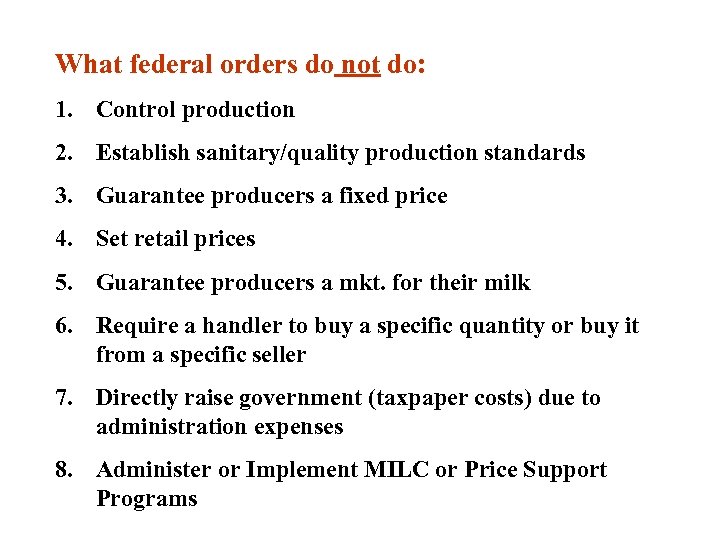 What federal orders do not do: 1. Control production 2. Establish sanitary/quality production standards 3. Guarantee producers a fixed price 4. Set retail prices 5. Guarantee producers a mkt. for their milk 6. Require a handler to buy a specific quantity or buy it from a specific seller 7. Directly raise government (taxpaper costs) due to administration expenses 8. Administer or Implement MILC or Price Support Programs
 MULTIPLE COMPONENT PRICING OF RAW MILK
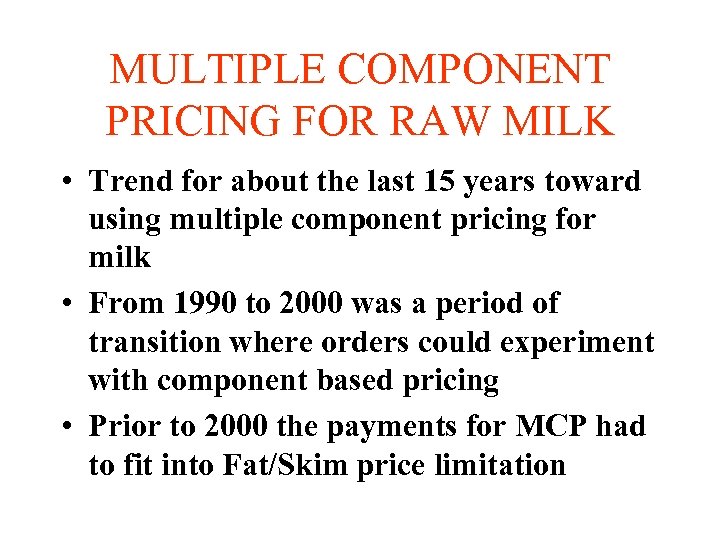 MULTIPLE COMPONENT PRICING FOR RAW MILK • Trend for about the last 15 years toward using multiple component pricing for milk • From 1990 to 2000 was a period of transition where orders could experiment with component based pricing • Prior to 2000 the payments for MCP had to fit into Fat/Skim price limitation
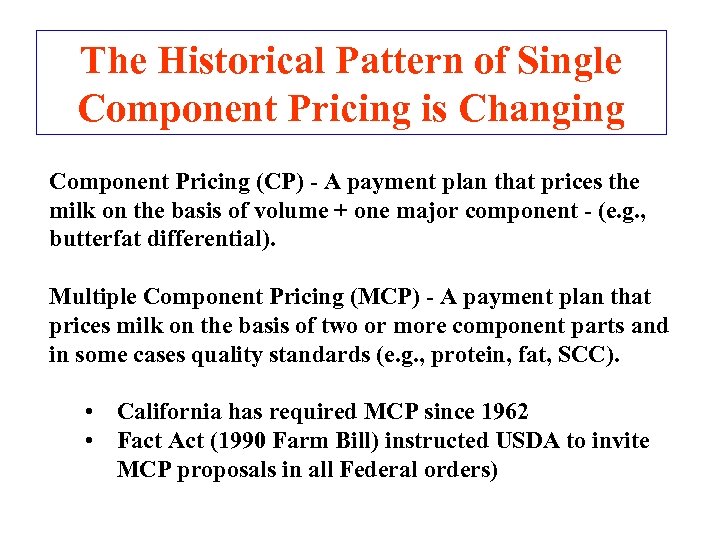 The Historical Pattern of Single Component Pricing is Changing Component Pricing (CP) - A payment plan that prices the milk on the basis of volume + one major component - (e. g. , butterfat differential). Multiple Component Pricing (MCP) - A payment plan that prices milk on the basis of two or more component parts and in some cases quality standards (e. g. , protein, fat, SCC). • California has required MCP since 1962 • Fact Act (1990 Farm Bill) instructed USDA to invite MCP proposals in all Federal orders)
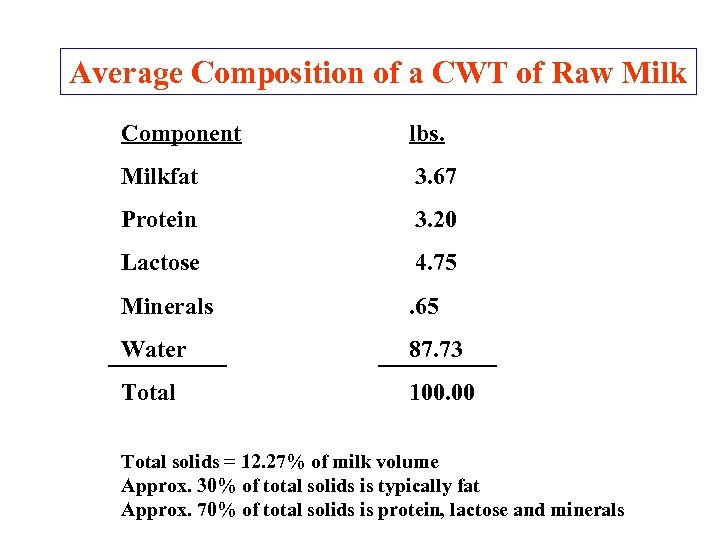 Average Composition of a CWT of Raw Milk Component lbs. Milkfat 3. 67 Protein 3. 20 Lactose 4. 75 Minerals . 65 Water 87. 73 Total 100. 00 Total solids = 12. 27% of milk volume Approx. 30% of total solids is typically fat Approx. 70% of total solids is protein, lactose and minerals
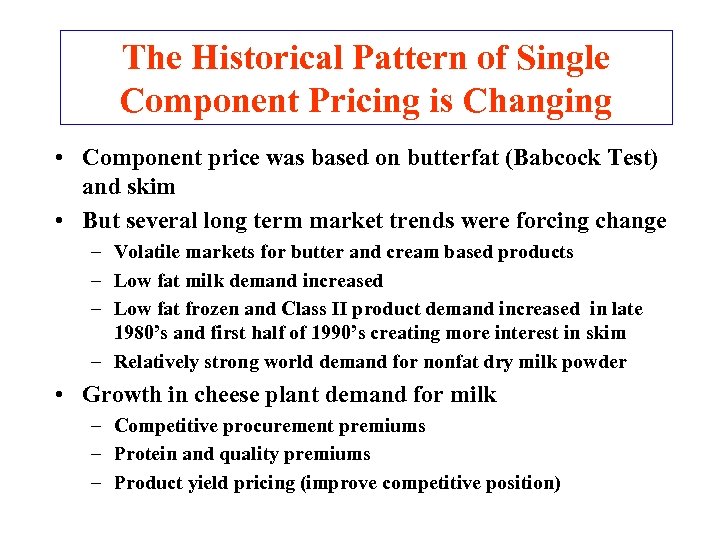 The Historical Pattern of Single Component Pricing is Changing • Component price was based on butterfat (Babcock Test) and skim • But several long term market trends were forcing change – Volatile markets for butter and cream based products – Low fat milk demand increased – Low fat frozen and Class II product demand increased in late 1980’s and first half of 1990’s creating more interest in skim – Relatively strong world demand for nonfat dry milk powder • Growth in cheese plant demand for milk – Competitive procurement premiums – Protein and quality premiums – Product yield pricing (improve competitive position)
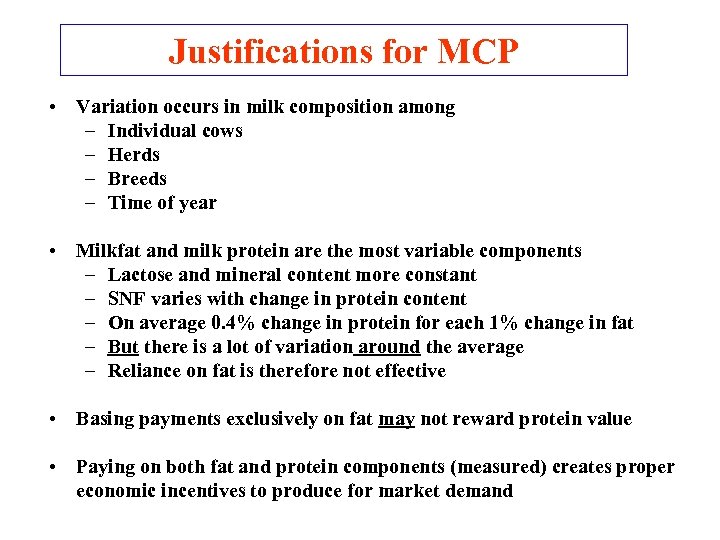 Justifications for MCP • Variation occurs in milk composition among – Individual cows – Herds – Breeds – Time of year • Milkfat and milk protein are the most variable components – Lactose and mineral content more constant – SNF varies with change in protein content – On average 0. 4% change in protein for each 1% change in fat – But there is a lot of variation around the average – Reliance on fat is therefore not effective • Basing payments exclusively on fat may not reward protein value • Paying on both fat and protein components (measured) creates proper economic incentives to produce for market demand
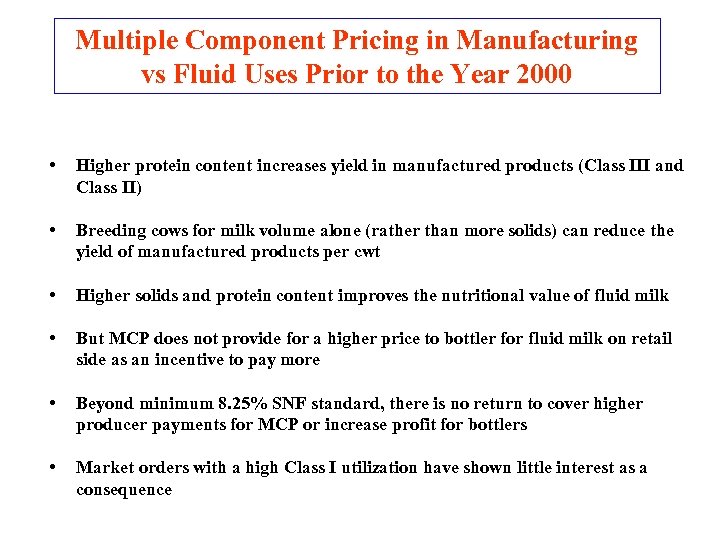 Multiple Component Pricing in Manufacturing vs Fluid Uses Prior to the Year 2000 • Higher protein content increases yield in manufactured products (Class III and Class II) • Breeding cows for milk volume alone (rather than more solids) can reduce the yield of manufactured products per cwt • Higher solids and protein content improves the nutritional value of fluid milk • But MCP does not provide for a higher price to bottler for fluid milk on retail side as an incentive to pay more • Beyond minimum 8. 25% SNF standard, there is no return to cover higher producer payments for MCP or increase profit for bottlers • Market orders with a high Class I utilization have shown little interest as a consequence
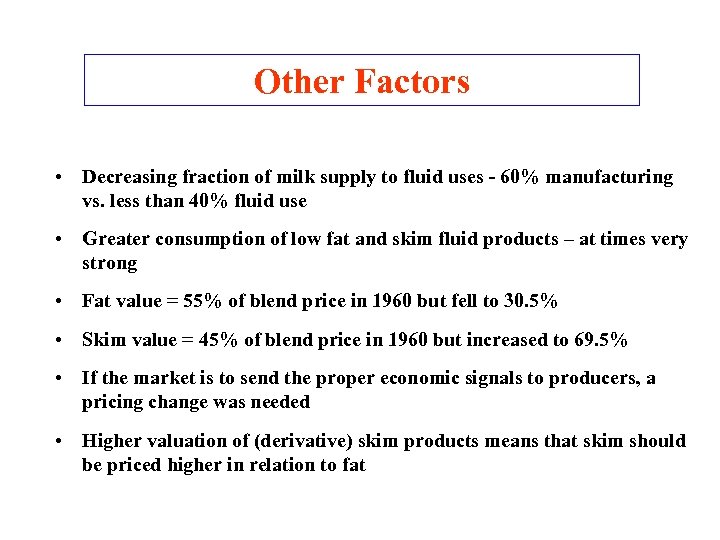 Other Factors • Decreasing fraction of milk supply to fluid uses - 60% manufacturing vs. less than 40% fluid use • Greater consumption of low fat and skim fluid products – at times very strong • Fat value = 55% of blend price in 1960 but fell to 30. 5% • Skim value = 45% of blend price in 1960 but increased to 69. 5% • If the market is to send the proper economic signals to producers, a pricing change was needed • Higher valuation of (derivative) skim products means that skim should be priced higher in relation to fat
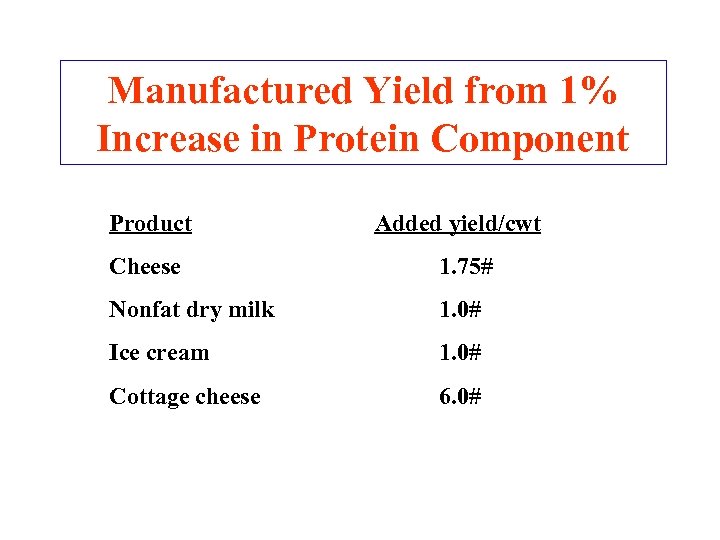 Manufactured Yield from 1% Increase in Protein Component Product Added yield/cwt Cheese 1. 75# Nonfat dry milk 1. 0# Ice cream 1. 0# Cottage cheese 6. 0#
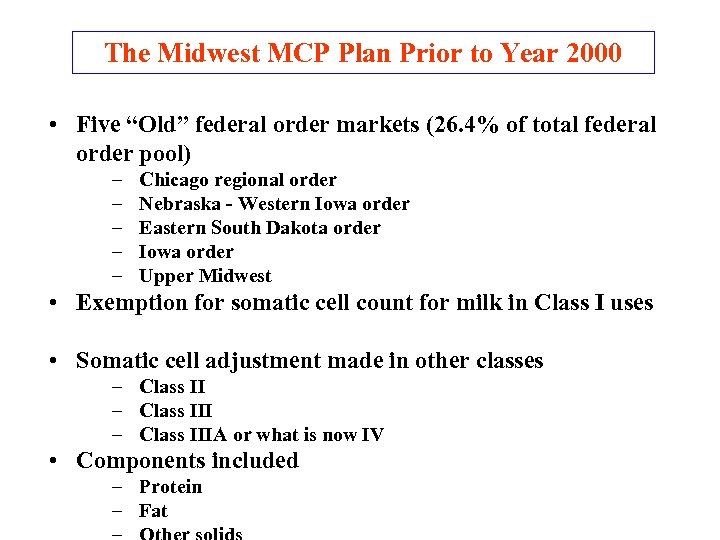 The Midwest MCP Plan Prior to Year 2000 • Five “Old” federal order markets (26. 4% of total federal order pool) – – – Chicago regional order Nebraska - Western Iowa order Eastern South Dakota order Iowa order Upper Midwest • Exemption for somatic cell count for milk in Class I uses • Somatic cell adjustment made in other classes – Class IIIA or what is now IV • Components included – Protein – Fat
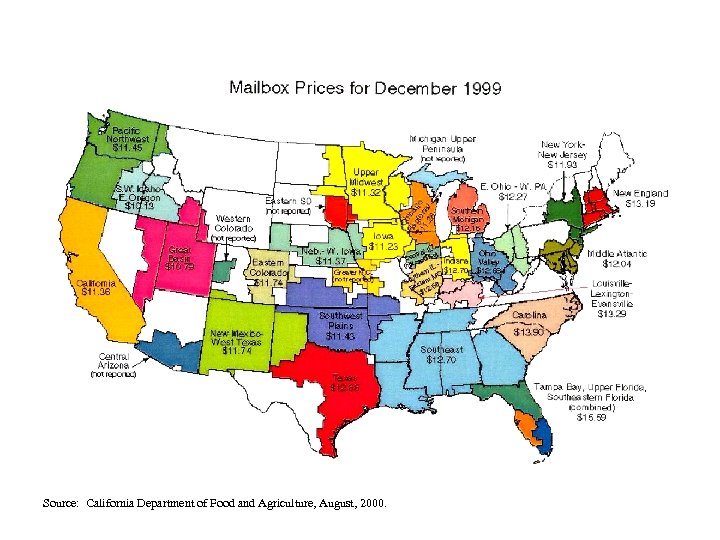 Source: California Department of Food and Agriculture, August, 2000.
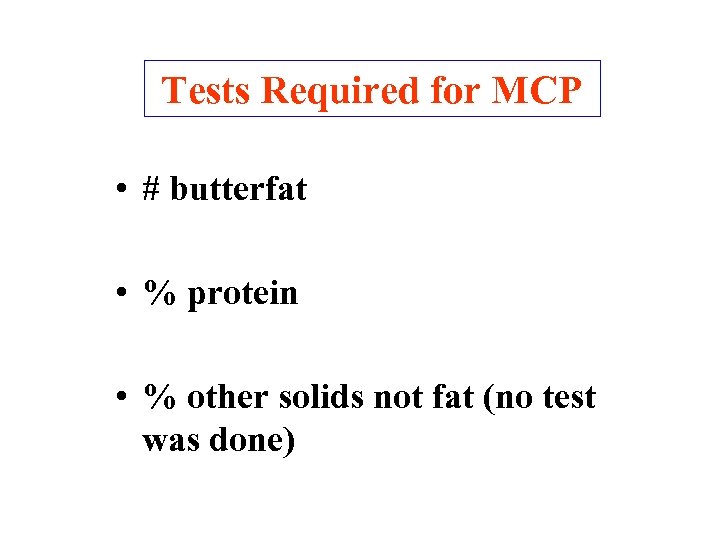 Tests Required for MCP • # butterfat • % protein • % other solids not fat (no test was done)
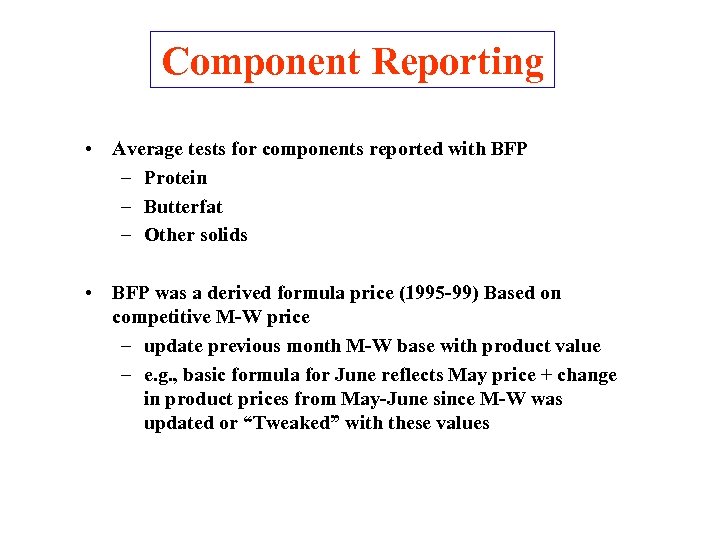 Component Reporting • Average tests for components reported with BFP – Protein – Butterfat – Other solids • BFP was a derived formula price (1995 -99) Based on competitive M-W price – update previous month M-W base with product value – e. g. , basic formula for June reflects May price + change in product prices from May-June since M-W was updated or “Tweaked” with these values
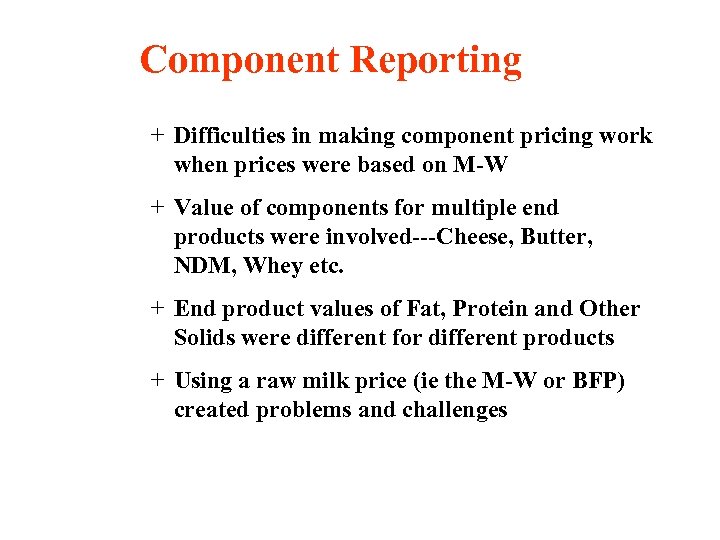 Component Reporting + Difficulties in making component pricing work when prices were based on M-W + Value of components for multiple end products were involved---Cheese, Butter, NDM, Whey etc. + End product values of Fat, Protein and Other Solids were different for different products + Using a raw milk price (ie the M-W or BFP) created problems and challenges
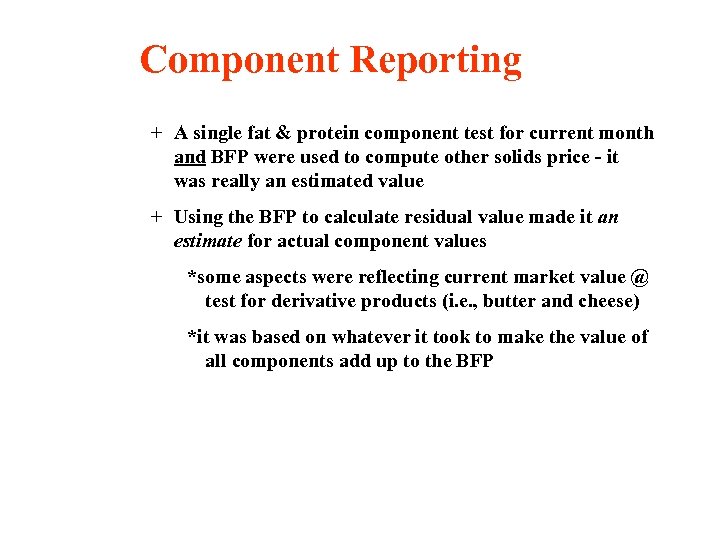 Component Reporting + A single fat & protein component test for current month and BFP were used to compute other solids price - it was really an estimated value + Using the BFP to calculate residual value made it an estimate for actual component values *some aspects were reflecting current market value @ test for derivative products (i. e. , butter and cheese) *it was based on whatever it took to make the value of all components add up to the BFP
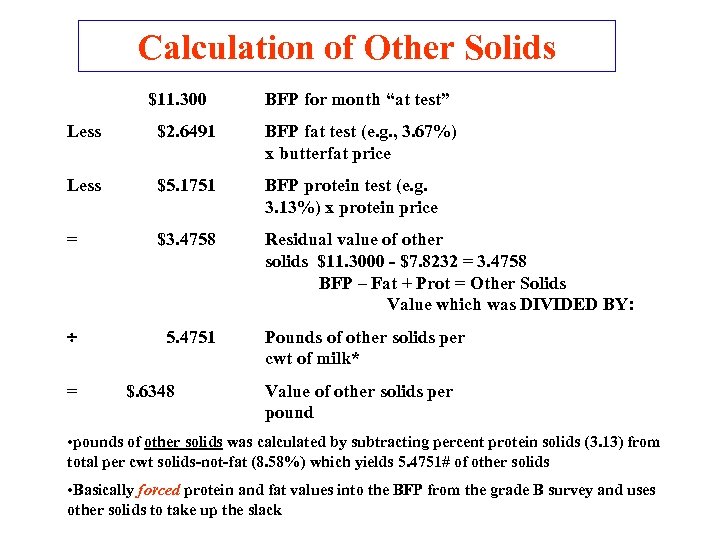 Calculation of Other Solids $11. 300 BFP for month “at test” Less $2. 6491 BFP fat test (e. g. , 3. 67%) x butterfat price Less $5. 1751 BFP protein test (e. g. 3. 13%) x protein price = $3. 4758 Residual value of other solids $11. 3000 - $7. 8232 = 3. 4758 BFP – Fat + Prot = Other Solids Value which was DIVIDED BY: 5. 4751 = $. 6348 Pounds of other solids per cwt of milk* Value of other solids per pound • pounds of other solids was calculated by subtracting percent protein solids (3. 13) from total per cwt solids-not-fat (8. 58%) which yields 5. 4751# of other solids • Basically forced protein and fat values into the BFP from the grade B survey and uses other solids to take up the slack
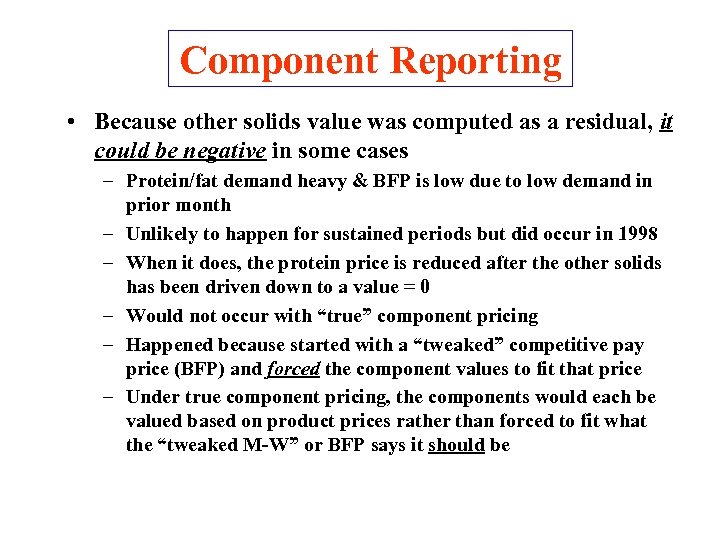 Component Reporting • Because other solids value was computed as a residual, it could be negative in some cases – Protein/fat demand heavy & BFP is low due to low demand in prior month – Unlikely to happen for sustained periods but did occur in 1998 – When it does, the protein price is reduced after the other solids has been driven down to a value = 0 – Would not occur with “true” component pricing – Happened because started with a “tweaked” competitive pay price (BFP) and forced the component values to fit that price – Under true component pricing, the components would each be valued based on product prices rather than forced to fit what the “tweaked M-W” or BFP says it should be
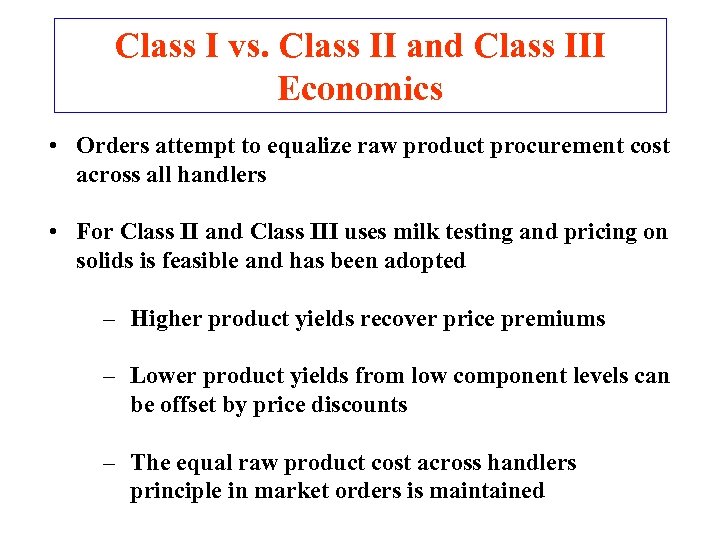 Class I vs. Class II and Class III Economics • Orders attempt to equalize raw product procurement cost across all handlers • For Class II and Class III uses milk testing and pricing on solids is feasible and has been adopted – Higher product yields recover price premiums – Lower product yields from low component levels can be offset by price discounts – The equal raw product cost across handlers principle in market orders is maintained
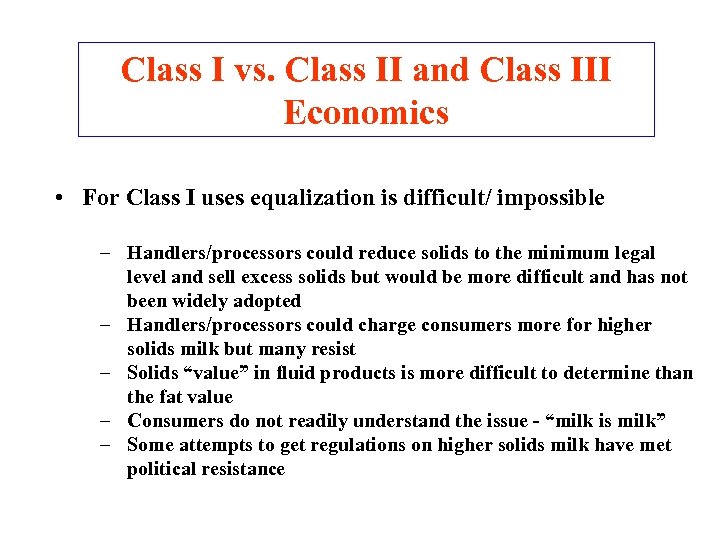 Class I vs. Class II and Class III Economics • For Class I uses equalization is difficult/ impossible – Handlers/processors could reduce solids to the minimum legal level and sell excess solids but would be more difficult and has not been widely adopted – Handlers/processors could charge consumers more for higher solids milk but many resist – Solids “value” in fluid products is more difficult to determine than the fat value – Consumers do not readily understand the issue - “milk is milk” – Some attempts to get regulations on higher solids milk have met political resistance
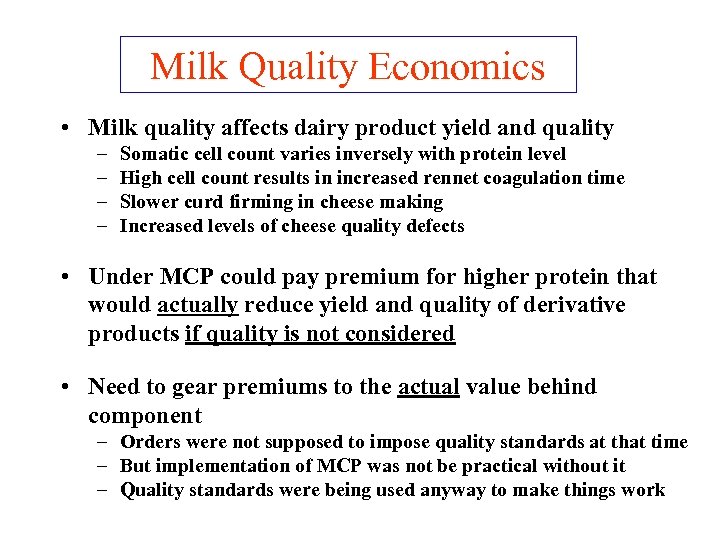 Milk Quality Economics • Milk quality affects dairy product yield and quality – – Somatic cell count varies inversely with protein level High cell count results in increased rennet coagulation time Slower curd firming in cheese making Increased levels of cheese quality defects • Under MCP could pay premium for higher protein that would actually reduce yield and quality of derivative products if quality is not considered • Need to gear premiums to the actual value behind component – Orders were not supposed to impose quality standards at that time – But implementation of MCP was not be practical without it – Quality standards were being used anyway to make things work
 Determination of Producer Price Under FMMO with Multiple Component Pricing POST Year 2000 0 rder Reform Uses Actual Component Pricing for All Components in the Milk (Incl. Other Solids)
 MAJOR PRICE CALCULATIONS The BFP and the class prices for all market orders( both those using MPC and those using Fat - Skim pricing) are based on component prices calculated from finished product prices
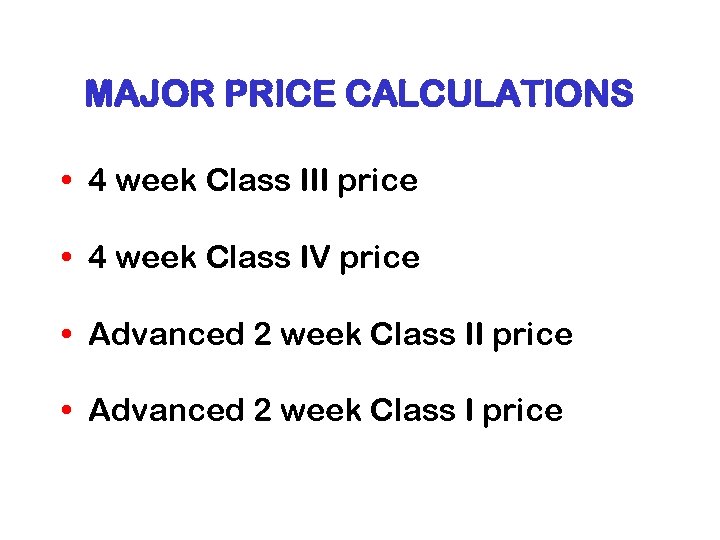 MAJOR PRICE CALCULATIONS • 4 week Class III price • 4 week Class IV price • Advanced 2 week Class II price • Advanced 2 week Class I price
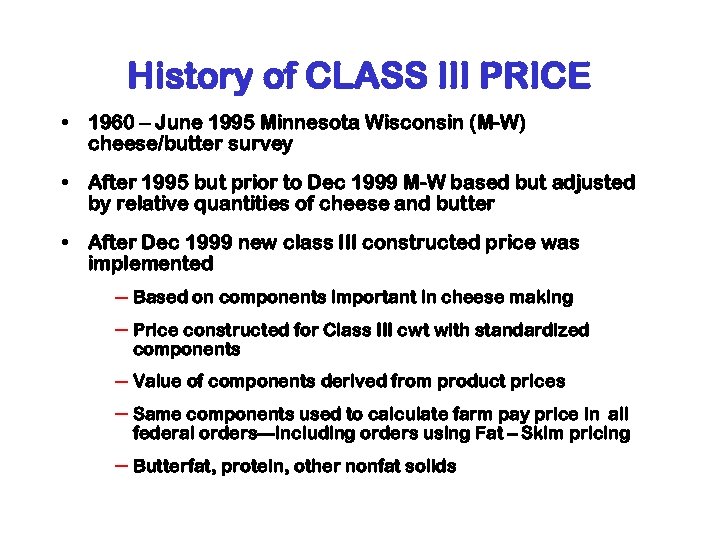 History of CLASS III PRICE • 1960 – June 1995 Minnesota Wisconsin (M-W) cheese/butter survey • After 1995 but prior to Dec 1999 M-W based but adjusted by relative quantities of cheese and butter • After Dec 1999 new class III constructed price was implemented – Based on components important in cheese making – Price constructed for Class III cwt with standardized components – Value of components derived from product prices – Same components used to calculate farm pay price in all federal orders---including orders using Fat – Skim pricing – Butterfat, protein, other nonfat solids
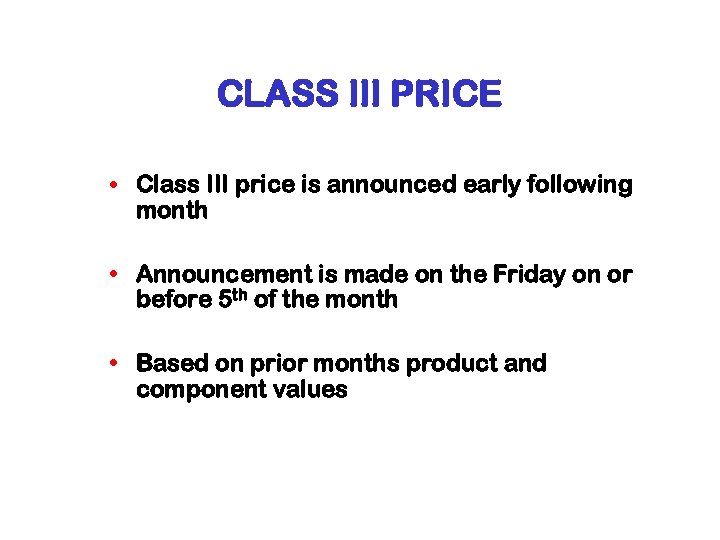 CLASS III PRICE • Class III price is announced early following month • Announcement is made on the Friday on or before 5 th of the month • Based on prior months product and component values
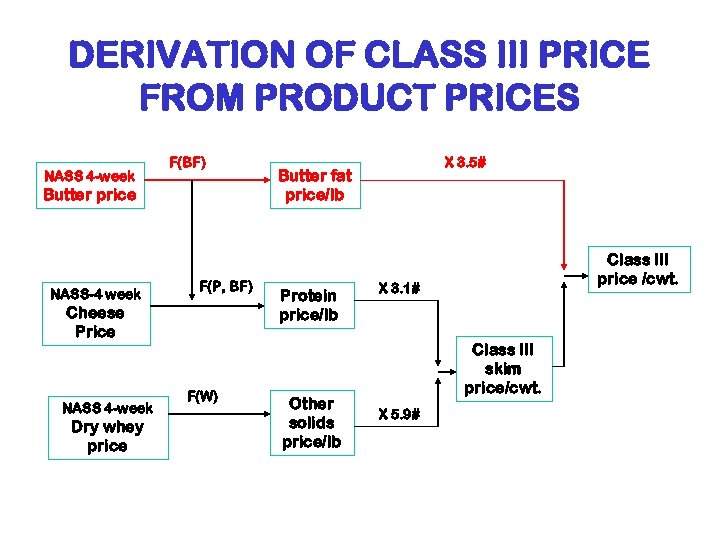
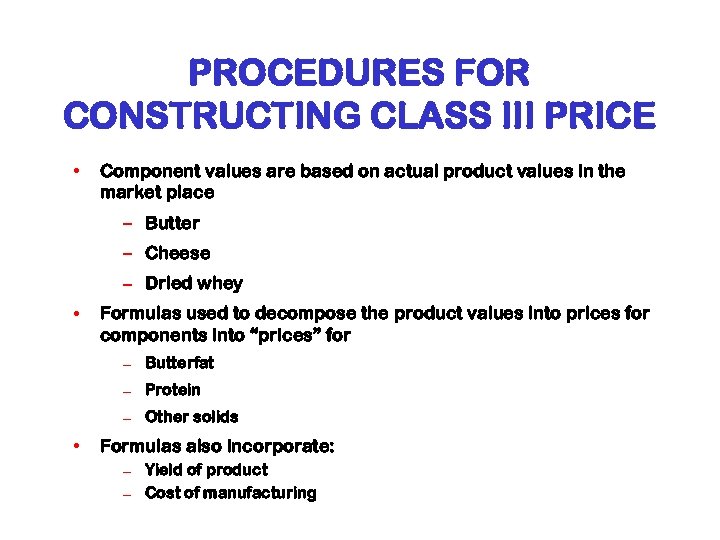 PROCEDURES FOR CONSTRUCTING CLASS III PRICE • Component values are based on actual product values in the market place – Butter – Cheese – Dried whey • Formulas used to decompose the product values into prices for components into “prices” for – Butterfat – Protein – Other solids • Formulas also incorporate: – Yield of product – Cost of manufacturing
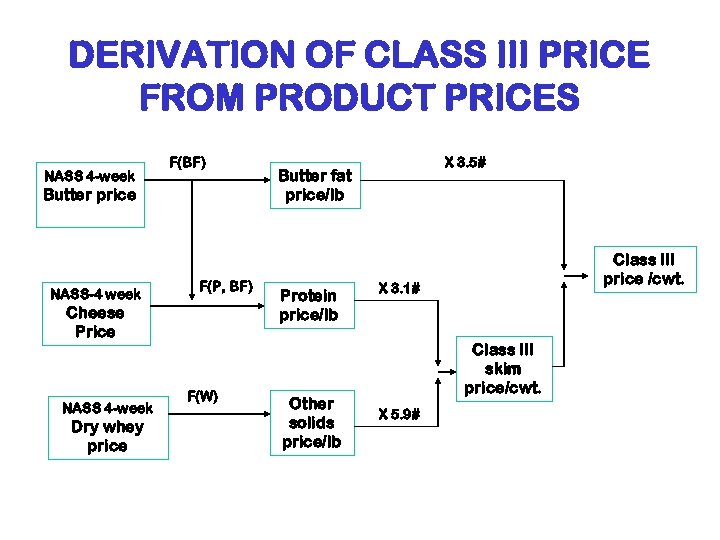 DERIVATION OF CLASS III PRICE FROM PRODUCT PRICES NASS 4 -week F(BF) Butter price NASS-4 week F(P, BF) Cheese Price NASS 4 -week Dry whey price F(W) X 3. 5# Butter fat price/lb Protein price/lb Other solids price/lb Class III price /cwt. X 3. 1# Class III skim price/cwt. X 5. 9#
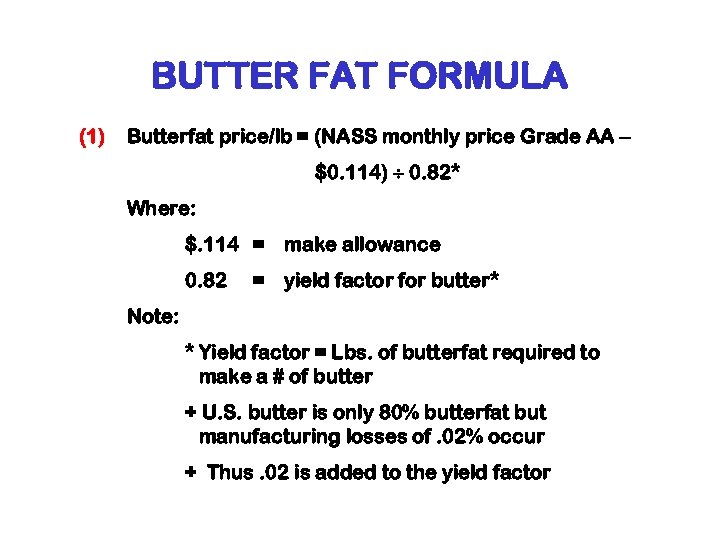 BUTTER FAT FORMULA (1) Butterfat price/lb = (NASS monthly price Grade AA – $0. 114) 0. 82* Where: $. 114 = make allowance 0. 82 = yield factor for butter* Note: * Yield factor = Lbs. of butterfat required to make a # of butter + U. S. butter is only 80% butterfat but manufacturing losses of. 02% occur + Thus. 02 is added to the yield factor
 INTERPRETATION OF BUTTERFAT FORMULA The value of butterfat to a plant making butter is the price of butter less the make allowances divided by the # of lbs. of butterfat needed to make a lb. of butter.
 DERIVATION OF CLASS III PRICE FROM PRODUCT PRICES NASS 4 -week F(BF) Butter price NASS-4 week F(P, BF) Cheese Price NASS 4 -week Dry whey price F(W) X 3. 5# Butter fat price/lb Protein price/lb Other solids price/lb Class III price /cwt. X 3. 1# Class III skim price/cwt. X 5. 9#